

Mesh vs Net Fabric: Key Differences for Apparel and Accessories
Mesh and net fabrics are easy to confuse. Both have visible openings between yarns, both can create transparent surfaces, and both appear in products ranging from sportswear and lingerie to evening dresses, footwear, and bags. Even textile suppliers sometimes use the terms interchangeably.
The difference becomes more meaningful when a fashion brand needs to select material for a specific product. A soft, stretchy mesh suitable for an athletic top may behave nothing like a stiff net used to give volume to a skirt. Yet the distinction is not as simple as saying mesh is always fine and flexible while net is coarse and rigid. Some net fabrics are exceptionally fine, and some technical meshes are deliberately firm.
For apparel businesses, these differences affect fabric specifications, pattern development, sewing methods, durability, sourcing costs, and customer expectations. Choosing the wrong open-structure textile can create problems that are difficult to identify from photographs alone.
This article compares mesh and net fabric from a practical textile perspective, explaining where the terms overlap, how constructions differ, and what designers, manufacturers, and sourcing teams should evaluate before selecting either material.
Quick Answer: What Is the Difference Between Mesh and Net Fabric?
Mesh and net fabric are overlapping categories of open-structure textiles made with interconnected yarns that create visible spaces or holes. The terms are not universally separated by a single manufacturing method, hole size, fiber composition, or performance standard.
In commercial apparel sourcing, mesh is frequently used as a broad description for knitted, woven, or engineered open fabrics, including sportswear mesh, power mesh, and three-dimensional spacer mesh. Net fabric often describes visibly open textile networks, including fine tulle, bridal illusion, fishnet, and various decorative or utility nettings.
The practical distinction depends on the product being discussed. A polyester sports mesh may emphasize ventilation and stretch, while a nylon tulle net may emphasize transparency and shape. However, both categories can contain flexible, firm, lightweight, or durable constructions.
The most reliable way to distinguish them is through fabric structure, opening geometry, yarn type, stretch recovery, weight, stiffness, and intended use.
For fashion brands, names provide a starting point. Technical specifications and garment sampling determine whether the material is suitable.
Why Mesh and Net Are Often Confused
The confusion begins with the word "mesh" itself. In textile terminology, mesh may describe the visible openings within a material rather than a unique fabric manufacturing process. A net is also made up of interconnected yarns that form openings, meaning that a net inherently has a mesh-like structure.
As a result, the same textile may be marketed under different names. A supplier might call a soft elastic material "power mesh," while another uses "power net." A decorative textile may appear in catalogs as mesh, netting, tulle mesh, or fine net.
These differences are not necessarily evidence of incorrect labeling. Commercial textile terminology has developed around manufacturing traditions, end uses, and regional supplier conventions.
A historical fabric reference preserved by the University of Arizona, Fabrics and their construction classifications, describes net fabrics that range from fine and sheer to coarse and open. It also identifies structures associated with Raschel, tricot, and bobbinet production. This illustrates why net cannot accurately be defined only as a large-hole, heavy-duty material.
For purchasing teams, the problem arises when a familiar material name substitutes for a measurable specification. A request for "soft net" or "breathable mesh" may communicate a general direction, but it does not establish what a manufacturer must deliver.
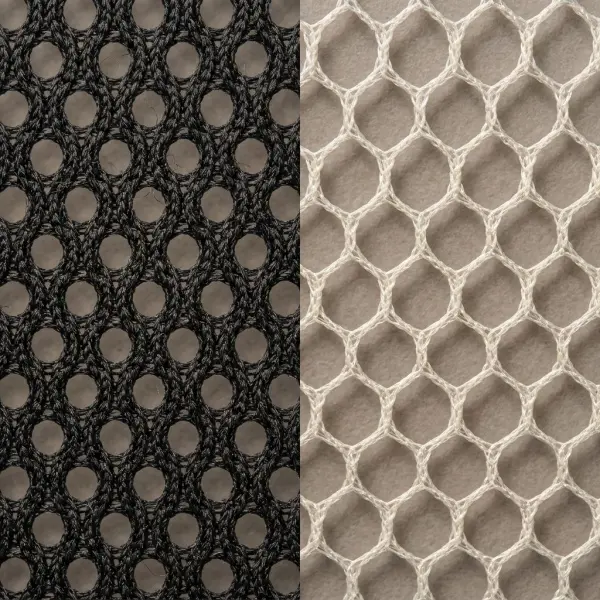
Mesh vs Net Fabric: Side-by-Side Comparison
The following comparison reflects common commercial usage rather than rigid technical definitions. Actual products can fall outside these general descriptions.
|
Comparison factor |
Mesh fabric |
Net fabric |
|
Basic description |
Broad category of textiles with open structures |
Textile networks with visible openings between interconnected yarns |
|
Common construction |
Warp knitting, weft knitting, some woven and other engineered structures |
Knitting, twisting, knotting, bobbinet, and other net-making constructions |
|
Opening size |
Fine to very large |
Fine to very large |
|
Typical appearance |
May appear technical, textured, smooth, or visibly open |
Often emphasizes a recognizable open network or sheer appearance |
|
Stretch |
Can be low, moderate, or highly elastic |
Can be low, moderate, or highly elastic |
|
Stiffness |
Ranges from soft apparel mesh to structured spacer materials |
Ranges from very soft illusion net to rigid decorative netting |
|
Common fibers |
Polyester, nylon, elastane blends, and others |
Nylon, polyester, silk, cotton, and others |
|
Typical apparel uses |
Sportswear, linings, lingerie, ventilation panels, footwear |
Bridalwear, veils, tutus, decorative panels, fishnet garments |
|
Typical accessory uses |
Bag pockets, footwear uppers, padded panels |
Decorative accessories, veils, netted compartments, utility applications |
|
Main sourcing priority |
Performance and construction appropriate to the product |
Opening structure, handling properties, and application-specific performance |
The most important point is that neither fabric name guarantees a particular property. Mesh is not automatically stronger or more breathable than net, and net is not necessarily more delicate or less stretchy.
A fine tulle net and a coarse polyester utility mesh, for example, cannot be meaningfully compared through their names alone. Their functional behavior must be evaluated at the fabric level.
How Their Textile Structures Differ
The structural differences between commercially described mesh and net materials often become clearer when examining how their yarns form openings.
Some open fabrics are built from knitted loops. Others depend on twisting, knotting, or specialized net-making processes. These methods create different relationships between yarn movement, fabric stability, and the geometry of the open spaces.
Understanding the construction is particularly important when the material will experience stretching, friction, tension, or repeated washing.
Knitted Mesh: Openings Created Through Loop Construction
Many apparel meshes are knitted. Their yarns form interconnected loops arranged to create spaces within the textile.
Warp-knitted fabrics use yarn systems supplied predominantly along the fabric length, while weft-knitted fabrics are formed through successive courses of loops. Both approaches can produce open structures, although the resulting stability and elasticity depend on the stitch pattern and yarn selection.
Warp-knitting equipment, including Raschel machines, is widely associated with the production of open knitted fabrics. Different lapping movements and yarn arrangements can produce structures for ventilation, elasticity, decorative appearance, or dimensional stability.
For a running shirt, knitted mesh may be selected because its loop construction provides the desired combination of flexibility, airflow, and surface feel.
This does not mean that all knitted meshes have strong elastic recovery. Structural stretch and recovery are different characteristics, and the use of elastane or other elastic yarns may substantially affect performance.
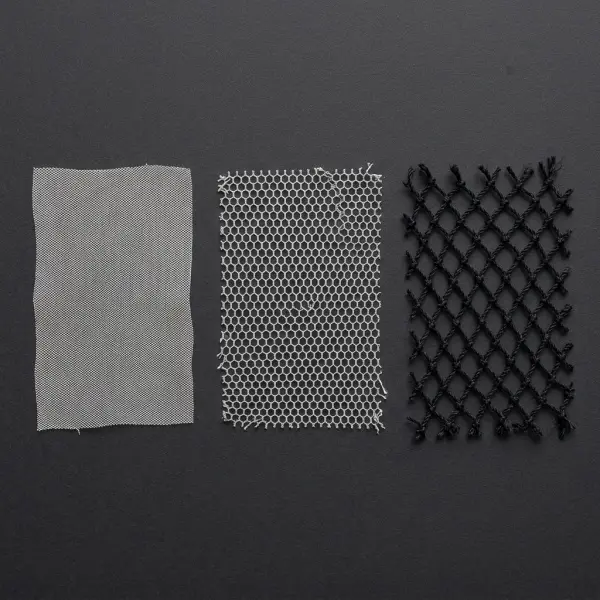
Net Fabric: Open Structures Made Through Several Methods
Net fabrics may be produced by knitting, knotting, twisting, or specialized net-making processes. Depending on their construction, intersections may be held in place through knitted structures, yarn crossings, twists, or knots.
Traditional knotted netting is one recognizable form, but it should not be used as the definition of all fashion net fabrics.
Fine tulle and bobbinet demonstrate this distinction. Both are associated with open structures, but their manufacturing methods and textile behavior differ from conventional knotted netting.
The arrangement of yarns can produce square, diamond, hexagonal, or other geometric openings. These shapes influence visual texture and can affect deformation under tension.
For garment development, the practical concern is whether the openings maintain their intended geometry during cutting, sewing, and wear.
Tulle and Bobbinet Are Important Examples
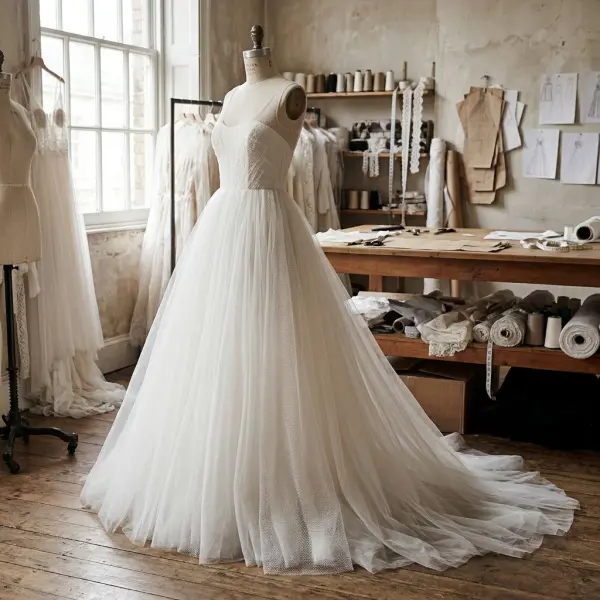
Tulle is a fine net fabric commonly associated with bridalwear, veils, dance costumes, and decorative apparel. Many commercial tulles feature small geometric openings and are produced using synthetic filament yarns, although other compositions are possible.
Its stiffness can vary significantly. A soft bridal tulle may drape close to the body, while a firmer tulle can contribute volume to a layered skirt.
Bobbinet is produced through a specialized bobbin-based net-making system. It is often associated with a regular hexagonal structure and has applications in fashion, embroidery grounds, and other specialized textile uses.
These materials show why "net fabric" is not synonymous with coarse fishnet. Some nets are deliberately engineered to be extremely fine, transparent, and visually unobtrusive.
The Differences That Matter Most in Actual Garments
A designer might initially compare mesh and net by looking at hole size. For manufacturing purposes, that is rarely sufficient.
Two fabrics with similar openings can produce different silhouettes, react differently to tension, and require different sewing methods. These differences become more visible when the textile is incorporated into a finished product.
1. Stretch and Recovery
Mesh and net fabrics may both stretch, but their degree of extension and recovery depend on construction.
A knitted sports mesh may extend through movement of its loops. An elastane-blended power mesh can provide substantially greater elastic recovery, making it suitable for close-fitting garments when appropriately engineered.
A non-elastic decorative net may have limited recovery, even if its openings deform temporarily under tension.
For example, a fashion brand developing a fitted sheer top cannot assume that a fine nylon net will behave like an elastic mesh simply because both materials are transparent.
The team should assess stretch in the relevant directions and evaluate whether the fabric returns sufficiently close to its original dimensions after repeated extension.
2. Drape and Silhouette
Drape describes how a fabric hangs and forms folds under its own weight. It is influenced by bending behavior, weight, yarn properties, and textile construction.
A soft mesh can fall close to the body and follow garment contours. A stiff decorative net may stand away from the body, making it useful where shape or volume is desired.
However, some fine nets drape very softly, while some engineered meshes are deliberately structured. The category name alone cannot predict the silhouette.
This distinction has direct implications for patternmaking. Replacing a stiff net with a soft mesh in a layered skirt may reduce fullness, even if the two fabrics have similar transparency.
3. Airflow and Ventilation
Both mesh and net can permit substantial airflow because of their open areas. Yet visible opening size is only one factor affecting air permeability.
Yarn thickness, fabric thickness, construction, finishing, and the conditions under which the fabric is stretched can influence how much air passes through.
For product comparisons, brands should avoid assuming that net fabric is always more breathable because its holes appear larger. A mesh material with a different structural arrangement may perform better or worse under specified conditions.
Where ventilation is a performance requirement, ISO 9237:1995 provides an internationally recognized method for measuring fabric air permeability.
The practical value of testing is comparability. Results are meaningful when samples are evaluated using compatible procedures and test conditions.
4. Transparency and Visual Coverage
Mesh and net may both be transparent, but the visual effect is not determined solely by the percentage of open area.
Yarn color, filament thickness, surface reflectance, number of fabric layers, and the background against which the textile is viewed all influence perceived coverage.
A skin-toned illusion net may become visually subtle against the wearer, while black mesh over a contrasting underlayer can create a strongly defined graphic texture.
For apparel businesses, transparency should be reviewed under realistic lighting and fit conditions. A sample that appears adequately covered on a tabletop may reveal considerably more when stretched over the body.
5. Resistance to Snagging and Damage
Open fabric structures can catch on jewelry, hooks, rough surfaces, or accessory hardware. The consequences depend on how the yarn network responds to localized tension.
A fine decorative net may develop a visible distortion or tear, while a more stable technical mesh may tolerate certain forms of repeated handling. The reverse is also possible when construction quality or intended use differs.
Testing requires particular care. The current ASTM D3939/D3939M-26 snagging resistance method explicitly identifies open-construction fabrics such as nets as unsuitable for that method because of interference between the test apparatus and the underlying pad.
This is a useful reminder that textile quality tests must be appropriate to the material's structure. Not every standard method produces meaningful results for every open fabric.
Common Mesh and Net Materials in Fashion
Commercial fabric catalogs contain numerous names that may overlap. Understanding the function behind each category helps purchasing teams interpret supplier descriptions more accurately.
|
Commercial material |
Structural or handling characteristics |
Typical applications |
|
Sportswear mesh |
Often knitted, designed for ventilation and suitable garment movement |
Training tops, jerseys, athletic panels |
|
Power mesh / power net |
Elastic open knitted textile with application-dependent support and recovery |
Lingerie, shapewear components, fitted garments |
|
Spacer mesh |
Three-dimensional knitted construction with separated surface layers |
Footwear, padded straps, selected accessories |
|
Soft tulle |
Fine, lightweight net with relatively soft handling |
Bridal overlays, soft veils, layered dresses |
|
Stiff tulle |
Fine net with enough stiffness to contribute volume |
Tutus, petticoats, structured skirt layers |
|
Bobbinet |
Specialized net construction, commonly with regular geometric openings |
Bridalwear, embroidery grounds, costume applications |
|
Fishnet |
Open network, commonly with prominent diamond-shaped openings |
Hosiery, fashion tops, statement panels |
|
Utility netting |
Open construction selected for strength, containment, or visibility |
Bag compartments, equipment pockets, accessory components |
These descriptions should not be interpreted as fixed industry-wide specifications. A product sold as fishnet, for example, may be highly elastic or relatively stable depending on its yarn composition and construction.
In particular, power mesh and power net are frequently used as overlapping commercial terms, not as two reliably distinct performance categories.
When sourcing, buyers should request a physical sample and technical data rather than assume that a material name establishes its intended behavior.
Mesh vs Net Fabric for Different Apparel Applications
Choosing between open-structure textiles is fundamentally a product-design decision. The right material depends on what the garment needs to achieve, how it will be worn, and how the fabric interacts with other components.
Sportswear and Activewear
Performance apparel often uses knitted mesh because designers need to balance ventilation, movement, coverage, and compatibility with garment construction.
For example, a sportswear brand may introduce a fine polyester mesh panel in a training shirt to provide additional airflow while preserving a familiar silhouette.
A decorative nylon net might create a similar visual effect, but that does not make it an equivalent replacement. Its stretch behavior, recovery, surface feel, and durability may be unsuitable for repeated athletic movement.
For performance garments, the selection process should prioritize measurable fabric behavior rather than appearance alone.
Bridalwear and Occasion Dresses
Fine net fabrics, including tulle and selected bobbinet constructions, are closely associated with bridalwear because they can create transparent layers without requiring an opaque fabric surface.
The appropriate material depends on the desired silhouette. A soft veil requires a different handling character from a voluminous skirt supported by several layers of firmer net.
Designers must also consider how the fabric responds to gathering, embroidery, edge finishing, and repeated handling during fittings.
A very fine net may produce the desired appearance but require more careful production and maintenance. For premium garments, those additional manufacturing requirements should be considered during costing rather than discovered after the design is approved.
Lingerie and Shapewear
Elastic mesh materials are frequently used in lingerie, but their functions vary. A decorative mesh panel may provide visual transparency, while a more supportive power mesh or power net can contribute to the garment's tension and fit.
This distinction is especially important when a bra or fitted undergarment uses different textiles in adjacent panels.
Replacing a supportive elastic mesh with a decorative net of similar appearance may change the garment's fit and support behavior.
The relevant parameters include force-extension characteristics, recovery, skin feel, seam strength, and the relationship between fabric tension and pattern dimensions.
The commercial labels "mesh" and "net" do not provide sufficient information to make these decisions independently.
Casual Fashion and Layered Clothing
Casual fashion uses both mesh and net for sheer effects, color layering, and surface texture.
A fine stretch mesh top may follow the body's shape and accommodate movement. A coarser open net may produce a more pronounced geometric appearance, particularly when layered over a contrasting garment.
Neither material is inherently more fashionable or versatile. The choice depends on silhouette, intended transparency, styling expectations, and production feasibility.
A retailer should also consider customer interpretation. If a product is highly transparent, product photographs and descriptions should clearly communicate whether it is intended to be worn with an additional layer.
For a closer examination of their functional roles, see why open-structure fabrics are used in sportswear, lingerie, and layering.
Mesh vs Net Fabric for Bags, Footwear, and Accessories
Accessory development introduces different performance requirements because materials may experience concentrated loads, repeated abrasion, or contact with hard objects.
A fabric that works well in a decorative garment panel may perform poorly in a bag compartment carrying accessories or equipment.
Mesh for Bag Pockets and Compartments
Mesh is commonly used in bag compartments where visibility and an open structure are useful. Examples include external water-bottle pockets, internal organizers, and selected ventilated storage areas.
For these applications, the material must do more than look open. It may need to recover from stretching, resist snagging, and retain adequate strength at the stitched attachment points.
An elastic mesh pocket can accommodate objects of different sizes, but excessive stretching or inadequate recovery may cause the pocket to sag.
A more stable netting material may work in some compartment designs, particularly when stretch is not required. The correct choice depends on expected loads, seam construction, and the shape of the stored items.
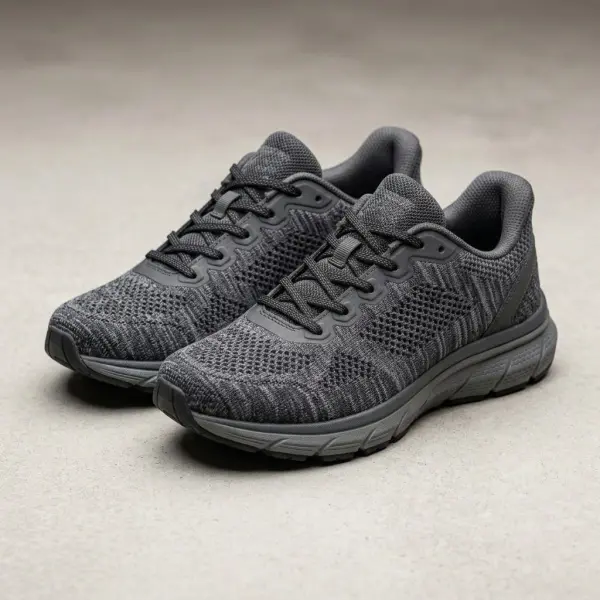
Spacer Mesh in Footwear and Padded Accessories
Three-dimensional spacer mesh is used in selected footwear and padded accessories because its construction can create separation between two fabric surfaces.
This structural depth may contribute cushioning, compressional resilience, and airflow pathways. However, performance depends on the connecting yarns, surface construction, and final product assembly.
Ordinary decorative net should not be treated as a substitute for spacer mesh merely because both materials contain visible openings.
A footwear developer needs to assess thickness, resilience, abrasion behavior, and the way the material responds to repeated compression.
Decorative Net for Fashion Accessories
Net fabrics also appear in veils, headwear, decorative bags, hair accessories, and costume details. Their value often lies in the visual pattern and the way the fabric holds or softens a shape.
For these products, stiffness, opening size, edge stability, and compatibility with trims may be more important than high air permeability.
A relatively firm net can support a decorative form, while a softer net may create a flowing or transparent effect.
Designers should assess how the material connects to frames, bands, handles, closures, or other components. Open structures can become damaged at concentrated attachment points unless those areas are appropriately reinforced.
Which Fabric Should a Fashion Brand Choose?
The decision becomes easier when the desired product function is separated from the fabric's commercial name.
A useful material-selection framework begins with the garment or accessory requirement and then identifies the properties needed to achieve it.
|
Product requirement |
Material direction to investigate |
Main property to verify |
|
Ventilation panel in an athletic shirt |
Fine or engineered knitted mesh |
Air permeability and skin comfort |
|
Supportive stretch panel in lingerie |
Power mesh or power net |
Stretch resistance and recovery |
|
Soft transparent bridal overlay |
Soft tulle or fine net |
Drape, transparency, and handfeel |
|
Full skirt with controlled volume |
Firmer tulle or structured net |
Bending stiffness and silhouette |
|
Flexible external bag pocket |
Elastic utility mesh |
Recovery, abrasion, and seam durability |
|
Decorative fishnet garment |
Fishnet or large-opening net |
Opening consistency and stretch |
|
Cushioned footwear component |
Appropriate spacer mesh |
Thickness and compression behavior |
The table suggests starting points, not final material approvals. A supplier may offer alternative constructions that achieve similar results.
For smaller brands, it can be more practical to compare two or three carefully chosen samples against a specific product requirement than to request a large collection of vaguely described open fabrics.
For more background on the technical behavior of knitted constructions, refer to mesh fabric structure, breathability, and fashion uses.
What Sourcing Teams Should Check Before Ordering
Material selection becomes commercially risky when visual approval is separated from technical approval. Mesh and net fabrics are particularly vulnerable to this problem because two samples may appear similar in a photograph while behaving very differently during garment production.
An effective sourcing process therefore begins with the approved garment application and identifies the properties that cannot change without affecting the product.
Confirm the Actual Construction
Ask the supplier whether the material is warp-knitted, weft-knitted, bobbinet, knotted, woven, or produced through another method.
The answer helps the development team understand the textile's structure and determine which performance evaluations are appropriate.
For example, an open knitted mesh containing elastane requires different fit and recovery considerations from a relatively stable decorative net.
Where suppliers use general descriptions such as "hexagon mesh" or "nylon net," a close-up structural photograph and physical sample can help clarify what is being offered.
Measure Weight and Opening Characteristics
Fabric weight is commonly specified in grams per square meter (GSM). It influences material consumption and can contribute to how a textile handles, but it does not by itself describe strength, stiffness, or durability.
The active ASTM D3776/D3776M-20(2025) standard covers methods for determining fabric mass per unit area.
For visibly open structures, buyers should also document the desired opening pattern and approximate dimensions.
A fabric can meet a target GSM while having a different yarn arrangement or opening geometry from the approved sample. That difference may affect appearance, transparency, and product behavior.
Test Stretch, Recovery, and Dimensional Stability
For elastic materials, testing should address both extension and the ability to recover after the force is removed.
This is particularly relevant to lingerie, fitted tops, and elastic pockets, where poor recovery can change the product's fit or function.
Dimensional stability should also be evaluated under realistic care conditions. Some materials may shrink, relax, distort, or change their handling characteristics after laundering.
The test method and acceptance criteria should reflect fabric construction and intended use.
Verify Strength and Snagging Performance
Strength requirements differ between a delicate veil and a load-bearing bag compartment.
Some textile strength tests may not be suitable for highly elastic or exceptionally open structures. For instance, ASTM D5034-21(2025) notes limitations for knitted fabrics and other textiles with high stretch.
Consequently, a laboratory should confirm the suitability of a method before testing. Buyers should not assume that every familiar woven-fabric test can be applied to an elastic mesh or coarse net.
Where attachment strength is the concern, garment- or product-level seam and load evaluations may be more informative than fabric-only testing.
Ask for Consistent Production Specifications
Before bulk purchasing, brands should establish an approved reference sample and document critical parameters.
A practical specification should include:
- Fiber composition and identifiable textile construction.
- Target fabric weight, usable width, thickness where relevant, and agreed tolerances.
- Opening pattern and visual consistency requirements.
- Stretch, recovery, stiffness, or strength requirements relevant to the product.
- Color, finishing, and appropriate colorfastness requirements.
- Laundering behavior and dimensional stability.
- Quality limits for holes, yarn defects, distortion, and inconsistent openings.
- Production lead time, minimum order quantity, and lot-to-lot consistency expectations.
The value of this documentation lies in reducing ambiguity. Without an agreed reference, a supplier may deliver a fabric that technically fits the general product name but differs materially from the sample used during garment development.

How Sewing and Production Requirements Can Differ
Open-structure fabrics create distinctive handling challenges. Yarn networks can shift, stretch, catch, or distort during cutting and sewing, particularly when a material has limited stability or very fine yarns.
The challenges are not exclusive to either mesh or net, but certain constructions are more sensitive than others.
Cutting and Handling Fine Net Fabrics
Very lightweight net fabrics may be difficult to spread consistently because they can shift or distort under handling tension.
When cutting layered tulle, controlling the position of the layers and maintaining accurate pattern alignment can become more important than the cutting operation itself.
Fine fabrics may also catch on rough cutting surfaces, sharp accessories, or damaged equipment.
Production teams should establish handling methods during sampling, including how the fabric is stored, layered, and transferred between operations.
Sewing Elastic Mesh
Elastic knitted mesh introduces different challenges. Uneven feeding can cause stretching during assembly, while an unsuitable seam may fail to accommodate garment movement.
Machine setup, thread selection, seam type, and tension must be compatible with the textile. Depending on the material, overedge or other stretch-compatible seam constructions may be appropriate.
When mesh is joined to a less extensible fabric, differential feeding can create puckering or distortion.
The final seam should be assessed for elasticity, strength, comfort, and appearance rather than approved solely because it looks acceptable immediately after sewing.
Finishing Decorative Net
Decorative nets may be cut, hemmed, bound, gathered, or incorporated into layered constructions, depending on their structure and the quality required.
Some fine nets can be used with minimally finished edges in appropriate designs, but that does not mean every net fabric can safely be left unfinished.
Yarn displacement, edge distortion, and durability at attachment points should be considered before selecting an edge treatment.
For premium occasionwear, the finish must also suit the appearance of the garment. A bulky seam or binding can become conspicuous against a sheer background.
Common Mistakes When Comparing Mesh and Net
Assuming Mesh Is Always Stronger Than Net
A buyer may consider mesh the stronger option because the term sounds more technical, while treating net as decorative or delicate. This overlooks the diversity of constructions within both categories.
A fine apparel mesh may be less resistant to certain forms of damage than a well-engineered utility net. Strength and durability depend on the actual yarn network and use conditions.
The better approach is to identify the expected stress and select suitable testing or product trials rather than relying on fabric labels.
Choosing Net Only by Hole Size
A designer may choose a large-opening net because it creates the desired visual effect, without considering stiffness, yarn thickness, or recovery.
The material may then distort the garment silhouette or feel uncomfortable against the skin.
A useful sample comparison should examine not only the geometry of the openings but also how the material bends, stretches, gathers, and behaves against adjacent fabrics.
Replacing Power Mesh With Decorative Net
Power mesh or power net used in a supportive garment may have specific elastic characteristics. Replacing it with an ordinary decorative net because the fabrics look similar can alter garment tension and fit.
This is especially relevant when the material forms part of a bra, bodysuit, or fitted support panel.
Any substitution should be treated as a new material approval requiring appropriate fit and performance evaluation.
Ignoring Production Waste and Handling Costs
Fine nets and unstable meshes can require additional care during spreading, cutting, stitching, and finishing. Some constructions may also have directional patterns that affect cutting efficiency.
If buyers compare only the price per meter, they may underestimate the total cost of using the fabric.
A more useful costing comparison considers usable width, material yield, handling time, additional components, defects, and expected rejection rates.
Overpromising Breathability or Durability
Marketing teams sometimes describe an open fabric as breathable, durable, or supportive without verifying those claims.
The visible structure alone does not establish how the fabric performs in the finished garment. A net overlay placed over an impermeable lining, for example, may contribute little to garment ventilation.
Product descriptions should distinguish visible design features from measurable performance properties. This reduces the risk of creating expectations the finished product cannot meet.
Important Technical Caveats for Fashion Businesses
The first caveat is terminology. There is no universal rule that mesh must be knitted and net must be knotted, nor a fixed opening-size threshold that reliably separates the two categories.
The second is material behavior. A soft net can be more flexible than a firm mesh, and an elastic net may provide considerable recovery. Broad comparisons must therefore remain conditional.
Third, textile performance changes with context. Stretching can alter opening geometry; layering can change airflow and transparency; sewing methods can affect strength; and laundering may change dimensions or handfeel.
Fourth, sustainability cannot be inferred from fabric openness. A lightweight mesh is not automatically a lower-impact choice, and a net made from recycled synthetic fibers is not necessarily environmentally superior to an alternative. Fiber sourcing, processing, finishing, product lifespan, and end-of-life pathways all influence the assessment.
Finally, the suitability of testing methods matters. Some highly open constructions are incompatible with standard procedures designed for more continuous fabric surfaces. Testing laboratories should confirm method applicability before comparing results.
These limitations do not make mesh and net difficult materials to use. They establish why material identification, product-level testing, and clear supplier specifications are essential.
A Practical Selection Framework for Fashion Brands
The most efficient way to select between mesh and net is to stop treating them as competing categories and evaluate materials against the intended product function.
A fashion brand developing a new open-structure garment can begin with three questions: What does the material need to do? What must it look and feel like? What manufacturing and durability constraints must it satisfy?
A sportswear company may find that a fine knitted mesh meets the necessary requirements for movement and ventilation. A bridal label may select fine tulle because drape and transparency are more important than elastic recovery. An accessory brand may choose a stable utility net or an engineered mesh according to load and attachment requirements.
Once the functional direction is clear, the sourcing team can compare a limited number of samples using consistent criteria.
A practical process follows this sequence:
- Define the application. Specify whether the fabric provides ventilation, transparency, support, structure, or containment.
- Identify suitable constructions. Shortlist knitted mesh, elastic net, tulle, spacer mesh, or other relevant alternatives.
- Review physical samples. Compare drape, surface feel, stretch, opening pattern, and appearance.
- Validate critical properties. Select tests appropriate to the material and expected use.
- Produce garment or product samples. Evaluate cutting, sewing, fit, appearance, and realistic handling.
- Approve the material specification. Record the chosen sample, tolerances, and supplier conditions before bulk ordering.
This framework reduces the risk of choosing a fabric based on terminology or aesthetics alone.
For businesses managing several collections, maintaining a reliable fabric library can also support consistency. Approved material records allow design, sourcing, production, and quality teams to work from the same references, making supplier comparisons and future reorder decisions more dependable.




Comments 0
Leave a CommentSend Comment
Anda harus Login terlebih dahulu untuk dapat memberikan komentar.