

Lace Fabric Explained: Types, Characteristics, and Fashion Uses
Quick Answer
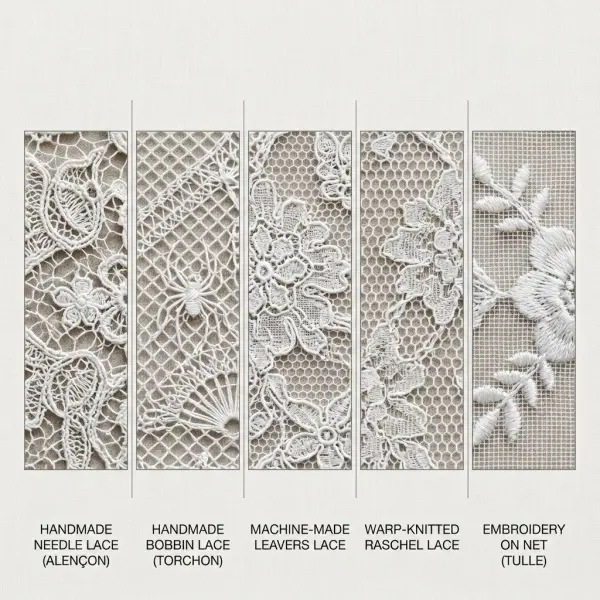
Lace fabric is an openwork textile in which threads form decorative motifs connected by a net, mesh, bars, braids, or other supporting structures. Traditional handmade lace is generally classified as needle lace or bobbin lace, while modern fashion production also relies on machine-made constructions such as Leavers lace and Raschel warp-knitted lace.
The word “lace,” however, does not describe one standardized material. A rigid cotton guipure, a fine nylon Chantilly-style lace, and an elastic lace developed for lingerie can differ substantially in weight, softness, transparency, stretch, recovery, durability, cost, and sewing behavior.
For fashion businesses, the most important question is therefore not simply whether a fabric is lace. Product teams need to identify its construction, fiber composition, motif size, ground structure, usable width, edge treatment, directional repeat, dimensional stability, and intended garment application.
A visually attractive lace may still create production problems if its motifs cannot be matched efficiently, its scalloped edges are inconsistent, or its stretch and recovery do not suit the garment pattern. Successful lace sourcing requires both aesthetic judgment and technical validation.
What Is Lace Fabric?
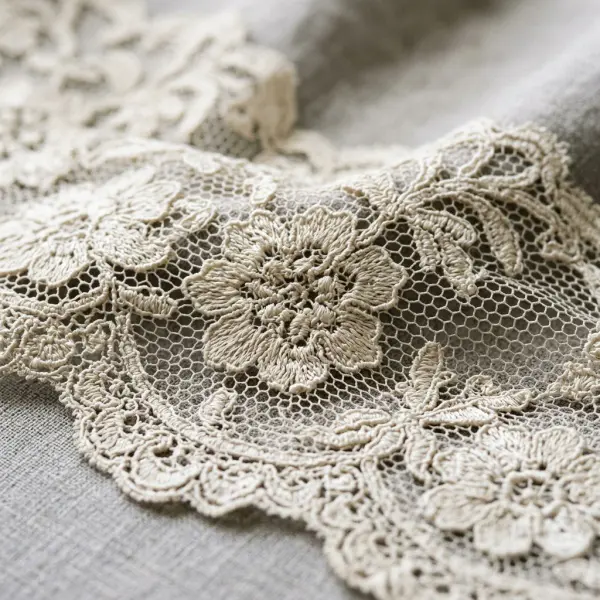
Lace fabric is a decorative openwork textile created by arranging threads into motifs and connecting structures so that solid areas and deliberate empty spaces become part of the design. Depending on the method, those threads may be looped, twisted, braided, knotted, embroidered, woven, or warp-knitted.
This definition matters because lace is a textile construction, not a fiber category. Lace may be made from linen, cotton, silk, viscose, polyester, polyamide or nylon, metallic yarns, elastane, and blends of several fibers. The fiber influences the handfeel, appearance, strength, dye response, care requirements, and price, but it does not by itself determine whether a textile qualifies as lace.
Historically, European handmade lace developed into a fabric independent of a woven foundation. The Metropolitan Museum of Art’s overview of European lace production explains that early lacemaking evolved partly from cutwork embroidery, in which sections of a woven ground were removed and the remaining spaces stabilized with stitches. By the sixteenth century, lacemakers were producing openwork structures without relying on the original fabric as a permanent base.
Modern commercial usage is less precise. Suppliers and retailers may use “lace” to describe true constructed lace, embroidery worked on tulle, chemical lace made on a removable foundation, decorative mesh, or knitted fabrics designed to imitate traditional lace. These products can all be commercially useful, but they do not necessarily behave in the same way during cutting, sewing, wear, or cleaning.
For product developers, the supplier’s style name is only the beginning of the specification.
Why Lace Is More Difficult to Classify Than It Appears
Lace can be named according to its production method, historical origin, motif style, ground structure, fiber composition, edge treatment, elasticity, or intended use. As a result, two lace products may carry similar names while having different constructions.
“Chantilly lace,” for example, originally referred to a particular tradition of fine bobbin lace associated with France. In contemporary wholesale catalogs, the term may be applied more broadly to lightweight floral lace with delicate outlines and a fine ground. The modern product might be produced on a Leavers machine, a Raschel machine, or through embroidery on net.
“Guipure,” by contrast, usually describes a structural appearance: relatively substantial motifs are connected by bars or bridges rather than supported by a continuous fine net. It does not automatically reveal the fiber, manufacturing technology, or country of origin.
This naming complexity creates several risks:
- A designer selects a lace by style name but receives a construction with different stretch or weight.
- A buyer assumes that a place-based name confirms geographic origin.
- A marketing team describes machine-made lace as handmade without documentation.
- A manufacturer calculates consumption using nominal width rather than usable motif width.
- A product team approves a sample without checking whether the bulk fabric uses the same yarn, finish, or machine setup.
The safest approach is to classify lace across several dimensions rather than relying on a single label.
How Is Lace Fabric Classified?
A practical lace specification should answer three separate questions:
- How was the structure made?
- What visual or historical style does it resemble?
- In what commercial format will it be supplied and used?
Combining these perspectives gives sourcing and manufacturing teams a more reliable understanding of the material.
Handmade Needle Lace
Needle lace is constructed using a needle and a single working thread. Stitches are built progressively over a temporary pattern or support until the textile structure can exist independently.
The Metropolitan Museum of Art identifies needle and bobbin lace as the two principal technical categories of traditional handmade lace. Needle lace is formed through repeated looping or buttonhole-type stitches, allowing dense motifs, raised outlines, delicate fillings, and highly controlled negative space.
Historic Venetian gros point is an especially sculptural example. Dense floral forms, raised cords, and padded details gave the textile a carved, three-dimensional appearance. Such work required considerable time and skill, making high-quality lace a valuable material used in dress, accessories, ceremonial garments, and ecclesiastical textiles.
Authentic handmade needle lace is rarely suitable for conventional volume apparel production. It is more likely to appear in museum collections, heirloom pieces, craft-based luxury products, restoration work, or highly limited commissions.
Handmade Bobbin Lace
Bobbin lace is made by twisting, crossing, and interlacing multiple threads wound onto individual bobbins. The work is generally formed over a pattern fixed to a padded surface, with pins helping to control the structure.
Compared with needle lace, bobbin lace originated from braiding logic rather than sequential needle stitching. It can produce fine grounds, floral motifs, geometric structures, edgings, and complex transitions between dense and open areas.
The number of threads, thread fineness, pattern complexity, and required hand manipulation all influence production time. This helps explain why fine historical lace was expensive and why mechanized lacemaking had such a significant commercial impact.
In contemporary sourcing, a “bobbin lace look” does not necessarily mean the product is handmade. Leavers machinery was developed to reproduce much of the visual complexity associated with hand-produced bobbin lace.

Leavers Lace
Leavers lace is a machine-made lace produced on specialized machinery that twists and interlaces large numbers of threads to create highly detailed patterns. It is often selected for luxury lingerie, bridal fabrics, couture, premium trims, and fashion applications where motif definition and a refined ground are important.
The process should not be confused with ordinary weaving. Leavers machines coordinate warp threads, bobbin threads, patterning mechanisms, tension, and finishing through a highly specialized production system.
The official Dentelle de Calais-Caudry description of Leavers lace production emphasizes the continuing combination of historical machinery, skilled operators, thread preparation, pattern development, inspection, mending, dyeing, and finishing. Contemporary digital controls may support design and machine operation, but specialist textile knowledge remains central to the result.
Leavers lace can offer:
- Fine and visually complex grounds
- Detailed floral or geometric motifs
- Defined outlines and subtle tonal effects
- High-end appearance
- Broad design possibilities within the machine’s technical limits
Its commercial disadvantages may include longer development cycles, limited production capacity, higher minimums or setup costs, specialist finishing requirements, and a higher price than many warp-knitted alternatives.
The name should also be verified carefully. A fabric that imitates the visual character of Leavers lace is not necessarily made on a Leavers machine.
Raschel Lace
Raschel lace is produced through warp knitting. Multiple yarn systems are supplied from beams or creels and manipulated by needle bars and guide bars to create a stable openwork fabric. Depending on the machine, yarn selection, and structure, Raschel lace may be rigid or elastic.
Modern multi-bar Raschel equipment can produce open-width lace, separable bands, lingerie fabrics, outerwear lace, stretch products, and detailed decorative surfaces. Technical documentation from Groz-Beckert on warp-knitted lace production identifies multi-bar Raschel machinery as a major production route for lace used in underwear and outerwear.
Machine manufacturers also offer Raschel systems designed for both patterned rigid lace and elastomeric lace containing elastane. These platforms can provide wide working widths, electronic pattern control, faster setup, and higher productivity than traditional Leavers production, although actual quality depends on yarns, gauge, number of pattern bars, machine configuration, finishing, and mill expertise.
Raschel lace is therefore not simply a “cheap lace.” The category ranges from basic mass-market trims to technically sophisticated elastic fabrics. A well-developed Raschel lace can offer strong pattern clarity, controlled recovery, soft handfeel, and commercially efficient production.
Embroidered Net and Chemical Lace
Some commercial lace fabrics are made by embroidering motifs onto tulle, mesh, or another base fabric. In this construction, the decorative stitching and the ground are created through different processes.
Chemical lace, sometimes called burnt-out embroidery or free-standing embroidery, is generally stitched onto a temporary or soluble support. Once that support is removed, the embroidered network remains. Depending on the design, the result may resemble guipure or heavy lace motifs.
These textiles are important in apparel sourcing, but they should not be assumed to have the same construction as needle, bobbin, Leavers, or Raschel lace. The distinction becomes particularly relevant when evaluating strength, motif stability, seam placement, fraying, backing, and cleaning.
A deeper comparison of these categories belongs in this guide to embroidery, lace, and appliqué.
Major Lace Styles Used in Fashion
Style names help designers communicate an aesthetic direction, but they should not replace technical information. The following categories describe commonly encountered visual or structural identities rather than universally standardized quality levels.
|
Lace style |
Typical visual or structural character |
Common fashion applications |
What buyers should verify |
|
Chantilly-style lace |
Fine ground, delicate floral motifs, soft outlines, often lightweight |
Lingerie, veils, overlays, sleeves, dresses |
Actual production method, motif clarity, softness, snag resistance |
|
Guipure lace |
Dense motifs connected by bars, with little or no continuous net ground |
Dresses, panels, collars, structured tops, trims |
Weight, stiffness, motif connection strength, seam bulk |
|
Corded lace |
Motifs outlined with a raised cord or heavier yarn |
Bridalwear, eveningwear, formal dresses, bodices |
Cord attachment, abrasion, pressing response, seam thickness |
|
Eyelash lace |
Fine fringed threads along cut or engineered edges |
Necklines, lingerie, hems, sleeves, decorative panels |
Fringe consistency, shedding, usable edge length, cleaning performance |
|
Stretch lace |
Openwork structure incorporating elastane or another elastic component |
Lingerie, fitted tops, bodywear, trims |
Stretch direction, percentage, recovery, power, skin comfort |
|
Crochet-style lace |
Larger looped or open motifs resembling crochet work |
Casual apparel, resortwear, trims, accessories |
Whether handmade or machine-made, weight, distortion, seam stability |
|
Alençon-style lace |
Fine ground with defined or corded motifs inspired by needle-lace traditions |
Bridal fabrics, veils, formal overlays |
Authentic origin versus style description, outline quality, finishing |
|
Metallic lace |
Lace incorporating metallic-effect yarns or coatings |
Occasionwear, accessories, statement panels |
Tarnishing, skin irritation, abrasion, dry-cleaning response |
These names are useful for design communication, but the technical specification must still identify the fiber composition, machine or construction type, width, repeat, stretch, weight, finish, and testing requirements.
What Characteristics Determine Lace Performance?
The visual pattern receives most of the attention during selection, yet production performance depends on less obvious structural characteristics. A lace that photographs beautifully may be difficult to cut, uncomfortable against the skin, or too unstable for the intended silhouette.
Ground Structure and Motif Coverage
The ground is the structure connecting the decorative motifs. It may be a fine hexagonal net, a warp-knitted mesh, twisted bars, braided bridges, or a denser looped construction.
Ground structure affects:
- Transparency
- Drape
- Tear propagation
- Snag sensitivity
- Stretch and recovery
- Seam stability
- How easily motifs can be cut and repositioned
Motif coverage also changes the perceived opacity. Two black laces with the same fiber composition may look very different over the body because one has widely spaced motifs while the other has dense floral coverage.
For lined garments, designers should evaluate the lace together with the actual backing color. A nude lining can emphasize motif contrast, while a matching lining creates a quieter tonal surface.
Weight, Thickness, and Dimensional Relief
Lace can range from barely perceptible net structures to heavy guipure with dense yarn accumulation. Weight affects drape, but grams per square metre alone may not explain the full behavior. Raised cords, embroidery density, beads, sequins, and concentrated motifs can make a lace feel heavier or stiffer in particular areas.
A lightweight lace is not automatically soft. Fine synthetic monofilaments, resins, metallic yarns, or firm finishing can create a crisp or abrasive hand despite low fabric weight.
Similarly, a substantial cotton guipure may soften after washing but become more dimensionally unstable. Testing must reflect the intended care method rather than assumptions based on appearance.
Stretch, Power, and Recovery
Stretch describes how far a fabric can extend. Recovery describes its ability to return toward its original dimensions after the load is removed. Power refers to the resistance the fabric provides during extension.
These properties should not be treated as interchangeable.
A very soft stretch lace may extend easily but provide little support. Another lace may stretch less yet exert considerably more holding force. In lingerie, bodywear, fitted sleeves, and close-fitting tops, this difference affects pattern dimensions, comfort, garment retention, and long-term fit.
Testing should record:
- Stretch direction
- Extension under a defined load
- Recovery after repeated extension
- Growth after wear simulation
- Differences between lengthwise and crosswise behavior
- Performance after washing or cleaning
A supplier’s description of “two-way stretch” can also be ambiguous. Some businesses use the phrase to mean stretch across the width only—left and right—while others use it for stretch in both width and length. Physical testing and a directional diagram prevent misunderstandings.
Handfeel and Skin Contact
Lace used over a lining does not require the same skin-contact performance as lace used for lingerie, underwear, neckline edges, or sleeve cuffs.
Comfort depends on more than fiber composition. Yarn twist, filament type, edge trimming, heat setting, dyeing, resin finishing, motif density, seams, labels, and elastic attachments can all affect the wearer’s experience.
A nylon-rich stretch lace may feel exceptionally soft when made with fine filaments and controlled finishing. A cotton lace may feel comparatively firm if its yarn is coarse or heavily finished. Fiber-based assumptions should therefore be validated through hand evaluation and wear trials.
Usable Width and Edge Design
Nominal fabric width is not always the same as usable width. Scallops, eyelash edges, damaged selvedges, uneven tension, and partial motifs may reduce the area available for pattern placement.
Some lace is supplied with two decorative scalloped edges. This can be commercially useful because both sides may become hems or necklines. It can also constrain marker planning if the garment requires matching orientation or mirrored pieces.
The cost calculation should consider:
- Nominal width
- Usable width
- Number of usable scalloped edges
- Motif repeat
- Directional design
- Space needed for matching
- Allowance for defects and shade grouping
Ignoring these factors can make a seemingly affordable lace expensive at the cutting stage.
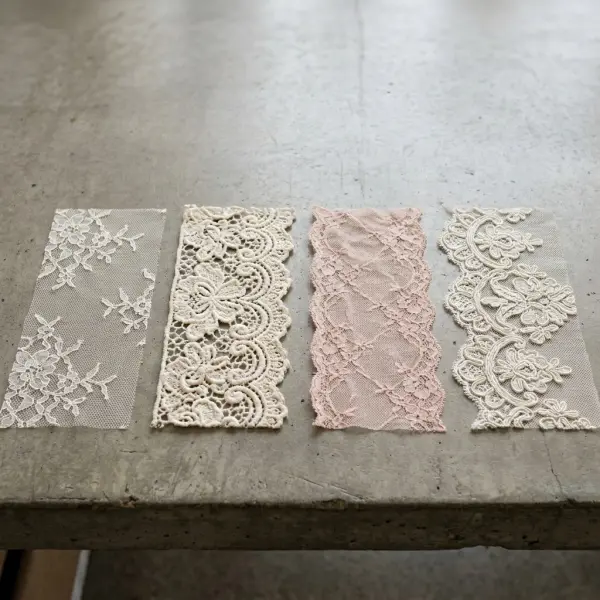
How Fiber Composition Changes Lace Fabric
The construction creates the lace identity, while the fiber system strongly influences performance.
Cotton and Linen
Cotton and linen can produce matte surfaces, natural-looking texture, good motif visibility, and an appearance associated with traditional craft. They are frequently used in guipure, crochet-style lace, edgings, casual garments, and heritage-inspired products.
However, cellulosic lace may shrink, crease, distort when wet, or become firmer depending on yarn and finishing. Open structures can also change dimensions more visibly than compact woven fabrics because there is less material restraining movement.
Pre-production washing or cleaning tests are essential when the finished garment will be sold as washable.
Silk
Silk can provide fine yarns, subtle luster, softness, and luxury positioning. Genuine silk lace is relatively uncommon in mass-market sourcing because of fiber cost, production requirements, care sensitivity, and limited availability.
The term “silky lace” does not confirm silk content. It may simply describe smoothness or shine. Composition should be verified through supplier documentation and, where necessary, laboratory testing.
Polyamide or Nylon
Polyamide is widely used in fine, lightweight, and stretch lace because it can be processed into strong, smooth filaments. It is common in lingerie and intimate apparel, especially when blended with elastane.
Its performance still varies. Filament fineness, yarn texturing, dyeing, heat setting, and finishing influence softness, shine, snagging, pilling, and recovery.
Heat sensitivity also matters during pressing and garment finishing. Production teams should establish safe temperature and pressure settings rather than applying a standard pressing process used for cotton or polyester fabrics.
Polyester
Polyester is used across mass-market and premium lace categories. It can offer dimensional stability, broad color possibilities, accessible pricing, and compatibility with high-volume manufacturing.
Yet “polyester lace” is not one quality level. Textured filament polyester, spun polyester, fine multifilament yarns, recycled-content yarns, and metallic-effect combinations can produce very different results.
Product claims concerning recycled content must be supported by traceable supplier documentation. Recycled fiber content also does not automatically establish that the finished lace has a lower overall environmental impact; dyeing, finishing, durability, energy use, waste, and garment lifespan remain relevant.
Viscose and Other Regenerated Cellulosics
Viscose-based yarns can add softness, drape, absorbency, and a subdued luster. They may appear in embroidery threads, lace motifs, or blended constructions.
Wet strength, shrinkage, fibrillation risk, surface abrasion, and dimensional change depend on the specific fiber and process. Buyers should not assume that all regenerated cellulosic yarns perform identically.
Elastane
Elastane is incorporated into lace when controlled stretch and recovery are required. Even a relatively small proportion may significantly affect behavior, but the result depends on where and how the elastic yarn is placed in the structure.
The declared elastane percentage does not by itself reveal:
- Maximum stretch
- Recovery speed
- Holding power
- Direction of stretch
- Resistance to heat or chemicals
- Durability after repeated laundering
Garment patterns should be developed from measured fabric behavior rather than composition percentages alone.
Where Is Lace Used in Fashion?
Lace is used when a designer needs controlled transparency, surface pattern, decorative edges, textural contrast, or a combination of visual delicacy and structural definition.
Lingerie and Intimate Apparel
Stretch lace is widely used in bras, briefs, bodysuits, camisoles, sleepwear, and decorative panels. It can provide flexibility and visual interest while reducing the need for printed surface decoration.
The material still needs to work with the engineering of the garment. A lace used on a supportive bra wing requires different power and recovery from lace used as a soft decorative cup overlay. Skin comfort, edge softness, seam strength, and repeated washing are particularly important.
Bridal and Formal Apparel
Fine lace, corded lace, guipure, appliquéd motifs, and embellished lace are frequently used in wedding dresses, veils, bodices, sleeves, overlays, and formal garments.
The material can help create visual depth without relying entirely on printed pattern or heavy embellishment. Motifs may also be cut individually and repositioned over seams, necklines, or transitions between opaque and transparent areas.
The strategic role of lace and related decorative materials in premium and ceremonial clothing is explored further in why decorative fabrics remain important in occasion wear design.
Everyday Dresses, Tops, and Skirts
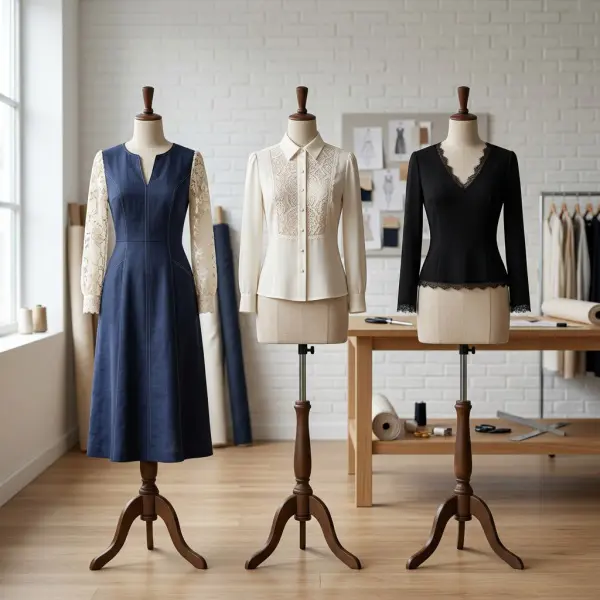
Lace is not limited to formalwear. It may appear as a yoke, sleeve, collar, insert, hem, overlay, side panel, or localized trim on day dresses, shirts, knit tops, skirts, and coordinated sets.
For everyday apparel, care requirements and durability become more commercially important. A garment intended for frequent washing should not depend on a lace that requires highly specialized maintenance unless the price point and customer communication support that choice.
Tailoring and Structured Garments
Lace can be laminated, layered, backed, quilted, or positioned over a stable substrate to create jackets, tailored dresses, corsetry, and structured panels.
In these applications, the base fabric may control most of the mechanical performance while the lace supplies the visible surface. The product developer must verify that both layers respond compatibly to pressing, cleaning, stretching, and seam construction.
Trims, Motifs, and Accessories
Narrow lace trims are used on cuffs, necklines, lingerie edges, children’s garments, headwear, bags, shoes, gloves, and accessories. Individual motifs may function as appliqués or localized decorative components.
Small components still require technical control. A trim with inconsistent width can disrupt automated attachment, while a motif with unsecured thread ends may unravel after cutting.
Product Development Implications of Working With Lace
Lace should be considered early in design development. Substituting it late in the process can change garment balance, opacity, seam construction, pattern dimensions, cost, and lead time.
Pattern Placement Can Be More Important Than Fabric Price
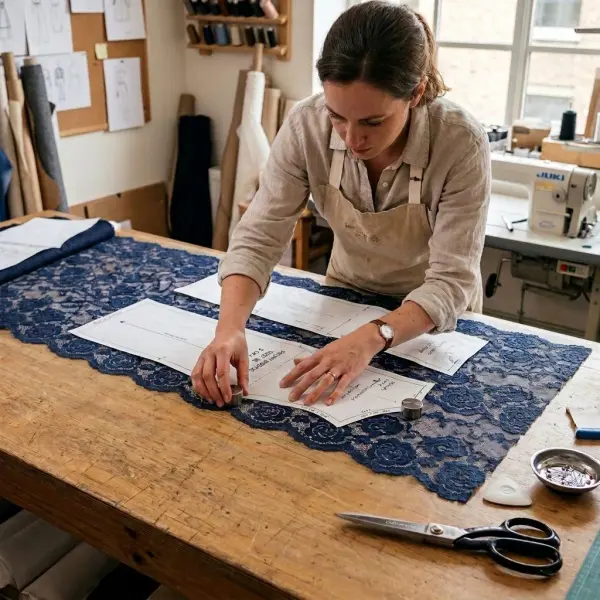
Large motifs may need to be centered at the front bodice, mirrored across sleeves, aligned at side seams, or positioned symmetrically around a neckline. This creates unused spaces in the marker and increases consumption.
A basic cost comparison based only on price per metre may therefore be misleading. A more expensive lace with a compact repeat and two usable scalloped edges can sometimes generate a lower garment-level material cost than a cheaper lace with a large directional repeat.
Before confirming the fabric, the pattern and costing teams should test a preliminary marker using the actual repeat.
Transparency Must Be Designed, Not Discovered During Fitting
Openwork fabric reveals the body, underwear, seam allowances, interfacing, pocket bags, labels, and internal construction. The designer must decide which of these elements should remain visible.
Possible solutions include:
- Full lining
- Partial lining
- Skin-tone backing
- Self-colored backing
- Strategic double layers
- Opaque facings
- Bound or concealed seam allowances
- Motif placement over sensitive areas
The backing fabric can alter color, drape, warmth, stretch, and overall price. It should be approved together with the lace rather than treated as a later production detail.
Cutting Requires Structural Awareness
Some lace structures distort when lifted, spread, or layered. Stretch lace may relax after cutting, while guipure may shift because dense motifs are connected by relatively narrow bridges.
Production teams may need to control ply height, spreading tension, resting time, cutting support, and bundling. Engineered borders and scallops often require single-ply cutting or carefully planned low-ply cutting.
Motif cutting also creates loose thread ends. Depending on the construction, these may need securing, heat control, stitching, binding, or incorporation into the seam.
Seam Selection Depends on the Lace
No single seam works for every lace. A fine net lace may need a narrow, low-bulk seam. Heavy guipure may require motif trimming, lapped construction, binding, or selective hand finishing. Stretch lace must retain elasticity without creating wavy seams or broken stitches.
The production team should evaluate:
- Seam appearance from both sides
- Seam extension and recovery
- Risk of yarn damage
- Needle size and point
- Thread compatibility
- Edge finishing
- Pressing response
- Bulk at intersecting seams
- Repairability
A visually invisible seam may require more labor than the initial garment cost estimate allows. Sampling should expose this issue before the selling price and delivery schedule are fixed.
How Fashion Businesses Can Source Lace More Strategically
The best sourcing decision connects the desired appearance with measurable production requirements. This is especially important when design, sourcing, and manufacturing are managed by different companies or countries.
Build a Complete Material Specification
A lace specification should include more than a supplier style number. At minimum, record:
- Supplier and mill
- Country of manufacture
- Lace construction or machine type
- Fiber composition
- Nominal and usable width
- Fabric weight where measurable
- Motif repeat and direction
- Ground structure
- Edge or scallop configuration
- Stretch and recovery by direction
- Color standard
- Finish
- Intended care method
- Minimum order quantity
- Lead time
- Testing requirements
- Approved sample reference
Photographs are useful but should not replace a retained physical standard. Texture, elasticity, dimensional relief, softness, and shade are difficult to judge consistently from images.
Evaluate the Supplier’s Technical Capability
A mill that produces lingerie lace may not be the best supplier for heavy guipure, embroidered bridal fabric, or artisanal cotton trim. Ask which technologies, yarn types, widths, gauges, dyeing methods, and finishing processes are handled internally.
Useful questions include:
- Is the lace made, dyed, and finished at the same facility?
- Which processes are subcontracted?
- Can the supplier maintain the same construction for repeat orders?
- How are broken threads, holes, and pattern defects repaired?
- Can the mill provide lot-level traceability?
- Are lab dips evaluated on the lace or only on yarn?
- Can the supplier test stretch and recovery after laundering?
- How are motif repeats controlled across production lots?
The answers help distinguish a general trading offer from a technically managed supply program.
Test the Actual Color and Finish
Lace can respond unevenly to dyeing because decorative yarns, ground yarns, elastic yarns, and cords may have different fiber compositions or dye affinities. Tone-on-tone lace may therefore show intentional or unintended contrast.
Dark shades can also make fine pattern defects harder to detect during inspection. Pale shades may reveal contamination, oil marks, yellowing, or inconsistent finishing more clearly.
Approval should cover:
- Shade under relevant lighting
- Color difference between motif and ground
- Colorfastness
- Elastic performance after dyeing
- Handfeel
- Odor
- Surface cleanliness
- Yellowing or discoloration risk
- Compatibility with lining and trims
For garments combining several materials, the lace should be tested with the full component package.
Calculate Cost at Garment Level
The commercial cost of lace includes more than its purchase price. Businesses should account for:
- Marker efficiency
- Motif matching
- Edge utilization
- Cutting method
- Additional lining
- Stabilization
- Sewing time
- Hand placement or appliqué work
- Inspection
- Repair
- Rejected sections
- Specialized cleaning or packaging
This broader calculation prevents an attractive fabric price from hiding a labor-intensive product.
Quality Checks for Lace Fabric
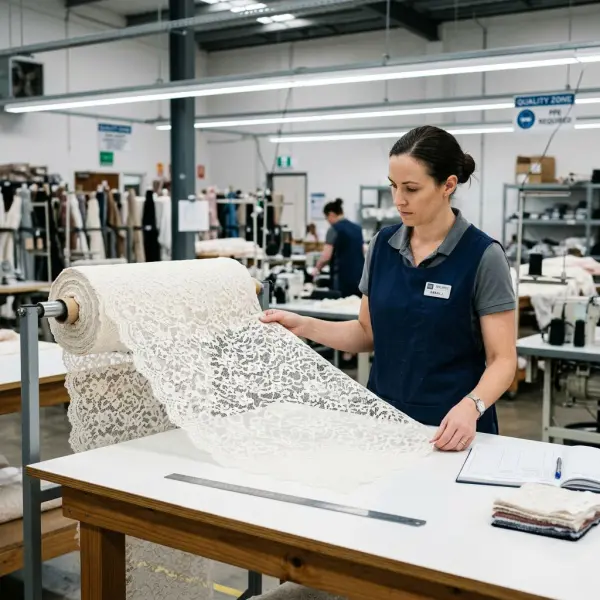
Inspection standards should be adapted to the construction. A defect that is serious in a fine net lace may be less visible in a dense guipure, while small variations in a handmade product may be part of its legitimate character.
Common inspection points include:
- Broken, missing, or loose yarns
- Holes outside the intended openwork pattern
- Dropped knitted structures
- Irregular motif outlines
- Distorted repeats
- Uneven scallops
- Damaged eyelash edges
- Width variation
- Bowing or skewing
- Barre or tension lines
- Shade variation
- Stains, oil, or contamination
- Excessive loose thread ends
- Poor cord attachment
- Embellishment loss
- Uneven stretch or recovery
Inspection should also distinguish repairable defects from defects that compromise structure. A loose decorative thread may be mendable; a broken connection in a critical motif bridge may continue to open during wear.
Garment-level testing is equally important. Fabric tests alone do not reveal whether a neckline stretches out, a seam feels abrasive, a motif catches on jewelry, or a lined garment twists after cleaning.
Common Mistakes When Selecting Lace
Choosing Lace From a Screen Image Alone
Digital images can communicate color and pattern, but they rarely show handfeel, dimensional relief, recovery, transparency over skin, or the scale of the motif accurately.
The result may be a material that looks refined in a close-up photograph but feels too stiff or visually oversized on the garment.
A physical cutting large enough to show the full repeat is more useful than a small swatch.
Treating All Lace as Delicate
Some lace is genuinely fragile. Other lace constructions are strong enough for repeated wear, elastic movement, or structured applications.
Assuming fragility can lead to unnecessary production restrictions. Assuming strength based on weight can be equally misleading. Testing should determine the actual risk.
Assuming Natural-Fiber Lace Is Automatically Higher Quality
Cotton, linen, and silk can support premium positioning, but fiber origin alone does not establish quality. Yarn evenness, motif execution, finishing, dimensional stability, and suitability for the garment remain decisive.
A technically refined polyamide lace may perform better in lingerie than a natural-fiber product that lacks stretch, softness, or recovery.
Ignoring Repeat and Direction
Directional floral patterns can create obvious upside-down motifs, asymmetrical sleeves, or mismatched garment panels. Correcting the problem during production increases fabric use and delays cutting.
Repeat data should be included in the bill of materials and marker planning process.
Approving the Fabric Without the Lining
A lace may look elegant over one lining but dull, harsh, or excessively transparent over another. The backing can also restrict stretch or create differential shrinkage.
Approval should treat the lace and backing as a composite visual and mechanical system.
Using Historical Names as Unsupported Marketing Claims
Terms such as Chantilly, Alençon, Venetian, or handmade can carry cultural, geographic, and luxury associations. Contemporary suppliers may use them to describe an appearance rather than verified origin or technique.
Brands should distinguish between language such as “Chantilly-inspired floral lace” and a documented claim that a product was produced through a specific regional tradition.
Making Broad Sustainability Claims
Neither handmade nor machine-made lace is automatically sustainable. Neither natural nor synthetic fiber content provides a complete environmental assessment.
Relevant factors include material origin, chemical processing, dyeing, energy, production waste, product durability, cleaning, repairability, transport, traceability, and end-of-life limitations. Claims should describe verifiable attributes rather than labeling the entire material “eco-friendly.”
What Brands Should Verify Before Acting
Lace terminology is not consistently used across all suppliers, regions, and market levels. Before committing to production, verify the construction rather than relying on the commercial name.
In particular:
- Confirm whether the lace is handmade, Leavers-made, warp-knitted, embroidered on net, or produced on a removable backing.
- Confirm whether a regional name indicates verified origin or only a visual style.
- Confirm the actual fiber composition of the ground, motif, cord, elastic yarn, and embellishments.
- Confirm usable width rather than nominal width alone.
- Confirm stretch direction, recovery, and power through physical testing.
- Confirm color and finishing on bulk-production material.
- Confirm whether the approved sample represents repeat-order capability.
- Confirm care requirements after the lace has been combined with lining, thread, elastic, and other garment components.
Lace selection succeeds when creative expectations and production facts describe the same material.





Comments 0
Leave a CommentSend Comment
Anda harus Login terlebih dahulu untuk dapat memberikan komentar.