
Fashion CRM Explained for Customer-Focused Brands
Quick Answer
Fashion customer relationship management, or fashion CRM, is a business system that organizes customer information and interactions so a brand can communicate more relevantly, deliver better service, and manage relationships across the customer lifecycle.
A fashion CRM may connect data from e-commerce stores, physical retail locations, customer service, loyalty programs, email, messaging channels, returns, and events. It can help teams recognize that a customer bought linen dresses online, returned a particular size, visited a store, joined a loyalty program, or responded to a product-care campaign.
The technology alone does not make a brand customer-focused. Its value depends on whether the data is accurate, customer permissions are respected, teams use the information consistently, and campaigns provide genuine value beyond repeated discounts.
For most fashion businesses, CRM should begin with practical priorities: creating dependable customer profiles, recording consent, improving service continuity, identifying meaningful customer segments, and measuring retention. More advanced personalization and automation should come later, once the underlying processes are reliable.

What Is Fashion CRM?
Fashion CRM is a customer relationship management system adapted to the commercial and service needs of fashion brands, retailers, and apparel businesses. It brings customer records, interaction history, preferences, permissions, and service activities into a coordinated system so teams can manage relationships more consistently.
A customer record might include contact information, purchase history, preferred store, loyalty status, communication consent, customer-service cases, and responses to previous campaigns. Depending on the brand’s technology and privacy policies, it may also include browsing behavior, wish-list activity, event attendance, or declared product interests.
The distinguishing feature is not simply that a business stores customer data. Transactional systems already do that. CRM connects the data to an ongoing relationship: what the customer has bought, how the brand has communicated, what assistance has been requested, and what action may reasonably be useful next.
This matters in fashion because customer decisions are rarely based on price alone. Fit confidence, style relevance, product availability, delivery experience, return handling, fabric expectations, and trust in the brand can all affect whether someone returns.
A CRM Is More Than an Email List
An email list normally contains addresses and subscription information. A CRM has a broader role. It may help customer-service agents see previous cases, allow store associates to recognize loyalty members, support segmentation by purchase behavior, and give marketing teams a shared record of communication preferences.
The difference becomes clear when something goes wrong. If a customer returns trousers because the fit was smaller than expected, a basic mailing list may continue promoting the same product indiscriminately. A connected CRM could record the return, suppress an unsuitable follow-up, and support a more relevant service response.
A CRM is also not the same as a loyalty program. Loyalty is one possible mechanism within a wider relationship strategy. Points and rewards may encourage participation, but they do not automatically produce useful customer understanding or good service.
Fashion CRM, CDP, POS, and Marketing Automation Are Not Identical
Several systems may work together, but they serve different primary functions.
|
System |
Primary role |
Typical fashion application |
Important limitation |
|
CRM |
Manages customer relationships, profiles, and interactions |
Service history, segmentation, clienteling, loyalty, campaign coordination |
Its profile is only as useful as the connected data and operating processes |
|
POS |
Processes and records retail transactions |
Store purchases, returns, payments, and inventory-related sales activity |
It may not provide a complete cross-channel customer history |
|
E-commerce platform |
Manages online shopping and orders |
Product browsing, checkout, online orders, and digital accounts |
Online activity may remain separate from stores or service channels |
|
CDP |
Unifies customer data from multiple sources for analysis and activation |
Identity resolution and cross-channel audience creation |
Implementation can be costly and technically demanding |
|
Marketing automation platform |
Executes rule-based or triggered communications |
Welcome sequences, replenishment reminders, and re-engagement campaigns |
Automation can amplify irrelevant decisions when data or rules are weak |
|
Customer service platform |
Manages support conversations and cases |
Delivery questions, complaints, exchanges, and returns |
Service records may remain isolated unless integrated with the CRM |
Smaller brands do not necessarily need every category as a separate platform. Some commerce or CRM products combine several capabilities. The more important question is whether responsibilities, data flows, and system ownership are clear.
How Does a Fashion CRM Work?
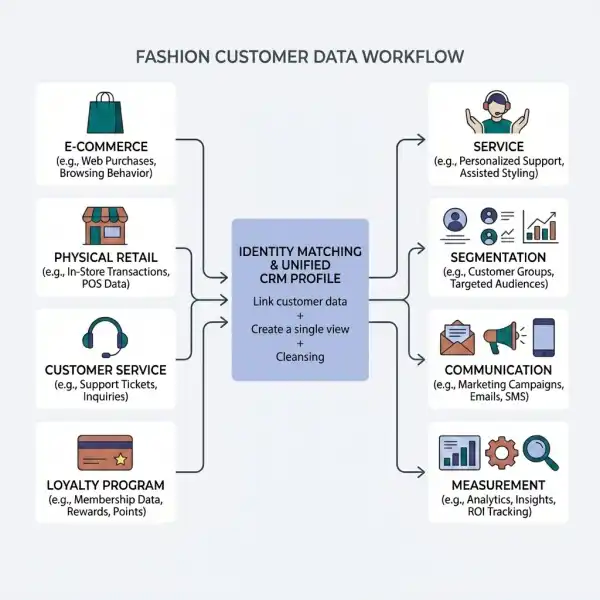
A fashion CRM generally collects permitted customer information from relevant touchpoints, connects records belonging to the same person, organizes those records into usable profiles, and makes the information available for service, segmentation, communication, and analysis.
The process sounds straightforward, but identity is often difficult in practice. One person may purchase online with an email address, buy in-store without identifying themselves, contact support through social messaging, and use a different phone number for delivery. The CRM cannot safely assume that every similar record belongs to the same customer.
A dependable workflow normally involves five connected activities:
- Data collection: The business receives customer data from purchases, account registrations, subscriptions, support requests, loyalty enrollment, store interactions, or other approved touchpoints.
- Identity management: The system matches, merges, or separates records using defined rules rather than informal assumptions.
- Profile organization: Relevant attributes, transactions, permissions, and interactions are arranged into a usable customer view.
- Activation: Authorized teams use the information for service, analysis, segmentation, and appropriate communication.
- Measurement and correction: The business evaluates results, records preference changes, removes duplicates, and corrects inaccurate information.
A CRM therefore operates as both technology and process. Software can store the record, but people still need to decide which information should be collected, who may access it, how conflicting records are resolved, and when data should be deleted.
What Information Can a Fashion CRM Contain?
The useful contents of a fashion CRM depend on the business model, customer permissions, local regulations, and the purpose for which the information was collected. More data is not automatically better.
Identity and Contact Information
This may include a customer’s name, email address, telephone number, account identifier, country, language, or preferred store. Contact records should distinguish between operational communication—such as order updates—and promotional communication, which may be subject to different permissions.
Purchase and Return History
Order data can show product category, size purchased, channel, date, value, discount use, returns, and exchanges. It may help a brand understand whether someone is a first-time customer, a consistent full-price buyer, or a customer experiencing repeated fit problems.
Return history needs careful interpretation. A return does not necessarily indicate dislike or low loyalty. The customer may have ordered two sizes intentionally, received a damaged item, encountered misleading imagery, or experienced late delivery. CRM data provides evidence of an event, not always the reason behind it.
Product and Style Preferences
A customer may explicitly select preferred categories or save products to a wish list. The brand may also infer interests from purchases or browsing behavior, provided that such processing is lawful and transparently explained where required.
Declared preferences and inferred preferences should not be treated as equivalent. Someone who bought a formal dress for a wedding has not necessarily adopted formalwear as a permanent style preference.
Fit-Related Information
Some fashion businesses record a usual size, preferred fit, alteration notes, or product-specific feedback. These details may improve service, especially in luxury clienteling, made-to-measure businesses, rental services, or categories with complex fit.
Size information is not perfectly transferable between products. A customer who wears a medium in one knit top may need another size in a tailored jacket because grading, ease, fabric stretch, and silhouette differ. CRM should support fit judgment rather than present an old purchase as a guaranteed recommendation. A deeper explanation belongs in fashion size recommendation technology.
Engagement and Service Records
A CRM may retain campaign responses, loyalty activity, event attendance, complaint history, product questions, and service resolutions. These records can prevent customers from having to repeat their situation whenever they change channels.
Sensitive notes require restraint. Store associates and service teams should record information that is relevant, factual, professionally worded, and permitted—not subjective commentary about a person.
Why Does CRM Matter to Fashion Brands?
CRM matters because it helps a fashion business shift from isolated transactions toward coordinated customer management. That can improve service continuity, make communication more relevant, and provide a clearer view of retention.
The potential is especially useful when a brand operates across several channels. Without coordination, the store team may not see an online return, customer service may not know that a shopper is a long-standing client, and marketing may send a promotional message while an unresolved complaint remains open.
The practical benefits usually fall into four areas.
More Relevant Customer Communication
A fashion brand can divide its audience using behavior that is meaningful to the business. A new customer may need care instructions or fit guidance. A frequent childrenswear buyer may respond to age-appropriate product updates. A customer who consistently purchases full-price outerwear should not automatically receive the same discount sequence as a dormant bargain shopper.
Relevance does not mean sending more messages. In some cases, the better CRM decision is to send fewer communications, suppress an inappropriate promotion, or wait until the customer has received an existing order.
Better Service Across Channels
A usable customer view can help service agents or authorized store associates understand previous purchases and unresolved issues. For example, a customer contacting a store about replacing a faulty zipper should not have to reconstruct the entire order history if the information is already available and accessible for that purpose.
This continuity is valuable, but access should be role-based. A store employee does not necessarily need to see every attribute held by the company. Customer convenience should not become an excuse for unrestricted internal visibility.

Clearer Retention Analysis
CRM can help a brand examine repeat purchase rate, time between purchases, customer retention by acquisition cohort, category movement, return patterns, and response to loyalty or service initiatives.
These metrics still require context. A bridalwear business will have a different natural purchase cycle from a basics subscription brand. A low purchase frequency is not necessarily poor performance when products are durable, expensive, seasonal, or occasion-specific.
More Informed Merchandising and Product Decisions
Aggregated CRM insights can reveal recurring customer needs. Repeated exchanges between adjacent sizes may point to a fit communication issue. Strong cross-purchase between trousers and a particular knit category may inform outfit merchandising. Requests for restocks can help identify missed demand.
CRM should not replace sales, inventory, product, and market analysis. It contributes a customer perspective to those decisions. Combining customer signals with margin, return reasons, stock availability, and product performance produces a more credible view than relying on email clicks alone.
How Fashion CRM Supports the Customer Lifecycle
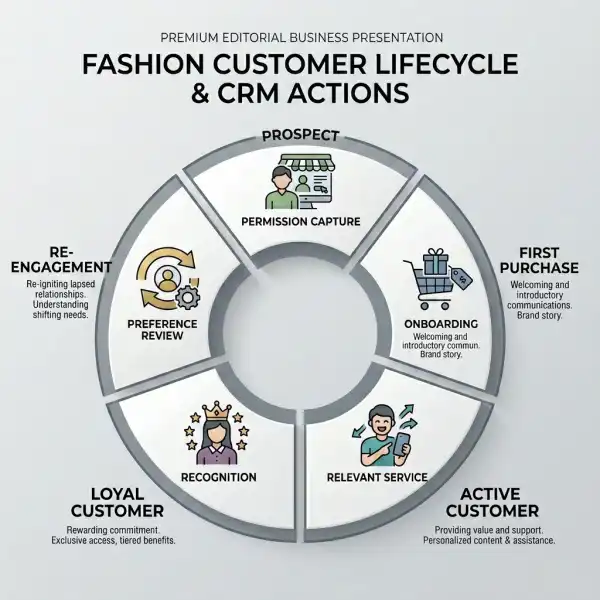
Fashion CRM can assist at different stages, but each stage calls for a different type of value. Treating every customer as an immediate sales opportunity usually produces repetitive promotions rather than relationship management.
|
Customer stage |
Useful CRM role |
Fashion example |
What to avoid |
|
Subscriber or prospect |
Record interests and permissions |
Send a requested denim-fit guide after newsletter registration |
Assuming subscription equals interest in every category |
|
First purchase |
Build confidence after the transaction |
Provide delivery updates, garment-care guidance, and a clear exchange route |
Sending another discount before the first order arrives |
|
Active customer |
Improve relevance and recognition |
Recommend a coordinating item based on an owned product |
Recommending returned or unavailable merchandise |
|
Loyal customer |
Recognize the relationship appropriately |
Offer early access, alteration support, or an invitation relevant to the customer |
Relying only on points and discounts |
|
At-risk customer |
Identify service or relevance problems |
Follow up after a poor delivery or repeated fit return |
Treating every period of inactivity as dissatisfaction |
|
Lapsed customer |
Test whether re-engagement is appropriate |
Send a preference update request or carefully selected return message |
Increasing frequency indefinitely when the customer does not respond |
The next article in this cluster examines how marketing automation helps fashion brands nurture repeat buyers. The distinction is important: CRM provides the relationship context, while marketing automation executes defined communications and actions. One can support the other, but they are not interchangeable.
What Does Fashion CRM Mean in Practice for Different Business Models?
CRM priorities should reflect how the brand sells, how often customers realistically repurchase, and what service the product requires.
A direct-to-consumer basics brand may emphasize replenishment timing, product-care education, subscriptions, and movement between entry-level and premium lines. A multibrand retailer may need category preference, brand affinity, online-to-store identity, and loyalty data. A luxury boutique may prioritize appointment history, associate ownership, alterations, gifting occasions, and highly controlled clienteling.
For made-to-measure apparel, the customer relationship may include measurements, fitting history, pattern adjustments, fabric selection, and production status. Those details are operationally valuable but can be sensitive and require clear access controls.
Wholesale apparel manufacturers generally use CRM differently. Their customers are businesses rather than individual shoppers, so records may include buyer contacts, account history, sample requests, quotations, collection feedback, order cycles, and service cases. This is still CRM, but the workflow resembles business-to-business account management rather than consumer lifecycle marketing.
Small brands should resist copying an enterprise CRM structure without considering their own operational capacity. A compact system used consistently is usually more valuable than a sophisticated configuration that nobody maintains.
How Can a Fashion Brand Implement CRM Strategically?
The sensible starting point is not a vendor demonstration. It is a clear statement of the customer and business problems the CRM should solve.
1. Define a Small Set of Use Cases
A brand might initially choose three priorities: creating one dependable customer record, giving service agents access to order context, and separating first-time customers from repeat customers.
These use cases are specific enough to shape the data and integration requirements. “Improve personalization” is not. That phrase could refer to email recommendations, store clienteling, homepage content, service responses, or product assortment, each requiring different capabilities.
2. Map Customer Touchpoints and System Ownership
The brand should document where customer information enters the business and which platform currently holds it. Common sources include:
- E-commerce accounts and orders
- Point-of-sale transactions
- Returns and exchange systems
- Email or messaging subscriptions
- Loyalty enrollment
- Customer-service cases
- Store appointments and events
- Wish lists and product alerts
The map should identify the authoritative source for each field. If the CRM, e-commerce platform, and loyalty system all store a customer’s email permission, the team needs a rule for which record governs and how changes are synchronized.
3. Establish Data and Permission Rules
Before importing historical records, define required fields, formats, duplicate rules, retention periods, and permission status. Old spreadsheets may contain valuable account history, but they may also contain outdated addresses, unexplained notes, and contacts whose marketing permissions cannot be confirmed.
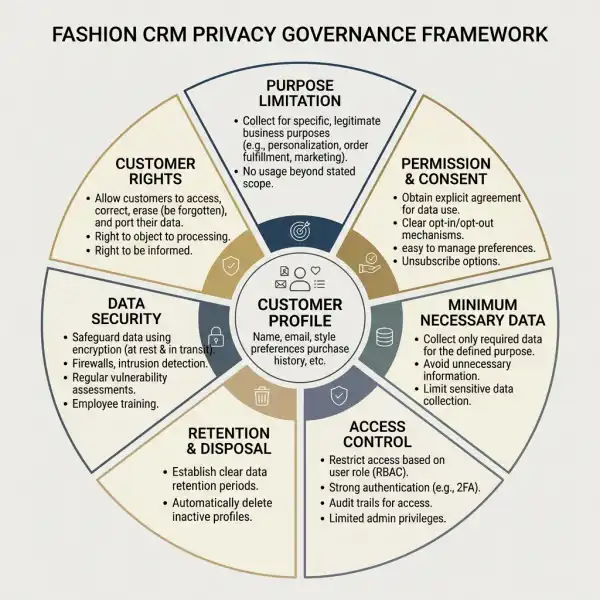
The European Commission’s GDPR processing principles include purpose limitation, data minimization, accuracy, storage limitation, security, and accountability. These principles are operationally relevant to CRM design: brands should know why a field is collected, how it will be used, who needs access, and how long it should remain.
4. Design the Minimum Useful Customer Profile
A useful profile does not need every possible attribute. It needs information that supports the selected use cases.
For an emerging omnichannel label, the first version might contain:
- A stable customer identifier
- Verified contact information
- Channel-specific permission status
- Online and identified store purchases
- Returns and stated return reasons
- Open customer-service cases
- Loyalty status, if applicable
- Preferred language or store when declared
Fit, style, and behavioral attributes can be added when the brand can explain their purpose and maintain them. The underlying discipline is explored further in why customer data quality matters in fashion CRM systems.
5. Integrate in Phases
A phased implementation limits risk. The first phase may connect e-commerce, customer service, and email permission records. Point-of-sale and loyalty integration can follow once identity matching and store processes have been tested.
A brand should test ordinary and difficult scenarios: guest checkout, shared household email addresses, changed telephone numbers, returns without an account, duplicate store profiles, consent withdrawal, and account deletion requests. These cases reveal more about CRM readiness than a polished demonstration using perfect sample data.
6. Assign Operational Ownership
Marketing may sponsor the system, but it should not own every decision alone. Customer service, retail operations, e-commerce, IT, data teams, legal or privacy advisers, and senior management may all have responsibilities.
Ownership should cover:
- Profile and field definitions
- Permission and suppression rules
- Integration monitoring
- Duplicate resolution
- Role-based access
- Campaign approval
- Privacy requests
- Performance review
- Incident response
Without named owners, data issues become everyone’s concern and nobody’s routine task.

How Should Fashion Brands Measure CRM Performance?
CRM success should be tied to customer and operational outcomes rather than database size alone. A million profiles are not valuable if identities are duplicated, permissions are uncertain, or teams cannot act on the information.
Appropriate measures depend on the implementation objective. They may include:
- Percentage of usable and permissioned customer profiles
- Duplicate or incomplete record rate
- Identified transaction rate across channels
- Customer-service resolution time
- Repeat purchase rate by acquisition cohort
- Retention over a commercially relevant period
- Unsubscribe and complaint rates
- Campaign incremental revenue, where a valid comparison is possible
- Loyalty participation and redemption quality
- Frequency of unresolved integration failures
Revenue attributed by a CRM platform should be reviewed carefully. If someone opens an email and buys a product several days later, the platform may claim the sale according to its attribution window. That does not prove that the communication caused the purchase. Holdout groups, controlled tests, and incremental analysis can provide stronger evidence when the scale and tooling permit them.
The measurement window must also fit the product. A 30-day repeat-purchase target may suit cosmetics sold by a fashion retailer, but it may be meaningless for winter coats or occasionwear.
Common Fashion CRM Mistakes
Collecting Data Without a Defined Use
Brands sometimes add fields because the software allows them, not because the information supports a legitimate customer or operational purpose. This increases maintenance and privacy exposure while making profiles harder to interpret.
A better approach is to connect every field to a use case, lawful basis where applicable, responsible owner, access rule, and retention decision.
Treating Purchase History as a Complete Preference Profile
One transaction provides limited context. A gift, urgent occasion purchase, markdown experiment, or substitute caused by stock availability may not represent a lasting preference.
Brands should combine transactional evidence with declared preferences, repeated behavior, product context, and customer feedback. Even then, recommendations should remain flexible rather than deterministic.
Using CRM Primarily to Increase Message Volume
Automation can make it easy to launch more campaigns, but frequency is not the same as relationship quality. Overlapping welcome, browse, cart, promotional, loyalty, and win-back sequences may expose one customer to several messages within a short period.
Frequency caps, channel priorities, service suppressions, and campaign conflict rules should be designed before scaling automated journeys.
Ignoring Returns and Service Problems
A high-value customer profile can look commercially attractive while hiding unresolved complaints or repeated quality failures. Sending a celebratory loyalty offer during a dispute is an avoidable sign that the CRM is disconnected from service reality.
Complaint status, delivery failures, refunds, and relevant return reasons should inform communication rules where technically and legally appropriate.
Buying Sophisticated Software Before Fixing Processes
CRM platforms cannot resolve unclear definitions, inconsistent store practices, missing consent records, or poorly structured product data by themselves. They may simply centralize the inconsistency.
For many growing brands, the correct sequence is to define the process, clean essential data, test a limited workflow, and then expand the technology.
Measuring Only Opens, Clicks, and Attributed Sales
Campaign metrics are useful but incomplete. They do not show whether the brand improved retention, reduced service friction, corrected fit-related problems, or created profitable incremental demand.
CRM reporting should connect communication performance with margin, returns, service outcomes, customer cohorts, and frequency of purchase appropriate to the category.
Important Privacy and Technical Caveats
Fashion CRM involves personal information, so implementation must reflect the laws applicable to the business, customer, channel, and jurisdiction. A global brand may face different requirements across markets. This article provides an operational overview, not legal advice.
The California Consumer Privacy Act gives qualifying California consumers rights concerning personal information, including rights to know, delete, correct, and opt out of certain selling or sharing practices, subject to the law’s scope and exceptions. Businesses should refer to the California Department of Justice CCPA guidance and obtain appropriate professional advice for their circumstances.
Electronic marketing rules can also differ from general data-processing rules. For example, the UK Information Commissioner’s Office explains that direct marketing requires a valid data-protection basis and that consent or legitimate interests may be relevant depending on the activity; separate electronic-communications requirements can also apply. The details are outlined in the ICO guidance on choosing a lawful basis for direct marketing.
Operational safeguards should include role-based access, authentication, documented integrations, auditability, data-retention controls, backup and recovery arrangements, vendor assessment, and a tested response process for incidents and individual rights requests. The NIST Privacy Framework provides a voluntary structure for identifying and managing privacy risk, although using a framework does not by itself establish legal compliance.
What Should Brands Verify Before Choosing a Fashion CRM?
The best CRM is not necessarily the product with the longest feature list. It is the system that can support the brand’s priority workflows, data obligations, team capability, and realistic budget.
During evaluation, decision-makers should verify:
- Whether the system can represent online, store, service, and loyalty interactions without producing uncontrolled duplicate profiles
- Which integrations are native, which require middleware, and who will maintain them
- How consent, unsubscribe, deletion, correction, and suppression are synchronized
- Whether access can be restricted by role, location, brand, or business unit
- How customer identity is matched and how uncertain matches are reviewed
- Whether return, refund, complaint, and availability data can influence campaigns
- How attribution and customer metrics are calculated
- Whether data can be exported in a usable format
- What security, hosting, backup, support, and incident terms the vendor provides
- The total implementation cost, including integration, migration, training, maintenance, and specialist support
A technically capable system can still be unsuitable if store teams will not use it, integrations exceed the available budget, or the brand lacks people who can maintain its rules. Vendor selection should therefore include workflow demonstrations using the brand’s real scenarios, not only a generic feature tour.
Frequently Asked Questions About Fashion CRM
Is CRM only useful for large fashion brands?
No. Small brands can benefit from CRM when they have a clear customer base and repeatable relationship needs. A modest operation might use CRM to organize customer-service history, distinguish first-time and repeat buyers, manage subscriptions, and prevent irrelevant campaigns.
The system should match the brand’s scale. A small direct-to-consumer label may need dependable e-commerce integration and basic segmentation rather than complex predictive modeling. Implementation becomes wasteful when software administration consumes more resources than the customer problems it solves.
Can a CRM increase repeat purchases?
A CRM can support repeat purchases by helping a brand recognize customer history, improve service, time communications more appropriately, and present relevant products or information. It cannot guarantee that customers will buy again.
Product quality, fit, pricing, availability, delivery, return experience, and genuine category demand still matter. CRM is most effective when it improves an already credible customer proposition. It cannot compensate indefinitely for poor products or unreliable fulfillment.
What is the difference between fashion CRM and clienteling?
Fashion CRM is the broader system for managing customer records and interactions. Clienteling is a relationship-based retail practice in which associates use permitted customer knowledge to provide more personal service, recommendations, appointments, or follow-up.
Clienteling may operate through CRM software, but the two terms are not synonymous. Effective clienteling also depends on staff judgment, training, boundaries, product knowledge, and consistent service standards. Poorly governed clienteling can feel intrusive even when the underlying data is technically available.
Does a fashion CRM need artificial intelligence?
No. Core CRM functions such as profile management, consent recording, segmentation, service history, and lifecycle reporting do not require artificial intelligence.
AI may help with tasks such as product recommendations, predicted customer value, next-action suggestions, or service summarization. These outputs remain dependent on data quality, model design, product availability, and human oversight. A brand should not add AI merely to modernize the feature list; it should identify a specific decision that the technology can improve and test the result against a simpler method.
How much customer data should a fashion brand collect?
A brand should collect data that is adequate and relevant for a stated purpose, limited to what is necessary, and handled according to applicable law. The exact amount therefore depends on the service and market.
An alteration business may reasonably need measurements that a basic accessories retailer does not. A newsletter sign-up usually does not require a date of birth, telephone number, full address, and style profile. Each additional field creates maintenance, security, and trust obligations, so collection should be purposeful rather than speculative.
Can CRM combine online and physical store customers?
Yes, if the systems can exchange data and the brand has a reliable, lawful way to identify the customer across channels. Loyalty identification, authenticated accounts, digital receipts, or customer-provided contact details may help connect transactions.
The difficult cases are anonymous store purchases, shared contact information, typing errors, and duplicate accounts. Brands should avoid aggressive matching that merges different people. It is better to leave an uncertain connection unresolved than to expose one customer’s history to another person.
How long does a fashion CRM implementation take?
There is no universal timeline. A focused integration involving one e-commerce store, a clean subscriber list, and a small service team may be relatively contained. An international omnichannel implementation involving stores, multiple brands, historical data, loyalty, customer service, and regional privacy requirements can take much longer.
The schedule should account for process design, data assessment, integrations, migration, permission validation, testing, staff training, and post-launch correction. Software configuration is only one part of the work.
Conclusion
Fashion CRM gives brands a structured way to understand and manage customer relationships across purchases, service conversations, stores, digital channels, loyalty activity, and marketing. Its central value is coordination: the right teams can work from a more dependable view of the customer instead of relying on disconnected transactions and assumptions.
That value does not come from collecting every available signal. It comes from choosing useful information, keeping it accurate, respecting customer permissions, connecting systems carefully, and turning the record into better decisions. Sometimes that means a relevant recommendation. Just as often, it means resolving a complaint, withholding an unsuitable campaign, or recognizing that a customer’s previous purchase does not define their future preferences.
For customer-focused fashion brands, CRM should be treated as operating infrastructure rather than a campaign tool. Start with the relationship problems that matter, build a trustworthy minimum profile, establish ownership, and expand only when the organization can support the additional complexity.




Comments 0
Leave a CommentSend Comment
Anda harus Login terlebih dahulu untuk dapat memberikan komentar.