

Knit Fabric Explained: Types, Properties, and Fashion Uses
Quick Answer
Knit fabric is a textile structure made by intermeshing yarn loops rather than crossing two yarn systems at right angles. Its looped construction usually gives the fabric more extensibility, body conformity, and freedom of movement than a comparably specified woven fabric, although actual stretch, recovery, stability, softness, and durability depend on the knit structure, fiber, yarn, fabric weight, finishing, and use of elastic yarn.
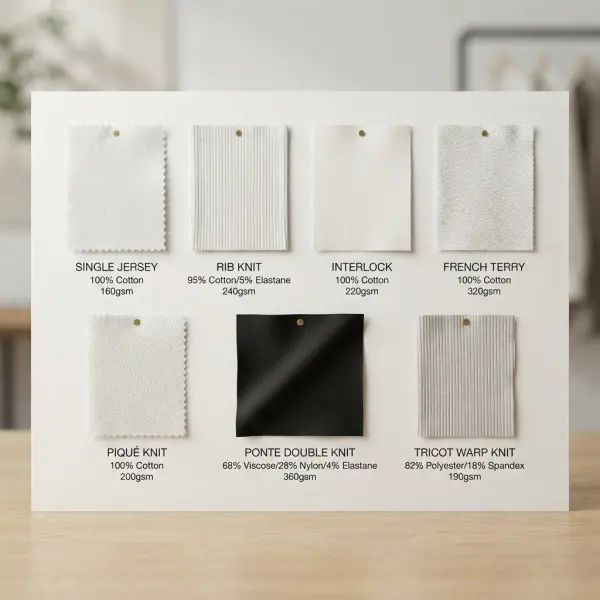
The knit fabric category includes lightweight single jersey for T-shirts, rib structures for collars and fitted garments, smooth interlock for babywear and premium basics, French terry and fleece for sweatshirts, piqué for polo shirts, Ponte for structured garments, and warp-knitted structures such as tricot and Raschel for lingerie, sportswear, linings, lace, and technical applications.
For fashion businesses, “knit” is not a sufficient fabric specification. A brand must define the construction, fiber composition, yarn characteristics, weight, width, stretch and recovery, dimensional stability, surface performance, colorfastness, finishing, and intended garment use. The right knit can improve comfort and fit; the wrong one can create shrinkage, spirality, seam distortion, pilling, inconsistent sizing, or production delays.
What Is Knit Fabric?
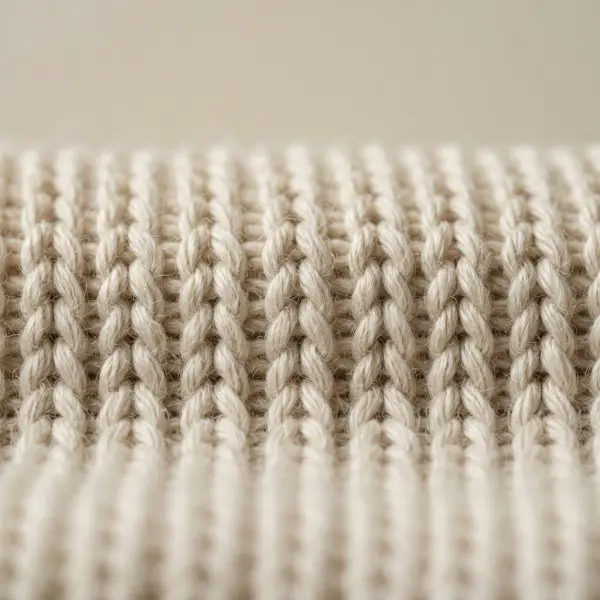
Knit fabric is a textile material formed by drawing yarn into a sequence of interconnected loops to create a flexible fabric structure. Those loops can be produced with one yarn, several yarns, or a large set of parallel yarns, depending on the knitting system and machine configuration.
This construction is the key to understanding knit performance. A woven fabric derives much of its stability from warp and weft yarns crossing one another, while a knit fabric can deform as its loops change shape. The yarn itself does not always need to stretch significantly for the fabric to extend. The loops can open, narrow, or shift under tension, allowing the material to conform more easily to the body.
This is why many T-shirts, leggings, sweaters, polo shirts, underwear, sweatshirts, socks, and activewear products are knitted. The structure can accommodate movement and curved body shapes without requiring the same amount of tailoring ease used in more rigid materials.
However, knit fabric should not be treated as a single performance category. A lightweight cotton single jersey, a dense polyester interlock, a wool rib knit, and a nylon-spandex tricot are all knits, but they behave very differently during cutting, sewing, wearing, laundering, and long-term use.
The CottonWorks overview of knit construction explains that knits are formed by intermeshing yarn into loops and that their ability to conform to the body comes from this loop geometry. t Fabric Is a Structure, Not a Fiber
One of the most common sourcing misunderstandings is using “knit” as though it describes the raw material. It does not.
Cotton, polyester, wool, viscose, nylon, acrylic, and elastane are fibers or fiber categories. Jersey, rib, interlock, piqué, and tricot describe fabric constructions or commercially recognized knit forms. A specification such as “cotton knit” therefore remains too broad for production.
A more useful specification would identify several variables:
- 95% cotton and 5% elastane single jersey
- Combed ring-spun yarn
- Target fabric weight of 200 grams per square metre
- Enzyme wash or other agreed finishing
- Specified width and usable width
- Agreed stretch and recovery requirements
- Maximum permitted dimensional change after laundering
- Required pilling, colorfastness, and appearance performance
Two fabrics with the same cotton percentage and nominal weight can still differ in handfeel, opacity, stretch, recovery, spirality, pilling tendency, shrinkage, and sewing behaviour. Yarn count, yarn twist, stitch length, knitting gauge, fabric density, finishing, compaction, and batch control all influence the outcome.
How Does Knit Fabric Construction Work?
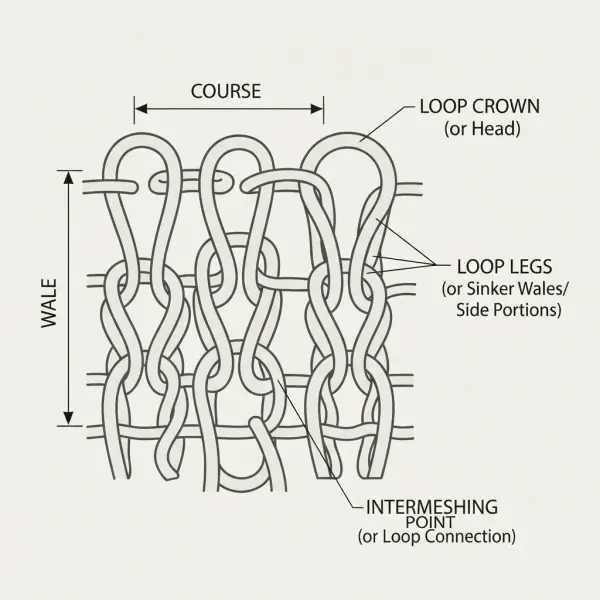
Knitted structures are created through repeating loops. On the fabric surface, the vertical columns of loops are called wales, while the horizontal rows are called courses.
These terms matter commercially because stitch density is often assessed through the number of wales and courses within a defined area. Together with yarn size and stitch length, this helps determine fabric weight, cover, thickness, handfeel, extensibility, and stability.
A tighter construction may produce better cover and a firmer hand, but it is not automatically superior. Excessive density may reduce drape or breathability for the intended product. A more open construction can feel lighter and more flexible, yet it may become transparent, unstable, or vulnerable to snagging.
The practical question is not whether a knit is tight or loose. It is whether its construction is appropriate for the garment.
Knit, Tuck, and Float Stitches
Many knitted fabrics are built through combinations of three fundamental stitch actions:
- Knit stitch: A new loop is drawn through an existing loop.
- Tuck stitch: The existing loop is held while an additional loop is formed, adding texture, width, or thickness.
- Float stitch: The yarn passes behind selected needles instead of forming a loop at every position.
These actions allow mills to engineer texture, pattern, weight, extensibility, stability, and appearance. Piqué surfaces, jacquard effects, waffle textures, and structured double knits can all depend on how stitches are selected and combined.
For a fashion brand, stitch terminology becomes particularly useful when approving development samples. Describing a material only as “textured knit” leaves too much room for interpretation. Referencing the agreed construction, visual standard, sample reference, and performance requirements gives the mill a clearer target.
Gauge, Stitch Length, and Fabric Density
Machine gauge generally describes the number of needles within a specified machine width. Finer-gauge machines are commonly used for smoother, lighter, or more refined fabrics, while coarser gauges can accommodate thicker yarns and more pronounced knit structures.
Gauge alone does not determine quality. A fine-gauge fabric made with unsuitable yarn or weak finishing controls can still perform poorly. Likewise, a coarse sweater knit may be intentionally premium because its yarn, texture, dimensional balance, and garment engineering suit the design.
Stitch length—the amount of yarn used to form a loop—is another influential variable. Longer loops tend to create a more open and extensible structure, while shorter loops generally produce a denser fabric. Changes to stitch length can affect fabric weight, width, shrinkage, cover, and handfeel, which is why unapproved machine adjustments may cause shade or performance inconsistencies across production lots.
The Two Main Knit Systems: Weft Knitting and Warp Knitting
Knitted fabrics are broadly divided into weft knits and warp knits. The distinction concerns how yarns are supplied and how the loops progress through the fabric.
Weft-Knitted Fabrics
In weft knitting, loops are formed across the width of the fabric or around a circular machine. A single yarn can contribute to a complete course, although commercial machines commonly use many yarn feeds to increase production.
Major weft-knit categories include:
- Single jersey
- Rib knit
- Interlock
- Purl knit
- French terry
- Fleece
- Piqué knit
- Jacquard knit
- Ponte and other double knits
Weft knits dominate many casualwear, underwear, sweater, hosiery, and sweatshirt applications. They can provide substantial widthwise extensibility and a soft, body-conforming character.
Their construction can also create operational risks. Certain weft knits may curl at cut edges, unravel or “run” when loops are damaged, distort during spreading, or develop spirality after laundering. These outcomes are not inevitable, but they must be controlled through yarn selection, knitting balance, finishing, relaxation, cutting, sewing, and testing.
Warp-Knitted Fabrics
Warp knitting uses multiple yarns running generally in the lengthwise direction. Each needle usually receives its own yarn, while guide bars move the yarns between adjacent needles to interconnect the loops.
Common warp-knit families include:
- Tricot
- Raschel
- Milanese, although it is less common in mainstream apparel sourcing
- Warp-knitted mesh
- Warp-knitted lace and net structures
Warp knits are frequently used where lightweight construction, controlled extensibility, dimensional stability, smooth surfaces, openwork structures, or resistance to laddering is important. Applications include lingerie, swimwear, sportswear panels, shoe uppers, linings, lace, mesh, and some technical textiles.
Compared with basic weft knits, warp knits are generally more resistant to unravelling when a loop is damaged. That does not make every warp knit more durable in every situation. Fine tricot can still snag, lightweight mesh can tear under concentrated force, and open Raschel structures may require careful seam engineering.
A detailed comparison of fabric systems belongs in Woven vs Knit Fabrics: Key Differences for Apparel Design. For the present discussion, the important point is that different loop systems create different combinations of stretch, stability, texture, production requirements, and garment suitability.
Main Types of Knit Fabric and Their Fashion Uses
Commercial fabric names are useful only when accompanied by an accurate construction and performance specification. Even so, several knit categories appear repeatedly across apparel development.
Single Jersey
Single jersey is a basic weft-knit construction commonly produced on one set of needles. Its technical face typically shows vertical V-shaped loops, while the reverse shows more visible horizontal loop arcs.
It is widely used for:
- T-shirts
- Tank tops
- Lightweight dresses
- Underwear
- Sleepwear
- Children’s clothing
- Base layers
- Casual tops
Single jersey is efficient and versatile, but its apparent simplicity can be misleading. Lightweight jersey may curl at the edges, stretch during sewing, show needle damage, twist after washing, or become transparent when extended. Cotton jersey may also shrink if fabric relaxation and compaction are inadequate.
For a premium T-shirt, the brand should look beyond fabric weight. Yarn quality, stitch uniformity, surface smoothness, skew control, shrinkage, neckline recovery, colorfastness, pilling, and shade consistency often matter more to customer satisfaction than a heavier GSM figure alone.
Rib Knit
Rib knit contains alternating face and reverse wales, commonly described through arrangements such as 1×1 or 2×2 rib. In its relaxed state, some wales contract behind others; when stretched, the structure opens in an accordion-like manner.
Rib is widely used for:
- Neckbands
- Cuffs
- Waistbands
- Fitted tops
- Tank tops
- Dresses
- Sweaters
- Socks
- Trims
Its widthwise extensibility makes rib valuable wherever a garment must expand over the body and then return toward its original shape. Recovery, however, should not be assumed. A pure cotton rib can stretch significantly but may not recover as strongly as a version engineered with elastane or other elastic yarn.
Collar failure is a familiar commercial example. A rib neckline may look correct at the approval stage but become wavy or enlarged after repeated laundering. The cause can involve inadequate recovery, poor neckband ratio, unsuitable seam construction, excessive heat, weak yarn, or insufficient testing—not simply the fact that it is rib knit.
The technical differences among rib, interlock, and other double knits are described in the CottonWorks guide to single and double knits.
Interlock
Interlock is a double-knit structure formed through two intermeshed rib arrangements. It usually has a smooth appearance on both sides and is thicker, more balanced, and less prone to edge curling than single jersey.
Typical uses include:
- Premium T-shirts
- Babywear
- Underwear
- Dresses
- Polo shirts
- Uniform tops
- Linings
- Structured basics
Interlock can provide excellent opacity and a polished handfeel, but the added yarn and denser structure normally make it heavier than a comparable single jersey. It may also require more material per garment, affecting cost and thermal comfort.
A brand developing a hot-climate basics range should therefore avoid selecting interlock solely because it feels premium on a hanger. The team should verify fabric weight, air permeability, moisture behaviour, garment silhouette, and intended wearing conditions.
Purl Knit
Purl structures show reverse-loop characteristics on both sides and can provide substantial lengthwise extensibility, texture, and thickness. They are more common in sweaters, scarves, babywear, and fashioned knitwear than in basic cut-and-sew T-shirt programs.
Purl construction can be useful for soft, reversible, or dimensional surfaces. Loose versions may snag or distort, however, making yarn strength and garment care particularly relevant.
French Terry
French terry is commonly a weft-knit fabric with a smooth face and uncut loops on the reverse. It is used for:
- Sweatshirts
- Hoodies
- Joggers
- Shorts
- Casual dresses
- Lightweight jackets
- Loungewear
The looped back creates volume and can help manage moisture by providing additional surface area, but “moisture-wicking” should not be claimed without testing. Fiber composition, yarn type, absorbency treatment, structure, finishing, and garment fit all influence liquid transport and drying.
French terry ranges from light summer-weight fabric to dense sweatshirt material. Product developers should check loop security, snagging, shrinkage, surface pilling, seam bulk, and whether the reverse loops catch on trims or fasteners.
Fleece Knit
In apparel sourcing, fleece often refers to a knitted fabric whose inner or outer surface has been brushed to raise fibers and create a soft, insulating pile. Many sweatshirt fleeces have a jersey-like face and a brushed reverse.
Common applications include:
- Hoodies
- Sweatpants
- Cold-weather loungewear
- Jackets
- Children’s clothing
- Workwear layers
- Blankets
Brushing can increase softness and perceived warmth because the raised surface traps air, but it may also affect pilling, linting, thickness consistency, and surface durability. Polyester-rich fleece may dry quickly, while cotton-rich fleece can provide a different moisture and handfeel profile. Neither should be described as universally better.
“Fleece” also has other meanings, including the wool coat removed from a sheep. A technical specification should therefore identify the actual fiber composition and knitted construction rather than relying on the commercial name alone.
Piqué Knit
Knitted piqué is recognized by its textured surface, often created through combinations of knit and tuck stitches. It is closely associated with polo shirts, although it is also used for dresses, casual jackets, children’s clothing, and uniforms.
Piqué can provide more visual structure and surface interest than plain jersey. The texture may help disguise minor cling or perspiration marks, but performance varies significantly by construction.
The development team should inspect:
- Surface definition after laundering
- Snagging tendency
- Shrinkage
- Collar compatibility
- Dimensional stability
- Opacity
- Color consistency
- Handfeel after finishing
A coarse, open piqué and a dense mercerized cotton piqué may serve very different market positions despite sharing the same broad name.
Ponte and Other Double Knits
Ponte, often called Ponte de Roma, is a family of stable double-knit fabrics commonly used for garments that need more structure than jersey.
Applications include:
- Trousers
- Dresses
- Skirts
- Blazers
- Jackets
- Structured tops
- Travel wear
Ponte can combine comfort with shape retention, particularly when elastane is included. It is not a direct substitute for tailoring cloth, however. Heavy or low-quality Ponte may bag at the knees, pill in friction zones, trap heat, show seam impressions, or produce excessive garment weight.
Pattern engineers should account for the actual stretch and recovery of each lot rather than applying a standard “stretch pattern” automatically. Negative ease that works for a resilient nylon blend may create distortion in a viscose-rich Ponte with weaker recovery.
Tricot
Tricot is a warp-knit structure often characterized by a smooth face and a different texture on the reverse. Depending on yarn, gauge, and finishing, it may be lightweight, dense, lustrous, brushed, or technical.
Typical uses include:
- Lingerie
- Linings
- Swimwear
- Sportswear
- Lightweight dresses
- Gloves
- Laminated fabric substrates
- Performance apparel components
Tricot’s stability and smoothness can make it suitable for close-fitting or layered garments. Fine constructions still require controlled needle selection, seam type, edge finishing, and snag testing.
Raschel
Raschel knitting can produce open, patterned, textured, pile, lace, mesh, or net-like materials. Its applications range from fashion lace and sports mesh to automotive, medical, agricultural, and industrial textiles.
For fashion use, Raschel structures are common in:
- Lace garments
- Lingerie
- Mesh panels
- Sportswear
- Decorative overlays
- Net fabrics
- Shoe components
An open structure may look visually light but can create challenges around seam slippage, edge stability, snagging, transparency, lining selection, and reinforcement. Designers should evaluate the entire garment system, not just the fabric swatch.
Knit Fabric Properties: What Actually Determines Performance?
Knit fabrics are often summarized as stretchy, comfortable, breathable, and wrinkle resistant. Those descriptions may be directionally useful, but they are too broad for responsible product development.
Each property is produced by a combination of structure and material choices.
|
Property |
What Creates It |
What Brands Should Verify |
|
Extensibility |
Loop geometry, stitch length, structure, yarn elongation |
Stretch percentage in relevant directions |
|
Recovery |
Elastic yarn, fiber resilience, construction, finishing |
Residual growth after repeated extension |
|
Drape |
Weight, yarn, density, finishing, structure |
Behaviour on the actual garment silhouette |
|
Opacity |
Fabric cover, color, thickness, stretch level |
Appearance in relaxed and extended states |
|
Dimensional stability |
Yarn relaxation, knitting balance, wet processing, compaction |
Shrinkage or growth after agreed laundering cycles |
|
Thermal comfort |
Fiber, thickness, porosity, moisture, trapped air |
Performance in the intended climate and activity |
|
Pilling resistance |
Fiber length, yarn, surface, construction, finishing, abrasion |
Tested surface appearance after use simulation |
|
Snag resistance |
Loop exposure, filament type, texture, garment use |
Performance against realistic contact hazards |
|
Shape retention |
Recovery, density, garment engineering, care |
Bagging at knees, elbows, necklines, and seats |
Stretch Is Not the Same as Recovery
A knit can stretch because its loops deform, but that does not guarantee it will return fully to its initial dimensions.
Stretch describes how far the fabric can extend. Recovery describes how effectively it returns after the force is removed. A fabric may have generous stretch but weak recovery, leading to bagging, neck enlargement, sagging elbows, or loose waistbands.
Elastane can improve recovery when correctly selected and incorporated, but its presence is not an automatic quality guarantee. Elastane percentage, yarn placement, heat setting, dyeing conditions, fabric density, storage, and garment construction all matter.
For close-fitting products, brands should approve both stretch and recovery values. Approving only composition and GSM leaves a major performance variable uncontrolled.
Breathability Depends on More Than Knitting
Loop construction can create spaces that permit air movement, but a knitted fabric is not automatically breathable.
A dense synthetic interlock may have lower air permeability than a lightweight open woven fabric. A loose cotton jersey may allow substantial air exchange, yet become clingy or slow to dry when saturated. Coatings, printing, lamination, brushing, and garment layering can further change comfort.
When thermal or moisture performance is commercially important, brands should specify and test the relevant property rather than making assumptions based on fiber name or construction.
Drape and Body Conformity
Knit structures can adapt to body curves because their loops can shift under tension. This often creates fluid drape and physical comfort, but it may also reveal contours, undergarment lines, or fitting inconsistencies.
A lightweight viscose jersey can drape attractively while growing in length during wear. A dense cotton interlock may remain more stable but feel bulky in a gathered silhouette. Ponte can support a structured dress, yet become heavy if the pattern includes excessive fullness.
Fabric choice should therefore follow garment architecture. A material that performs beautifully in a fitted top may fail in a long dress, wide-leg trouser, or sharply tailored jacket.
Edge Curling and Unravelling
Basic single jersey tends to curl at cut edges because its loop structure is not balanced in the same way on both sides. This creates practical difficulty during spreading, cutting, binding, hemming, and sewing.
Edge curling can be managed through:
- Fabric relaxation
- Correct lay tension
- Temporary edge control
- Suitable cutting equipment
- Appropriate seam and hem methods
- Finishing adjustments
- Choosing a more balanced structure when necessary
Weft knits can also run or ladder when loops are broken. Double knits and warp knits generally behave differently, but no construction is immune to damage.
Dimensional Stability, Shrinkage, and Spirality
Dimensional change is one of the most commercially important knit issues because it affects fit, size consistency, seam position, and customer satisfaction.
Knitted fabrics can shrink or grow as stresses introduced during yarn production, knitting, wet processing, drying, and finishing are released. Cotton knits frequently require controlled relaxation and compaction to achieve an agreed shrinkage level.
Spirality or skew can cause side seams to rotate toward the front or back after laundering. The problem may be associated with yarn torque, knitting direction, machine conditions, fabric construction, finishing, or garment assembly.
AATCC identifies separate methods for evaluating dimensional change, fabric skew, and garment seam twist after home laundering. The AATCC laundering test overview includes TM135 for fabrics, TM150 for garments, TM179 for skew change, and TM207 for seam twist. ling Is a System Problem
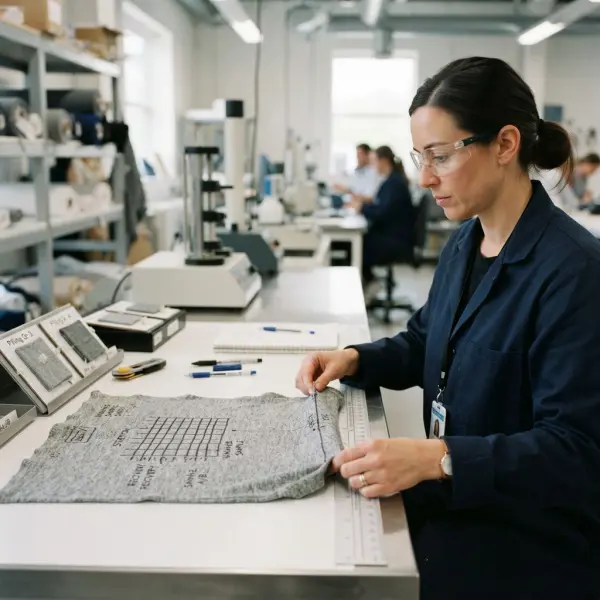
Pills are small balls of entangled fibers attached to the fabric surface. Pilling is not determined by fiber composition alone. It is influenced by fiber dimensions, yarn construction, fabric structure, finishing, laundering, abrasion, and end use.
Synthetic fibers may hold pills on the surface because of their strength, while short or loosely bound fibers may migrate more easily from a fabric. Blends can behave differently from single-fiber materials. Brushed or fuzzy surfaces also require careful evaluation.
ASTM notes that pilling is a complex property affected by fiber, yarn, fabric construction, and finishing. Its Martindale method evaluates surface change against visual standards rather than treating pilling as a simple material label. ns a brand should not ask a supplier, “Does this fabric pill?” as a yes-or-no question. A stronger request is: “What pilling method, sample condition, cycle count, and minimum rating are agreed for this product?”
How Fiber and Yarn Change Knit Fabric Behaviour
The knit structure creates the fabric framework, while the fiber and yarn determine much of its touch, strength, moisture response, surface appearance, thermal behaviour, care requirements, and cost.
Cotton Knits
Cotton is widely used in T-shirts, underwear, polos, babywear, sweatshirts, and casualwear. It can provide softness, absorbency, and familiar skin comfort, but these qualities vary with cotton type, yarn quality, finishing, and construction.
Cotton knits may require particular attention to:
- Shrinkage
- Spirality
- Colorfastness
- Pilling
- Surface hairiness
- Fabric growth
- Drying time
- Batch consistency
Combed yarns generally remove more short fibers than carded yarns, which can contribute to a cleaner surface. Compact or ring-spun yarn systems can also create different appearance and performance characteristics, but no yarn label should replace physical approval and testing.
Polyester and Nylon Knits
Polyester and nylon are widely used in sportswear, swimwear, lingerie, linings, fleece, mesh, and performance products. They can provide strength, dimensional control, quick drying, and compatibility with engineered yarn forms.
Their properties still depend on yarn design. A texturized filament yarn behaves differently from a smooth filament, a spun polyester yarn, or a microfilament construction. Finishing can add moisture-management behaviour, softness, antistatic properties, or surface effects, but claims should correspond to tested performance.
Synthetic knits may also retain oily odors, generate static under certain conditions, or develop persistent pilling. Product use and care expectations should guide the specification.
Viscose and Other Regenerated Cellulosic Knits
Viscose, modal, and lyocell are regenerated cellulosic fibers often selected for softness and fluid drape. In knit form, they can create comfortable tops, dresses, underwear, sleepwear, and loungewear.
Some constructions may grow during wear, become heavy when wet, shrink after laundering, or show weak recovery. Blending with cotton, polyester, nylon, or elastane can modify performance, but each blend introduces new trade-offs.
Terms such as “bamboo fabric” often refer to regenerated cellulose produced from bamboo feedstock rather than mechanically processed bamboo fiber. That distinction is explored in Bamboo Fabric Explained: Properties, Benefits, and Fashion Uses.
Wool and Acrylic Knits
Wool knits can provide insulation, moisture buffering, resilience, and premium handfeel. They are common in sweaters, cardigans, base layers, dresses, accessories, and outerwear components.
Wool performance differs by fiber diameter, yarn system, construction, finishing, and care treatment. Fine wool may feel soft against the skin, while coarser fibers can feel more textured. Felting shrinkage, abrasion, pilling, moth damage, and care requirements must be considered.
Acrylic is often used as a lower-cost alternative or blend component in sweaters. It can provide bulk and color clarity, but may pill, develop static, or feel less comfortable under heat depending on yarn and construction.
Elastane and Elastic Yarns
Elastane is commonly added to improve stretch recovery and fit retention. It may be knitted as bare elastane, covered yarn, core-spun yarn, or another engineered form.
More elastane is not always better. Excessive or poorly controlled stretch can:
- Increase fabric and processing cost
- Complicate dyeing and heat setting
- Create width inconsistency
- Increase cutting tension sensitivity
- Reduce recyclability in some systems
- Produce an overly compressive garment
- Cause premature failure if exposed to unsuitable heat or chemicals
The correct percentage and yarn placement depend on the garment. A loose T-shirt, fitted rib top, sports bra, waistband, and swimwear fabric require different stretch profiles.
Where Knit Fabrics Are Used in Fashion
Knit fabrics support a remarkably broad product range, from low-cost basics to luxury fashion and highly engineered performance garments.
T-Shirts and Everyday Basics
Single jersey and interlock dominate many basic apparel programs because they can provide softness, efficient production, and comfortable movement.
The primary commercial challenge is consistency. A bestseller may be reordered across multiple seasons, factories, dye lots, or countries. Minor changes in yarn, knitting, finishing, or width can alter garment measurements and handfeel even when the composition label remains unchanged.
Brands should retain approved reference standards and compare new production against measurable tolerances rather than relying only on visual similarity.
Underwear, Base Layers, and Body-Fitting Apparel
Rib, jersey, interlock, tricot, and stretch knits are commonly used close to the skin. Here, seam comfort, recovery, moisture behaviour, opacity, softness, and elastic compatibility become particularly important.
A fabric may pass basic stretch evaluation but still fail in wear if it rolls at edges, traps heat, becomes transparent, or loses recovery after washing. Wear trials should simulate movement, sitting, bending, perspiration, and repeated care.
Activewear and Sportswear
Performance knit development may involve polyester, nylon, elastane, mesh, warp knit, seamless knitting, engineered zones, or double-knit constructions.
Commercial claims such as moisture-wicking, cooling, compression, four-way stretch, odor control, or ultraviolet protection require defined test methods and claim substantiation. A supplier’s generic statement should not automatically become consumer-facing marketing copy.
Garment pattern, seam placement, panel orientation, and fit can be as influential as the textile. A high-performance fabric cut in the wrong direction or stretched excessively during sewing may still produce an uncomfortable garment.
Sweaters and Fully Fashioned Knitwear
Sweaters may be cut and sewn from knitted fabric, knitted as shaped panels, or produced through whole-garment and seamless methods.
Fully fashioned production can shape components through knitting rather than cutting them entirely from yardage. This may reduce certain forms of cutting waste and create distinctive construction details, but it requires specialized programming, machinery, yarn control, linking, finishing, and operator expertise.
The commercial advantage depends on order size, design complexity, machine availability, programming time, and quality expectations. It should not be framed as automatically lower-cost or zero-waste.
Sweatshirts, Hoodies, and Loungewear
French terry and brushed fleece are important in comfort-focused apparel. Product success depends on more than softness at the point of sale.
Brands should examine whether:
- The surface pills after laundering
- The brushed back sheds fibers
- Rib trims recover correctly
- The garment shrinks evenly
- Heavy seams become uncomfortable
- The hood or pocket distorts the body
- The fabric weight suits the intended climate
- Color shades remain consistent across body and trim
A soft initial handfeel can be created through finishing, but the more commercially relevant question is how the material performs after repeated use and care.
Structured Dresses, Trousers, and Jackets
Ponte, Milano rib, interlock, and other double knits can support garments that need more body than lightweight jersey.
These fabrics may help designers combine a cleaner silhouette with comfort, but structured knit garments still need disciplined pattern cutting. Uncontrolled negative ease, heavy pockets, unsupported waistlines, or unsuitable seam allowances can lead to sagging and distortion.
Good fit remains a garment-system issue involving fabric, pattern, construction, grading, and customer body variation. This relationship is discussed further in Garment Fit Explained: Why Good Fit Matters in Fashion.
Lingerie, Lace, and Mesh
Warp-knitted tricot and Raschel structures are common in intimate apparel, lace, net, and mesh. These materials may need specialized needles, stretch lace seams, elastic application, lining, reinforcement, or bonding.
Decorative openwork should be evaluated for snagging, edge stability, transparency, seam strength, and abrasion against hardware. A lace that looks refined in a sample book may not survive repeated contact with hooks, zippers, bags, or rough surfaces.
What Knit Fabrics Mean for Fashion Businesses
The commercial value of knit fabric lies in its ability to connect comfort, fit, visual identity, production efficiency, and customer expectations. The same flexibility that makes knits attractive also introduces variability that must be managed.
Sourcing Implications
A sourcing team should request more than a hanger swatch and a composition statement. At minimum, the technical file should identify:
- Knit construction
- Fiber composition
- Yarn description where relevant
- Finished fabric weight and tolerance
- Finished width and usable width
- Stretch and recovery
- Dimensional stability
- Spirality or skew
- Pilling and abrasion
- Colorfastness
- Shade tolerance
- Finishing process
- Care requirements
- Restricted-substance compliance
- Minimum order and lead time
- Continuity or repeat-order availability
Specifications should distinguish between greige and finished fabric values. Wet processing, heat setting, brushing, washing, compacting, coating, and printing can materially alter the final textile.
Product Development Implications
Designers should select knit fabric alongside pattern development, not after the silhouette has been finalized.
The development sequence should include:
- Define the garment’s movement, fit, opacity, climate, and care requirements.
- Select candidate structures and fiber systems.
- Measure stretch, recovery, weight, width, and dimensional change.
- Develop the pattern using actual tested values.
- Sew prototypes with production-representative machines and threads.
- Conduct laundering and wear trials.
- Revise fabric, pattern, or construction before bulk approval.
This sequence reduces the risk of forcing a fabric into a design for which it was never suitable.
Manufacturing Implications
Knit fabrics may stretch, curl, relax, or distort during spreading and sewing. Production controls may include:
- Relaxation before cutting
- Low-tension spreading
- Accurate lay height
- Directional cutting control
- Ballpoint or stretch needles where appropriate
- Differential feed adjustment
- Overlock, coverstitch, flatlock, or stretch-compatible seams
- Controlled pressing temperature
- Stabilization at shoulders, necklines, openings, or zippers
- In-line measurement after key operations
Seam choice should correspond to fabric extensibility and garment use. A rigid seam on a highly extensible area may break even when the fabric itself remains intact. Conversely, an unnecessarily bulky stretch seam may reduce comfort or create visible ridges.




Comments 0
Leave a CommentSend Comment
Anda harus Login terlebih dahulu untuk dapat memberikan komentar.