

Garment Costing Explained for Fashion Brands
Quick Answer
Garment costing is the process of calculating how much it costs to develop, produce, pack, ship, and sell a garment before setting its selling price. For fashion brands, it is not just an accounting task. It is a commercial decision-making tool that connects design, material selection, production method, supplier negotiation, pricing, and margin control.
A basic garment cost includes materials, trims, labor, factory charges, packaging, freight, duties, overhead allocation, and margin. The final number depends on garment complexity, order quantity, fabric consumption, production location, quality requirements, and the selling model used by the brand. A direct-to-consumer brand, for example, may calculate margins differently from a wholesale brand selling to retailers.
The biggest value of garment costing is clarity. It helps a fashion brand understand whether a product can be produced profitably at the intended price point. Without proper costing, a design may look commercially attractive but quietly lose money after sampling, rework, shipping, markdowns, or small-batch inefficiencies are included.

What Is Garment Costing?
Garment costing is a structured calculation method used to estimate the total cost of making a garment so a fashion business can decide whether the product is commercially viable. It connects product design with production reality: the fabric chosen, the trims required, the sewing operations involved, the factory capacity needed, the packaging standard, the shipping method, and the target margin.
In simple terms, garment costing answers one business question: can this garment be made, delivered, and sold at a price that protects the brand’s profit?
That sounds straightforward until a brand starts working with real samples. A blouse with a delicate ruffle, lining, covered buttons, and narrow finishing may look similar to a simpler blouse in a product sketch. In costing terms, the two products are very different. The first may need more fabric, more sewing time, more quality control, more pressing, and a higher rejection allowance. Costing forces those differences into the open before the brand commits to production.
A practical garment cost sheet usually includes direct costs and allocated business costs. Direct costs are tied clearly to the garment itself, such as fabric, trims, labels, cut-make-trim charges, printing, embroidery, washing, packing, and freight. Allocated costs include product development, overhead, marketing, platform fees, returns allowance, staff time, and sometimes financing cost. Not every brand includes every item in the same way, but the logic should be consistent.
For export-oriented apparel businesses, costing should also be aligned with trade terms. The International Chamber of Commerce’s Incoterms® 2020 explain how responsibilities for cost, risk, freight, and insurance are allocated between buyer and seller in international transactions. This matters because a FOB price, landed cost, and delivered price can represent very different commercial responsibilities.
Why Garment Costing Matters for Fashion Brands
Garment costing matters because fashion margins are rarely protected by creativity alone. A strong design can still fail commercially if the production cost is too high for the intended retail price, if the order quantity is too low for the chosen construction, or if hidden costs appear after the selling price has already been announced.
For a small fashion brand, this often happens during the transition from sample to production. A prototype may be approved based on its look, but once the brand requests real production quotes, the factory may reveal that the garment needs more complicated sewing operations, higher minimum fabric purchase, special fusing, additional pressing, or longer finishing time. If the brand has already positioned the product at a low price point, there may be little room left to adjust.
Costing protects decision-making at several levels:
- It helps designers understand the commercial effect of design details.
- It allows sourcing teams to compare supplier quotations more fairly.
- It gives founders and merchandisers a clearer view of margin before committing to inventory.
- It helps production teams identify which parts of the garment create cost pressure.
- It gives retail and marketing teams a more realistic basis for pricing, discounting, and promotion.
The main point is not to make every product cheap. Premium garments can and often should cost more to produce when the material, construction, fit, finish, and brand positioning justify it. The danger is not high cost by itself. The danger is unclear cost.
The Main Components of Garment Costing
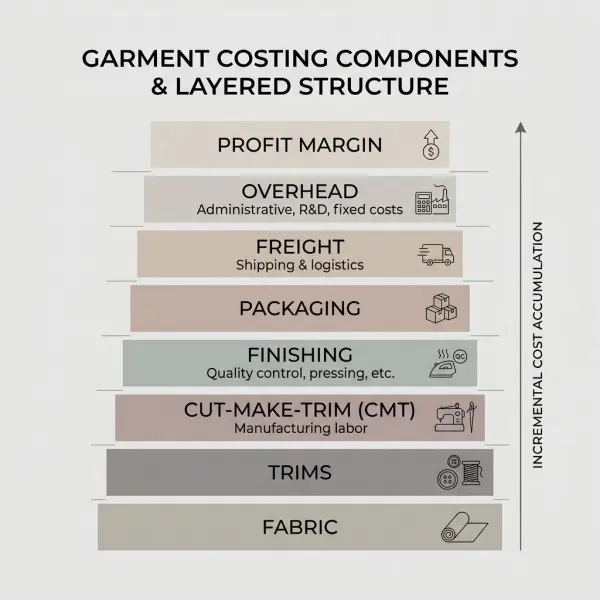
A garment cost is built from several layers. Some are visible to customers, such as fabric quality or decorative trims. Others are hidden inside the production system, such as cutting efficiency, machine time, packing materials, supplier margin, inspection cost, freight, and administrative overhead.
A simple cost sheet usually begins with the product specification. This includes the garment type, style code, size range, fabric type, colorways, trims, order quantity, construction details, packaging requirements, and delivery terms. Without this information, the cost is only a rough estimate.
The core cost components usually include:
|
Cost Component |
What It Means |
Why It Matters |
|
Fabric |
Main material used for the garment |
Often one of the largest cost drivers, especially for fabric-heavy styles |
|
Trims |
Buttons, zippers, elastics, labels, thread, linings, interlinings, drawcords, snaps, and other components |
Small items can become significant across large quantities |
|
Cut, make, trim |
Factory charge for cutting, sewing, finishing, and sometimes basic trims handling |
Reflects labor time, machine use, efficiency, and factory margin |
|
Printing, embroidery, washing, or special finishes |
Additional processes after or during garment production |
Can affect cost, lead time, quality risk, and minimum order quantity |
|
Packaging |
Polybags, hangtags, cartons, tissue, inserts, stickers, and barcode labels |
Important for retail presentation, logistics, and compliance |
|
Freight and duties |
Transport, customs duties, taxes, insurance, and destination handling |
Especially important for international sourcing and landed cost |
|
Development and overhead |
Sampling, pattern work, fit sessions, admin, rent, software, salaries, marketing, and operational support |
Often underestimated by small brands |
|
Profit margin |
The margin required for the business to survive and grow |
Determines whether the product is commercially viable |
This table simplifies the structure, but it shows why garment costing is not just a supplier quote. A factory may quote the sewing cost, but the brand still needs to understand the full commercial cost from product idea to customer delivery.
How Garment Costing Works in Practice
Garment costing usually begins before production, not after. The ideal process starts when a product concept is being developed, because design decisions made early can affect cost dramatically. A pocket, lining, pleat, contrast panel, special wash, hidden zipper, or custom hardware may look small in the design room but add measurable cost in production.
A practical costing workflow often follows this sequence:
- Define the garment specification clearly.
- Estimate fabric consumption based on pattern, size range, and marker efficiency.
- List all trims, labels, packaging, and finishing requirements.
- Estimate or request cut-make-trim cost from the manufacturer.
- Add freight, duties, inspection, and handling where relevant.
- Allocate development, overhead, marketing, and business operating costs.
- Add required profit margin.
- Compare the final cost with the target wholesale or retail price.
This workflow helps a brand avoid one of the most common early-stage mistakes: designing first, costing later. When costing enters too late, the brand may be forced to remove design details, downgrade materials, raise prices unexpectedly, or accept a weaker margin.
A better approach is target costing. In target costing, the brand starts with the intended retail price, target margin, and selling model, then works backward to define the maximum allowable production cost. This is especially useful for brands with clear price architecture, such as entry-level T-shirts, mid-range dresses, premium outerwear, or capsule collections.
For example, if a direct-to-consumer brand wants to sell a dress at $120, it cannot simply approve a $70 landed cost and hope the product works. The brand still needs room for payment processing, marketing, return handling, warehousing, customer service, discounts, unsold inventory risk, and profit. The acceptable product cost may be far lower depending on the business model.

Costing Is Different From Pricing
Costing and pricing are closely connected, but they are not the same. Costing calculates what a garment costs the business. Pricing decides what the customer or retailer will pay.
This distinction matters because a product can be accurately costed but poorly priced. A garment may cost $20 to produce, but whether it should sell for $45, $80, or $160 depends on brand positioning, channel strategy, perceived value, competitor pricing, customer expectations, and margin requirements.
Cost-plus pricing is the simplest model. The brand calculates total cost and adds a markup. This can work for basic products, private label orders, or wholesale environments where margins are predictable. But fashion pricing often needs more nuance. A strong brand may be able to command a higher price because of design, fit, storytelling, retail experience, exclusivity, or customer loyalty. A new brand with limited awareness may need sharper pricing to reduce purchase hesitation.
The safer approach is to use costing as a boundary, not as the only pricing tool. Costing tells the brand the minimum commercial reality. Pricing tells the brand what the market may accept.
Costing answers internal questions
Garment costing is mainly an internal business tool. It helps teams answer:
- Can we produce this garment within the target cost?
- Which design details create the biggest cost pressure?
- Does this supplier quote make sense?
- What happens to margin if order quantity changes?
- Can we afford markdowns or wholesale discounts?
- Is the product worth keeping in the collection?
These questions are operational. They help the business avoid margin surprises before production begins.
Pricing answers market questions
Pricing, by contrast, connects the product to the customer and sales channel. It asks whether the perceived value is strong enough for the price. A premium linen shirt, for instance, may justify a higher price if the fabric quality, fit, finishing, and brand presentation support the claim. But if the product looks similar to cheaper alternatives and the brand has weak differentiation, the market may resist the price even when the cost sheet is technically correct.
This is why costing should be done with merchandising and brand strategy in mind. The numbers need commercial context.
The Difference Between Estimated Cost, Quoted Cost, and Actual Cost
Fashion brands should distinguish between estimated cost, quoted cost, and actual cost. These numbers may look similar in a spreadsheet, but they serve different purposes.
Estimated cost is the brand’s internal projection before receiving full supplier confirmation. Quoted cost is the price offered by a supplier or manufacturer based on the product details provided. Actual cost is what the garment truly costs after production, shipping, inspection, and adjustments are completed.
|
Cost Type |
When It Is Used |
Practical Risk |
|
Estimated cost |
Early product development and range planning |
May miss construction complexity or real supplier constraints |
|
Quoted cost |
Supplier negotiation and production approval |
May exclude hidden charges, freight, duties, or later changes |
|
Actual cost |
Post-production margin review |
May reveal losses after it is too late to adjust retail price |
A disciplined brand compares all three. If the estimated cost is always lower than the quoted cost, the design or merchandising team may be underestimating production complexity. If the quoted cost is consistently lower than the actual cost, the brand may be missing freight, rework, inspection, exchange-rate movement, or last-minute changes.
This comparison is especially valuable over time. After several production cycles, the brand can identify patterns: which product categories are profitable, which factories quote reliably, which materials create unexpected waste, and which design details repeatedly create cost overruns.
Where Garment Costing Fits in the Product Development Cycle
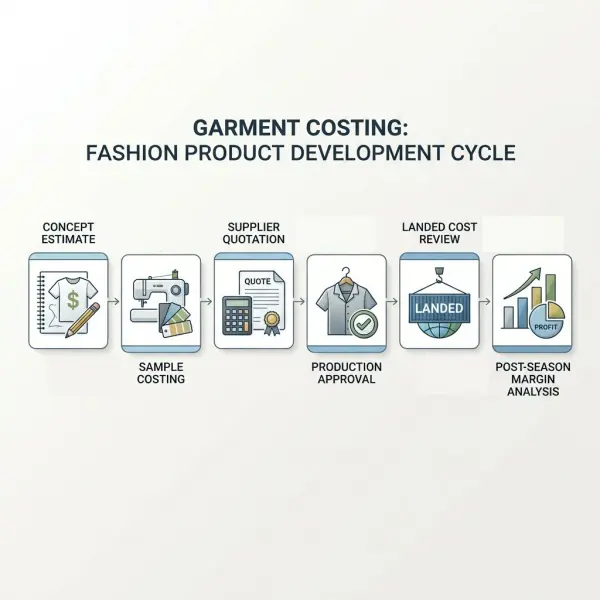
Garment costing should not be treated as a one-time calculation at the end of development. It should evolve as the product moves from concept to sample, from sample to production, and from production to post-season review.
At concept stage, costing is rough. The brand may use assumptions based on similar products, expected fabric type, target supplier, and price architecture. This early estimate helps the team decide whether the idea belongs in the collection.
At sample stage, costing becomes more specific. The pattern, fabric consumption, trims, sewing operations, finishing, and packaging become clearer. This is where the brand should identify whether the product needs simplification, better sourcing, or a price adjustment.
At production stage, costing should be confirmed against the final purchase order, approved sample, size breakdown, color quantities, shipping terms, and quality standards. Any change at this stage can affect margin. A late fabric substitution, added lining, revised packaging, or extra inspection requirement may seem small, but it can shift cost across the full order.
After selling, the brand should compare expected margin with actual margin. This is where costing becomes a learning system, not just a spreadsheet.
Why Small Fashion Brands Often Underestimate Garment Costs
Small fashion brands often underestimate garment costs because they focus on visible production costs and miss the costs that sit around the product. Fabric and sewing may be counted, but sampling, failed prototypes, photoshoots, packaging, platform fees, returns, storage, taxes, and markdowns are sometimes treated as separate business problems.
That separation can be dangerous. If a garment is sold through e-commerce, the brand may pay for payment processing, warehousing, fulfillment, packaging, customer service, returns, advertising, and unsold inventory. If the garment is sold wholesale, the brand may need to offer a lower wholesale price while still carrying development and production risk. If the garment is sold through marketplaces, commissions and promotional discounts can reduce margin further.
The mistake is not always caused by poor financial knowledge. Often it comes from growth pressure. A founder wants to launch faster, meet a buyer request, or hit a target price. The costing sheet becomes optimistic because the business wants the product to work.
A realistic costing process gives the team permission to make difficult decisions earlier. The brand may decide to remove a costly detail, increase order quantity, change supplier, simplify packaging, reposition the product, or cancel the style. Canceling an unprofitable style before production is not a failure. In many cases, it is good merchandising discipline.
How Order Quantity Affects Garment Cost
Order quantity affects garment cost because many costs behave differently at different production volumes. Fabric may have minimum order quantities. Trims may require bulk purchase. Factories may charge more for small orders because setup time, line planning, cutting, and administration are spread across fewer units.
A 50-piece order and a 5,000-piece order do not simply differ by scale. They often operate under different production economics. Small orders may be suitable for testing demand, limited drops, made-to-order models, or premium niche products. Large orders may reduce unit cost, but they increase inventory risk if demand is uncertain.
This is where fashion brands need to separate unit cost from business risk. A larger order may reduce the cost per garment, but it can still be financially dangerous if the brand cannot sell through the inventory at the planned price. Lower unit cost does not automatically mean better business.
For emerging brands, a slightly higher unit cost may be acceptable when it reduces stock risk, supports controlled testing, or allows better cash flow. For established brands with predictable demand, larger production runs may make more sense. The right answer depends on sell-through confidence, working capital, supplier capability, and the product’s role in the collection.
Garment Costing and Supplier Negotiation
Garment costing helps brands negotiate with suppliers more intelligently. Without a cost breakdown, negotiation often becomes a blunt request for a lower price. That may create tension, reduce quality, or push the supplier to cut corners.
A better negotiation starts with understanding the cost structure. If fabric accounts for most of the cost, pressuring the sewing price may not solve the problem. If the garment has complex construction, changing the design may be more effective than demanding a discount. If packaging is expensive, the brand may be able to simplify presentation without affecting product quality.
Suppliers also need accurate information. A vague tech pack or incomplete specification can lead to unreliable quotes. The factory may protect itself by quoting high, or worse, quote low and add charges later. Clear specifications reduce confusion and help both parties make better decisions.
A brand should usually provide:
- Technical sketch or reference sample
- Fabric type, weight, width, and composition if known
- Size range and size breakdown
- Construction details
- Trim and label requirements
- Colorways and order quantity
- Packaging expectations
- Testing, inspection, or compliance requirements
- Delivery terms and shipment expectations
The more precise the information, the more useful the quote. This does not mean the brand must know everything from day one, but it should update the costing sheet as product details become clearer.
For international production, trade rules can also influence final cost. The World Trade Organization explains that rules of origin determine the national source of a product, which can affect duties and restrictions in some import scenarios. Brands sourcing across borders should verify applicable origin rules instead of assuming that country of sewing alone tells the whole cost story.
Garment Costing for Different Fashion Business Models
Garment costing changes depending on how the brand sells. The cost sheet for a wholesale brand, direct-to-consumer label, private label supplier, or made-to-order studio may use the same basic cost categories, but the margin logic can differ significantly.
A direct-to-consumer brand usually controls retail price but carries more responsibility for marketing, fulfillment, returns, customer service, and digital operations. A wholesale brand may sell larger quantities to retailers but at a lower wholesale price, which means the costing must leave enough margin for both the brand and the retailer. A private label manufacturer may work on tighter margins but more predictable orders. A made-to-order brand may avoid inventory risk but carry higher unit labor and operational handling costs.
|
Business Model |
Costing Priority |
Margin Challenge |
|
Direct-to-consumer brand |
Landed cost, fulfillment, marketing, returns, and retail margin |
High customer acquisition and operational costs can reduce profit |
|
Wholesale brand |
Production cost, wholesale price, retailer margin, delivery reliability |
Lower selling price requires disciplined product costing |
|
Private label supplier |
Efficient production, buyer specification, bulk order economics |
Competitive pricing and factory efficiency are critical |
|
Made-to-order brand |
Labor time, customization, small-batch material sourcing |
Higher unit cost must be justified by personalization or exclusivity |
|
Premium designer label |
Material quality, craftsmanship, finishing, brand value |
Cost must support perceived value and product credibility |
This is why copying another brand’s markup formula can be risky. Two brands may sell similar garments but have very different cost structures, channels, return rates, marketing expenses, and customer expectations.
The Role of Fabric, Labor, and Overhead in Costing
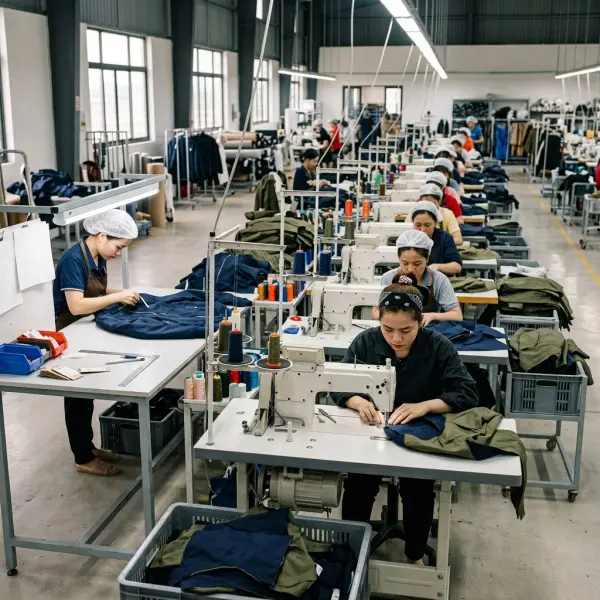
Fabric, labor, and overhead are three of the most important cost categories in apparel, but they should not be treated as isolated numbers. Fabric affects cutting efficiency, sewing difficulty, defect risk, shrinkage, pressing, care instructions, and customer perception. Labor depends on garment construction, operator skill, line efficiency, wage conditions, and production location. Overhead reflects the business system that supports the garment, from factory administration to brand marketing and product development.
This article focuses on the full costing framework. A deeper breakdown of these three drivers belongs in the next article: how fabric, labor, and overhead affect apparel costs.
For now, the important point is this: fabric, labor, and overhead interact. A cheaper fabric may create more cutting waste or quality complaints. A complex design may increase labor time. A small brand may have higher overhead per unit because development and marketing costs are spread across fewer pieces.
Labor-related costing should also be handled responsibly. The International Labour Organization has documented employment, wages, and productivity issues in the Asian garment sector, including persistent decent work challenges. Fashion brands should be careful not to treat labor only as a negotiable cost line without considering compliance, supplier stability, and responsible sourcing expectations.
How to Build a Basic Garment Cost Sheet
A garment cost sheet should be clear enough for business decisions and detailed enough to avoid margin surprises. It does not need to be overly complicated at the beginning, but it should be consistent.
A basic garment cost sheet may include these sections:
- Product information: style code, category, season, size range, colorways, order quantity.
- Material cost: fabric, lining, interlining, trims, thread, labels, packaging.
- Manufacturing cost: cutting, sewing, finishing, pressing, washing, printing, embroidery, quality control.
- Logistics cost: freight, insurance, duties, customs handling, local delivery.
- Business allocation: sampling, pattern making, overhead, marketing, warehousing, returns allowance.
- Selling structure: wholesale price, retail price, target margin, markdown allowance.
The most useful cost sheets are not only calculators. They also capture assumptions. For example, the sheet should note whether fabric consumption is based on sample measurement or marker calculation, whether freight is estimated or confirmed, whether duties are included, and whether the price is FOB, CIF, landed, or delivered.
This matters because a number without context can mislead the team. A jacket that “costs $35” may mean $35 ex-factory, $35 FOB, or $35 landed in the destination warehouse. Those are not the same commercial reality.
A simple garment costing formula
A simplified formula can help teams understand the structure:
Total garment cost = materials + trims + manufacturing + finishing + packaging + logistics + duties + allocated overhead
Selling price should then be evaluated against:
Required selling price = total garment cost + required margin + channel-related costs
This formula is not universal, but it gives brands a practical starting point. The key is to define what each cost includes and apply the same logic consistently across products.
Costing Example: A Simple Woven Shirt
Consider a small fashion brand developing a woven cotton shirt. The garment uses main fabric, fusible interlining for the collar and cuffs, buttons, thread, care label, brand label, hangtag, polybag, and carton packing. It requires cutting, sewing, buttonholing, pressing, inspection, and packing.
At first glance, the brand may focus only on fabric and sewing. But a more realistic cost sheet would include:
|
Cost Item |
Example Consideration |
|
Main fabric |
Consumption per garment, fabric width, shrinkage, waste allowance |
|
Interlining |
Collar, cuffs, placket structure |
|
Buttons |
Quantity per shirt, spare button, quality level |
|
Labels and hangtags |
Brand label, care label, size label, barcode or retail tag |
|
Sewing cost |
Number of operations, seam type, collar construction, buttonholes |
|
Pressing and inspection |
Final appearance and quality control |
|
Packaging |
Folding, tissue, polybag, carton, retailer requirement |
|
Freight and duty |
Depends on sourcing country, delivery terms, and destination |
|
Overhead allocation |
Sampling, pattern work, admin, marketing, and operational costs |
This example shows why two shirts with similar photos can have very different cost structures. A basic shirt with simple seams and standard buttons will not cost the same as a premium shirt with high-density fabric, refined collar construction, mother-of-pearl buttons, special finishing, and strict measurement tolerance.
What Brands Should Verify Before Approving a Cost
Before approving a garment cost, fashion brands should verify what the number actually includes. Many costing problems come from comparing incomplete numbers. One supplier may quote only cut-make-trim. Another may include trims and packing. A third may quote FOB. A fourth may include delivery to warehouse. These prices cannot be compared fairly unless the scope is clear.
The approval process should check both cost and assumptions. A low quote may be attractive, but if it excludes important items, depends on unrealistic fabric consumption, or assumes a larger order quantity than the brand can commit to, it may not be useful.
Brands should verify:
- Does the quote include fabric, trims, labels, and packaging?
- Is the fabric cost based on confirmed price or estimate?
- Is fabric consumption based on pattern marker, sample measurement, or supplier assumption?
- Are cutting waste, shrinkage, and defect allowance included?
- Does the manufacturing cost include finishing, pressing, and inspection?
- Are printing, embroidery, washing, or special processes included?
- What Incoterm or delivery basis is being used?
- Are freight, duties, insurance, and destination charges included?
- Does the quote depend on a minimum order quantity?
- What happens if size ratio, color count, or delivery date changes?
This verification step is not bureaucracy. It is margin protection. It helps prevent situations where a product appears profitable during development but becomes weak once real production and delivery costs are included.

Common Misconceptions About Garment Costing
One common misconception is that garment costing is mainly about getting the lowest supplier price. In reality, strong costing is about understanding cost behavior. A low price is not useful if it causes quality failures, late delivery, poor fit consistency, or weak supplier relationships.
Another misconception is that a standard markup solves everything. Markup is only meaningful when the cost base is complete. If a brand applies markup to an incomplete cost, the selling price may still be too low. This is especially risky when freight, returns, marketing, platform commissions, and markdowns are excluded from the calculation.
A third misconception is that costing only belongs to the finance team. In apparel, costing is cross-functional. Designers influence cost through silhouette, construction, fabric, and trims. Merchandisers influence cost through range architecture and target price. Sourcing teams influence cost through supplier choice and negotiation. Production teams influence cost through efficiency and quality control. Marketing and retail teams influence cost through channel expenses and promotion strategy.
The deeper costing errors that reduce profitability deserve their own discussion, especially because they often appear after a brand has already scaled. That topic continues in common costing errors that reduce fashion profitability.
How Garment Costing Supports Better Product Strategy
Good garment costing helps brands decide which products deserve space in a collection. Not every attractive design deserves production. Some styles are brand-building pieces with lower margin but strong visual impact. Others are commercial core products that must deliver reliable profit. Some may be useful for customer acquisition, while others should be removed because they consume too much development time for too little return.
Costing gives the brand a way to see these roles clearly. A product with a lower margin may still be justified if it creates editorial value, supports a campaign, or completes a collection story. But that decision should be conscious. The problem begins when every product is treated as equally strategic while only a few carry the business financially.
For fashion brands, a practical product strategy may classify styles into:
- Core profit products with stable demand and controlled cost
- Seasonal statement pieces that support brand identity
- Entry-price products that attract new customers
- Premium products that justify higher craftsmanship or material cost
- Test products used to explore demand before scaling
This classification helps teams avoid judging every garment only by unit cost. A high-cost piece can be valuable if it supports the right strategy. A low-cost piece can still be harmful if it damages brand perception, creates returns, or fails to sell.
Practical Steps for Fashion Brands
Fashion brands can apply garment costing more effectively by making it part of routine product development, not a last-minute approval step. The goal is to create a repeatable costing discipline that supports design, sourcing, pricing, and margin management.
A practical starting point is to build a simple cost sheet template and use it for every style. The template should be consistent across categories but flexible enough to handle different garment types. A T-shirt, tailored jacket, evening dress, and activewear legging will not have identical cost structures, but the brand should still use the same costing logic.
Brands can strengthen the process through a few habits:
- Set target cost before sampling begins.
- Review cost after first sample, fit sample, and final pre-production sample.
- Compare supplier quotes using the same cost scope.
- Track estimated cost, quoted cost, and actual cost separately.
- Build a cost history by category, supplier, and season.
- Review margin after the selling season, not only before production.
- Keep costing connected to pricing, merchandising, and inventory planning.
The operational benefit grows over time. After several seasons, the brand can estimate new products more accurately, negotiate with suppliers more confidently, and identify which categories deserve investment.
Garment costing also connects naturally with broader operational planning. Production timelines, supplier capacity, and order quantities can affect cost as much as the design itself. Brands that want a stronger production workflow may also benefit from reviewing apparel production planning for manufacturers, especially when scaling from small batches to more structured production.
Responsible Costing and Supply Chain Reality
Garment costing should not be used only to push costs downward. Fashion supply chains involve real workers, factories, compliance obligations, environmental constraints, and operational risk. A brand that demands unrealistic prices may receive lower quality, hidden subcontracting, missed deadlines, or weaker supplier commitment.
Responsible costing does not mean accepting any price without negotiation. It means understanding what the price represents. If a supplier quote is significantly lower than others, the brand should ask why. Is the factory more efficient? Is the fabric cheaper? Are trims excluded? Is labor being underpriced? Are compliance costs missing? Is quality control reduced?
The OECD’s Due Diligence Guidance for Responsible Supply Chains in the Garment and Footwear Sector encourages enterprises to identify, prevent, mitigate, and account for potential adverse impacts in garment and footwear supply chains. Costing cannot replace due diligence, but it can help brands ask more informed questions about how a price is achieved.
A commercially strong brand does not need to choose between margin discipline and responsible sourcing. It needs a costing system that makes trade-offs visible. Better visibility supports better decisions.

Important Technical Caveats
Garment costing is useful, but it is not perfectly fixed. Costs can change because of fabric price movement, exchange rates, freight conditions, supplier capacity, order quantity changes, quality issues, and last-minute product revisions. A cost sheet should therefore be treated as a controlled estimate until production and delivery are complete.
Brands should also avoid assuming that one costing formula works across all categories. Knitwear, denim, tailoring, lingerie, activewear, outerwear, footwear, and accessories can have very different costing structures. Denim may include washing and finishing complexity. Tailoring may involve interlining, pressing, and skilled sewing. Activewear may involve performance fabrics, elastics, bonding, or testing. A simple template may need category-specific adjustments.
Currency is another caveat. Brands sourcing internationally may quote in one currency, sell in another, and pay expenses in a third. Exchange-rate movement can affect margin, especially when production lead times are long.
Finally, costing is only as accurate as the input data. Incomplete tech packs, vague fabric specifications, uncertain order quantities, or unclear shipping terms will produce unreliable costs. The solution is not a more complicated spreadsheet. The solution is better product data and disciplined updates.
FAQ
What is garment costing in simple terms?
Garment costing is the process of calculating the total cost required to make and deliver a garment before deciding its selling price. It usually includes fabric, trims, sewing, finishing, packaging, freight, duties, overhead, and margin. For fashion brands, garment costing helps determine whether a product can be sold profitably at the intended price point. A good costing sheet does not only show numbers; it also shows assumptions such as order quantity, delivery terms, fabric consumption, and production method.
What is the difference between garment costing and apparel pricing?
Garment costing calculates the internal cost of producing and delivering a garment. Apparel pricing decides what the buyer or customer will pay. Costing is based on materials, labor, overhead, logistics, and margin needs. Pricing also considers brand positioning, sales channel, customer perception, competitor prices, and retail strategy. A garment can be costed correctly but still priced poorly if the market does not accept the price or if the selling channel requires higher margins.
What should be included in a garment cost sheet?
A garment cost sheet should include product details, fabric consumption, fabric price, trims, labels, thread, manufacturing cost, printing or embroidery, washing or finishing, packaging, quality control, freight, duties, overhead allocation, and target margin. For better accuracy, the sheet should also state whether the cost is estimated, quoted, or actual. It should identify the delivery basis, order quantity, currency, and any assumptions that affect the final number.
Why does garment cost change after sampling?
Garment cost often changes after sampling because the sample reveals construction details that were unclear in the original design. The pattern may require more fabric than expected, the sewing may be more complex, trims may need upgrading, or the fit adjustment may add panels, lining, or finishing steps. Supplier quotes may also change when order quantity, color count, size range, or delivery requirements become clearer. This is why brands should update costing at every major development stage.
Is a lower garment cost always better?
A lower garment cost is not always better. It may improve margin if quality, delivery, compliance, and customer expectations remain intact. But if the lower cost comes from poor fabric, weak construction, rushed production, underpriced labor, or excluded charges, it can create bigger losses through returns, markdowns, delays, or brand damage. The better goal is not the cheapest cost, but the right cost for the product’s quality level, price point, and business model.
How can a fashion startup start garment costing with limited experience?
A fashion startup can start by creating a simple spreadsheet with fabric, trims, manufacturing, packaging, freight, overhead, and target margin. The brand should cost every style, even small batches, and compare estimated cost with supplier quotes and final actual cost. Over time, this creates a useful cost history. Startups should also ask suppliers to clarify what each quote includes, because an incomplete low quote can be more dangerous than a higher but transparent quote.
How often should garment costing be reviewed?
Garment costing should be reviewed at concept stage, after first sample, before production approval, after shipment, and after the selling season. Early reviews help guide design and supplier decisions. Production reviews protect margin before orders are placed. Post-season reviews show whether the product performed as expected after markdowns, returns, freight, and operational costs. Brands that review costing only once often miss the gap between planned margin and actual profit.
Conclusion
Garment costing is one of the most practical disciplines a fashion brand can build. It turns design ambition into commercial reality by showing what a product truly requires in materials, labor, production, logistics, overhead, and margin.
The value is not only in calculating a number. The value is in making better decisions earlier. A strong costing process helps brands choose the right materials, negotiate with suppliers more clearly, protect margins, price products more realistically, and understand which styles deserve investment.
For growing fashion brands, costing becomes even more important as product ranges expand and supply chains become more complex. A small error repeated across many styles can quietly reduce profitability. A disciplined costing system, by contrast, gives the brand a clearer view of risk, value, and commercial potential.
Good costing does not limit creativity. It gives creativity a stronger business foundation.





Comments 0
Leave a CommentSend Comment
Anda harus Login terlebih dahulu untuk dapat memberikan komentar.