

Fashion Consignment Business Explained for Retailers and Designers
Fashion consignment offers an alternative way for clothing brands, independent designers, and retailers to work together without following the conventional buy-and-resell model. Rather than purchasing every garment before it reaches the sales floor, a retailer can display and sell selected products on behalf of their owner, sharing the proceeds when a customer makes a purchase.
For emerging fashion labels, this arrangement can provide access to established boutiques and new customer segments. For retailers, it creates opportunities to introduce distinctive collections without committing the same upfront purchasing capital required by traditional stock ownership. The commercial appeal is clear, but the arrangement also introduces questions about inventory responsibility, pricing authority, commissions, and payment timing.
Understanding how fashion consignment works requires looking beyond the retail display. The business model depends on how the retailer and product owner coordinate stock, sales, customer service, and financial accountability.
Quick Answer: What Is a Fashion Consignment Business?
A fashion consignment business is a retail arrangement in which a clothing brand, designer, or individual product owner places merchandise with a retailer to sell on their behalf. The product owner, known as the consignor, generally retains ownership until the merchandise is sold or another agreed event transfers control. The retailer, known as the consignee, manages the selling process and receives an agreed commission or share of the sale proceeds.
Unlike a conventional wholesale transaction, the retailer does not typically purchase consigned garments when they arrive. Payment to the consignor is instead triggered by qualifying sales and settled according to the contract.
This model can be used for new designer collections, independent fashion labels, vintage apparel, luxury resale, and selected accessories. However, new-product consignment and secondhand consignment can involve different operational requirements, particularly around product condition, authenticity, and customer expectations.
The central business trade-off is straightforward: retailers can reduce upfront inventory investment, while designers gain retail distribution opportunities but continue carrying much of the unsold-stock and delayed-payment risk. Successful consignment therefore depends on transparent agreements, reliable inventory records, suitable product selection, and realistic expectations about sales performance.
What Is a Fashion Consignment Business?
Fashion consignment is a distribution and retail business model built around the separation of product ownership from retail selling responsibility. One business supplies the merchandise, while another provides a retail environment, customer access, and sales services.
In a typical arrangement, an independent designer delivers a selection of dresses, blouses, or accessories to a multi-brand boutique. The boutique displays the pieces alongside other collections, explains the products to customers, processes purchases, and periodically reports completed sales. The designer receives the agreed portion of those sales, while unsold merchandise remains subject to the contract's return or withdrawal provisions.
Consignment does not necessarily involve secondhand clothing. It can also support the distribution of newly manufactured apparel, especially where independent brands want to test physical retail demand without securing large wholesale orders. The commercial structure is similar, although the product sourcing and selling requirements may differ.
The Two Main Parties in a Consignment Arrangement
The consignor is the person or business supplying merchandise for sale. In fashion, this may be a clothing designer, apparel brand, accessory producer, luxury goods owner, or individual seller of pre-owned garments.
The consignee is the retailer or selling intermediary accepting the merchandise. This may be an independent boutique, department store concession operator, specialist resale shop, or online consignment business.
Their responsibilities are complementary but not identical. The consignor generally supplies eligible products and maintains ownership under the agreed terms. The consignee provides sales execution, merchandising, and customer-facing retail services. Both parties need reliable information about what was delivered, what sold, what remains, and what amount is owed.

Where Fashion Consignment Is Commonly Used
Consignment can serve several fashion retail categories, although the reasons for adopting it are not always the same.
An emerging ready-to-wear brand may place a limited collection in a local boutique to evaluate demand. A designer producing occasionwear may use consignment to reach customers who prefer trying garments before purchasing. An accessories label might work with a lifestyle store to introduce a small selection of handbags or jewelry.
Secondhand and luxury resale businesses may also operate on consignment, accepting previously owned products and selling them for a share of the final price. In those cases, the retailer may need additional processes for condition grading, authenticity checks, provenance records, or handling one-of-a-kind inventory.
These applications share the same underlying principle, but each requires its own merchandising, pricing, and risk-management approach.
How Does Fashion Consignment Work?
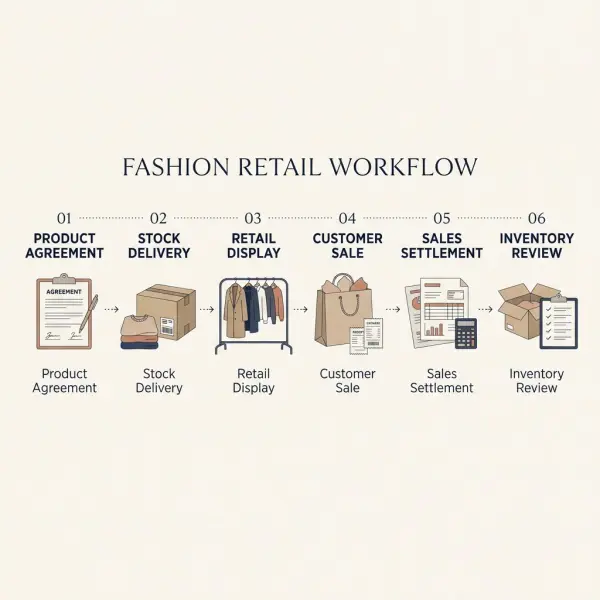
A fashion consignment arrangement usually follows a sequence of product selection, stock delivery, retail selling, sales reconciliation, and payment settlement.
The process is relatively easy to understand conceptually. Operationally, however, it requires a level of coordination that businesses sometimes underestimate, particularly when merchandise includes numerous sizes, colors, styles, or unique pieces.
[H3] From Product Selection to Final Settlement
The typical workflow includes six stages:
- Product selection and agreement. The retailer and consignor agree on eligible products, quantities, retail prices, commission arrangements, and commercial conditions.
- Stock delivery and inspection. Garments arrive at the retail location and are checked for quantities, sizes, condition, labels, and supporting documentation.
- Merchandising and selling. The retailer displays the products, assists customers, and processes transactions through its approved sales channels.
- Sales recording. Each completed transaction is associated with the relevant consignor, product, agreed price, and commission calculation.
- Sales reconciliation and payment. The parties confirm qualifying sales, returns, discounts, and fees before the retailer remits the amount due.
- Unsold inventory review. Remaining merchandise may continue selling, be rotated, discounted with authorization, transferred, or returned under the agreement.
The retailer does not necessarily pay the consignor immediately after every individual transaction. Some arrangements use monthly reporting and settlement, while others establish shorter or longer periods. Those terms should be agreed upon before the stock is delivered.
What Happens When an Item Does Not Sell?
Unsold merchandise is one of the defining operational considerations of consignment. Because the retailer has not ordinarily purchased the goods outright, remaining products are commonly returned or handled under another contractually agreed process.
Consider a boutique accepting 40 linen dresses from a local designer for a seasonal collection. If only 18 sell during the initial selling period, the remaining 22 must be accounted for. The boutique might extend the display period for selected sizes, request permission to reduce prices, or arrange for the designer to collect the unsold stock.
The practical difficulty is that merchandise may lose commercial relevance while waiting for a buyer. Seasonal colors, occasion-specific designs, and trend-sensitive silhouettes may become harder to sell after their original selling window, even if the garments remain in perfect condition.
Consignment therefore does not eliminate inventory risk. It reallocates parts of that risk between the retailer and the product owner.
Ownership and Control: The Foundation of Consignment
In a genuine consignment arrangement, physical delivery of merchandise does not automatically mean the retailer has purchased or obtained control of it. The contractual terms and the substance of the transaction determine when control transfers.
This distinction matters for both commercial responsibility and financial reporting. A boutique may physically hold a designer's garments for several weeks without having an unconditional obligation to purchase them.
Under IFRS 15 guidance on consignment arrangements, indicators include the supplier retaining control until a specified event, having the ability to require return or transfer of the products, and the dealer lacking an unconditional obligation to pay. The standard also makes clear that delivering goods held on consignment does not itself justify recognizing revenue from their sale.
For a designer, this means placing garments in a store should not automatically be treated as completed sales. For the retailer, holding products on behalf of their owner requires separate inventory controls and an appropriate assessment of the business's role in the transaction.
Legal ownership, accounting control, physical custody, and responsibility for loss are related but distinct matters. Their treatment can vary by jurisdiction and contractual substance.

How Do Consignment Commissions and Payments Work?
Fashion consignment usually relies on an agreed division of qualifying sale proceeds. The retailer receives compensation for providing access to customers, physical or digital selling space, sales staff, merchandising, and transaction services.
The remaining amount is payable to the consignor, subject to the terms covering discounts, taxes, returns, and permitted deductions.
There is no universally applicable commission percentage across the fashion industry. An arrangement involving premium designer garments, for example, may carry different commercial terms from one involving secondhand accessories or everyday apparel. The appropriate split depends on the retailer's operating costs, customer reach, product value, and services provided.
A Simple Fashion Consignment Commission Example
Suppose an independent fashion designer supplies a jacket with an agreed retail price of $150. The parties establish a 35% retailer commission and a 65% consignor share, both calculated on the actual selling price before any separately applicable taxes or fees.
|
Component |
Amount |
|
Jacket selling price |
$150.00 |
|
Retailer commission (35%) |
$52.50 |
|
Designer share (65%) |
$97.50 |
|
Designer's production cost (assumed) |
$52.00 |
|
Designer's remaining contribution |
$45.50 |
The designer's $45.50 contribution is not net profit. It must still cover any additional packaging, transportation, development, marketing, administrative, financing, and other applicable business costs.
Likewise, the retailer's $52.50 commission is not pure profit. It contributes toward rent, labor, payment processing, merchandising, customer service, and other retail expenses.
This distinction matters because a commission arrangement can appear commercially attractive when viewed only as a percentage of the selling price. Its actual viability depends on the costs associated with delivering the sale.
Discounts, Returns, and the Final Payout
A sale occurring at a discounted price may change the amount each party receives.
If the jacket in the previous example sells for $120 instead of $150, and the contract provides for the same 35%/65% split on the discounted selling price, the retailer receives $42 and the designer receives $78.
The result is different if the agreement requires the retailer to absorb unauthorized discounts or guarantees a minimum payout to the designer. Consequently, pricing authority should never be left to assumption.
Customer returns add another layer of complexity. A retailer may need to reverse a previous sale, adjust the consignor's settlement, or hold payment until the agreed return period has been addressed.
As explained in Shopify's guide to consignment business arrangements, payment schedules, commission splits, markdown authority, and unsold-stock policies are core commercial terms rather than minor administrative details.
Why Fashion Retailers Use the Consignment Model
For retailers, the main commercial advantage of consignment is the ability to offer merchandise without necessarily paying for it before customer demand is demonstrated.
That can be especially useful for independent boutiques operating with limited purchasing budgets. Instead of allocating substantial capital to every new designer collection, a retailer may introduce smaller ranges and evaluate which products resonate with its audience.
This creates assortment flexibility. A boutique serving customers interested in contemporary modest fashion, for example, could test a limited capsule collection from an unfamiliar designer before considering a larger commercial relationship.
However, lower stock-purchasing requirements do not make consignment cost-free. Merchandise still occupies display space, requires staff attention, and consumes operational resources. Retailers should evaluate the contribution generated by consigned merchandise relative to those costs.
Expanding Product Variety Without Equivalent Upfront Stock Investment
A boutique may use consignment to introduce categories that would otherwise be difficult to justify through outright purchasing. Limited-edition accessories, occasionwear, and niche designer collections are possible examples.
This is particularly useful when demand is uncertain or the retailer is exploring a new customer segment. The store can assess customer responses, sizing patterns, and product preferences before committing to a deeper assortment.
Yet a broader assortment is only valuable when it remains coherent. Adding too many unrelated products may weaken the store's identity, complicate merchandising, and make purchasing decisions harder for customers.
Retailers should therefore connect consignment decisions with their broader fashion assortment planning strategy, rather than treating available consignment merchandise as an invitation to fill every empty rack.
Testing Consumer Demand Through Actual Sales
Consignment can provide a practical environment for learning which garment designs attract customer interest.
For example, a retailer considering a new knitwear label may initially accept a small selection of cardigans in different colors and sizes. Sales records can then indicate which variants sell, how quickly they move, and whether demand appears strong enough to justify replenishment.
The value of the experiment depends on the quality of the data. Poor product placement, inadequate stock depth, insufficient selling time, or unusually aggressive pricing can distort the results.
A low sell-through rate does not automatically prove that a designer's products lack market potential. It may also reflect a mismatch between the collection, the retailer's audience, the season, or the merchandising approach.
Why Independent Designers and Fashion Brands Choose Consignment
For designers, consignment can serve as an entry point into retail environments that might otherwise require established wholesale relationships, confirmed purchase orders, or a proven sales history.
An emerging fashion label may have a visually distinctive collection but lack sufficient brand recognition to persuade a retailer to purchase substantial quantities upfront. Under consignment, the boutique can evaluate the merchandise with less purchasing exposure, making a limited trial commercially possible.
The designer gains a physical point of sale and opportunities for customers to examine fabric texture, fit, workmanship, and styling. This can be valuable for products whose characteristics are difficult to communicate through ecommerce photography alone.
The challenge is financial. Designers generally remain responsible for funding production before the products sell, and consignment revenue may arrive later than expected—or not arrive at all for unsold pieces.
Accessing Retail Customers Without Opening a Store
Operating a standalone boutique involves fixed costs and management responsibilities that many small fashion businesses are not ready to assume.
Consignment can give a designer access to an existing retail environment while allowing the business to concentrate on product development, production coordination, and brand building.
However, distribution access is not the same as customer acquisition. A retailer must still have a relevant audience, effective sales practices, and sufficient motivation to present the products well.
Designers should evaluate prospective retail partners based on customer compatibility, store positioning, merchandising quality, and reporting reliability—not simply the opportunity to appear in another physical location.
Learning From Retail Performance
Direct customer feedback can help designers make better product development decisions.
A boutique may report that customers admire a dress but regularly request longer sleeves, different sizing, or an alternative fabric weight. These observations can inform future sampling and collection planning, provided they are collected consistently and interpreted alongside actual sales performance.
For brands seeking to understand more than basic demographics, these observations can support fashion customer segmentation and purchasing behavior analysis.
Consignment can therefore provide commercial learning opportunities, but designers should avoid producing additional stock based on isolated comments or a small number of transactions. Consistent evidence across product variants and selling periods is more useful than individual anecdotes.

Product Selection and Merchandising in Fashion Consignment
Effective consignment starts before the garments arrive at the store. Retailers and designers need to establish whether the products match the intended customer, selling environment, price positioning, and seasonal assortment.
A carefully selected collection usually creates a more coherent retail presentation than an assortment assembled solely from whatever products are available for consignment.
This is particularly relevant to independent fashion retailers. Limited floor space forces merchants to make choices about which brands receive visibility, how much stock to display, and which garments deserve replenishment.
Choosing Products That Fit the Retail Audience
A designer's collection may be commercially appropriate for one boutique and unsuitable for another, even when product quality is comparable.
A store specializing in minimalist workwear may have stronger customer interest in tailored separates than heavily embellished evening dresses. A concept store focused on artisanal design may find greater value in distinctive textile construction and limited-production pieces.
Retailers should evaluate the collection's compatibility with existing products, expected customer spending, size requirements, and product differentiation.
Designers, meanwhile, should understand how their garments will be positioned alongside competing merchandise. Placement, styling, and sales communication affect whether the customer recognizes the intended value of the collection.
Product Presentation Still Matters
Consigned merchandise should meet the same retail presentation standards as merchandise purchased outright.
Garment labels, care instructions, hangers, packaging, and product descriptions contribute to customer confidence and a consistent store experience. Poorly prepared merchandise may also increase staff handling time and create confusion at checkout.
For new apparel, retailers should establish expectations regarding garment condition, finishing quality, size labeling, and product information. For pre-owned clothing, condition grading and disclosure of visible wear become particularly important.
A consignment agreement can allocate responsibility for these requirements, but the operational work still needs to happen consistently.
Managing Consignment Inventory Across Retail Channels
Inventory management is one of the most demanding aspects of fashion consignment because the retailer handles products that may belong to several different consignors.
A multi-brand store could carry dozens of products with different commission structures, selling periods, pricing permissions, and settlement dates. Without organized records, even a relatively small operation can encounter missing stock, incorrect payouts, and disagreements over unsold merchandise.
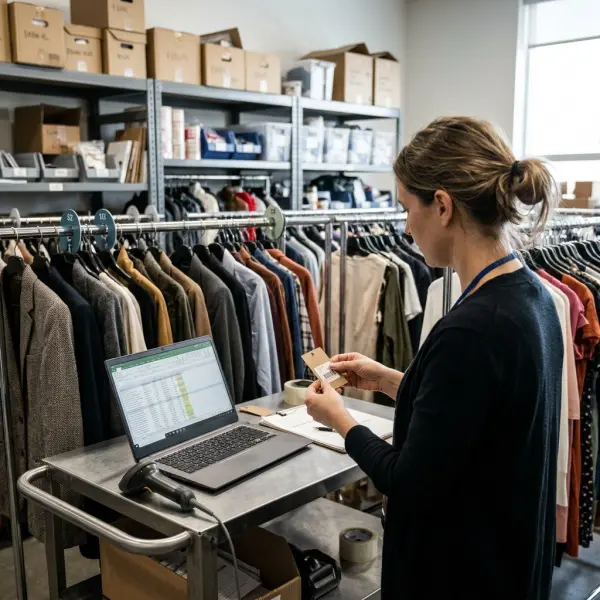
Consignment inventory should therefore be identifiable separately from retailer-owned merchandise, even when both are sold through the same point-of-sale system.
Essential Information to Track
An effective consignment inventory record should connect each product to its owner and transaction history. Useful fields include:
- Consignor or designer identification.
- Product SKU or unique item reference, description, size, and color.
- Quantity received and acceptance date.
- Agreed retail price and authorized markdown rules.
- Commission percentage or settlement formula.
- Quantity sold, returned, damaged, or remaining.
- Transaction dates, settlement status, and agreed selling-period end date.
For one-of-a-kind vintage or luxury merchandise, individual item identifiers may be necessary because products cannot always be grouped into interchangeable stock units.
The principle is simple: inventory records should make it possible to identify who owns a product, where it is, whether it has sold, and what financial obligation arose from the transaction.
Keeping Physical and Digital Inventory Aligned
A retailer selling through both a physical boutique and an ecommerce store needs a reliable method for preventing the same consigned item from being sold twice.
This can be challenging when products move between a shop floor, storage room, photography area, and fulfillment location. Inventory reservations, transaction synchronization, and regular stock reconciliation become particularly important.
A point-of-sale or inventory management system may simplify the work, but the underlying processes still require discipline. A poorly configured system can reproduce the same errors as a manual spreadsheet.
According to Shopify's 2026 explanation of consignment inventory, retailers and suppliers need distinct records covering goods received, quantities sold, returns, payment obligations, and remaining stock. The appropriate accounting and inventory treatment also depends on the arrangement and applicable rules.
The Importance of a Clear Consignment Agreement
A written consignment agreement establishes how the retailer and consignor will work together and what happens when normal selling conditions change.
Without documented terms, disagreements can emerge over issues that initially appear straightforward: who can authorize a discount, when a sale is considered final, whether a returned garment can be resold, or who bears the cost of a damaged item.
The agreement should reflect the practical realities of the specific retail arrangement rather than relying entirely on a generic template.
Commercial Terms That Should Be Defined
Important areas commonly include:
- Product ownership and identification: Which goods are supplied and when, if ever, ownership or control transfers.
- Retail pricing and markdown authority: Who establishes prices and approves promotional reductions.
- Commission and deductions: How the settlement amount is calculated, including any permitted fees or taxes.
- Sales reporting and payment: Reporting frequency, reconciliation procedures, payment deadlines, and dispute resolution.
- Product handling and liability: Responsibility for theft, loss, damage, storage, insurance, and transport.
- Returns and unsold merchandise: Customer return rules, consignment duration, stock withdrawal, return freight, and end-of-term procedures.
- Sales channels and branding: Where products may be sold and how the designer's name, images, and trademarks may be used.
These clauses should work together. For example, a retailer may have permission to run a seasonal promotion, but the agreement should also establish whether the discount reduces the consignor's payout proportionately or is absorbed by the retailer.
A well-defined arrangement reduces administrative uncertainty and helps both businesses evaluate the relationship on comparable financial terms.
Measuring the Performance of a Fashion Consignment Program
Consignment should be managed as a commercial distribution channel, not simply as a collection of garments waiting to sell.
Retailers need to understand whether consigned products generate sufficient contribution relative to floor space, staff time, and other operating costs. Designers need to assess sales performance, capital tied up in merchandise, and the reliability of payment.
A small group of practical metrics can provide a more useful picture than sales revenue alone.
Key Performance Indicators for Consignment
|
Metric |
What It Measures |
Business Relevance |
|
Sell-through rate |
Share of available stock sold during a defined period |
Indicates product movement and demand |
|
Sales contribution |
Commission or retained revenue from qualifying sales |
Helps evaluate commercial value |
|
Stock age |
Time merchandise remains unsold |
Identifies slow-moving products |
|
Return rate |
Proportion of sold items subsequently returned |
Highlights fit, quality, or expectation issues |
|
Settlement timeliness |
Whether payouts meet agreed deadlines |
Supports financial control and partner trust |
|
Contribution after direct costs |
Sales contribution less relevant direct expenses |
Helps assess economic viability |
Sell-through should be calculated consistently across stores and periods. A simple initial-batch calculation divides units sold by units received, but more advanced reporting may account for replenishment, transfers, returns, and the timing of stock availability.
Example: Reviewing a Small Consignment Collection
Suppose a boutique accepts 60 garments from an independent brand and sells 24 during the first eight weeks.
The initial-batch sell-through rate is:
24 ÷ 60 × 100 = 40%.
This result indicates how much of the initial delivery moved during the measurement period. It does not, by itself, establish whether the program is successful.
A retailer would also examine commission earned, selling space occupied, seasonality, returns, and whether the products attract relevant customers. The designer would evaluate the contribution from sold units, the cost of producing the 36 remaining garments, and potential demand through other channels.
If customers repeatedly request unavailable sizes while other sizes remain unsold, the response may involve adjusting size allocation rather than abandoning the collection.
Good consignment analysis connects sales results to decisions that improve the next allocation of stock.

Common Fashion Consignment Mistakes and How to Avoid Them
Treating Consignment Merchandise as Free Inventory
Retailers sometimes focus on the absence of upfront purchasing costs while overlooking the resources required to sell the merchandise. Consigned garments still occupy space, require handling, and compete for staff attention. If the products generate little commission or create excessive administrative work, the arrangement may contribute less than expected. Retailers should evaluate commercial performance against actual operating requirements, not merely compare consignment with the initial cost of purchasing inventory.
Accepting Products Without a Clear Customer Fit
A boutique may accept merchandise because a designer offers favorable commission terms rather than because the products match its customers. This can create an inconsistent assortment and weaken the store's merchandising identity. Poor sell-through may then frustrate both parties, even though the collection could perform better in another retail environment. A more effective approach begins with customer compatibility, product positioning, and a defined purpose for the assortment.
Failing to Track Stock by Individual Consignor
When several designers supply similar products, inconsistent tagging and inventory records can lead to incorrect stock allocation or payment. A retailer might record a sale against the wrong owner or fail to identify merchandise returned to the store. These errors become more difficult to resolve as transaction volumes increase. Unique product references, documented receiving procedures, and regular reconciliation provide a stronger operational foundation.
Leaving Discount Decisions Unclear
Pricing disagreements often emerge when a retailer wants to clear slow-moving merchandise but the designer expects to maintain a particular brand position. Unauthorized discounts can reduce the consignor's expected contribution and damage trust. They may also create inconsistent prices across retail channels. A written markdown policy should define approval authority, permitted discount ranges, and how the financial impact is shared.
Expanding Before Understanding Cash Flow
A designer may interpret placement in several boutiques as evidence of commercial growth, even when much of the stock remains unsold. Expanding production to serve additional stores can increase working-capital requirements without generating corresponding cash receipts. This is particularly risky for small brands financing manufacturing from limited resources. Designers should monitor sell-through, payment timing, and stock exposure before committing to additional locations.
Neglecting the End of the Consignment Period
Retailers and designers may focus heavily on product delivery while overlooking how the relationship will conclude. Unsold merchandise can remain in storage, collections may become outdated, and responsibility for return shipping may be disputed. The agreement should define review dates, stock withdrawal procedures, final reconciliation, and responsibilities for any unresolved items. Clear exit arrangements make consignment easier to repeat, even when a collection performs below expectations.
How Fashion Businesses Can Apply Consignment Strategically
Consignment is most useful when the commercial arrangement has a clear business purpose.
For a retailer, that purpose might involve testing an unfamiliar designer, expanding a specialist product category, or introducing limited seasonal merchandise. For a brand, it might involve reaching customers in a new geographic market, gathering product feedback, or developing a relationship with a potential long-term retail partner.
The objective should determine the assortment, selling period, reporting requirements, and criteria for continuing the partnership.
Start With a Defined Pilot Collection
A limited trial offers a practical way to examine operational compatibility before expanding stock commitments.
For example, a designer and boutique could agree to an eight-week pilot with a selected range of products, a documented commission structure, and a scheduled performance review. The exact duration and quantity should reflect the products' selling cycle rather than a universal industry rule.
The pilot should test more than customer demand. It should also establish whether deliveries arrive accurately, garments are presented appropriately, sales reports are reliable, and financial settlement works as expected.
A collection that performs moderately but generates clear customer insights may justify another structured experiment. One that creates repeated inventory or payment disputes may require operational changes before either party scales the relationship.
Build a Repeatable Operating Process
Even a small consignment program benefits from standardized receiving and reporting procedures.
Both parties should agree on a product list before delivery, confirm received quantities, and use consistent identifiers in sales records. The retailer should have a defined process for processing returns, reconciling physical stock, and communicating relevant issues to the consignor.
For designers supplying multiple retailers, consistent internal documentation becomes particularly valuable. It makes it easier to compare store performance without reconstructing product and payment information from separate email conversations.
As the program grows, appropriate inventory software may reduce repetitive administration, provided it supports consignor-level tracking and the applicable settlement rules.
Decide Whether to Continue, Adjust, or Exit
At the end of a pilot, the decision should be based on commercial evidence rather than the number of products initially accepted.
A retailer might continue with faster-moving styles while reducing underperforming variants. A designer could change the assortment, modify delivery quantities, or move selected garments to a store with a more suitable audience.
A successful pilot can also lead to discussion of different distribution arrangements, including wholesale purchasing. The financial and contractual distinctions deserve separate consideration, which is explored in Consignment vs Wholesale: Key Differences in Fashion Retail Models.
Consignment does not have to become a permanent arrangement. Its value may lie in generating enough reliable information for both parties to make a better long-term distribution decision.

What Fashion Brands Should Verify Before Using Consignment
Consignment agreements should not be evaluated solely through commission percentages. The legal, accounting, and operational substance of the arrangement can materially affect its risks and financial results.
Legal Protection and Creditor Risk
A contract stating that the designer owns the merchandise may not, by itself, provide complete protection in every jurisdiction.
In the United States, certain commercial consignments can fall within Article 9 of the Uniform Commercial Code. Under UCC Section 9-319 concerning consignee rights and creditors, a consignee may be treated as having rights and title to goods for specified creditor and purchaser purposes, subject to applicable exceptions.
This creates a potential concern if a retailer experiences financial distress. Some consignors may need to consider security-interest perfection, priority rules, or other protective steps under applicable law.
The relevant requirements vary by jurisdiction and transaction type. Businesses should obtain qualified legal advice rather than assuming that a general ownership clause eliminates all exposure.
Accounting and Revenue Recognition
Accounting treatment should reflect the substance of the transaction, not merely the label attached to the agreement.
For a genuine consignment arrangement under IFRS 15, delivering goods to the retailer does not ordinarily create revenue for the consignor when control has not transferred. The retailer must also assess whether it acts as a principal or agent when determining how to recognize revenue from the customer transaction.
The distinction can affect whether a retailer reports gross sales revenue or a net commission amount. The correct treatment depends on contractual rights, control, and the applicable accounting framework.
Inventory ownership, revenue recognition, sales tax or value-added tax, and customer refund liabilities should be reviewed with qualified local accounting or tax advisers.
Product Compliance and Customer Responsibilities
Retailers and designers should establish who is responsible for garment labeling, product safety obligations, consumer remedies, and claims about product characteristics.
The applicable requirements depend on the product and market. New children's apparel, for example, may raise different compliance considerations from adult accessories or secondhand garments.
Brands should also review the potential implications of damaged goods, defective products, inaccurate product descriptions, and unverified sustainability claims.
Before committing to a larger network of retail partners, designers should evaluate these risks alongside the financial and operational considerations discussed in What Fashion Brands Should Consider Before Selling Through Consignment.
Frequently Asked Questions About Fashion Consignment
Is Fashion Consignment Only Used for Secondhand Clothing?
No. Fashion consignment can involve both newly manufactured products and previously owned merchandise. Independent designers may supply new garments to a boutique, while resale businesses may accept clothing or accessories from individual owners. Both arrangements involve an intermediary selling goods under agreed terms rather than necessarily purchasing the products upfront.
The operational differences can be significant. New garments may require consistent sizing, care labels, and collection-level stock management. Secondhand items often require individual condition assessment, authentication where relevant, and unique pricing. Retailers should establish processes suitable for the category instead of assuming that all consignment merchandise can be handled identically.
Who Owns Clothing in a Consignment Store?
In a typical genuine consignment arrangement, the consignor retains ownership or control of the clothing until a specified event, commonly its sale to the end customer. The retailer holds the product and facilitates the transaction without necessarily purchasing the merchandise when it arrives.
However, physical possession, legal title, accounting control, and rights against creditors are not interchangeable concepts. The commercial agreement and applicable legal rules determine how these matters operate. Designers should document the inventory supplied and understand the legal protections available in their jurisdiction, particularly when placing valuable merchandise with retailers that they have not previously worked with.
How Much Commission Does a Fashion Consignment Store Take?
There is no single commission percentage that applies to every fashion consignment business. The retailer's share is negotiated and can depend on product category, expected selling price, customer reach, merchandising services, marketing responsibilities, and other commercial conditions.
A store with extensive customer service and higher operating costs may need a different arrangement from a small specialist boutique. Designers should evaluate the amount they retain after commission and relevant expenses, rather than judging the agreement only by the advertised percentage. The parties should also specify whether discounts, processing fees, taxes, or returns change the calculation, so that both can estimate their actual financial contribution.
Do Designers Get Paid When They Deliver Consignment Stock?
Not usually for the merchandise itself under a standard consignment arrangement. The designer is commonly paid after qualifying customer sales occur, subject to the agreed settlement timetable and any applicable deductions or adjustments. A retailer may still require or provide deposits, advance amounts, or other contractual arrangements, but these do not automatically convert the transaction into an ordinary wholesale purchase.
This distinction affects working capital. Designers may need to finance production, delivery, and inventory holding costs before receiving customer-sale proceeds. Businesses should forecast payment delays and the possibility that some items remain unsold, particularly when expanding into several retail locations simultaneously.




Comments 0
Leave a CommentSend Comment
Anda harus Login terlebih dahulu untuk dapat memberikan komentar.