

Common Production Planning Challenges in Fashion Manufacturing
Quick Answer
Common production planning challenges in fashion manufacturing include incomplete product information, late material arrivals, unrealistic capacity assumptions, frequent buyer changes, inaccurate production data, poor coordination between departments, quality rework, and weak visibility across subcontracted processes. These problems often appear during production, but many begin earlier during order confirmation, sample approval, costing, material planning, and scheduling.
Fashion manufacturing is especially vulnerable to planning problems because garments are style-specific, material-sensitive, labor-intensive, and deadline-driven. A small delay in fabric approval, trim delivery, cutting release, sewing line allocation, or quality inspection can affect the entire production flow. The result may be idle time, overtime, missed shipment dates, higher rework, reduced margins, and weaker buyer confidence.
The solution is not simply to create more reports. Manufacturers need clearer production readiness checks, more realistic capacity planning, better data discipline, stronger cross-functional communication, and earlier escalation of risks. For brands, the lesson is equally important: stable specifications, timely approvals, and realistic lead times are part of responsible production planning.

Why Production Planning Challenges Are So Common in Fashion Manufacturing
Production planning in fashion manufacturing is difficult because apparel is not a uniform product category. A factory may produce T-shirts, dresses, jackets, trousers, activewear, uniforms, and embellished garments within the same season. Each style may require different fabrics, trims, machines, operators, finishing methods, quality controls, packaging rules, and delivery priorities.
This creates operational complexity. A production plan may look reasonable when viewed only by order quantity and delivery date. But once the factory considers fabric shrinkage, color approval, line skill, machine attachments, standard minute value, washing requirements, and buyer inspection windows, the plan becomes much more fragile.
Many production planning challenges also come from the way fashion orders are commercially managed. Brands often work with seasonal calendars, trend-sensitive launch dates, tight inventory windows, and changing demand expectations. Manufacturers, on the other hand, must translate those commercial needs into physical production capacity. When communication is late or incomplete, the factory absorbs the pressure.
That is why production planning should not be treated as a clerical function. It is a coordination system. When it is weak, every department feels the impact: merchandising chases approvals, purchasing chases materials, cutting waits for fabric, sewing waits for input, finishing becomes overloaded, quality teams face rework, and logistics struggles to protect shipment dates.
For a broader foundation, manufacturers can first review apparel production planning explained for manufacturers. This article focuses more specifically on the problems that cause planning failure and how fashion businesses can manage them more realistically.
Challenge 1: Incomplete Product Information
One of the most common production planning challenges is starting the plan before the product is fully defined. A purchase order may be confirmed, but the tech pack may still be incomplete. A sample may be approved visually, but the measurement specification may still need adjustment. A fabric may be selected, but shrinkage, shade, or testing results may not yet be available.
This creates a dangerous planning gap. The factory begins reserving capacity, ordering materials, and preparing production dates based on information that may still change. When the missing details finally arrive, the production plan may need revision. In some cases, the factory discovers that the original timeline was never realistic.
Incomplete product information often includes:
- unclear measurement specifications;
- missing construction details;
- unapproved lab dips or strike-offs;
- incomplete bill of materials;
- unclear packing requirements;
- missing artwork, embroidery, print, or wash standards;
- unresolved fit comments after sample review.
The operational consequence is not only delay. It can also affect costing, material consumption, line layout, machine preparation, and quality control. A small specification change may alter sewing time, trim usage, finishing method, or inspection criteria.
A better approach is to separate “commercially confirmed” from “production-ready.” An order may be commercially important, but it should not enter a firm production schedule until the critical technical inputs are verified.

Challenge 2: Late or Unreliable Material Availability
Material delay is one of the most damaging planning problems in garment manufacturing. Fabric, trims, labels, packaging, interlining, thread, zippers, buttons, elastic, and specialty components all need to arrive in the correct quantity and specification before production can proceed smoothly.
A factory may have available sewing lines, trained operators, and confirmed shipment dates, but none of that matters if fabric is late or trims are incomplete. In apparel, material readiness is not just about warehouse arrival. The materials must also be inspected, tested, approved, and matched to the production requirements.
Fabric creates particular complexity. Shade variation, shrinkage, width variation, defects, color fastness, and washing behavior can all affect production planning. A fabric that arrives late but passes inspection may still be manageable. A fabric that arrives on time but fails inspection can be more disruptive.
Material problems often come from weak visibility. Purchasing may know that fabric has been ordered, but production may not know whether it has shipped. Merchandising may assume trims are ready, while the warehouse has only received partial quantity. A brand may approve a lab dip late, compressing the entire factory schedule.
GS1 describes its standards as a common language for identifying, capturing, and sharing supply chain data, which is relevant because inconsistent product and material data can make coordination harder across trading partners. GS1 standards
The practical lesson is straightforward: material status should be visible before production dates are locked. If the plan does not clearly show what is received, inspected, approved, pending, delayed, or short, the factory is planning with blind spots.

Challenge 3: Unrealistic Capacity Assumptions
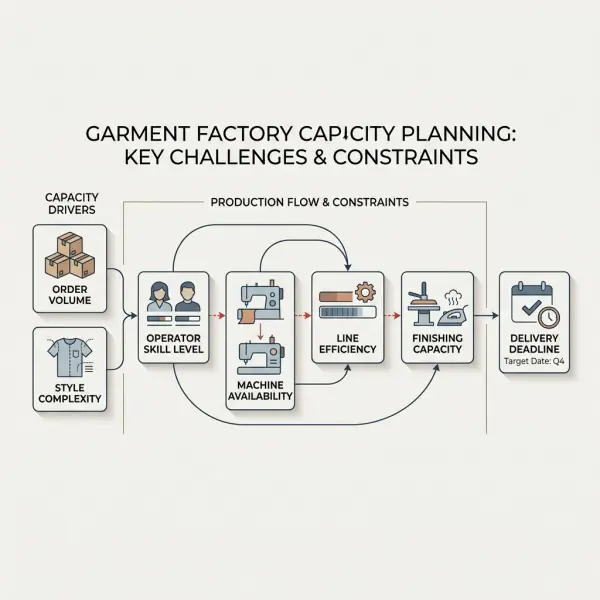
Capacity planning errors are another major cause of production planning failure. A factory may assume it has enough capacity because the production calendar shows open days. But garment capacity is not just calendar space. It depends on available operators, skill level, machine type, line efficiency, product complexity, working hours, quality risk, and finishing capacity.
This is where many plans become too optimistic. A factory may accept multiple urgent orders because total monthly capacity looks sufficient. But when the same week requires several complex styles, new sample approvals, high inspection requirements, and finishing-heavy products, the actual load may exceed the factory’s capability.
Capacity assumptions become especially risky when planners use average efficiency for every style. A repeat basic T-shirt may run smoothly at a high efficiency level. A new woven jacket with lining and structured details may need a slower ramp-up. If both are planned with the same assumptions, the schedule will likely fail.
The problem is not only operational. It is commercial. Unrealistic capacity planning can lead to late shipments, unplanned overtime, extra subcontracting, quality pressure, and margin erosion. It can also damage the buyer relationship if the factory repeatedly confirms timelines it cannot protect.
A stronger approach is to plan capacity by product type, complexity, line skill, and confirmed readiness. The factory should know which lines are strong in knits, wovens, denim, outerwear, activewear, or delicate fabrics. Capacity should reflect reality, not hope.
Challenge 4: Frequent Order Changes and Priority Shifts
Fashion manufacturing often deals with change. Buyers may adjust quantities, modify size ratios, change delivery priorities, revise packaging, delay approvals, or request urgent shipment splits. Some changes are unavoidable. The problem begins when changes are not managed as formal planning events.
Frequent changes can destabilize the entire production plan. A sewing line prepared for one style may suddenly need to switch to another. Cutting may release panels for an order that is no longer the top priority. Finishing may become overloaded because urgent styles are pushed forward without adjusting downstream capacity.
The deeper issue is that order changes have hidden consequences. A change in color ratio may affect material allocation. A delivery split may affect packing and logistics. A revised trim may affect sewing preparation. A new priority may delay another buyer’s order.
Production planners need a change-control habit. Before accepting a change, the team should ask what will be affected, whether materials are ready, whether the assigned line can handle the revision, and whether the new timeline is realistic.
This connects closely with how production scheduling improves garment efficiency, because scheduling is where frequent priority shifts become visible on the factory floor.
Challenge 5: Poor Coordination Between Departments
Production planning depends on many departments, but fashion factories often operate in silos. Merchandising communicates with the buyer. Purchasing communicates with suppliers. Warehouse tracks material receipt. Production controls cutting and sewing. Quality monitors defects. Logistics prepares shipment. If each department works from separate information, planning accuracy declines.
A common example is material readiness. Merchandising may believe fabric is ready because the supplier confirmed shipment. Purchasing may know there is a delay. Warehouse may have received only part of the fabric. Quality may still need inspection. Production may have already planned cutting. Each department is working with a different version of reality.
This fragmentation creates avoidable firefighting. Teams spend time chasing updates instead of solving constraints. Meetings become reactive. Production plans are revised too late.
Better coordination does not always require advanced software. It requires a shared operating rhythm: one production status view, clear ownership, daily exception review, and escalation rules. The most important planning information should be visible to all relevant teams.
Useful shared planning indicators include:
- order confirmation status;
- sample approval status;
- material order and receipt status;
- production readiness status;
- cutting, sewing, finishing, and packing progress;
- quality defect and rework status;
- shipment risk level.
When these indicators are visible, planning conversations become more specific. Instead of asking “Is the order okay?” teams can ask “Which requirement is still blocking production readiness?”
Challenge 6: Inaccurate Production Data
Production planning becomes unreliable when the factory uses weak data. This may include outdated efficiency assumptions, inaccurate standard minute values, incomplete output reporting, unclear WIP records, or inconsistent material consumption data.
Some factories plan from historical averages that no longer reflect actual operations. Others rely on manual reports that arrive too late to support daily decisions. In smaller factories, planners may depend heavily on supervisor estimates. Experience is valuable, but unsupported estimates can become risky when order complexity increases.
Inaccurate data affects decisions across the factory. If the standard minute value is understated, the daily output target may be unrealistic. If defect rates are not tracked properly, quality risk may be underestimated. If cutting output is not updated accurately, sewing may wait unexpectedly. If warehouse inventory is incorrect, production may be scheduled before materials are truly available.
For apparel businesses, product data accuracy also matters beyond the factory. GS1 US explains that apparel variants such as color and size can be assigned unique GTINs to support inventory accuracy and product identification. GS1 US apparel and general merchandise guidance
Manufacturers do not need perfect data to improve planning. But they do need reliable data for the decisions that matter most: capacity, materials, output, quality, and shipment risk.

Challenge 7: Quality Problems and Rework
Quality issues are often treated as production problems, but they are also planning problems. If a style has complex construction, delicate fabric, strict measurement tolerance, special washing, or high buyer standards, the production plan must allow enough time and control for quality management.
When quality is not integrated into planning, defects are discovered too late. A factory may complete sewing output on paper, but if a significant portion requires rework, the order is not truly on track. Rework consumes labor, reduces effective capacity, delays finishing, and may compress final inspection.
Quality-related planning failures often happen when:
- new styles are scheduled without a pilot run;
- difficult operations are not identified early;
- inline inspection is understaffed;
- finishing capacity is underestimated;
- measurement checks are delayed;
- fabric behavior is not tested before bulk cutting;
- buyer quality requirements are not communicated clearly to operators.
A better production plan treats quality as part of the route, not as a final checkpoint. For high-risk styles, the plan should include first output review, inline quality control, measurement audit, and enough time for correction before the shipment window.
This is especially important for brands that depend on consistent customer experience. Poor quality planning may create late delivery, but it can also create returns, complaints, markdowns, and reputational damage.
Challenge 8: Subcontracting and Limited Supply Chain Visibility
Many apparel manufacturers use subcontractors for embroidery, printing, washing, pleating, garment dyeing, special finishing, or overflow sewing. Subcontracting can be commercially useful, but it adds planning complexity.
The main challenge is visibility. If a subcontracted process is not tracked with the same discipline as internal production, the factory may lose control over timing, quality, capacity, and compliance. A four-day embroidery delay can disrupt sewing. A washing problem can affect shade, shrinkage, and measurements. An overflow sewing unit may produce inconsistent quality if instructions are unclear.
Subcontracting also has responsible sourcing implications. The OECD garment and footwear due diligence guidance is designed to help enterprises identify and address potential adverse impacts across garment and footwear supply chains. OECD Due Diligence Guidance for Responsible Supply Chains in the Garment and Footwear Sector
For production planning, this means external processes should not be treated as invisible gaps between internal stages. They should be planned, confirmed, monitored, and documented. The factory should know who is doing the work, what capacity is available, when goods will move, what quality standard applies, and what risk exists if the subcontractor is delayed.
Challenge 9: Unrealistic Lead Times and Purchasing Pressure
Production planning challenges do not sit only inside the factory. Some come from brand purchasing practices. When brands place orders late, delay approvals, change specifications, or compress delivery windows, the manufacturer may face pressure that no planning system can fully absorb.
This is not a simple blame issue. Fashion brands also face demand uncertainty, retail deadlines, inventory risk, and competitive pressure. But if commercial urgency is passed to the factory without realistic adjustment, the result may be overtime, rushed quality control, margin pressure, or unplanned subcontracting.
The ILO has highlighted decent work challenges and opportunities in textile and clothing supply chains, including the importance of addressing working conditions across the sector. ILO brief on decent work in textiles and clothing supply chains
Better planning requires better buyer-supplier collaboration. Brands should provide timely decisions, realistic calendars, stable specifications, and clear priorities. Manufacturers should communicate capacity constraints early rather than accepting timelines that are unlikely to succeed.

How Fashion Businesses Can Manage Production Planning Challenges
Managing production planning challenges requires discipline before, during, and after production. The best approach is not to wait until shipment is at risk. It is to identify uncertainty early and make it visible.
[H3] Strengthen production readiness checks
A production readiness check should confirm that the factory has the information, materials, approvals, capacity, and quality standards needed to begin bulk production. This prevents the common mistake of starting production based on partial readiness.
A useful readiness check should review:
- final purchase order and delivery date;
- approved sample and complete tech pack;
- confirmed BOM and material consumption;
- fabric and trim receipt status;
- fabric inspection and shrinkage results;
- line allocation and machine requirements;
- quality checkpoints and buyer standards;
- packing and logistics instructions.
This checklist should not be treated as paperwork. It should be a decision gate. If critical items are missing, the plan should remain tentative.
Build realistic buffers around high-risk stages
Planning buffers are often misunderstood. A buffer is not an excuse for slow execution. It is a recognition that some processes carry higher uncertainty. New materials, imported trims, washing, embroidery, printing, external subcontracting, and buyer inspections may require realistic time protection.
The right buffer depends on product complexity, supplier reliability, factory capability, and delivery sensitivity. Too little buffer creates constant crisis. Too much buffer may reduce capacity utilization. The planner’s job is to use evidence and experience, not arbitrary padding.
Create one shared production status view
A shared status view helps merchandising, purchasing, production, quality, warehouse, and logistics work from the same information. This can be a system dashboard, an ERP module, or a disciplined manual tracker. The tool matters less than the accuracy and update routine.
The shared view should identify confirmed orders, pending approvals, material risk, production progress, quality issues, and shipment risk. It should also show ownership. A risk without an owner is just information.
Review planning performance after shipment
Factories often move quickly to the next order after shipment. This is understandable, but it means the same planning problems can repeat. A short post-shipment review can identify whether the delay came from material, approval, capacity, scheduling, quality, or logistics.
The goal is not to assign blame. The goal is to improve the next plan. Over time, this creates better historical data and stronger decision-making.
Common Mistakes to Avoid
Production planning challenges become more expensive when teams normalize them. A factory that treats every order as urgent eventually loses the ability to distinguish real crisis from routine poor planning.
Mistake 1: Confirming delivery before checking production readiness
This happens when commercial pressure moves faster than operational verification. The manufacturer confirms the delivery date, then later discovers that materials, approvals, or capacity are not ready. The business impact can include overtime, late shipment, and reduced margin.
The better approach is to confirm delivery based on verified readiness or clearly state the assumptions behind the commitment.
Mistake 2: Hiding uncertainty to keep the buyer comfortable
Some manufacturers avoid communicating early risk because they fear damaging the buyer relationship. Unfortunately, hidden risk usually becomes visible later in a more damaging form. A buyer may tolerate early escalation better than a surprise delay near shipment.
A stronger approach is to communicate risk with options: revised timeline, alternative material, partial shipment, line adjustment, or priority decision.
Mistake 3: Treating planning as separate from quality
When quality control is only considered at the end, the factory may produce large volumes of defective or inconsistent garments before the issue is discovered. This creates rework and shipment pressure.
Planning should identify quality risk before production starts, especially for new styles, difficult fabrics, strict measurements, and special finishing.
Mistake 4: Using the same planning logic for every product category
A basic knit product, structured coat, denim garment, embellished dress, and activewear style all behave differently in production. If the planning system treats them the same, it will underestimate complexity.
Better planning reflects product category, construction difficulty, operator skill, machine needs, quality risk, and finishing route.
Mistake 5: Depending on software without process discipline
Planning software can improve visibility, but it cannot compensate for inaccurate data, unclear roles, late updates, or unrealistic assumptions. A digital system will only scale good discipline or expose weak discipline.
Before investing heavily in tools, manufacturers should clarify planning workflows, ownership, update frequency, and decision rules.
What Brands and Manufacturers Should Verify Before Acting
Before making planning decisions, fashion businesses should verify whether the issue is a real production constraint or a communication failure. The answer affects the solution.
A material delay may require supplier escalation. A capacity problem may require line reallocation. A quality issue may require technical intervention. A buyer approval delay may require commercial escalation. Treating all problems as “factory delay” leads to poor decisions.
Brands and manufacturers should verify:
- whether the order is technically complete;
- whether all approvals are final;
- whether material status is confirmed physically, not only verbally;
- whether capacity is based on real line capability;
- whether the production schedule includes cutting, sewing, finishing, inspection, packing, and logistics;
- whether subcontracted processes are visible;
- whether quality risk is planned before bulk production;
- whether delivery commitments reflect real constraints.
The most useful question is not “Why is production late?” It is “Which assumption in the plan was wrong, incomplete, or not updated quickly enough?”
FAQ: Production Planning Challenges in Fashion Manufacturing
What is the biggest production planning challenge in garment manufacturing?
The biggest challenge is often the gap between confirmed commercial orders and actual production readiness. A buyer may confirm an order, but the factory may still be waiting for final tech packs, sample approvals, fabric testing, trims, or packing instructions. When planning begins before these details are complete, the schedule becomes unstable. Material delay, capacity pressure, and quality rework may appear later, but the root problem is often incomplete readiness at the start.
Why do garment production plans fail even when factories have enough workers?
Factories may have enough workers overall but still lack the right capacity for a specific style, line, or production week. Apparel capacity depends on operator skill, machine type, line balance, product complexity, standard minute value, material behavior, and finishing requirements. A factory may be fully staffed but still struggle if a complex style is assigned to an unsuitable line or if multiple high-risk orders compete for the same resources.
How do material delays affect apparel production planning?
Material delays can disrupt cutting, sewing, finishing, and shipment. Even if fabric arrives before the sewing date, it may still need inspection, shrinkage testing, shade control, and approval. Trim shortages can also stop production because a garment cannot be completed without the correct zipper, button, label, elastic, or packaging component. Strong planning separates ordered materials from received, inspected, approved, and production-ready materials.
How can brands reduce production planning problems with suppliers?
Brands can reduce planning problems by providing complete tech packs, timely sample feedback, stable specifications, realistic lead times, clear delivery priorities, and fast approval decisions. They should also avoid changing quantities, size ratios, trims, or packaging after production has been scheduled unless the impact is discussed openly. Better buyer behavior does not remove all factory risk, but it gives manufacturers a stronger foundation for reliable execution.
What is the role of quality control in production planning?
Quality control should be built into production planning, not left until final inspection. If a garment uses difficult fabric, complex construction, strict measurement tolerance, washing, printing, or embellishment, the plan should include early checkpoints. These may include pilot runs, first output approval, inline inspection, measurement checks, and finishing review. When quality is planned early, defects are easier to prevent or correct before they affect large production quantities.
Can production planning software solve these challenges?
Production planning software can improve visibility, coordination, and data access, especially for factories handling many styles, lines, buyers, and materials. But software cannot solve weak processes by itself. If data is inaccurate, departments do not update information, or capacity assumptions are unrealistic, the system will still produce unreliable plans. Manufacturers should strengthen planning discipline first, then use software to scale and improve visibility.
Why is subcontracting a planning risk in apparel manufacturing?
Subcontracting becomes a planning risk when external processes are not fully visible or controlled. Embroidery, printing, washing, pleating, garment dyeing, and overflow sewing can affect timing, quality, compliance, and shipment readiness. If subcontracted work is treated as a hidden stage, the factory may discover problems too late. Good planning includes subcontractor capacity, movement dates, approval requirements, quality standards, and contingency options.
How often should production planning risks be reviewed?
Production planning risks should be reviewed frequently enough to support decisions before delays become critical. In active production, daily exception reviews are often useful for material shortages, output gaps, quality issues, and shipment risks. Weekly planning reviews can focus on upcoming orders, capacity loading, approvals, and buyer priorities. The review rhythm should match factory complexity. The goal is not more meetings, but earlier visibility and clearer decisions.
Conclusion
Production planning challenges in fashion manufacturing are rarely isolated. A late fabric approval can affect cutting. Cutting delays can reduce sewing output. Sewing bottlenecks can compress finishing. Quality rework can threaten shipment. A buyer change can disturb an entire line plan. What appears as a production-floor problem often begins as incomplete information, weak coordination, or unrealistic assumptions.
The strongest manufacturers manage planning as a live operating system. They verify readiness before committing capacity, track materials accurately, plan around real constraints, integrate quality into the production route, and communicate risks early. They also review performance after shipment so the same problems do not repeat unnoticed.
For fashion brands, the message is equally clear. Reliable production is not only the supplier’s responsibility. Brands influence planning outcomes through lead times, approvals, specification stability, purchasing behavior, and communication discipline.
Fashion manufacturing will always involve uncertainty. But uncertainty does not have to become chaos. With stronger planning habits, clearer data, and more responsible collaboration, manufacturers and brands can reduce avoidable disruption, protect efficiency, and build more reliable production partnerships.





Comments 0
Leave a CommentSend Comment
Anda harus Login terlebih dahulu untuk dapat memberikan komentar.