
Jacquard Fabric Explained: Structure, Texture, and Fashion Uses
Jacquard fabric has a distinctive place in fashion because its decorative character is created within the textile itself. Rather than relying on a printed floral motif or surface embroidery, jacquard weaving allows patterns, textures, and contrasting effects to emerge through the arrangement of yarns. The result can be subtle and contemporary, richly ornamental, or somewhere between the two.
For fashion designers, this structural approach creates possibilities that ordinary surface decoration does not always provide. A jacket can feature a tonal botanical pattern visible mainly when light catches the fabric. A structured dress can use a sculptural woven motif to create visual depth without additional embellishment. Even a simple handbag can gain character from a carefully selected geometric jacquard.
Yet jacquard is frequently misunderstood as a specific material or a guarantee of luxury. Neither assumption is accurate. The term describes a pattern-forming technique, while the fiber composition, fabric weight, durability, drape, and production quality vary considerably.
Understanding these distinctions helps apparel brands select appropriate fabrics, communicate with mills, and develop garments that balance design appeal with practical manufacturing requirements.
Quick Answer: What Is Jacquard Fabric?
Jacquard fabric is a patterned textile produced using specialized weaving technology that controls individual warp yarns, or selected groups of yarns, to create designs directly within the fabric structure. Unlike printed fabric, where color or decoration is applied to an existing surface, woven jacquard develops its pattern through the interlacing of warp and weft threads.
This technique can produce floral motifs, geometric patterns, ornamental designs, logos, and subtle tonal textures. The fabric may be made from cotton, silk, wool, polyester, viscose, or various fiber blends. Its thickness, softness, sheen, and flexibility depend on the yarns, weave construction, and finishing processes rather than the jacquard technique alone.
Jacquard is commonly used in dresses, jackets, tailored separates, occasionwear, accessories, and decorative textiles. Related fabric categories include damask and many modern brocades.
For fashion businesses, its main advantage is the ability to integrate decorative design directly into the textile. However, complex patterns can introduce additional sourcing costs, fabric consumption, cutting constraints, and quality-control considerations. A suitable jacquard must therefore be assessed for both visual appearance and garment performance.
How Jacquard Fabric Is Made: Understanding the Woven Structure
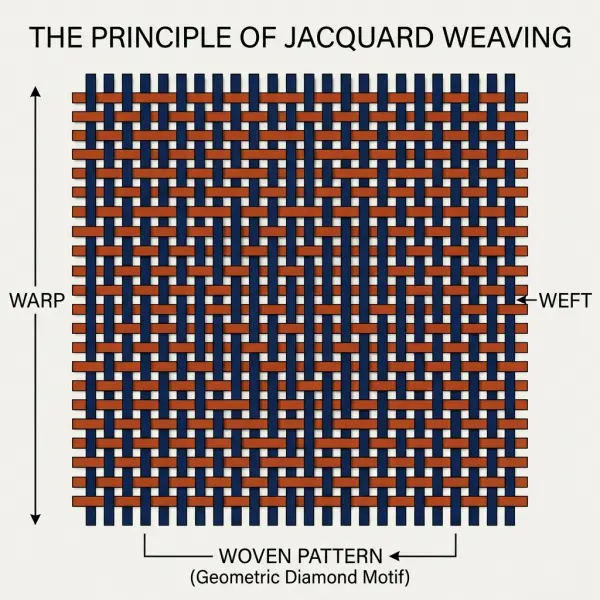
The defining feature of jacquard fabric is the way its pattern is constructed. In conventional weaving, a loom interlaces lengthwise warp yarns with crosswise weft yarns. The resulting appearance depends on how these yarns pass over and under one another, creating familiar structures such as plain weave, twill, and satin.
Jacquard weaving extends this principle through more detailed control of the warp yarns. Instead of relying entirely on groups of yarns moving together, the jacquard mechanism allows individual warp ends to be selected according to a programmed design.
That greater control makes it possible to produce large motifs, complex curves, pictorial patterns, and combinations of different weave effects within the same fabric. According to CottonWorks' technical explanation of complex woven fabrics, jacquard weaving can use mechanical or electronic shedding systems to control individual warp ends and create intricate patterned surfaces.
The Role of Warp and Weft Yarns
Warp and weft yarns provide the foundation of woven jacquard construction. Warp yarns run lengthwise through the fabric, while weft yarns travel across them. The pattern emerges when selected yarns become more or less visible on the surface through different interlacing arrangements.
For example, a floral jacquard might use a smooth, reflective weave for the flower petals and a more matte structure for the surrounding background. Even when the entire fabric uses yarns of similar colors, the contrast between these weave effects can make the motif visible.
The jacquard mechanism does not create color independently. The designer must coordinate yarn selection, yarn coloration, weave construction, and finishing to achieve the intended appearance. This distinction becomes particularly important when translating artwork into a fabric design.
From Punched Cards to Electronic Pattern Control
The history of jacquard technology helps explain why the technique became so significant to textile production. French inventor Joseph Marie Jacquard developed an influential loom mechanism in the early nineteenth century that used sequences of punched cards to control which warp threads were raised during weaving.
The Smithsonian Institution's history of punched cards documents how this mechanism enabled complex textile patterns to be produced through programmable instructions. It also became an important historical example of machines performing repeatable operations according to stored information.
Modern industrial jacquard looms commonly use electronic controls rather than physical punched cards. Designers can prepare digital pattern information, translate it into weave instructions, and adjust the design to the mill's equipment and yarn configuration.
This does not eliminate the need for skilled textile development. The mill must still evaluate yarn behavior, pattern definition, loom settings, fabric stability, and finishing requirements. A design that looks appealing on a computer screen may require several adjustments before it produces a satisfactory woven sample.
Is Every Jacquard Fabric Woven?
The term jacquard is also used in knitting, although woven and knitted jacquard fabrics have different structures.
Woven jacquard forms its pattern through the interlacing of warp and weft yarns. Knitted jacquard creates patterns through controlled needle selection, stitch formation, and yarn arrangements. Patterned sweaters and certain knitwear fabrics are examples of knitted jacquard applications.
This article focuses primarily on woven jacquard because of its importance in structured apparel, occasionwear, decorative fashion textiles, and premium garment development. When sourcing jacquard, fashion buyers should nevertheless confirm whether the supplier is offering a woven or knitted construction. The distinction affects stretch, recovery, cutting behavior, and sewing requirements.
What Gives Jacquard Fabric Its Distinctive Texture?
Jacquard fabric develops its visual character through combinations of yarns, interlacings, surface effects, and finishing treatments. The decorative pattern may appear raised, smooth, reflective, matte, or nearly flat, depending on how the textile is engineered.
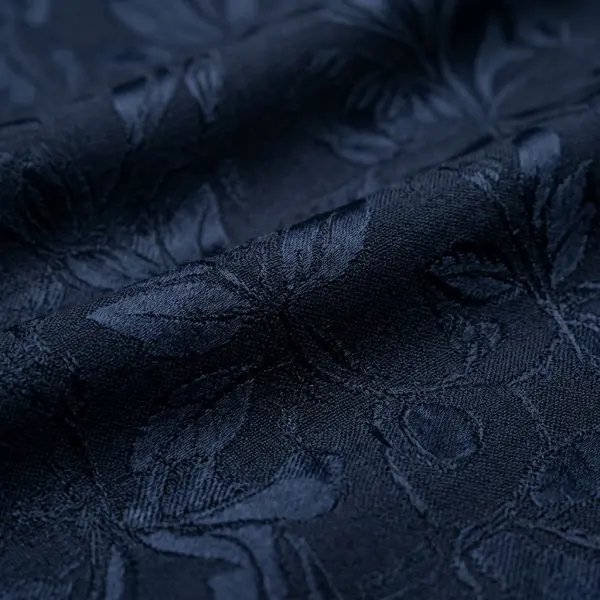
A common misconception is that jacquard must have a prominent three-dimensional surface. Some qualities do feature pronounced relief, but others rely on subtle contrasts in light reflection. A dark navy jacquard, for instance, might reveal an understated floral motif without using a contrasting color.
The most useful way to evaluate jacquard texture is to separate its appearance from its actual physical construction.
Raised Motifs and Surface Relief
Some jacquard constructions produce pronounced decorative effects through variations in yarn thickness, weave structure, or fabric layers. These differences can create motifs that appear to sit above the background.
Raised texture can give a garment a sculptural quality, particularly when combined with structured silhouettes. However, the degree of relief does not automatically indicate greater strength or better fabric quality.
Highly raised surfaces may also be more vulnerable to abrasion or snagging in particular applications. Designers need to consider where the fabric will experience contact with bags, furniture, jewelry, or other garments.
Tonal Patterns, Sheen, and Light Reflection
One of jacquard's more refined decorative effects comes from the interaction between matte and reflective yarn surfaces.
Satin-related weave areas can reflect light differently from adjacent weave structures, creating a visible motif even when the yarns share a similar color. This makes tonal jacquard useful for garments where the designer wants texture without a strongly contrasting print.
Lighting changes the appearance considerably. A fabric that looks understated under diffuse showroom lighting may reveal much stronger highlights under directional retail or event lighting.
For product development, viewing the same sample under multiple lighting conditions helps prevent unexpected differences between studio photography, retail presentation, and actual wear.
Fabric Weight, Body, and Drape
Jacquard fabrics vary from lightweight qualities with fluid movement to substantial textiles with considerable body. The technique itself does not establish a fixed weight or silhouette.
A lightweight jacquard might suit a flowing blouse, depending on the fiber and construction. A medium-weight cotton-blend jacquard could provide structure for a skirt, while a heavier woven quality might support a tailored coat or decorative jacket.
The relationship between weight and drape deserves particular attention. A heavier fabric will not necessarily hang better, and a lighter fabric will not always feel softer. Yarn stiffness, weave density, finishing, and fiber characteristics all influence how the cloth behaves.
For brands developing fitted or sculptural garments, testing the fabric on an actual garment sample is usually more informative than judging it from a small swatch.
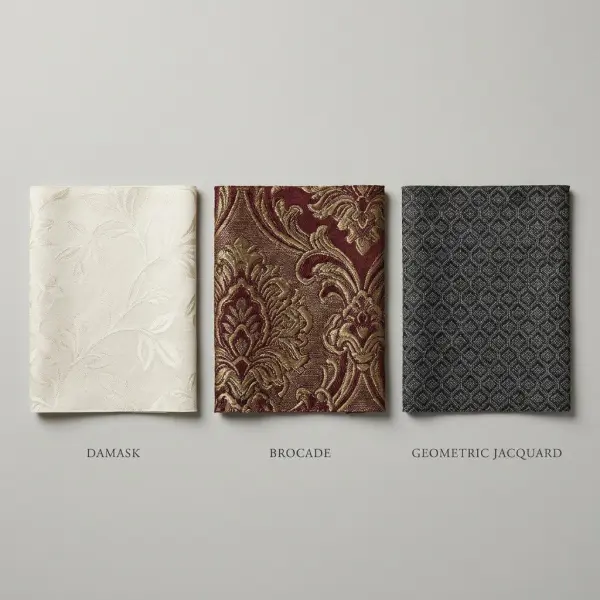
Common Jacquard Fabric Styles and Their Visual Characteristics
Jacquard describes a method of pattern formation rather than one standardized fabric appearance. Within the broader family of complex figured woven textiles, several familiar styles can be produced using jacquard equipment.
The most recognizable examples include damask and brocade, alongside geometric and more contemporary decorative constructions.
|
Fabric style |
Typical visual character |
Common fashion applications |
|
Damask |
Often features reversible or contrasting matte-and-sheen motifs |
Dresses, tailored separates, formalwear |
|
Brocade |
Richly figured decorative patterns, sometimes incorporating metallic or supplementary yarns |
Occasionwear, jackets, ceremonial garments |
|
Matelassé |
Padded or quilted-looking relief created through textile construction |
Structured jackets, coats, skirts |
|
Geometric jacquard |
Repeating abstract or geometric motifs |
Contemporary suits, dresses, accessories |
|
Tonal jacquard |
Subtle patterns created with limited color contrast |
Minimalist premium apparel, tailored garments |
These categories are not defined exclusively by a modern jacquard loom. Some have much older textile histories, and their exact structures vary. The Museum of Fine Arts, Boston's textile glossary identifies brocade, damask, brocatelle, and matelassé among the textile constructions associated with jacquard weaving.
For an apparel buyer, the category name is useful as an initial description, but it is not a complete specification. Two fabrics described as brocade may differ significantly in composition, surface floats, weight, finish, and intended use.
The distinction between these decorative textile families is explored further in Jacquard vs Brocade: Key Differences in Decorative Woven Fabrics.
How Jacquard Fabric Is Used in Fashion Design
Jacquard works particularly well when the textile itself is intended to contribute to a garment's design identity. Unlike a plain fabric that depends primarily on silhouette or embellishment, jacquard can introduce significant visual detail before the garment is cut and sewn.
This can be commercially attractive for brands developing occasionwear, tailored collections, and distinctive accessories. A woven motif may provide enough decorative interest that additional surface treatments are unnecessary.
However, the most suitable application depends on the fabric's weight, surface construction, flexibility, and comfort requirements.
Dresses and Occasionwear
Jacquard is frequently associated with structured dresses and special-occasion garments because decorative patterns and pronounced body can work together effectively.
A floral jacquard with moderate stiffness may support an A-line silhouette or a fitted bodice with a fuller skirt. By contrast, a softer and lighter quality may be more appropriate for a relaxed dress with less architectural shaping.
Designers should check whether the pattern remains attractive across darts, waist seams, pleats, and curved garment sections. Large motifs may become visually interrupted when the fabric is manipulated.
The lining is equally important. A decorative woven fabric with a textured reverse may need a compatible lining to improve comfort or protect exposed floats. The construction decisions are closely related to garment lining, comfort, and finishing.
Jackets, Blazers, and Tailored Separates
Jacquard can add a distinctive identity to tailored garments without relying on highly contrasting surface decoration.
A geometric jacquard blazer, for example, might use a restrained two-tone pattern that becomes more noticeable at close range. A textured jacquard jacket can also provide visual richness when paired with plain trousers or a simple skirt.
The challenge is maintaining garment balance. A dense jacquard may become bulky at lapels, collars, pocket edges, and seam intersections. Excessive stiffness can also affect sleeve movement and overall comfort.
Tailoring teams should therefore evaluate fabric thickness, pressability, seam allowances, and compatibility with interlinings before finalizing construction.
Skirts, Trousers, and Contemporary Fashion Separates
Decorative jacquard is not limited to formal clothing. Smaller-scale geometric patterns, softer yarns, and restrained colors can make it suitable for contemporary separates.
A coordinated jacquard skirt and jacket may create a distinctive collection look, while patterned trousers can introduce texture into an otherwise understated outfit. For everyday garments, the key is balancing decoration with durability and freedom of movement.
Trousers deserve particular scrutiny because their seat, inner-thigh, and knee areas experience repeated movement and friction. A jacquard that performs well on a structured skirt may not be appropriate for fitted trousers.
This difference illustrates why fabric suitability should be assessed by garment type rather than by appearance alone.
Fashion Accessories and Decorative Details
Jacquard can also be used in handbags, fabric belts, footwear components, woven labels, and other accessories.
These applications allow brands to introduce decorative motifs without constructing an entire garment from patterned fabric. A limited-edition handbag with a distinctive woven motif, for instance, can reinforce a collection's visual identity while keeping the main apparel range relatively simple.
Accessories may nevertheless require backing materials, reinforcement, edge finishing, or abrasion testing. A fabric intended for a decorative jacket is not automatically suitable for a bag that will repeatedly rub against clothing or other surfaces.
Why Jacquard Fabric Appeals to Premium Fashion Brands
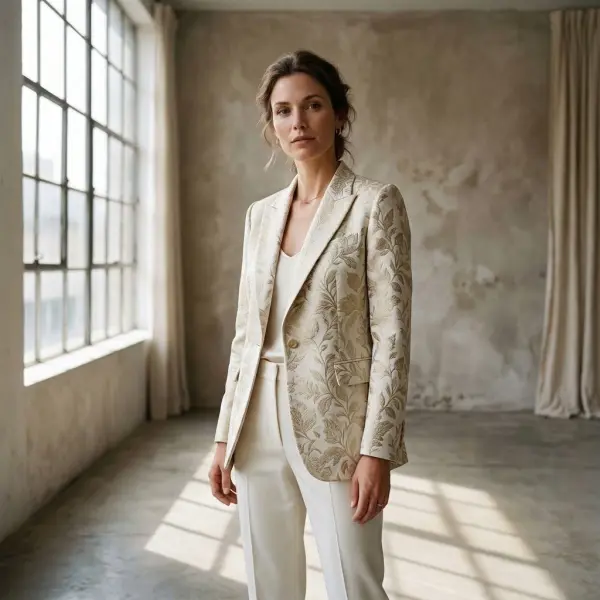
Jacquard can support premium product positioning because it allows a brand to communicate design through the textile's construction. Intricate woven patterns, distinctive surface effects, and carefully coordinated yarns can create visual interest that is difficult to reproduce in exactly the same way using conventional printing.
Yet a jacquard fabric is not automatically luxurious. Premium perception depends on the quality of the yarns, the consistency of weaving, the refinement of the design, and the finished garment. A poorly balanced jacquard made with unsuitable yarns can look attractive on a sample card but perform disappointingly in production.
For fashion brands, the commercial value lies in how effectively the textile supports the collection's identity and price positioning.
Creating Distinction Through Textile Design
A custom jacquard motif can become part of a brand's recognizable visual language. Instead of repeatedly applying a logo, a brand may use an abstract pattern, stylized botanical design, or distinctive geometric arrangement across selected products.
Such designs can be developed through variations in color, yarn composition, motif scale, and weave structure. A restrained motif might work on tailored separates, while a richer version could appear on occasionwear or accessories.
The commercial benefit depends on consistency. If the motif changes substantially between production batches or performs poorly after finishing, the intended visual identity becomes harder to maintain.
Supporting Perceived Value Without Excessive Decoration
Jacquard can create a refined decorative effect without requiring embroidery, appliqué, or other embellishments after weaving. This may simplify certain garment assembly operations, although the cost and complexity are transferred to the textile production stage.
For example, a fashion brand developing an occasionwear capsule might compare a plain fabric with added embroidery against a purpose-designed woven jacquard. The jacquard could reduce some separate decoration operations, but it might require higher fabric minimums, longer development, or more expensive yarns.
Neither approach is universally more economical. The relevant comparison is the total finished-garment cost, including fabric production, decoration, cutting, sewing, waste, quality control, and delivery.
Jacquard Fabric Design Considerations: Pattern, Fit, and Construction
A successful jacquard garment requires coordination between textile design and garment development. Fabric selection cannot be separated from patternmaking, seam placement, cutting efficiency, or the desired finished silhouette.
One particularly important consideration is how the woven motif behaves after the fabric is divided into garment panels.
Pattern Scale and Garment Proportions
Large decorative repeats can produce dramatic garments, but they may be difficult to position consistently across different sizes.
A floral motif that looks balanced on a size-small dress may appear differently on larger sizes because the garment panels contain different portions of the pattern. The issue becomes more complicated when the design requires a specific flower, geometric element, or focal motif to appear at a particular location.
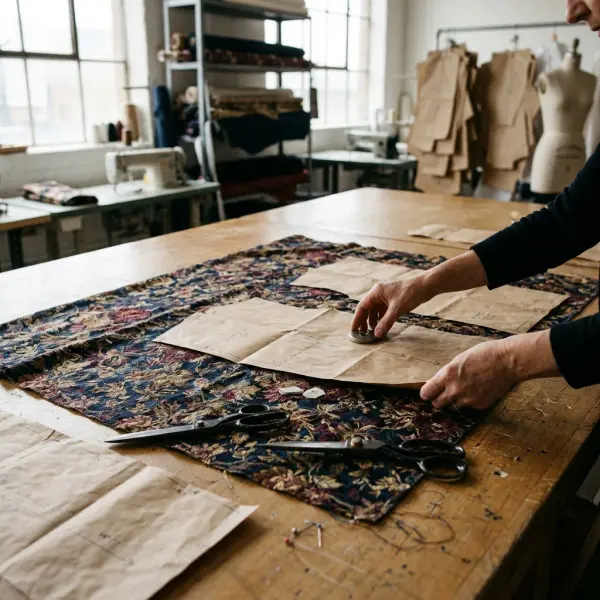
Brands should evaluate full-width fabric samples and test the motif against actual garment pattern pieces. Digital mockups can help with preliminary placement, but physical sampling remains important for confirming scale and alignment.
Cutting Direction and Pattern Matching
Some jacquard fabrics have directional motifs or surface effects that look different when rotated. Depending on the design, reversing a pattern piece may produce noticeable differences in color, sheen, or motif orientation.
Maintaining consistent direction can reduce marker efficiency because pattern pieces cannot always be rotated freely to minimize waste.
Matching motifs at center-front openings, side seams, or visible pockets may require additional fabric allowance. This is especially relevant for large-scale decorative patterns and symmetrical garments.
A purchasing team that calculates fabric consumption using only garment dimensions may therefore underestimate the actual material requirement.
Sewing, Pressing, and Finishing Behavior
Jacquard fabrics may present construction challenges related to bulk, fraying, yarn floats, or heat sensitivity. These characteristics are not universal, but they must be checked on the specific fabric.
Dense woven jacquards can create thick seam intersections, while loose or delicate constructions may require careful handling to avoid distortion. Some synthetic or metallic-effect yarns may also be sensitive to inappropriate ironing temperatures.
Production teams should test needle selection, stitch formation, seam finishing, pressing conditions, and any required interfacing or lining. The most reliable procedures are those developed using production-representative fabric samples.
How Fashion Businesses Can Apply Jacquard Fabric Strategically
For fashion businesses, jacquard should be treated as a product-development decision rather than simply a decorative fabric choice. The selection influences sourcing, garment design, production cost, quality assurance, and retail presentation.
The most effective approach begins with the intended garment and customer, followed by a clear material specification. Textile appearance matters, but commercial viability depends on whether the fabric can be reproduced consistently at the required quality, price, and volume.
Start With the Garment's Functional Requirements
Before approaching suppliers, the development team should define what the fabric must achieve. A structured blazer requires different properties from a fluid blouse, even when both use decorative woven patterns.
The sourcing brief should address the garment's expected movement, comfort requirements, intended season, desired appearance, and target retail positioning.
A practical specification framework might include the following:
|
Specification |
What the brand should confirm |
Why it matters |
|
Fabric construction |
Woven or knitted jacquard; relevant structural details |
Determines stretch, sewing behavior, and material suitability |
|
Fiber composition |
Exact fiber percentages and yarn characteristics |
Influences feel, care, performance, and labeling |
|
Fabric weight |
Mass per unit area, usually expressed in g/m² |
Helps evaluate suitability for the intended silhouette |
|
Usable width |
Width available after excluding unusable edges |
Affects garment yield and purchasing quantity |
|
Pattern repeat |
Horizontal and vertical repeat dimensions |
Influences cutting layout and motif matching |
|
Pattern direction |
One-way, two-way, or otherwise restricted placement |
Affects marker efficiency and visual consistency |
|
Surface construction |
Floats, relief, backing, and face-versus-reverse characteristics |
Helps identify snagging and finishing risks |
|
Color and finish |
Approved colors, surface effects, and finishing process |
Supports consistent appearance between batches |
|
Performance |
Relevant abrasion, dimensional stability, colorfastness, and other testing |
Reduces unexpected performance problems |
|
Commercial terms |
Minimum order, development cost, lead time, and reorder conditions |
Establishes whether the fabric is commercially feasible |
This specification should be confirmed with the mill rather than inferred from a sample photograph or product name. Textile suppliers may use similar commercial descriptions for fabrics with substantially different constructions.
Develop Samples Before Committing to Production
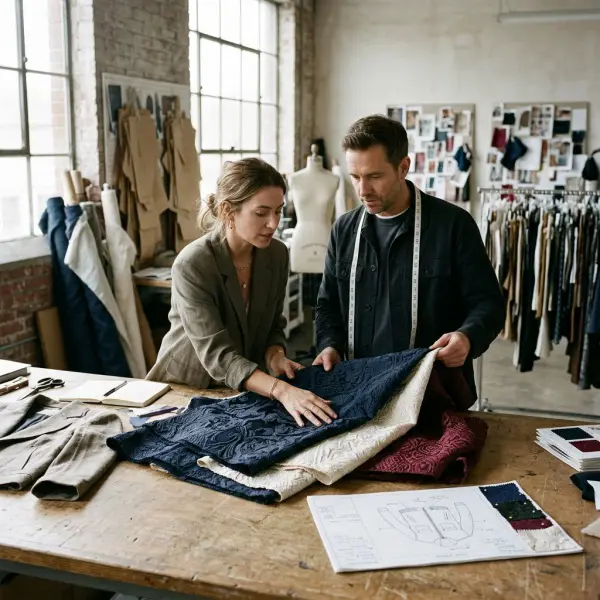
Fabric swatches are useful for initial selection, but they reveal only part of the material's behavior. A small sample may show texture and color without demonstrating how the fabric drapes across a full garment.
Brands should progress from material evaluation to a production-representative garment prototype. This allows designers and manufacturers to assess motif placement, sewing behavior, seam bulk, garment movement, and comfort.
Sampling is particularly important for decorative fabrics with long floats, directional patterns, or pronounced surface relief. Problems that are difficult to notice on a flat sample can become obvious around collars, sleeves, waist seams, and pocket openings.
Where custom jacquard development is involved, approval should cover both the woven fabric and the finished garment.
Calculate the Total Commercial Cost
Jacquard sourcing decisions should consider more than the supplier's quoted price per meter.
Production costs may include weave development, yarn preparation, machine setup, sampling, finishing, testing, and minimum-order requirements. Complex patterning can also affect weaving efficiency. CottonWorks notes that jacquard fabrics are normally more expensive to produce because of their complexity and slower weaving speed, although actual quotations depend on the construction and supplier.
For a small collection, the price difference may be significant when development costs are distributed across relatively few garments. For a recurring product with stable demand, the calculation may be different.
A brand should therefore evaluate landed fabric cost, estimated consumption per garment, cutting loss, expected production volume, and the achievable selling price together.
Align Jacquard With Collection Positioning
Jacquard can be used selectively rather than across an entire collection. A distinctive jacket, dress, or accessory may provide enough textile interest to establish a seasonal theme while allowing other garments to use simpler materials.
This approach can help control complexity. It also gives buyers the opportunity to test customer interest before committing to larger custom developments.
The relationship between decorative fabrics, product variety, and inventory exposure is closely connected to fashion assortment planning and product mix decisions.
A more detailed approach to premium product development is covered in How Fashion Designers Choose Jacquard Fabrics for Premium Apparel.
Common Mistakes When Working With Jacquard Fabric
Mistake 1: Assuming All Jacquard Fabrics Are Heavy or Stiff
Some designers associate jacquard exclusively with substantial formalwear fabrics. This can lead them to reject suitable lighter constructions or select overly heavy qualities for garments that require movement. Because jacquard is a patterning technique, the resulting fabric can vary considerably in weight and flexibility. Brands should begin with the garment's performance requirements and assess the physical sample rather than relying on the fabric category name.
Mistake 2: Selecting Fabric Based Only on the Decorative Pattern
A visually appealing motif does not guarantee that the material will perform well when worn. A highly textured jacquard may create friction, feel uncomfortable against the skin, or contain exposed yarn floats that are unsuitable for certain garments. If these issues are discovered after fabric purchasing, the brand may need to change construction details or redesign the product. Early evaluation should cover both the visible face and the reverse side of the cloth.
Mistake 3: Ignoring Pattern Repeat During Cutting
Large or directional motifs can create cutting inefficiencies that are easily overlooked during initial costing. When pattern pieces must align across seams or maintain a particular orientation, the factory may need more fabric than a standard consumption estimate suggests. This can increase material cost and complicate production planning. The solution is to confirm repeat dimensions, direction, and intended motif placement before approving the cutting marker.
Mistake 4: Assuming Woven Patterns Cannot Deteriorate
Because a jacquard motif is integrated into the textile structure, it is not subject to the same surface-print removal mechanism as a printed design. Nevertheless, yarn colors can fade, the surface can abrade, and exposed floats can snag or break. A woven pattern is therefore not a guarantee of permanent appearance. Brands should specify appropriate performance testing and care instructions according to the garment's intended use.
Mistake 5: Treating the Jacquard Label as Proof of Premium Quality
The word jacquard describes construction, not a verified quality grade. A fabric with an intricate woven pattern may still contain unsuitable yarns, inconsistent weaving, poor finishing, or unacceptable dimensional changes. Positioning such a product as premium without reviewing its performance can create a mismatch between customer expectations and actual quality. Suppliers should provide specifications, representative samples, and relevant test evidence before the material is approved.
What Brands Should Verify Before Choosing Jacquard Fabric
Jacquard provides significant design flexibility, but textile appearance alone cannot establish whether a fabric is suitable for commercial apparel production. Brands need technical evidence for the performance characteristics relevant to the intended garment.
For example, a decorative jacket and a heavily worn pair of trousers may require different abrasion expectations. Similarly, a washable cotton-blend jacquard should be evaluated differently from a delicate formalwear fabric intended for professional cleaning.
Relevant testing may include dimensional stability, rubbing colorfastness, abrasion resistance, and other requirements determined by the garment's use and market. The International Organization for Standardization publishes methods such as ISO 5077 for determining dimensional change after washing and drying, ISO 105-X12 for colorfastness to rubbing, and ISO 12947-2 for determining abrasion-related specimen breakdown using the Martindale method.
These standards define test methods; they do not, by themselves, establish one universal acceptable result for every jacquard garment. Brands must determine appropriate performance requirements based on product category, customer expectations, and applicable market requirements.
Sustainability Claims Require Separate Evidence
Jacquard weaving does not automatically make a fabric more sustainable than printed, embroidered, or conventionally woven alternatives.
The environmental profile depends on factors such as fiber production, dyeing, yarn preparation, weaving efficiency, finishing, energy consumption, fabric waste, product durability, and end-of-life considerations.
A complex woven motif might eliminate a separate decorative process in one product, but it could also introduce additional yarn consumption or manufacturing complexity. Without a defined comparison and supporting data, neither outcome should be presented as an environmental benefit.
Brands should evaluate the complete material and manufacturing specification before making claims about reduced impact, improved durability, or environmental performance.
Frequently Asked Questions About Jacquard Fabric
1. Is jacquard fabric made from cotton or polyester?
Jacquard fabric can be made from cotton, polyester, silk, wool, viscose, and various fiber blends. The term describes how the pattern is constructed rather than identifying a specific fiber. Cotton jacquard may offer a different feel and moisture-management profile from polyester jacquard, while silk or viscose constructions can produce different drape and surface effects. However, fiber content alone does not determine fabric performance. Yarn characteristics, weave density, finishing, and fabric weight all contribute to the result. Fashion buyers should request a complete fiber composition and examine a physical sample before deciding whether a particular jacquard is appropriate for their collection.
2. Is jacquard fabric suitable for everyday clothing?
Jacquard can be suitable for everyday apparel when its construction matches the garment's comfort and durability requirements. Lightweight woven jacquards may work for blouses, while stronger or more substantial constructions may be appropriate for skirts, jackets, and casual separates. The presence of a decorative motif does not automatically make the fabric too formal for daily use. However, exposed floats, excessive stiffness, or poor abrasion performance may limit suitability for garments exposed to frequent friction. Brands developing everyday jacquard products should test movement, laundering behavior, color stability, and surface durability before approving the fabric for production.
3. What is the difference between jacquard and embroidered fabric?
Jacquard patterns are formed as part of the textile construction, while embroidery uses additional stitching to create decoration on a base fabric. Woven jacquard develops its motifs through warp and weft interlacing, whereas embroidery typically adds thread to a fabric that has already been produced. Both techniques can create decorative depth, but they differ in manufacturing sequence, design flexibility, surface construction, and cost implications. A jacquard may reduce the need for a separate embroidery operation, although it can require more complex textile development. Apparel brands should compare finished-garment costs and appearance rather than assuming that either method is inherently superior.
4. Does jacquard fabric wrinkle easily?
Wrinkling depends on the fiber composition, yarn structure, fabric construction, and finishing rather than the jacquard patterning technique alone. A cotton or viscose jacquard may behave differently from a polyester-rich construction, while dense weaving or specific finishing treatments can influence crease formation. Some textured patterns may visually disguise minor wrinkles, but this does not mean the fabric is resistant to creasing. Designers should examine a fabric sample after folding, handling, and appropriate care testing. For travelwear, uniforms, or garments requiring frequent maintenance, crease recovery and pressing behavior should be included in the material approval process.
5. Can jacquard fabric be washed at home?
Some jacquard fabrics can be washed at home, while others require specialist care. The appropriate method depends on fiber composition, weave stability, finishing, dye behavior, decorative yarns, and garment construction. A washable cotton-blend jacquard may tolerate a suitable domestic laundering process, whereas a delicate silk or metallic-effect jacquard may require more restrictive care. The decorative structure itself does not determine the correct washing method. Apparel brands should establish care instructions using relevant fabric and finished-garment testing rather than copying instructions from another jacquard product. Consumers should follow the care label supplied with the specific garment.
6. Is jacquard fabric more expensive than printed fabric?
Jacquard can be more expensive than printed fabric, particularly when it involves custom pattern development, complex weaving, specialized yarns, or small production quantities. The total cost also depends on loom efficiency, order volume, finishing, and production setup. Printed textiles may offer more economical options for certain artwork, especially when a brand wants to introduce multiple designs without developing a separate weave structure for each one. However, the price difference is not fixed across all products. Brands should compare the cost of equivalent finished fabrics and garments, including development, decoration, material waste, and quality requirements.
7. Is jacquard always a premium fabric?
Jacquard is not automatically premium. It is a textile patterning method that can be used across different quality and price levels. Intricate woven patterns may contribute to a sophisticated appearance, but genuine product quality depends on yarn selection, fabric consistency, finishing, garment construction, comfort, and durability. A poorly finished jacquard can perform worse than a carefully manufactured plain fabric. For premium fashion brands, the material should reinforce the garment's overall design and quality proposition rather than serve as the only justification for a higher selling price. Testing and production consistency remain essential.
Conclusion: Understanding Jacquard Beyond Its Decorative Appearance
Jacquard fabric is valuable to fashion design because it brings pattern and textile structure together. Instead of treating decoration as a separate surface treatment, jacquard allows designers to develop visual identity through the construction of the material itself.
Its versatility is also the reason it requires careful evaluation. Jacquard can be lightweight or substantial, understated or elaborate, flexible or relatively rigid. No single description captures all of its possible characteristics, and the presence of an intricate woven motif does not establish material quality.
For fashion businesses, the most productive approach is to connect textile selection with garment requirements, manufacturing capabilities, and commercial positioning. The right jacquard should work not only as a fabric swatch but also as a finished product that meets expectations for fit, comfort, appearance, and durability.
Brands that understand these relationships can use jacquard more deliberately, choosing decorative woven fabrics for the value they bring to a particular design rather than for the appeal of the label alone.





Comments 0
Leave a CommentSend Comment
Anda harus Login terlebih dahulu untuk dapat memberikan komentar.