
Jacquard vs Brocade: Key Differences in Decorative Woven Fabrics
Jacquard and brocade are frequently mentioned together in fashion sourcing conversations, particularly when designers are looking for richly patterned textiles. Both can feature intricate floral motifs, geometric designs, and decorative surfaces that make garments visually distinctive. Yet the terms do not describe exactly the same thing.
Jacquard refers primarily to a method of controlling yarns during weaving, allowing complex patterns to be formed directly within the fabric. Brocade, on the other hand, refers to a decorative woven textile or patterning technique traditionally associated with elaborate motifs, often created using supplementary yarns. Many modern brocades are woven on jacquard looms, which explains why the two names sometimes appear together in supplier catalogs.
For apparel brands, this distinction has practical consequences. A lightweight tonal jacquard might suit an understated tailored jacket, while an ornate brocade with metallic-effect yarns may be more appropriate for ceremonial clothing or statement occasionwear. The difference is not simply about which fabric looks more luxurious. It concerns structure, surface behavior, garment suitability, production requirements, and cost.
Understanding where jacquard and brocade overlap—and where they differ—helps fashion businesses evaluate decorative textiles more accurately rather than making purchasing decisions based on names alone.
Quick Answer: What Is the Difference Between Jacquard and Brocade?
The main difference between jacquard and brocade is that jacquard describes a weaving technology and the patterned fabrics associated with it, while brocade describes a decorative woven textile or patterning technique. Brocade traditionally involves additional pattern-forming yarns, particularly supplementary wefts, although commercial terminology can be broader.
Jacquard fabrics can range from subtle tonal patterns to complex multicolored designs. Their appearance depends on yarn selection, weave structure, and finishing. Brocade is generally associated with more elaborate decorative motifs and may incorporate colored, lustrous, or metallic-effect yarns to create visual contrast.
The two categories are not mutually exclusive. A brocade can be produced using jacquard weaving technology, and a single textile may correctly be described as both jacquard and brocade.
For fashion designers, jacquard offers a broad range of patterned textile possibilities, while brocade often serves designs requiring a more ornamental appearance. However, neither term guarantees a particular fiber composition, weight, comfort level, or quality grade.
The most reliable selection method is to examine the actual textile construction, physical performance, and intended garment application rather than assuming that one category is inherently superior.
Understanding Jacquard and Brocade as Textile Categories
The comparison becomes clearer when the two terms are considered from a textile-construction perspective rather than a retail-description perspective.
Jacquard identifies how intricate woven patterns can be controlled during production. Brocade identifies a decorative textile tradition and associated methods of introducing ornamental yarns into a woven structure. These are different levels of classification, which is why they can overlap.
What Is Jacquard Fabric?
Jacquard fabric is a patterned textile commonly produced using a jacquard loom mechanism that allows individual warp ends to be controlled independently. This permits the creation of complex woven designs through variations in yarn interlacing, color, and texture.
The resulting fabric might be floral, geometric, abstract, pictorial, or nearly monochromatic. It may be lightweight or heavy, soft or structured, depending on its yarns, density, and finishing.
The textile education resource CottonWorks explains jacquard weaving and individual warp-yarn control, including how different basic weave arrangements can be combined to form elaborate designs.
CottonWorks™
In practical sourcing, jacquard is often used as an umbrella term for a wide variety of patterned woven fabrics. A supplier might offer a cotton jacquard for casual dresses, a viscose-blend jacquard for tailored separates, or a richly figured polyester jacquard for formalwear.
Readers looking for a more detailed explanation of the technology can refer to Jacquard Fabric Explained: Structure, Texture, and Fashion Uses.
What Is Brocade Fabric?
Brocade is a decorative woven textile associated with ornamental patterns that are often formed using supplementary yarns in addition to the fabric's ground structure.
In technical textile terminology, brocading often refers specifically to the introduction of supplementary weft yarns in selected pattern areas rather than across the entire fabric width. The European silk-heritage resource SILKNOW defines a brocading weft as a supplementary or complementary weft limited to the part of the fabric where the motif is required.
Traditional brocades may include silk, colored supplementary wefts, and metallic yarns. Modern commercial brocades can also use synthetic fibers and metallic-effect yarns. However, metallic threads are not essential to every brocade, and the term does not automatically indicate silk composition.
Brocade commonly has an ornate appearance, but its actual surface structure may be relatively flat or noticeably raised depending on the design. Different regional textile traditions also use techniques and terminology that do not fit one simplified commercial definition.
Why One Fabric Can Be Both Jacquard and Brocade
A textile can qualify as both jacquard and brocade because the descriptions refer to different aspects of its construction.
A jacquard-controlled loom may produce an elaborate decorative fabric that incorporates supplementary patterning wefts. In that situation, jacquard identifies the pattern-control method, while brocade describes the decorative construction or fabric category.
A historical example documented by the Smithsonian's National Museum of American History is a 1913 Cheney Brothers brocade, described as a jacquard-woven textile incorporating supplementary weft yarns.
This overlap is central to understanding textile specifications. Asking whether a fabric is jacquard or brocade may produce an incomplete answer because the two descriptions are not necessarily alternatives.
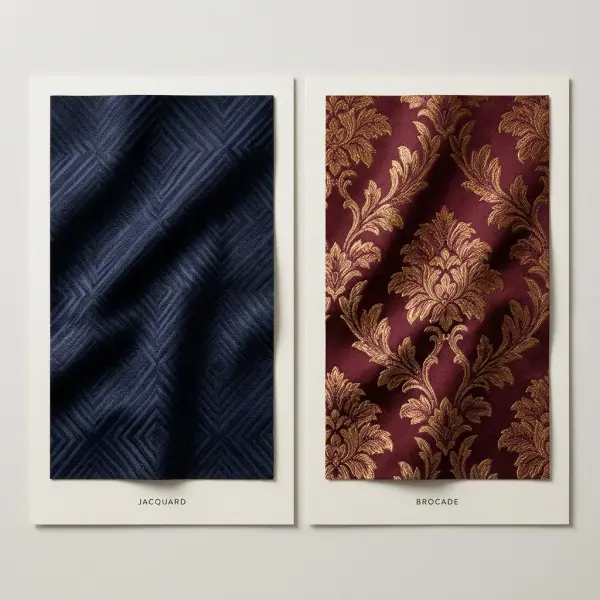
Jacquard vs Brocade: A Practical Comparison
Although the categories overlap, comparing their typical characteristics is useful when evaluating fabrics for apparel collections.
The table below contrasts jacquard as a broad patterned-weaving category with brocade as a specific decorative textile category. These are common characteristics, not universal rules.
|
Comparison factor |
Jacquard |
Brocade |
|
Primary meaning |
Pattern-control weaving technology and resulting textiles |
Decorative woven textile or brocading technique |
|
Pattern formation |
Complex yarn interlacing controlled by a jacquard mechanism |
Often uses supplementary yarns to create ornamental motifs |
|
Visual appearance |
Subtle, tonal, geometric, floral, or elaborate |
Frequently ornate, figured, and visually prominent |
|
Surface texture |
Flat, smooth, raised, or structured |
Often textured or visually dimensional, but can also be relatively flat |
|
Metallic yarns |
Optional |
Common in some styles, but not required |
|
Fiber composition |
Cotton, silk, wool, polyester, viscose, and blends |
Silk, cotton, polyester, viscose, and other fibers or blends |
|
Fabric weight |
Highly variable |
Highly variable, although some traditional decorative constructions are substantial |
|
Drape |
Depends on yarns, weave, and finishing |
Depends on yarns, weave, supplementary patterning, and finishing |
|
Typical apparel uses |
Jackets, dresses, skirts, trousers, accessories |
Occasionwear, ceremonial attire, statement jackets, accessories |
|
Production method |
Commonly jacquard-controlled weaving |
May be produced using jacquard equipment or other brocading methods |
|
Potential cost drivers |
Pattern complexity, yarns, loom setup, weaving efficiency |
Decorative yarns, additional patterning operations, complexity, finishing |
|
Main sourcing consideration |
Verify the specific weave and performance requirements |
Verify decorative yarn structure, floats, handling, and garment suitability |
The table should not be interpreted as a quality ranking. A carefully manufactured jacquard can be more elaborate or expensive than a commercially labeled brocade, while a lightweight brocade can be suitable for garments that require less structure.
The useful question for sourcing teams is not simply which category is better. It is whether a specific textile delivers the intended appearance and performs satisfactorily in the finished garment.
The Structural Difference: Woven Patterns vs Supplementary Decoration
The most technically meaningful distinction between jacquard and brocade concerns how the decorative design is produced.
Both can be woven textiles, and both can incorporate complex structural effects. However, jacquard patterning does not necessarily require extra decorative yarns, whereas brocading traditionally involves supplementary yarns that contribute to the motif.
Understanding this difference helps explain why two visually similar fabrics may behave differently during garment manufacturing.
Jacquard Patterns Can Be Created Through Changes in Weave Structure
In many jacquard fabrics, the design is formed by changing how the existing warp and weft yarns interlace. Different weave areas can create contrasting light reflection, color distribution, or surface texture.
Consider a tonal black jacquard with a large botanical motif. The flowers may appear more reflective because their weave structure differs from that of the matte background. The fabric does not necessarily require a separate set of ornamental yarns to make the design visible.
This construction can produce sophisticated patterns with relatively restrained color combinations. It is particularly useful when the designer wants the textile to contribute visual depth without dominating the overall garment.
That does not mean every jacquard is simple or lightweight. Jacquard technology can also support complex fabrics incorporating additional yarn systems, multiple layers, and elaborate decorative constructions.
Brocade Often Uses Additional Patterning Yarns
Traditional brocading introduces decorative yarns into selected parts of a woven ground. These supplementary yarns can create colored motifs, metallic effects, or a more pronounced surface.
For example, a silk fabric may use one yarn system to form its base structure and additional gold-colored yarns to create floral ornamentation. The supplementary yarns may appear prominently on the fabric face without performing the same structural role as the ground yarns.
Museum collections provide well-documented examples. The Los Angeles County Museum of Art records a sixteenth-century Italian silk brocade with metal-strip and metallic-thread supplementary-weft patterning.
It is worth distinguishing between continuous supplementary wefts that travel across the width of the cloth and discontinuous brocading wefts introduced only where the pattern requires them. Both can contribute to decorative textile effects, but they may differ in yarn consumption, production method, and reverse-side appearance.
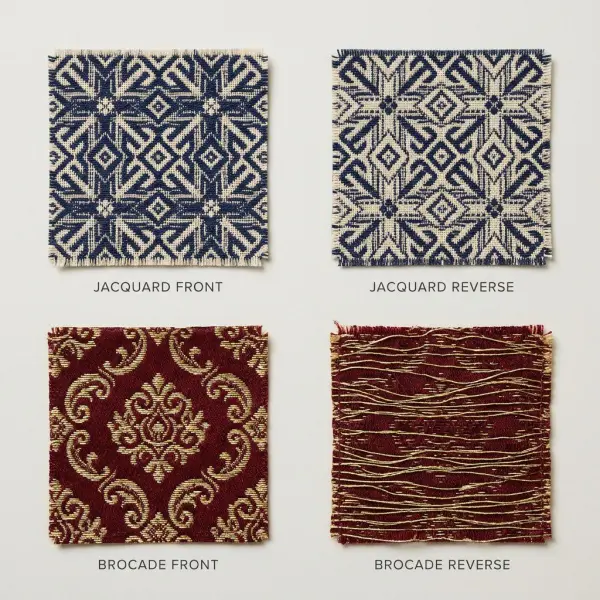
The Reverse Side Can Reveal Important Construction Details
Examining the reverse of a decorative fabric is often more informative than relying on its front surface alone.
A jacquard may show a contrasting or reversed version of its design, depending on its weave structure. Some woven patterns are nearly reversible, while others have a clearly designated face and reverse.
Brocade may expose supplementary yarns, floats, or other evidence of its decorative construction on the reverse. These features can affect how the material should be handled, lined, cut, and sewn.
However, an exposed float is not sufficient to identify a fabric definitively as brocade. Other woven constructions also use floats, and finishing or backing treatments may conceal the original patterning structure.
For accurate classification, a textile specialist may need to inspect the yarn systems and interlacings rather than relying entirely on visual appearance.
Texture, Appearance, and Draping: What Designers Actually Notice
From a design perspective, jacquard and brocade are often compared through visual richness. Brocade is conventionally associated with elaborate decoration, while jacquard encompasses both subtle and highly decorative surfaces.
That distinction is useful for initial styling decisions, but it is insufficient for evaluating physical performance. The appearance of a textile can suggest stiffness, weight, or dimensionality without accurately indicating how it will behave when made into clothing.
Jacquard Can Create Subtle Surface Complexity
A contemporary jacquard might use a small repeating geometric pattern, a tonal botanical motif, or a restrained abstract design. These patterns can add interest without producing a strong contrast against the garment's base color.
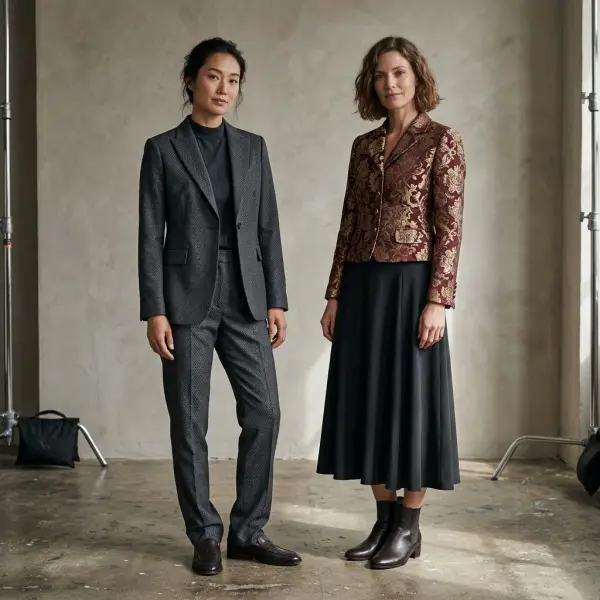
For minimalist premium apparel, this subtlety can be useful. A charcoal jacquard blazer may reveal its pattern mainly under directional lighting, allowing the garment to remain versatile across different outfits.
The fabric can also contribute visual structure to otherwise simple silhouettes. A straight-cut dress made from carefully selected jacquard may appear more detailed than the same design in a plain weave, even without additional embroidery or decorative trims.
However, a strongly figured jacquard can be just as visually elaborate as brocade. The difference is not a strict division between minimalism and ornamentation.
Brocade Often Emphasizes Ornament and Contrast
Brocade frequently uses contrasting yarns, intricate motifs, and reflective surfaces to produce a more prominent decorative effect.
Metallic-effect threads can emphasize floral scrolls, medallions, and other ornamental forms. Colored supplementary yarns may also create motifs against a contrasting ground, giving the textile a layered appearance.
This visual richness makes brocade particularly suitable for garments intended to attract attention through material decoration. Formal jackets, ceremonial robes, occasionwear dresses, and statement accessories are familiar examples.
The designer must nevertheless manage the relationship between motif scale and garment proportions. Large decorative patterns can look impressive on an uninterrupted length of fabric but become visually fragmented when divided by numerous seams, darts, or small panels.
Neither Fabric Has a Fixed Weight or Drape
There is no universal rule that brocade must be heavier or stiffer than jacquard.
Some brocades are substantial because they use dense construction and multiple yarn systems. Others may be relatively lightweight. Similarly, jacquard fabrics range from fluid qualities to heavily structured materials.
Drape depends on several interacting characteristics, including fiber composition, yarn twist, fabric density, thickness, weave structure, and finishing.
For example, a dense polyester jacquard could be more rigid than a lighter silk brocade. Conversely, a brocade with substantial metallic-effect patterning may require a structured silhouette or additional garment support.
A fashion business should therefore assess the actual fabric sample rather than treating the category name as a substitute for weight, flexibility, or handfeel specifications.
How Jacquard and Brocade Shape Different Fashion Applications
The choice between jacquard and brocade often begins with the desired visual character of the garment. However, the strongest decisions also consider how the material will interact with the wearer's movements, the garment pattern, and the intended occasion.
Both fabrics can support premium apparel, but their typical applications reveal different design priorities.
Tailored Jackets and Contemporary Separates
Jacquard can work effectively for tailored jackets, coordinated sets, and structured separates when the designer wants the fabric to carry a subtle or moderately decorative pattern.
A navy geometric jacquard jacket, for example, could be paired with plain trousers to create a balanced professional or smart-casual look. The woven texture adds distinction while allowing the silhouette to remain the main design feature.
Brocade may be appropriate when the jacket is intended as a statement piece. A short ceremonial jacket with richly figured metallic motifs can become the central element of an outfit.
The construction requirements may differ. Highly decorative brocade surfaces can introduce more noticeable pattern-matching concerns, while substantial supplementary yarns may require special attention at lapels, seam intersections, and pocket openings.
These considerations depend on the specific cloth rather than on brocade as a category.
Evening Dresses and Special-Occasion Apparel
Both jacquard and brocade are suitable for certain eveningwear and occasionwear designs.
Jacquard may be selected for understated elegance, structured silhouettes, or tonal motifs. Brocade is often chosen when a more ornamental textile appearance contributes to the intended occasion or design concept.
A fitted dress with a full skirt could use a firm jacquard to create shape, while a decorative brocade might be used for a cropped jacket worn over a plain evening dress. Alternatively, a lightweight brocade with suitable drape could form the main fabric of a dress.
Comfort remains important. A decorative surface that feels appealing in a showroom may require lining to prevent friction against the skin. Weight and stiffness must also be assessed around the bodice, shoulders, and waist.
The choice of full or partial garment lining can affect comfort, appearance, bulk, and the final manufacturing cost.
Ceremonial Clothing and Culturally Significant Textiles
Brocaded textiles have long been used in various ceremonial and formal clothing traditions. Their significance extends beyond decorative appearance because particular motifs, weaving practices, and garment forms may carry cultural or historical meaning.
For example, the Metropolitan Museum of Art documents Japanese formal obi incorporating silk and gold-thread supplementary-weft patterning. Its collection includes a wedding obi made from brocaded silk, illustrating how complex decorative weaving is connected to formal dress traditions.
The Metropolitan Museum of Art
Other regional traditions use supplementary-weft decoration in different ways. These techniques should not be treated as interchangeable merely because their fabrics share an ornate appearance.
Fashion brands incorporating culturally associated motifs should understand their origins, appropriate contexts, and the communities or makers connected to them. Technical similarity does not erase cultural distinctions.
Bags, Footwear, and Decorative Accessories
Jacquard and brocade can both be incorporated into handbags, footwear uppers, fabric belts, and decorative accessories.
A geometric jacquard may provide a recognizable repeat pattern for an everyday bag, while brocade can contribute a more ornamental character to an evening clutch or special-occasion accessory.
Accessories create different performance demands from apparel. Fabric surfaces may experience concentrated friction, repeated folding, contact with hardware, and exposure to external surfaces.
A delicate brocade with long decorative floats could be visually suitable for a clutch but require reinforcement or protective construction. A more compact jacquard may be a practical alternative for an accessory intended for frequent use, provided testing confirms the required durability.
Manufacturing and Sourcing Differences That Affect the Final Garment
For fashion manufacturers, the name of the textile is less important than the actual construction and production behavior.
Two fabrics offered under the same decorative category may require substantially different sewing procedures, cutting allowances, quality checks, or care instructions. A supplier's product description should therefore be treated as the starting point for technical evaluation, not as a complete manufacturing specification.
Pattern Matching and Fabric Consumption
Both jacquard and brocade can have large decorative repeats that require careful positioning on garment pattern pieces.
When motifs must align at center fronts, side seams, or visible pockets, cutting layouts may become less efficient. Fabric pieces may need to be positioned according to the pattern repeat rather than arranged solely for minimum material consumption.
This issue is particularly noticeable when a decorative motif forms the primary visual feature of a garment. A mismatched floral medallion on an otherwise carefully tailored jacket can undermine the intended appearance.
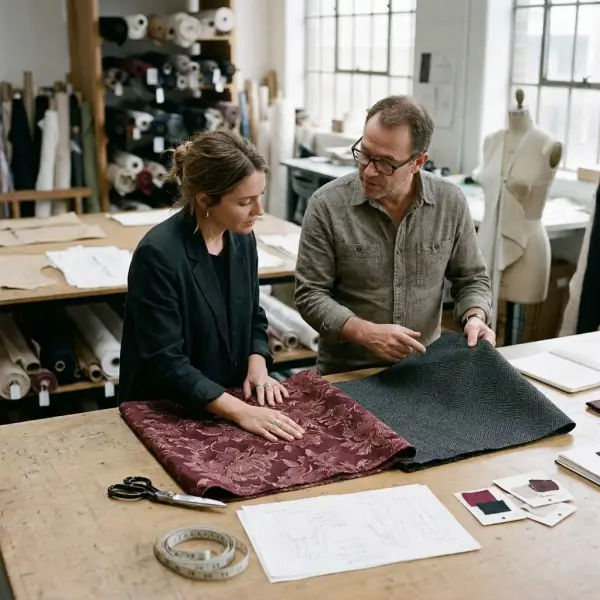
Brands should confirm horizontal and vertical repeat measurements, usable width, and pattern direction before calculating fabric requirements. For large motifs, reviewing a full-width sample is more reliable than evaluating a small swatch.
Sewing and Seam Finishing
Decorative woven fabrics may require special handling during sewing, particularly when the structure contains dense yarn intersections, loose edges, long floats, or metallic-effect components.
A compact jacquard can still fray, while a relatively lightweight brocade may be stable enough for straightforward construction. Neither material category guarantees easy or difficult sewing.
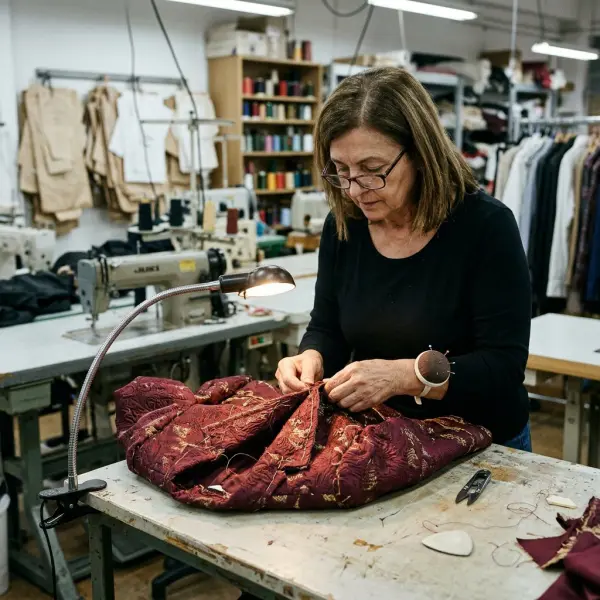
The manufacturer should evaluate needle and thread selection, stitch density, seam bulk, edge finishing, and pressing behavior. Sample seams are useful for identifying whether decorative yarns shift, break, or become visually distorted during construction.
If the fabric has a textured reverse, a lining or suitable backing may be necessary for wearer comfort or to protect the textile. This decision should be made during sampling rather than added automatically after production problems appear.
Decorative Yarn Floats and Abrasion
Long yarn floats can create a visually attractive surface, but they may also introduce snagging risks.
This is relevant to some brocaded constructions, although long floats can occur in other woven fabrics as well. The concern is not the label brocade itself but whether exposed yarns are vulnerable to friction or catching.
For a jacket intended for occasional formal use, the acceptable performance profile may differ from that of trousers or an everyday handbag. A fabric that is suitable for one application can be inappropriate for another.
Brands should evaluate the intended points of contact, customer care expectations, and relevant abrasion or snagging performance. Where necessary, the design may need a different textile construction rather than simply a stronger sewing method.
Color Consistency and Metallic-Effect Finishing
Decorative textiles can be particularly sensitive to visible differences in color and sheen between production batches.
A subtle jacquard may rely on consistent contrast between matte and reflective weave areas. A brocade incorporating metallic-effect yarns may depend on the appearance of the decorative yarns remaining consistent across the fabric width and between lots.
Finishing processes can influence these results. Heat, pressure, moisture, or chemical treatment may affect different yarn types in different ways.
Manufacturers should use approved production standards, confirm tolerances with suppliers, and evaluate material appearance under relevant lighting conditions before bulk acceptance.
Is Jacquard or Brocade More Expensive?
Neither jacquard nor brocade is universally more expensive. The cost depends on fiber composition, yarn quality, weave complexity, decorative yarn systems, production quantity, finishing, and supplier capability.
A custom jacquard may require significant pattern development and complex loom setup. Brocade may also involve expensive supplementary yarns, additional weaving operations, or specialized finishing. In some cases, both characteristics exist in the same fabric.
For a fashion brand, the relevant comparison is the total cost of developing and manufacturing the finished product.
How Textile Construction Influences Cost
A patterned textile can incur costs before bulk weaving begins. The mill may need to prepare pattern files, determine suitable weave structures, test yarn combinations, and produce samples for approval.
Jacquard weaving can introduce production complexity because the mechanism controls individual warp yarns to form intricate patterns. CottonWorks identifies increased complexity and slower weaving as factors that commonly contribute to higher jacquard fabric costs.
For brocade, additional considerations may include supplementary-yarn materials, their placement within the structure, and the handling of delicate or specialized decorative yarns.
However, a supplier manufacturing an established brocade design at scale may offer more competitive pricing than a custom-developed jacquard produced in a small order.
[H3] Why Fabric Price Alone Is Misleading
Imagine a fashion brand evaluating two fabrics for a limited-edition jacket. One is a relatively affordable jacquard with a large directional repeat. The other is a more expensive brocade with a smaller motif and better cutting flexibility.
The first fabric may have a lower quoted price per meter but require additional consumption to align motifs across the jacket. The second may cost more per meter yet produce less cutting waste.
Other factors include lining requirements, sewing time, finishing losses, fabric defects, and the cost of rejected garments.
Brands should compare the landed and production-adjusted costs of both options. A useful calculation considers fabric consumption per approved garment, expected cutting loss, additional construction requirements, and the total quantity being manufactured.
How Fashion Brands Should Choose Between Jacquard and Brocade
The most effective selection process begins with the garment's intended purpose rather than the decorative textile category.
A designer developing an understated tailored collection may favor a jacquard with controlled texture and a subtle repeat. A brand preparing an elaborate occasionwear capsule may consider brocade for its ornamental character. These are starting points, not fixed rules.
The final decision should also reflect fit, comfort, durability, production capability, and commercial positioning.
A Practical Material Selection Framework
|
Design requirement |
Suitable direction |
What to verify |
|
Subtle texture for tailored clothing |
Tonal jacquard |
Drape, pressability, seam bulk |
|
Strong decorative statement |
Ornamental jacquard or brocade |
Motif scale, surface stability, pattern matching |
|
Formalwear with metallic effects |
Brocade or metallic-yarn jacquard |
Yarn durability, care requirements, comfort |
|
Everyday patterned clothing |
Compact, suitable jacquard construction |
Abrasion, mobility, wash performance |
|
Structured occasionwear |
Firm jacquard or brocade |
Shape retention, lining compatibility, garment weight |
|
Decorative handbags |
Tested jacquard or reinforced brocade |
Surface abrasion, snagging, reinforcement |
|
Custom brand motif |
Purpose-developed jacquard, potentially including brocade effects |
Design feasibility, minimum order, development cost |
This framework should be used to shortlist textiles rather than to make final approval decisions. Actual fabric samples and production trials remain essential.
What to Include in a Supplier Evaluation
When requesting quotations or sampling options, fashion businesses can improve decision-making by providing a consistent set of requirements.
A practical sourcing checklist should cover:
- Construction: Confirm whether the fabric is jacquard-woven, brocaded, or a combination, and identify the yarn systems where relevant.
- Composition and weight: Obtain the fiber percentages, fabric weight, and usable width.
- Pattern characteristics: Verify repeat dimensions, direction, colorways, and the appearance of both sides.
- Performance: Identify appropriate abrasion, snagging, colorfastness, dimensional-stability, and care requirements.
- Production feasibility: Confirm minimum order quantities, sample approval procedures, lead times, and available capacity.
- Commercial cost: Compare total material and garment manufacturing costs rather than quoted fabric prices alone.
Supplier answers should be supported by representative physical samples, technical specifications, and relevant test results. This is particularly important when custom patterns or specialized decorative yarns are involved.
Brands requiring a more detailed methodology can explore How Fashion Designers Choose Jacquard Fabrics for Premium Apparel.
Common Mistakes When Comparing Jacquard and Brocade
Mistake 1: Treating Them as Mutually Exclusive Fabrics
Fashion buyers sometimes assume that jacquard and brocade must represent two completely separate manufacturing categories. This can lead to unnecessary confusion when a supplier describes one fabric using both terms. In reality, a brocade can be jacquard-woven, so the descriptions may identify different aspects of the same textile. The better approach is to request the technical construction rather than forcing every material into one exclusive category.
Mistake 2: Assuming Brocade Always Contains Real Gold or Silver
Metallic effects are strongly associated with traditional ornamental brocades, but the appearance of gold or silver does not establish the actual yarn composition. Modern products may use synthetic metallic-effect yarns or other materials designed to create a reflective appearance. Misidentifying these materials can lead to inaccurate labeling, pricing assumptions, or care instructions. Brands should obtain verified composition details from the supplier and avoid making material claims based only on color or sheen.
Mistake 3: Choosing the More Decorative Fabric Without Testing Comfort
An elaborate brocade can look impressive in a fashion presentation but become uncomfortable if the garment is heavy, stiff, or abrasive against the skin. Similarly, a densely constructed jacquard may restrict movement when used in an unsuitable silhouette. These issues often arise when fabric selection is driven primarily by visual impact. A production-representative garment sample should be used to assess comfort, flexibility, and the need for lining before the fabric is approved.
Mistake 4: Believing Intricate Patterns Guarantee High Quality
Complex weaving can create a sophisticated appearance, but it does not guarantee durable or well-manufactured fabric. Problems such as uneven yarn tension, unstable decorative floats, inconsistent color, or unsuitable finishing may affect either category. Buyers who treat decorative complexity as proof of quality may overlook defects that become visible during garment production or wear. Material evaluation should include construction consistency, physical performance, and finishing quality alongside appearance.
Mistake 5: Ignoring the Commercial Meaning of the Fabric Name
The terms jacquard and brocade can be used broadly in retail and supplier catalogs. A commercially labeled brocade may not match a narrow historical or technical definition, while a product labeled jacquard may give little information about its actual construction. Relying solely on these names can result in misunderstandings between design, procurement, and manufacturing teams. Written specifications and approved reference samples provide a more reliable basis for purchasing and production.
Technical and Sustainability Caveats Worth Understanding
The comparison between jacquard and brocade should not be reduced to simple rules about luxury, durability, or environmental impact.
Neither category has a universally defined performance level. Specific fabric construction determines whether a textile is sufficiently durable for a particular application, and neither technique automatically produces a more sustainable garment.
Durability Must Be Evaluated by Intended Use
A decorative textile suitable for a special-occasion jacket may not provide adequate performance for everyday trousers or heavily used accessories.
Brands should determine appropriate testing based on the garment category. Relevant international methods include ISO 12947-2 for assessing abrasion-related specimen breakdown and ISO 105-X12 for evaluating colorfastness to rubbing. These methods provide standardized assessment procedures, but acceptable results must be established for the relevant product and market.
Where long decorative floats are present, snagging behavior may also require evaluation. Testing should be performed on the actual approved fabric construction rather than a different fabric marketed under the same category name.
Neither Fabric Is Automatically More Sustainable
Jacquard weaving and brocade production may involve different yarn systems and manufacturing processes, but environmental performance cannot be inferred from those names alone.
A comparison would need to account for fiber production, dyeing, weaving energy, finishing, cutting waste, garment durability, and other relevant lifecycle factors. The use of supplementary yarns does not by itself prove a fabric has a higher environmental impact, just as eliminating a separate embroidery process does not automatically establish an environmental benefit.
Brands making sustainability claims should use relevant, verifiable evidence and define precisely which materials and processes are being compared.
Historical and Commercial Definitions Are Not Always Identical
Brocade has a long history that predates the jacquard loom. Decorative textiles incorporating supplementary yarns were produced using earlier weaving technologies, so traditional brocade should not be described as a textile invented by Joseph Marie Jacquard.
The Metropolitan Museum of Art identifies the introduction of Jacquard's influential mechanism in 1801, while museum collections document brocaded textiles from considerably earlier periods.
Modern commercial usage is broader and can blur distinctions between brocade, damask, and other figured woven fabrics. For technical communication, identifying the actual weave structure is more dependable than relying on a historical or retail label.
Frequently Asked Questions About Jacquard vs Brocade
1. Is brocade a type of jacquard fabric?
Many modern brocades can be described as jacquard fabrics when they are manufactured using jacquard weaving technology. However, brocade is not universally a subset of jacquard because brocading techniques existed before the invention of the jacquard mechanism and can be produced using other methods. The distinction is that jacquard describes a pattern-control approach, while brocade describes a decorative textile or patterning technique. For fashion sourcing, the most useful information is whether the supplier's material uses supplementary yarns, how its pattern is formed, and whether the resulting construction is suitable for the intended garment.
2. Which fabric is better for wedding dresses: jacquard or brocade?
Both jacquard and brocade can be suitable for wedding dresses, depending on the desired silhouette, decorative effect, and comfort requirements. A tonal jacquard may work well for a structured dress with understated woven motifs, while an ornate brocade may suit a design featuring elaborate decorative patterns. The better choice depends on actual fabric weight, drape, stiffness, surface feel, and construction compatibility. Designers should also consider whether the motif will remain balanced across bodice seams, skirts, and other garment components. Full-garment sampling is particularly valuable because a fabric that looks attractive flat may behave differently when shaped.
3. Is brocade thicker than jacquard?
Brocade is not necessarily thicker than jacquard. Some brocades have substantial structure because they incorporate dense weaving and supplementary yarn systems, but others can be relatively lightweight. Jacquard fabrics also vary widely in thickness, from lighter patterned cloths to heavy decorative textiles. Fiber composition, yarn size, weave density, and finishing have a greater influence on thickness than the category name alone. Apparel buyers should request fabric weight, examine the material's physical thickness, and assess its drape. These characteristics are especially important for garments with closely fitted sections, layered construction, or detailed seam intersections.





Comments 0
Leave a CommentSend Comment
Anda harus Login terlebih dahulu untuk dapat memberikan komentar.