
Community-Led Growth Strategies for Fashion Businesses
Quick Answer
Community-led growth is a business strategy where an engaged customer community becomes a meaningful driver of brand awareness, retention, advocacy, product feedback, and customer acquisition. For fashion businesses, it works best when customers do more than buy products. They style them, recommend them, discuss them, review them, attend brand experiences, share feedback, and help shape the cultural meaning of the brand.
In fashion, community-led growth can take many forms: referral programs, ambassador communities, customer styling challenges, co-created product capsules, private previews, local events, loyalty experiences, resale or repair communities, and customer-led content. The strongest strategies are not built around forcing customers to promote the brand. They are built around giving customers useful reasons to participate.
Community-led growth does not replace product quality, creative direction, merchandising, pricing, or paid marketing. It strengthens them by turning customer participation into a repeatable growth loop. The goal is not simply to create more noise online. The goal is to build a brand ecosystem where trust, belonging, feedback, and advocacy compound over time.
What Community-Led Growth Means in Fashion
Community-led growth means using an engaged customer community as a core growth engine rather than treating community as a side activity. In fashion, this is especially relevant because clothing is inherently social. People do not only buy garments for utility. They buy for identity, confidence, occasions, lifestyle, aesthetics, cultural belonging, and personal expression.
A fashion community becomes growth-oriented when participation helps the brand attract, convert, retain, or learn from customers. A customer who shares a realistic outfit photo may reduce purchase hesitation for another shopper. A member who explains sizing can improve confidence before checkout. A loyal buyer who invites a friend to a styling event can create high-trust acquisition. A group of customers who provide feedback on a sample can help the brand avoid costly product mistakes.
This is different from traditional top-down marketing. The brand still leads the creative direction, but growth becomes more participatory. Customers are not simply the audience for campaigns. They become part of the brand’s distribution, credibility, insight, and cultural relevance.
A useful general definition of community-led growth frames community as a driver of adoption, engagement, retention, and advocacy. In fashion, that definition needs a style-specific interpretation: community-led growth works when customer participation strengthens the way people discover, trust, wear, and return to the brand.
Why Community-Led Growth Matters for Fashion Businesses
Fashion businesses face a difficult growth environment. Paid media costs can rise, social algorithms can shift, marketplaces can compress brand identity, and trend cycles can make products feel replaceable. At the same time, customers often want more confidence before buying: better fit information, realistic styling, trustworthy reviews, value justification, and proof that the brand understands their lifestyle.
Community-led growth helps address some of these pressures by creating customer-driven trust. A polished campaign can attract attention, but a trusted customer explaining why a garment works in real life can reduce uncertainty in a different way. A brand story can introduce meaning, but a community can make that meaning visible through repeated participation.
This does not mean community-led growth is free. It requires time, moderation, content planning, customer support, event operations, data discipline, and leadership commitment. The benefit is that community activity can compound. Every useful discussion, fit review, styling story, event memory, or customer recommendation can make the next purchase decision easier for someone else.
Harvard Business Review’s article on getting brand communities right notes that strong brand communities can support loyalty, marketing efficiency, brand meaning, and business ideas. For fashion brands, those benefits become particularly important when products depend on trust, taste, and identity.
The Growth Loop Behind Fashion Communities
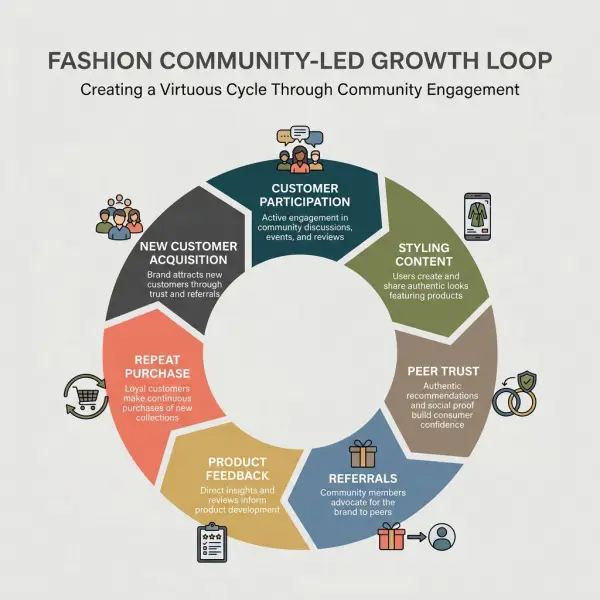
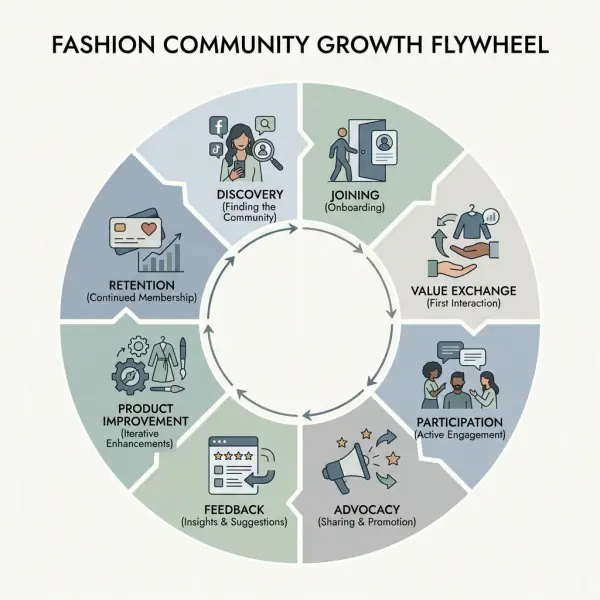
Community-led growth is strongest when it works as a loop. A customer joins the brand ecosystem, receives value, participates, builds trust, influences others, provides feedback, and returns with stronger attachment. The brand then uses that participation to improve products, content, retail experiences, and customer communication.
A simple fashion community growth loop may look like this:
- A customer discovers the brand through content, referral, event, or social proof.
- The customer joins a community touchpoint such as email, private group, event, loyalty program, or styling series.
- The brand provides useful value through styling, education, access, or support.
- The customer participates by asking questions, sharing outfits, reviewing products, or attending events.
- Other customers gain trust from this participation.
- The brand learns from community behavior and improves decisions.
- Better experiences increase retention, advocacy, and new customer acquisition.
The power of the loop depends on the quality of each step. If the product is weak, advocacy will not last. If the community provides no value, participation will fade. If the brand collects feedback but never acts, members will stop contributing. If advocacy becomes too commercial, trust may decline.
Strategy 1: Turn Customers Into Style Advocates
Fashion advocacy works best when customers have a reason to share that feels natural. People do not usually recommend a brand only because the brand asks them to. They recommend when the product solves a problem, expresses their identity, earns compliments, fits well, feels worth the price, or becomes part of their lifestyle.
Style advocacy can be encouraged through customer spotlights, outfit challenges, member styling edits, real-fit galleries, wardrobe stories, or community lookbooks. The brand’s role is to make participation easy, respectful, and useful. A customer should not need professional photography or influencer-level confidence to contribute.
For example, a contemporary workwear brand may invite customers to share how they wear one blazer across office, travel, dinner, and weekend settings. A modest fashion brand may invite members to show layering ideas for different climates and occasions. A denim brand may feature long-term wear stories, repair marks, and fit journeys.
The growth value comes from credibility. Customer styling content often answers questions that brand campaigns cannot fully answer: How does the garment look on different bodies? Can it work outside a studio? Does it match real routines? Is it easy to style?
Make Advocacy Useful, Not Performative
A fashion brand should avoid turning every customer into a mini influencer. That can feel forced and may exclude customers who value the brand quietly. Instead, advocacy should be designed around usefulness:
- real outfit examples;
- sizing and fit explanations;
- care and repair experiences;
- occasion-based styling;
- travel or workwear use cases;
- honest product reviews;
- wardrobe-building stories.
This kind of advocacy supports growth because it helps other customers make better decisions. It is less about viral reach and more about trusted relevance.
Strategy 2: Build Referral Systems Around Trust
Referral programs are often treated as discount mechanics. “Give a friend 10%, get 10%.” That can work in some cases, but fashion referrals are stronger when they are built around trust and taste.
A fashion customer recommends a brand because the recommendation reflects on them. If the product disappoints, the referrer may feel responsible. This means referral programs should be designed carefully. The best referral strategy begins with a product experience that customers are proud to share.
Referral systems can be structured in several ways. A brand may reward both the existing customer and the new customer. It may invite loyal customers to private events with a guest. It may create style consultation credits. It may offer early access to a capsule collection. It may provide non-discount rewards such as alterations, care services, exclusive content, or community recognition.
The more premium the brand, the more carefully incentives should be handled. Excessive discounting may weaken perceived value. For higher-end fashion businesses, access, service, personalization, or recognition may be more appropriate than constant price reductions.
Referral Programs Should Protect Brand Value
A strong referral program should answer four questions:
- Why would a customer feel proud to recommend this brand?
- What benefit does the new customer receive?
- What reward fits the brand’s price position and identity?
- How will the brand prevent spammy or purely incentive-driven sharing?
Referral works best when it feels like a trusted introduction, not a coupon distribution system.
Strategy 3: Use Ambassador Programs Responsibly
Ambassador programs can be effective when they are built around genuine customer alignment. They become risky when brands select ambassadors only for follower count or treat them as low-cost advertising inventory.
A fashion ambassador should represent the brand’s values, style language, customer base, and product reality. For a technical activewear brand, this may mean customers who actually train in the products. For a tailoring brand, it may mean professionals who understand fit and wardrobe investment. For a modest fashion label, it may mean women who can style products in culturally sensitive, practical, and elegant ways.
Ambassador programs should also be transparent. If ambassadors receive payment, free products, commissions, affiliate links, or other material benefits, disclosure rules may apply. The FTC Endorsement Guides explain that material connections between endorsers and brands should be clearly disclosed when they might affect how consumers evaluate the endorsement. Brands operating in other markets should verify local advertising and consumer protection requirements.
A responsible ambassador strategy includes selection criteria, disclosure guidance, content expectations, brand education, feedback responsibilities, and clear rules for using ambassador content. It should also allow ambassadors to speak in their own voice. Over-scripted advocacy often feels less trustworthy.
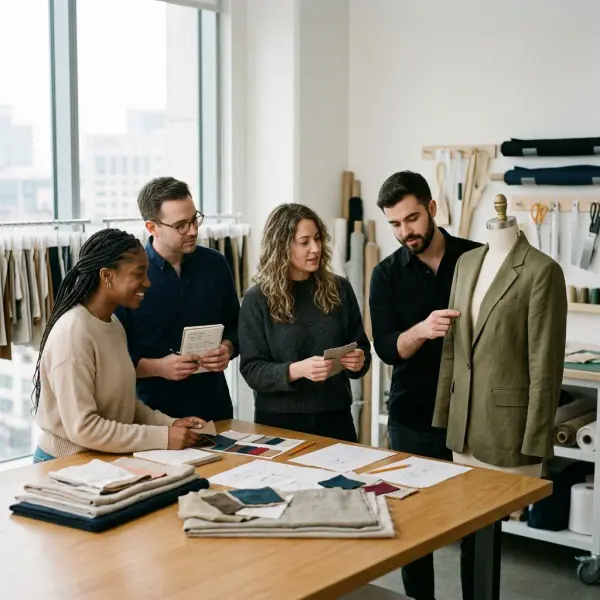
Strategy 4: Co-Create Products With the Community
Co-creation can be a powerful community-led growth strategy, but it must be handled with discipline. Asking customers for ideas is easy. Turning those ideas into commercially viable products is harder.
Fashion product development involves design coherence, fabric availability, minimum order quantities, fit testing, production timelines, cost targets, margin requirements, quality control, and brand positioning. Community input can improve decisions, but it should not replace professional product development.
Co-creation works best when the brand defines the decision space clearly. Instead of asking, “What should we make next?” a brand may ask members to choose between two sleeve lengths, vote on a color range, test pocket placement, review fit notes, or give feedback on styling gaps. This keeps participation focused and operationally useful.
For example, a womenswear brand may invite its community to test two trouser rises before finalizing production. A handbag brand may ask loyal customers about internal pocket layout. A children’s brand may collect parent feedback on washability and closures. A modest fashion brand may ask customers about lining, sleeve coverage, fabric opacity, and layering comfort.
Co-Creation Must Balance Customer Input and Creative Direction
Community co-creation can create excitement because customers feel involved before launch. It can also reduce uncertainty by validating specific product decisions. But brands should avoid designing entirely by committee. The brand still needs a point of view.
The best co-creation process usually has boundaries:
- the brand defines the product concept;
- the community gives input on specific decisions;
- the product team validates feasibility;
- the brand communicates what changed because of feedback;
- customers receive appropriate recognition or access.
When done well, co-creation turns product development into a relationship-building process. When done poorly, it creates unrealistic expectations and operational confusion.
Strategy 5: Create Launches That Members Can Participate In
Traditional fashion launches are often broadcast moments: a campaign goes live, products appear online, emails are sent, and ads begin. Community-led launches work differently. They give members a role before, during, or after the launch.
Members may preview products early, attend a styling session, vote on final names, receive fit education, share first impressions, host local try-on moments, create outfit interpretations, or answer peer questions. This kind of participation can generate trust and context before the product reaches a wider audience.
A launch becomes stronger when community members understand the product story. Why was the piece made? What problem does it solve? What styling situations does it serve? What fabric or fit decisions matter? What should customers know before buying?
This is especially important for products that need explanation: technical outerwear, premium basics, tailored pieces, modest layering systems, adaptive apparel, sustainable materials, occasionwear, or investment accessories. Community-led launch content can reduce confusion and improve customer confidence.
A Practical Community-Led Launch Flow
A fashion brand can structure a community-led launch in stages:
- Pre-launch: invite selected members to preview the concept or sample.
- Education: explain fit, fabric, styling, and intended use.
- Participation: ask members to share questions or styling ideas.
- Launch: release product with community-informed content.
- Post-launch: collect reviews, fit feedback, and styling examples.
- Optimization: improve product pages, FAQs, visuals, or future production based on feedback.
This approach turns launch activity into a learning loop rather than a one-way announcement.
Strategy 6: Use Events as Growth Infrastructure
Events are often treated as brand moments, but they can also become community-led growth infrastructure. A well-designed event can create trust faster than months of passive content.
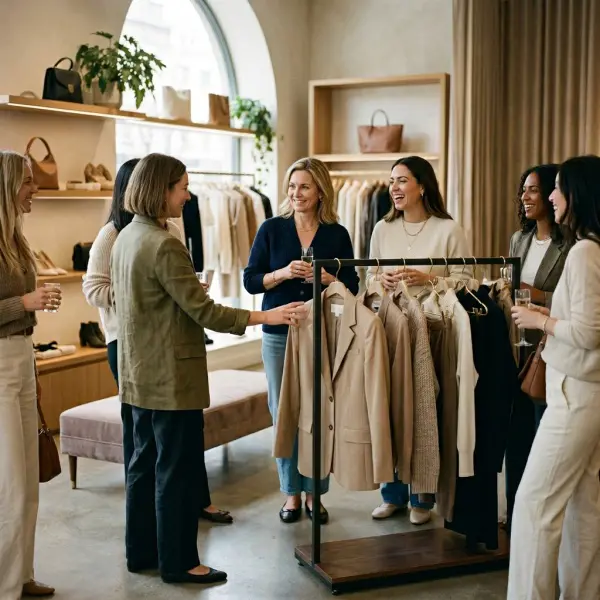
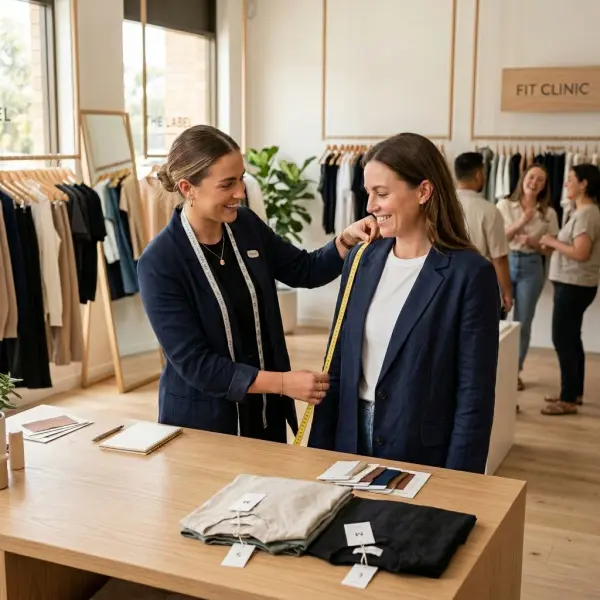
Fashion events do not need to be large or expensive. A small styling workshop, fit clinic, trunk show, repair session, fabric education class, capsule wardrobe session, designer conversation, customer preview, or local meetup can create meaningful connection. The key is that the event must provide value beyond product display.
Events can support acquisition when members bring friends. They can support retention when customers feel closer to the brand. They can support product education when customers try pieces in person. They can support content when real questions and styling moments emerge. They can support feedback when the team observes how customers respond to garments directly.
For retail brands, events can also make stores more useful. A store becomes not only a transaction space, but a community space. This can be valuable for brands trying to differentiate physical retail from ordinary shopping.
Strategy 7: Build Retention Through Member Value
Community-led growth is not only about acquiring new customers. In fashion, retention may be even more valuable because repeat customers often understand the brand better, need less education, and may become stronger advocates.
Retention through community depends on ongoing value. Customers need reasons to stay engaged between purchases. This matters for fashion categories with longer purchase cycles, such as premium apparel, outerwear, bridal, formalwear, leather goods, jewelry, tailoring, or sustainable wardrobe brands.
Member value can include styling education, care guidance, early access, wardrobe planning, repair support, private events, loyalty recognition, alteration services, resale guidance, or seasonal outfit edits. The goal is to help customers get more value from what they already own, not only push new products.
This is where community-led growth connects closely with how fashion brands build engaged customer communities. Engagement creates the relationship. Member value keeps the relationship alive.
Retention Value Should Match the Product Category
A premium basics brand may focus on care, layering, and wardrobe planning. A streetwear brand may focus on drops, collaborations, and cultural access. A bridal brand may focus on milestones, alterations, styling, and post-wedding preservation. A sustainable fashion brand may focus on repair, resale, and responsible care, while avoiding exaggerated environmental claims.
Retention is stronger when the community experience reflects the actual customer journey.
Strategy 8: Turn Customer Insight Into Growth Decisions
Community-led growth is not only visible advocacy. It is also learning. A community can reveal what customers want, what they do not understand, what prevents purchase, what creates dissatisfaction, and what makes them return.
Fashion businesses can use community insight to improve growth decisions across product, merchandising, marketing, and retail. For example, repeated questions about garment opacity may indicate a need for better product photography or lining information. Frequent styling confusion may suggest a need for outfit bundles or editorial guides. Fit complaints may point to sizing chart problems. Strong community interest in a discontinued item may signal potential for a limited reissue.
This is different from letting customers control the brand. The brand should interpret community insight through commercial, creative, and operational judgment. Not every comment deserves action. But repeated patterns can be valuable growth signals.
A practical system may include monthly community insight reviews, tagging recurring themes, comparing feedback with sales and returns, assigning business owners, and reporting what changed because of customer input.
Strategy 9: Encourage Peer Support
Peer support is one of the most underused growth assets in fashion communities. When customers help each other choose sizes, style garments, care for products, or understand a collection, the brand gains credibility and reduces friction.
Peer support works especially well in categories where customers need confidence before purchasing: denim, bras, tailoring, modest fashion, maternity wear, activewear, footwear, premium basics, technical apparel, and occasionwear. Customers may trust another customer’s fit experience because it feels closer to real life than a brand description.
However, brands should monitor peer support carefully. Incorrect sizing advice, misleading care instructions, or unsupported claims can create problems. The brand should participate where needed, correct misinformation politely, and provide official resources such as fit guides, care pages, and product FAQs.
Peer support should not become a substitute for customer service. It should complement it.

Strategy 10: Build Community Into the Brand’s Owned Ecosystem
Community-led growth becomes more sustainable when the brand owns at least part of the relationship. Social media is useful for discovery, but relying entirely on rented platforms leaves the brand exposed to algorithm changes, policy shifts, ad cost increases, and changing content formats.
Owned community infrastructure may include email, SMS, a membership portal, event database, customer account area, loyalty platform, editorial hub, mobile app, private group, or clienteling system. The right choice depends on brand size and customer behavior. A small brand may begin with email and events. A larger brand may integrate community data with CRM, loyalty, retail, and e-commerce systems.
The goal is not to collect data irresponsibly. Brands should manage customer information with transparency, consent, security, and respect for applicable privacy laws. Community trust can be damaged quickly if customers feel their participation is being tracked or monetized without clarity.
An owned ecosystem also makes measurement more useful. The brand can better understand which community activities support repeat purchase, referral, product feedback, event attendance, or customer satisfaction.
What Community-Led Growth Does Not Mean
Community-led growth does not mean customers run the brand. It does not mean every product should be crowdsourced. It does not mean paid marketing becomes unnecessary. It does not mean every customer must become a public advocate. It also does not mean growth will happen quickly.
The phrase can be misleading if brands use it as a fashionable label for ordinary social media activity. Posting on Instagram is not community-led growth. Running a referral discount is not automatically community-led growth. Creating a private group with no programming is not enough.
Community-led growth requires a real value exchange. Customers contribute attention, trust, feedback, content, referrals, and participation. The brand gives value back through better products, clearer education, access, recognition, service, and belonging.
If that exchange is missing, the strategy becomes extractive.
Common Mistakes in Community-Led Growth
Fashion brands often fail with community-led growth because they try to scale participation before earning trust.
Mistake 1: Treating Community as Cheap Marketing
This happens when brands see customers mainly as unpaid promoters. They ask for content, referrals, reviews, and feedback without providing meaningful value in return. The consequence is declining trust. A better approach is to design mutual benefit: education, recognition, access, service, or product improvements.
Mistake 2: Over-Incentivizing Referrals
Referral rewards can help, but excessive incentives may attract low-quality sharing. If customers recommend only for discounts, the brand may gain transactions without genuine loyalty. A stronger referral system protects brand value and encourages recommendations that feel personal and trusted.
Mistake 3: Scaling Ambassador Programs Too Quickly
Large ambassador programs can become difficult to manage. Poor disclosure, inconsistent content, weak brand alignment, or low-quality promotion can damage credibility. Brands should start with a smaller group of aligned advocates and build clear standards before scaling.
Mistake 4: Ignoring Operational Feedback
Community-led growth depends on listening. If customers repeatedly raise fit, quality, delivery, or service issues and the brand only celebrates positive content, the community may lose confidence. Feedback should be categorized, reviewed, and connected to business decisions.
Mistake 5: Confusing Activity With Growth
A busy community is not automatically a growth engine. The important question is whether community activity improves trust, retention, referrals, product decisions, customer satisfaction, or brand relevance. Noise is not the same as progress.
Metrics for Community-Led Growth
Community-led growth needs measurement, but not every valuable community effect appears immediately in revenue. Fashion brands should use a mix of engagement, retention, advocacy, insight, and commercial indicators.
Useful metrics may include:
- repeat participation rate;
- member-to-member interaction;
- referral conversion;
- ambassador content quality and disclosure compliance;
- customer-generated content permission rate;
- event attendance and repeat attendance;
- repeat purchase among community members;
- product feedback themes adopted;
- reduction in repeated customer service questions;
- review volume and quality;
- community-influenced revenue;
- customer lifetime value by community segment.
The purpose of measurement is not to reduce community to a performance dashboard. It is to understand whether the community is helping the business grow in a healthy way.
A useful question for leadership is: “What business decisions are better because this community exists?” If the answer is unclear, the community strategy may need sharper design.
What Brands Should Verify Before Using Community as a Growth Engine
Before relying on community-led growth, fashion brands should verify that the foundation is strong enough. Community can amplify strength, but it can also amplify weakness.
Brands should check:
- Is the product quality consistent enough for customers to recommend?
- Is sizing and fit information clear enough to support peer discussion?
- Does the brand have a clear identity that customers understand?
- Are customer support and returns handled reliably?
- Are UGC, ambassador, affiliate, and endorsement disclosures managed properly?
- Does the team have moderation capacity?
- Is customer feedback reviewed by decision-makers?
- Does the community have value beyond promotions?
- Can the brand measure retention, referral, and advocacy realistically?
Community-led growth should be treated as a strategic operating model, not a shortcut. The stronger the business fundamentals, the more powerful community participation becomes.
FAQ
What is community-led growth in fashion?
Community-led growth in fashion is a strategy where customer participation helps drive awareness, trust, retention, advocacy, and product insight. It may include referrals, customer styling content, ambassador programs, member events, co-creation, peer support, and loyalty experiences. The goal is to make the community part of the brand’s growth system while still maintaining strong product quality, creative direction, and operational discipline.
How is community-led growth different from influencer marketing?
Influencer marketing usually relies on paid or gifted creator partnerships to reach an audience. Community-led growth is broader. It focuses on customers, loyal members, advocates, event participants, reviewers, and peer relationships. Influencers may be part of the strategy, but they are not the whole strategy. Community-led growth depends more on ongoing trust and participation than one-off campaign reach.
Can small fashion brands use community-led growth?
Yes. Small fashion brands can often use community-led growth effectively because they can build closer relationships with early customers. They can start with simple actions such as customer styling stories, small events, fit feedback, referral invitations, email communities, or private previews. The priority should be trust and usefulness, not expensive technology or large-scale ambassador programs.
What is the best community-led growth strategy for fashion brands?
There is no single best strategy. A workwear brand may benefit from styling education and referral events. A denim brand may benefit from fit clinics and repair culture. A modest fashion brand may benefit from occasion styling and community lookbooks. A sustainable fashion brand may benefit from care, repair, and resale programs. The right strategy depends on the brand’s product category, customer motivation, and operational capacity.
How can fashion brands encourage referrals without discounting too much?
Brands can use non-discount referral rewards such as early access, private styling sessions, alteration credits, care services, exclusive event invitations, limited product previews, or community recognition. Discounts can work, but they should fit the brand’s price position. Premium brands especially need to protect perceived value and avoid training customers to engage only for price incentives.
Is co-creation a good growth strategy for fashion brands?
Co-creation can be useful when the brand defines the decision space clearly. Customers can provide valuable input on colors, fit details, styling needs, pocket placement, fabric preferences, or product use cases. However, brands should not design entirely by committee. Product development still requires creative direction, sourcing feasibility, production knowledge, cost control, and quality management.
What are the risks of community-led growth?
The risks include overcommercializing the community, mishandling customer content, poor endorsement disclosure, weak moderation, unrealistic co-creation promises, excessive referral incentives, and ignoring negative feedback. Community-led growth can also expose operational weaknesses. Brands should ensure product quality, service, sizing, and customer support are strong enough before scaling community activity.
How should fashion brands measure community-led growth?
Fashion brands should measure engagement quality, referral behavior, repeat purchase, member retention, event participation, customer-generated content, product feedback adoption, review quality, and community-influenced revenue. They should not rely only on likes, comments, or follower count. The best measurement connects community activity to trust, retention, advocacy, insight, and better business decisions.
Conclusion
Community-led growth is powerful because it turns fashion customers into participants in the brand’s momentum. They do not simply receive campaigns. They style, recommend, review, question, attend, co-create, and help others understand the brand.
For fashion businesses, this creates a different kind of growth asset. Paid media can buy attention. A strong community can build trust. Campaigns can introduce products. A community can show how those products live in real wardrobes. Trend reports can inform direction. A community can reveal what customers actually need, misunderstand, value, and repeat.
The strategy requires care. Brands must protect transparency, avoid over-extraction, manage disclosure, listen to feedback, and keep product quality at the center. Community-led growth is not a shortcut around business fundamentals. It is a way to make strong fundamentals more visible, trusted, and shareable.
In a crowded fashion market, the brands that grow through community are not simply louder. They are more connected. And connection, when managed with discipline, can become one of the most defensible advantages a fashion business has.




Comments 0
Leave a CommentSend Comment
Anda harus Login terlebih dahulu untuk dapat memberikan komentar.