

How Fashion Brands Sell to Boutiques, Retailers, and Institutional Buyers
Selling clothing to other businesses requires more than offering attractive designs at wholesale prices. A fashion brand approaching an independent boutique, a multi-store retailer, or an institutional procurement team must understand how each buyer selects products, manages budgets, evaluates suppliers, and makes purchasing decisions.
A boutique owner may personally choose garments that match the store's identity and customer preferences. A larger retailer may involve merchandising teams, category buyers, vendor onboarding procedures, and inventory planning systems. An institutional buyer purchasing uniforms or workwear may prioritize specifications, price consistency, delivery schedules, and documented supplier capabilities.
These differences shape the entire business-to-business (B2B) sales process, from identifying prospects and presenting collections to negotiating orders and developing repeat business.
For apparel brands and suppliers, the practical challenge is not simply finding more potential customers. It is building an approach that fits how each type of customer actually buys.
Quick Answer: How Do Fashion Brands Sell to Business Buyers?
Fashion brands sell to boutiques, retailers, and institutional buyers by identifying suitable business customers, presenting products or manufacturing capabilities that meet their requirements, negotiating commercial terms, and fulfilling confirmed orders reliably.
Independent boutiques typically evaluate wholesale collections based on product differentiation, customer fit, available purchasing budgets, and potential retail margins. Larger retailers may apply more structured buying processes involving assortment planning, supplier approval, inventory systems, and delivery requirements. Institutional buyers, including companies, schools, hotels, and healthcare organizations, often purchase clothing through quotation requests, procurement procedures, or negotiated supply agreements.
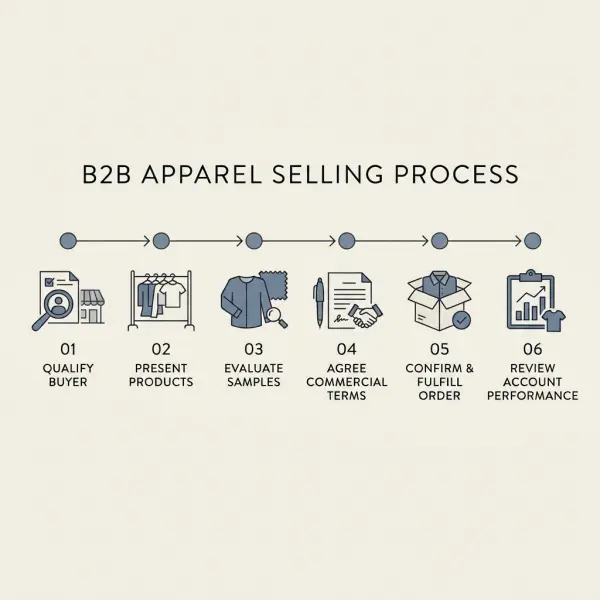
The sales process usually includes prospect research, buyer qualification, product presentation, sample evaluation, commercial negotiation, order confirmation, fulfillment, and post-sale account management.
However, the buying process is not identical across organizations. Some independent retailers purchase through online wholesale platforms, while larger retailers may negotiate directly with brands. Institutional purchases may involve competitive tenders or straightforward private negotiations, depending on the organization.
The most effective approach is to match the sales presentation, product offer, pricing structure, and service commitments to the buyer's commercial priorities rather than using one generic sales pitch for every customer.

Understanding the Different Types of Fashion Business Buyers
Fashion business buyers can appear similar because they purchase clothing in quantities intended for commercial or organizational use. Yet their motivations, internal procedures, and measures of success can differ considerably.
A small boutique may be concerned about committing too much cash to a new brand. A chain retailer may need products that can be distributed across several locations while maintaining consistent product identification and supply availability. An institution buying uniforms may care less about seasonal fashion appeal and more about garment durability, standardized sizing, and repeat ordering.
Recognizing those differences helps suppliers avoid developing an offer that works well for one customer but creates problems for another.
Independent Boutiques: Curated Assortments and Customer Fit
Independent boutiques are typically smaller retail businesses with their own merchandise positioning and purchasing decisions.
Their product selections often reflect a defined customer base, local shopping behavior, store identity, and available inventory budget.
A boutique specializing in minimalist contemporary clothing may be interested in a small collection of well-constructed neutral garments. The same store may decline a colorful occasionwear collection even when the designs are commercially successful elsewhere.
For a fashion brand, this means understanding the store before presenting products. A carefully selected group of relevant styles is usually more useful than sending an entire collection without considering the retailer's assortment.
The buyer also needs confidence that wholesale prices, order quantities, and delivery commitments are appropriate for a business of that size.
Multi-Store Retailers: Scalability and Merchandising Performance
Larger retailers may purchase apparel through dedicated buying or merchandising teams responsible for product categories, seasons, or customer segments.
These buyers can evaluate products against planned assortments, purchasing budgets, price architecture, inventory availability, and expected sales performance.
Unlike a boutique owner who may personally approve an order, a larger retailer may require coordination between buying, merchandising, finance, logistics, and compliance functions.
Some retailers operate centralized purchasing systems, while others give individual stores or regional teams varying degrees of authority.
A brand seeking this type of account needs to establish who makes the purchasing decision and what documentation is required before products can enter the retailer's systems.
Institutional Buyers: Specifications and Procurement Reliability
Institutional buyers purchase clothing to support organizational needs rather than conventional fashion retail.
Examples include hotels purchasing employee uniforms, schools procuring student clothing, healthcare organizations ordering workwear, and corporations providing branded apparel to staff.
Their buying decisions may involve procurement departments, operational managers, finance teams, and the employees who will ultimately wear the garments.
The product must meet a practical purpose. A hotel uniform, for instance, may need to support movement, repeated laundering, appropriate appearance, and availability of replacement garments.
Institutional contracts can involve standardized specifications, sample approval, quotation comparisons, or formal tender processes.
Not all institutions use the same procedures. A privately operated hospitality business may negotiate directly with a supplier, whereas a public-sector organization may need to follow specific procurement rules.
How Buyer Priorities Change the Sales Approach
The same apparel supplier may need three different commercial presentations for three different buyer types.
A boutique may respond to a distinctive product story and a manageable opening order. A large retailer may want structured assortment data and evidence that products can be delivered consistently. An institutional procurement team may prioritize compliance with technical requirements and the supplier's ability to perform under a contract.
|
Buying Consideration |
Independent Boutique |
Larger Retailer |
Institutional Buyer |
|
Main purchasing purpose |
Sell curated merchandise to customers |
Meet merchandising and commercial performance targets |
Supply clothing for organizational use |
|
Product priority |
Distinctiveness, styling, customer fit |
Assortment consistency, price positioning, sales potential |
Function, specifications, sizing, reliability |
|
Key decision-makers |
Owner or store buyer |
Category buyer, merchandising and other relevant teams |
Procurement, operations, finance and end-user representatives |
|
Common presentation |
Lookbook, line sheet, samples |
Assortment proposal, product data, samples, commercial terms |
Technical proposal, samples, quotation, compliance documents |
|
Order structure |
Often smaller, flexible assortments |
May involve larger or scheduled orders |
Contract quantities, phased deliveries, or call-off orders |
|
Main commercial concern |
Inventory commitment and resale margin |
Product performance and supply execution |
Contract value and fulfillment of requirements |
|
Repeat-purchase driver |
Successful sell-through and customer demand |
Product performance and replenishment economics |
Contract performance and ongoing organizational needs |
These distinctions are useful starting points, not rigid categories.
A boutique may operate multiple locations, a large retailer may test emerging brands through small orders, and a private institution may use a purchasing process much simpler than government procurement.
The supplier's first responsibility is to understand the actual customer's decision process instead of relying entirely on assumptions about business size.

How Fashion Brands Approach Independent Boutiques
Selling to an independent boutique is often a relationship-driven process, but a strong commercial foundation still matters.
Boutique buyers have limited shelf or rail space, finite purchasing budgets, and customers who expect merchandise that fits the store's identity.
A supplier must therefore demonstrate why its products deserve space alongside brands the retailer already carries.
Research the Boutique Before Making Contact
The first step is identifying stores that genuinely match the brand's positioning.
A fashion label selling premium linen separates should look beyond general lists of clothing retailers. It should examine whether prospective boutiques stock products with similar material quality, styling, price levels, and customer appeal.
Useful research includes the store's website, current brand assortment, social media content, product prices, location, and customer positioning.
This helps the brand decide whether the opportunity is worth pursuing and which products to present.
For example, a small coastal boutique carrying relaxed summer clothing may be a suitable prospect for a resortwear collection. A formal occasionwear specialist would require a different product offer.
The objective is not to imitate the boutique's existing merchandise. It is to demonstrate that the proposed collection complements the store without introducing unnecessary assortment duplication.
Create a Focused Wholesale Pitch
A boutique wholesale pitch should communicate product relevance and commercial feasibility quickly.
Instead of explaining every aspect of the brand's history, the supplier can introduce a small selection of styles that correspond to the retailer's current merchandising needs.
A useful initial presentation should communicate:
- The brand's product category and positioning.
- Why the collection fits the boutique's customer base.
- The specific styles proposed for consideration.
- Wholesale prices and suggested retail prices, where appropriate.
- Available sizes, colors, and opening order requirements.
- Product availability, delivery timing, and next steps.
This information allows the buyer to assess both consumer appeal and practical purchasing requirements.
A brand may use a short introductory email, a wholesale marketplace, a trade show appointment, or an existing business referral to initiate contact. The best channel depends on how the boutique prefers to evaluate prospective suppliers.
The presentation should invite a relevant commercial discussion rather than pressure the buyer into making an immediate purchase.
Make the Opening Order Manageable
A boutique considering an unfamiliar clothing label faces uncertainty about customer demand.
An opening assortment that requires purchasing too many styles, colors, or sizes may create unnecessary financial exposure.
Fashion suppliers can sometimes make initial orders more accessible through curated product selections, reasonable order minimums, or flexible style combinations.
This does not mean every supplier should accept very small orders. Production requirements, fulfillment costs, and product margins still need to support the transaction.
Wholesale platform Faire distinguishes between a minimum order value and a product-level minimum order quantity in its official explanation of wholesale order minimums and minimum order quantity guidance.
That distinction is useful when structuring boutique accounts. A brand may establish an overall minimum order value while allowing retailers some flexibility in their selection of eligible products.
Support the Boutique After Delivery
The commercial relationship does not end when the garments arrive.
A boutique may need accurate product descriptions, care information, imagery, or styling references to present the collection effectively.
It may also need clarification about replenishment availability, defective merchandise procedures, or delivery discrepancies.
A brand that provides reliable information and handles operational issues professionally may become easier for the boutique to work with over time.
Sales performance matters as well. When both parties are willing and able to share relevant data, feedback on popular sizes, slower-selling styles, and customer preferences can help improve future assortments.
The goal is to understand what actually sells rather than assuming that a successful initial purchase guarantees repeat orders.

How Fashion Brands Sell to Larger Retailers and Retail Chains
Approaching a multi-store retailer generally requires a more structured sales process than selling to a single independent boutique.
The buyer may be responsible for a defined category, seasonal budget, or merchandise plan. Purchasing decisions must support the retailer's broader operating model, not simply the personal preference of one individual.
For a fashion supplier, securing a meeting is only one part of the challenge. The proposed collection must also satisfy the retailer's commercial, administrative, and supply requirements.
Identify the Right Buying Department
Large retail organizations may separate purchasing responsibilities by category, product type, customer segment, or brand portfolio.
A supplier offering performance activewear should seek the team responsible for the relevant category rather than assuming that any purchasing contact can evaluate the collection.
Some retailers publish supplier application procedures or maintain vendor registration portals. Others assess new brands through established category teams, buying appointments, or commercial introductions.
Before approaching the organization, the supplier should research whether it accepts direct brand applications, purchases through distributors, or requires an established trading relationship.
A presentation sent to the wrong department may receive no useful response even when the products are commercially suitable.
Present the Collection as a Retail Assortment
Larger retailers often need more detailed merchandising information than a general collection presentation provides.
The buyer may assess how products fit a particular season, price band, customer segment, or category plan.
A structured proposal could include core styles, seasonal additions, color options, size ranges, planned retail price points, and delivery windows.
The retailer may also consider its open-to-buy budget, which represents planned purchasing capacity after accounting for factors such as expected sales, inventory, and outstanding orders.
Shopify's explanation of open-to-buy planning describes how retailers use this approach to align inventory purchasing with financial and stock objectives.
A strong wholesale proposal therefore helps the buyer understand where the products fit in the merchandise plan and what commitment the assortment requires.
For deeper background, see fashion assortment planning for retail and online stores.
Prepare for Supplier Onboarding
Supplier onboarding is the process through which a retailer establishes the commercial, administrative, and operational information needed to begin purchasing from a vendor.
The exact requirements depend on the retailer, country, category, and supply arrangement.
A larger retailer may request information concerning company registration, tax details, banking information, product data, insurance, applicable compliance documentation, and delivery procedures.
Retailers with integrated inventory systems may also require standardized product identifiers, digital product catalogs, and structured purchasing documents.
GS1 explains that each distinct size-and-color variation of a product needs its own Global Trade Item Number (GTIN) when using GS1 identification standards. See its official guidance on apparel product variations.
However, standardized GTINs are not universally required for every business transaction. Suppliers should confirm which identifiers and data formats the retailer actually uses.
Incomplete onboarding information can delay commercial activation even after the buyer has expressed interest in the products.
Demonstrate Supply and Replenishment Capability
A retailer considering a new supplier may want to know whether the brand can fulfill the initial order and respond to subsequent demand.
This is especially relevant for products intended to remain available beyond a short seasonal launch.
The supplier should be able to distinguish available inventory from products requiring additional manufacturing and clarify the likely replenishment lead time.
For example, a brand may have 400 units of a basic trouser available immediately but require six weeks to complete another production batch, depending on material availability and factory capacity.
Those circumstances create different purchasing decisions for the retailer.
A buyer may accept a limited seasonal launch but hesitate to treat the product as a continuously replenished item until supply reliability has been demonstrated.
Brands should avoid describing production capacity as guaranteed availability unless the necessary resources are confirmed.
Understand Commercial Negotiations Beyond Unit Price
Larger retail accounts may negotiate conditions that extend beyond the wholesale price.
Depending on the arrangement, these can include payment periods, marketing contributions, delivery booking requirements, packaging standards, agreed allowances, defect procedures, and policies addressing late or incomplete shipments.
Some retailers may request consignment arrangements or sale-or-return terms rather than conventional outright wholesale purchasing.
These arrangements have different financial implications.
Under a conventional wholesale sale, ownership and inventory risk are determined by the agreed contract. Under consignment, the supplier commonly retains ownership until specified sales or other contract events occur, although the detailed risk allocation must be checked.
A supplier should calculate profitability under the actual commercial terms, not only compare the nominal selling price with manufacturing cost.

How Fashion Brands Sell to Institutional and Corporate Buyers
Institutional clothing sales require suppliers to translate organizational needs into a clearly defined product and service offer.
Unlike conventional fashion wholesale, the buyer may not need a collection of styles for resale. Instead, it may need standardized garments for employees, students, participants, or other intended users.
This changes the relationship between product development, quotation, delivery planning, and after-sales support.
Identify the Organization's Actual Clothing Requirements
The first step is understanding why the organization needs apparel and how the garments will be used.
A hospitality company may prioritize a consistent professional appearance, laundering durability, and employee comfort. A school may focus on uniform specifications, sizing, affordability, and repeat availability. A corporate buyer ordering event merchandise may emphasize branding, quantity, delivery deadlines, and distribution arrangements.
The supplier should clarify the relevant operational requirements before recommending fabrics or garment designs.
Important questions may include:
- Who will wear the garments, and in what working conditions?
- Are there approved colors, logos, patterns, or design specifications?
- What sizes and quantities are required?
- Are specific care, durability, or performance characteristics necessary?
- Will the order be delivered to one location or several?
- Is the purchase a one-time requirement or an ongoing supply program?
Answers to these questions influence material selection, sample development, manufacturing cost, and delivery planning.
A supplier that begins with a generic catalog may miss requirements that materially affect the feasibility of the order.
Distinguish Private Procurement From Public Tenders
Private organizations may purchase uniforms through direct negotiation, requests for quotation (RFQs), competitive proposals, or approved-supplier arrangements.
Public-sector organizations may be subject to formal procurement rules, including supplier eligibility requirements, documented evaluation criteria, submission procedures, and contractual conditions.
For example, the United States maintains SAM.gov Contract Opportunities as a federal procurement opportunity portal. The United Kingdom provides public procurement information through services including Find a Tender.
These are jurisdiction-specific examples, not universal systems for institutional clothing purchasing. Suppliers must verify the applicable procedures in the buyer's country and organization.
A request for quotation generally focuses on pricing and defined purchasing requirements, while a request for proposal (RFP) may ask suppliers to explain how they will deliver a broader solution. Actual terminology and evaluation procedures vary.
Submitting an attractive price is not enough if the supplier fails to meet mandatory specifications or administrative requirements.
Build a Specification-Based Proposal
An institutional apparel proposal should demonstrate that the supplier understands the required garment and can fulfill the contract.
The document may describe the proposed fabrics, construction details, design options, size specifications, branding methods, sample approval stages, production schedule, and delivery arrangements.
For a hotel uniform program, the supplier might present one approved shirt design in several size options, coordinated trousers, and a defined process for requesting replacement garments.
The quotation should identify what is included in the price and which services require additional charges.
For example, custom embroidery, individual employee measurement sessions, special packaging, or delivery to several destinations may affect production and fulfillment costs.
Where material performance or durability is a contractual requirement, the supplier should establish appropriate testing, inspection, or verification methods rather than relying on general promotional claims.
Plan for Sizing, Samples, and User Acceptance
Sizing can be a significant operational issue in institutional apparel projects.
Unlike a conventional retail assortment, which a shopper may try on before purchase, an institutional uniform order may need to accommodate a workforce with varied body measurements and fit preferences.
Suppliers may offer fit samples, size charts, or measurement sessions to help determine the required size distribution.
The agreed sizing system should be documented before bulk production.
It is also useful to clarify whether the buyer requires approval from management, procurement representatives, or intended wearers before production can proceed.
Approval procedures help reduce ambiguity, but they do not eliminate the need for production quality control.
If an organization expects frequent staffing changes, replacement ordering procedures and continued availability of approved fabrics and trims may become as important as the original delivery.
Structure the Contract Around Ongoing Requirements
Some institutional orders involve a single event or defined delivery. Others involve continuing demand under a supply agreement.
A contract may specify estimated quantities, unit prices, delivery locations, order procedures, quality acceptance criteria, and the agreement period.
For repeat programs, a framework or call-off arrangement may allow the buyer to place orders as needed, subject to the contract's rules. The supplier should distinguish estimated quantities from any legally binding purchase commitment.
This is particularly important for apparel suppliers reserving fabric or production capacity.
A proposed annual volume does not automatically mean the customer is obligated to purchase that quantity.
The supplier should assess how much inventory or material commitment is justified by confirmed orders and enforceable terms.

Finding and Qualifying Fashion B2B Sales Opportunities
A fashion sales pipeline begins with identifying prospective buyers that match the supplier's commercial strengths.
Finding a business contact is relatively easy compared with establishing whether the organization has a genuine purchasing need, suitable budget, and an accessible decision process.
The supplier should qualify opportunities before investing heavily in sampling, travel, customization, or prolonged negotiations.
Use Sales Channels That Match the Buyer Type
Different channels provide access to different purchasing audiences.
For independent boutiques, relevant opportunities may come through wholesale marketplaces, retail directories, direct outreach, trade events, and referrals from existing stockists.
Larger retailers may be accessible through category buyer introductions, supplier application systems, trade shows, or established distributors.
Institutional opportunities can arise through procurement notices, supplier registration, industry relationships, or direct conversations with operational decision-makers.
Digital wholesale marketplaces can simplify product discovery and ordering for some retailers. However, suppliers should examine marketplace commissions, customer relationship rules, payment timing, and return policies before relying on these platforms.
Direct relationships provide a different degree of control but usually require more internal effort in prospecting, account management, and order administration.
Neither route is universally preferable.
Evaluate Opportunities Before Preparing Detailed Proposals
A prospective customer may express interest without having the budget, purchasing authority, or timeline required to place an order.
Useful qualification questions concern product fit, approximate purchasing volume, decision authority, expected delivery dates, and specific commercial requirements.
A boutique considering a small seasonal order may only need a line sheet and samples. A corporate buyer requesting several hundred custom uniforms may need extensive technical discussions before a meaningful quotation can be prepared.
The supplier should also assess whether the opportunity matches its financial and operational capacity.
A large order that requires specialized materials, uncertain payment arrangements, or unrealistic delivery commitments may be less attractive than a smaller but more predictable account.
Effective qualification protects both sales resources and production capacity.
Build a Sales Pipeline With Clear Stages
A structured pipeline allows fashion businesses to monitor sales opportunities without confusing initial interest with confirmed revenue.
A simple system can track the following stages:
- Prospect identified: The organization appears commercially relevant.
- Buyer qualified: Requirements, purchasing fit, and appropriate contacts have been established.
- Presentation or sampling: The buyer is evaluating the proposed products or capabilities.
- Quotation submitted: The supplier has provided commercial terms for review.
- Negotiation and approval: The parties are resolving pricing, specifications, quantities, or internal authorizations.
- Order confirmed: The business has received an accepted order or binding agreement under the applicable terms.
- Fulfillment and account review: The supplier delivers and evaluates the transaction.
Pipeline stages should correspond to observable business events rather than subjective confidence.
A verbal expression of interest, for example, should not automatically be recorded as a confirmed purchase.
This distinction becomes especially important when sales forecasts influence material ordering or production scheduling.
Turning Buyer Interest Into Confirmed Orders
Buyer interest becomes commercially meaningful when both parties agree on exactly what will be supplied and under what conditions.
The process may be straightforward for ready-stock wholesale merchandise, but more involved when an order includes garment development, customized labeling, or institutional specifications.
Clarify the Offer Before Negotiating
A quotation should identify the products or services being offered, the applicable quantities, and the commercial conditions.
For wholesale clothing, this may include style codes, color and size combinations, unit prices, order minimums, availability, and shipping arrangements.
For customized production, the quotation may also reference approved specifications, sample requirements, development charges, and manufacturing lead times.
A supplier should avoid presenting a delivery schedule based solely on best-case production assumptions.
Before making a firm commitment, it should verify relevant constraints such as fabric availability, production capacity, and the time required for any outstanding approvals.
Negotiate the Complete Transaction
Discounts are only one part of a B2B negotiation.
Payment timing, delivery responsibility, packaging requirements, returns, product acceptance, and cancellation terms can significantly affect the value of an order.
For international transactions, the International Trade Administration explains the risks associated with payment methods such as advance payment, letters of credit, documentary collections, and open-account sales in its trade payment methods guide.
Suppliers should also clarify logistics responsibilities. Where appropriate, the International Chamber of Commerce's Incoterms rules can define specified delivery obligations, costs, and risk transfers.
These rules do not replace a complete sales contract.
The commercial objective is to make responsibilities clear enough that the supplier can deliver the order and the buyer understands what it will receive.
Confirm the Order and Control Changes
A buyer's purchase order typically records the requested products, quantities, prices, and other purchasing information.
However, a purchase order does not necessarily establish every contractual obligation on its own. Its legal effect depends on the terms, acceptance, and applicable law.
Suppliers should confirm that relevant specifications, delivery arrangements, and payment conditions have been agreed before beginning work that creates substantial financial exposure.
If a buyer changes colors, quantities, delivery dates, or customization requirements after confirmation, the supplier should document any resulting effect on price or lead time.
This change-control discipline is particularly useful for manufacturing and institutional orders where seemingly small revisions can affect material consumption or production scheduling.
Practical Application: Building a Buyer-Specific Sales Plan
Fashion brands can improve their B2B approach by developing a separate commercial proposition for each buyer segment while maintaining a common operational foundation.
A sales plan should connect customer selection, product offering, commercial requirements, and fulfillment capacity.
Consider a fictional apparel company producing contemporary workwear and coordinated casual clothing.
It wants to expand beyond direct consumer sales into three business segments.
|
Sales Element |
Boutique Strategy |
Retail Chain Strategy |
Institutional Strategy |
|
Target account |
Independent contemporary fashion boutique |
Regional multi-store apparel retailer |
Hotel group seeking employee uniforms |
|
Initial offer |
Curated capsule collection |
Structured assortment with core and seasonal styles |
Standardized uniform range |
|
Selling emphasis |
Distinctive styling and customer relevance |
Retail margins, product data, delivery, replenishment |
Specifications, wearer needs, service reliability |
|
Sales document |
Lookbook and wholesale line sheet |
Category assortment proposal and vendor information |
Technical proposal and quotation |
|
Initial commercial goal |
Obtain an appropriate opening order |
Complete buyer evaluation and meet onboarding requirements |
Secure specification approval and a commercially viable contract |
|
Post-sale priority |
Gather sell-through feedback and evaluate reorders |
Track delivery and replenishment performance |
Manage sizing, quality, replacement orders, and service obligations |
These approaches can share product development resources, but they should not automatically use identical pricing, fulfillment arrangements, or sales commitments.
A retail collection may include more trend-sensitive designs, while an institutional uniform program may benefit from stable materials and repeatable production specifications.
The brand should evaluate whether serving multiple segments creates genuine operating efficiencies or excessive complexity.
Coordinate Sales With Product Development and Sourcing
Business buyers may request changes to fabric, fit, branding, packaging, or delivery specifications.
A sales team should know which modifications the company can support and under what conditions.
Changes that seem commercially minor may require new sampling, revised patterns, different materials, or adjusted minimum quantities.
For this reason, B2B account planning should involve appropriate representatives from product development, purchasing, production, and finance.
The same coordination principle applies when working with outside factories. The quality of a buyer commitment depends partly on the reliability of the manufacturing partners supporting it.
See how fashion brands evaluate production partners and material suppliers for more detail on sourcing decisions.
Use Account Economics to Prioritize Growth
Winning a large retailer or institutional contract may appear more prestigious than supplying several small boutiques.
However, account size alone does not determine profitability.
One customer may require significant marketing support, frequent deliveries, or extended payment terms. Another may place smaller but predictable orders with fewer administrative demands.
A practical account review should consider gross margin, account servicing costs, fulfillment complexity, collection of receivables, and the amount of working capital required.
Brands can then prioritize accounts that contribute to sustainable business performance rather than simply increasing reported wholesale revenue.




Comments 0
Leave a CommentSend Comment
Anda harus Login terlebih dahulu untuk dapat memberikan komentar.