

Fashion Customer Service Explained for Online and Retail Brands
Quick Answer
Fashion customer service is the system a fashion business uses to help customers before, during, and after a purchase, covering activities such as product guidance, sizing support, order questions, delivery problems, exchanges, returns, complaints, and post-purchase assistance. For online brands, service often happens through email, chat, social media, messaging apps, marketplaces, and self-service tools. In physical retail, it also includes face-to-face product assistance, fitting-room support, checkout interactions, and handling problems in store.
Fashion makes customer service unusually product-dependent. A service representative may need to explain how a garment fits, whether a fabric stretches, how two sizes compare, when an out-of-stock color will return, or whether an item qualifies for exchange after being worn or altered. Good service therefore depends on more than polite communication. It requires accurate product information, clear policies, accessible order data, sensible escalation procedures, and coordination between customer-facing teams and operations.
For most brands, the objective is not to answer every inquiry instantly. It is to build a service system that gives customers accurate, consistent, and appropriately fast help across the channels where they shop.

What Is Fashion Customer Service?
Fashion customer service is the operational function that helps customers understand, purchase, receive, use, exchange, return, or resolve problems involving fashion products. It connects customer communication with product knowledge, inventory information, payment and order records, fulfillment, store operations, and after-sales policies.
That definition matters because customer service is sometimes treated as little more than answering messages. In practice, the service team often sits at the intersection of several business functions. A question about a delayed jacket may require access to fulfillment data. A complaint about sizing may reveal a problem with a size chart or product description. A repeated question about fabric transparency may indicate missing merchandising information rather than a failure by the support agent.
Fashion also creates service questions that are difficult to answer through generic scripts. Clothing and footwear involve fit, personal preference, body variation, fabric behavior, styling expectations, care requirements, and subjective perceptions of comfort. An agent can explain that a dress has a relaxed cut or that a woven fabric has limited mechanical stretch, but cannot guarantee that the garment will feel or look identical on every customer.
The strongest service systems therefore distinguish between information the brand can verify and outcomes that depend on the individual customer.
Why Is Customer Service Different in Fashion?
Fashion customer service combines conventional retail support with product interpretation. Customers are not only asking whether an order has shipped. They may also need help translating measurements, photographs, material descriptions, garment construction, and styling information into a purchasing decision.
An online shopper considering two trouser sizes, for example, may ask whether the waistband stretches and whether the fit runs close to the body. The useful answer requires more than reading a standard size chart. Ideally, the service team can consult garment measurements, fabric composition, fit notes, stretch characteristics, and potentially model measurements. Without that information, even a well-intentioned representative may give an answer that sounds confident but is not sufficiently grounded.
Physical stores introduce a different set of conditions. Customers can touch fabrics and try garments on, but service staff need to manage fitting rooms, locate alternative sizes, explain promotions, check stock at another location, arrange transfers or online orders, and resolve exchanges without creating unnecessary friction.
These environments differ operationally, but the underlying requirement is the same: customer-facing teams need reliable information and enough authority to solve reasonable problems.
Fashion service begins before the purchase
Customer service does not begin only when something goes wrong. In fashion, many interactions occur while the customer is still evaluating the product.
Typical pre-purchase questions include:
- Which size is most appropriate based on the brand's measurement information?
- Is the fabric stretchy, sheer, lined, heavy, or lightweight?
- How does one style differ in fit from another?
- Is a garment suitable for a particular climate or occasion?
- Is a product available in another store, color, or size?
- When is a sold-out item expected to return?
- What are the exchange or return conditions?
A capable service team can reduce uncertainty by answering these questions accurately. It should not, however, replace the product page. When the same question appears repeatedly, brands should consider whether product descriptions, size information, imagery, FAQs, or merchandising content need improvement.
That distinction is operationally important. Customer service should handle individual uncertainty and exceptions; it should not become a permanent workaround for incomplete product information.

The Main Responsibilities of a Fashion Customer Service Team
The precise scope depends on the brand's channel mix, order volume, product complexity, geography, and operating model. A direct-to-consumer label may centralize support in one small team, while an omnichannel retailer may divide responsibilities between stores, contact centers, ecommerce operations, and specialized departments.
Despite these differences, most fashion service operations cover several recurring areas.
Product and sizing assistance
Product support is one of the areas where fashion service differs most clearly from many other retail categories. Representatives need enough product literacy to interpret information rather than simply repeat it.
Useful resources may include garment measurements, size charts, fit classifications, fabric composition, stretch notes, care instructions, lining information, model measurements, product photography, stock information, and known fit observations. For footwear, relevant details may include width, fastening systems, heel height, materials, and size-conversion information.
Brands should be careful with personalized fit promises. Body proportions and fit preferences vary, so statements such as "this will definitely fit you" can create unrealistic expectations. A more defensible approach is to provide measurable product information and explain how the garment was designed to fit.
Order and delivery assistance
Once an order has been placed, the questions become more operational. Customers may need help confirming payment, correcting an address, checking fulfillment status, understanding split shipments, tracing delayed parcels, or determining what happens when a package is lost or damaged.
The service team therefore needs appropriate visibility into the order-management and fulfillment process. Asking a customer to contact one team for payment, another for delivery, and another for returns may reflect internal organizational boundaries, but those boundaries are rarely meaningful to the customer.
This does not mean every service representative should have unrestricted system access. Access should follow security and privacy requirements. It does mean the service workflow should allow the representative either to retrieve the necessary information or escalate the case without forcing the customer to reconstruct the problem repeatedly.

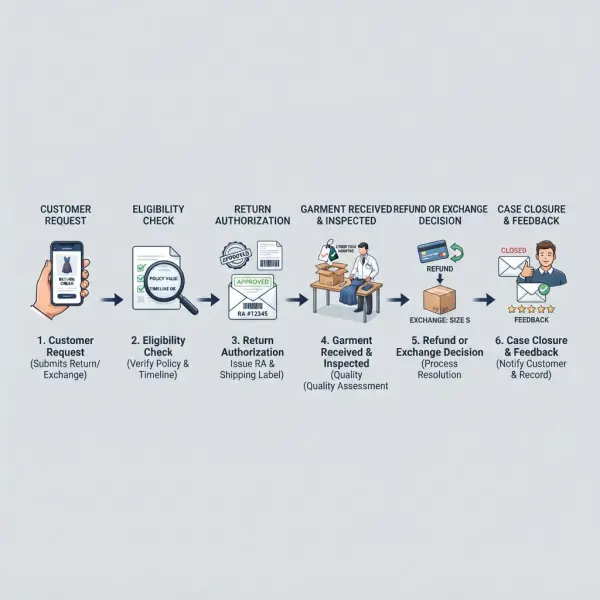
Returns, refunds, and exchanges
Returns are especially significant in ecommerce because customers cannot fully inspect or try products before purchasing. National Retail Federation research estimated that 19.3% of online retail sales in the United States would be returned in 2025, although return rates vary substantially by retailer, category, market, and policy. The same research found that the returns experience can influence customers' willingness to shop with a retailer again. 2025 Retail Returns Landscape
Fashion businesses therefore need a clearly defined process covering eligibility, time limits, condition requirements, return shipping, refunds, exchanges, damaged goods, final-sale merchandise, promotional purchases, and any regional consumer-law obligations that apply.
A generous return policy is not automatically the correct strategy for every brand. Free returns, long windows, and instant refunds can make purchasing easier, but they also create fulfillment, fraud, working-capital, and reverse-logistics costs. Customer service needs to implement the policy consistently rather than quietly expanding or restricting it case by case.
Research specifically examining fashion ecommerce returns has also highlighted the operational complexity associated with high-volume returns and differences in return behavior across product categories. research on fashion ecommerce returns
Complaints and service recovery
Some cases require more than providing information. The customer may have received the wrong item, encountered a defective garment, experienced repeated delivery failures, or been given inconsistent information by different representatives.
Effective complaint handling begins by identifying the actual failure. If the problem is operational, an apology without correction is insufficient. If the wrong size was shipped, the priority is to determine how to replace or refund it under the brand's policy. If the customer's expectation differs from an accurately described product, the response may need to explain the available options without incorrectly accepting responsibility for a product defect.
Service recovery should therefore combine communication with resolution authority. Representatives need clear boundaries for refunds, replacement shipments, store credit, expedited shipping, goodwill adjustments, or escalation to a manager.
Online Customer Service Versus In-Store Service
Online and physical retail service perform many of the same functions, but the information available to the customer is different.
|
Service Area |
Online Fashion Brand |
Physical Fashion Retail |
|
Product evaluation |
Depends heavily on images, descriptions, measurements, reviews, and digital support |
Customer can physically inspect and often try the product |
|
Sizing assistance |
Requires clear measurement and fit information |
Can combine product knowledge with fitting-room experience |
|
Inventory questions |
Often involves warehouse or digital stock visibility |
May require store-level and cross-store stock checking |
|
Delivery |
Central service issue |
Relevant mainly for orders, transfers, or home delivery |
|
Exchanges and returns |
Usually involves return authorization and shipping |
Can often be resolved directly at the store |
|
Communication |
Email, chat, social, messaging, marketplace, phone |
Primarily face-to-face, supplemented by digital channels |
|
Customer history |
Potentially available through ecommerce or CRM systems |
Depends on identification and integration between store and customer systems |
The table should not imply that online service is inherently more difficult. Digital channels can make order history, written documentation, and asynchronous communication easier. Physical stores, meanwhile, give customers direct access to products but require frontline employees to make decisions in real time.
Omnichannel brands face the additional challenge of connecting the two. A customer who buys online may expect to exchange the item in a store. Someone who discovers a garment in a store may later ask the digital service team about a different color. Whether those journeys are supported depends on inventory architecture, payment systems, returns policies, and operational integration—not simply on the willingness of staff to help.
What Does Good Fashion Customer Service Actually Require?
Good service is often described in emotional terms: friendly, helpful, empathetic, or personal. Those qualities matter, particularly in difficult interactions, but they are not enough to run a reliable service operation.
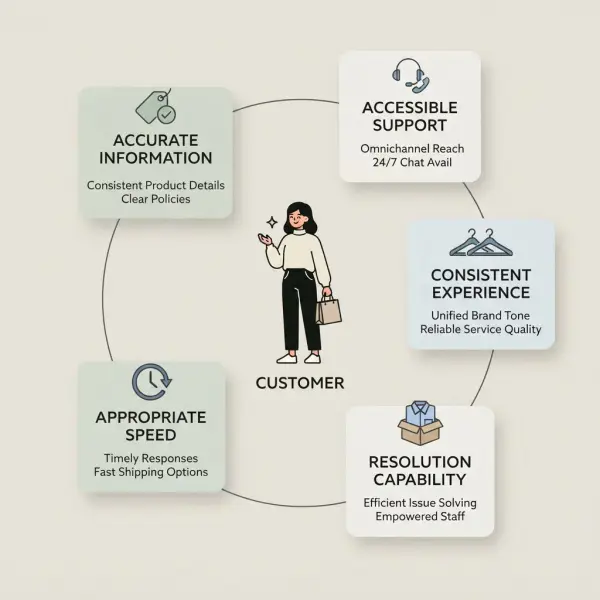
A more useful framework is to think about service quality as a combination of accuracy, accessibility, consistency, resolution capability, and appropriate speed.
Accurate information
Accuracy comes first because fast misinformation can create a second problem while attempting to solve the first. Service agents should not improvise garment composition, refund timing, inventory availability, delivery commitments, or policy exceptions.
A practical service operation gives representatives access to an agreed source of truth. Depending on the business, this may combine a product information management system, ecommerce platform, order management system, warehouse data, policy knowledge base, customer relationship management platform, and internal escalation notes.
For smaller brands, sophisticated software is not mandatory. A well-maintained shared knowledge base and clearly assigned responsibilities may be more useful than an expensive platform containing incomplete information.
Accessible support
Accessibility means customers can find an appropriate way to get help and understand when a response can reasonably be expected. It does not necessarily mean operating every possible channel around the clock.
A small label that monitors email and WhatsApp carefully may provide more dependable service than one that advertises support through email, Instagram, Facebook Messenger, live chat, TikTok, phone, and several marketplaces but responds inconsistently.
Brands should therefore select channels based on customer behavior and operating capacity. They should also clarify service hours where real-time support is not available.
Consistency across channels
Customers generally perceive the brand as one organization even when the business separates ecommerce, social media, warehouse, and store teams internally. Salesforce research has reported strong customer expectations for consistent interactions across company departments. State of the Connected Customer research
For a fashion retailer, consistency becomes visible in practical details. A return policy explained on the website should not be interpreted entirely differently in a store. A customer should not receive contradictory sizing information from Instagram and live chat. Promotions that apply only to certain channels should state those limitations clearly rather than leaving frontline staff to resolve confusion after purchase.
Consistency does not require identical responses. Different cases may justify different resolutions. What matters is that those differences follow recognizable rules.
Resolution capability
A service team that can communicate but cannot resolve cases becomes a message-forwarding function. Excessive escalation increases customer effort and consumes internal time.
The aim should be to resolve routine issues at the lowest appropriate level while reserving specialist intervention for cases involving unusual financial exposure, suspected fraud, legal concerns, product-safety issues, privacy, repeated failures, or policy exceptions beyond normal authority.
This requires explicit decision rights. Agents need to know not only what they are allowed to do, but also what evidence is needed and when escalation becomes mandatory.
Appropriate response speed
Speed matters, but response time should be matched to the nature of the inquiry. A customer standing at a store checkout requires immediate assistance. A request to change a shipping address may be time-sensitive because fulfillment can make the change impossible. A general product-care question may tolerate a longer response.
Contact-center research by Qualtrics has identified waiting time and first-contact resolution among important aspects of customer-service satisfaction. Qualtrics Contact Center Trends 2025
For fashion businesses, this suggests that a single average response-time target can be too simplistic. Case priority should consider urgency as well as queue age.
Product Knowledge Is Service Infrastructure
One of the most practical investments a fashion brand can make is improving the information available to customer-facing staff. Training agents to "be helpful" will not compensate for incomplete size specifications, ambiguous material descriptions, or inaccessible stock information.
A useful product knowledge record may include measurements by size, intended fit, fabric composition, lining, closure type, garment length, stretch characteristics, care instructions, country-specific sizing conversions where appropriate, model measurements, recurring fit observations, and known product limitations.
Not every detail needs to be shown to every customer. The point is to prevent service representatives from guessing.
Product feedback can also travel in the opposite direction. Suppose support repeatedly receives messages saying the sleeve of a particular jacket feels shorter than expected. That pattern may warrant investigation by merchandising, technical design, quality, or product-development teams. The issue might originate in the size specification, production tolerance, styling photography, description, or simply an unusual concentration of customers with different expectations.
Customer service should therefore contribute evidence without automatically diagnosing the cause.
Customer Service Should Connect With the Rest of the Fashion Business
A service department cannot compensate indefinitely for failures elsewhere. Many customer problems originate upstream.
A late order may reflect fulfillment capacity. A refund delay may come from finance or payment processing. High volumes of fit questions may indicate insufficient product information. Repeated complaints about seams may need quality investigation. Customers repeatedly receiving unavailable-item cancellations may reveal inventory synchronization problems.
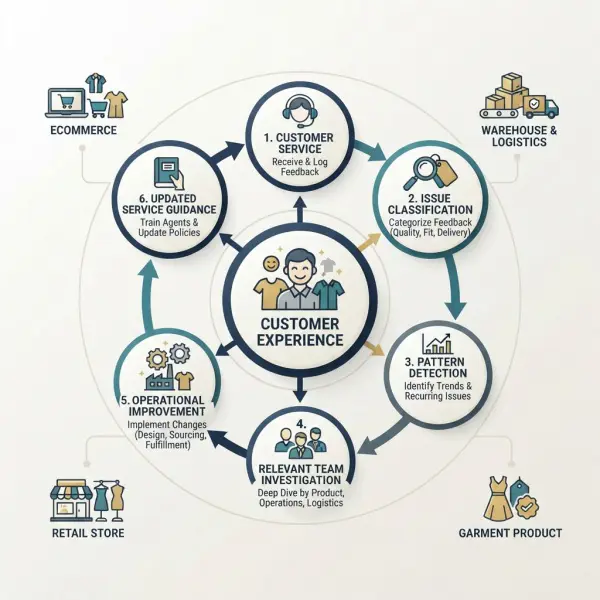
A useful service system therefore includes a feedback loop:
- Customer inquiry or complaint is recorded.
- The service team classifies the issue consistently.
- Repeated patterns become visible.
- Relevant teams investigate the underlying cause.
- Operational or product changes are made where justified.
- Service guidance is updated so representatives have current information.
This turns customer service data into operational evidence rather than leaving thousands of conversations trapped inside inboxes.
The interpretation still requires caution. A high number of complaints about one product may indicate a genuine problem, but complaint counts alone do not establish defect rates unless they are compared with units sold, return reasons, inspection results, customer expectations, and other relevant evidence.
What Technology Supports Fashion Customer Service?
Technology can organize service work, but it does not remove the need for product knowledge, policy design, or operational responsibility.
The useful technology stack depends heavily on scale. A small fashion startup may operate effectively with a shared helpdesk, ecommerce administration system, shipment tracking, a documented knowledge base, and disciplined tagging. A larger omnichannel retailer may require integration between customer relationship management, order management, inventory, point-of-sale, product information, logistics, loyalty, and returns systems.
Common capabilities include:
- Ticket or conversation management, so inquiries from supported channels can be tracked rather than lost in personal inboxes.
- Customer and order lookup, allowing authorized representatives to understand transaction history.
- Knowledge management, providing current policies and approved product information.
- Case categorization, which helps identify recurring issues and workload patterns.
- Templates and macros, useful for repetitive information while still allowing case-specific editing.
- Service-level monitoring, helping teams see overdue or urgent cases.
- Returns management, where scale justifies structured authorization, tracking, and disposition workflows.
- Reporting, allowing managers to examine issue categories, resolution time, repeat contacts, and other operational indicators.
The mistake is assuming that adding technology automatically improves service. Poorly maintained integrations can expose outdated stock, duplicate conversations, or send customers automated messages that conflict with what staff are telling them.
Technology should simplify a sound workflow rather than conceal an undefined one.
Where does AI fit?
Artificial intelligence can assist with classification, summarization, knowledge retrieval, suggested replies, translation, and basic self-service. These applications may reduce repetitive work, particularly when policies and knowledge sources are structured clearly.
Fashion businesses should still be cautious about delegating ambiguous fit guidance, unusual refunds, complaints, sensitive customer data, or complex policy exceptions entirely to automated systems. Generative systems can produce plausible but incorrect information when data sources, retrieval controls, or escalation rules are weak.
Current customer research also shows that adoption should not be interpreted as universal consumer comfort with AI-mediated brand interactions. PwC's 2025 customer experience survey, for example, reported substantial consumer hesitation around using AI tools to engage with brands. PwC 2025 Customer Experience Survey
For customer service, the safer strategic question is therefore not "How much support can AI replace?" but "Which service tasks can be automated without reducing accuracy, accountability, privacy, or appropriate access to a human?"
How Should Fashion Brands Measure Customer Service?
No single metric describes service performance adequately. Fast first responses can coexist with unresolved problems, while high customer satisfaction scores may be based on only a small portion of customers who choose to complete surveys.
Fashion businesses should combine service metrics with operational context.
|
Metric |
What It Can Indicate |
What to Watch |
|
First response time |
How quickly customers initially receive attention |
Does not show whether the issue was solved |
|
Resolution time |
How long cases remain unresolved |
Complex cases naturally take longer |
|
First-contact resolution |
Whether customers need repeated interactions |
Requires consistent definition of a resolved case |
|
Recontact rate |
Whether customers return about the same problem |
Useful for detecting incomplete answers |
|
Customer satisfaction |
Customer perception after an interaction |
Survey participation can create response bias |
|
Inquiry category |
Why customers are contacting the brand |
Classification needs to be consistent |
|
Escalation rate |
How often agents require additional authority |
High or low rates are not automatically good or bad |
|
Return reason |
Why products are being returned |
Customer-selected reasons may not fully identify root cause |
|
Complaint rate |
Frequency of complaints relative to business volume |
Raw complaint counts alone can be misleading |
The most useful measurements often connect service data with the business process that generated it. If "Where is my order?" inquiries rise sharply, the service manager should not merely measure how quickly agents answer them. The brand should examine whether delivery performance, tracking communication, or estimated delivery information changed.
Similarly, a surge in size questions may require product-content improvement rather than additional customer service staffing.
How Can a Fashion Brand Build a Practical Service System?
A fashion business does not need to begin with a complex contact center. It needs a repeatable operating model.
1. Define the service scope
Start by documenting what the service team owns. Include pre-purchase questions, order issues, cancellations, delivery problems, returns, exchanges, defects, payment inquiries, store-related cases, and any areas handled elsewhere.
Ambiguous ownership is a common source of delay because representatives spend time finding someone willing or authorized to make a decision.
2. Map the main customer journeys
Identify where customers commonly need help across discovery, purchase, fulfillment, delivery, use, return, exchange, and complaint resolution.
An online apparel brand might discover that most interactions concentrate around sizing before purchase and tracking after dispatch. A physical retailer may find that promotional rules and exchanges create more work. The service system should be designed around actual demand rather than a generic customer-service template.
3. Establish a source of truth
Document approved information for products, policies, fulfillment, payments, returns, warranties where relevant, promotions, and escalation.
When information changes, define who updates it. A knowledge base that nobody owns becomes unreliable quickly, and staff eventually return to asking colleagues through private messages.
4. Create decision boundaries
Specify what frontline representatives may resolve independently.
For example, the rules might define whether an agent can replace a verified wrong item, waive a shipping fee under defined circumstances, issue store credit, reopen an exchange request, or escalate a suspected quality defect.
Decision authority should reflect transaction value, fraud exposure, regulatory requirements, and staff experience. The objective is controlled autonomy, not unrestricted discretion.
5. Create an escalation path
Frontline staff should know where difficult cases go and what information must accompany the escalation.
A quality complaint may require photographs, order information, batch or style identifiers, and a description of the problem. A suspected payment issue may need finance review. A privacy request may require a designated specialist.
Structured escalation prevents cases from circulating informally between departments.
6. Review patterns, not only individual tickets
Once basic service is stable, managers should review recurring contact drivers. This is where service becomes strategically useful.
If hundreds of customers ask a question that could be answered accurately on the product page, the scalable solution is not necessarily answering the next hundred messages faster. It may be correcting the missing information upstream.
What Fashion Brands Should Verify Before Changing Their Service Strategy
Customer service practices should not be copied from another retailer without considering the operating model behind them. A global fashion marketplace, a made-to-order label, a luxury boutique, a small direct-to-consumer brand, and a mass-market chain face very different economics and customer expectations.
Before adopting a new policy or service feature, verify several conditions.
First, determine whether the operational systems can actually support the promise. Offering real-time inventory visibility is useful only if inventory records are sufficiently reliable. Promising instant exchanges may be difficult when stock is fragmented or products are made to order.
Second, review the economics. Free returns or generous goodwill credits may reduce customer friction but can become expensive when average order values, margins, logistics costs, or fraud exposure are unfavorable.
Third, account for regional requirements. Consumer-protection, cancellation, refund, privacy, warranty, accessibility, and communication rules vary between jurisdictions. Global brands should not assume one policy can be copied unchanged across all markets.
Finally, test whether the service change solves a real customer problem. Adding another support channel is not an improvement when the existing channels already struggle with incomplete information or unresolved cases.
Common Misconceptions About Fashion Customer Service
Fast replies automatically mean good service
Response speed is useful, but it measures only one part of the experience. A customer who receives an immediate but inaccurate answer may need additional contacts and ultimately spend more time resolving the problem. Brands should therefore examine speed together with accuracy and resolution.
Customer service owns every customer problem
The service team often becomes the visible recipient of failures elsewhere, but responsibility for root-cause correction may sit with merchandising, fulfillment, technology, payments, quality, retail operations, or another team. Service should coordinate the case and provide evidence, not absorb permanent responsibility for systemic defects it cannot fix.
More channels automatically improve accessibility
Each channel creates monitoring, staffing, training, routing, and consistency requirements. Opening live chat or social messaging without enough coverage can actually create uncertainty because customers do not know whether their messages are being handled. Channel expansion makes sense when operating capacity expands with it.
A script can standardize every interaction
Templates are useful for repeatable facts, but fashion cases often contain details that require interpretation. An exchange request involving an unworn garment is different from a suspected manufacturing defect, and a size question about a stretch-knit top differs from one about a structured woven blazer. Scripts should support judgment rather than eliminate it.
Excellent service can compensate for a weak product indefinitely
Service can recover some individual failures, but it cannot sustainably compensate for inaccurate sizing, persistent quality problems, unreliable fulfillment, or misleading merchandising. Repeated service contacts may instead be evidence that another process needs correction.
A deeper examination of these operational failures belongs in common customer service gaps that hurt fashion businesses.

Customer Service as a Source of Customer Insight
Customer conversations contain information that is difficult to capture through sales data alone. Orders show what people bought. Service interactions can help explain where customers became uncertain, what they misunderstood, and what went wrong.
The distinction matters. A product with healthy sales may still create disproportionate support work because its sizing is difficult to understand. Another product may generate few complaints but a high number of pre-purchase questions because the photography does not communicate fabric thickness. Customer service data can make these patterns visible.
Brands should avoid treating every comment as representative of the entire customer base. Service data is naturally biased toward customers who needed assistance and chose to contact the company. Its value comes from combining qualitative conversations with order volume, returns, product data, web behavior, store feedback, and other relevant information.
When analyzed carefully, service becomes part of the brand's listening infrastructure.
Where Customer Service Fits in the Wider Customer Experience
Customer service is one component of customer experience, not a synonym for the entire concept. Customer experience also includes product quality, website usability, store design, pricing communication, checkout, delivery, packaging, fit, returns, loyalty interactions, and many other touchpoints.
Service becomes especially visible when customers encounter uncertainty or failure. That gives it disproportionate influence over how some customers remember the brand, but it should not be used as a substitute for designing the rest of the experience well.
Research across industries consistently finds relationships between service satisfaction and loyalty-related behaviors such as willingness to purchase more, trust, and recommendation, although the strength and causal mechanisms depend on research design and context. Qualtrics' global contact-center research, for example, has reported substantially stronger loyalty intentions among consumers satisfied with their service experiences. Qualtrics research on customer service satisfaction and loyalty
For fashion brands, that relationship deserves its own analysis because reviews, repeat purchasing, and trust are affected by more than service alone. Product quality, fit consistency, delivery, value perception, and brand credibility also matter. These relationships are explored further in how service quality influences reviews, repeat sales, and trust
FAQ: Fashion Customer Service
What is the simplest definition of fashion customer service?
Fashion customer service is the system a fashion business uses to answer customer questions and resolve purchase-related problems before, during, and after a transaction. It commonly covers product information, sizing, stock availability, orders, delivery, returns, exchanges, defects, complaints, and store or ecommerce assistance. The important word is system: good service depends not only on individual employees being friendly, but also on reliable product data, policies, order visibility, escalation rules, and cooperation with operational teams.
Is customer service more important for online fashion than physical retail?
The service challenges are different rather than universally greater. Ecommerce customers cannot normally inspect or try garments before purchase, so sizing information, product descriptions, delivery communication, and returns support become especially important. Physical retail reduces some of that uncertainty but creates other requirements, including fitting-room assistance, real-time inventory questions, checkout support, and immediate handling of exchanges or complaints. Omnichannel retailers need to coordinate both environments so customers understand what can be done online, in stores, and across channels.
Should fashion customer service agents recommend sizes?
They can help customers interpret sizing information, but recommendations should be appropriately qualified. Agents can compare body or garment measurements, explain intended fit, describe stretch, and point to model information where available. They should avoid guaranteeing that a size will fit perfectly because body proportions, personal comfort, styling preferences, garment construction, and measurement methods vary. The most reliable approach is to combine accurate garment data with transparent guidance rather than presenting a subjective fit prediction as certainty.
What customer service channels should a small fashion brand use?
A small brand should usually prioritize a manageable number of channels that its customers actually use and that the team can monitor reliably. Email plus one well-supported conversational channel may be sufficient for many businesses. Marketplace sellers may also need to prioritize platform messaging because response requirements can affect marketplace operations. Adding channels should follow demand and staffing capacity. Five poorly monitored channels usually create a less dependable experience than two channels with clear response expectations, accurate information, and consistent case tracking.
Can customer service reduce fashion returns?
Customer service may prevent some avoidable returns by improving pre-purchase information about measurements, fit, materials, product features, and policies, but it cannot eliminate returns. Customers may still change their minds, order multiple sizes, find that a garment feels different than expected, receive an incorrect or defective item, or return products for other legitimate reasons. Brands should therefore analyze return reasons and product-level patterns rather than treating lower returns as solely a customer-service target.
Should customer service be outsourced?
Outsourcing can work when responsibilities, product knowledge, system access, quality controls, escalation procedures, data protection, and performance expectations are defined clearly. It becomes more difficult when products require nuanced fit guidance or when agents cannot access reliable order and inventory information. The decision should therefore be based on process maturity and economics rather than assuming that an external provider is automatically cheaper or less capable. A poorly documented service operation generally remains difficult after outsourcing because the provider inherits the same information and decision gaps.
What information should a fashion service team share with product teams?
Service teams should share structured patterns rather than forwarding isolated complaints without context. Useful information may include recurring sizing questions, frequently misunderstood descriptions, product-specific return reasons, suspected quality concerns, care questions, stock frustrations, or repeated differences between customer expectations and the product received. Whenever possible, those observations should be compared with units sold, return volumes, inspection results, and other evidence. Customer conversations can reveal valuable signals, but they should be treated as one data source rather than definitive proof of a product problem.





Comments 0
Leave a CommentSend Comment
Anda harus Login terlebih dahulu untuk dapat memberikan komentar.