

Genuine Leather vs Vegan Leather: What Fashion Buyers Should Know
Quick Answer
Genuine leather is animal hide or skin that has been tanned so its fibrous structure is preserved, while vegan leather is a retail umbrella term for non-animal materials designed to provide a leather-like appearance or function. Neither label, by itself, tells a fashion buyer enough about quality.
“Genuine leather” confirms that a material is leather, but it does not identify whether the material is full grain, corrected grain, split leather, heavily coated, or suitable for a particular product. “Vegan leather” describes an animal-free positioning rather than a standard construction. It may refer to polyurethane (PU)- or polyvinyl chloride (PVC)-coated textile, a plant-containing composite, or another developing material system.
The practical comparison therefore requires more than checking two names on a swatch card. Buyers should verify the exact material construction, finish, backing, thickness, physical test results, manufacturing compatibility, supply consistency, care requirements, legal labelling, and evidence behind environmental claims. A strong material choice is the one that meets the product brief and can be supplied repeatedly at an acceptable total cost. It is not automatically the option with the more familiar, premium-sounding, or sustainability-oriented label.

What Do “Genuine Leather” and “Vegan Leather” Actually Mean?
The two terms answer different questions. Genuine leather describes material origin: the sheet is made from animal hide or skin processed as leather. Vegan leather describes an exclusion claim: the marketed material is intended to avoid animal leather and other animal-derived inputs within the scope claimed. One is a material identity; the other is a positioning category that can contain several unrelated constructions.
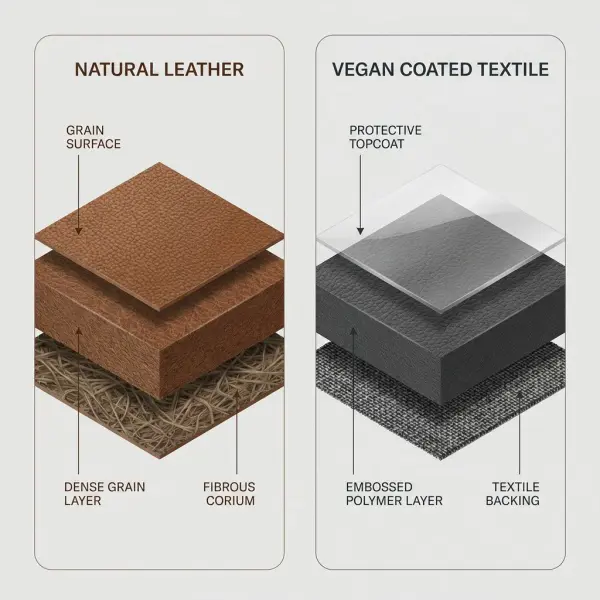
Leather itself has a technical basis. The United Nations Economic Commission for Europe describes it as hide or skin whose original fibrous structure remains more or less intact and has been tanned so that it will not decompose under normal conditions. That definition, included in the UNECE leather traceability analysis, distinguishes leather from a textile coated to resemble it and from a sheet made by binding leather fibers together.
The word “genuine” is often misunderstood as a formal rank below top-grain leather. It is safer for buyers to treat it as confirmation of real leather, not as a complete grade specification. A genuine-leather product could use grain leather, corrected leather, split leather, suede, or another leather construction. Quality still depends on the hide section, fiber structure, tanning, finishing, thickness, selection standard, workmanship, and intended use.
Vegan leather is even broader. Conventional versions commonly use a woven, knitted, or nonwoven textile backing with a PU or PVC surface. Newer alternatives may contain cactus-derived feedstock, fruit residues, pineapple-leaf fiber, cork, natural rubber, mycelium, microbial cellulose, or other bio-derived inputs. Many remain composites that need a binder, backing, adhesive, pigment, or protective coating. Buyers should therefore ask what the finished material contains by layer, rather than treating its headline ingredient as the whole composition.
For a fuller map of these constructions, see leather and leather alternatives for fashion applications. The buyer comparison here begins after the category has been identified: what exactly is being purchased, and does it fit the commercial brief?
Genuine Leather vs Vegan Leather at a Glance
There is no single test result, cost pattern, or environmental profile that applies to every genuine or vegan leather. The table below compares the questions buyers can reasonably ask at category level without turning tendencies into guarantees.
|
Buying factor |
Genuine leather |
Vegan leather |
What the buyer should verify |
|
Core material |
Tanned animal hide or skin with its fibrous structure retained |
Non-animal leather-like material; often a coated textile or multilayer composite |
Exact material name and composition, not only the retail label |
|
Internal structure |
Natural three-dimensional fiber network; density and thickness vary across a hide |
Engineered backing, coating, binder, and finish; construction varies by supplier |
Cross-section, backing, layer thickness, and bonding method |
|
Surface character |
Can retain natural pores, marks, variation, and patina; heavy finishes may create a more uniform face |
Can be made highly regular or embossed to imitate specific grains |
Approved appearance standard and acceptable batch variation |
|
Cutting format |
Supplied as hides or skins with variable outlines and usable zones |
Commonly supplied in rolls or sheets with more regular dimensions |
Usable yield, defect allowance, width, roll length, and inspection method |
|
Performance |
Depends on species, hide section, tannage, grain or split structure, finish, thickness, and care |
Depends on substrate, polymer or binder, layer adhesion, finish, thickness, and aging resistance |
Results for the exact material code under product-relevant tests |
|
Production behavior |
May require grading, nesting around defects, skiving, edge finishing, and leather-specific process control |
May offer consistent cutting but can respond differently to needles, heat, folding, adhesives, and edge paint |
A production-intent prototype and controlled factory trial |
|
Repair and aging |
Some leathers can be conditioned, refinished, or repaired; feasibility depends on finish and damage |
Repairability varies; peeling, coating damage, or delamination can be difficult to restore invisibly |
Expected failure mode, spare components, and realistic repair method |
|
Claims risk |
“Genuine,” species, grain type, tannery credentials, and environmental claims need accurate scope |
“Vegan,” plant-based, bio-based, plastic-free, recycled, biodegradable, and recyclable claims need evidence |
Market-specific labelling review and substantiation for every claim |
The most useful row is the last one in each comparison: verification. Category-level knowledge helps create a shortlist, but purchase approval must attach to a named supplier, material code, color, thickness, finish, backing, batch tolerance, and intended component.
Quality Varies More Within Each Category Than the Labels Suggest
A buyer choosing between “genuine” and “vegan” is comparing labels at too high a level. A corrected-grain leather, an aniline leather, a basic PVC-coated fabric, and an engineered PU microfiber each has a different specification and failure profile.
Genuine leather requires a precise leather description
Leather quality begins with structure, selection, and processing. Full grain retains the grain surface, corrected grain has been altered before finishing, and split leather comes from a lower layer of a divided hide. The Leather Working Group terminology guide distinguishes grain, flesh, and middle splits. “Leather” alone therefore leaves important information unstated.
Finish matters as much as layer. Aniline leather preserves natural character but may show stains and color movement more readily; pigmented leather can provide a more even, protected surface. Polymer-coated split leather may look regular, but its structure is not the same as intact grain leather.
A useful leather purchase description normally includes:
- Species and origin information relevant to traceability or legal requirements.
- Grain, corrected-grain, split, suede, nubuck, or other construction.
- Tanning, finish, thickness, color, temper, and acceptable variation.
- Hide selection grade, usable-area expectation, defect rules, and measurement method.
These details make intended quality measurable during sampling, inspection, cutting, and repeat ordering.
Vegan leather requires a layer-by-layer bill of materials
For vegan leather, name the technology rather than repeat the vegan claim. A PU-coated knit, PVC-coated woven fabric, coated microfiber, and plant-containing composite can carry similar retail language while differing in weight, stretch, aging, processability, and end-of-life options.
Ask for the backing fiber and structure, surface polymer or binder, finish, and complete bio-based or recycled percentage with its measurement basis. Establish whether the plant input replaces polymer, acts as filler, or forms the structural network.
A material can be commercially attractive without being plastic-free. The complete construction is still needed to set tests, approve claims, plan processing, and compare suppliers.
Which Performs Better in a Fashion Product?
Neither genuine leather nor vegan leather performs better in every application. Performance belongs to an exact material-component combination. A material suitable for the body of a structured tote may fail when folded into a narrow handle; a shoe upper that resists surface abrasion may still crack at the vamp after repeated flexing.
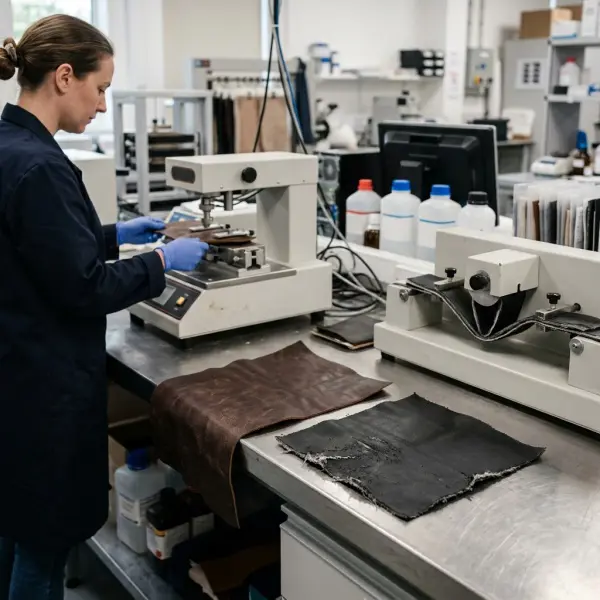
A peer-reviewed laboratory comparison found substantial variation among leather and alternatives in tensile strength, tear resistance, flexing, and water-vapor behavior. No tested alternative reproduced leather's full combination of characteristics. The practical lesson from the study comparing leather and alternative materials is not that every leather wins, but that appearance cannot replace tests on the exact material.
For most fashion accessories, footwear, and outerwear programs, the test plan should be built around likely failure points:
- Repeated movement: flex cracking, whitening, creasing, and delamination.
- Mechanical loading: tensile, tear, seam, stitch-hole, and attachment strength.
- Surface exposure: abrasion, rub fastness, scratches, stains, cleaning, light, and color migration.
- Climate and storage: heat, humidity, cold flexibility, hydrolysis where relevant, blocking, and aging.
- Wear comfort: weight, handfeel, and air, water-vapor, and thermal behavior.
Thresholds should reflect the component: a rigid wallet panel and a bending shoe upper do not need the same flex requirement. Test the finished product because adhesives, reinforcement, hardware, and geometry can move the failure point.
Aging creates different forms of value and risk
Some leathers develop valued patina; others stain, stretch, or wear unevenly. Vegan alternatives can retain uniform early appearance, but longer-term behavior depends on polymer chemistry, topcoat, layer adhesion, environment, and care. Peeling or delamination may be harder to repair than a scuff on a repairable leather finish. Specify aging and aftercare rather than generalizing by category.
The product-specific consequences are examined further in why material choice matters in bags, shoes, and outerwear. Buyers should use that component logic when turning material test results into an approval decision.
Cost, Consistency, and Manufacturing Change the Comparison
Quoted price rarely predicts finished-product economics. Leather cost depends on usable area, hide shape, defects, shade matching, cutting yield, labor, and rejected panels. A low price per square foot can become expensive when yield is poor.
Rolls or regular sheets can simplify cutting and improve visual consistency. Total cost can still rise through minimums, custom colors, reinforcement, adhesives, testing, slower operations, rejects, or long replenishment lead times.
Buyers should compare a cost model that includes:
- Landed material cost and usable yield after defects, edges, and shade zones.
- Reinforcement, lining, adhesive, edge treatment, and machinery requirements.
- Testing, development, assembly time, rework, and reject rate.
- Warranty, repair, complaint, and replacement exposure.
- Minimum order, lead time, color continuity, and inventory commitment.
The result can differ for a seasonal run and a repeatable core product. A startup may prioritize modest minimums; a larger brand may need exact color control, capacity, change notification, and continuity.
A substitute material can require a product redesign
Switching material families is not cosmetic. Different stretch, thickness, folding, edge, stitch-hole, and adhesive behavior may require new reinforcement, seams, needles, or pattern geometry.
Run production-intent material before freezing the pattern and operation sequence. A controlled trial can expose cracking, puckering, glue marks, coating damage, shade variation, or cycle-time changes missed in swatch review.
Sustainability and Ethics Are Not Settled by Either Label
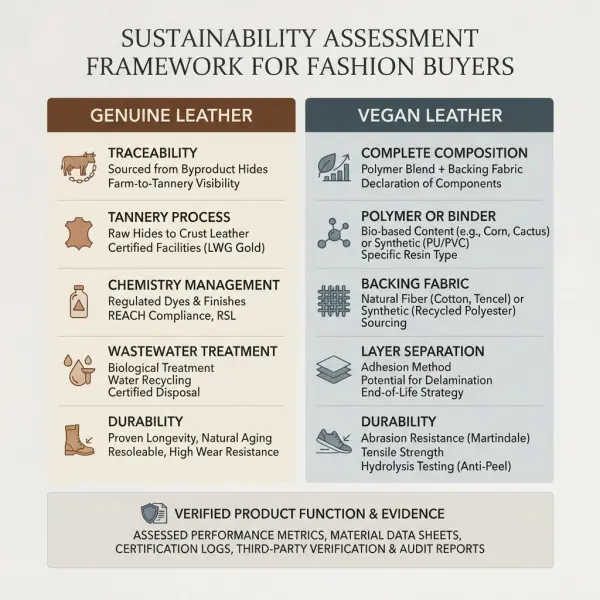
Genuine leather and vegan leather present different impact questions, but neither label is an environmental conclusion. A responsible comparison needs equivalent function and duration, a defined system boundary, traceable data, and disclosure of what is included or excluded.
For leather, examine livestock traceability, land-use and animal-welfare risks, tanning chemistry, water, energy, restricted substances, wastewater, waste, worker conditions, and durability. The Leather Working Group Manufacturer Standard assesses eligible processing facilities across defined sections; it does not certify every attribute of a finished product.
For vegan leather, examine feedstocks, backing, coating, solvents, additives, energy, durability, layer separation, and recycling infrastructure. Textile Exchange notes in its overview of other synthetic materials that PU coating can be difficult to separate from its base. Recycled input in one layer therefore does not make the composite circular.
Animal-free composition can be an ethical requirement, but it remains separate from environmental performance. Natural origin or agricultural residue does not prove low impact, biodegradability, recyclability, or freedom from fossil-derived polymers.
Environmental claims need narrow, verifiable wording
Terms such as “eco-friendly,” “sustainable leather,” “plant-based leather,” “biodegradable vegan leather,” and “recyclable” can imply much more than one piece of evidence supports. The US Federal Trade Commission's Green Guides caution against deceptive environmental claims and set conditions for claims including degradability, compostability, recyclability, recycled content, and renewable materials.
A safer description identifies the verified attribute and scope. If only the backing is certified, say so rather than implying that the whole material is recycled. Check the calculation basis, complete material weight, exclusions, test method, certificate owner, validity, and exact supplier code.
Labelling and Product Descriptions Require Market-Specific Review
Material language affects consumer understanding, customs, labelling, and advertising compliance. Requirements vary by product and market; do not copy one description globally without review.
In the United States, FTC guidance says material made to look like leather but not made from leather should be disclosed as non-leather or by its general composition. It also addresses split, bonded, or reconstituted leather and non-leather backing. Buyers should review 16 CFR Part 24 on leather and imitation-leather products, not rely on supplier marketing names.
For EU footwear, Directive 94/11/EC covers material labelling for the upper, lining and sock, and outer sole, distinguishing leather, coated leather, textiles, and other materials. Review the EU footwear-labelling directive with national implementation and other applicable rules.
The internal product record must therefore support accurate legal, customs, care, sustainability, and marketing disclosures for each market.
A Practical Buying Framework for Fashion Teams
The strongest comparison process separates non-negotiable product requirements from optional material narratives. A buyer can then eliminate unsuitable options before investing in colors, prototypes, campaign language, or volume commitments.
- Define the component and use case. State where the material will sit, how it will bend or carry load, likely exposure, expected service level, care method, target price, and aesthetic standard.
- Replace category labels with specifications. For leather, identify species, grain or split construction, tanning and finish information, thickness, temper, selection standard, and usable-area expectation. For vegan leather, document each layer, backing, coating or binder, finish, weight, thickness, and claimed bio-based or recycled content.
- Create comparable test plans. Test candidates against the same product-relevant thresholds where technically appropriate. Add construction-specific tests such as hydrolysis or delamination checks when the material architecture warrants them.
- Prototype with production-intent processes. Use the intended pattern, reinforcement, thread, needle, adhesive, edge finish, lining, hardware, and machinery. Test the assembled product, not only flat material.
- Model total cost and supply risk. Include yield, defects, labor, testing, minimum orders, lead time, color continuity, capacity, change control, warranty risk, and contingency supply.
- Verify compliance and claims. Review restricted-substance documentation, applicable labelling, traceability, certification scope, care instructions, and every environmental or ethical statement.
- Approve a controlled standard. Keep an approved swatch, technical sheet, signed color or finish standard, test reports, tolerance table, supplier code, and process notes tied to the purchase order.
This framework belongs within a wider fashion sourcing strategy for growing apparel brands. Material approval works best when sourcing, design, technical development, quality, compliance, and marketing share one version of the specification.

Common Buying Mistakes That Create Avoidable Risk
Treating genuine leather as a complete quality grade
The phrase does not define grain layer, finish, selection, thickness, yield, or performance. Copying retail terminology into a purchase order can produce compliant but unsuitable delivery. Specify the construction and approval standard.
Treating vegan leather as a composition
“Vegan” does not identify PU, PVC, coated microfiber, plant composite, or another construction. Record animal-free status and technical composition separately so testing, claims, and production can be planned.
Comparing an anonymous low grade with a premium sample
A poor leather versus an advanced alternative does not establish a category hierarchy. Compare candidates for the same component, price architecture, quality level, and service expectation.
Approving the face while ignoring the reverse and edge
Backing, adhesion, coating thickness, flesh side, fiber density, and cut edge affect sewing, folding, and delamination risk. Inspect the cross-section and test the full construction.
Choosing from purchase price instead of usable product cost
Leather yield and inspection change cost; alternatives may add reinforcement, adhesive, testing, minimum-order, or reject costs. Model cost per accepted finished unit.
Writing the sustainability story before receiving evidence
Supplier language can become an unrestricted product claim too early. Approve marketing only after composition, testing, certificate scope, and product design are fixed.
Important Technical and Commercial Caveats
- Genuine does not mean uncoated or minimally processed. Genuine leather may carry pigments, protective finishes, embossing, or polymer coatings. Ask what forms the visible surface.
- Vegan does not automatically mean plastic-free. Many established and emerging vegan materials contain PU, PVC, synthetic adhesives, or fossil-derived layers, even when plant inputs are present.
- Natural variation is not automatically a defect. Leather can show scars, pores, shade movement, and grain differences, but the purchase agreement should define which variations support the design and which are unacceptable.
- Uniformity is not proof of durability. A consistent roll can still crack, peel, migrate color, or delaminate if the construction is unsuitable for the product or storage climate.
- Biodegradability requires conditions and complete-material evidence. Results for one ingredient do not establish what happens to the finished multilayer sheet.
- Certification has a boundary. Confirm the certified facility, process, material, transaction, or claim; do not convert a narrow certificate into an unrestricted whole-product statement.
- Performance results are not transferable by material name. A pass result for one supplier code, thickness, finish, or color may not represent another variant.
The commercial principle is simple: qualify the claim to the evidence and qualify the material to the application. Both steps are needed before a buyer can make a defensible comparison.
Frequently Asked Questions
Is genuine leather always better quality than vegan leather?
No. Genuine leather confirms that the material is leather, but it does not specify its grain structure, finish, selection grade, thickness, or performance. Vegan leather also covers constructions ranging from basic coated fabrics to more highly engineered composites. A particular leather may outperform a particular alternative in flexing, breathability, repairability, or aging, while the alternative may offer more regular dimensions, surface consistency, or resistance to a defined exposure. Buyers should compare exact supplier codes using the same product brief, relevant laboratory tests, production trial, and total-cost model rather than treating either category as a quality score.
Does genuine leather mean full-grain leather?
No. Full-grain leather retains the grain surface without corrective removal, while “genuine leather” does not identify a specific grain category. A genuine-leather item may use full grain, corrected grain, split leather, suede, or another leather construction, depending on the product and description. Buyers should request the precise leather type, finish, thickness, selection standard, and test results. If a supplier uses “genuine” as the only technical description, the purchase order leaves too much open to interpretation. Consumer-facing copy should also follow the labelling rules of the target market and accurately describe coated, split, or bonded constructions where applicable.
Is all vegan leather made from polyurethane or PVC?
No, although PU- and PVC-coated textiles remain common commercial forms. Vegan alternatives may also use natural rubber, cork, cellulose, agricultural residues, mycelium, microbial cellulose, or other bio-derived structures. These inputs do not guarantee that the entire material is plant-based or plastic-free. A finished sheet may still need a synthetic binder, coating, adhesive, reinforcement, or textile backing. Ask for composition by layer, percentage calculations for the complete material, and supporting test or certification documents. The term “vegan” should be evaluated as an animal-free claim, while polymer content, bio-based content, recyclability, and biodegradability require separate evidence.
Which option is more suitable for a small fashion brand?
The more suitable option is the one a small brand can specify, test, purchase at workable minimums, manufacture reliably, and reorder consistently. Stock-service vegan materials may offer regular roll dimensions and accessible existing colors, while leather merchants may provide smaller quantities or distinctive natural character depending on the market. Both can create cash-flow pressure through minimums, shade matching, testing, or waste. Before committing, calculate accepted-unit cost, request current stock and replenishment information, build one production-intent prototype, and confirm whether the supplier will maintain the same material code and finish. Small volume does not remove the need for a written specification.
Which is easier to care for and repair?
It depends on the finish and type of damage. A pigmented leather may tolerate routine wiping and sometimes be recolored or refinished, while an aniline surface may require more careful stain management. Some coated vegan materials are easy to wipe clean, but peeling, deep coating abrasion, or delamination can be difficult to repair invisibly. Care instructions should be validated on the exact color and finish, including the effect of cleaners, moisture, heat, and friction. Product design also matters: replaceable straps, accessible hardware, sound edge construction, and available repair partners can extend useful life more reliably than a generic claim that one material family is repairable.
Can plant-based vegan leather be called biodegradable?
Only when evidence supports that claim for the relevant finished material under clearly stated conditions. Plant-derived powder, fiber, oil, or agricultural residue may form only part of a composite that also includes polymer binder, textile backing, adhesive, pigment, and topcoat. Testing one ingredient does not establish the biodegradation of the complete sheet. Buyers should request the test standard, laboratory, specimen description, percentage of the material tested, environment, duration, result, and remaining residues. Marketing should also consider local rules governing degradable or compostable claims. Without complete-material evidence, describe the verified plant or bio-based content narrowly instead.
What should be included in a purchase order for leather or vegan leather?
The purchase order should reference the approved supplier and material code, color, finish, thickness and tolerance, width or area-measurement method, backing or leather construction, quantity, defect standard, packaging, test requirements, chemical compliance, delivery date, and approved control sample. Add batch and change-notification requirements when repeatability matters. For leather, include selection grade and acceptable natural variation; for vegan alternatives, include layer construction and relevant aging or delamination requirements. Environmental, recycled, bio-based, traceability, or certification claims should be tied to named documents and scope. A generic line such as “black genuine leather” or “black vegan leather” is not an adequate production specification.
Conclusion
Genuine leather and vegan leather are useful retail categories, but weak buying specifications. Genuine leather can contain very different hide layers, finishes, and quality levels. Vegan leather can describe coated synthetics, plant-containing composites, and newer material systems whose chemistry and commercial readiness are not equivalent.
The buyer's task is therefore not to choose the more persuasive label. It is to convert each candidate into comparable information: construction, performance, manufacturing behavior, usable cost, supply reliability, care, compliance, and claim evidence. That process may still lead a brand to prefer leather for one product and a vegan alternative for another. It may also lead an animal-free brand to choose among several vegan constructions on technical grounds.
A defensible decision is specific. It names the exact material, the component it is approved for, the tests it passed, the production method it supports, the commercial conditions under which it works, and the claims the evidence can honestly carry. Everything else belongs on the shortlist, not yet on the purchase order.




Comments 0
Leave a CommentSend Comment
Anda harus Login terlebih dahulu untuk dapat memberikan komentar.