
How Brands Decide Product Mix, Color Options, and Size Depth
A fashion brand can develop a beautiful collection and still struggle to turn it into a commercially successful product range. The challenge often begins with decisions that appear relatively small: whether to introduce another blouse style, offer a new color, or purchase more medium-sized garments instead of distributing inventory equally across all sizes.
Each decision changes the assortment customers see and the inventory the business must finance.
Fashion brands decide product mix, color options, and size depth by combining customer demand, merchandise performance, brand positioning, production capabilities, and inventory budgets. The objective is to provide relevant choices while allocating purchasing quantities to the products and variants most likely to meet customer needs.
These decisions are closely connected but serve different purposes. Product mix determines which categories and styles belong in the collection. Color selection influences visual variety and customer preference. Size depth determines how many units are available within the selected size range.
For retailers and ecommerce businesses, the challenge is not simply selecting attractive designs. It is translating those designs into an assortment that can be produced, stocked, sold, and replenished under realistic commercial conditions.
Quick Answer: How Do Fashion Brands Plan Product Mix, Colors, and Sizes?
Fashion brands plan product mix, color options, and size depth by evaluating which garments customers need, which product variations are commercially relevant, and how available inventory should be distributed.
Product mix planning determines the balance between categories such as tops, trousers, dresses, knitwear, and outerwear. Color planning identifies which colorways should be offered for each style and how inventory should be allocated between them. Size planning defines the available size range and the quantity of stock assigned to each size.
These decisions are typically informed by historical sales, customer preferences, return patterns, seasonal demand, brand positioning, and sourcing constraints.
For example, a casualwear brand may offer several reliable everyday T-shirt styles, introduce selected seasonal colors, and distribute stock according to an estimated size-demand profile. The brand might purchase deeper quantities of proven products while testing unfamiliar designs more cautiously.
However, historical sales do not always reflect true customer demand. Missing sizes, limited stock availability, aggressive discounts, and uneven product exposure can distort the results.
The most useful approach is to combine demand evidence with commercial judgment, then adjust the assortment as actual selling performance becomes clearer.

Understanding the Three Decisions Behind a Fashion Product Range
Product mix, color options, and size depth are related components of assortment planning, but they operate at different levels of the product hierarchy.
A retailer first decides which products deserve to be offered. It then determines how those products should vary and how much stock should be committed to each variation.
Product Mix: Which Garments Should the Brand Sell?
Product mix is the composition of categories, styles, and product types within a retailer's merchandise offering. It describes how a collection is structured and how different products contribute to the business.
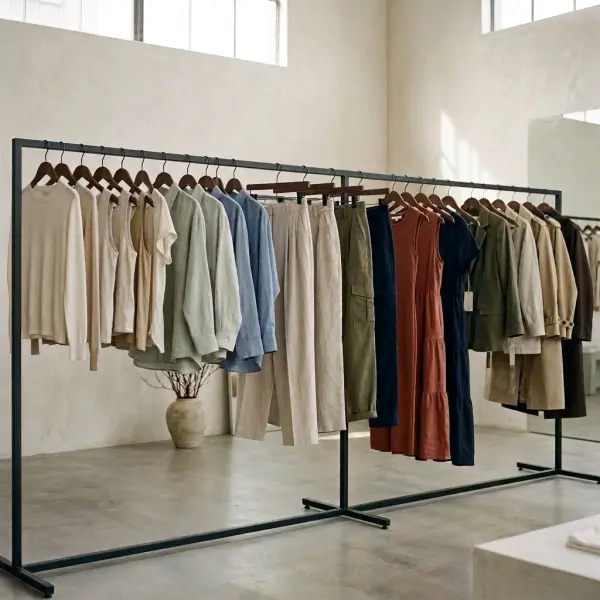
A contemporary women's clothing brand might focus on relaxed shirts, tailored trousers, basic tops, dresses, and lightweight outerwear. These categories collectively establish the retailer's assortment identity.
However, product mix involves more than counting styles. Merchandising teams also consider the relative importance of each category in terms of expected sales, inventory investment, gross margin, and customer demand.
A collection containing ten dress styles and five shirt styles does not necessarily allocate twice as much inventory to dresses. The number of styles, quantity of units, purchasing value, and expected sales contribution are different measures of the product mix.
Color Options: Which Variations Deserve a Place in the Collection?
Color options, often called colorways, are the distinct color versions offered for a particular garment style.
A shirt may be available in white, navy, and olive green. Each colorway creates an additional choice for the customer and requires its own planning assumptions.
Color selection influences collection coherence, styling versatility, visual merchandising, and purchasing commitments. Different colors can also appeal to different customer segments or shopping occasions.
Yet offering more colors does not automatically increase total sales. If several options appeal to essentially the same customers, the brand may distribute demand across more variants without generating enough additional purchases to justify the complexity.
Size Range and Size Depth: Two Different Decisions
Size range identifies which sizes are offered, while size depth refers to the quantity of inventory available in each size.
For example, a brand may sell a blouse in XS, S, M, L, and XL. That is the offered size range. If it purchases 20 units of S, 35 units of M, and 25 units of L, those quantities contribute to its size depth.
A related concept is the size curve or size profile, which expresses the expected distribution of demand or planned stock across sizes.
The distinction matters because providing a size does not guarantee meaningful availability. A retailer may advertise a broad size range but repeatedly disappoint customers when selected sizes sell out shortly after launch.
Why These Decisions Must Be Considered Together
Each additional combination of style, color, and size creates a distinct inventory variant when managed as a separately sellable item.
Consider one blouse design offered in three colors and five sizes.
|
Planning dimension |
Decision |
|
Garment style |
1 blouse |
|
Color options |
3 colors |
|
Size range |
XS, S, M, L, XL |
|
Sellable variants |
15 combinations |
The result is 15 distinct style-color-size combinations, generally managed through separate stock keeping units (SKUs).
GS1 US explains in its apparel and general merchandise identification guidance that individual color and size variants can require separate Global Trade Item Numbers (GTINs) for standardized product identification.
A retailer's internal SKU and a GS1 GTIN are not the same identifier, although both can support accurate product identification and inventory management.
The practical implication is that a seemingly modest expansion in color or size options can substantially increase the number of inventory records, purchase quantities, and availability decisions the business must manage.
How Fashion Brands Decide Their Product Mix
Product mix decisions begin with the commercial role of each category. Fashion brands need to understand not only whether a product is attractive, but also why it belongs in the collection and what customer need it serves.
The foundations of this process are explained in Fashion Assortment Planning Explained for Retail and Online Stores. At the product level, the challenge becomes more specific: deciding which styles to introduce, continue, revise, or remove.
Start With Customer Shopping Needs
Product categories should reflect the situations in which customers expect to wear the garments.
A brand serving office professionals may prioritize tailored trousers, blouses, shirts, and lightweight layering pieces. A casual lifestyle label may concentrate on T-shirts, denim, relaxed trousers, and versatile outerwear.
These product categories have different purchasing patterns, fit expectations, material requirements, and seasonal considerations.
Merchandising teams should therefore investigate how customers build wardrobes rather than relying exclusively on individual product popularity.
For example, a brand may discover that its best-selling trousers frequently appeal to customers looking for coordinated office outfits. Introducing complementary shirts may strengthen the product range more effectively than adding another unrelated trouser silhouette.
Balance Proven Products With New Designs
Most fashion collections contain products with varying levels of demand certainty.
Established garments may have repeatable sales histories, while newly introduced styles involve greater uncertainty. Both can have a place in the collection, but they should not necessarily receive equivalent purchasing commitments.
A useful merchandising distinction separates products into three commercial roles:
- Core products: Established garments intended to meet recurring customer needs, such as basic T-shirts or signature trousers.
- Seasonal products: Styles developed for specific weather conditions, occasions, or selling periods.
- Fashion-led products: Designs introduced to provide novelty, explore emerging preferences, or test new silhouettes.
The appropriate proportions depend on the business model. A trend-oriented boutique may require frequent product introductions, while an essentials-focused brand may rely more heavily on consistent core styles.
A collection can become stagnant when it lacks meaningful novelty, but excessive experimentation can also make purchasing requirements difficult to forecast.
The better question is how much newness the brand can support without weakening its most dependable categories.
Evaluate Product Contribution, Not Just Sales Volume
A product's importance should not be judged exclusively by the number of units sold.
A basic top may sell in large quantities but generate a relatively modest margin per unit. A tailored jacket might sell less frequently yet contribute a higher gross profit per purchase.
Retailers also need to consider return rates, markdown requirements, manufacturing costs, and the extent to which products complement one another.
For example, removing a lower-volume layering piece could reduce the attractiveness of coordinated outfits, even if the item appears weak when evaluated in isolation.
This does not mean retaining every complementary product. It means evaluating the contribution of a product within the collection rather than relying on a single performance measure.
Use Category Roles to Guide Style Counts
Once a brand has identified its product priorities, it can establish a provisional style count by category.
Consider a fictional everyday womenswear brand preparing a 20-style collection.
|
Product category |
Planned styles |
Share of styles |
Primary purpose |
|
Everyday tops |
6 |
30% |
Core wardrobe essentials |
|
Shirts and blouses |
5 |
25% |
Work and casual dressing |
|
Trousers |
4 |
20% |
Core outfit-building |
|
Dresses |
3 |
15% |
Lifestyle and occasion needs |
|
Outerwear |
2 |
10% |
Seasonal layering |
|
Total |
20 |
100% |
Balanced merchandise selection |
These figures are illustrative, not universal assortment benchmarks.
The brand would still need to decide which categories receive larger purchasing quantities. A category containing fewer styles may represent a greater share of total inventory units if its products have stronger demand.
How Brands Choose Color Options for Each Style
Color planning is a commercial decision as much as a creative one. A color that looks compelling in a design presentation may not justify production if customers are unlikely to purchase it in sufficient quantities.
Fashion designers, merchandisers, and buyers therefore need to distinguish between a color's aesthetic relevance and its expected sales contribution.
Begin With the Brand's Color Identity
A consistent brand palette helps create visual relationships between products.
A minimalist fashion label may work with black, white, navy, beige, and muted earth tones. A youth-oriented streetwear brand may use brighter seasonal accents or more expressive graphic combinations.
These examples illustrate different positioning choices rather than fixed rules for either market.
The central question is whether a color supports the brand's visual identity and offers something useful to its intended customers.
A coherent palette can also make garments easier to combine into outfits, which may support product storytelling and coordinated merchandising.
Separate Commercial Colors From Experimental Colors
Brands often distinguish between familiar colors with demonstrated demand and colors introduced to test new preferences.
Commercial colors may include established neutrals or recurring best-selling shades, depending on the brand and product category. Experimental colors might reflect a seasonal design direction or a new customer preference.
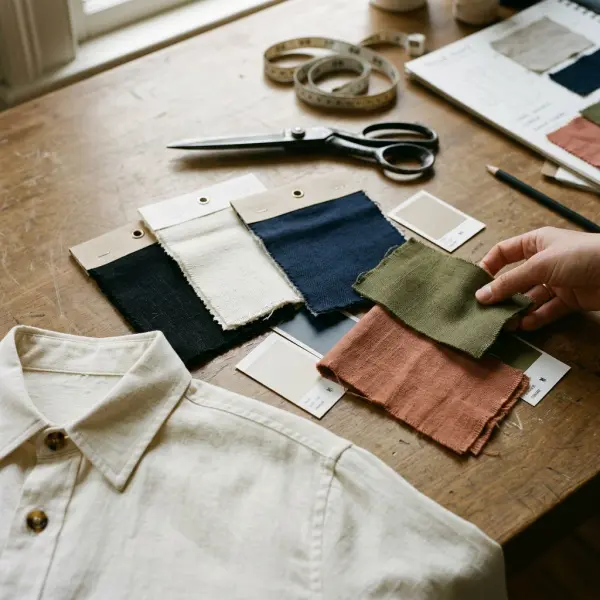
For example, a cotton shirt could be offered in white and navy as established options, with muted terracotta introduced as a smaller seasonal test.
The decision should be supported by available evidence. It would be misleading to assume that neutral colors always outperform expressive shades, since customer preferences vary by market, category, price point, and brand identity.
Analyze Color Performance at the Right Level
Overall color popularity does not necessarily predict demand for every garment.
A retailer might sell large quantities of black trousers but find that ivory performs better than black in a particular blouse style. A color associated with formal dressing may behave differently when applied to casual knitwear.
Merchandising teams should therefore examine color performance within relevant product groups, ideally comparing similar garments sold under reasonably comparable conditions.
The analysis should consider:
- Sales units and sell-through by style-color combination.
- Initial inventory availability and periods of stockout.
- Selling price, promotions, and markdown activity.
- Differences between physical stores and online channels.
- Returns and customer feedback related to the color or its representation.
These measures provide context for distinguishing genuine preferences from results influenced by inventory or merchandising conditions.
Consider Fabric, Dyeing, and Manufacturing Constraints
Not every color can be produced at the same cost, lead time, or consistency.
Fabric suppliers may require minimum dye lots, and certain shades may present additional challenges involving color matching, testing, production scheduling, or repeatability.
The selected fiber, dyeing method, finishing process, and supplier capabilities affect the final result.
A brand developing a specific green shade across cotton shirts, polyester jackets, and knitted accessories may discover that identical digital color references do not produce identical visual results on different materials.
The sourcing team should verify physical samples, acceptable color tolerances, and production requirements before committing to substantial quantities.
Reliable material information and swatch references are part of a broader digital fabric library workflow that supports coordination between design, merchandising, and suppliers.
How Many Colors Should a Fashion Product Have?
There is no universally correct number of color options for a garment.
The appropriate count depends on customer demand, differentiation between colors, initial purchasing quantities, replenishment capabilities, and production economics.
A signature T-shirt with stable repeat demand may support several recurring colors. A highly distinctive seasonal jacket might require only one or two versions if its selling opportunity is limited.
The objective is not to maximize color choice but to ensure that each color has a commercially justified role.
A Practical Color Allocation Example
Imagine a fashion brand planning 240 units of one relaxed shirt style in three colors.
Based on its own hypothetical planning assumptions, the retailer establishes the following initial allocation:
|
Color option |
Planned share |
Initial units |
Commercial role |
|
Black |
50% |
120 |
Established core color |
|
Ecru |
30% |
72 |
Complementary neutral |
|
Sage green |
20% |
48 |
Seasonal color test |
|
Total |
100% |
240 |
|
This plan allows the brand to offer visual choice without purchasing equal quantities of every color.
However, the allocation would need to be checked against supplier minimum quantities, pack configurations, demand assumptions, and the brand's remaining purchasing budget.
If the factory requires a minimum of 100 units per color, the proposed sage green order may not be feasible. The brand would need to negotiate a different production arrangement, revise the assortment, or reconsider the color.
That production constraint should be identified before the color range is approved, not after product photography and marketing plans are completed.
How Fashion Brands Determine Size Depth
Size planning requires a different type of analysis from color selection. While colors are often associated with visual preference, sizes must also correspond to garment measurements and the fit requirements of customers.
A style can be commercially appealing yet fail to generate expected sales when suitable sizes are unavailable.
Start With a Relevant Size Range
The first decision is which sizes a particular product will offer.
An apparel brand may use an XS–XL range, a numerical sizing system, or a category-specific structure such as waist and inseam combinations for trousers.
However, size labels alone do not establish consistent garment dimensions. Measurements can vary across brands, garment types, intended fits, materials, and sizing systems.
A relaxed-fit shirt and a fitted blouse may require different garment specifications even when they use the same nominal size labels.
Size-range decisions should therefore consider intended customer coverage, product construction, grading feasibility, and the information needed for customers to select an appropriate fit.
Build a Size Curve From Demand Evidence
A size curve expresses the expected proportion of demand or planned inventory assigned to each size.
For example, a hypothetical brand might estimate the following size distribution for a particular shirt:
|
Size |
Estimated demand share |
|
XS |
10% |
|
S |
20% |
|
M |
30% |
|
L |
25% |
|
XL |
15% |
|
Total |
100% |
The percentages are illustrative and should not be treated as standard size distributions for any population or apparel category.
Actual demand profiles vary with target customers, garment fit, region, product type, and the retailer's available sizing.
A brand selling oversized streetwear may experience a different demand distribution from a company specializing in tailored professional garments. Historical demand for the same nominal sizes may also change after fit specifications are revised.
Oracle's assortment planning guidance on size profiles describes how size profiles can be used to divide planned buying quantities and receipts among individual sizes.
Why Equal Size Allocation May Be Misleading
Equal allocation assumes that every offered size requires the same quantity of inventory.
For a five-size product, this would mean assigning 20% of units to each size. Such a distribution can be reasonable when supporting evidence indicates relatively even demand, but it should not be adopted automatically.
If the retailer's actual customer demand is concentrated in particular sizes, uniform purchasing may create shortages in those sizes while other sizes remain available for longer.
The consequence is not necessarily weak demand for the product itself. Customers may want the garment but be unable to purchase the version that fits them.
Correct for Missing-Size Bias
Historical size sales require careful interpretation.
Suppose medium-sized shirts sell out early while large-sized shirts remain available throughout the selling period. A simple comparison of final sales quantities may understate potential demand for medium.
This is an example of constrained sales data: recorded sales reflect what could be purchased, not necessarily everything customers wanted to purchase.
Retailers can investigate the discrepancy using stock availability records, stockout timing, waitlist requests, customer inquiries, and comparable products. These indicators may help estimate unmet demand, but they do not automatically reveal the exact number of lost sales.
Brands with limited data should avoid presenting adjusted size curves as more precise than the evidence allows.
Connect Size Depth to Product Fit and Returns
A size curve based on one garment does not necessarily transfer reliably to another.
Fabric stretch, pattern construction, silhouette, ease allowance, length, and garment measurements all influence how a product fits. A nominal size M in a fitted woven shirt may serve different customer measurements from size M in a loose jersey top.
Returns can provide additional insight when customers consistently report that a garment runs small, feels too long, or has unsuitable proportions.
However, a size-related return does not always indicate that the size curve is wrong. The underlying issue may involve garment specifications, inconsistent production, inaccurate size guidance, or customer expectations.
Size allocation decisions should therefore be coordinated with product development and fit-quality evaluation.

Putting Color and Size Decisions Into One Inventory Plan
Color and size decisions become operationally meaningful when they are converted into actual SKU-level purchasing quantities.
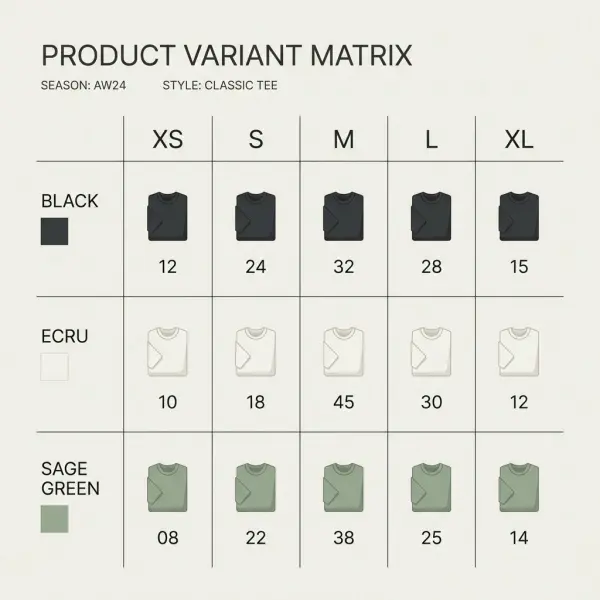
Return to the hypothetical relaxed shirt with three colorways and a total planned purchase of 240 units.
The brand has already allocated 120 units to black, 72 units to ecru, and 48 units to sage green. It now applies the illustrative size curve of XS 10%, S 20%, M 30%, L 25%, and XL 15%.
The resulting purchase plan is:
|
Color / Size |
XS |
S |
M |
L |
XL |
Total |
|
Black |
12 |
24 |
36 |
30 |
18 |
120 |
|
Ecru |
7 |
14 |
22 |
18 |
11 |
72 |
|
Sage green |
5 |
10 |
14 |
12 |
7 |
48 |
|
Total |
24 |
48 |
72 |
60 |
36 |
240 |
This simplified model produces 15 SKUs and an internally consistent quantity plan.
The figures show how a relatively straightforward product concept becomes a detailed inventory commitment. Merchandising teams are no longer purchasing 240 shirts in general; they are purchasing defined quantities of 15 separate variants.
Why the Initial Matrix Is Only a Starting Point
The matrix assumes that each color follows approximately the same size distribution. Actual customer demand may differ by color, channel, or location.
For example, a retailer may observe that its black shirts attract different purchasing patterns from its seasonal colorways. Such differences can justify different size allocations when the evidence is sufficiently reliable.
Manufacturing constraints may also require adjustments. Factories sometimes supply fixed size-ratio packs or impose minimum quantities that prevent the exact planned allocation from being purchased.
Oracle's retail assortment planning documentation identifies color and size as explicit dimensions of assortment planning, alongside historical performance and selling-location considerations.
A mathematically balanced purchasing matrix is useful, but it is not necessarily an executable manufacturing order. The brand must reconcile the planned distribution with supplier capabilities, inventory economics, and expected demand.
How Product Mix and Variant Depth Change Across Retail Channels
A fashion brand may use the same product development process for all its customers while adopting different inventory allocations for physical stores, ecommerce, and wholesale accounts.
These differences arise because selling environments have distinct customer needs and operational constraints.
Physical Retail: Availability Within Limited Space
Physical stores must accommodate both customer choice and display capacity.
Offering every color and size of every style may not be practical in a small boutique. Retailers may prioritize the most relevant products for a location while using stockrooms or centralized inventory to support additional availability.
A store situated in a business district may have different sales patterns from a location serving customers who primarily purchase casualwear. These differences should be investigated through local sales and customer evidence rather than assumed from location alone.
Store-level size demand also requires monitoring. A network-wide size curve may conceal meaningful differences between individual branches.
Ecommerce: Wider Presentation, More Complex Availability
Online fashion stores can display extensive product variation without placing every item in a physical showroom.
However, presenting a wider product range does not eliminate the need for accurate inventory and fulfillment management.
Each color and size must be represented correctly in the product catalog, with reliable stock status, relevant product images, and appropriate measurements or fit guidance.
A customer selecting a specific color should not encounter misleading imagery showing a different fabric appearance. Similarly, a size displayed as available should reflect the retailer's actual ability to fulfill the order under the stated terms.
Online retailers should also distinguish between variants with strong visibility and those that receive little exposure. A low-performing color may have been difficult to discover rather than genuinely unpopular.
Wholesale: Decisions Influenced by Buyer Requirements
Fashion brands supplying retailers may need to adapt their variant plans to wholesale purchasing requirements.
A wholesale buyer may request specific colors, size ratios, delivery schedules, or packaging arrangements. These requests can differ from the demand observed through the brand's direct-to-consumer channels.
The brand must evaluate whether those commitments fit its production economics and available inventory.
Wholesale orders can provide useful demand information, but they should not automatically be interpreted as equivalent to final consumer demand. Retail buyers may purchase according to their own forecasts, store capacities, and commercial priorities.
The Commercial Trade-Off Between More Options and Deeper Stock
Expanding a collection through additional styles, colors, or sizes can create genuine customer value. It can also divide a fixed inventory budget among more individual SKUs.
Consider two hypothetical purchasing strategies for a single apparel category:
|
Decision |
Strategy A: More variety |
Strategy B: Greater depth |
|
Number of styles |
Higher |
Lower |
|
Color choices per style |
More extensive |
More selective |
|
Inventory per SKU |
Generally shallower |
Generally deeper |
|
Customer benefit |
Greater variety and discovery |
Better potential availability of selected variants |
|
Primary trade-off |
Greater SKU complexity and fragmented demand |
More concentrated exposure to fewer styles |
|
Suitable context |
Diverse, changing customer preferences |
Demonstrated repeat demand for selected products |
Neither strategy is universally preferable.
A fashion retailer introducing trend-oriented products may benefit from testing more designs in limited quantities. A brand with dependable core items may benefit from maintaining stock availability through deeper purchasing or replenishment.
The decision becomes more difficult when customers value both variety and dependable availability. In that situation, brands may need a portfolio approach that treats proven products differently from uncertain launches.
When New Variants Add Genuine Customer Value
Additional variations may be worthwhile when they satisfy needs that existing products do not address.
Examples include introducing a required trouser length, developing a distinct garment fit, or offering a color that serves an established customer preference.
By contrast, adding several minimally differentiated shades may provide little additional value if customers view them as interchangeable.
The brand should consider whether a proposed variant expands the addressable customer need or mainly divides purchasing interest across more choices.
The Importance of Replenishment Capability
Brands with dependable replenishment arrangements have greater flexibility to purchase conservatively and increase orders when demand becomes clearer.
Those relying on long production cycles or fixed seasonal purchase commitments face greater uncertainty. A successful color may sell out before the supplier can produce additional units, while a less popular shade remains available.
Merchandising plans should reflect this operational reality. A strategy based on rapid replenishment is ineffective if production and delivery schedules cannot support it.
A Practical Decision Framework for Fashion Brands
Product mix, color selection, and size allocation are easier to manage when every decision follows a consistent sequence.
A retailer does not necessarily need a sophisticated forecasting platform. It needs reliable product information, clearly stated planning assumptions, and a process for connecting those assumptions to purchasing decisions.
The following framework can support small brands and larger merchandising teams.
|
Decision stage |
Main question |
Evidence to review |
Expected output |
|
Product category |
What should the collection contain? |
Customer needs, category performance, brand positioning |
Category and style plan |
|
Style selection |
Which designs deserve investment? |
Historical performance, newness, product differentiation |
Approved style list |
|
Color planning |
Which colors justify production? |
Color-level sales, customer feedback, supplier constraints |
Colorway selection and allocation |
|
Size planning |
Which sizes and quantities are required? |
Size availability, sales, fit feedback, return patterns |
Size range and size curve |
|
Financial validation |
Can the assortment be purchased profitably? |
Cost, margin, MOQ, inventory budget |
Feasible purchase quantities |
|
Performance review |
Which assumptions need adjustment? |
Actual sales, stockouts, returns, replenishment feasibility |
Revised variant decisions |
The value of the framework lies in its sequence. A brand should not finalize extensive color options before determining whether the category has adequate commercial demand. Nor should it approve size quantities without considering actual fit specifications.




Comments 0
Leave a CommentSend Comment
Anda harus Login terlebih dahulu untuk dapat memberikan komentar.