

How Spectrophotometers Help Measure Fabric Color Consistency
Quick Answer
A spectrophotometer is a color measurement instrument that evaluates how a fabric reflects light across different wavelengths, allowing textile manufacturers to compare color samples with approved standards using numerical data. In apparel production, spectrophotometers help detect shade differences, evaluate laboratory samples, and monitor color consistency between dye lots, suppliers, and production batches.
Unlike visual inspection alone, spectrophotometer measurements provide a repeatable technical basis for describing color differences. The instrument measures spectral reflectance, which software can convert into color coordinates such as CIE L*a*b*. Color differences are then calculated using methods such as CIEDE2000 or CMC, depending on the agreed evaluation procedure.
These measurements support decisions during lab dip development, bulk fabric approval, and textile quality control.
However, reliable results depend on appropriate instrument geometry, calibration, sample preparation, measurement conditions, and color tolerance specifications. Fabric texture, transparency, surface direction, and fluorescent whitening agents can influence measurement results.
Spectrophotometers therefore strengthen textile color consistency when they are used within a controlled quality management process rather than treated as automatic pass-or-fail devices.
Introduction: Why Two Fabric Samples Can Look Different Even When Their Colors Are Supposed to Match
A garment manufacturer receives two deliveries of navy-blue fabric intended for the same production order. Both deliveries were dyed according to an approved color standard, and both suppliers describe their materials as matching the required shade.
Under normal warehouse lighting, the difference is difficult to identify. When the fabrics are placed beside each other on a cutting table, however, one batch appears slightly more reddish while the other has a cooler blue appearance.
The difference may seem minor when the materials are examined separately. Once garments from the two batches are displayed together, that variation can become more noticeable, particularly when individual panels are cut from different lots.
This is a familiar challenge in textile manufacturing. Color perception depends on lighting, surrounding colors, material characteristics, and human vision. Even experienced inspectors may disagree about whether a small shade difference is acceptable.
Spectrophotometers help address this problem by measuring the optical characteristics of fabric samples under controlled conditions. Instead of relying exclusively on descriptions such as "slightly darker" or "too purple," quality teams can examine numerical differences and compare them with agreed specifications.
The instrument does not replace the judgment of an experienced colorist. It provides additional evidence to support consistent decisions, particularly when several suppliers, laboratories, or production facilities must work toward the same color standard.

What Is a Spectrophotometer in Textile Manufacturing?
A textile spectrophotometer is an optical measurement instrument used to quantify the spectral characteristics of light reflected by a fabric or other textile material. It helps manufacturers evaluate color consistently by converting measured light information into data that can be compared with a defined reference.
In practical textile operations, the instrument is commonly used to evaluate dyed fabric, yarn, laboratory samples, and finished textile materials. Suitable instruments can also support the measurement of some non-fabric components, although sample geometry and presentation requirements vary.
The key distinction is that a spectrophotometer does not simply recognize a color as red, blue, or green. It measures how the sample interacts with light at different wavelengths under controlled instrumental conditions.
For reflective textiles, the resulting spectral reflectance data can be processed to calculate color coordinates for specified illuminants and standard observers.
This allows a quality control team to evaluate whether a newly dyed fabric is sufficiently close to its approved standard and, when it is not, describe the direction and magnitude of the difference.
The process is part of the broader digital color matching workflow used in textile and apparel production, but the accuracy of the entire workflow depends heavily on how well the physical samples are measured.
Spectrophotometers Versus Colorimeters
Spectrophotometers and colorimeters are both used for instrumental color measurement, but they are not interchangeable in every application.
A conventional tristimulus colorimeter uses optical filters and detectors designed to produce measurements corresponding to colorimetric responses. A spectrophotometer records wavelength-dependent information that can be used to calculate color values under different specified viewing conditions.
This makes spectral measurement especially useful in textile operations where manufacturers need to examine color differences, evaluate different illuminants, and communicate detailed color data between laboratories.
|
Feature |
Tristimulus Colorimeter |
Spectrophotometer |
|
Main measurement output |
Colorimetric coordinates or tristimulus values |
Spectral reflectance data and calculated color values |
|
Spectral information |
Generally does not provide a full spectral reflectance curve |
Provides wavelength-dependent measurements |
|
Evaluation under different illuminants |
Depends on instrument design and available calculations |
Can calculate color under different specified illuminants using spectral data |
|
Textile dye formulation |
Generally limited compared with spectral methods |
Commonly used to support computer-assisted formulation |
|
Typical suitability |
Defined color checking tasks |
Detailed textile color evaluation and formulation workflows |
The appropriate instrument depends on the measurement objective rather than the assumption that one device is universally superior.
For a textile dye house developing formulations and evaluating potential metamerism, spectral information is particularly valuable. A simpler colorimeter may still be suitable for specific controlled applications where its measurement capabilities meet the required specification.
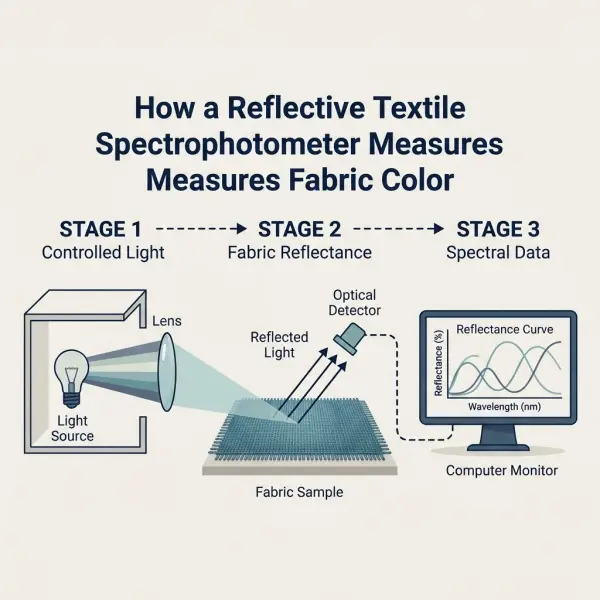
How Does a Spectrophotometer Measure Fabric Color?
A spectrophotometer measures fabric color by illuminating the textile sample, analyzing the light returned from its surface, and recording its wavelength-dependent optical response.
For conventional reflective textile measurements, the process begins with a light source and an optical system that directs illumination toward the material. The instrument then measures reflected light using its detector and wavelength-selection system.
The measurement is compared with an instrument reference to obtain spectral reflectance factors. Software uses this information to derive colorimetric values under defined conditions.
Several technical stages are involved, and each contributes to the reliability of the final result.

Step 1: Illuminate the Fabric Under Controlled Conditions
The instrument uses a controlled light source to illuminate the textile sample through a defined optical arrangement.
The precise relationship between illumination and measurement angles depends on the instrument's geometry. This matters because a fabric can reflect light differently depending on its texture, surface finish, and direction.
A smooth, tightly woven material may interact with light differently from brushed cotton, satin, or a raised-pile textile.
The instrument geometry determines which reflected-light components contribute to the measurement. For consistent comparisons, the reference and production samples should be measured using compatible geometry and operating conditions.
Step 2: Measure Spectral Reflectance
After the light interacts with the sample, the spectrophotometer records its wavelength-dependent response.
Visible color measurement typically considers wavelengths covering approximately 400–700 nanometers, although the exact spectral range and interval depend on the instrument.
A blue fabric, for example, generally reflects a different distribution of visible wavelengths from a yellow or red fabric. The instrument records this behavior as a spectral reflectance curve.
The curve provides information about the sample's optical characteristics that is more detailed than a simple color name or three-number color coordinate.
Two materials can have similar calculated color values under one illuminant while possessing different spectral reflectance curves. That distinction helps explain why some textile colors appear to match under one light source but differ under another.
Step 3: Convert Spectral Measurements Into Color Coordinates
Color management software uses the measured spectral data to calculate numerical color values.
The calculations depend on the specified illuminant, the selected standard observer, and the colorimetric system being used.
One widely used system is CIE L*a*b*, also known as CIELAB. Its calculation framework is defined by ISO/CIE 11664-4:2019.
CIELAB describes color through three coordinates:
- L*: Lightness, progressing from black toward white.
- a*: Position along the green-to-red axis.
- b*: Position along the blue-to-yellow axis.
These values make color differences easier to communicate in technical terms.
For instance, when a dyed fabric differs from its approved reference, color coordinates can help determine whether the sample is lighter, darker, more reddish, more yellowish, or shifted in another direction.
The results still require interpretation, but the discussion begins with a measurable description rather than an entirely subjective impression.
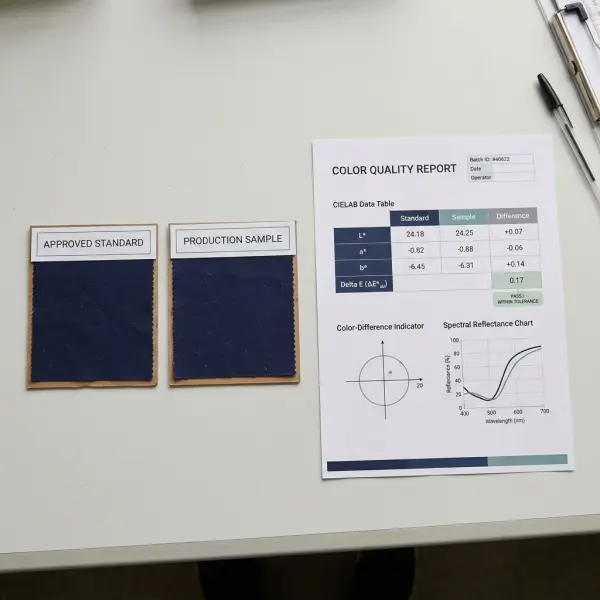
Step 4: Compare the Sample With an Approved Standard
The final stage is evaluating the measurement against the relevant reference.
The spectrophotometer software can calculate the color difference between two sets of measurements using an agreed formula.
The resulting difference may be reported as Delta E, while individual coordinate differences provide additional information about how the sample deviates from its target.
A result should be interpreted using the specified tolerance, measurement procedure, and color-difference method.
A small numerical difference may support acceptance, but the instrument alone cannot decide whether a fabric is commercially suitable. The result must be considered alongside material appearance, product requirements, and any applicable visual inspection criteria.
What Makes Spectrophotometer Measurements Reliable?
A spectrophotometer can produce highly useful color data, but reliable results depend on more than the technical specifications of the instrument.
A laboratory must control how the equipment is maintained, how samples are prepared, and how measurements are collected.
The AATCC EP6 instrumental color measurement procedure provides guidance for instrumental color measurement, including specimen handling considerations. Meanwhile, ISO 105-J01:1997, confirmed as current by ISO in 2024, addresses general principles for measuring textile surface color.
For fashion businesses relying on multiple suppliers, these procedural considerations are essential. Two laboratories using sophisticated instruments can still generate different results if their measurement practices are inconsistent.
Instrument Calibration and Performance Verification
Calibration and instrument standardization are necessary parts of routine color measurement.
Spectrophotometers typically use manufacturer-specified reference standards and procedures to establish or check their operating condition. Depending on the device, these processes may involve white calibration standards, black references, diagnostic checks, or other verification materials.
The precise procedure and frequency should follow the instrument manufacturer's instructions and the laboratory's validated quality system.
A laboratory should also distinguish routine instrument standardization from broader performance verification. A successful calibration routine does not automatically prove that every measurement condition or cross-instrument comparison is correct.
Changes in instrument performance, environmental conditions, optical contamination, or improper reference handling can affect measurement reliability.
The correct approach is to maintain documented procedures, monitor performance over time, and investigate unexpected shifts before approving production samples.
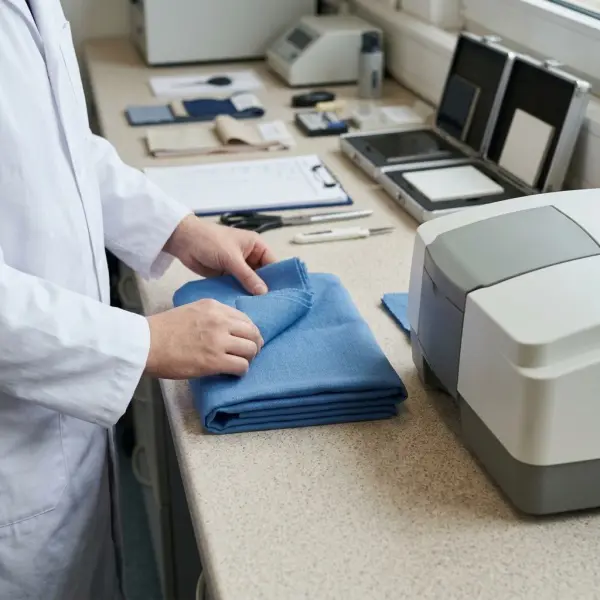
Sample Preparation and Fabric Opacity
Fabric thickness and opacity can influence the measurement because light may pass through the material and interact with whatever is behind it.
A single layer of lightweight jersey, mesh, or loosely woven textile may not provide the same measurement as several folded layers.
For this reason, laboratories often fold fabrics or use specified backing materials to obtain stable readings.
However, more layers are not always better. Excessive folding may create pressure, uneven surfaces, or other positioning problems.
The objective is to prepare the sample in a controlled and repeatable manner that is suitable for the textile being evaluated.
Fabric Direction and Surface Texture
Textile construction can introduce direction-dependent color measurements.
Brushed fabrics, corduroy, pile textiles, and some patterned or textured materials may reflect light differently when rotated or viewed from another direction.
Even relatively ordinary woven fabrics can exhibit directional effects caused by yarn orientation and surface structure.
A laboratory may therefore measure a sample in multiple positions and orientations to obtain a more representative result.
The number of measurements should reflect the material's variability rather than follow an arbitrary rule for every textile.
Technical guidance from Datacolor on textile sample measurement emphasizes sample repositioning, appropriate handling, and repeated readings when evaluating textile materials.
Understanding Spectrophotometer Geometry: d/8° and 45°/0°
Instrument geometry describes the arrangement of illumination and observation within a color measurement device.
It affects which optical characteristics of the sample influence the measured result.
Two commonly encountered configurations are diffuse/8-degree geometry, written d/8°, and directional 45°/0° geometry.
Both can be useful, but they are designed around different optical measurement conditions.
Diffuse/8° Spectrophotometers
A d/8° spectrophotometer illuminates the sample diffusely, typically using an integrating sphere, and measures the returned light at an angle of approximately eight degrees from the surface normal.
This arrangement is commonly used in textile color laboratories, particularly for dye formulation and instrumental color quality control.
Integrating sphere instruments are useful because diffuse illumination can reduce the influence of certain directional surface effects. They also provide measurement options that may include or exclude specular reflection.
The two commonly described measurement modes are:
- SCI (Specular Component Included): Includes the specular reflection component in the measurement.
- SCE (Specular Component Excluded): Excludes or reduces the specular component according to the instrument design.
These modes can produce different results, especially for materials with noticeable gloss or surface differences.
The selected mode should be appropriate to the evaluation objective and consistent between the reference and sample measurements.
45°/0° Spectrophotometers
A 45°/0° spectrophotometer illuminates the sample at approximately 45 degrees and measures reflected light along the surface normal.
The reciprocal 0°/45° arrangement also exists.
These geometries generally exclude direct specular reflection and can provide measurements that are sensitive to surface appearance.
They are used in various color quality applications where the relationship between visual appearance and instrument measurement is important.
For textile businesses, the choice between directional and integrating sphere measurement should reflect the material, the intended evaluation, and any existing customer or industry specifications.
The distinction is discussed in X-Rite's explanation of sphere and 0°/45° measurement.
Switching between instrument geometries without considering their measurement differences can undermine consistency across laboratories.
How Spectrophotometers Help Detect Fabric Shade Differences
Spectrophotometers help identify shade differences by converting measured sample and reference colors into comparable numerical values.
The instrument itself collects the optical measurements, while the associated software performs the color calculations.
The most useful information often comes from evaluating both the overall color difference and its individual components.
What Does Delta E Tell a Textile Quality Inspector?
Delta E, written ΔE, describes the calculated difference between two colors under specified conditions.
For textile quality control, it is commonly used to evaluate whether a sample falls within an agreed color tolerance.
However, Delta E is not a single universal calculation.
Common color-difference methods include CIE 1976 ΔE*ab, CMC (l), and CIEDE2000.
The ISO/CIE 11664-6:2022 CIEDE2000 standard specifies a formula designed to improve agreement between calculated differences and perceived color differences under relevant reference conditions.
In textile applications, AATCC EP14: Small Color Differences addresses evaluation using methods including CIEDE2000 and CMC (l).
These methods should not be treated as interchangeable because the same pair of samples may produce different numerical values under different formulas.
There is no universal Delta E value that automatically determines whether every fabric should pass or fail. Acceptance limits must be defined in relation to the selected calculation method, product requirements, and relevant material characteristics.
Why the Direction of Color Difference Matters
Consider a hypothetical textile laboratory examining three samples against the same approved dark-blue standard.
Sample A is slightly lighter than the reference. Sample B has a subtle red shift, while Sample C has a small yellow shift.
Even if their overall calculated color differences are similar, they may not look equally acceptable when incorporated into finished garments.
For example, a buyer may be relatively tolerant of a modest lightness variation but particularly sensitive to a hue shift that makes two garment panels look noticeably different.
This is why quality teams examine more than the total Delta E value.
Individual CIELAB differences, along with lightness, chroma, and hue difference information where appropriate, help colorists understand how the sample should be corrected or why it appears unsuitable.
Tolerance Is a Manufacturing Agreement, Not a Universal Number
A textile color tolerance defines an acceptable level of difference under specified evaluation conditions.
Brands and suppliers should establish those conditions before production begins.
A meaningful tolerance specification identifies the reference standard, color-difference formula, measurement geometry, illuminant, observer, and any relevant visual evaluation requirements.
It may also include additional controls for specific color directions or material categories.
For instance, a brand selling coordinated suits may require a different level of visual consistency from a manufacturer producing unrelated garment styles.
The key is to establish realistic requirements that reflect the product rather than applying one numerical threshold to every color and material.
Measuring Color Consistency Across Fabric Batches
The practical value of spectrophotometer measurement becomes particularly clear when a manufacturer must maintain a consistent shade across multiple production lots.
A dye house may produce the same nominal color repeatedly over several weeks. Raw material characteristics, processing conditions, and finishing operations can introduce variation between batches.
The challenge is not merely determining whether each batch is close to the reference. It is also preventing unacceptable differences between materials that will be used together.
Lab Dip Approval
During color development, the dye house produces laboratory samples to evaluate proposed formulations.
A spectrophotometer can measure each lab dip and compare it against the target.
The resulting data helps a colorist identify whether an adjustment is necessary and supports communication with the approving team.
Suppose a fabric sample is too reddish and slightly darker than the approved standard. Instrument results can support that assessment and help direct the next formulation trial.
The spectrophotometer does not independently determine the required dye recipe. That task depends on formulation software, available colorant data, process conditions, and the experience of the colorist.
The distinction matters because measurement accuracy and formulation accuracy are related but separate technical capabilities.
Bulk Dyeing and Lot-to-Lot Consistency
After lab dip approval, the dye house scales production to the required fabric quantity.
Changes in production equipment, liquor ratio, chemical conditions, substrate variability, and finishing may influence the resulting color.
Spectrophotometer measurements can help detect differences between bulk production samples and the approved reference.
A manufacturer may also compare separate production lots to identify trends that are not obvious when each lot is examined independently.
For example, several batches may individually satisfy the buyer's tolerance while gradually shifting in the same color direction. Such a pattern can indicate process drift that deserves investigation.
By maintaining consistent measurement records, a factory can detect the trend before it develops into a larger production problem.
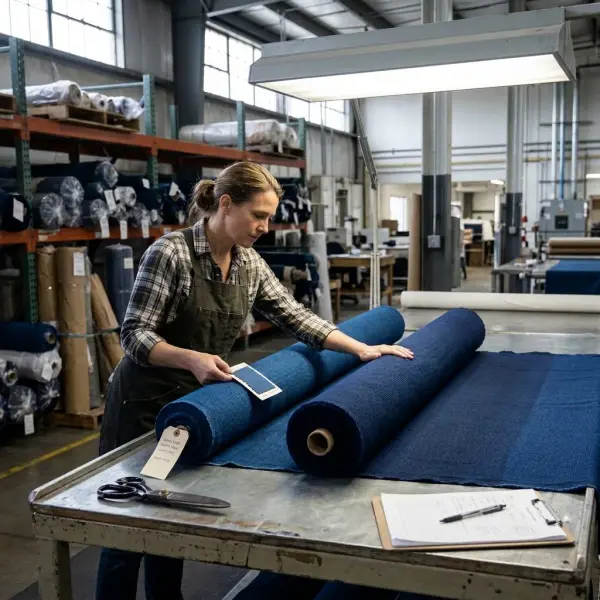
Shade Continuity Within a Single Fabric Roll
Color variation does not always occur only between different dye lots.
Some textile materials can exhibit shade variation across their width or along their length because of uneven processing conditions.
Spectrophotometers can support checks at representative locations, provided the sampling plan is appropriate to the production process and fabric construction.
However, measuring one small area cannot characterize an entire roll. Measurements should be combined with suitable visual inspection and a sampling approach designed to detect relevant variation.
A manufacturer producing large garment quantities may need to assess both instrumental color consistency and the practical consequences of using fabric from different roll sections.
The appropriate level of inspection depends on product requirements, process capability, and the risk of visible shade differences after cutting and assembly.
Matching Components From Different Suppliers
A fashion brand may purchase its primary fabric from one supplier and obtain ribbing, lining, elastic, or trims from others.
These components can have different fibers, textures, gloss, and manufacturing processes.
Spectrophotometer data provides a common technical reference, but closely matching numerical values do not guarantee identical appearance across all materials.
The quality team may need to evaluate the components together under controlled lighting, particularly when they will appear adjacent on the finished garment.
The objective is a commercially acceptable visual relationship supported by documented measurement criteria.
Special Measurement Challenges With Different Fabric Types
Not every textile responds to spectrophotometer measurement in the same way.
The measurement method must account for the material's physical and optical characteristics, especially when dealing with fabrics that are translucent, highly textured, reflective, or directionally structured.
A laboratory protocol suitable for a plain cotton fabric may require adjustment when applied to satin, velvet, mesh, or optically brightened white textiles.
|
Fabric or Material |
Main Measurement Challenge |
Practical Control |
|
Plain woven cotton |
Variation in weave orientation or local dye uniformity |
Consistent presentation and representative measurements |
|
Lightweight jersey |
Background influence and limited opacity |
Controlled folding or agreed backing material |
|
Velvet or pile fabric |
Directional reflection and changing pile orientation |
Standardized direction and multiple measurements where suitable |
|
Satin or glossy polyester |
Surface reflection influences measured appearance |
Appropriate geometry and controlled presentation |
|
Heather or melange fabric |
Multiple fiber colors within the measurement area |
Representative aperture and repeated measurements |
|
Mesh or lace |
Open spaces allow the background to influence readings |
Suitable backing or specialized measurement methods |
|
Optically brightened white fabric |
Sensitivity to ultraviolet content and fluorescence |
Appropriate UV settings and textile-specific verification |
These considerations help explain why apparently conflicting color data may not always indicate a manufacturing problem.
Sometimes the discrepancy originates in the way the sample was presented to the instrument.
Why Velvet and Other Pile Fabrics Need Extra Attention
Pile textiles have raised surface fibers that can change appearance according to their direction and viewing angle.
Velvet, for example, may appear darker or lighter when brushed in different directions because of changes in light interaction with the pile.
A spectrophotometer reading taken in one orientation may therefore differ from a reading taken after rotating the same sample.
A controlled procedure may specify a consistent pile direction or require multiple measurements, depending on the purpose of the evaluation.
The approval process should also preserve visual assessment of the fabric's intended appearance. Averaging several measurements can characterize an aspect of the material, but it may conceal direction-dependent differences that remain important in the finished garment.
Measuring White and Optically Brightened Fabrics
White textile measurement presents a distinct technical challenge when fluorescent whitening agents are present.
These agents absorb ultraviolet radiation and emit visible light, contributing to the perceived whiteness or brightness of the fabric.
The measured result can depend on the ultraviolet content of the instrument's illumination.
Two laboratories using different UV conditions may therefore obtain inconsistent readings even when they examine the same material.
The AATCC EP11 procedure for spectrophotometer UV energy calibration addresses calibration for optically brightened textiles using a textile-specific reference.
For manufacturers producing white shirts, uniforms, knitwear, or other products where whiteness consistency matters, UV control should be treated as part of the measurement system rather than an optional software setting.
Evaluating Patterned and Multicolored Textiles
Conventional spot-measurement spectrophotometers are designed to evaluate the optical response within a defined measurement area.
This can be difficult when a textile contains printed motifs, lace openings, mixed yarn colors, or small contrasting components.
A single measurement might combine several colors or be influenced by the underlying material.
Where the business objective requires separate evaluation of individual colors, specialized imaging-based or spatially resolved measurement systems may be more appropriate.
The equipment must be selected according to the actual sample and the required information. A conventional instrument remains highly useful for uniform color areas, but it should not be expected to resolve every complex textile pattern.
Repeatability and Reproducibility: Two Different Quality Requirements
A color measurement system must produce consistent results within a laboratory and support meaningful comparisons between laboratories.
These requirements are related but distinct.
Repeatability concerns the consistency of repeated measurements under closely controlled conditions, such as using the same instrument and a defined measurement procedure over a short period.
Reproducibility, in a broader measurement context, concerns agreement when relevant measurement conditions differ. In textile color management, inter-instrument agreement is especially important when several devices or facilities exchange color data.
A spectrophotometer may demonstrate excellent short-term repeatability while still producing measurements that differ from those of another instrument.
The resulting disagreement may arise from instrument geometry, model differences, settings, calibration condition, sample presentation, or other factors.
For brands managing a distributed supplier network, both characteristics matter.
Why Multiple Readings Can Improve Measurement Confidence
A single reading represents the sample only within the instrument's measurement area and under the specific presentation conditions.
If the textile is uneven, textured, or directionally sensitive, a single measurement may not capture its representative color.
Repeated measurements at appropriately selected locations can reveal local variation and provide a more reliable estimate of the sample's overall characteristics.
The readings should be collected according to a consistent procedure and evaluated for unexpected variability.
Averaging spectral measurements or appropriate calculated values may be useful, but laboratories should follow a validated approach rather than assuming that averaging automatically resolves every material problem.
High variation between individual readings can itself be valuable evidence of an unsuitable sample preparation method or uneven fabric coloration.
Cross-Laboratory Color Communication
A brand and its textile supplier may each use their own spectrophotometer.
Sharing spectral data can reduce ambiguity, but successful communication also requires compatible instrument settings and reference management.
Before introducing digital approvals across locations, organizations should compare representative samples and confirm that their systems produce sufficiently consistent results.
Where necessary, an agreed reference laboratory or controlled transfer standards can help investigate persistent disagreements.
The quality objective is not to assume all instruments will return exactly identical readings. It is to establish a level of agreement appropriate to the specified textile color tolerance.
How Apparel Manufacturers Can Build a Practical Fabric Color Measurement Procedure
A reliable measurement system begins with a documented operating procedure that can be repeated by different staff members and across production shifts.
The procedure should specify how approved references are maintained, how fabric samples are prepared, what settings are used, and what happens when a measurement falls outside the agreed tolerance.
For a manufacturer introducing instrumental color quality control, the following framework provides a practical starting point.
Establish the Reference and Evaluation Conditions
Before taking production measurements, identify the correct approved standard.
The reference may be a master fabric sample supported by spectral data or a controlled digital color standard with relevant material specifications.
The measurement procedure should identify the instrument geometry, aperture, color-difference formula, illuminant, observer, and applicable acceptance limits.
These details must remain consistent throughout the intended comparison workflow.
An incorrect or outdated reference can invalidate the approval decision even when the instrument operates properly.
Prepare and Measure Representative Samples
The laboratory should prepare fabric samples according to the material's requirements and its approved operating procedure.
Samples should be clean, appropriately conditioned, and free from obvious contamination or handling defects that could influence the reading.
If a material is translucent, directional, or nonuniform, the protocol should specify how it must be folded, backed, positioned, or measured repeatedly.
The appropriate number of readings should be determined from the material characteristics and the laboratory's repeatability assessment.
The aim is to represent the material being approved, not merely to generate a convenient pass result.
Record Results and Make an Approval Decision
Measurement data should be linked to the correct material and production identifiers.
Useful records generally include:
- Approved color standard and version.
- Fabric description, supplier, and production lot.
- Instrument identification and measurement settings.
- Measurement date and sample preparation method.
- Relevant color coordinates and color-difference values.
- Acceptance decision and any required corrective action.
The exact format may vary between laboratories, but the information should allow a reviewer to reconstruct the basis for the decision.
Where visual evaluation is required, its result should be recorded alongside the instrumental findings rather than replaced by them.
Investigate Failures Before Adjusting Production
An out-of-tolerance measurement does not immediately prove that the dye recipe is incorrect.
Before changing the manufacturing process, the team should verify that the correct reference was used, sample preparation was appropriate, and the instrument operated within its expected condition.
If the result remains valid, production personnel can investigate dyeing, substrate, and finishing variables.
Corrective action should address the cause of the deviation rather than relying on repeated arbitrary adjustments.
This distinction can prevent unnecessary reprocessing caused by measurement errors.
Common Mistakes When Using Spectrophotometers for Fabric Color Control
Measuring Only One Fabric Layer Without Considering Opacity
One of the most common measurement errors occurs when a thin or loosely constructed textile is placed directly against the instrument without considering the background.
Light passing through the fabric may interact with the backing surface, affecting the measured result. Consequently, two laboratories can obtain different readings from the same material if their backing conditions differ.
A better procedure defines the appropriate number of layers or backing material and verifies that the resulting measurement is stable.
Using Different Instrument Geometries Without Validation
A factory and a buyer may use instruments with different measurement geometries while assuming their readings are directly equivalent.
Because geometry affects the measurement of reflected light, particularly on textured or glossy surfaces, the results may differ even when the samples are physically identical.
The parties should agree on the measurement method or establish a validated comparison procedure before using the data for acceptance decisions.
Ignoring Fabric Direction During Measurement
Directional textiles can produce different readings when their orientation changes relative to the instrument.
This becomes problematic when one inspector measures a brushed fabric in the pile direction while another measures it in the opposite direction.
The resulting differences may be interpreted incorrectly as dyeing variation. A controlled procedure should specify the required orientation and whether multiple readings are necessary.





Comments 0
Leave a CommentSend Comment
Anda harus Login terlebih dahulu untuk dapat memberikan komentar.