

Local vs Overseas Sourcing: What Fashion Businesses Should Compare
Quick Answer
Local sourcing generally means obtaining materials or production services within the brand’s domestic or nearby regional market, while overseas sourcing involves buying across national borders, often from established textile and garment manufacturing centers.
Neither option is automatically cheaper, faster, more sustainable, or higher quality.
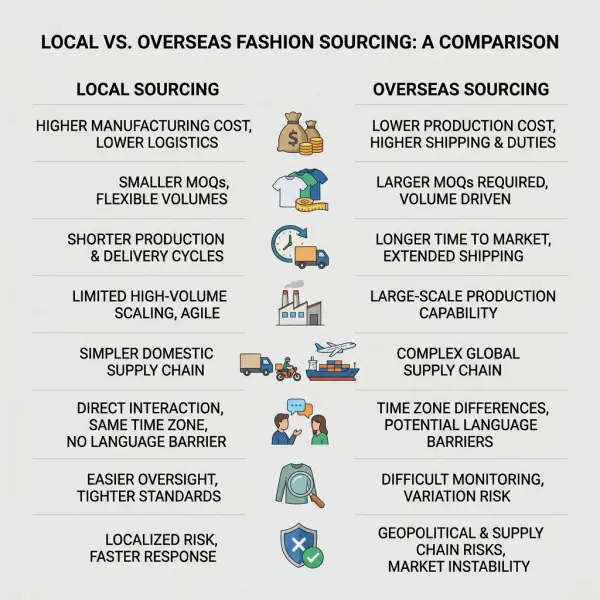
Local suppliers may offer easier communication, smaller minimum orders, quicker sampling, closer production oversight, and shorter transport routes. However, their labor costs, material options, machinery, or production capacity may be less competitive for certain products.
Overseas suppliers may provide lower ex-factory prices, specialist manufacturing, integrated material ecosystems, and capacity for larger orders. Those benefits can be offset by longer logistics, import duties, customs procedures, currency exposure, larger minimum quantities, and more working capital tied up before goods are sold.
The correct comparison is therefore not simply local price versus overseas price. Fashion businesses should compare equivalent product specifications using total landed cost, end-to-end lead time, minimum order quantities, quality capability, supply-chain visibility, compliance requirements, communication, capacity, and disruption risk.
For many growing apparel brands, the strongest solution is a mixed sourcing portfolio: different locations for different product categories, order sizes, development stages, and delivery needs.

What Do Local and Overseas Sourcing Actually Mean?
Local sourcing in fashion refers to purchasing materials, components, manufacturing services, or finished products from suppliers located within the brand’s home country or immediate commercial region.
Overseas sourcing refers to obtaining those inputs from suppliers located in another country, requiring a cross-border commercial and logistics process.
The distinction sounds straightforward, but actual apparel supply chains are rarely that clean.
A garment may be sewn locally using imported fabric, thread, zippers, elastic, and labels. Another product may be manufactured overseas using cotton or wool originally sourced from the brand’s domestic market. A supplier described as local may also subcontract printing, washing, or embroidery to another region.
Location can therefore refer to several different stages:
- Origin of the fiber
- Location of yarn production
- Location of fabric knitting or weaving
- Dyeing and finishing location
- Garment assembly location
- Printing, washing, or embroidery location
- Packaging location
- Final distribution market
When fashion businesses say a garment is “locally made,” they should clarify which production stage is local. Local assembly does not necessarily mean that every material or process originated locally.
Similarly, overseas sourcing is not one uniform model. Manufacturing in a neighboring country with efficient road transport is operationally different from sourcing across several time zones through a multi-port ocean route.
Useful geographic terms include:
- Domestic sourcing: purchasing within the brand’s home country.
- Regional sourcing: sourcing within a neighboring economic or geographic region.
- Nearshoring: moving or placing production closer to the primary sales market.
- Offshoring: sourcing production from a more distant foreign market, often to access cost, capacity, or specialist capabilities.
- Reshoring: returning an activity previously performed overseas to the brand’s domestic market.
- Hybrid sourcing: deliberately using more than one geographic sourcing model.
These terms describe location strategy. They do not, by themselves, indicate product quality, labor conditions, environmental performance, or financial advantage.
The First Comparison: Equivalent Products and Responsibilities
Before comparing local and overseas quotations, the business must ensure that both suppliers are pricing the same product and assuming the same responsibilities.
A quotation for a basic cotton shirt can vary because suppliers have priced different:
- Fabric weights or constructions
- Fiber compositions
- Yarn quality
- Dyeing or finishing processes
- Stitch densities
- Seam constructions
- Measurement tolerances
- Labels and packaging
- Quality inspections
- Testing requirements
- Freight responsibilities
- Payment terms
An overseas factory may quote a full-package price that includes fabric, trims, sewing, finishing, labels, and export packaging. A local workshop may quote only cutting and sewing, expecting the brand to supply every material.
The second quotation may look cheaper even though it excludes much of the product cost.
A reliable comparison begins with a common technical pack, bill of materials, quality standard, packaging instruction, order quantity, delivery destination, and commercial basis.
This is one reason fashion businesses need a broader fashion sourcing strategy before choosing a location. Geography is only one variable inside the sourcing model.
Local vs Overseas Sourcing at a Glance
The following comparison reflects common patterns rather than universal rules.
|
Comparison factor |
Local sourcing may offer |
Overseas sourcing may offer |
What must be verified |
|
Unit price |
Competitive at small scale or where transport is costly |
Lower ex-factory cost in established production centers |
Equivalent specifications and price inclusions |
|
Minimum order quantity |
Smaller quantities and flexible color runs |
Better economics for larger standardized orders |
Garment, fabric, dyeing, and trim minimums |
|
Development speed |
Faster meetings, samples, and physical review |
Strong development capability in specialist clusters |
Total sample cycle, not courier time alone |
|
Production capacity |
Flexible small-batch capacity |
Large production lines and scalable volume |
Confirmed capacity during the required period |
|
Material selection |
Immediate access to local stock materials |
Wider access to mills, components, and specialist finishes |
Material availability, lead time, and continuity |
|
Quality control |
Easier site access and correction |
Established systems and specialist technical expertise |
Actual production controls and inspection evidence |
|
Logistics |
Shorter domestic transport and fewer border processes |
Efficient export infrastructure in mature hubs |
Route reliability, customs, freight, and handovers |
|
Communication |
Shared language, time zone, and business context |
Experienced export teams and structured account management |
Response quality, escalation, and documentation |
|
Working capital |
Potentially shorter cash cycle |
Lower price at sufficient scale |
Deposit, payment timing, transit inventory, and currency |
|
Compliance |
Familiar domestic requirements |
Export experience and recognized certification systems |
Product, labor, environmental, and import obligations |
|
Flexibility |
Easier adjustments and replenishment |
Flexible only where supplier model and capacity permit |
Cost and timing of changes |
|
Risk diversification |
Lower international logistics exposure |
Access to multiple large supply markets |
Concentration, geopolitical, transport, and supplier risk |
A local factory may outperform an overseas supplier across nearly every category—or the reverse. The table should guide investigation, not replace supplier-level assessment.

Is Overseas Sourcing Always Cheaper?
No. Overseas sourcing may have a lower quoted production price, but that does not necessarily produce a lower cost when the goods reach the brand’s warehouse.
The relevant figure is usually total landed cost, combined with the expected cost of quality failures, delays, and excess inventory.
A simplified calculation is:
Total landed cost = product price + development + inspections + inland transport + international freight + insurance + customs charges + duties and taxes + brokerage + destination handling + warehousing
The business may also need to account for:
- Currency conversion and exchange-rate movement
- Bank or payment charges
- Buying-agent commissions
- Sample courier costs
- Travel or supplier-assessment costs
- Financing cost of deposits and goods in transit
- Rework, replacement, or rejected products
- Expedited air freight after delays
- Markdown risk caused by late arrival
A factory price difference of one or two dollars can disappear when allocated across a small shipment. Conversely, international freight and import handling may represent a relatively small amount per unit when a larger order uses container space efficiently.
Scale changes the answer.
Why Local Production Can Be Expensive
Domestic production can carry higher labor, property, utility, regulatory, and overhead costs. Local suppliers may also purchase fabric and components in smaller quantities, limiting their ability to negotiate upstream prices.
A local factory that depends on imported materials may face the same currency, freight, and customs exposure as an overseas factory, while adding domestic manufacturing costs afterward.
Local sourcing can therefore be commercially difficult for basic, labor-intensive products sold in price-sensitive markets. Its advantages may be more compelling for:
- Small initial runs
- High-margin products
- Frequent replenishment
- Customized products
- Products requiring close development
- Limited editions
- Orders where late delivery would be especially costly
Why Overseas Production Can Become Expensive
Overseas sourcing becomes less attractive when the order is too small to spread fixed logistics and import costs efficiently.
Costs may rise further when:
- The supplier requires large fabric minimums
- The brand orders too many low-volume colors
- Freight must be upgraded from sea to air
- Customs documentation is incomplete
- The product classification or duty assumption is incorrect
- A quality issue requires remote rework or replacement
- The brand holds several months of inventory
- Currency moves against the buyer
- Production misses the intended selling season
International freight is also exposed to route disruption and price volatility. UN Trade and Development reported that maritime freight rates remained elevated and volatile during 2024 and 2025 as geopolitical tension, rerouting, trade-policy changes, and supply-demand imbalances affected shipping markets. This does not mean overseas sourcing is generally unreliable, but it confirms that freight assumptions should not be treated as permanently fixed. UNCTAD Review of Maritime Transport 2025
The commercially useful question is not “Which location has the lowest labor cost?” It is “Which supply route produces the best margin after all required activities, risks, and timing are included?”
How Minimum Order Quantities Change the Decision
Minimum order quantity, or MOQ, is often the factor that makes a theoretically attractive supplier commercially unsuitable.
An apparel order can be subject to several minimums:
- Minimum garments per style
- Minimum units per color
- Minimum units per size
- Fabric mill minimum
- Dye-house minimum
- Print or embroidery minimum
- Custom trim minimum
- Packaging minimum
A local workshop may accept 100 garments, but the local material supplier may not hold the required fabric. If the fabric must be custom-produced overseas at a much larger minimum, the small garment MOQ does not solve the inventory problem.
An overseas full-package manufacturer may quote 1,000 units per style, yet permit the quantity to be divided across several colors using a shared fabric. Another supplier may allow only two colors because each requires a separate dye lot.
MOQ should therefore be analyzed at material and process level—not only at factory level.
When Smaller Local Minimums Create Value
Low minimums can be valuable when the brand is:
- Testing a new product category
- Entering an uncertain market
- Launching a trend-sensitive design
- Producing expensive or unusual sizes
- Serving a narrow customer segment
- Preserving cash for marketing and distribution
A higher per-unit cost may be justified if it prevents the brand from holding hundreds of unsold garments.
When Larger Overseas Minimums Make Sense
Larger minimums can improve economics when demand is sufficiently predictable and the product has a longer selling life.
They may be appropriate for:
- Proven core products
- Wholesale commitments
- Uniform programs
- Permanent basics
- Large retail distribution
- Products using specialized materials unavailable locally
The risk is not the MOQ itself. The risk is accepting it without realistic demand, margin, storage, and cash-flow analysis.
Which Option Provides a Faster Lead Time?
Local sourcing often shortens transportation and communication time, but it does not automatically shorten total lead time.
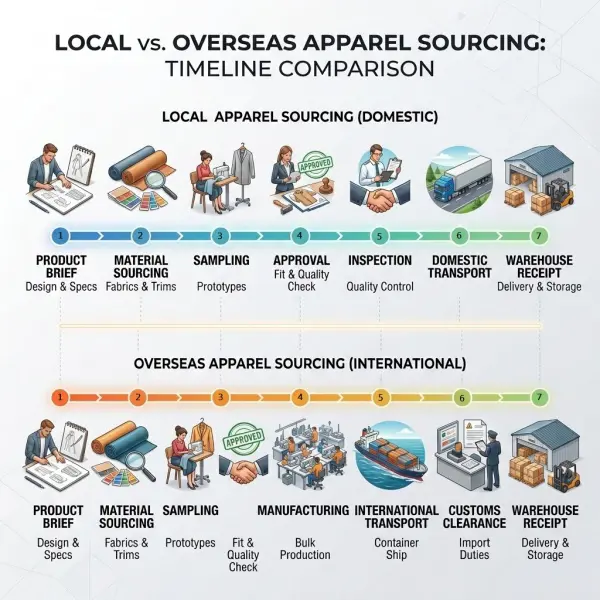
Total lead time begins before production and ends when saleable goods are available at the required location. It can include:
- Supplier briefing and quotation
- Material search
- Pattern development
- Prototype sampling
- Fit correction
- Fabric or trim production
- Pre-production approval
- Production booking
- Cutting and sewing
- Finishing and inspection
- Transportation and customs
- Warehouse receiving
A local supplier using imported fabric can have a long material lead time even though the sewing site is nearby. An overseas supplier located inside an integrated textile cluster may develop material, trims, samples, and bulk production faster than a local factory coordinating fragmented vendors.
The correct metric is therefore brief-to-warehouse lead time, not factory-to-warehouse transport time.
Local Sourcing May Be Faster When
- Materials are locally available
- The supplier has immediate capacity
- Samples can be physically reviewed
- Domestic transport is predictable
- The product requires frequent changes
- Replenishment quantities are small
- Customs and international freight would create significant delay
Overseas Sourcing May Be Faster When
- The product requires capabilities concentrated in a foreign manufacturing cluster
- The supplier controls or has direct access to fabric and trim production
- The order is planned well in advance
- Sampling and approvals are managed digitally and efficiently
- Export logistics are mature
- Production capacity is reserved before material commitment
The World Bank’s Logistics Performance Indicators 2.0 measure international supply-chain speed and connectivity using operational shipment data rather than a single global assumption. The indicators highlight that logistics performance varies by country, route, transport mode, and infrastructure. A brand should assess the actual sourcing corridor rather than assuming all international transport carries the same time or reliability. World Bank Logistics Performance Indicators 2.0
Does Local Sourcing Provide Better Quality?
Not necessarily.
Quality depends on the supplier’s technical capability, material control, machinery, workforce skills, production systems, inspection procedures, and understanding of the buyer’s specification.
Location affects how easily a brand can observe and resolve quality issues, but it does not determine whether those issues will occur.
A nearby factory may allow the design team to attend fittings, examine fabric, approve colors, and inspect production in person. This access can be valuable for complex development or teams with limited experience documenting products.
However, easy access cannot compensate for unsuitable machinery or weak process control.
An overseas supplier may have:
- Specialist production lines
- Automated cutting
- Fabric testing equipment
- Strong pattern and engineering teams
- Established inspection procedures
- Experience with international buyer standards
- Integrated printing, washing, or finishing operations
A technically advanced overseas facility may produce more consistent results than a small local workshop. A highly skilled local specialist may outperform a large export factory on tailored, craft-based, or short-run products.
Quality comparisons should be based on evidence:
- Sample accuracy
- Material conformity
- Measurement consistency
- Seam and construction quality
- Color and finish consistency
- Test results where required
- Defect prevention
- Corrective-action performance
- Production history on comparable products
Final samples alone are not enough. A sample may be made by the most experienced technician rather than the normal production line. Brands should evaluate whether the supplier can reproduce the approved standard across the full quantity.
Access to Materials and Specialist Capabilities
One of the strongest reasons to source overseas is access to established manufacturing ecosystems.
Some sourcing regions contain dense networks of:
- Fiber and yarn suppliers
- Knitting and weaving mills
- Dyeing and finishing facilities
- Trim manufacturers
- Printing and embroidery suppliers
- Testing laboratories
- Machinery technicians
- Freight and export services
- Specialist garment factories
This concentration can reduce coordination time and provide access to technical capabilities unavailable in a smaller domestic industry.
A local supplier may sew an activewear product well but lack access to suitable stretch fabric, bonded seams, performance finishes, or specialist elastic. An overseas production cluster may provide the complete ecosystem.
The opposite can also occur. Local sourcing may offer access to:
- Regionally distinctive textiles
- Traditional craft techniques
- Small-batch workshops
- Specialized tailoring
- Rapid prototyping
- Domestic deadstock or stock fabrics
- Direct relationships with material makers
The decision should be product-specific.
A basic woven shirt, a hand-embroidered dress, a waterproof shell, and a seamless sports bra should not be sourced using the same capability assumptions.
Communication, Time Zones, and Decision Speed
Local suppliers often share the buyer’s language, time zone, business practices, and cultural context. Meetings can happen quickly, and physical samples can move without international courier procedures.
These advantages are meaningful when product development depends on frequent interpretation rather than complete technical documentation.
However, local communication is not always better. A supplier may be geographically close but informal, inconsistent, or reluctant to document agreements. An experienced overseas exporter may provide structured merchandising teams, sample comments, production reports, and clear escalation channels.
The relevant questions include:
- Who is responsible for the account?
- Does the contact understand product construction?
- Are sample comments documented?
- How quickly are problems reported?
- Can technical information be communicated accurately?
- Who approves commercial changes?
- Is production status visible?
- Are decisions recorded in a shared system?
Time-zone differences may slow real-time discussion, but they can also create a productive cycle when one team reviews information while the other is offline. This only works when briefs and responses are precise.
The strategic issue is not whether communication happens face to face or through video calls. It is whether the communication produces accurate, timely, traceable decisions.
Working Capital and Inventory Exposure
Overseas sourcing commonly extends the time between cash leaving the business and finished goods generating revenue.
A typical order may require:
- Deposit before material purchase
- Balance payment before shipment
- International transit
- Customs processing
- Warehouse receiving
- Retail distribution
- Customer sell-through
During that period, capital is tied up in materials, production, and inventory.
Large minimums and longer lead times may also force the brand to forecast demand further in advance. Forecast error becomes more expensive because the business has committed both cash and quantity earlier.
Local sourcing may shorten the cash cycle when suppliers permit smaller, more frequent orders. It may also reduce the amount of stock required to maintain availability.
Yet local production is not automatically cash-flow friendly. Some domestic suppliers require full payment in advance, source imported materials with long lead times, or charge prices that significantly compress the brand’s gross margin.
Fashion businesses should compare:
- Deposit percentage
- Payment milestone
- Currency
- Time from deposit to saleable inventory
- Average inventory quantity
- Reorder speed
- Cost of unsold stock
- Supplier credit terms
- Finance and bank charges
A lower unit price can be less attractive if it requires substantially more working capital and exposes the brand to greater markdown risk.
Import Duties, Rules of Origin, and Customs Responsibilities
Cross-border sourcing introduces obligations that do not normally apply to purely domestic transactions.
Depending on the product and destination market, the business may need to manage:
- Tariff classification
- Customs valuation
- Country of origin
- Preferential tariff eligibility
- Import licenses
- Product documentation
- Fiber-content and care labeling
- Broker instructions
- Duties, taxes, and handling charges
- Forced-labor or supply-chain evidence
Rules of origin determine the country considered to be the origin of a product for trade purposes. They are not necessarily based only on where final sewing occurred.
The World Trade Organization defines rules of origin as laws, regulations, and administrative determinations used to establish the country of origin of goods. Preferential rules may also determine whether a product qualifies for reduced tariffs under a trade agreement. WTO explanation of rules of origin
A garment assembled in one country from fabric made in another may or may not qualify for a particular tariff preference. The answer depends on the relevant agreement and product-specific origin rule.
Brands should not assume that a supplier’s statement such as “FOB price” includes every import-related cost or guarantees preferential origin.
Incoterms® rules help clarify certain responsibilities, costs, and risk-transfer points between seller and buyer. They do not determine tariff classification, ownership, payment terms, regulatory compliance, or whether goods qualify for reduced duties. ICC Incoterms® 2020 guidance
Before confirming an overseas price, the business should establish:
- The exact Incoterms® rule and named place
- Who books freight
- Where delivery occurs
- When risk transfers
- Who handles export clearance
- Who acts as importer
- Which duties and taxes apply
- What origin documentation is required
- Who is responsible for destination charges
These matters should be reviewed with a qualified customs broker or trade adviser for the relevant country and product.

Compliance and Supply-Chain Visibility
It is easier to see a nearby facility, but geographic proximity does not automatically provide full supply-chain transparency.
A local garment factory may subcontract work or rely on imported materials from unknown upstream sources. An overseas factory may operate a well-documented supply chain with traceable mills and formal compliance processes.
Brands should evaluate actual visibility rather than distance.
Relevant information includes:
- Legal supplier identity
- Physical production location
- Authorized subcontractors
- Material and trim suppliers
- Fiber and material origin where relevant
- Social and environmental risk assessments
- Test reports
- Transaction and shipping records
- Corrective-action history
- Product-specific compliance documentation
The OECD garment and footwear guidance describes responsible sourcing due diligence as a continuing process of identifying, preventing, mitigating, tracking, and communicating supply-chain impacts. It applies to both domestic and international supplier relationships; overseas sourcing does not create the only risks, and local sourcing does not remove them. OECD due diligence guidance for garment and footwear supply chains
For brands importing into the United States, U.S. Customs and Border Protection advises companies to understand their supply chains, trace inputs, evaluate risk, communicate with suppliers, and maintain documentation relating to forced-labor compliance. The required evidence depends on the product and enforcement context. CBP forced-labor compliance resources
These obligations can increase the administrative work associated with overseas sourcing. They can also apply to local brands using imported materials, particularly when the finished product is later exported.
Is Local Sourcing More Sustainable?
Local sourcing may reduce transport distance for some stages, but distance alone is not a reliable measure of total environmental impact.
The environmental profile of a garment can also depend on:
- Fiber production
- Yarn and fabric processing
- Dyeing and finishing
- Energy source
- Chemical management
- Water use
- Material waste
- Garment durability
- Transport mode
- Order quantity
- Unsold inventory
- Packaging
- Product use and disposal
A locally sewn garment made from air-freighted imported fabric may not have a lower transport impact than an efficiently shipped overseas garment. A small local production run that closely matches demand may reduce excess inventory, although this depends on actual sell-through and production efficiency.
Overseas production can also use modern, efficient equipment or lower-impact energy—or the opposite. Local facilities can have strong environmental practices or weak ones.
The correct assessment is supplier- and process-specific.
Brands should avoid statements such as “locally made is sustainable” unless they can explain the relevant evidence. More defensible communication describes the exact feature:
- Sewn within a named region
- Produced in smaller batches
- Made using a specified locally sourced fabric
- Manufactured using renewable electricity, where verified
- Designed for replenishment to reduce forecast inventory
- Shipped by a stated transport method
Local sourcing can support regional employment, skills, and industry capacity. Those are meaningful social and economic considerations, but they should not be presented as proof of lower environmental impact.
Risk Exposure: Different Location, Different Risk
Local and overseas sourcing do not represent low risk and high risk. They represent different risk profiles.
Common Local Sourcing Risks
Local supply networks may face:
- Limited specialist capacity
- Dependence on one or two factories
- Higher unit costs
- Imported-material dependency
- Limited machinery or technical processes
- Small supplier financial vulnerability
- Difficulty scaling successful products
- Informal documentation
Common Overseas Sourcing Risks
International supply networks may face:
- Freight disruption
- Port or customs delays
- Currency volatility
- Trade-policy changes
- Longer recovery from quality failures
- Political or geopolitical disruption
- Large minimum orders
- Unauthorized subcontracting
- Limited upstream visibility
- More complex legal enforcement
The operational consequence of a risk matters as much as its probability.
A two-week delay may be manageable for a permanent basic but damaging for a holiday collection. A temporary supplier closure may be manageable if a substitute product exists but critical if the supplier controls proprietary tooling or a unique material.
Risk analysis should therefore connect each sourcing route to product importance, selling calendar, available inventory, and recovery options.
When Local Sourcing Is More Suitable
Local sourcing is often strategically attractive when the business needs speed, flexibility, close collaboration, or controlled quantities.
It may be particularly suitable for:
Early Product Development
Designers can review patterns, construction, fit, and materials directly. This can shorten the learning cycle for brands that are still developing their technical process.
Market Testing
Small quantities allow the business to observe customer response before committing more inventory. The higher unit cost may be offset by lower stock exposure.
Fast Replenishment
When materials and capacity are available locally, the brand can reorder proven products based on actual sales rather than long-range forecasts.
Customized or Made-to-Order Products
Local coordination may support customer-specific measurements, personalization, and short production batches.
Complex or Craft-Based Products
Products requiring close interaction with artisans, tailors, or specialist makers may benefit from proximity.
High-Margin Collections
Premium pricing can provide room for higher manufacturing cost where local production supports product quality, limited availability, or brand positioning.
Local sourcing works best when its operational advantages are deliberately used. Paying more for nearby production provides little value if the brand still approves late, maintains weak specifications, and orders in unpredictable bursts.
When Overseas Sourcing Is More Suitable
Overseas sourcing may be the stronger option when the business needs scale, specialized materials, integrated production, or competitive manufacturing economics.
It may be suitable for:
High-Volume Core Products
Stable demand can justify larger production runs and longer planning cycles.
Products Requiring Specialist Industrial Capability
Technical knitwear, bonded garments, coated outerwear, seamless products, complex footwear, and certain washes or finishes may require capabilities concentrated in specific manufacturing regions.
Material-Intensive Products
Factories located near mills and component suppliers may coordinate product development more efficiently than a distant local assembler.
Wholesale and Retail Programs
Confirmed purchase orders may support larger quantities and planned delivery windows.
Highly Price-Sensitive Categories
Where customers have limited tolerance for higher prices, overseas scale and production efficiency may be commercially important.
International Product Portfolios
A global brand may source near major consumer markets or distribution hubs rather than defining one country as universally local.
Overseas sourcing performs best when the buyer can plan, document, forecast, and manage logistics. It is less forgiving when product information changes continuously or demand is highly uncertain.





Comments 0
Leave a CommentSend Comment
Anda harus Login terlebih dahulu untuk dapat memberikan komentar.