
How Closure Choice Affects Garment Function, Fit, and Durability
A closure does more than open and close a garment. It controls access, holds parts of the garment in position, manages tension around the body, and influences how the product performs after repeated wear and care.
Replacing buttons with snaps, for example, may make a jacket faster to operate, but it also changes how force is transferred to the fabric. Replacing a concealed zipper with a button placket alters the garment’s bulk, visual line, and ability to fit close to the body. Even two zippers with similar appearances may perform differently when their element size, tape, slider, or care compatibility does not match the application.
For fashion businesses, closure selection is therefore a product engineering decision as much as a trim or styling choice. The most suitable option must work with the pattern, fabric, wearer, production method, intended lifespan, and target price.
Quick Answer
Closure choice affects garment function by determining how quickly, securely, and comfortably the garment can be opened, closed, or adjusted. It affects fit because each closure manages overlap, tension, bulk, and movement differently. It affects durability because the closure, surrounding fabric, reinforcement, thread, and attachment method must withstand repeated operation and care as one system.
Buttons provide adjustment and strong visual character but secure an opening only at intervals. Zippers create a continuous closure and can support close-fitting silhouettes, although the zipper tape may add stability or rigidity. Hooks offer discreet, concentrated fastening but usually suit limited opening distances. Snaps are quick to operate, yet opening force can stress the fabric around their attachment points.
No closure is inherently the most durable or functional. Suitability depends on fabric weight and stretch, garment category, opening location, expected load, wearer capability, care method, manufacturing consistency, repairability, and applicable product requirements.
Why Closure Choice Is a System Decision
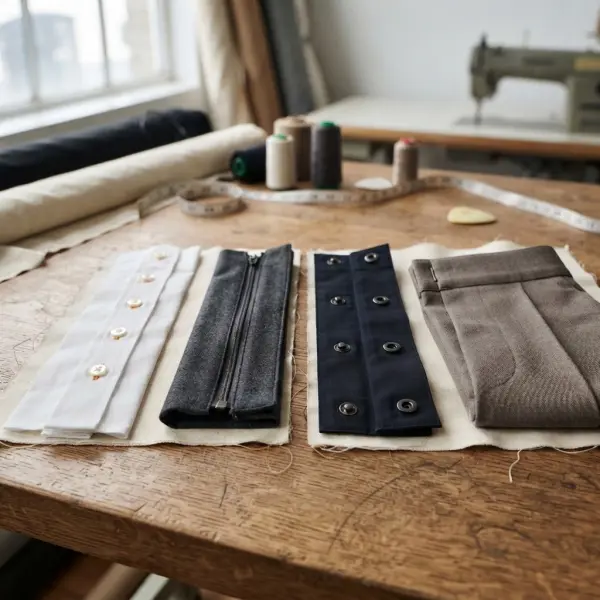
A garment closure is not just the hardware visible on the finished product. It is a system made up of the fastener, its mating component, the fabric layers beneath it, the opening construction, reinforcement, attachment thread or setting method, and the pattern allowance that accommodates it.
A technically strong component can still create an unsatisfactory garment if the rest of the system is unsuitable. A heavy-duty snap attached to unsupported lightweight fabric may remain intact while tearing away from the garment. A zipper may pass an isolated strength test but create a stiff or wavy opening when sewn into a soft knit. A button may be secure, yet the garment can still gape because the buttons are spaced too far apart for the tension at the opening.
The four main categories—explained in more detail in garment closures including buttons, zippers, hooks, and snaps—manage the opening differently:
- Buttons and buttonholes secure separate points.
- Zippers close the opening continuously along their installed length.
- Hooks hold concentrated points with little visible bulk.
- Snaps interlock at selected points through applied pressure.
Those mechanical differences influence almost every later decision, from pattern development and sample approval to sewing operations, care testing, and repair.
How Does Closure Choice Affect Garment Function?
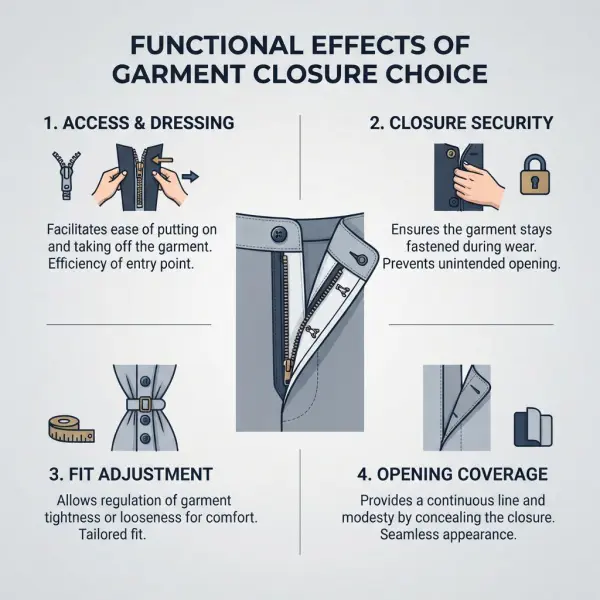
Closure choice affects how the wearer accesses the garment, how securely the opening remains closed, how much adjustment is available, and how easily the fastener can be operated in real use.
Function must be defined for the particular product. A closure that works well on an occasional-wear dress may be impractical on a uniform opened several times during a shift. A small hook can produce a clean finish on tailored trousers but may be difficult for a wearer with limited hand dexterity.
Dressing and Undressing
The closure determines how far the garment can open and how much effort is required to put it on or remove it. Close-fitting garments generally need enough opening length to pass over the head, shoulders, hips, hands, or feet without overstressing the fabric or seams.
A concealed zipper may allow a fitted dress to open widely while maintaining an uninterrupted exterior when closed. A partial button placket may be sufficient for a loose blouse but inadequate if the neckline does not expand enough to pass comfortably over the wearer’s head.
Access should be tested on a person or appropriate dress form—not inferred only from a flat pattern. The required opening depends on the garment silhouette, fabric extensibility, body area, dressing direction, and intended wearer.
Speed and Frequency of Operation
Zippers and snaps can usually close a long opening faster than a series of individual buttons. This can make them useful for outerwear, uniforms, childrenswear, and other garments where dressing speed matters.
Speed alone is not a sufficient selection criterion. A separating zipper may be quick once the insertion pin is engaged, but aligning the pin and retainer box can be difficult for some users. A firm snap may close quickly but require substantial force to release. Large buttons may be slower than a zipper yet easier to grip than a small slider pull.
For garments opened repeatedly, the design team should consider the full interaction:
- How is the component gripped?
- How accurately must the two sides be aligned?
- How much force is needed?
- Can it be operated with one hand?
- Will gloves, long nails, limited vision, or reduced dexterity affect use?
- Does the opening remain stable during operation?
These questions are particularly relevant for workwear, adaptive clothing, children’s products, maternity garments, nursing apparel, and clothing intended for older consumers. The best response may involve a larger puller, fewer buttons, a magnetic system with suitable safety assessment, or a combination of closures rather than a single generic solution.
Security and Resistance to Accidental Opening
A functional closure must stay closed under the forces expected during movement. The appropriate level of security differs by location.
A snap on a decorative pocket flap experiences different forces from a snap across a close-fitting chest opening. A hook at the top of a dress zipper supports a small concentrated area, whereas a trouser waistband closure may be subjected to repeated tension during sitting, bending, and movement.
Stronger holding force is not automatically better. If the force required to release a snap is greater than the surrounding fabric can tolerate, repeated opening may distort the material or pull the component out. The wearer may also open the garment by pulling the fabric rather than gripping the hardware, increasing local stress.
Buttons can sometimes release under tension if the buttonholes are oversized or incorrectly oriented. Zippers may resist opening continuously, but their function depends on slider design, element engagement, stops, and installation.
ASTM D2062 addresses characteristics such as zipper opening and closing, separator functioning, and sticking at stops. Its scope also recognizes that published tests do not evaluate every property that may influence satisfactory zipper performance. See the ASTM test methods for zipper operability.
Adjustability
Buttons, hooks, and repeated rows of snaps can offer adjustable fastening positions. Waist tabs, cuffs, convertible garments, bras, and childrenswear frequently use this principle.
A zipper normally closes along one fixed path. It may provide a large opening, but it does not automatically allow the wearer to change the circumference. Two-way zippers provide access from different directions, yet that is not the same as size adjustment.
Adjustability can improve comfort and extend practical use, but multiple fastening positions need clear spacing. A cuff with two buttons should create meaningful size options without twisting the sleeve. Hook-and-eye tape must provide enough adjustment while keeping the garment balanced at each position.
Protection and Coverage
Closures can influence protection from wind, dust, light rain, or workplace exposure, but their presence does not automatically make a garment protective.
A zipper closes an opening more continuously than spaced buttons, yet air or moisture may still pass through the elements, tape, seam, or slider area. Storm flaps, underlays, coated components, seam construction, and garment design may be needed for additional coverage.
Technical or protective apparel should follow its applicable product specification and testing regime. A closure described as water-resistant by a supplier should not be presented as making the complete garment waterproof unless the finished product has been designed and evaluated for that claim.
How Does Closure Choice Affect Garment Fit?
A closure affects fit by controlling where garment edges meet, overlap, separate, or carry tension. It may also introduce stiffness, thickness, weight, or visible interruption into the silhouette.
The relationship is most noticeable in close-fitting garments, but it also matters in loose apparel. A button placket can affect the drape of a fluid blouse. A heavy center-front zipper can pull down the front of a lightweight jacket. Snaps installed at uneven intervals can cause the opening between them to flare or roll.
Continuous Versus Intermittent Closure
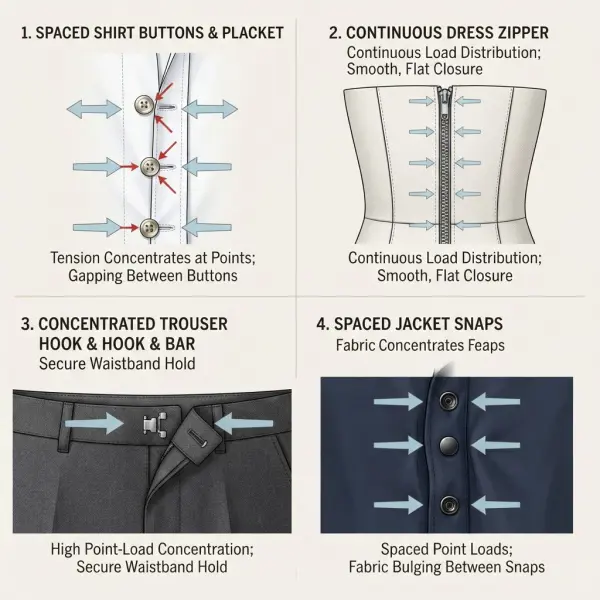
Zippers create a continuous connection between the two sides of an opening. This can support a smooth, close-fitting line because tension is distributed along the installed zipper rather than concentrated at widely separated fastening points.
Buttons and snaps hold the opening at intervals. The areas between them remain dependent on placket construction, fabric stiffness, button or snap spacing, and the amount of tension across the body.
This difference explains why a fitted dress commonly uses a zipper rather than a short series of buttons. Buttons can certainly be used, but the designer may need a structured placket, closer spacing, or an additional concealed closure to control gaping.
Intermittent fastening is not a defect. It can create intentional ease, ventilation, adjustability, or visual rhythm. The design simply needs to acknowledge how the opening behaves between fastening points.
Overlap, Extension, and Pattern Allowance
Buttons, hooks, and snaps generally require one garment edge to overlap another. That overlap must be built into the pattern. Its width depends on the closure size, garment category, fabric, edge construction, desired appearance, and required security.
A button placed too close to the opening edge can distort the placket or allow the edge to roll outward. Positioned too far from the edge, it may create excessive overlap or shift the garment’s center line.
Trouser hook-and-bar systems often need an extended waistband tab. If that extension is too short, the closure may sit under excessive tension. If it is too long or insufficiently supported, the waistband can project away from the body.
Zippers usually join two prepared edges without the same visible overlap, although lapped zipper installations and protective plackets require additional pattern allowance. Changing the closure after pattern approval may therefore require more than replacing one bill-of-material item.
Bulk and Rigidity
Every closure adds some combination of thickness, stiffness, or weight. The effect may be negligible on heavy outerwear but highly visible on lingerie, fine knitwear, or a bias-cut dress.
A concealed zipper can provide a discreet exterior, yet its tape and seam allowances create a firmer vertical line. A row of covered buttons may suit the visual direction of a formal dress but introduces repeated points of bulk. A trouser hook is relatively flat, which is one reason it is often chosen for clean waistbands.
Bulk becomes especially important where the closure sits beneath another garment or directly against the body. Large snaps on a fitted shirt may print through a jacket. A thick zipper seam can feel uncomfortable at the side of a close-fitting dress. Internal buttons and hooks can cause pressure if their position coincides with a prominent body area.
Tension Distribution and Gaping
The forces at a closure are rarely uniform. A shirt may experience more tension across the bust or abdomen than at the upper chest. Trousers may place greater stress on the waistband and upper fly when the wearer sits. A fitted sleeve cuff is loaded when the hand passes through or the wrist bends.
Closure type, spacing, position, and reinforcement should respond to these higher-stress zones. Adding more buttons can reduce the distance between fastening points, but it does not correct insufficient garment ease. Reinforcing a placket may control distortion, but excessive reinforcement can make the area too rigid.
Fit problems should therefore be diagnosed before the closure is blamed. Gaping may result from:
- Insufficient pattern ease
- Poor button or snap spacing
- Incorrect overlap
- Fabric stretch or instability
- Misaligned closure placement
- Weak placket construction
- A closure that is too bulky for the material
The correct solution depends on the cause. Moving or adding fasteners can be appropriate in some cases, while other cases require pattern correction.
Stretch Fabrics Require Special Judgment
A closure is often less extensible than the fabric surrounding it. Sewing a stable zipper into a highly stretchable knit can restrict movement along the opening and concentrate stress at the zipper ends. Conversely, a stretch garment without sufficient opening stability may ripple, grow, or pull away from the closure.
Stabilization may be needed, but the objective is not to make every area rigid. The reinforced opening should remain compatible with the garment’s expected movement and recovery.
Designers should also distinguish between fabric stretch that helps the wearer enter the garment and stretch required during wear. If a neckline already expands sufficiently, adding a zipper may be unnecessary. If the garment needs controlled compression, an opening may still be required even though the fabric stretches.
How Does Closure Choice Affect Durability?
Closure durability is the ability of the complete fastening system to remain usable and appropriately attached through expected wear, operation, and care. It includes more than whether the metal or plastic component breaks.
A closure can become functionally unacceptable because the fabric tears, the zipper tape shrinks, the slider stops locking, a finish changes color, a buttonhole enlarges, or a snap becomes difficult to open. None of these outcomes is explained by hardware strength alone.
The Weakest Part May Not Be the Closure
In many garments, failure occurs in the interface between the closure and the textile. Pulling a snap applies force to a small area around its attachment. Repeated use can enlarge the hole, damage yarns, or delaminate a coated material. A button may remain undamaged while its sewing thread breaks or the surrounding fabric tears.
This is why pull or attachment testing should be conducted on the relevant assembly when appropriate, not only on loose components. The finished combination may include:
- Outer fabric
- Interfacing or reinforcement patch
- Lining
- Closure components
- Sewing thread or mechanical attachment
- Actual production settings
ASTM’s textile standards catalogue lists separate methods for zipper strength and operability, snap resistance to unsnapping, snap holding strength, and button properties. The separate methods reflect an important point: attachment security, operating force, and component strength are related but not identical characteristics. See the ASTM standards for textile fastener subassemblies.
Repeated Operating Cycles
Most closures experience repeated mechanical action. Zipper elements engage and separate, sliders move along the chain, buttonholes stretch around buttons, hooks rub against their receiving components, and snap springs flex during opening and closing.
The number and severity of cycles differ dramatically by product. A closure on an evening dress may be used occasionally, while a fly zipper or uniform snap can be opened many times each week. Pocket fasteners may receive additional pulling because users operate them quickly or at an angle.
A design team should define a realistic use scenario rather than assuming all garments require the same performance level. Excessive specifications can add unnecessary cost and bulk, while insufficient specifications create early failure and returns.
Laundering, Dry Cleaning, Heat, and Moisture
Care compatibility is central to closure durability. Zipper tapes, coatings, painted buttons, plated hooks, plastic components, and attachment materials can react differently to heat, moisture, detergent, solvents, bleach, pressing, or tumble drying.
Dimensional compatibility is particularly important. If the garment fabric and zipper tape shrink at different rates, the opening may become wavy or distorted even though the zipper still operates.
ASTM D3692 provides guidance for selecting zippers for care-labeled apparel and identifies properties such as shrinkage, colorfastness, and ironing deformation. It also states that, after initial selection, the chosen zipper should be tested in a prototype item to confirm suitability. See the ASTM practice for selecting zippers for care-labeled apparel.
That prototype principle is useful for other closures as well. A supplier’s trim report cannot fully predict how a component will behave after it is installed in a specific garment construction.
Finish and Corrosion Performance
Metal components may be affected by moisture, salt, laundering chemicals, perspiration, or incompatible finishes. Corrosion can change appearance, stain nearby fabric, create rough surfaces, or interfere with operation.
The degree of risk depends on the base material, plating or coating, exposure conditions, garment use, and maintenance. Coastal outerwear, swim-related products, industrial uniforms, and garments worn directly against the skin may need different evaluation from occasional indoor apparel.
Color and finish should therefore be treated as performance attributes as well as aesthetic choices. An aged metal effect may be intentionally irregular, but unwanted finish loss or color transfer is a different matter.
Repairability and Replacement
A durable product is not necessarily one in which the original closure never fails. Repairability can extend useful garment life when a component eventually wears out.
Sewn buttons and hooks are often relatively straightforward to replace. A standard zipper can be repaired or replaced, although the labor may be substantial when it is integrated into a lined or technically constructed garment. Applied snaps and tack buttons may require specialized tools and can leave permanent holes in the textile.
Brands interested in repair services should consider whether replacement components will remain available. Proprietary pullers, branded buttons, unusual coatings, and custom snap sizes can complicate later repairs unless spare stock is retained.

Comparing Closure Effects in Practice
The following comparison shows general tendencies rather than universal performance rankings.
|
Closure |
Functional effect |
Fit implication |
Durability consideration |
Often suitable when |
|
Buttons |
Individual fastening with possible adjustment |
Requires overlap; may gape between points under tension |
Button, attachment thread, buttonhole, and fabric must remain stable |
Visual character, adjustability, and repairability are valued |
|
Zippers |
Fast, continuous opening and closure |
Supports a clean line but may add rigidity |
Slider, elements, tape, stops, seam, and care compatibility all matter |
A long or close-fitting opening needs continuous closure |
|
Hooks |
Discreet fastening at concentrated points |
Adds little exterior bulk but offers limited opening coverage |
Small attachment area and alignment require attention |
The opening needs a low-profile primary or supporting closure |
|
Snaps |
Quick pressure-operated fastening |
Requires overlap and may show movement between snaps |
Opening force is transferred around each attachment point |
Fast access and a clean repeated hardware detail are desired |
These tendencies should be interpreted in relation to component size and construction. A fine coil zipper behaves differently from a large molded plastic zipper. A delicate sew-on snap is not equivalent to a ring-spring snap intended for heavier material.
Closure Choice by Garment Category
Shirts and Blouses
Buttons support the visual structure of conventional shirts and allow the wearer to open only part of the placket. Their spacing, diameter, buttonhole orientation, and placket stability affect both appearance and fit.
Snaps can make the shirt faster to operate and create a western, workwear, or minimalist look, depending on their finish and visibility. They may require more localized reinforcement than sewn buttons and may be less easily replaced by the consumer.
A zipper can create a more continuous and often sportier front, but its weight and rigidity should suit the fabric. On a fluid blouse, an inappropriate zipper may dominate the drape.
Dresses and Fitted Skirts
Concealed zippers are common because they provide a long opening with limited exterior interruption. Their installation must accommodate the fabric and seam position. Very lightweight, bias-cut, stretch, or heavily beaded garments may require additional development.
Buttoned openings can become a defining design feature, but close-fitting areas need adequate spacing and overlap. Decorative buttons over a concealed zipper can sometimes provide the desired appearance while the zipper manages access and continuous closure.
Hooks are often used at the top of a zipper to align the opening and reduce load during operation. They should not be expected to compensate for a zipper that is too short or a garment that lacks sufficient ease.
Trousers and Tailored Garments
A trouser closure often combines systems: a zipper fly, hook-and-bar waistband closure, and internal button. This is not unnecessary duplication. Each component can help stabilize or secure a different part of the opening.
The waistband hook creates a flat exterior, the internal button can distribute force, and the zipper controls the fly opening. Removing one component to reduce cost may change how tension is carried by the remaining components.
Tailored jackets often use buttons because they contribute to proportion and styling. Button position also affects the garment’s visual waist and how the front sections move when fastened.
Jackets and Outerwear
Zippers provide continuous closure and fast operation. Separating zippers are practical when the garment must open completely, while two-way versions can release the lower front of a long coat for sitting or movement.
Buttons offer easier field replacement and can support a traditional, formal, or utilitarian appearance. Snaps work well on storm flaps and pockets, but their holding force and attachment must suit the material.
Many outerwear designs combine a zipper with a snap or button placket. The additional layer may improve coverage or styling, but it also adds operations, cost, bulk, and more components that require quality control.
Childrenswear and Adaptive Clothing
The user’s physical capability and safety context deserve more weight than visual convention. Large zipper pulls, easy-grip buttons, carefully selected snaps, elasticized sections, and alternative fastening systems may improve access for particular users.
The solution should still be assessed for unintended opening, detachable components, sharp edges, chemical requirements, and garment use. In the United States, the Consumer Product Safety Commission identifies buttons, zippers, and snaps among the accessible components relevant to certain children’s apparel requirements. Its clothing guidance for children’s products provides market-specific context, but brands selling internationally must verify the rules in every destination market.
Cost and Production Implications
Closure cost includes more than the purchase price of the component. It can also include pattern changes, reinforcement, special machinery, setting dies, additional operations, slower handling, testing, rejected garments, replacement stock, and repair obligations.
A basic sewn button may have a low unit cost but require button sewing and buttonhole operations. Applied snaps can be efficient at scale once the correct equipment and settings are established, yet they may introduce tooling requirements. A premium separating zipper may cost more per unit but replace a longer sequence of individual fastening operations.
The commercially suitable choice depends on total installed cost and product risk:
- Component and mating-part cost
- Minimum order quantities
- Custom color or finish charges
- Production equipment and tooling
- Sewing or setting time
- Reinforcement materials
- Inspection and testing
- Repair and replacement availability
- Failure or return risk
Reducing cost by changing the closure late in development can be misleading. If the replacement requires a new overlap, different seam allowance, extra reinforcement, or another production operation, the total saving may be smaller than the trim price suggests.
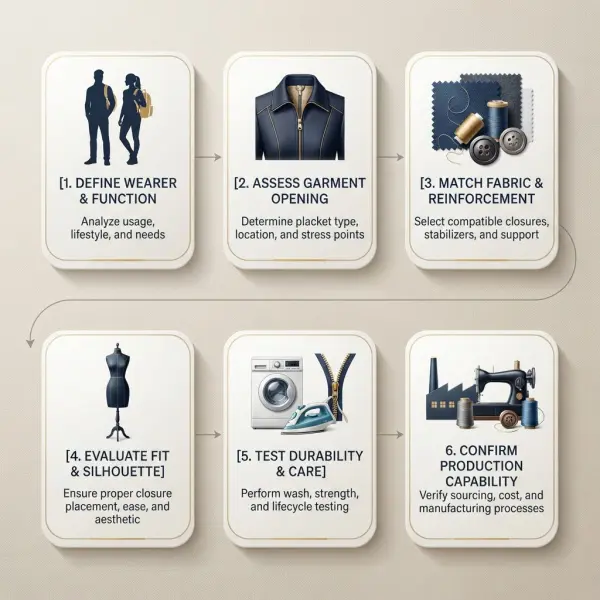
How Fashion Businesses Can Apply These Insights
Define the Required Function Before Selecting the Trim
The design brief should state what the closure needs to do. “Use a black zipper” is incomplete. A more useful brief identifies the opening location, length, separating requirement, expected frequency of use, visibility, fabric, care method, and target wearer.
This prevents styling preferences from becoming the only selection criterion.
Develop the Closure With the Pattern and Fabric
Closure position, overlap, seam allowance, reinforcement, and access length should be resolved during pattern development. The actual production fabric should be used as early as possible because thickness, stretch, drape, surface finish, and fraying influence the result.
A closure approved on a generic sample card is not necessarily approved for the garment.
Create a Complete Technical Specification
The bill of materials and technical package should identify the supplier, component code, construction, size, color, finish, mating parts, installation method, placement, reinforcement, and acceptable substitute policy.
For applied snaps or tack buttons, the specification may also need the compatible setting die, machine conditions, and supplier-recommended fabric thickness range. For zippers, teams should define element type and size, tape, slider, puller, length, end configuration, and installation style.
Test the Garment as the Customer Will Use It
Evaluation should include more than opening the sample a few times on a table. The team should try the garment on, move in it, sit, bend, dress and undress, operate the fastener from realistic angles, and follow the intended care procedure.
Higher-risk products may require laboratory testing according to buyer protocols, applicable standards, or regulations. The test plan should be based on the failure modes relevant to that garment rather than a generic checklist applied identically to every product.
Control Bulk Production and Substitutions
Component variation, machine settings, operator handling, and reinforcement placement can change bulk performance even after an approved sample succeeds. Production inspection should confirm both appearance and function.
Substitutions should undergo documented approval. A replacement that matches the original color may still have a different opening force, tape shrinkage, finish, size, or attachment geometry.
Common Closure Selection Mistakes
Choosing From Appearance Alone
A trim may fit the mood board but conflict with the fabric or wearer. Heavy hardware can distort lightweight material, while a small concealed fastener may be impractical on workwear.
The better approach is to preserve the visual concept while testing alternative sizes, constructions, materials, or installation methods.
Treating Closure Strength as One Number
Zipper chain strength, slider operation, snap opening force, button strength, attachment security, and fabric tear resistance measure different aspects of performance. One passing result does not establish complete garment durability.
Teams should define the relevant failure risks and select tests accordingly.
Ignoring the Care Label Until Late Development
A closure may look and operate correctly before washing but cause puckering, finish change, corrosion, or dimensional distortion after care. The trim and prototype should be evaluated against the intended care process before bulk approval.
Using the Closure to Correct Poor Fit
Adding another button or a stronger snap may reduce visible gaping, but it cannot reliably solve insufficient ease, incorrect shaping, or poor balance. It may simply transfer more stress to the placket.
Fit should be corrected at pattern level when the pattern is the underlying cause.
Assuming the Factory Can Install Every System
Applied snaps, tack buttons, waterproof-style zippers, or unusual concealed components may require specific machines, dies, folders, presser feet, or operator skills. A factory’s general garment-making capability does not confirm competence with every fastening system.
The production team should review equipment and trial the intended construction before final approval.
Construction faults and preventive controls are discussed more deeply in common closure construction problems and how to prevent them.
What Brands Should Verify Before Final Approval
Before approving a closure for bulk production, brands should verify:
- The garment provides enough opening for realistic dressing and removal.
- The wearer can operate the closure comfortably.
- The fastener remains closed during expected movement.
- The opening lies flat without unintended gaping, rippling, or bulk.
- Component size and weight suit the fabric and silhouette.
- Reinforcement supports the attachment without excessive stiffness.
- Closure and garment respond compatibly to the intended care process.
- The supplier code and complete mating system are documented.
- Bulk-production equipment and settings have been confirmed.
- Relevant mechanical, chemical, and product safety requirements are addressed.
- Replacement components or repair options are considered where appropriate.
Approval should be based on the finished prototype and intended use—not only on a loose trim sample.
Frequently Asked Questions
Which garment closure provides the best fit?
No closure provides the best fit in every garment. Zippers can support smooth, continuous closure in fitted dresses and skirts, while buttons allow overlap and adjustment but may gape between fastening points. Hooks create low-profile fastening at concentrated areas, and snaps provide fast operation with intermittent hold. The best fit comes from matching the closure to the pattern, opening location, fabric stability, body tension, and intended silhouette. An unsuitable pattern cannot be corrected reliably by selecting a stronger fastener.
Are zippers more durable than buttons?
Not universally. A zipper contains several interacting parts, including tapes, elements, slider, puller, and stops. Failure in any one can affect the whole opening. Buttons are mechanically simpler and often easier to replace, but their attachment thread, buttonholes, and surrounding fabric can wear or fail. Durability depends on component quality, installation, frequency of use, care conditions, and garment construction. The relevant question is whether the complete closure system is durable enough for the intended product.
Why do buttoned garments gape between buttons?
Gapping usually occurs when tension between fastening points exceeds the ability of the fabric and placket to remain aligned. Causes may include insufficient garment ease, excessive spacing, incorrect button placement, weak placket construction, unstable fabric, or inadequate overlap. Adding buttons may help when spacing is the primary problem, but it will not correct an undersized or poorly balanced pattern. The garment should be evaluated on the body to identify where the tension begins and whether the cause is fit, construction, or both.
Can a stronger snap make a garment more durable?
Only when the fabric, reinforcement, and attachment can tolerate the higher force. A snap with greater resistance to opening may remain closed more securely, but it can place more stress on the surrounding textile every time the wearer pulls it apart. If users grip the fabric rather than the snap, damage becomes more likely. Suitable snap strength should balance security with usable opening force, fabric support, target wearer capability, and expected frequency of operation.
Does a zipper change the stretch of a garment?
Yes, along the installed opening it often does. Most conventional zipper tapes and element systems stretch less than highly elastic knit or stretch woven fabrics. The zipper can stabilize the opening, but it may also restrict extension or concentrate stress near its ends. Appropriate reinforcement, seam construction, zipper type, and placement depend on how the garment is intended to stretch during dressing and wear. Testing the zipper in the actual fabric is more reliable than judging the components separately.
Should a garment closure be tested before bulk production?
Yes, when its failure or incompatibility could affect safety, function, appearance, compliance, or customer satisfaction. The appropriate evaluation ranges from repeated use and care trials on a prototype to formal laboratory testing under buyer standards or regulations. The plan should reflect the garment category and expected risks. Testing loose hardware alone is not enough when the likely weakness is the attachment, reinforcement, fabric, or finished opening.
Is the cheapest closure usually the lowest-cost option?
Not necessarily. Total installed cost includes the component, sewing or setting operations, reinforcement, equipment, tooling, inspection, testing, rejection risk, and possible repairs or returns. A low-priced snap that requires new dies and creates attachment failures may cost more overall than an initially more expensive alternative. Commercial comparison should therefore use the complete production and risk cost rather than only the supplier’s unit price.
Conclusion
Closure choice shapes how a garment is entered, secured, adjusted, worn, maintained, and eventually repaired. It also changes how tension is distributed, how closely an opening can follow the body, and how much bulk or rigidity is introduced into the silhouette.
The central principle is compatibility. Buttons, zippers, hooks, and snaps are durable and functional only when their size, construction, attachment, fabric support, care performance, and operating force suit the garment.
Fashion businesses make better closure decisions when they begin with the wearer and product function, develop the fastening alongside the pattern and fabric, and approve the finished system through realistic use and care evaluation. That approach prevents a small trim decision from becoming a recurring fit complaint, production defect, or premature product failure.





Comments 0
Leave a CommentSend Comment
Anda harus Login terlebih dahulu untuk dapat memberikan komentar.