

Common Vendor Management Mistakes That Disrupt Fashion Operations
Quick Answer
Common vendor management mistakes in fashion include unclear specifications, frequent last-minute changes, unrealistic production timelines, weak purchase-order control, poor visibility into material readiness, inconsistent quality follow-up, inadequate communication, excessive dependence on individual suppliers, limited subcontracting visibility, delayed payments, and supplier scorecards that do not lead to corrective action.
These mistakes matter because apparel production is highly interdependent. A delayed fabric approval can shift cutting. A missing trim can stop assembly even when the main fabric is ready. A late design revision can invalidate previously purchased materials. A factory that receives unrealistic lead times may face pressure across production planning, overtime, subcontracting, quality, and delivery.
Vendor disruption is therefore not always evidence that a supplier is simply “unreliable.” Some failures originate with the vendor, while others are created or amplified by the buying company itself. Effective vendor management requires brands to separate those causes, detect problems early, control changes, maintain realistic commitments, and use performance data to improve both supplier behavior and internal purchasing practices.
Why Vendor Management Mistakes Become Operational Problems
Fashion businesses rarely buy a finished product through one isolated transaction. Apparel production typically connects fabrics, trims, sampling, approvals, manufacturing, finishing, inspection, packaging, logistics, and commercial deadlines. Each activity can depend on information or materials created somewhere else in the chain.
That dependency creates a simple operational reality: a small failure upstream can become a large disruption downstream.
A three-day delay in approving a lab dip may not initially appear serious. But if bulk dyeing cannot start until approval is received, and the garment factory has already reserved production capacity, those three days can move fabric delivery into another production window. Cutting may then shift, sewing capacity may be reassigned, and the original shipment date can become difficult to maintain.
The same logic applies to trims, packaging, technical specifications, purchase-order revisions, and payment.
This is why fashion vendor management should not be reduced to supplier negotiation or performance scoring. It is partly the discipline of coordinating commitments across organizations before small inconsistencies become operational emergencies.

Mistake 1: Treating Vendor Management as a Purchasing Department Problem
One of the most structural mistakes is assuming that supplier performance belongs only to sourcing or procurement. Apparel vendors usually interact with information created by design, product development, merchandising, technical teams, planning, quality control, finance, logistics, and management. When these functions operate independently, the vendor often receives conflicting signals.
A designer may revise a color after sourcing has confirmed material availability. Merchandising may increase quantity without checking factory capacity. Finance may change payment timing without realizing that the supplier needs funds to purchase raw materials. A production team may negotiate a delivery date based on information that product development later changes.
The supplier sees one customer. Internally, however, that customer may behave like several disconnected organizations.
A stronger approach assigns clear ownership while preserving cross-functional visibility. The sourcing or vendor-management team may coordinate the relationship, but design changes, technical approvals, forecast revisions, commercial commitments, and payment actions should feed into the same operational picture.
This becomes increasingly important as brands scale. More employees do not automatically create better supplier control. Without clear responsibilities, additional teams can create additional points of contradiction.
Mistake 2: Sending Incomplete or Unstable Specifications
A supplier cannot consistently manufacture requirements that have not been clearly defined.
Incomplete tech packs, ambiguous material descriptions, missing tolerances, inconsistent color references, outdated artwork, unspecified packaging, or unclear construction details force vendors to ask questions or make assumptions. Both responses consume time. When assumptions reach bulk production, they can also create defects or rework.
The problem becomes more serious when specifications continue changing after development has progressed.
Late design changes do more than create administrative work. They can affect pattern pieces, marker consumption, fabric quantity, trim requirements, artwork, manufacturing sequence, costing, production planning, and materials already purchased.
Better Buying Institute supplier research has specifically identified poor communication, inaccurate tech packs, extensive internal reviews, numerous sample requests, and excessive design changes as factors that add waste, extend development timelines, and increase supplier costs.
This does not mean a fashion brand should freeze creativity prematurely. Product development naturally involves iteration. The management objective is to distinguish development-stage experimentation from production-stage change.
Once materials, capacity, or production have been committed, every change should be evaluated for its downstream consequences before it is confirmed.
What Better Change Control Looks Like
A practical change-control process does not need to be bureaucratic. It needs to make four things visible:
- What changed?
- Which specification or order version is now valid?
- Which materials, costs, quantities, or production steps are affected?
- Has the supplier confirmed the impact on price and timing?
Version control is particularly important. A factory should not have to decide whether an attachment named TechPack_Final_v7_REVISED2.pdf is actually the approved production file.
The operational rule is simple: there should be one identifiable current version, and superseded versions should no longer compete for attention.

Mistake 3: Treating the Quoted Lead Time as a Guaranteed Calendar
A statement such as “lead time: 30 days” is incomplete unless both parties understand when those 30 days begin and what assumptions support them.
Does the clock start when the purchase order is issued? When the deposit is received? When lab dips are approved? When all trims arrive? When fabric becomes available? When the pre-production sample is signed off?
These distinctions can materially change the production calendar.
Lead times can also contain several dependent stages. A garment might require fabric production, dyeing, inspection, transportation to the factory, cutting, sewing, washing, finishing, final inspection, and packing. A delay in one stage can consume buffer intended for another.
Brands create avoidable risk when they calculate backward from a retail launch date and assign whatever production duration remains rather than asking what the process realistically requires.
That does not mean supplier lead times should be accepted without challenge. Vendors should be expected to provide realistic commitments and flag constraints. But aggressive schedules become especially dangerous when the buyer treats the requested date as proof that operational capacity exists.

Build Dates From Dependencies, Not Hope
A more reliable production calendar identifies major approval and material dependencies and gives each a visible owner.
For example:
- Purchase order confirmed.
- Fabric or material order released.
- Color and artwork approvals completed.
- Bulk material ready.
- Trims complete.
- Pre-production requirements closed.
- Cutting begins.
- Sewing begins.
- Finishing and inspection completed.
- Goods ready for shipment.
Not every business needs this exact sequence, and different garments require different milestones. The value lies in making dependencies explicit.
When one milestone slips, teams can then assess the real downstream impact rather than discovering the problem only when the final shipment date is missed.
Mistake 4: Changing Orders Without Recalculating the Operational Impact
Fashion orders change. Forecasts improve, retailers revise demand, styles perform differently from expectations, and management may decide to increase or reduce quantities.
The mistake is assuming that quantity, color mix, delivery date, and product specification can change independently.
Increasing an order from 2,000 to 4,000 pieces may require additional fabric, trims, labor, production capacity, quality inspection time, packaging, and freight space. If fabric has already been dyed, extra yardage may come from another lot and require shade management. If the factory's next production window is already booked, the incremental quantity may not fit into the original schedule.
Reducing an order can also create consequences. Suppliers may already have purchased raw materials or reserved production capacity based on the buyer's earlier commitment.
ILO research has long examined how buyer purchasing practices—including order and commercial practices—interact with supplier operations and working conditions in global supply chains. Its global survey included 1,454 suppliers across 87 countries, highlighting why purchasing behavior cannot be separated entirely from supplier operating conditions.
For fashion businesses, the practical lesson is narrower but important: a change request is not operationally neutral.
The buyer should request an impact assessment before treating a change as confirmed.
Mistake 5: Managing Finished-Garment Dates Without Managing Material Readiness
A factory cannot manufacture garments from missing materials.
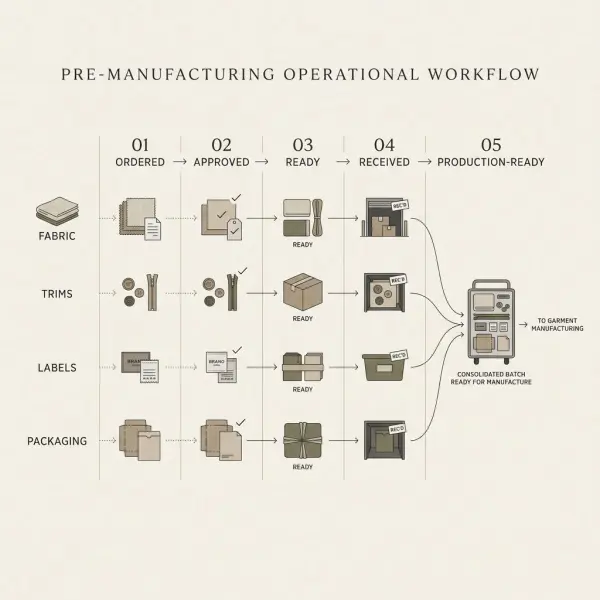
This sounds obvious, yet fashion teams sometimes track the factory's shipment date much more closely than the readiness of fabrics, trims, labels, packaging, and other inputs required to achieve it.
Material readiness is particularly important when different components have different lead times. A custom zipper may take longer than the shell fabric. Printed packaging may wait for finalized regulatory or marketing information. Imported interlining may become delayed in transit. Fabric can physically arrive but remain unusable because inspection has identified a problem.
An effective vendor-management process therefore asks not only whether materials have been “ordered,” but whether they will be production-ready when required.
For critical components, useful status distinctions might include ordered, confirmed, in production, awaiting approval, completed, shipped, received, inspected, and approved for production.
That visibility helps teams identify which component is actually on the critical path.
Mistake 6: Waiting Until Final Inspection to Discover Quality Problems
Final inspection is an important control point, but it is an expensive place to discover a problem that has existed throughout production.
If incorrect seam construction is found after thousands of garments have been completed, the business may face sorting, repair, rejection, delayed shipping, or commercial compromise. The same issue identified during early production may require correcting only a small number of pieces and adjusting the process before output continues.
Vendor quality management should therefore operate at appropriate stages rather than only at the end.
Depending on the product and manufacturing environment, those stages may include incoming-material inspection, pre-production confirmation, first-output review, inline inspection, measurement monitoring, finishing checks, and final inspection.
The goal is not maximum inspection. Inspection itself does not create quality. The goal is early detection combined with process correction.
Brands also need to distinguish isolated defects from systemic problems. A single skipped stitch and a recurring construction failure require different responses. Repeated issues should lead to root-cause investigation and corrective action rather than simply another round of sorting.
ISO/IAF guidance on external providers similarly emphasizes defining criteria for externally provided products and services, maintaining current information on approved providers, and verifying that purchased outputs satisfy requirements.
Mistake 7: Recording Vendor Problems Without Closing Corrective Actions
Many companies are good at documenting problems and less disciplined about determining whether the problem actually disappeared.
A quality claim may be emailed. A supplier apologizes. Replacement goods arrive. The immediate crisis ends. Three months later, the same problem occurs again.
An effective issue record should connect the symptom to a response and then to verification.
For significant or recurring issues, teams should ask:
- What happened?
- Which orders or products are affected?
- What immediate containment is required?
- What is the likely root cause?
- What corrective action has been agreed?
- Who owns it?
- When is it due?
- What evidence shows that it worked?
Not every minor error needs formal root-cause analysis. The management effort should remain proportional to the problem.
But repeated failures deserve more than repeated apologies.
Mistake 8: Using Vendor Scorecards as Decoration
A supplier scorecard has little value if its only outcome is a quarterly presentation.
Brands may track on-time delivery, defect rates, sample turnaround, communication, commercial performance, corrective-action status, or other metrics. These can help organize evidence, but a numerical score should lead somewhere.
A deteriorating delivery score should trigger investigation. A repeated quality problem should lead to corrective action. A consistently strong vendor may justify greater order allocation or earlier development involvement. A strategically important supplier with one persistent weakness may need a formal improvement plan.
Scorecards also need causal accuracy.
If a supplier delivery appears late because the buyer approved production ten days after the agreed deadline, recording the entire delay against the supplier corrupts the data. Eventually, the company may make sourcing decisions based on metrics that describe its own behavior as though it were vendor performance.
The stronger approach is to track both the outcome and relevant cause.
This makes vendor data useful for management rather than merely measurable.
Mistake 9: Ignoring Buyer-Caused Vendor Disruption
Fashion companies often examine supplier performance more closely than their own purchasing behavior.
That creates a blind spot.
Late approvals, inaccurate forecasts, repeated sampling, order changes, short-notice volume increases, delayed payments, and unrealistic deadlines can reduce the supplier's ability to plan materials, labor, capacity, and cash.
ILO research on global supply chains has examined relationships between purchasing practices and working conditions, while field research across Bangladesh, China, India, South Africa, and Turkey found evidence suggesting relationships between certain purchasing practices and factors including wages, working time, occupational safety, temporary workers, and outsourcing.
These findings should not be simplified into a claim that every buyer change directly creates poor working conditions. Supply-chain outcomes have multiple causes. They do demonstrate why buyer behavior deserves inclusion in responsible supplier management rather than assuming responsibility flows only toward the vendor.
Better Buying research has likewise documented suppliers' concerns about extensive design changes, poor communication, and development practices that add time and waste.
For operational managers, this means vendor reviews should include a mirror.
Ask not only, “What did the supplier do wrong?” but also, “What conditions did we create?”
Mistake 10: Paying Late or Using Commercial Terms Without Considering Supplier Cash Flow
Payment is part of vendor management.
Suppliers must often finance raw materials, wages, overhead, subcontractors, utilities, and production before receiving full payment from the buyer. Payment timing therefore affects cash flow throughout the relationship.
Commercial terms vary widely, and there is no universal payment structure suitable for every vendor. The mistake is agreeing to terms without understanding whether those terms are economically workable—or failing to honor terms that have already been agreed.
Better Buying research on payment practices has documented supplier concerns regarding payment-term extensions, cancellations, shipping delays, and their consequences for supplier cash flow and business continuity.
For a small fashion brand, responsible commercial management does not mean paying everything in advance. That may create unacceptable buyer risk. It means understanding the financial mechanics of the arrangement and meeting agreed obligations reliably.
Poor payment behavior can eventually become an operational problem. A financially constrained supplier may struggle to purchase materials, retain production capacity, prioritize orders, or invest in corrective improvements.
Commercial discipline and production reliability are more connected than they may appear.
Mistake 11: Assuming an Approved Vendor Remains Approved Forever
Supplier conditions change.
Management changes. Skilled employees leave. Machines age or are replaced. Order volumes expand. A supplier wins a large new customer and becomes capacity constrained. Production moves to another building. New subcontractors enter the chain. Financial stress develops. Previously strong communication deteriorates.
Vendor approval should therefore be understood as a decision made under a set of conditions, not a permanent status.
The appropriate review frequency depends on risk and business importance. A critical production partner may justify frequent performance reviews, while a low-risk commodity supplier may require less attention.
Triggers can also be more useful than fixed annual dates. Significant quality deterioration, facility changes, unexplained delivery failures, ownership changes, new subcontracting, major capacity shifts, or expansion into unfamiliar product categories may all justify reassessment.
This distinction connects directly with how brands evaluate fabric suppliers, trims vendors, and production partners. Qualification establishes initial suitability. Ongoing vendor management determines whether that suitability still exists.
Mistake 12: Becoming Dependent on a Critical Vendor Without Recognizing the Risk
Single sourcing is not automatically a mistake.
A close relationship with one fabric mill or factory can simplify communication, concentrate volume, improve development collaboration, and create mutual familiarity. For smaller brands, splitting limited volume across several vendors can actually reduce leverage and increase complexity.
The mistake is unrecognized dependency.
If one factory produces 90% of a brand's revenue-generating styles and there is no realistic alternative, that is a strategic dependency whether the company labels it as such or not. The same can happen with proprietary fabric, custom hardware, special printing, unique washing capability, or a particular yarn.
Supplier concentration should therefore be evaluated using both business importance and replacement difficulty.
The response does not always need to be immediate dual sourcing. Possible risk treatments include maintaining an alternative technical specification, identifying potential backup suppliers, keeping tooling ownership clear, reserving safety stock for long-lead components, or developing a contingency production plan.
The objective is resilience proportional to risk, not duplication for its own sake.
Mistake 13: Ignoring Subcontracting and Multi-Tier Visibility
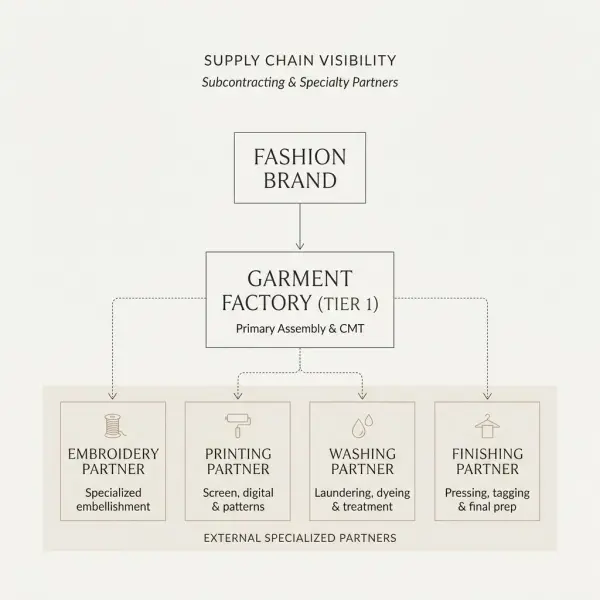
A purchase order may name one supplier while actual production involves several organizations.
A garment factory might subcontract embroidery, printing, washing, pleating, finishing, or part of sewing. A commercial fabric supplier may coordinate greige fabric, dyeing, finishing, and inspection through different facilities.
Subcontracting can be a legitimate part of apparel production. The management problem occurs when the buyer does not know that it is happening or assumes that approval of one company automatically covers every downstream process.
The OECD's 2026 overview of garment and footwear due diligence describes the sector as highly fragmented and multi-tiered and notes that subcontracting is common, while visibility often decreases further upstream.
This creates operational as well as responsible-sourcing implications.
Unexpected subcontracting can affect lead time, process consistency, traceability, technical control, and the ability to investigate defects. Where relevant, brands should therefore understand which processes are performed internally, which are external, and how the direct vendor controls those providers.
Mistake 14: Treating Audits and Certifications as a Substitute for Vendor Management
Audits, assessments, certificates, and supplier declarations can provide valuable information. They do not eliminate the need for ongoing management.
A certification normally applies to a defined scope. That scope might relate to a specific facility, management system, material, process, chain-of-custody arrangement, or set of requirements. It should not automatically be interpreted as proof of every unrelated technical, social, environmental, commercial, or production characteristic.
The OECD continues to emphasize this distinction in its work on sustainability initiatives and due diligence. In July 2026, for example, the OECD published an alignment assessment of Worldwide Responsible Accredited Production's written certification standards against OECD garment and footwear due diligence guidance, illustrating that certification schemes themselves can be evaluated according to specific scope and alignment criteria rather than treated as universally interchangeable evidence.
For fashion businesses, the practical lesson is to ask what a document actually establishes.
A valid audit can support risk assessment. A relevant certificate can support a particular sourcing requirement. Neither means the vendor no longer needs quality monitoring, performance review, corrective action, commercial management, or supply-chain visibility.
Mistake 15: Managing Every Vendor With the Same Intensity
Standard procedures can improve consistency, but equal treatment is not always efficient risk management.
A packaging vendor supplying readily replaceable standard cartons does not usually require the same management attention as the only factory manufacturing the brand's core product. Similarly, a proprietary fabric used across several best-selling styles deserves different contingency planning from a decorative trim with several approved alternatives.
Vendor segmentation allows teams to allocate management effort according to business impact.
A simple framework can consider:
|
Vendor Situation |
Management Approach |
|
Low impact, easy to replace |
Standard ordering and periodic review |
|
Operationally important |
Routine quality and delivery monitoring |
|
High impact or difficult to replace |
Closer forecasting, capacity review, contingency planning |
|
Strategic relationship |
Joint planning, performance reviews, improvement and development |
|
Persistently underperforming |
Corrective-action plan, reduced exposure, or exit assessment |
The categories should not become permanent labels. Vendor importance can change as products, volumes, markets, and alternatives change.
Mistake 16: Using Technology to Automate an Unclear Process
ERP, PLM, vendor portals, supplier scorecards, workflow automation, and traceability platforms can improve vendor management—but only when the underlying process is understood.
Digitizing an unclear approval process merely creates an unclear digital approval process.
Before implementing technology, fashion businesses should define which information matters, who owns it, which event changes status, which approval is authoritative, what counts as late, how a vendor issue is closed, and which decisions should follow performance data.
This principle also applies to fashion ERP systems. Integrated systems become valuable when they connect meaningful purchasing, inventory, production, and finance data. They become expensive filing cabinets when teams maintain inconsistent workflows outside the system and update records only after problems occur.
Technology should reduce information latency and coordination errors. It should not hide process ambiguity behind dashboards.

A Better Way to Manage Vendor Disruption
Preventing every disruption is unrealistic. Fashion businesses operate with uncertain demand, physical materials, human production systems, logistics, and multiple external organizations.
The more practical goal is to make disruption visible early, attributable accurately, and manageable consistently.
A useful operating rhythm can combine several controls.
First, establish one current source of truth for specifications, orders, approvals, and critical dates. Second, track major material and production dependencies instead of monitoring only the final shipment date. Third, record meaningful deviations while they occur. Fourth, distinguish supplier-caused problems from buyer-caused problems. Fifth, use corrective action for recurring failures. Finally, periodically review whether the vendor remains suitable for its current role.
This creates a closed management loop:
Requirement → commitment → execution → exception → cause → corrective action → verification → performance decision
That loop is more useful than a large supplier database that simply records names and contact details.
What Fashion Businesses Should Verify Before Blaming a Vendor
When an order goes wrong, the immediate question is often, “What did the supplier do?”
A better investigation begins with the complete timeline.
Check whether the specification was stable and approved on time. Confirm when the purchase order became commercially valid. Review whether required materials and trims were actually ready. Determine whether the supplier raised the risk early and whether the buyer responded. Check whether quantities or delivery dates changed. Review payment obligations. Identify which production processes were subcontracted and whether that was known.
Then establish where the deviation occurred.
This does not remove supplier accountability. A vendor that accepted an achievable commitment and failed to meet it should be held responsible for that performance. A vendor that concealed production problems or unauthorized outsourcing creates a different management issue.
The point is causal accuracy.
Without it, brands risk replacing a supplier while preserving the internal process that created the disruption. The same failure then reappears with the next vendor.
Important Caveats About Vendor Performance
Vendor performance data should be interpreted with context.
On-time delivery can be misleading if the agreed date changes repeatedly. Teams should preserve both original and revised commitments where useful.
Defect rates depend on consistent inspection methods and defect definitions. Two factories cannot be meaningfully compared if different standards were applied.
Responsiveness should not become a proxy for performance. A supplier answering messages within ten minutes is not necessarily better than one providing a complete technical response several hours later.
Low prices do not establish efficiency if frequent rework, excess inventory, long lead times, or poor flexibility create hidden costs elsewhere.
Audit results are evidence from a defined assessment under particular conditions. They should not be treated as permanent representations of everything occurring in a supply chain.
The strongest vendor-management decisions therefore combine metrics with operational evidence and professional judgment.
Frequently Asked Questions About Vendor Management Mistakes
What is the most damaging vendor management mistake for a fashion brand?
There is no single universal mistake, but unclear or unstable requirements often create unusually broad downstream effects because they influence materials, costing, sampling, capacity, quality, and delivery simultaneously. A factory cannot reliably execute a moving specification. For many growing brands, establishing one controlled product specification and a clear approval process provides more immediate value than adopting sophisticated supplier software. The highest-priority mistake, however, depends on the business. A company with excellent specifications but chronic payment delays or extreme single-source dependence may face a different risk.
How can a brand tell whether a production delay is the supplier's fault?
Reconstruct the milestone timeline rather than relying on the final delivery date alone. Check purchase-order confirmation, buyer approvals, material readiness, specification changes, supplier commitments, quantity revisions, production progress, subcontracted activities, and communications about emerging risks. A supplier-caused delay is clearer when the buyer met its obligations and the vendor failed against an achievable confirmed commitment. Many cases contain shared causes, however. Recording causal categories over several orders creates more useful performance data than automatically assigning every late shipment to the factory.
Are frequent supplier changes bad for a fashion business?
Not necessarily, but unnecessary switching can create hidden costs. A new fabric supplier may produce different shade, handfeel, width, or shrinkage characteristics. A new factory needs time to learn the brand's construction standards and approval process. Sampling, testing, negotiation, tooling, and onboarding may need to be repeated. Suppliers that consistently fail critical requirements should not be retained merely for stability, but brands should compare the cost of improvement with the cost and risk of replacement. Vendor development can sometimes produce better results than repeated sourcing resets.
Should fashion brands penalize suppliers for late deliveries?
Commercial consequences may be appropriate when they are clearly agreed, legally valid, proportionate, and connected to supplier-controlled failure, but penalties alone do not solve weak production systems. Before imposing consequences, brands should establish the cause of delay and confirm that buyer-side approvals, changes, material decisions, and payments did not contribute. Repeated lateness usually requires a corrective plan addressing root causes such as capacity booking, material planning, unrealistic commitments, or communication. Contract terms and remedies also vary by jurisdiction, so businesses should obtain appropriate legal advice rather than relying on generic penalty formulas.
Is dual sourcing always safer than using one supplier?
No. Dual sourcing can reduce concentration risk, but it also introduces duplicated development, testing, quality alignment, minimum quantities, relationship management, and potentially inconsistent materials or workmanship. It works best when the business impact of supply interruption justifies those additional costs. Some small brands may be better served by maintaining one primary strategic supplier while pre-qualifying an alternative for critical products. Risk diversification should be based on replacement difficulty and business impact rather than an assumption that two suppliers are automatically better than one.
How should a fashion brand handle repeated quality problems?
Repeated defects should move beyond individual claims into root-cause and corrective-action management. The brand should document the recurring failure, establish which products or processes are affected, contain current defective output, investigate why the problem keeps occurring, agree on corrective action, and verify the result on subsequent production. If the same significant problem continues after reasonable corrective efforts, reducing future orders or reconsidering vendor approval may be justified. The decision should consider technical severity, commercial impact, supplier responsiveness, alternative availability, and whether the buyer contributed to the issue.
Can better software fix vendor management problems?
Software can improve visibility, version control, workflow, reporting, and information exchange, but it cannot compensate for undefined responsibilities or unrealistic commercial behavior. If teams do not know which specification is final, what constitutes approval, who owns a delayed decision, or how performance should be measured, an ERP or supplier portal may simply reproduce the confusion digitally. Fashion businesses should first define the process and data needed for decisions, then choose technology that reduces manual work, connects functions, and surfaces exceptions early.
How often should vendor problems be reviewed?
Operational exceptions should be addressed as soon as their impact becomes meaningful, while broader vendor performance can be reviewed on an order, monthly, quarterly, seasonal, or other risk-based cycle. Critical suppliers normally require more frequent attention than easily replaceable vendors. The review rhythm should also increase when quality deteriorates, volumes rise, capacity becomes constrained, management changes, corrective actions remain open, or the supplier begins new processes. Review frequency should follow business risk rather than an arbitrary universal calendar.
Conclusion
Vendor disruption in fashion rarely begins with the dramatic moment when a shipment misses its date. It usually begins earlier—with an unclear specification, a late approval, an unrealistic calendar, an untracked material, an order revision, an unresolved defect, a payment problem, an invisible subcontractor, or a warning that nobody converted into action.
That makes vendor management a shared operating discipline rather than a system for grading suppliers from a distance.
Good brands still hold vendors accountable. They expect realistic commitments, consistent quality, clear communication, controlled production, and corrective action when performance falls short. But they apply similar discipline internally: stable specifications, timely decisions, responsible purchasing practices, accurate forecasts where possible, controlled changes, and reliable commercial commitments.
The distinction matters.
A business that only asks suppliers to improve can repeatedly recreate the same disruption. A business that examines the entire buyer–vendor system has a better chance of identifying where the failure actually originates and preventing it from recurring.
The goal is not a supply chain without problems. That is unrealistic.
The goal is a vendor-management system in which problems become visible early enough to act, responsibilities are clear enough to resolve them, and operating history becomes knowledge rather than a collection of repeated emergencies.





Comments 0
Leave a CommentSend Comment
Anda harus Login terlebih dahulu untuk dapat memberikan komentar.