
Why Rainwear and Lightweight Outerwear Are Becoming More Stylish
Quick Answer
Rainwear and lightweight outerwear are becoming more integrated into mainstream fashion because designers are treating protective garments as part of the outfit rather than as equipment worn only when the weather turns bad. Windbreakers, anoraks, shell jackets, lightweight parkas, and raincoats now appear in cropped proportions, sculpted funnel necks, oversized silhouettes, refined neutral palettes, saturated color, and styling combinations that deliberately contrast technical fabrics with tailoring, skirts, dresses, denim, and softer materials.
This shift is visible across both luxury and mass-market fashion. During 2025–2026, technical jackets and windbreakers appeared repeatedly in runway coverage and transitional-season retail edits, while brands from luxury houses to high-street retailers offered increasingly fashion-led interpretations. Vogue's 2026 coverage, for example, identified sporty jackets, technical jackets, and lightweight transitional outerwear across collections from Miu Miu, Prada, Saint Laurent, Balenciaga, and others.
The important point for fashion businesses is that functionality has not disappeared. Instead, technical utility is increasingly being designed as an aesthetic language as well as a performance requirement.
Rainwear Is No Longer Designed Only for the Rain
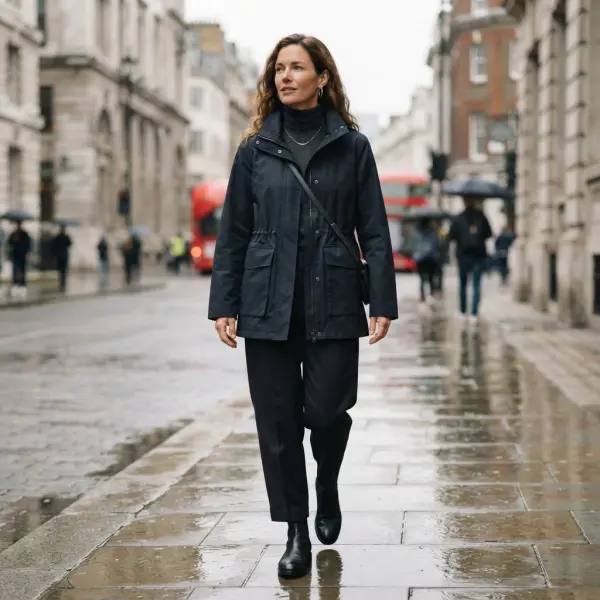
Rainwear traditionally communicates its purpose very clearly. Hoods, protective closures, synthetic shell fabrics, generous coverage, storm flaps, drawcords, and practical pockets tell the wearer that the garment exists primarily to deal with bad weather.
That functional identity has not disappeared, but contemporary fashion has become much more willing to reinterpret it. A windbreaker can now function as the focal point of an outfit even when rain is not expected. An anorak can be styled with tailoring. A lightweight shell can replace a conventional spring jacket. A cropped technical blouson can be treated almost like a bomber or fashion jacket rather than emergency weather protection.
Recent runway and retail evidence supports this crossover. Vogue described windbreakers, anoraks, soft shells, and sporty zip-up jackets as prominent across spring/summer 2026 collections, while British Vogue documented windbreakers appearing at luxury labels as well as retailers such as Uniqlo, Cos, H&M, Arket, and Massimo Dutti.
That does not mean every rain jacket has suddenly become fashionable, nor does it prove a permanent global consumer shift. Fashion trends vary by region, price segment, season, and customer group. What can be observed more confidently is a stronger overlap between technical outerwear and everyday fashion design than the old division between “fashion jacket” and “weather jacket” suggests.
This article examines that design convergence. The technical distinctions between water repellency, water resistance, breathability, and finished-garment weather performance are covered in weather-ready fashion for everyday dressing.
What Changed in the Design of Lightweight Outerwear?
The most visible change is not one new technology. It is the way familiar technical components are being proportioned, styled, colored, and combined.
The same basic components that once signaled conventional rainwear—a nylon-like shell, zipper, drawcord, hood, stand collar, and elasticated hem—can produce a very different result when a designer changes the silhouette. A jacket cropped above the hip reads differently from a long hiking shell. A dramatically high funnel neck can become a framing device around the face. An oversized hood can create volume. A drawcord can shape the waist rather than merely seal out wind.
British Vogue's coverage of technical jackets in 2026 repeatedly highlighted these characteristics. Cos's technical parka, for example, was discussed in terms of its parachute-like shape, oversized utility pockets, hood, and adjustable waist, while H&M Studio's version used an exaggerated funnel neck and cinched silhouette. These are functional references being deployed as visible design features.
This matters because customers do not experience a garment as a list of components. They experience its overall silhouette.
A hood is functional. An oversized hood attached to an architectural collar also affects proportion. A drawcord is functional. A drawcord that turns a straight shell into a rounded blouson changes the entire outfit. A zipper can provide closure, but its placement and length also influence the line of the garment.
Fashion-led outerwear increasingly works because these technical components are treated as design vocabulary rather than hidden engineering.
The Silhouette Has Become More Important
Among the clearest changes in lightweight outerwear is the move away from a single generic shell shape.
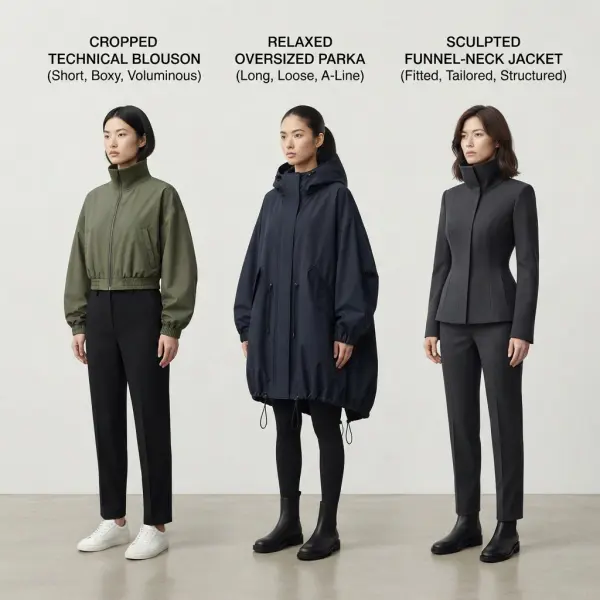
Designers are working with several recognizable silhouettes: cropped windbreakers, voluminous parkas, rounded blousons, cocoon shells, waist-cinched jackets, boxy anoraks, funnel-neck jackets, and shortened trench-inspired raincoats. Vogue's 2026 transitional outerwear coverage showed lightweight options ranging from sporty blousons to cropped trench coats, while its pre-fall reporting specifically highlighted technical jackets and funnel-neck outerwear.
The silhouette gives these pieces fashion relevance beyond their protective function.
Consider the difference between two jackets made from broadly similar lightweight shell materials. One is thigh-length, straight, generously fitted, and covered with visible pockets. The other finishes at the waist, has a softly gathered hem, curved sleeves, a structured collar, and minimal visible hardware. Both can reference functional outerwear, yet they communicate completely different fashion identities.
For apparel businesses, silhouette is often a more accessible point of differentiation than proprietary textile technology. A smaller brand may not have the resources to develop an exclusive membrane system, but it can still create a distinctive product through proportion, pattern cutting, pocket geometry, collar treatment, sleeve volume, and thoughtful placement of functional adjustment.
The Funnel Neck Turned Protection Into a Styling Device
One particular detail illustrates the broader transformation especially well: the funnel neck.
A high collar has an obvious practical function. It can provide additional coverage around the neck and reduce exposure to wind when closed. Yet contemporary fashion styling often uses the same construction for visual effect. The collar may be deliberately oversized, folded, zipped high around the chin, or combined with a concealed hood to create volume around the face.
British Vogue noted the fashion appeal of stand and funnel-neck silhouettes in its coverage of Uniqlo's windproof blouson in 2025, and the shape continued through 2026 technical outerwear coverage.
The distinction is subtle but commercially important. Functional detailing becomes more valuable to fashion customers when it does two jobs at once: solving a practical problem while contributing to the garment's identity.
This principle applies well beyond collars. Adjustable hems can transform proportions. Hood construction can change the rear silhouette. Oversized pockets can function as visual blocks. Elasticated cuffs can introduce sportswear references into otherwise refined clothing.
The opportunity is not to add technical details indiscriminately. It is to identify which details can contribute meaningfully to both use and appearance.
Technical Fabrics Are No Longer Confined to Technical Styling
Fabric plays a major role in this crossover because lightweight outerwear materials have visual characteristics that conventional tailoring fabrics often do not.
Crisp synthetic shells can hold volume differently from soft woven fabrics. Coated textiles can create subtle surface sheen. Ripstop structures introduce grid-like texture. Matte lightweight fabrics can give oversized garments visual scale without the heaviness associated with wool or padded outerwear.
These characteristics can become aesthetic assets.
Designers can exaggerate volume because some lightweight materials have relatively little physical weight. A large hood, wide sleeve, or ballooned body can look visually substantial while remaining easier to carry than a heavy coat. Conversely, very thin technical fabrics can produce a deliberately lightweight, almost transient appearance that works particularly well for transitional dressing.
This does not mean all technical fabrics behave the same way. Handfeel, stiffness, drape, noise, coating, lining, breathability, durability, and weather performance can vary widely. A fabric selected mainly because it photographs well may perform poorly in use, while a highly functional material may not create the intended silhouette.
Product development therefore needs to connect fabric performance with fabric expression.
A fashion-led rain jacket should not merely ask, “Does this textile resist rain?” It should also ask: Does it gather cleanly? Does it collapse when the jacket is open? Does it hold the intended collar? Is the surface excessively shiny? Does it create noise during movement? Does it feel acceptable against exposed skin? How does it look after repeated folding?
Those questions sit at the intersection of technical sourcing and fashion design.
Why Contrast Styling Has Made Technical Jackets Look Different
Another important factor is what these jackets are being worn with.
Technical outerwear once tended to be styled with other function-oriented clothing: hiking trousers, performance shoes, fleece, base layers, or sportswear. Contemporary fashion frequently does the opposite. The outer shell may be the most technical-looking component of an otherwise non-technical outfit.
Recent fashion coverage shows windbreakers combined with skirts, shorts, tailoring, lace, leather, denim, and polished footwear rather than exclusively with outdoor apparel. British Vogue described technical jackets worn with slip skirts, lace-trimmed shorts, and heels, while 2026 runway coverage showed fashion houses combining sporty outerwear with broader ready-to-wear collections.
The aesthetic tension is part of the appeal.
A shell jacket worn with technical trousers creates a coherent functional outfit. The same shell worn over a fluid dress produces contrast between hard and soft, practical and decorative, synthetic and tactile. A windbreaker over tailored trousers can make formal clothing feel less rigid. A bright technical jacket over neutral basics can work as the dominant color block.
This allows rainwear to participate in fashion even when the customer does not identify with an overtly outdoor aesthetic.
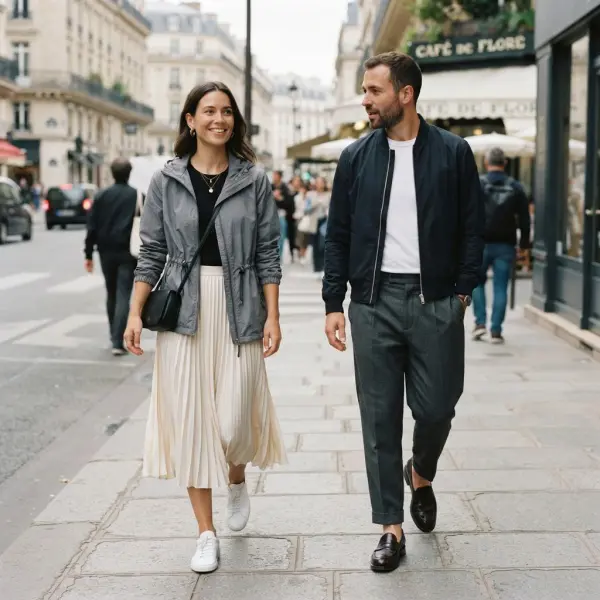
Color Has Helped Move Rainwear Beyond Pure Utility
Traditional protective outerwear has never been exclusively neutral. Outdoor and safety-oriented clothing has long used strong color for visibility and identity. What has changed in fashion is how color is being used as part of seasonal styling rather than purely functional coding.
Contemporary lightweight jackets appear in understated black, grey, navy, beige, olive, and brown, but also in red, orange, burgundy, pink, chartreuse, pastel tones, and deliberate color blocking.
For spring 2026, British Vogue specifically identified red windbreakers across runway and high-street offerings, including interpretations from Fendi, Onitsuka Tiger, H&M, Uniqlo, Arket, and Massimo Dutti. In September 2026, WWD similarly highlighted brightly colored windbreakers within fall outerwear coverage.
These observations should be treated as fashion-cycle evidence rather than proof that bright rainwear universally outsells neutral outerwear. Customer preferences will vary.
What they demonstrate is that the technical jacket has become available to designers as a color vehicle.
This is especially effective because many lightweight shells have relatively simple surfaces. Where a tailored coat may derive richness from wool texture, lapels, buttons, and structured construction, a minimalist shell can derive much of its identity from color, proportion, and hardware.
That simplicity can make small color decisions unusually powerful.
From Gorpcore to a Broader Functional Fashion Language
Some of this crossover is commonly associated with gorpcore, a fashion label applied to the adoption of outdoor clothing and equipment within everyday style.
But describing every fashionable technical jacket as gorpcore is increasingly limiting.
Outdoor-fashion crossover has broadened beyond literal hiking references. Highsnobiety has documented how technical fabrics and outdoor design have entered luxury fashion through both historical precedents and contemporary collaborations, including fashion houses working with performance-oriented brands.
By 2026, many lightweight technical jackets no longer need hiking boots, cargo trousers, or outdoor-brand logos to make sense in a fashion context. They may instead borrow from minimalism, 1990s sportswear, luxury ready-to-wear, workwear, preppy styling, or urban commuting.
The technical shell has effectively become another outerwear archetype.
That is similar to what happened historically with garments such as the bomber jacket, trench coat, field jacket, and parka. Each originated from highly functional contexts, yet fashion eventually separated the visual language from the original operational requirement.
A modern shell jacket does not necessarily have to look like equipment. The source vocabulary can remain visible while the fashion meaning evolves.
Why Lightweight Outerwear Works Especially Well for Transitional Dressing
Lightweight outerwear also solves a practical styling problem: the period when conditions do not justify a heavy coat but a single indoor layer is not enough.
Vogue's spring 2026 coverage explicitly emphasized this transitional role, describing lightweight outerwear as useful across fluctuating temperatures and highlighting sporty blousons, cropped trenches, and other adaptable jackets. Its summer trend coverage similarly identified lightweight layering as a way to handle variable conditions without the bulk associated with colder-weather dressing.
From a fashion perspective, transitional outerwear has another advantage. Because it is not buried beneath a heavier coat, the jacket becomes highly visible.
It can frame the entire outfit.
That visibility helps explain why details such as funnel necks, cropped hems, drawcords, oversized sleeves, contrast zippers, bold color, and unusual proportion receive so much design attention. The jacket may be lightweight in physical terms while carrying significant visual weight.
For brands, this also extends the merchandising role of outerwear. Lightweight jackets can bridge seasonal deliveries, work as travel pieces, support layering stories, and pair with both warm-weather and cooler-weather products.
The precise wardrobe implications vary significantly by climate and customer lifestyle and are explored more deeply in how function, comfort, and climate shape modern wardrobes.
Packability Can Influence the Design Language
A useful lightweight jacket often needs to move between being worn and carried.
That requirement produces design constraints that can also create aesthetic opportunities.
Reducing bulk may encourage unlined construction, lightweight hardware, compact hoods, thin fabrics, simplified pocket bags, and fewer rigid components. Some garments can fold into a bag or internal pocket, while others are simply light enough to carry over an arm or store in a tote.
But packability is not automatically beneficial.
An extremely compressible fabric may wrinkle heavily. Lightweight construction may compromise structure. Minimal hardware can reduce adjustability. Very thin shells may appear insubstantial to customers expecting premium outerwear.
This creates a familiar fashion-product trade-off: the lightest product is not necessarily the most desirable product.
For a premium fashion label, a slightly heavier fabric with better drape and tactile quality may create stronger perceived value than an ultralight alternative. For travel or active customers, the reverse could be true.
The appropriate decision depends on the product's role, not on maximizing a single specification.
Function Is Becoming More Discreet
One reason modern rainwear can integrate more easily with everyday wardrobes is that functional components do not always need to dominate the appearance of the garment.
Technical design can be visually quiet.
A hood may fold into a collar. Adjustment systems can sit inside hems. Zipper pockets can follow seam lines. Ventilation can be integrated into back yokes. Drawcord ends can be concealed. Protective front closures can be hidden beneath clean plackets.
This approach differs from deliberately expressive utility styling, where pockets, webbing, cords, buckles, and technical hardware become prominent visual elements. Both approaches can work, but they serve different brand identities.
The important lesson is that functionality and visibility are separate decisions.
Fashion teams should ask not only which feature is needed, but also how much visual attention it should receive.
For a minimalist brand, weather protection may work best when nearly invisible. For a sports-inspired label, the technical architecture can become the central visual story. For a youth-oriented fashion brand, exaggerated toggles and oversized pockets may deliberately communicate utility even when their functional importance is secondary.
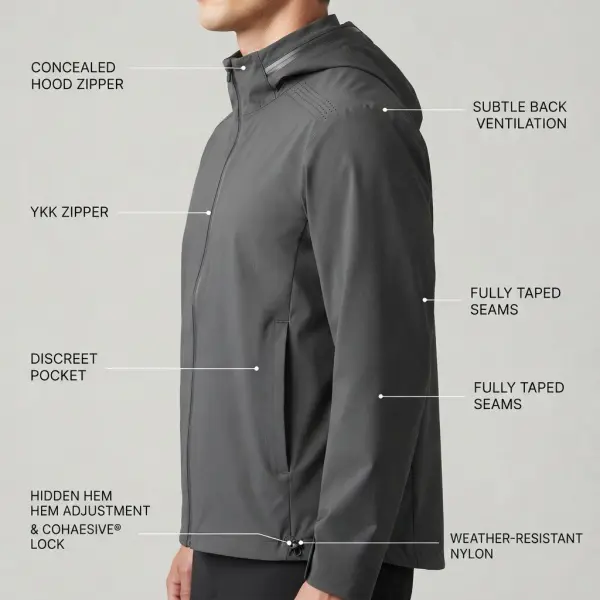
Fashionable Does Not Automatically Mean More Functional
This distinction deserves emphasis because technical aesthetics can create misleading impressions.
A jacket may look highly protective because it uses glossy shell fabric, waterproof-style zippers, taped-looking details, a high collar, and a large hood. None of those visual characteristics alone proves a particular level of water resistance.
Similarly, a luxury price does not establish superior weather performance.
Some fashion-led rainwear may prioritize silhouette, material appearance, brand identity, or styling over demanding outdoor performance. That is not inherently a design failure if the product is accurately positioned. Problems arise when aesthetic cues cause customers to infer capabilities that the product has not been designed or tested to provide.
British Vogue's coverage itself occasionally distinguishes fashion-led interpretations from more performance-oriented waterproof garments, demonstrating how visually similar products can occupy different functional positions.
For fashion businesses, this is where merchandising language becomes critical.
“Technical-inspired,” “lightweight shell,” “water-repellent,” “wind-resistant,” and “waterproof” should not be treated as interchangeable descriptions. Each implies something different, and stronger performance claims require appropriate substantiation.
Fashionability can enhance utility. It cannot substitute for verification.
How Brands Can Make Lightweight Outerwear Feel More Fashion-Led
There is no single formula, but several design decisions consistently shape the transition from utilitarian shell to fashion product.
The first is proportion. Changing body length, sleeve volume, shoulder shape, or hem geometry immediately affects how technical material is perceived.
The second is surface treatment. Matte, semi-matte, translucent, coated, crinkled, ripstop, or softly textured materials create different visual identities even before styling enters the picture.
The third is detail hierarchy. If every zipper, pocket, cord, seam, hood, and fastening competes for attention, the product can quickly feel like equipment. Selecting one or two defining details often produces a more controlled fashion identity.
The fourth is color strategy. A technical jacket can disappear into a neutral wardrobe or become the outfit's dominant statement piece.
Finally, fashion teams should design the product with its surrounding wardrobe in mind. A jacket intended to be worn with wide trousers may need a different length from one designed around skirts. A shell layered over tailoring needs adequate room in the armhole and shoulder. A jacket positioned for warm-weather travel may need to work over only a T-shirt or dress.
The product is not experienced in isolation.
That last point is frequently overlooked when brands borrow details from outdoor apparel. Functional reference can provide inspiration, but the final garment still has to belong convincingly to the customer's wardrobe.
A Practical Design Framework for Fashion-Led Rainwear
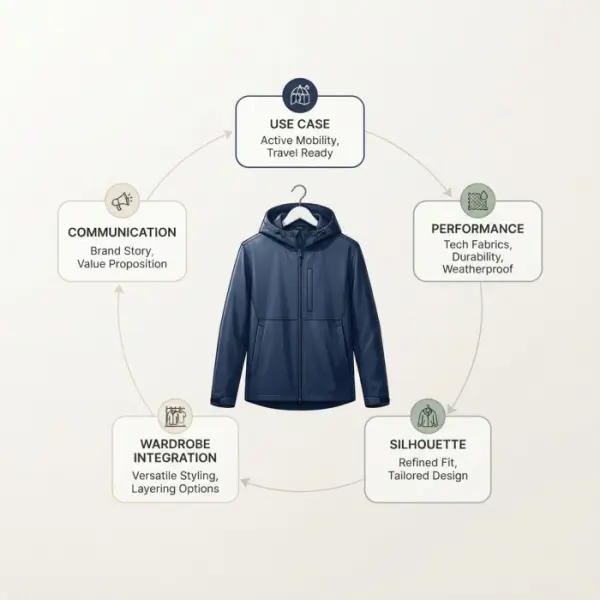
A useful way to approach product development is to separate five decisions:
|
Design Decision |
Question for the Product Team |
Why It Matters |
|
Use case |
When and where will this jacket realistically be worn? |
Prevents unnecessary technical complexity |
|
Performance |
Which weather-related properties genuinely matter? |
Aligns sourcing and testing with customer needs |
|
Silhouette |
What makes the garment visually distinctive? |
Creates fashion relevance beyond function |
|
Integration |
What existing wardrobe pieces should it work with? |
Improves styling versatility |
|
Communication |
Which claims can the brand substantiate? |
Reduces customer misunderstanding |
The sequence matters.
A common mistake is to begin with an attractive technical fabric and then attempt to build a product story around it. A stronger process usually starts with the wearer and the design objective, then selects materials and features that support both.
That can produce a garment that is technically modest but commercially coherent—or a more advanced product where stronger weather performance is genuinely useful.
Retail Merchandising Is Also Changing the Meaning of Rainwear
Product design alone does not determine whether a technical jacket feels fashionable. Merchandising context matters.
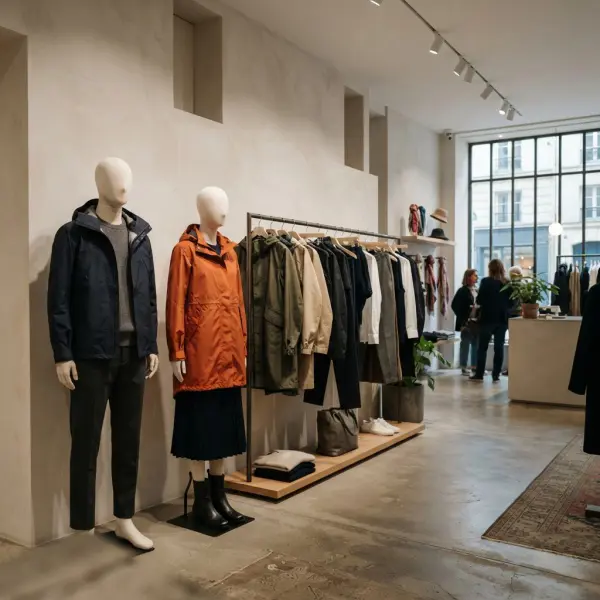
Place the same jacket beside hiking footwear, trekking trousers, and camping equipment and customers are likely to read it as outdoor gear. Pair it with denim, tailoring, dresses, fashion sneakers, handbags, and seasonal accessories and the garment enters a different visual category.
Current fashion publishing reinforces this broader styling context. Vogue's spring and pre-fall 2026 shopping coverage treats technical jackets alongside other seasonal outerwear trends rather than isolating them as specialist weather equipment.
For multi-category fashion retailers, this creates opportunities for cross-merchandising.
A lightweight shell can sit within:
- a transitional wardrobe edit;
- a city-commuting story;
- a travel capsule;
- a sports-inspired trend;
- a color-focused seasonal campaign;
- a layered weekend wardrobe.
The same garment may therefore reach customers who would never actively search for “rainwear.”
That is strategically significant. A category becomes larger when customers buy it not only because they need protection, but also because they want the garment as part of their style.
However, brands should be careful not to infer sales growth from editorial visibility alone. Fashion coverage can demonstrate aesthetic adoption, but without retailer or market-level sales data it does not prove that the entire rainwear category is growing at the same rate.
The Business Opportunity Is Broader Than Selling Rain Jackets
For fashion companies, the more interesting opportunity may be the expansion of functional design principles into adjacent categories.
Once customers become comfortable with technical fabrics and utility details in everyday clothing, similar language can move into overshirts, skirts, trousers, bags, vests, dresses, and hybrid jackets.
This is already visible in the wider crossover between sport, outdoor, and luxury fashion. Recent coverage of technical-fashion collaborations and runway collections suggests that performance-derived design is no longer restricted to specialist outdoor labels.
From a product-architecture perspective, that can help brands build coherent capsules rather than isolated rain jackets.
A lightweight shell may connect with:
- quick-drying trousers;
- packable accessories;
- lightweight layering pieces;
- utility skirts;
- technical overshirts;
- weather-conscious footwear;
- travel-oriented bags.
The strategic advantage is not necessarily higher technical sophistication. It is category coherence.
Customers can understand how products work together, while the brand develops a recognizable design vocabulary around mobility, weather, travel, or adaptable dressing.
Common Mistakes When Making Rainwear More Fashionable
Mistake 1: Copying Outdoor Details Without Understanding Their Purpose
A designer may add storm flaps, toggles, webbing, large pockets, or waterproof-style zippers because they create a technical appearance.
If those components do not support the intended garment use, the result can feel decorative rather than resolved. They also add material, manufacturing operations, cost, weight, and potential quality-control points.
A better approach is to understand the function first and then decide whether the element should remain literal, simplified, concealed, or reinterpreted.
Mistake 2: Prioritizing an Interesting Silhouette Over Wearability
An enormous hood or dramatically cinched waist may photograph well but become irritating during everyday movement.
Fashion-led functional clothing still needs to survive ordinary use: carrying a bag, sitting on public transport, layering over another garment, accessing pockets, driving, walking, and repeatedly opening or closing the jacket.
Sampling should therefore include actual wear situations rather than only static fit evaluation.
Mistake 3: Assuming a Technical-Looking Fabric Is Technically Advanced
Surface appearance can be deceptive.
Shiny nylon, ripstop texture, coated handfeel, taped detailing, or a waterproof-style zipper can visually suggest high performance without proving any specific weather capability.
Claims should follow verified specifications rather than aesthetics.
Mistake 4: Adding Every Functional Feature at Once
More features do not automatically create a better jacket.
Multiple pocket systems, ventilation openings, adjustment cords, removable components, two-way zippers, packable construction, and complex hoods can quickly increase cost and manufacturing difficulty. They may also create visual clutter.
The strongest everyday outerwear often prioritizes the few features customers are most likely to use.
Mistake 5: Designing the Jacket Without Designing the Outfit
A technically competent jacket can still struggle commercially if customers cannot imagine how to wear it.
Length, volume, color, collar proportion, and surface texture should be evaluated beside the trousers, skirts, dresses, shoes, and accessories likely to surround the product.
The difference between “rain gear” and “fashion outerwear” is often visible in the styling ecosystem, not only in the jacket itself.
What Brands Should Verify Before Following the Trend
The current visibility of technical jackets can make the category attractive, but fashion businesses should resist simply copying whatever silhouette is receiving attention.
Several issues deserve validation.
First, determine whether the target customer actually needs another lightweight outerwear product. Climate, commuting patterns, existing wardrobe habits, price sensitivity, and seasonality vary considerably between markets.
Second, identify which aspect of the product creates value. It might be weather protection, low weight, silhouette, color, packability, layering versatility, or simply visual identity. Those are different propositions and should not be confused.
Third, verify performance claims independently of the trend narrative. A fashionable jacket can be modestly protective and still be a good product. It simply needs accurate positioning.
Finally, consider longevity. A highly specific trend detail may create strong short-term visual relevance but make the product feel dated sooner. More restrained designs may have less immediate novelty but integrate into wardrobes for longer.
There is no universal correct balance. It depends on brand positioning, customer expectations, target price, and product lifecycle.
Frequently Asked Questions
Why are windbreakers fashionable again?
Windbreakers are receiving renewed fashion attention because their lightweight construction, adjustable silhouettes, technical surfaces, and sporty references fit several current styling directions at once. During 2026, Vogue and British Vogue documented windbreakers and technical jackets across luxury runways, street style, and high-street retail.
Their appeal also extends beyond practical weather protection. Cropped lengths, funnel necks, oversized shapes, bright colors, and contrast styling allow the jacket to act as a fashion piece.
This remains a trend observation rather than evidence that every consumer segment prefers windbreakers. Demand will differ by climate, market, demographic, and brand positioning.
Is gorpcore responsible for fashionable rainwear?
Gorpcore helped make outdoor apparel more visible within fashion, but it is only part of the story.
Technical fabrics and utility-derived garments have influenced fashion well before the gorpcore label became common, and contemporary outerwear now draws from sportswear, minimalism, luxury fashion, military garments, commuting apparel, and 1990s styling as well as outdoor culture. Highsnobiety has documented this broader history and the continued crossover between performance-oriented brands and luxury fashion.
For brands today, it may therefore be more useful to think in terms of functional fashion rather than trying to make every technical jacket conform to a recognizable gorpcore look.
Can a stylish rain jacket still provide serious weather protection?
Yes, but appearance does not establish performance.
A well-designed jacket can combine strong weather protection with thoughtful proportion, color, and styling. However, resistance to rain depends on factors such as the textile system, seams, closures, hood construction, and overall garment engineering rather than how technical the jacket looks.
Brands should decide the required level of protection before developing the fashion details and then substantiate any specific performance claims.
A garment can also be successful with relatively modest protection if its intended use is clearly communicated—for example, short urban exposure to intermittent rain rather than prolonged severe-weather conditions.
Why are lightweight jackets useful for fashion brands?
Lightweight jackets can bridge seasonal gaps and work across multiple styling stories.
They may function as spring or autumn outerwear, travel layers, rain protection, sports-inspired fashion, or wardrobe pieces for fluctuating temperatures. Their relatively low bulk can also make them easier to layer with shirts, knits, dresses, and tailoring.
From a merchandising perspective, this versatility allows one product to connect several categories.
The limitation is that “versatile” should not become vague positioning. Product teams still need a clear primary wearer, climate, use case, silhouette, and price proposition. Trying to make one jacket suitable for every customer and condition usually weakens the design brief.
Do technical details make a jacket look more expensive?
Not necessarily.
Complex hardware, waterproof-style zippers, taped seams, molded cord ends, or specialized materials can raise manufacturing cost, but they do not automatically increase perceived value. Customers may respond more strongly to fit, silhouette, fabric handfeel, finishing, color, branding, or overall design coherence.
Technical details can even reduce perceived sophistication if they appear decorative or poorly integrated.
For premium fashion products, restraint can be especially effective. A carefully engineered collar, clean pocket architecture, and refined adjustment system may communicate more design intent than a jacket overloaded with visible technical components.
Should small fashion brands develop technical outerwear?
They can, provided the technical ambition matches their sourcing and quality-control capabilities.
A small brand does not necessarily need to begin with highly complex waterproof construction. A lighter product—such as a well-designed wind-resistant or water-repellent jacket—may require fewer specialized manufacturing processes while still delivering meaningful customer value.
The key is to avoid overstating performance.
Before committing to more advanced construction, the brand should understand supplier capabilities, minimum order quantities, material lead times, testing requirements, seam construction, hardware sourcing, repair implications, and quality-control processes. Fashionability can be achieved at several technical levels; credibility depends on making claims that the product can actually support.
Will technical jackets remain fashionable after the current trend cycle?
No one can confirm that any specific silhouette will remain fashionable indefinitely.
Current 2025–2026 runway, street-style, and retail coverage provides strong evidence that windbreakers and technical lightweight jackets are receiving significant fashion attention now.
Individual expressions—such as a particular color, cropped proportion, or exaggerated funnel neck—may change as fashion cycles move on.
The broader functional outerwear category may prove more durable because rain protection, wind management, layering, and transitional dressing solve recurring practical needs. Brands seeking longer product life can therefore separate the enduring use case from the temporary styling details layered onto it.
Conclusion
The shift in rainwear and lightweight outerwear is not simply a story about functional clothing becoming prettier. It reflects a deeper change in how fashion uses technical design.
Hoods, drawcords, shell fabrics, funnel necks, elasticated hems, oversized pockets, and protective silhouettes are no longer restricted to garments that visually announce themselves as outdoor equipment. Designers increasingly use those elements to create proportion, texture, contrast, color, and identity.
Current 2025–2026 fashion coverage shows this clearly: windbreakers, anoraks, technical blousons, lightweight parkas, and related silhouettes have appeared across luxury collections, high-street retail, transitional dressing, and street style.
The most useful lesson for fashion businesses, however, is not to copy a windbreaker because windbreakers are currently visible.
It is to recognize that function can become part of the design language.
A jacket can protect from the weather while also creating silhouette. A drawcord can adjust fit while shaping proportion. A technical textile can offer practical properties while introducing texture or volume. A hood can provide coverage while changing the architecture of the garment.
When those decisions are intentional, lightweight outerwear stops feeling like something customers reluctantly put on because it is raining. It becomes something they may choose to wear because it completes the outfit—and happens to be useful when the weather changes.





Comments 0
Leave a CommentSend Comment
Anda harus Login terlebih dahulu untuk dapat memberikan komentar.