

Common Apparel Defects and How Manufacturers Prevent Them
What Are Common Apparel Defects?
Common apparel defects are quality problems that affect the appearance, fit, function, durability, safety, or saleability of garments. They can appear in fabric, cutting, sewing, measurements, washing, finishing, labeling, or packaging. Examples include stains, holes, shade variation, skipped stitches, seam puckering, uneven hems, incorrect measurements, poor pressing, broken zippers, missing buttons, wrong labels, and packaging errors.
Manufacturers prevent apparel defects by controlling quality before, during, and after production. This usually means inspecting fabrics and trims before cutting, approving pre-production samples, checking cutting accuracy, using inline inspection during sewing, monitoring measurements, training operators, maintaining machines, classifying defects clearly, and documenting corrective actions.
Not every defect has the same severity. A safety issue such as a sharp object inside a garment may be critical. A visible stain, broken zipper, or incorrect size may be major. A loose thread inside a seam may be minor, depending on the product and buyer standard. Strong quality control depends on knowing the difference.
For fashion brands, defect prevention is not only a factory concern. It protects customer trust, reduces returns, supports consistent sizing, and helps suppliers improve over time.
Why Apparel Defects Happen in Manufacturing
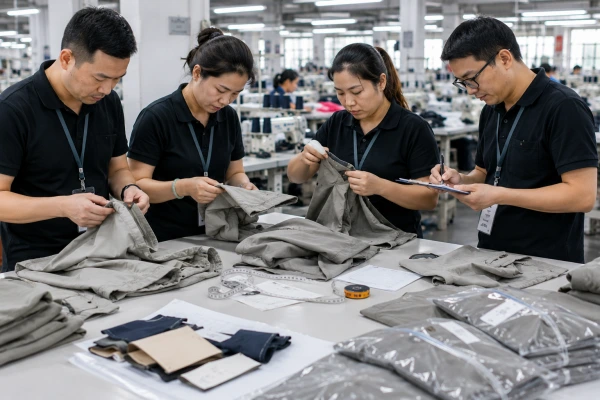
Apparel manufacturing is a sequence of many connected decisions. A garment may pass through design, pattern making, material sourcing, fabric inspection, cutting, sewing, washing, finishing, packing, and shipment before it reaches a customer. Each stage can create defects if specifications are unclear, materials behave unexpectedly, machines are poorly adjusted, operators are rushed, or inspection feedback is weak.
The difficulty is that garment quality is both technical and visible. A seam may be structurally weak. A sleeve may be slightly twisted. A fabric shade may change under different lighting. A size label may be wrong even when the garment itself is well made. Some defects are obvious immediately, while others appear after washing, wearing, transport, or retail handling.
This is why manufacturers need more than final inspection. Final inspection can catch many visible problems, but it cannot easily prevent a recurring sewing issue that started days earlier on the production line. Defect prevention works best when manufacturers understand the root cause behind each defect, not just the defect name.
A stain, for example, may come from dirty handling, machine oil, careless pressing, storage conditions, or packaging contamination. Seam puckering may come from thread tension, needle size, fabric behavior, poor feeding, wrong stitch density, or incompatible sewing construction. The same visible defect can have different causes.
That is the core of professional apparel quality control: identify the defect, classify its severity, trace its cause, and prevent it from spreading.
The Main Categories of Apparel Defects
Apparel defects are easier to manage when they are grouped by production stage. This helps QC teams identify where the issue likely started and which team should correct it.
The most common categories include:
- Fabric and material defects.
- Cutting and pattern-related defects.
- Sewing and workmanship defects.
- Measurement and fit defects.
- Washing, dyeing, and finishing defects.
- Trims and accessory defects.
- Labeling and packaging defects.
- Safety and compliance-related defects.
This structure prevents quality teams from treating every problem as a sewing issue. Some defects start before sewing begins. Others appear only after finishing or packing. A practical classification system helps manufacturers take the right corrective action instead of repeatedly repairing symptoms.

Fabric and Material Defects
Fabric defects are among the most expensive apparel defects because they can affect the garment before production truly begins. If defective fabric is cut and sewn, the manufacturer may lose labor time, trims, production capacity, and shipment reliability.
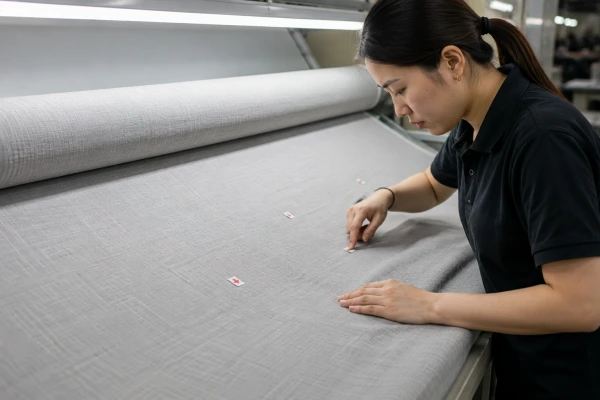
Fabric defects can come from spinning, knitting, weaving, dyeing, printing, finishing, transport, storage, or handling. Some are visible on the roll. Others become clear only after washing, pressing, or garment assembly. This is especially important for fabrics with stretch, surface texture, special finishes, prints, coatings, or garment-dye processes.
Common fabric and material defects include holes, stains, slubs, barre, shade variation, bowing, skewing, print defects, yarn contamination, pilling tendency, poor colorfastness, and excessive shrinkage. Technical testing may be needed for performance-related issues. ASTM notes that textile standards cover physical, mechanical, and chemical properties of textiles and fabrics, while AATCC develops textile test methods used for product quality evaluation. ASTM textile standards AATCC textile testmethods
Shade Variation
Shade variation happens when the color is inconsistent between rolls, within the same roll, between panels, or across garment components. It can be caused by dye lot differences, uneven dyeing, fabric finishing variation, poor roll segregation, or careless cutting room handling.
This defect is especially visible in solid colors, premium basics, suiting, uniforms, activewear sets, and products where panels sit next to each other. A slight shade difference may be acceptable in some washed or textured products, but it can look unacceptable on a clean black dress, white shirt, or matching co-ord set.
Manufacturers prevent shade variation by:
- Checking dye lots before production.
- Inspecting fabric rolls under controlled lighting where possible.
- Separating rolls by shade group.
- Cutting garment panels from the same shade group.
- Avoiding mixed panels from different rolls when shade risk is high.
The key is not only to identify shade variation, but to control roll usage before cutting. Once different shades are sewn into the same garment, correction becomes difficult and often commercially inefficient.
Fabric Holes, Snags, Slubs, and Surface Faults
Holes, snags, slubs, broken yarns, thick-thin yarn irregularities, and surface faults can make garments look damaged even when the sewing quality is acceptable. Some slubs may be intentional in certain fabrics, such as linen-look materials or textured yarn fabrics. Others are defects because they interrupt the intended surface appearance.
The factory should not assume that every surface irregularity is acceptable just because the fabric has texture. The decision depends on the approved standard, product category, placement, visibility, and customer expectation.
Manufacturers prevent these defects by inspecting fabric before cutting, marking defective areas, using fabric inspection systems, and ensuring cutting teams avoid visible defects on major garment panels. For premium garments, even small surface faults on the front body, collar, or sleeve may be unacceptable.
Shrinkage and Dimensional Instability
Shrinkage becomes a quality defect when the finished garment no longer meets approved measurements after washing, pressing, steaming, or finishing. It is a common issue in cotton, rayon, viscose, linen, wool blends, knits, denim, and fabrics with unstable finishing.
The challenge is that shrinkage is not always visible during production. A garment may pass measurements before washing but fail after laundering. For casualwear, childrenswear, uniforms, and e-commerce products, this can create customer dissatisfaction after first wash.
Manufacturers reduce shrinkage risk by testing fabric behavior before bulk cutting, allowing fabric relaxation, using preshrunk or stabilized fabrics where appropriate, controlling washing and drying processes, and setting realistic measurement tolerances. The right method depends on fabric type and product requirement.

Cutting and Pattern Defects
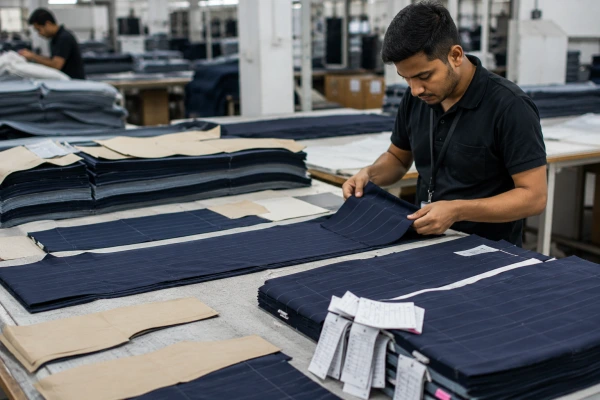
Cutting defects often look like sewing defects later. If panels are inaccurate, off-grain, poorly aligned, or mixed between shades, the sewing line may struggle to produce a clean garment. The operator may be blamed for a problem that started in the cutting room.
Cutting quality depends on fabric relaxation, spreading tension, marker accuracy, cutting tools, ply control, notch placement, bundle numbering, and panel handling. A small error can repeat across many units because cutting is done in layers.
Off-Grain Panels and Twisting
Off-grain panels occur when fabric grain is not aligned correctly during cutting. This can cause twisting, uneven drape, distorted seams, or garments that rotate on the body after wearing or washing. It is often seen in T-shirts, dresses, trousers, and lightweight woven or knit garments.
Manufacturers prevent off-grain issues by checking fabric grain before spreading, controlling fabric tension, allowing proper fabric relaxation, aligning markers correctly, and training cutting teams to identify fabric distortion. For knits, relaxation time can be important because fabric may contract or shift after being unrolled.
Mismatched Stripes, Checks, and Prints
Stripe, check, and print matching requires more planning than cutting plain fabric. Mismatched patterns at side seams, pockets, plackets, yokes, or center fronts can make garments look poorly made even if the sewing is technically strong.
This defect often happens because the cutting marker prioritizes fabric efficiency over visual alignment, or because the product specification did not clearly state which pattern-matching points are required. In lower-priced garments, perfect matching may not always be commercially realistic. In premium shirts, tailored pieces, and visible print placements, it may be essential.
The prevention method is straightforward but requires discipline: define matching requirements before cutting, create suitable markers, cut critical parts carefully, and inspect panels before sewing.
Incorrect Panel Size or Shape
Incorrect panel size can lead to poor fit, uneven seams, twisted garments, puckering, or measurement failure. Causes may include wrong pattern version, marker error, cutting machine inaccuracy, fabric shifting, excessive ply height, or poor bundle control.
Manufacturers prevent this by confirming the approved pattern, checking marker placement, controlling ply height, measuring cut panels, verifying notches, and keeping pattern revisions clearly documented.
Sewing and Workmanship Defects
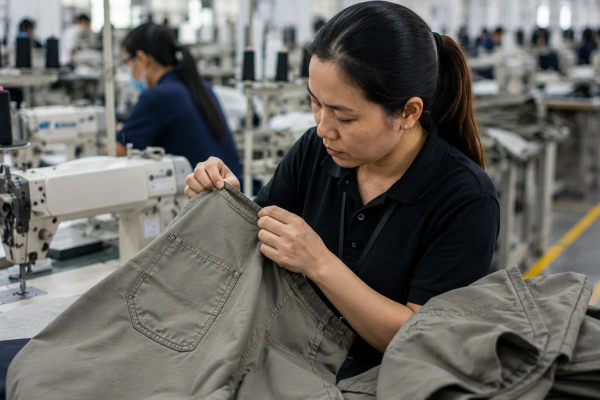
Sewing defects are usually the most visible category in garment inspection because they appear on seams, hems, collars, plackets, pockets, waistbands, sleeves, and closures. They can affect appearance, comfort, strength, and durability.
Workmanship quality depends on operator skill, machine condition, needle and thread selection, stitch type, fabric handling, seam construction, line balancing, and supervision. Even when operators are experienced, defects can appear if the production method is unsuitable for the fabric.
Skipped Stitches
Skipped stitches occur when the machine fails to form stitches consistently. This may happen because of incorrect needle size, worn needle, wrong needle type, poor thread compatibility, machine timing issues, fabric thickness, or operator handling.
A skipped stitch may look small, but it can weaken a seam and create a visible quality problem. On stretch garments, sportswear, undergarments, and high-stress seams, skipped stitches may become more serious because the garment needs to move with the body.
Manufacturers prevent skipped stitches by using the correct needle and thread, maintaining machine timing, checking stitch formation during inline inspection, training operators, and adjusting machine settings for difficult fabrics.
Seam Puckering
Seam puckering is the wrinkled or wavy appearance along a seam. It can make a garment look cheap, poorly sewn, or badly pressed. Common causes include excessive thread tension, fabric feeding imbalance, needle damage, shrinkage differences between thread and fabric, wrong stitch density, or unsuitable seam construction.
Seam puckering is especially visible on lightweight woven fabrics, smooth synthetics, shirts, dresses, linings, and formalwear. It may become worse after washing if thread and fabric shrink differently.
Prevention usually requires testing the seam construction before bulk production. Manufacturers may need to adjust thread tension, stitch density, needle size, presser foot pressure, feeding method, or thread type. Pressing can improve appearance, but it should not be used to hide a recurring sewing problem.
Open Seams and Broken Stitches
Open seams occur when stitching fails to join panels securely. Broken stitches can happen during sewing, washing, pressing, finishing, or wear. Causes may include weak thread, poor seam allowance, improper stitch type, high seam stress, operator error, or damage during finishing.
This defect can directly affect garment durability. A loose inner thread may be minor, but an open side seam, broken crotch seam, or detached waistband can make the garment unsellable.
Manufacturers prevent this by confirming seam strength requirements, using correct thread, maintaining stitch density, controlling seam allowance, reinforcing stress points, and checking functional seams during inline and final inspection.
Uneven Hems, Collars, Pockets, and Plackets
Uneven placement defects are common because many garment parts depend on visual symmetry. A slightly tilted pocket, uneven hem, crooked placket, or misaligned collar can affect perceived quality immediately.
These defects may come from poor marking, inaccurate cutting, operator handling, weak guides, lack of templates, rushed production, or inconsistent pressing. They are especially important in shirts, jackets, dresses, trousers, uniforms, and premium basics.
Manufacturers prevent placement defects with templates, sewing guides, clear marking, operator training, first-piece approval, and frequent inline inspection. The first few pieces from each operation should be checked carefully before the line continues at full speed.
Measurement and Fit Defects
Measurement defects happen when finished garments do not match the approved size chart within agreed tolerances. Fit defects happen when the garment may technically measure close to spec but still does not sit correctly on the body.
These two issues are related but not identical. A garment can pass flat measurements and still fit poorly because of pattern balance, fabric stretch, drape, sleeve pitch, rise shape, shoulder slope, or construction method. This is why fit approval and measurement control both matter.
Measurement defects often come from pattern errors, grading mistakes, cutting inaccuracy, sewing variation, shrinkage, pressing distortion, washing variation, or inconsistent measurement technique. In e-commerce, measurement inconsistency can become expensive because customers often return garments that do not match expected fit.
Manufacturers prevent measurement defects by using approved measurement points, training QC teams to measure consistently, checking size sets, monitoring inline measurements, controlling wash shrinkage, and comparing finished garments with approved samples.
Common Measurement Problems
The most frequent measurement issues vary by garment type, but several appear across many apparel categories:
- Body length too short or too long.
- Chest, waist, or hip measurement outside tolerance.
- Sleeve length inconsistency.
- Shoulder width or armhole imbalance.
- Inseam or outseam variation in trousers.
- Waistband too tight or too loose.
- Hem opening inconsistency.
- Collar, cuff, or placket dimension errors.
The better prevention strategy is to catch measurement drift early. If a factory waits until final inspection, the issue may already affect a large quantity. Inline measurement checks allow supervisors to adjust operations before the problem spreads.
Washing, Dyeing, and Finishing Defects
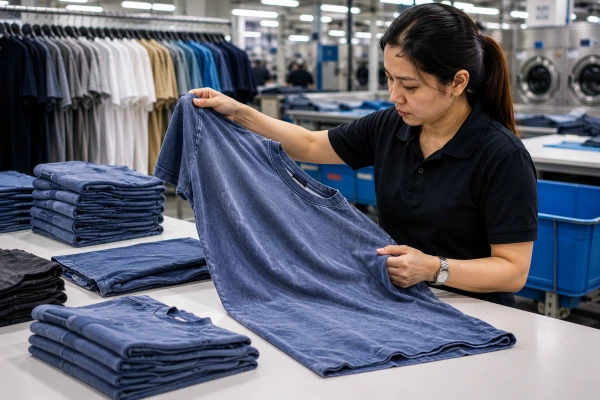
Washing and finishing can improve garment appearance, hand feel, softness, color, and commercial appeal. But they can also introduce defects if not controlled properly.
This is especially relevant for denim, garment-dyed apparel, enzyme-washed products, pigment-dyed garments, distressed looks, soft-finished knits, and items requiring special pressing or steaming. The same garment may look acceptable after sewing but fail after washing or finishing.
Color Bleeding and Poor Colorfastness
Color bleeding happens when dye transfers from one area to another or from the garment to another material. Poor colorfastness may appear during washing, rubbing, perspiration, light exposure, or storage. This can be especially risky for dark colors, contrast trims, prints, denim, and garments with white or light-colored components.
Colorfastness testing should match product use. A fashion item worn occasionally may need a different test priority from sportswear exposed to sweat or workwear exposed to repeated laundering. AATCC develops textile test methods used by the industry for product quality, while ASTM provides textile standards covering fabric properties and test methods. AATCC textile quality methods ASTM textile standards
Manufacturers reduce colorfastness risk through proper fabric testing, dyeing control, washing trials, approved lab dips, bulk shade approval, and clear buyer standards before production.
Poor Pressing and Finishing Marks
Pressing can improve garment presentation, but poor pressing can create shine marks, seam impressions, distorted shapes, flattened texture, scorched fabric, or unwanted creases. These problems often occur when temperature, pressure, steam, or pressing time is not suitable for the fabric.
Manufacturers prevent pressing defects by testing finishing conditions, training finishing operators, using correct pressing tools, protecting delicate surfaces, and checking garments after pressing rather than assuming pressing always improves quality.
Inconsistent Wash Effects
For washed garments, the desired effect must be controlled carefully. Denim fading, garment dye variation, stonewash effects, enzyme wash softness, or pigment finish irregularity can become defects if they do not match the approved standard.
Some variation may be part of the design. But uncontrolled variation can create assortment inconsistency and customer dissatisfaction. Manufacturers should keep approved wash standards, test bulk lots, control recipe and timing, and inspect shade consistency before packing.
Trims, Accessories, and Functional Defects
Trims can make or break garment quality. A garment may have good fabric and clean sewing, but a faulty zipper, weak button, poor elastic, wrong drawcord, damaged snap, or incorrect interlining can create product failure.
Trims and accessories should be inspected before production and checked again during final garment inspection. Functional defects often affect customer satisfaction quickly because they interfere with use.
Common trim and accessory defects include:
- Broken or stiff zippers.
- Loose or missing buttons.
- Weak snap attachment.
- Elastic losing recovery.
- Drawcords inserted incorrectly.
- Wrong trim color or size.
- Label placement errors.
- Interlining bubbling or delamination.
- Metal parts with sharp edges or corrosion risk.
Manufacturers prevent these defects by approving trim samples, testing functionality, checking supplier consistency, verifying attachment strength, controlling storage conditions, and inspecting trims before sewing. For children’s garments or products with safety-sensitive components, brands may need stricter compliance checks.
Labeling, Packaging, and Shipment Defects
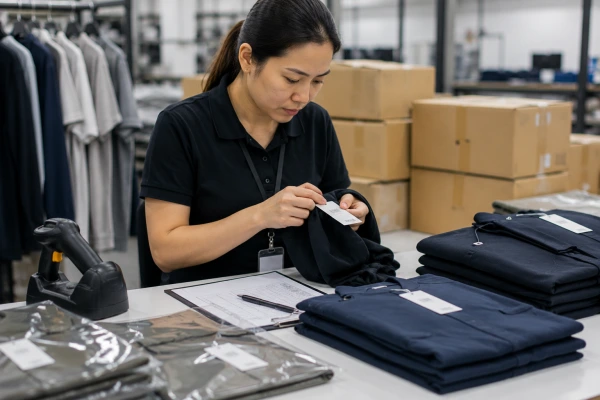
Packaging and labeling defects may not affect the garment’s construction, but they can create serious commercial problems. Retailers, warehouses, marketplaces, and customs processes depend on accurate labels, barcodes, carton markings, care instructions, and size information.
A wrong barcode can disrupt inventory receiving. An incorrect care label can create customer complaints or compliance concerns. A mislabeled size can lead to returns even if the garment itself is well made. Poor carton packing can damage garments during transport.
Manufacturers prevent these issues by checking label artwork, care content, size labels, hangtags, barcode scans, polybag size, carton assortment, shipping marks, and packing ratio before shipment. Packaging inspection should not be rushed at the end of production.
Critical, Major, and Minor Defects
Defect classification helps manufacturers and buyers decide how serious a problem is. Without classification, quality decisions become emotional and inconsistent.
A critical defect is usually a defect that may create safety risk, legal non-compliance, or serious product failure. A major defect is likely to affect saleability, appearance, fit, function, or customer satisfaction. A minor defect is less likely to affect function or saleability but still shows imperfect workmanship or presentation.
This classification must be defined before inspection. It should reflect buyer standards, product type, retail channel, and customer expectation. A minor issue in one product may be major in another.
Examples of Defect Severity
The examples below are general, not universal. Buyers and manufacturers should define their own standards clearly.
|
Defect Severity |
Typical Meaning |
Apparel Example |
|
Critical |
Safety, legal, or severe product risk |
Sharp object inside garment, unsafe small part on children’s clothing, serious needle contamination |
|
Major |
Affects saleability, function, fit, or visible quality |
Broken zipper, visible stain, open seam, wrong size measurement, incorrect label |
|
Minor |
Less likely to affect use but affects appearance or workmanship |
Small loose thread, slight internal sewing irregularity, minor pressing crease |
This distinction is important in AQL-based inspections because defect severity can influence acceptance limits. ISO 2859-1 is an acceptance sampling system for inspection by attributes and is indexed by acceptance quality limit, but brands still need to define what types of garment defects count as critical, major, or minor in their own inspection criteria. ISO 2859-1 acceptance sampling
How Manufacturers Prevent Apparel Defects
Manufacturers prevent defects by combining technical preparation, disciplined production, inspection, and corrective action. Prevention is not one department’s job. It involves merchandising, sourcing, pattern making, cutting, sewing, finishing, quality control, and factory management.
The most effective defect prevention systems usually start before bulk production. Once production begins, defects can still be controlled, but the cost of correction often increases with every stage.
1. Clear Specifications and Approved Samples
The first prevention tool is clarity. Factories need accurate tech packs, approved samples, measurement charts, construction details, trim approvals, label specifications, packaging instructions, and defect criteria. Ambiguous standards create inconsistent production.
This connects directly with the previous article garment quality control process explained step by step, which explains where each checkpoint fits inside the production workflow.
2. Material Inspection Before Cutting
Fabric and trims should be inspected before they enter production. This is where shade variation, fabric defects, shrinkage risks, and trim problems can be identified early.
Material inspection should not be treated as a formality. It is often the most efficient point to prevent large-scale defects. If defective fabric is cut and sewn, the cost of correction becomes much higher.
3. First-Piece and Inline Inspection
First-piece inspection checks the early output of a sewing operation before the line continues at scale. Inline inspection checks work-in-progress garments while production is active.
Together, they help factories detect problems early. If a pocket is positioned incorrectly, a seam is puckering, or a measurement is drifting, the line can be corrected before hundreds of garments are affected.
4. Machine Maintenance and Operator Training
Many sewing defects are linked to machine condition and operator handling. Needle damage, poor timing, tension imbalance, dull cutting tools, worn folders, or unsuitable presser feet can create recurring defects.
Operator training is equally important. A factory cannot rely only on inspection if operators do not understand the approved method, quality standard, or common risk points.
5. Defect Tracking and Root Cause Analysis
Defect reports should be used as learning tools, not just pass-or-fail documents. When a defect appears repeatedly, the factory should identify where it started, why it happened, and what needs to change.
Corrective action may involve retraining, machine adjustment, process revision, supplier feedback, pattern correction, fabric replacement, or tighter inspection. The best factories treat defect data as operational intelligence.

How Fashion Brands Should Work With Manufacturers on Defect Prevention
Fashion brands should not expect manufacturers to prevent defects without clear standards. A factory can provide production expertise, but the brand must define what quality means for its product and market position.
A premium brand, a fast-fashion label, a uniform supplier, and a sportswear startup may all have different quality priorities. The same loose thread, shade variation, or measurement deviation may carry different commercial weight depending on the product.
Brands can reduce defect risk by giving manufacturers practical, production-ready information:
- Clear tech packs and measurement tolerances.
- Approved pre-production samples.
- Fabric and trim approval records.
- Defect classification standards.
- Critical measurement points by garment type.
- Packaging and labeling instructions.
- Testing requirements where relevant.
- Feedback from customer returns or retail complaints.
This collaboration matters because factories cannot easily solve quality issues they cannot see. If customers repeatedly complain about fit, pilling, zipper failure, or shrinkage, that feedback should return to product development and supplier management.
For sourcing and sustainability teams, defect prevention also supports responsible production. Fewer defects can mean less rework, fewer rejected goods, and better use of materials, although brands should avoid claiming sustainability benefits unless they can support those claims with data. OECD guidance for garment and footwear supply chains emphasizes due diligence and responsible business conduct, which can include supplier engagement and risk management. OECD garment and footwear due diligence guidance
Common Mistakes in Apparel Defect Management
Mistake 1: Repairing Defects Without Finding the Root Cause
Repairing defective garments may solve the immediate shipment problem, but it does not prevent recurrence. If seam puckering appears across many garments, trimming threads or pressing seams harder is not enough. The factory needs to investigate thread tension, needle selection, feed balance, stitch density, fabric behavior, and operator method.
The business consequence is repeated rework. Rework consumes time, labor, and production capacity. It can also create secondary defects if repairs are rushed.
The better approach is to document the defect, identify where it started, correct the process, and verify that the next pieces are improved.
Mistake 2: Blaming Operators for Process Problems
Some defects are caused by poor workmanship, but many are caused by weak systems. Operators may be blamed for skipped stitches when machine timing is wrong. They may be blamed for uneven panels when cutting accuracy was poor. They may be blamed for shade mismatch when fabric rolls were not segregated.
This mistake damages morale and fails to solve the real problem. Quality teams should ask whether the operator had the right tools, correct method, clear sample, proper machine setting, and enough time to do the work properly.
A better approach is to separate skill issues from process issues. Both need correction, but they require different solutions.
Mistake 3: Treating All Defects Equally
Not every defect deserves the same response. A safety-related issue, wrong size label, open seam, small loose thread, and internal chalk mark do not carry the same risk.
When factories treat all defects equally, they may waste time fixing low-risk issues while missing serious quality problems. When buyers treat every minor issue as a major failure, supplier relationships can become unnecessarily tense.
The better approach is to define critical, major, and minor defects before inspection. This makes decision-making more consistent and commercially realistic.
Mistake 4: Ignoring Post-Sale Defect Feedback
Some defects only become visible after garments reach customers. Shrinkage, pilling, color fading, weak seams, zipper failure, and fit inconsistency may appear after wear or washing.
If brands do not send this feedback back to product development and suppliers, the same problems may repeat in future collections. Customer returns and reviews can be valuable quality data when analyzed carefully.
The better approach is to connect retail feedback with factory quality records. This turns customer complaints into product improvement.
What Brands Should Verify Before Acting
Apparel defect prevention should be based on the product’s actual risk profile, not a generic checklist. A silk blouse, denim jacket, sports bra, childrenswear item, formal blazer, and cotton T-shirt do not need identical inspection emphasis.
Before setting defect standards, brands should verify:
- Product category and customer expectation.
- Fabric behavior, including shrinkage, stretch, colorfastness, and surface sensitivity.
- Critical measurements and fit points.
- Safety or compliance requirements.
- Required testing methods and applicable market standards.
- Supplier capability and past defect history.
- Retail channel requirements for labeling, packaging, and barcodes.
- Commercial tolerance for rework, delay, or rejected goods.
Testing requirements should be selected carefully. ASTM and AATCC provide textile standards and test methods, but brands need to choose methods that match the product use case. A test that matters for activewear may not be the priority for a decorative occasionwear garment. ASTM textile standards AATCC test methods
FAQ: Common Apparel Defects
What are the most common apparel defects in garment manufacturing?
The most common apparel defects include fabric stains, holes, shade variation, slubs, skipped stitches, seam puckering, open seams, uneven hems, incorrect measurements, poor pressing, broken zippers, loose buttons, wrong labels, and packaging errors. The frequency depends on garment type, material, factory capability, and buyer requirements. For example, shade variation may be a major issue in solid-color fashion basics, while seam strength may be more important in workwear or activewear. A professional QC system should classify defects by severity and trace each issue back to its likely production stage.
What causes sewing defects in garments?
Sewing defects can be caused by machine settings, needle selection, thread quality, stitch density, fabric handling, operator skill, seam construction, or poor inline supervision. Skipped stitches may come from needle or machine timing issues. Seam puckering may come from tension imbalance or fabric behavior. Uneven pockets may come from poor marking or lack of templates. The visible defect is only the starting point. Manufacturers need to identify the root cause before deciding whether the solution is machine adjustment, operator training, construction revision, or material change.
How do manufacturers prevent fabric defects from reaching finished garments?
Manufacturers prevent fabric defects by inspecting fabric before cutting, checking shade variation, marking defective areas, separating rolls by shade group, testing shrinkage where relevant, and confirming fabric width and usable quality. For sensitive fabrics, manufacturers may also run lab tests or production trials before bulk cutting. The goal is to stop defective material before it becomes part of finished garments. Once fabric has been cut and sewn, correction becomes more expensive and sometimes impossible without replacing panels or remaking garments.
What is the difference between major and minor apparel defects?
A major defect is likely to affect garment saleability, appearance, fit, function, durability, or customer satisfaction. Examples may include broken zippers, visible stains, open seams, wrong measurements, or incorrect labels. A minor defect is less likely to affect function or saleability, such as a small loose thread in a non-visible area. The classification depends on product type and buyer standard. A minor issue in one garment may be major in another, especially if the product is premium, safety-sensitive, or visually minimal.
Can final inspection prevent apparel defects?
Final inspection can detect defects before shipment, but it cannot fully prevent them. By final inspection, most production costs have already been incurred. If defects are widespread, the factory may need sorting, rework, repacking, or shipment delay. Defect prevention requires earlier controls such as fabric inspection, pre-production sample approval, cutting checks, first-piece inspection, inline sewing inspection, and finishing review. Final inspection is still important, but it works best as the last checkpoint in a broader quality control system.
Why do garment measurements vary during production?
Garment measurements can vary because of fabric shrinkage, stretch, cutting inaccuracies, sewing tension, seam allowance variation, pressing distortion, washing processes, or inconsistent measurement technique. Some variation is normal, which is why brands define tolerances. However, repeated measurement failure indicates a process issue. Manufacturers should monitor measurements during production, not only at final inspection. For styles with strong fit sensitivity, such as trousers, fitted dresses, jackets, or activewear, measurement control should be more rigorous.
How should brands respond when defects are found?
Brands should first classify the defect severity and understand the quantity affected. Then they should ask for root cause analysis and corrective action, not only repair. Depending on the issue, the response may include rework, replacement, sorting, shipment hold, discount negotiation, process correction, or future supplier improvement. The response should match the defect’s risk. A critical safety issue requires stronger action than a minor internal thread end. The best brands use defect findings to improve future production, not only to solve one shipment.
Conclusion: Defect Prevention Is Better Than Defect Sorting
Common apparel defects are not random accidents. Most have traceable causes in materials, cutting, sewing, finishing, packaging, or communication. The more clearly manufacturers understand those causes, the easier it becomes to prevent defects before they reach finished garments.
For fashion brands, this matters commercially. Defects can affect customer trust, return rates, delivery reliability, supplier relationships, and brand perception. A garment with poor stitching, inconsistent sizing, wrong labels, or visible stains does not only represent a production mistake. It represents a broken expectation.
The strongest manufacturers do not simply inspect more. They learn faster. They use fabric checks, approved samples, inline inspection, measurement control, machine maintenance, operator training, and defect data to build more reliable production systems.
That is the real goal: not a perfect inspection report, but a production process that keeps producing better garments with fewer repeated mistakes.





Comments 0
Leave a CommentSend Comment
Anda harus Login terlebih dahulu untuk dapat memberikan komentar.