

Why Accurate Fabric Data Matters in Digital Fashion Workflows
A fabric can look convincing on a computer screen and still behave very differently when made into a physical garment. A virtual dress may appear to fall smoothly over the body, while the actual fabric creates unexpected volume around the waist. A digital jacket may look structured and balanced, yet the selected textile may be too soft to maintain the intended shape without additional construction support.
These differences are not always caused by the design software itself. They can begin with the information used to represent the material.
As fashion businesses introduce digital fabric libraries, three-dimensional garment simulation, and connected product development systems, fabric data becomes part of the information used to make design and production decisions. Measurements, images, supplier specifications, and material identifiers may pass between designers, technical developers, sourcing specialists, and manufacturers.
When this information is inaccurate or incomplete, the same error can influence several stages of development. A wrong fabric weight, an outdated supplier specification, or an inappropriate simulation parameter may lead teams to evaluate a material under assumptions that do not match the physical textile.
Accurate fabric data therefore matters beyond creating realistic digital garments. It helps fashion businesses understand what a material actually is, how it is expected to behave, and which decisions can reasonably be made using its digital representation.
Quick Answer: Why Is Accurate Fabric Data Important in Digital Fashion?
Accurate fabric data is essential in digital fashion workflows because it connects virtual material representations with the physical characteristics, technical specifications, and sourcing information of real textiles. Reliable data helps design, product development, and sourcing teams evaluate materials consistently and reduces the risk of making decisions based on misleading digital references.
Fabric data may include fiber composition, construction, weight, thickness, stretch behavior, bending properties, surface appearance, color information, supplier references, and material approval status. In 3D garment simulation, selected mechanical properties help software calculate how virtual fabric responds to forces and deforms around a garment.
However, a realistic fabric image does not guarantee an accurate simulation. Visual textures and mechanical behavior require different information, and software systems may interpret material parameters differently.
For fashion businesses, the goal is not necessarily to capture every possible textile property. It is to maintain sufficient, verified, and relevant information for the decisions being made. Digital materials can support more dependable development workflows when their limitations are understood and critical results are validated against physical evidence.
What Does Accurate Fabric Data Actually Mean?
Accurate fabric data consists of material information that correctly represents the relevant characteristics of an identifiable textile, using appropriate measurements, descriptions, references, and verification methods.
The definition sounds straightforward, but accuracy has several dimensions. A record may identify the fiber composition correctly while containing an outdated supplier code. Another may use reliable laboratory measurements but apply them to the wrong fabric version. A third may have excellent visual textures while relying on estimated mechanical properties.
None of these records should automatically be treated as fully verified.
For practical material management, reliable fabric data should meet four conditions:
- Correctness: The recorded value or description corresponds to the identified material and is supported by an appropriate source.
- Completeness for purpose: The record contains the information needed for its intended use, whether that involves visual design, sourcing, simulation, or technical approval.
- Traceability: Users can identify the material, its version, the origin of important values, and the evidence supporting them.
- Currency: Information affected by supplier changes, testing updates, or specification revisions is maintained appropriately.
These conditions are interdependent. A precisely measured value is not operationally useful if nobody knows which fabric it belongs to, while a well-organized material library can still produce poor decisions if the values inside it are unreliable.
Accuracy should also be understood relative to the intended application. A fabric photograph may be sufficient for early mood-board development but inadequate for evaluating drape or approving a production color. The amount of information required increases when the consequences of an incorrect decision become more significant.
Accurate Data Is Not the Same as Detailed Data
A digital material record containing dozens of fields may appear sophisticated, but the number of fields does not establish its reliability. Unverified measurements, copied supplier descriptions, and automatically generated values can create an impression of precision without providing meaningful evidence.
Consider two records for the same woven fabric. One contains a clear supplier identity, confirmed construction, measured weight, reliable image, and current approval status. The other contains numerous numerical simulation parameters whose measurement method is unknown.
For a sourcing decision, the first record may be more trustworthy even though it contains less information. For garment simulation, neither record may be sufficient until the relevant mechanical properties are available and appropriately validated.
The practical lesson is that fashion teams should prioritize verified information over the appearance of technical complexity.

The Different Types of Fabric Data Used in Digital Fashion
Digital fashion workflows rely on several categories of material information. Each serves a different purpose, and confusing them can create problems when moving from visual exploration to technical development.
A digital fabric library may contain all these categories, but not every individual fabric record needs the same level of detail. The appropriate combination depends on how the material will be used.
|
Data category |
Typical information |
Main purpose |
Risk when inaccurate |
|
Material identity |
Fabric code, supplier reference, composition, construction |
Identify the correct textile |
Wrong material selected or specified |
|
Visual properties |
Color, texture, print scale, roughness, surface appearance |
Support visual design and rendering |
Misleading garment appearance |
|
Physical dimensions |
Mass per unit area, thickness, usable width |
Describe material characteristics and support calculations |
Incorrect material comparison or planning |
|
Mechanical properties |
Bending, stretch, shear, recovery where relevant |
Support garment simulation and technical assessment |
Unrealistic virtual fabric behavior |
|
Performance data |
Shrinkage, colorfastness, strength, pilling or other relevant tests |
Evaluate suitability for intended use |
Unsupported quality or durability assumptions |
|
Sourcing information |
Availability, price, minimum order, lead time |
Support procurement and commercial planning |
Incorrect purchasing decisions |
|
Governance information |
Version, data source, test date, approval status |
Maintain consistency and traceability |
Outdated or unverified records reused |
The categories overlap in operational use, but they should not be treated as interchangeable.
For example, a fabric's mass per unit area influences its physical characteristics and may be needed for simulation, yet that value alone does not determine how the material drapes. Similarly, fiber composition describes what the textile is made from but cannot independently establish how it stretches, feels, or performs after laundering.
Understanding these distinctions helps businesses avoid assigning more meaning to a particular data field than it can reasonably support.

Why Fabric Mechanical Properties Matter in 3D Garment Simulation
Three-dimensional garment design software uses mathematical models to simulate how virtual fabric moves and deforms. These models require material parameters that influence the behavior of the simulated cloth.
In physical garments, textile behavior results from interactions involving fiber properties, yarn structure, knit or weave construction, finishing treatments, fabric geometry, and applied forces. Reproducing that behavior digitally is challenging because fabrics are flexible structures with direction-dependent and sometimes nonlinear responses.
A systematic review of fabric mechanical parameters for 3D cloth simulation, published in Computer-Aided Design, examines how measurement methods, parameter definitions, and simulation models influence the accuracy of virtual garments.
For fashion teams, the most important implication is that a fabric cannot be represented mechanically with complete reliability simply by assigning a familiar name or selecting a visually similar preset.
Fabric Weight and Thickness Influence Behavior but Do Not Define Drape
Fabric mass per unit area, commonly expressed in grams per square meter (g/m² or GSM), describes the mass of a fabric relative to its area. It is a useful property for identifying and comparing textiles, but it does not directly measure stiffness, flexibility, or drape.
Two fabrics with similar GSM values may behave differently because of their fiber composition, yarn characteristics, construction, and finishing. A tightly woven material may resist bending differently from a softer knitted fabric even when their mass per unit area is comparable.
Thickness provides another relevant measurement. It influences aspects of fabric geometry and may affect how layers interact in a garment, although the measured value can depend on the pressure applied during testing.
The ISO 3801:1977 standard describes methods for determining mass per unit length and mass per unit area of woven fabrics. For textile thickness, ISO 5084:1996 specifies a measurement method under defined pressure conditions, with stated exclusions for particular textile categories.
These standards illustrate why data fields should be accompanied by relevant measurement context. Recording a weight or thickness without its units, source, and applicable test method may create ambiguity when the information is reused.
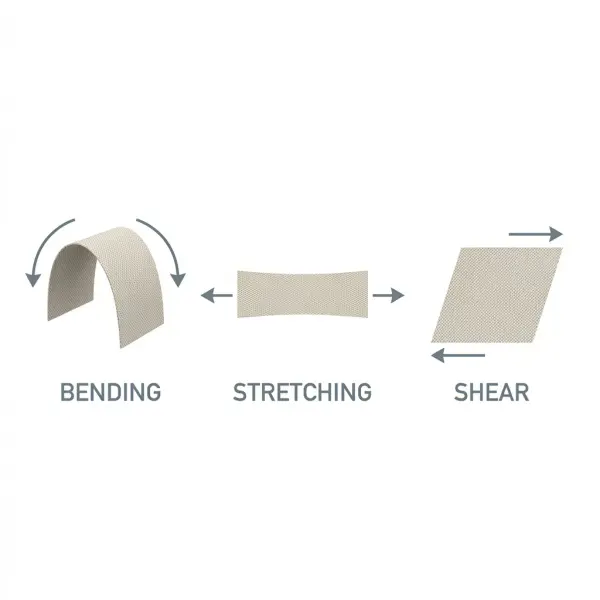
Bending Properties Help Describe Fabric Stiffness
Bending behavior concerns how a fabric resists changes in curvature. It is particularly relevant when examining folds, garment volume, and the way fabric projects away from the body.
A relatively stiff fabric may help maintain the shape of a structured skirt or jacket, while a more flexible material may produce softer folds. However, the result also depends on garment geometry, fabric weight, seams, interlinings, and other construction details.
In digital garment simulation, inappropriate bending parameters can produce folds or silhouettes that differ from those of the physical material. A fabric represented as too flexible may collapse more than expected, while excessive simulated stiffness may create unnaturally rigid shapes.
Bending behavior may also vary between fabric directions. Depending on the construction, bending along one orientation can produce a different response from bending along another. Accurate simulation therefore requires more than a single general description such as "soft" or "structured."
Stretch and Recovery Affect Fit-Related Behavior
Stretch describes how a textile extends under an applied force, while recovery concerns how it returns toward its earlier dimensions after that force is reduced or removed.
These characteristics are particularly relevant to fitted garments, sportswear, leggings, and other products that rely on controlled elasticity. Yet stretch percentages by themselves may not fully explain how the material behaves.
Two textiles may extend by similar amounts under one test condition while requiring different forces to achieve that extension. Their recovery behavior may also differ after repeated stretching or sustained loading.
For virtual garment development, this means that using the wrong material parameters can affect simulated tension, distortion, and fit-related behavior. Such problems are especially consequential when teams interpret virtual fit results as evidence for technical decisions.
It is also necessary to distinguish directions of extension. Woven fabrics may respond differently along warp, weft, and bias directions, while knitted fabrics have their own directional behavior. These differences need appropriate representation in the material model used by the software.
Shear Properties Influence How Fabric Deforms
Shear deformation involves changes in the angles between directions within the fabric structure. It contributes to how textiles conform to curved surfaces and develop folds.
This property is important because fabrics do not deform only through straightforward stretching or bending. When a material wraps around the body or moves across a three-dimensional shape, several deformation mechanisms may occur together.
An incorrect shear response can therefore influence the simulated appearance of drape and localized distortion. The effect depends on the fabric, garment design, and simulation system.
For fashion businesses, the practical challenge is ensuring that the parameters used by their software correspond appropriately to the intended physical material rather than assuming that all similar-looking fabrics will behave alike.
Visual Accuracy and Mechanical Accuracy Are Different Problems
A realistic digital fabric requires more than one type of information. Its visible surface and its physical behavior are represented through different properties, even though both contribute to the final virtual garment.
Visual material assets may describe color, texture, roughness, surface relief, and other rendering characteristics. Mechanical parameters influence how the simulated textile moves, bends, stretches, and responds to forces.
A high-resolution scan can improve surface appearance without improving the accuracy of the fabric's physical behavior. Conversely, carefully measured mechanical properties may produce useful simulation behavior even when the digital texture is visually simplified.
This distinction is particularly important when design teams evaluate virtual garments using rendered images. A polished presentation may encourage confidence in the entire simulation even though some aspects of the material remain unverified.
Color Data Requires Appropriate Capture and Interpretation
Fabric color may appear different under different illumination, viewing conditions, and display settings. Digital photographs can also introduce variations through camera processing, white balance, exposure, and color-management practices.
For early design exploration, consistent photography may provide sufficient information to compare broad color directions. Production color approval, however, may require physical standards or instrument-based evaluation under defined conditions.
The ISO 105-J03:2009 standard describes a method for calculating color differences between textile specimens measured under the same conditions. This type of quantitative comparison should not be confused with a fabric's colorfastness performance under washing, rubbing, light exposure, or other conditions, which requires appropriate separate testing.
Fashion brands should therefore distinguish between a digital color preview, a measured color reference, and an approved production shade. These represent different levels of evidence.
Texture Scale and Surface Properties Affect Rendering
A digital material may reproduce the correct pattern but display it at the wrong scale. For instance, a woven texture might appear exaggerated on a virtual blouse, while a printed motif may look smaller or larger than it would on the actual textile.
Surface properties also influence visual appearance. The degree of simulated roughness, reflection, transparency, and surface relief can change the way virtual lighting interacts with a material.
These details matter for fashion presentations because viewers often evaluate fabric suitability through visible characteristics. Satin, poplin, crepe, and textured knits may require different rendering treatment to communicate their surface appearance plausibly.
Nevertheless, a carefully rendered fabric should still be understood as a digital interpretation. It does not establish real-world color accuracy, tactile feel, or textile performance without additional evidence.
How Incorrect Fabric Data Affects Fashion Product Development
Fabric information rarely remains inside a single digital asset. It may be copied, referenced, or exchanged between material libraries, garment design systems, product specifications, sourcing records, and manufacturing documents.
This creates a practical risk: an error introduced early in the process can influence several later decisions if users assume the original information has already been verified.
Consider a development team evaluating a woven material for a tailored overshirt. The digital fabric is associated with an incorrect weight specification and mechanical parameters that do not reflect the intended supplier material. Designers approve the virtual silhouette because it appears appropriately structured.
Later, the physical sample behaves differently, requiring changes to the garment design or construction. The problem may not be the original design concept but the mismatch between the digital material and the actual textile.
This hypothetical scenario illustrates how material-data errors can create rework even when individual departments follow their usual procedures.
Design Decisions May Be Based on Misleading Simulations
When simulation parameters are inaccurate, a virtual garment may suggest a drape, volume, or degree of tension that does not correspond closely to the physical result.
A technical designer might adjust a pattern to correct a virtual issue that would not occur with the actual material. Alternatively, a simulation may conceal a problem that becomes apparent only during physical fitting.
Neither outcome means that 3D garment design is inherently unreliable. It means that the usefulness of a particular result depends on the quality of its inputs, the simulation model, and the validation of the overall garment setup.
Fabric data is one contributor to simulation accuracy, alongside pattern geometry, seam settings, avatar characteristics, and other software parameters.
Sourcing Errors Can Change the Material Used in Production
Incorrect fabric identifiers or specifications can create problems when a selected material moves into sourcing and purchasing.
A brand might have several fabrics from the same supplier with similar appearance but different constructions. If the digital material record refers to the wrong supplier code, the sourcing team could request a textile that differs from the one intended during design development.
This may result in additional sample reviews, specification corrections, or procurement changes. The risk increases when material information is transferred manually between systems or recreated under inconsistent names.
Clear links between digital material identities, supplier references, and approved specifications help reduce ambiguity. Accurate records complement the broader practices involved in fashion vendor management.
Manufacturing Decisions Require More Than Fabric Appearance
Garment manufacturing depends on material characteristics that may not be visible in digital renders. Fabric stability, shrinkage, seam performance, finishing behavior, and other properties can influence construction methods and quality requirements.
For example, a fabric that stretches or distorts during handling may need different manufacturing controls from a more dimensionally stable material. A textile that shrinks after laundering may require appropriate testing and decisions about pattern allowances or finishing.
These considerations cannot be established reliably from visual textures alone. The relevant material data and test evidence must be evaluated according to the garment's intended use.
Accurate records make it easier for technical and production teams to recognize which information is already verified and which questions remain unresolved.

How Fabric Measurements Become Digital Simulation Parameters
Physical fabric measurements do not always move directly into garment simulation software without interpretation. Different applications may use different parameter definitions, mathematical models, input formats, and conversion procedures.
A measurement obtained from a textile testing instrument may need to be processed before it becomes a parameter recognized by a particular 3D garment application. This conversion can influence the resulting simulation.
Research on objective fabric measurements for commercial 3D virtual garment simulation examined the relationship between measured fabric properties and parameters used in commercial software. The study identified differences in the conversion of objective measurements into virtual simulation parameters.
This is an important consideration for brands using more than one technology platform. Material data should not be assumed to produce identical behavior across applications merely because the same underlying textile was measured.
Measurement Methods Must Be Appropriate for the Property
Reliable data collection begins with selecting methods that correspond to the material property being evaluated.
Mass per unit area, thickness, bending behavior, extension, shear, and drape require different measurement approaches. The appropriate testing procedure also depends on the textile structure and the intended application of the results.
For example, a drape test evaluates a particular aspect of how a fabric hangs under defined conditions. ISO 9073-9:2008 specifies a method for determining drapability, including the drape coefficient, and its scope covers nonwoven, woven, and knitted fabrics.
However, a drape coefficient is not a complete description of fabric mechanics. Different fabrics can produce similar values under a particular test while exhibiting other behavioral differences relevant to garment development.
The measurement procedure should therefore be chosen according to the properties that the digital workflow needs to represent.
Units, Direction, and Test Conditions Need Documentation
A numerical value becomes less reliable when its measurement context is missing. Weight must have a defined unit, thickness may depend on the testing pressure, and mechanical behavior may vary with the direction and conditions of loading.
For some properties, conditioning of test specimens and environmental conditions also affect the reliability or comparability of results. Teams should retain the relevant testing details rather than storing isolated values without explanation.
A structured fabric record should identify whether a parameter was measured, supplier-declared, estimated, or generated by software. These categories carry different levels of evidence.
This distinction becomes especially important when data is transferred between companies or platforms. A receiving team may not know the assumptions behind a number unless they are documented.
Software Compatibility Does Not Guarantee Equivalent Behavior
Digital fabric formats can be designed for particular software environments. Even where materials can be imported into another application, their properties may require mapping, conversion, or recalibration.
Browzwear's Fabric Testing Service documentation describes a process combining mechanical property testing and textile texture capture, with output prepared for Browzwear applications. The service also offers optional comparison of physical and digital drape.
The existence of such validation procedures reflects an important technical principle: creating a software-compatible material is not necessarily the same as demonstrating that it reproduces the intended physical behavior accurately.
Businesses using multiple garment development platforms should therefore verify how their data is interpreted and whether the resulting simulations are sufficiently comparable for the intended decisions.
What Does Fabric Data Validation Look Like in Practice?
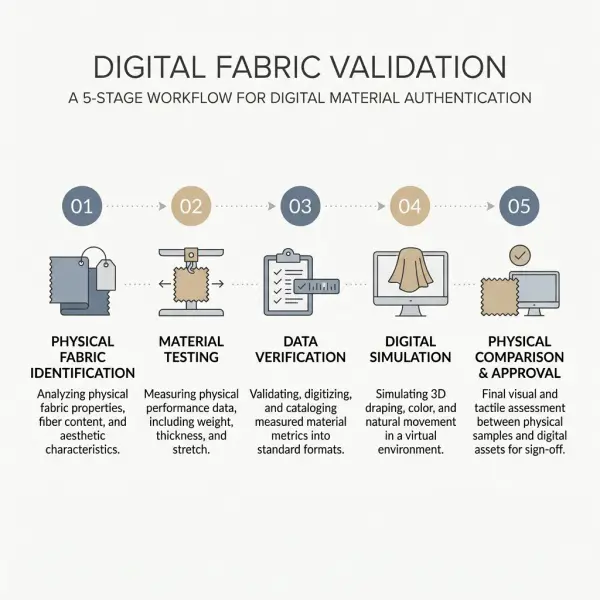
Fabric data validation is the process of checking whether recorded textile information and digital material behavior correspond sufficiently to reliable physical references for the intended use.
Validation can occur at several levels. Basic records may be checked against supplier specifications, while more demanding digital simulation workflows may compare virtual material behavior with measured properties or physical drape results.
The appropriate level of validation depends on the consequences of the decision. A preliminary visual concept may tolerate some approximation, but technical development decisions that affect physical sampling or pattern changes require greater confidence.
Start With the Physical Material Identity
The team should first establish that the digital record refers to the correct fabric. This means confirming the supplier, material code, construction, composition, and other essential identifiers.
Where several colors or finish variations exist, the record should distinguish those options clearly. Significant changes in textile construction or finishing may require a new version or material identity rather than an informal update to the existing record.
This step prevents technically sophisticated data from being associated with the wrong physical reference.
Verify the Data Against Its Original Evidence
Supplier specifications, laboratory results, measurements, and internal records should be reviewed for consistency. Teams should establish which values are independently measured and which originate from supplier declarations.
Discrepancies need investigation rather than automatic reconciliation. For example, two weight measurements may differ because of sample variation, test conditions, finishing changes, or data-entry errors.
The library should preserve enough information to explain which value is currently accepted and why. This is more reliable than silently replacing one number with another.
Compare Digital Behavior With Physical References
When a digital material is intended for garment simulation, validation may include comparing a virtual fabric's behavior with that of the corresponding physical textile.
Depending on the application, this might involve controlled fabric drape comparisons, deformation tests, or evaluations of a garment prototype.
A 2026 study published in IEEE Transactions on Visualization and Computer Graphics, Evaluating the Accuracy of Fabric Mechanical Digitization Methods, compared commercial digitization approaches against physical drape measurements. Its findings indicate that AI-based methods can achieve competitive accuracy in the evaluated setting, while differences and limitations remain between approaches.
The implication is not that one category of digitization method is universally sufficient. Validation should consider the specific fabric types, measurement approach, software environment, and behavior relevant to the intended decision.
Establish Acceptance Criteria Before Using the Results
A validation exercise is more useful when the team knows what constitutes an acceptable result. Otherwise, a virtual material may be approved based on subjective resemblance alone.
Acceptance criteria may relate to relevant measurements, acceptable deviations under defined tests, visual appearance under controlled conditions, or a documented comparison with physical garment behavior.
The appropriate tolerances depend on the textile, testing method, software, product category, and intended application. There is no universal accuracy threshold that can establish whether all digital fabrics are ready for every development decision.
Building a Fabric Data Quality Process for Fashion Businesses
Accurate fabric data requires an operating process, not merely a collection of sophisticated measurement tools. For many fashion businesses, the first improvements involve organizing existing information, identifying trusted sources, and assigning responsibility for data maintenance.
A brand that has inconsistent supplier codes and incomplete material specifications may benefit more from strengthening its record-management practices than from immediately investing in advanced fabric digitization equipment.
The objective is to establish a dependable connection between a physical fabric, its digital assets, and the decisions made using those assets.
Define a Minimum Data Standard
The business should specify which fields are required for different material uses. Basic design references may need reliable images and identifying information, while materials intended for production development require additional specifications and approval evidence.
Simulation-ready materials may need compatible visual files and relevant mechanical parameters. The exact requirements should reflect the selected software and the garments being developed.
A practical data standard should also distinguish mandatory fields from optional or application-specific information. Requiring every possible parameter for every fabric can create unnecessary administrative work.
Record Data Provenance and Verification Status
Each important measurement or specification should be linked to its source wherever practical. This makes it easier to determine whether the information came from a supplier, an internal test, a specialist digitization provider, or a software estimation process.
Useful record fields include:
- Material ID and version: Identifies the exact textile and its relevant revision.
- Data source: Indicates who supplied or measured the information.
- Measurement method and units: Preserves the context required to interpret numerical values.
- Verification date: Shows when the information was checked.
- Validation status: Distinguishes unverified, reviewed, and approved information for defined uses.
- Responsible owner: Identifies who maintains the record and authorizes changes.
These fields support traceability without requiring every employee to become a textile testing specialist. Their role is to make important information easier to understand and challenge when necessary.
Introduce Material-Specific Approval Levels
Not every digital material needs the same level of approval. A fabric used only for early visual exploration may be acceptable with verified identity and appropriate imagery, while a material used for simulation-based technical decisions may require further testing and validation.
For example, a fashion brand could distinguish visual-reference approval, sourcing-specification approval, and simulation-validation approval.
These categories should be clearly defined so that users understand what each status permits. A material marked as suitable for visualization should not automatically be considered approved for technical fit evaluation or bulk production.
Maintain Records When Fabrics Change
Fabric specifications may change when suppliers modify yarns, constructions, finishing treatments, or production processes. Commercial details may also change without altering the underlying textile.
The data system needs a way to distinguish these events. A routine price update does not necessarily require a new technical material identity, while a significant change in composition or mechanical properties may justify creating a separate material version.
Historical records should remain traceable where they support earlier product decisions. Without this continuity, teams may struggle to establish which fabric specification was used when a particular garment was developed.
Common Fabric Data Mistakes in Digital Fashion Workflows
Material-data problems are often caused by ordinary workflow practices rather than unusual technical failures. Errors can emerge when teams transfer values manually, reuse old assets, or assume that a digital material has already been validated by someone else.
Using Generic Fabric Presets as Verified Materials
Garment design software may provide predefined materials that are useful for initial simulations. These presets can help designers explore a concept before measured properties for the intended fabric are available.
The mistake occurs when the preset is treated as an accurate substitute for a specific supplier textile without appropriate validation. Similar fabric names do not establish equivalent physical behavior, and a generic material may respond differently from the intended fabric.
A better approach is to identify the preset as provisional and replace or calibrate it when the development decision requires material-specific accuracy.
Confusing Visual Realism With Technical Validation
A convincing render can create the impression that the garment has been comprehensively evaluated. Yet lighting, texture quality, and surface details mainly influence visual appearance, while mechanical behavior depends on other inputs.
If a virtual garment is used to judge fit or drape, the team needs to understand which properties have been measured and which remain estimated. Separating visual approval from technical validation reduces the risk of making unsupported decisions.
The same distinction should be communicated when sharing garment renders with colleagues, suppliers, or customers.
Copying Measurements Without Units or Methods
Measurements can lose meaning when they are transferred between spreadsheets, software systems, and material records without sufficient context.
A thickness value without a unit or testing condition may be misinterpreted. An extension value without information about the relevant load or testing direction may not describe the behavior another user expects.
The solution is not simply adding more numerical fields. Teams should preserve the measurement method, units, source, and relevant conditions so that values can be interpreted consistently.
Ignoring Fabric Versions and Finishing Changes
Two fabrics supplied under similar commercial names may differ because of changes in construction, finishing, or production specifications. Reusing digital parameters from an older version without verification can create mismatches between virtual development and current physical samples.
This is especially problematic when teams continue using digital assets from previous collections. A record that was once accurate may no longer represent the material currently available.
Version control and supplier confirmation help maintain the relationship between approved digital information and the intended physical textile.
Treating Every Fabric Property as Equally Necessary
Advanced digitization can produce considerable amounts of material information, but collecting data without understanding its intended use may increase cost and complexity.
A small accessories business does not necessarily require the same simulation workflow as a brand developing fitted performance apparel. Even within one brand, materials used for basic visual concepts may need less technical information than those used for simulation-supported product engineering.
The better strategy is to define the decision first, identify the properties required to support it, and invest in suitable measurements accordingly.
Important Technical Limits of Fabric Digitization
Digital fabric accuracy remains dependent on the textile, digitization method, simulation model, and validation procedure. No single measurement method or asset format captures every aspect of a real fabric under all conditions.
Complex surfaces, highly irregular constructions, multilayer textiles, bulky materials, and fabrics with specialized finishes may be difficult to represent using particular digitization systems.
Browzwear's fabric testing guidance identifies potential digitization limitations for materials such as faux fur, sherpa, engineered knits, laminates, and fabrics with unusual structures. Some irregular textures may also create difficulties when generating repeatable digital surfaces.
These limitations are specific to the capabilities and procedures of individual technologies. They should not be interpreted as proof that such textiles can never be digitized.
AI-Generated Material Parameters Still Require Evaluation
Some digitization approaches estimate material behavior using algorithms or machine-learning models rather than relying exclusively on conventional mechanical testing.
These methods may be useful when physical testing is costly, logistically difficult, or impractical for a large number of preliminary materials. However, their reliability depends on the training data, model design, fabric types, and behaviors being evaluated.
Research published in 2026 indicates that selected AI-based approaches can produce competitive drape accuracy, but that finding does not establish equivalent performance across every textile, test condition, or garment application.
Businesses should distinguish estimated parameters from directly measured ones and establish validation requirements appropriate to their intended uses.
Accurate Fabric Data Does Not Guarantee an Accurate Garment Simulation
Fabric properties are only one component of a digital garment model. Pattern geometry, seam construction, avatar shape, body posture, simulation settings, and numerical methods can also influence the virtual result.
A study published in 2026 comparing virtual and physical fit in customized garments identified limitations involving avatar representation and fabric behavior, while recognizing the usefulness of virtual fitting workflows.
This means that even well-measured fabric data cannot independently guarantee the accuracy of a complete virtual garment. Technical teams should evaluate the combined workflow rather than treating one accurate material record as proof that every simulated outcome is correct.
Sustainability Benefits Should Not Be Assumed
Reliable digital fabric information may help teams evaluate alternatives and avoid some unnecessary physical iterations. However, the environmental benefit of a particular digital workflow depends on what it replaces, how it is implemented, and the resources consumed in creating and maintaining digital assets.
A reduction in physical samples does not automatically establish a proportional reduction in environmental impact. Digitization activities, computing infrastructure, testing requirements, and downstream production decisions also influence the outcome.
Brands making sustainability claims should use appropriate evidence and avoid presenting digital fabric adoption itself as proof of reduced environmental impact.





Comments 0
Leave a CommentSend Comment
Anda harus Login terlebih dahulu untuk dapat memberikan komentar.