

Common Export Challenges for Small and Medium Fashion Brands
Quick Answer
Small and medium fashion brands commonly struggle with export because cross-border orders place pressure on several business systems at once. The most frequent challenges include choosing the wrong market or channel, calculating prices without full landed-cost visibility, financing production before receiving payment, maintaining quality across larger orders, meeting destination-specific product requirements, preparing consistent documents, managing delivery delays, and verifying unfamiliar buyers or distributors.
These problems are rarely caused by international shipping alone. They usually emerge when an informal domestic process is expected to support more formal buyer specifications, longer lead times, multiple service providers, currency exposure, customs procedures, and less forgiving delivery commitments.
Smaller businesses may feel these pressures more strongly because fixed compliance, testing, logistics, and administrative costs are spread across lower volumes. They also have fewer people available to manage exceptions when production, documentation, payment, or transport does not proceed as planned.
The practical solution is not to eliminate every export risk. It is to identify which risks could materially damage margin, cash flow, product conformity, or buyer trust—and build controls before accepting larger or repeated orders.

Why Export Challenges Affect Smaller Fashion Businesses Differently
Small and medium-sized enterprises face many of the same international trade requirements as larger companies, but they usually have fewer resources to absorb the associated costs and operational demands.
A product test, customs consultation, professional translation, buyer audit, freight booking, or corrected shipment document may cost the same regardless of whether the order contains 300 garments or 30,000. For a smaller order, these fixed costs represent a greater proportion of revenue.
The Organisation for Economic Co-operation and Development notes that smaller enterprises tend to be underrepresented in cross-border trade partly because they have fewer resources to meet the costs of participating in international markets. It also observes that trade barriers and administrative costs can affect smaller businesses disproportionately. OECD overview of SMEs and international trade
Fashion adds another layer of difficulty because garments combine commercial and technical variables. A single order may involve several fabrics, trims, colours, sizes, product descriptions, packaging formats, and delivery dates. A small change to one variable can affect labels, cost, measurements, care instructions, customs data, and buyer approval.
A larger apparel exporter may have separate teams for merchandising, technical development, quality assurance, compliance, logistics, finance, and account management. In a small brand, the same founder or manager may handle all of them.
That concentration can produce speed and flexibility. It also creates a fragile system when information remains in one person’s inbox, memory, or private spreadsheet.
Challenge 1: Entering a Market Without a Strong Commercial Fit
The first export challenge often appears before production begins: the product receives international attention, but the market-entry case is weak.
A brand may interpret social-media followers, website traffic, sample enquiries, or compliments from overseas buyers as proof of demand. These signals can be useful, but they do not confirm that customers will purchase the product at the price required to cover international distribution.
Commercial fit depends on several factors working together:
- Product relevance
- Customer segment
- Price position
- Climate and season
- Sizing expectations
- Sales channel
- Competitor strength
- Local retail margins
- Import costs
- Brand recognition
A product may be desirable but poorly matched to the chosen channel.
For example, a handmade fashion label may attract interest from a large distributor. The proposed order volume appears attractive, but the distributor expects lower wholesale prices, rapid replenishment, standardized packaging, and consistent availability across several seasons. The label’s value may depend precisely on limited production and slow craft processes.
The problem is not that either party is wrong. The business models are misaligned.
Why This Challenge Happens
Growing brands often enter the market through whichever opportunity appears first. A distributor sends an enquiry, a marketplace invites the brand to join, or a retailer requests samples. Because overseas interest feels difficult to replace, the company adjusts itself around the opportunity without first testing whether the relationship supports its positioning and operating capacity.
The result can be a large amount of preparation for a market that does not provide a viable margin or repeatable demand.

How to Manage It
A brand should define a narrow market hypothesis before adapting its entire collection. It should test:
- Who is expected to buy
- Why the product is relevant
- Which competing options already exist
- What the final retail price may become
- Which channel can explain the product effectively
- Whether the channel’s volume and margin expectations fit the brand
The initial test can involve retailer interviews, targeted advertising, small online releases, trade-show discussions, sample feedback, or a controlled wholesale order.
The objective is not to prove that a country “likes fashion.” It is to establish whether a particular offer can work through a particular channel.
A structured preparation process is covered in what fashion businesses should prepare before entering global markets.
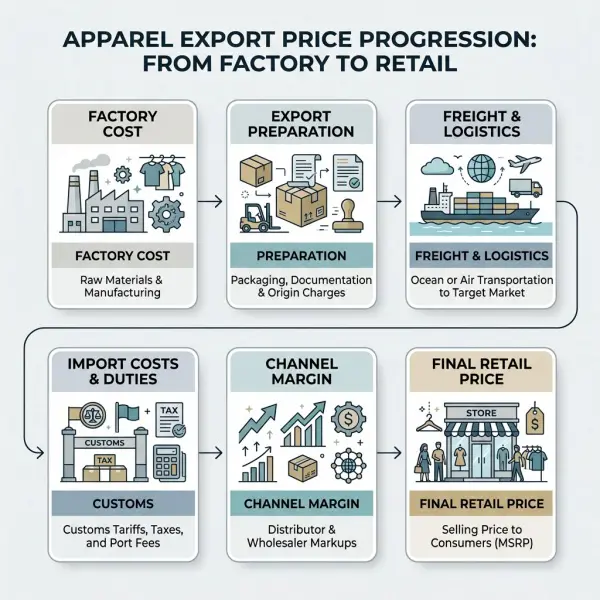
Challenge 2: Losing Margin Between the Factory and the Customer
Export orders can look profitable at the product-cost level while becoming unattractive once the complete transaction is calculated.
Small brands commonly begin with a domestic wholesale or retail price and then add estimated shipping. That calculation may omit testing, export packaging, inland transport, freight-forwarder charges, insurance, customs services, payment fees, currency conversion, commissions, import duty, local delivery, and the buyer’s or distributor’s required margin.
The result is a product that is either too expensive in the destination market or insufficiently profitable for the exporter.
The Difference Between Export Price and Market Price
The exporter’s selling price is only one layer of the final commercial structure.
|
Cost layer |
What it may include |
|
Product cost |
Materials, trims, labour, finishing, factory overhead |
|
Export preparation |
Labels, testing, inspection, documentation, cartons |
|
Export delivery |
Inland transport, terminal handling, freight, insurance |
|
Import cost |
Duty, tax, brokerage, clearance, local transport |
|
Channel margin |
Agent, distributor, wholesaler, or marketplace margin |
|
Retail margin |
Retail operating costs, markdown exposure, and profit |
|
Customer price |
Final amount presented in the destination market |
Not every cost belongs to the exporter. The allocation depends on the contract and selected delivery arrangement. However, the brand should understand the complete price chain even when another party pays part of it.
Without this visibility, management may agree to a buyer’s target price without realizing that the order produces little contribution after export-specific costs.
Incorrect Use of Delivery Terms
Margin problems are frequently linked to poorly understood Incoterms® rules.
Incoterms® 2020 contains 11 trade terms that help define buyer and seller obligations, costs, and risks related to delivery. The selected term should be combined with a precise named place or port. These rules do not replace the full contract or independently settle payment terms, ownership, specifications, or remedies for breach. official ICC Incoterms 2020 guidance
A quotation stating only “FOB price” or “shipping included” can leave critical questions unresolved:
- Which port or location is named?
- Who pays inland transport?
- Who completes export formalities?
- When does risk transfer?
- Who arranges the main carriage?
- Who pays insurance?
- Which additional fees are excluded?
The better approach is to calculate costs under the exact proposed transaction and state the selected rule, named place, currency, validity period, quantity, and payment structure clearly.
Challenge 3: Financing the Order Before Receiving the Revenue
Export growth can create a cash-flow problem even when the order is profitable on paper.
Apparel businesses often need to pay for fabric, trims, printing, manufacturing, testing, packaging, and logistics before receiving the buyer’s final payment. The production cycle may last several weeks, followed by transport time and an additional credit period.
A large purchase order therefore creates both revenue potential and a financing obligation.
The Working-Capital Gap
Consider a simplified sequence:
- The buyer pays a 20% or 30% deposit.
- Fabric and trim suppliers require substantial upfront payment.
- The factory requires progress or completion payments.
- Testing and inspection must be paid before shipment.
- Freight or export charges become due.
- The buyer pays the balance after shipment or after receiving the goods.
The buyer’s deposit may not cover the company’s production outlay. If the business funds the gap from its normal operating account, domestic orders, payroll, supplier payments, and marketing activity can be affected.
Trade-finance instruments can help manage payment and working-capital risks, but the appropriate instrument depends on the transaction, buyer relationship, documentation capability, cost, and availability. ICC identifies instruments such as letters of credit, documentary collections, receivables finance, supply-chain finance, trade loans, and credit insurance as mechanisms that may support international transactions under different conditions. ICC overview of trade finance for businesses
A letter of credit, for example, may reduce payment uncertainty when its conditions are met, but it also introduces banking costs and strict documentary requirements. It is not a substitute for reading the terms carefully or preparing accurate documents.
Better Financial Controls
Before accepting an order, the brand should model:
- Total cash required
- Supplier payment schedule
- Buyer deposit and balance dates
- Currency exposure
- Financing cost
- Delay scenarios
- Rework or rejection exposure
- Minimum cash reserve
- Effect on existing operations
A commercially impressive order should be declined, reduced, divided into stages, or renegotiated when it threatens the financial stability of the company.
Volume is not growth when the company cannot finance it safely.
Challenge 4: Production Capacity That Looks Stronger Than It Is
Many small fashion brands know how many garments their workshop can theoretically produce. Fewer know how many conforming garments can be completed, inspected, packed, and released within a fixed export window.
Capacity figures often exclude the time and variability associated with:
- Material procurement
- Sample corrections
- Colour approval
- Printing or embroidery
- Cutting bottlenecks
- Specialist machines
- Worker availability
- Quality rework
- Label preparation
- Carton packing
- Final inspection
- Production for other clients
A workshop may state that it can sew 2,000 pieces per month, but the relevant question is whether it can produce 2,000 units of the specific export style, size assortment, material, and quality level during the required period.
Why Capacity Breaks Under Export Pressure
Domestic production may be flexible enough to accommodate partial deliveries, minor substitutions, or informal deadline changes. International buyers may have fixed retail launch dates, consolidation schedules, vessel bookings, distribution plans, or promotional calendars.
A delay of several days at the factory can become a much larger commercial problem if it causes the order to miss a scheduled shipment.
Capacity can also deteriorate when brands accept more volume by adding unapproved subcontractors. The additional facility may use different machines, operators, construction methods, or quality practices.
How to Reduce Capacity Risk
The production plan should identify:
- Realistic daily or weekly output
- Critical operations
- Confirmed material dates
- Factory loading
- Sample approval deadline
- Inspection stages
- Rework allowance
- Packaging time
- Shipment cutoff
- Approved subcontracting conditions
A capacity buffer is not wasted efficiency. It is protection against normal production variation.
Brands should also distinguish between a temporary surge and sustainable capacity. Extraordinary overtime may complete one order, but it should not become the assumed foundation for every future quotation.
Challenge 5: Reproducing the Approved Product Consistently
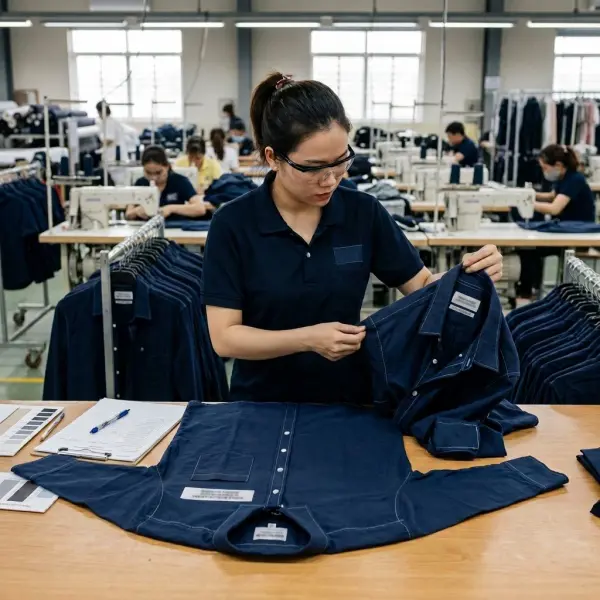
In apparel export, quality is not simply whether a garment looks attractive. It is whether the bulk product conforms to the specification, approved sample, buyer requirements, and applicable rules.
Quality disputes often arise because the parties agreed on a general impression rather than measurable acceptance criteria.
The buyer may expect a particular fit, shade, handfeel, seam finish, print position, or carton assortment. The supplier may believe that minor variations are acceptable because they do not affect basic wearability.
Both perspectives can be understandable, but they produce conflict when expectations were not documented.
Common Sources of Variation
Quality inconsistency may result from:
- Different fabric batches
- Uncontrolled shrinkage
- Pattern or grading errors
- Incorrect seam allowance
- Operator variation
- Print or embroidery placement
- Trim substitution
- Colour variation
- Inadequate pressing
- Mixed label versions
- Incorrect size ratios
- Packaging mistakes
Some variation is inherent in textile and garment production. The operational question is which variation is acceptable, how it is measured, and what action follows when it exceeds the agreed limit.
Quality Control Without Excessive Bureaucracy
A smaller brand does not need to reproduce the complete quality system of a multinational retailer. It does need a controlled reference.
That may include:
- Approved pre-production sample
- Measurement chart and tolerances
- Bill of materials
- Construction details
- Colour reference
- Label and packing instructions
- In-line checks
- Final inspection record
- Defect and rework procedure
- Shipment-release authority
ITC emphasizes that export quality is determined by the ability to meet applicable technical requirements and customer expectations, rather than by a vague internal idea of excellence. Its guidance also highlights the difficulties small exporters can face in accessing current standards, technical expertise, testing, inspection, and certification services. ITC export quality management guidance
The strongest quality system detects problems before the entire order is finished.
Challenge 6: Navigating Different Compliance and Buyer Requirements
A garment that is acceptable in its domestic market may need different labels, tests, warnings, records, or responsible-party information in the destination market.
Small exporters frequently face two overlapping layers:
- Mandatory requirements, established through laws, regulations, customs rules, or product-safety obligations.
- Commercial requirements, established by buyers, retailers, marketplaces, certification programmes, or private standards.
The second layer may be stricter than the legal minimum.
A retailer may require colourfastness, shrinkage, restricted-substance, packaging, audit, or traceability evidence even where the law does not prescribe that exact test for every garment.
Information Is Often Fragmented
Compliance information may be distributed across textile regulations, consumer-product rules, chemical legislation, customs guidance, labelling rules, packaging obligations, and buyer manuals.
Small companies may not have a compliance specialist able to interpret how these sources interact.
ITC reports that many enterprises experience difficulty with standards, technical regulations, and conformity-assessment procedures because of information gaps, limited internal expertise, and restricted access to affordable testing or certification infrastructure.
The problem is not solved by searching for a generic phrase such as “international apparel certification.” There is no single certificate that proves universal export compliance.
Certification Can Become a Costly Distraction
A buyer may request a specific certification, audit, or test report. In that case, the business should verify:
- Who requires it
- Which product or facility it covers
- Whether the provider must be accredited
- Whether the buyer accepts the issuing body
- How long the result remains valid
- Whether annual surveillance is required
- Whether the cost is recoverable through the order
A certificate that does not match the target market, product, production site, or buyer programme may provide little commercial value.
The correct sequence is:
Identify requirement → confirm scope → choose accepted evidence → calculate cost → complete assessment.
Not the reverse.
Challenge 7: Inconsistent Product and Shipment Data
Export documents often fail because different teams use different versions of the same information.
The catalogue may describe a garment as a “women’s casual top.” The customs file may call it a “blouse.” The factory record may use an internal style name. The invoice may show a simplified fibre description, while the physical label shows a different composition.
None of these differences automatically means the shipment is non-compliant. They do, however, create questions when quantities, values, composition, origin, or product identity cannot be reconciled.
Where Inconsistency Begins
Data problems commonly originate from:
- Manual retyping
- Multiple spreadsheets
- Outdated tech packs
- Revised orders not shared with every department
- Product names used instead of technical descriptions
- Estimated carton weights
- Unverified supplier composition
- Labels printed before final confirmation
- Last-minute substitutions
- Separate files owned by sales, production, and logistics
A freight forwarder can process the information supplied by the exporter, but it cannot determine the true composition, construction, origin, or commercial value of the garment without reliable source data.
Create One Controlled Product Record
The business should maintain one approved record containing:
- Style and stock codes
- Product description
- Fibre composition
- Knit or woven construction
- Country of manufacture
- Size and colour variants
- Unit value
- Tariff-classification reference
- Net and gross weight
- Carton quantity
- Label version
- Buyer purchase-order reference
Transaction documents can then be generated or checked against this record.
The goal is not advanced software. A well-controlled spreadsheet may be adequate for a small exporter. The essential requirement is version control, ownership, and review.
Challenge 8: Customs Classification and Origin Errors
Apparel customs classification can be more technical than it appears.
Classification may depend on garment construction, fibre composition, gender category, knit or woven structure, intended use, and specific design features. Marketing language is not a reliable classification method.
A “lightweight performance jacket” could require analysis of whether it is a jacket, windbreaker, sports garment, knitted article, woven article, coated garment, or another category under the destination tariff schedule.
An incorrect classification may affect:
- Duty
- Import restrictions
- Documentation
- Trade statistics
- Licensing
- Clearance time
- Preferential origin claims
Preferential Origin Creates Additional Complexity
Country-of-origin marking and eligibility for a reduced tariff under a trade agreement are not always the same.
A garment assembled in one country may fail a preferential rule when the applicable agreement requires specific changes to yarn, fabric, or garment classification. The required transformation differs across agreements and tariff headings.
Brands should retain records for relevant materials and production stages before signing an origin declaration.
A certificate of origin should not be treated as an administrative form that can be completed after production without supporting evidence.
Practical Control
For higher-value or repeated products, the exporter should document:
- Proposed tariff code
- Technical product description
- Composition
- Knit or woven construction
- Photographs
- Manufacturing process
- Material origin
- Broker or customs advice
- Applicable trade-agreement rule
- Supporting supplier records
When classification remains uncertain, an official ruling or qualified specialist opinion may be appropriate, depending on the jurisdiction.
Challenge 9: Documentation Errors That Delay Payment or Delivery
A commercial invoice can be accurate in most respects and still create a problem because one critical field differs from another document.
Common discrepancies include:
- Incorrect buyer or consignee name
- Different quantities between invoice and packing list
- Wrong currency
- Incomplete product description
- Incorrect Incoterms rule or named place
- Missing purchase-order reference
- Incorrect carton count
- Estimated rather than confirmed weight
- Inconsistent origin information
- Document dates that do not align
- Missing signatures or declarations
- Late submission to the bank or carrier
The consequence depends on the transaction. It may involve a customs query, amended document, storage charge, bank discrepancy, delayed payment, or buyer complaint.
Documentary Payment Raises the Standard
When payment depends on documentary compliance, accurate goods alone may not be sufficient. The documents must also conform to the applicable credit or collection instructions.
A letter of credit can reduce payment risk when its conditions are satisfied, but complex or impractical documentary conditions can create new risks. The exporter should review the requirements before accepting the instrument, not after the shipment has been dispatched.
Every document requirement should have:
- A responsible owner
- A source of data
- A preparation deadline
- A reviewer
- A delivery method
- An archive location
Document control is a commercial process, not merely an administrative task.
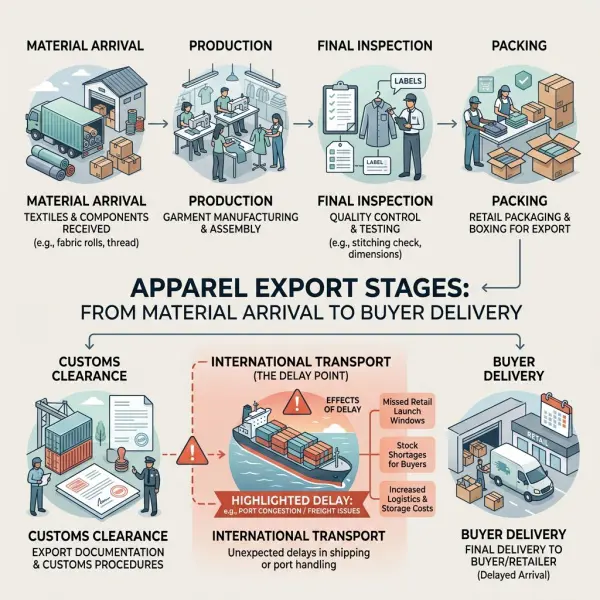
Challenge 10: Delivery Delays and Unpredictable Logistics Costs
International transport introduces factors that the fashion brand cannot fully control.
Bookings may change, ports may become congested, flights may be rescheduled, customs may request clarification, weather may disrupt transport, or a carrier may impose additional charges.
Fashion products are particularly sensitive to timing when they are connected to:
- Retail seasons
- Fashion weeks
- Promotional launches
- Holidays
- School calendars
- Resort seasons
- Uniform contracts
- Event merchandise
A shipment that arrives late may still be physically usable but commercially less valuable.
The Cost of Solving Delays at the Last Minute
When production runs late, brands may switch from sea to air freight to protect the delivery date. This can save the buyer relationship but remove most or all of the order margin.
The direct freight difference is only one cost. Urgent intervention may also require:
- Split shipments
- Weekend labour
- Priority inspection
- Document amendments
- Additional handling
- Storage
- Buyer discounts
- Lost future orders
Build the Shipment Date Backward
The delivery plan should begin with the buyer’s required arrival date and work backward through:
- Destination clearance
- International transit
- Carrier cutoff
- Export clearance
- Inland transport
- Inspection and packing
- Production completion
- Rework allowance
- Material availability
- Sample approval
The date the factory finishes sewing is not the export delivery date.
Challenge 11: Unfamiliar Buyers, Agents, and Distributors
An overseas enquiry may look credible because it includes a company website, branded signature, large order estimate, or invitation to negotiate. These details are useful but do not prove legal status, creditworthiness, market capability, or purchasing authority.
Small brands can become vulnerable when the potential order appears significantly larger than their normal business.
Risks may include:
- Buyer impersonation
- Fraudulent payment confirmation
- Unreasonable sample requests
- Unverified credit terms
- Hidden distributor conflicts
- Unclear ownership
- Weak local sales capability
- Excessive exclusivity
- Intellectual-property misuse
- Requests to pay unusual third-party fees
Official export guidance recommends investigating foreign markets and counterparties before concluding agreements. Useful checks may include legal identity, trade and bank references, business history, distribution capability, authorized contacts, financial condition, and relevant restricted-party requirements. official guidance on export buyer due diligence
Exclusivity Deserves Particular Caution
A distributor may request exclusive rights for a country or region before proving its sales capacity.
Exclusivity can be justified when the partner invests in marketing, inventory, showroom operations, regulatory work, or local distribution. It becomes risky when the territory is broad, targets are vague, the contract is long, and the brand has limited termination rights.
A more balanced agreement can define:
- Product scope
- Territory
- Sales channels
- Minimum purchases
- Performance milestones
- Marketing obligations
- Reporting
- Intellectual-property use
- Term and renewal
- Termination
- Treatment of existing customers
The brand should avoid granting permanent strategic control in exchange for an initial promise rather than verified performance.
Challenge 12: Currency and Payment Risk
A profitable price can change when costs and revenue are denominated in different currencies.
A brand may quote the buyer in U.S. dollars or euros while paying fabric, labour, and overhead in its local currency. Exchange-rate movement between quotation, deposit, material purchase, production, shipment, and final payment can improve or reduce margin.
The exposure becomes greater when:
- The quotation remains valid for a long period
- The order has a long production cycle
- The buyer pays a small deposit
- The final balance is delayed
- Imported materials use another currency
- The brand does not update cost assumptions
Payment risk is separate from currency risk. A buyer may receive the goods but dispute the invoice, delay payment, experience financial distress, or fail to pay.
Controls for Smaller Exporters
Depending on scale and availability, controls may include:
- Short quotation validity
- Larger deposit
- Milestone payments
- Currency buffer
- Currency-matched supplier agreements
- Bank transfer before shipment
- Letter of credit
- Documentary collection
- Credit insurance
- Credit limits
- Staged order quantities
No payment method is ideal for every relationship. More secure arrangements may create higher cost or reduce buyer flexibility. Open-account terms may support competitiveness but increase exposure.
The decision should reflect buyer history, order value, country risk, profit margin, bargaining power, and the exporter’s ability to absorb non-payment.
Challenge 13: Managing Returns, Claims, and Defective Goods Across Borders
Domestic customer problems can often be resolved through replacement, local courier service, repair, or direct inspection. Cross-border claims are slower and more expensive.
Returning a carton or shipment may involve:
- International freight
- Customs re-entry
- Duty or tax issues
- Inspection
- Storage
- Repair
- Replacement production
- Disposal
- Commercial discount
- Lost selling season
A claims policy should therefore be agreed before shipment.
It may define:
- Notification period
- Evidence required
- Inspection rights
- Defect categories
- Acceptable tolerance
- Repair or replacement options
- Credit-note conditions
- Responsibility for freight
- Treatment of saleable goods
- Maximum liability where legally appropriate
Photographs alone may not prove the scale or cause of a quality issue. For significant disputes, an independent inspection may be useful.
The goal is not to make claims difficult for the buyer. It is to prevent every disagreement from becoming an improvised negotiation.
Challenge 14: Scaling Too Quickly After One Successful Order
The first export order may succeed because the founder monitors every detail, the factory gives it special priority, and the buyer accepts small imperfections during the trial.
That success can create false confidence.
The second or third order may be larger, include more styles, require faster delivery, or overlap with other production commitments. The informal effort that made the pilot work may no longer be available.
Signs That Growth Is Exceeding the System
Warning signs include:
- Repeated urgent material purchases
- Constant founder intervention
- Different files for the same product
- Quality checks performed only at the end
- Orders accepted before capacity review
- Domestic customers receiving lower priority
- Supplier payments delayed
- Increased air-freight use
- Frequent label corrections
- Buyer updates becoming reactive
- Margin declining as volume increases
These symptoms suggest that revenue is growing faster than the company’s operating capability.
Scale the Process Before the Assortment
A more controlled sequence is:
- Repeat the existing product successfully.
- Stabilize materials and suppliers.
- Document the workflow.
- Review actual margin and cash cycle.
- Train another person to manage critical tasks.
- Add capacity or a new facility carefully.
- Expand styles, markets, or channels.
The business should avoid changing market, product, factory, packaging, and payment structure at the same time. When too many variables change together, it becomes difficult to identify the cause of failure.





Comments 0
Leave a CommentSend Comment
Anda harus Login terlebih dahulu untuk dapat memberikan komentar.