

How Washing, Drying, and Storage Affect Everyday Fashion
A garment does not stop changing when it leaves the factory. Every wash, drying cycle, ironing session, day on a hanger, and month inside a wardrobe exposes the product to physical or environmental conditions that can alter its color, dimensions, surface, shape, and overall appearance.
That does not mean washing or drying is inherently damaging. Clothing needs to be cleaned and maintained. The issue is whether the treatment is appropriate for the garment and proportionate to what it actually needs.
For everyday fashion, three parts of the care cycle deserve particular attention: washing introduces water, chemistry, temperature, and mechanical action; drying introduces heat, movement, gravity, and environmental exposure; storage determines how the garment is supported and what it encounters between wears. The effect of each stage depends on fiber type, fabric construction, dyeing and finishing, garment structure, trims, prints, coatings, and the manufacturer's validated care instructions.
Understanding these mechanisms helps consumers care for clothes more intelligently. It also helps fashion brands design products, establish care labels, test finished garments, and communicate realistic ownership requirements before and after purchase.
Quick Answer: How Do Washing, Drying, and Storage Affect Clothes?
Washing, drying, and storage affect clothes because each stage exposes garments to different forms of stress. Washing combines water, detergent or other cleaning chemistry, temperature, and mechanical movement. Drying can add heat, tumbling, sunlight, gravity, or prolonged moisture. Storage can create stretching, sharp folds, compression, light exposure, humidity problems, dust accumulation, or pest risk when garments are stored poorly.
These effects are not identical across clothing. A cotton shirt, stretch legging, wool sweater, printed T-shirt, structured jacket, and embellished dress may require very different treatment even when several of them look equally robust.
Care labels are therefore the practical starting point. Under the GINETEX system associated with ISO 3758, washing temperatures indicate the maximum permitted temperature, bars beneath the wash symbol indicate reduced mechanical action, and separate symbols describe tumble drying, natural drying, ironing, bleaching, and professional textile care. GINETEX textile care symbols
The useful rule is not simply "wash cold," "never tumble dry," or "fold everything." It is to match the treatment to the complete garment and its actual care requirements.
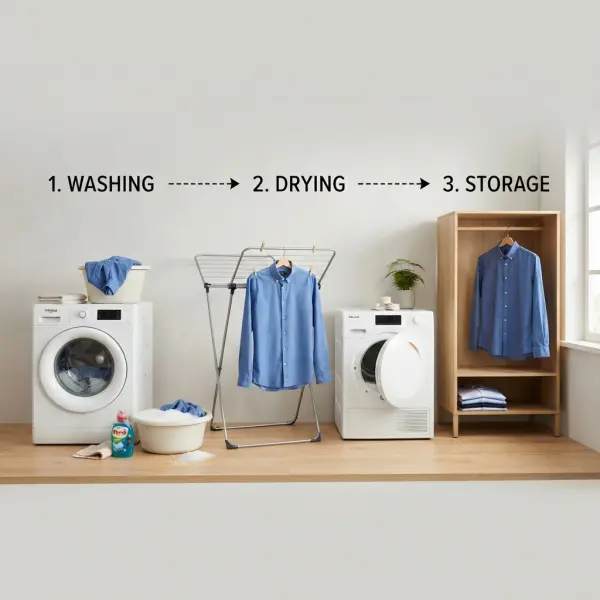
Clothing Care Is a Repeated Material Process
The effect of care is cumulative. A garment may look unchanged after one correctly performed wash, yet repeated cycles gradually reveal how stable its color, dimensions, seams, surface, trims, and finishes really are. This is one reason durability testing often evaluates products after repeated care rather than assessing only an unused garment.
WRAP's clothing durability research with the Leeds Institute of Textiles and Colour evaluates characteristics including dimensional stability, pilling, snagging, abrasion, tensile strength, tear strength, and performance through washing and drying. That does not mean laundering is responsible for every durability problem. It shows that care performance is one component of how clothing behaves during repeated real-world use. WRAP clothing durability research
This distinction matters commercially. A garment may satisfy a customer's expectations when new but disappoint after several weeks if its surface pills quickly, its dimensions change, its print deteriorates, or its structure becomes difficult to restore after cleaning. Care performance is therefore part of product quality, not merely an after-sales issue.
For consumers, the implication is equally practical: care cannot make an inherently weak product indestructible, but unsuitable washing, drying, or storage can accelerate problems that might otherwise have developed more slowly. This builds on the broader maintenance principles discussed in clothing care habits that help garments last longer.
What Happens to Clothing During Washing?
Washing is not a single variable. A domestic wash combines water, cleaning chemistry, time, temperature, and mechanical action, while the garment also interacts with other articles in the load. Changing one part of that system can change both cleaning performance and textile stress.
GINETEX makes this visible through the washing symbols themselves. The temperature shown inside the wash tub specifies the maximum washing temperature, while one bar underneath indicates a milder process with reduced mechanical action and two bars indicate a very mild process used for especially sensitive articles such as some wool garments. how washing care symbols work
The care label therefore communicates more than whether a garment can enter a washing machine. It may also limit temperature and the intensity of the washing process.
Water Temperature Can Affect More Than Cleaning
Temperature influences laundering, but the simplistic assumption that hotter is always cleaner or colder is always safer is not sufficient for garment care. The permitted temperature depends on the complete textile product, and GINETEX describes the stated temperature as a maximum that should not be exceeded. Milder treatments and lower temperatures than the maximum shown on the label are permitted within its care system. GINETEX care labelling guidance
Higher temperatures can be inappropriate for garments whose dyes, finishes, components, or dimensional stability are sensitive to heat. At the same time, cleaning requirements also matter. A garment carrying significant soil or used under specific hygiene conditions cannot be managed solely around the objective of minimizing textile stress.
For everyday clothing, temperature should therefore be chosen by combining three pieces of information: what the care label permits, how soiled the garment is, and what level of cleaning is actually required.
This is more technically sound than applying the same temperature rule to every load.
Mechanical Action Changes the Way Garments Experience Washing
Inside a washing machine, garments flex, rub, compress, rotate, and interact with other textiles. That movement helps cleaning, but sensitive garments may require reduced mechanical action. The bars beneath the GINETEX wash symbol explicitly communicate this distinction.
Mechanical exposure also depends on what else enters the wash. A lightweight knit washed together with garments containing hard zippers, hooks, heavy seams, or abrasive surfaces does not experience the same conditions as it would in a more compatible load. Overloading may also alter garment movement and cleaning effectiveness, while an excessively aggressive cycle may be unnecessary for lightly soiled articles.
The practical lesson is not that every item requires individual laundering. It is that sorting is partly about physical compatibility, not only color.


Detergent and Bleach Are Part of the Care System
Cleaning chemistry also has to match the garment. Detergent type, concentration, bleaching agents, stain removers, and specialty products can interact differently with fibers, dyes, prints, and finishes.
Care labels address some of these limits explicitly. Under GINETEX, the bleaching symbol indicates whether bleaching is permitted and whether only oxygen or non-chlorine bleaching agents may be used. In the United States, the Federal Trade Commission's Care Labeling Rule similarly requires manufacturers to provide appropriate bleaching warnings where regular use of certain bleach types would harm the product. FTC Care Labeling Rule
More detergent is also not synonymous with better garment care. Cleaning products need to be used according to their instructions, machine conditions, water conditions, soil load, and garment requirements. Improvised chemical combinations are particularly risky because the result may affect color or material performance and, depending on the substances involved, can also create safety hazards.
Sorting Protects More Than Color
Color separation remains important where dye transfer is possible, but useful sorting can consider several other characteristics as well: garment weight, surface sensitivity, lint generation, hardware, soil level, and required cycle.
A heavy pair of jeans, for example, behaves differently in a wash from a fine lightweight knit. A dark item known to release dye may require separation from pale clothing. A garment with exposed hooks may present a snagging risk to a loosely structured textile.
The FTC's U.S. guidance specifically recognizes warnings such as "wash with like colors" or "wash separately" when a garment could harm other products in the wash. FTC guide to clothing care instructions
Sorting therefore functions as basic risk management: articles sharing a machine should ideally be compatible not only in color, but also in the treatment they require.
Repeated Washing Can Reveal Weak Product Engineering
When a garment twists, shrinks disproportionately, loses surface quality, or suffers trim failure after ordinary care that complies with its label, the issue cannot automatically be blamed on the consumer. The product itself may not have been sufficiently stable for its intended use.
This is why apparel companies commonly evaluate dimensional stability, color behavior, construction, components, and appearance after care during product development and quality assurance. The exact test regime should reflect the materials, intended market, care claim, expected product use, and applicable standards.
For a fashion brand, a realistic care claim must work on the finished garment rather than only on a fabric swatch. The FTC rule illustrates this principle in the U.S. by requiring care instructions to account for components such as non-detachable linings, trims, buttons, and zippers and requiring a reasonable basis for the prescribed instructions.
Drying Can Be as Important as Washing
Drying is sometimes treated as the passive stage after laundering, but it can strongly influence shape and appearance. Depending on the method, a wet garment may experience heat, tumbling, gravity, direct sunlight, airflow, or prolonged contact with moisture.
GINETEX therefore distinguishes tumble drying from natural drying and provides specific symbols for processes such as line drying, drip line drying, flat drying, drip flat drying, and drying in the shade. Tumble-drying dots indicate the thermal severity of the permitted process. GINETEX drying symbols
A care routine that pays close attention to washing but ignores drying is therefore incomplete.
Tumble Drying Combines Heat and Mechanical Movement
A tumble dryer exposes garments to repeated movement as well as thermal energy. Whether that treatment is appropriate depends on the garment and the drying instruction.
A symbol permitting tumble drying does not mean every possible dryer setting is suitable. GINETEX differentiates normal and mild tumble-drying processes through temperature severity, while a crossed tumble-drying symbol means the article is unsuitable for tumble drying.
This matters for fashion brands because drying performance can expose compatibility problems between materials. A garment may combine a shell fabric, elastic, fusible components, printing, lining, decorative materials, or trims that respond differently to repeated heat.
For consumers, the safest shortcut remains simple: check the drying instruction rather than assuming that machine-washable automatically means machine-dryable.
Air Drying Is Not One Single Method
"Air dry" sounds straightforward, yet a wet garment can be hung from a hanger, placed on a line, dripped vertically, shaped and dried flat, or kept away from direct sunlight. These approaches apply different loads to the garment.
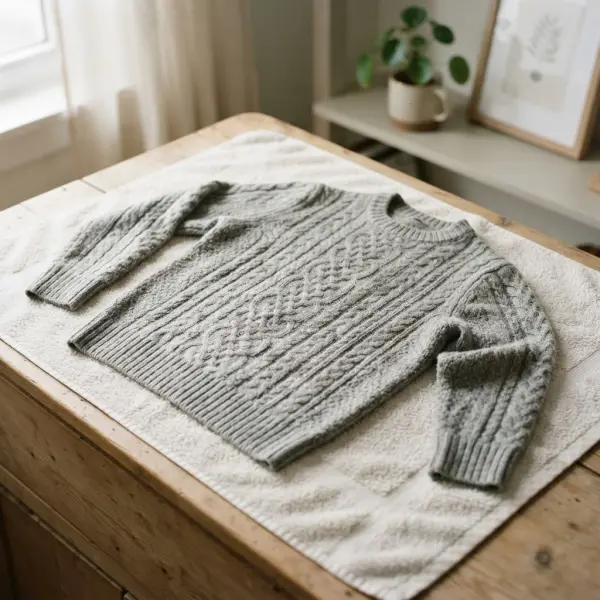
A wet knitted sweater illustrates the difference particularly well. Woolmark recommends flat drying many wool sweaters unless the care claim permits another method, noting that line drying or hanger drying can stretch knitwear because the wet garment's weight pulls on the structure. It also advises avoiding direct sunlight and direct heat for wool garments. Woolmark guide to drying a wool sweater
That example should not be generalized into "all clothes must dry flat." Woven shirts, jackets, technical garments, and other products may have completely different instructions. It demonstrates instead why drying method needs to match garment construction.
Direct Sunlight Is Not Neutral for Textiles
Sunlight can be convenient for drying, but prolonged light exposure should not be treated as completely neutral for textile appearance. Light and ultraviolet radiation can contribute to photochemical changes, including fading and weakening in susceptible textile materials.
The Canadian Conservation Institute documents light and ultraviolet radiation as important deterioration agents for textiles, although museum preservation standards are much more conservative than the practical requirements of everyday wardrobes. Canadian Conservation Institute guidance on textiles and light
For normal clothing, this does not mean that all outdoor drying is unsafe. Rather, some garments—especially those with vulnerable color or material systems—may specify drying in shade, and those instructions should be followed. GINETEX includes dedicated shade-drying symbols precisely because light exposure can be relevant to the care process.
Leaving Garments Damp Creates a Different Problem
Removing excessive heat from a routine is not useful if garments are then stored before they are properly dry. Residual moisture can create an unfavorable storage environment and, under sufficiently damp conditions, contribute to odor, mildew, or material deterioration.
Woolmark's storage guidance specifically recommends ensuring sweaters are completely dry before storage, while textile conservation guidance from the Smithsonian and Canadian Conservation Institute also emphasizes clean, dry storage conditions and avoidance of damp environments. Woolmark sweater storage guidance
For everyday clothing, the implication is straightforward: drying is complete when the garment is sufficiently dry for its next use or storage, not merely when the dryer or wash program finishes.
Storage Continues the Care Process Between Wears
Clothing can spend far more time inside a wardrobe than on the body. Storage therefore deserves more attention than simply deciding where an item fits.
During storage, garments can be affected by gravitational load, compression, sharp folds, abrasion, dust, insects, light, moisture, and contact with surrounding materials. The scale of the risk varies enormously between an everyday cotton T-shirt stored for a week and a wool coat stored for an entire season, but the underlying principles remain relevant.
A well-organized wardrobe does more than look neat. It supports garments according to their construction and helps reduce avoidable deterioration between wears.
Clean and Dry Before Long-Term Storage
A garment being put away for several months deserves more preparation than one returning to the wardrobe overnight. Visible stains, body residues, dampness, and existing pest activity are easier to address before storage than after a season inside a closed space.
Woolmark advises that wool sweaters should be completely dry before storage and kept in a dry, cool environment away from direct sunlight. Smithsonian textile preservation guidance similarly recommends that textiles be stored as clean as practical because accumulated dust and soil can contribute to deterioration.
Everyday wardrobes do not require museum conservation procedures, but the underlying principle transfers well: do not create a storage problem by putting clothing away dirty, damp, or already infested.
Hanging and Folding Serve Different Garments
Whether clothing should be hung or folded depends on how well its structure can support its own weight.
Structured woven garments often benefit from appropriately shaped hangers that support the shoulder area. Heavy or stretch-sensitive knitwear can behave differently because gravity concentrated at the shoulders may distort the garment over time. Heavily decorated pieces can also place substantial load on their own construction.
The Canadian Conservation Institute recommends avoiding hanging fragile, knitted, bias-cut, heavily decorated garments, and items with weak shoulder seams in conservation storage. It describes flat storage as providing full support and therefore reducing the stress of a textile supporting its own weight. Canadian Conservation Institute basic textile storage guidance
Again, archival practice should not be copied mechanically into an everyday closet. The relevant insight is that storage should support the garment rather than continuously pulling it out of shape.
Folding Has Its Own Trade-Off
Folding avoids hanger-related stretching, but sharp folds can concentrate stress in the same locations over long storage periods. This is particularly relevant to delicate, structured, coated, heavily decorated, or long-term stored textiles.
The Canadian Conservation Institute notes that repeated stress along sharp fold lines can contribute to damage in vulnerable textiles and recommends minimizing folding for conservation storage.
For ordinary wardrobe use, this does not make folding a bad method. T-shirts, casual trousers, knitwear, and many other everyday garments can be stored efficiently that way. The more practical principle is to avoid tightly compressing garments or forcing delicate pieces into severe folds simply to maximize wardrobe capacity.

Wardrobe Humidity and Airflow Matter
Textiles interact with environmental moisture. Extremely damp conditions are particularly undesirable because they can support mould and create problems for textile fibers, dyes, adhesives, and metal components.
Museum conservation sources discuss relative humidity far more precisely than most households need to, and those numerical targets should not be presented as mandatory wardrobe standards. The practical lesson is simpler: avoid persistently damp storage areas, condensation-prone spaces, and wardrobes where clothing is routinely packed away before drying properly.
For seasonal storage in humid climates, occasional inspection can be more valuable than simply sealing garments and forgetting them for months. Evidence of moisture, odor, staining, pest activity, or corrosion on metal trims should be addressed early.
Light Exposure Continues Even When Clothing Is Not Being Worn
A garment hanging beside a sunny window is technically in storage, but it is still exposed to light. Over long periods, differential light exposure can contribute to uneven fading, particularly if only one side of the garment receives regular sunlight.
Conservation guidance identifies light as a major deterioration factor for textile dyes and fibers. Everyday clothes do not need total darkness under normal use, but wardrobes and storage locations should avoid unnecessary prolonged direct sunlight where practical.
This consideration becomes especially relevant for display-style wardrobes, open rails placed beside windows, or seasonal clothing left untouched in the same exposed position for months.
Pest Risk Is Material and Climate Dependent
Not every garment is equally attractive to textile pests, but animal-fiber garments such as wool deserve particular attention during longer-term storage. Woolmark notes that moth larvae can damage wool fibers and recommends storage practices intended to reduce this risk.
Prevention begins with inspection, cleanliness, and appropriate storage rather than waiting until visible holes appear. If an active infestation is suspected, the problem should be addressed across the relevant storage area rather than treating a damaged garment in isolation.
This is also one reason fashion brands selling wool or other pest-vulnerable products may benefit from providing seasonal storage guidance rather than limiting customer instructions to washing alone.
Washing, Drying, and Storage Should Be Treated as One System
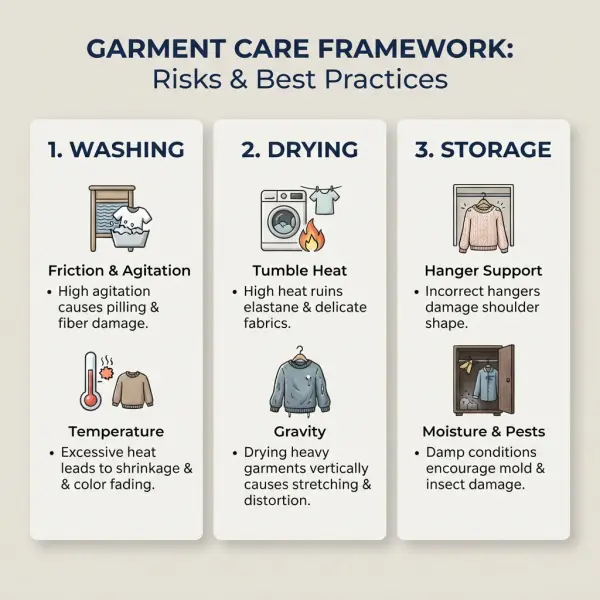
Many care failures occur because each stage is considered independently. A delicate garment may be washed perfectly and then distorted while drying. A sweater may be dried correctly and then stretched for months on an unsuitable hanger. A jacket may be professionally cleaned and returned to a damp or sun-exposed storage area.
A more useful way to think about everyday garment care is as a sequence:
|
Care stage |
Main variables |
Typical risks when unsuitable |
Better decision |
|
Washing |
Water, temperature, chemistry, mechanical action, load |
Color change, dimensional change, surface wear, snagging, component damage |
Follow garment-specific washing limits and match treatment to actual soil |
|
Drying |
Heat, movement, gravity, sunlight, time |
Shrinkage, distortion, stretching, fading, finish or component damage |
Use the drying method and severity permitted by the care label |
|
Storage |
Support, folding, compression, moisture, light, pests |
Stretching, creases, mildew, fading, holes, distortion |
Store clean and dry using support appropriate to the garment |
The table illustrates why a single rule cannot optimize every stage. The right outcome depends on compatibility between product design and the entire care sequence.
What This Means for Fashion Product Development
Care performance should be considered while the garment is being developed, not after production has already been completed. A design team selecting fabrics, trims, prints, elastic, linings, adhesives, and decorative components is effectively designing a care system as well as a garment.
The finished product should be able to withstand the care method being promised to the customer. In the U.S., FTC rules require covered manufacturers and importers to have a reasonable basis for care instructions and to consider the complete product, including non-detachable components. Other markets have their own regulatory frameworks, but the operational lesson remains useful globally: instructions should be based on evidence rather than assumption.
Care testing can also reveal product-development trade-offs before they become customer complaints. A visually appealing trim that restricts an otherwise washable garment to specialist cleaning may be appropriate for a premium occasion product but inconvenient on a frequently worn everyday item. A heavy knit that distorts easily when hung may require clear storage guidance. A print that needs a restrictive ironing instruction must communicate that requirement convincingly.
For brands, care is therefore connected to product positioning. The intended customer's willingness and ability to maintain the garment should be considered alongside aesthetics, performance, and price.
Retail Communication Should Set Ownership Expectations Before Purchase
Customers often discover demanding care requirements only after buying a product. That is technically too late for information that could have influenced the purchasing decision.
Where care is unusually restrictive or materially affects convenience, product pages can communicate it clearly before checkout. A customer choosing an everyday work blouse may evaluate "machine washable" differently from "professional clean only." Someone buying travel clothing may care about drying requirements. A customer considering heavy knitwear may benefit from knowing that the garment should be stored folded rather than hung.
This does not require turning every product page into a textile manual. A concise care summary can communicate what matters most, while the permanent label carries the formal instructions and a longer guide provides optional detail.
Clearer communication also reduces the temptation for brands to blame customers automatically when something goes wrong. If a garment has unusual limitations, those limitations should have been validated, communicated, and reflected in the product's intended use.
Common Washing, Drying, and Storage Mistakes
Treating Every Machine-Washable Garment the Same Way
"Machine washable" does not necessarily prescribe the same temperature or mechanical intensity for every product. Care symbols can specify different maximum temperatures and mild or very mild processes. Mixing everything into the same cycle may therefore expose some products to treatment outside their recommended conditions.
The better approach is to group garments with compatible care requirements rather than using machine washability as the only sorting criterion.
Assuming Machine Washable Also Means Tumble Dryable
Washing and drying instructions are separate because the garment can tolerate one process without necessarily tolerating another. Some products may be machine washed but require line drying, flat drying, shade drying, or another natural drying method.
Checking only the wash symbol and ignoring the drying symbol removes half of the relevant care information.
Hanging Heavy Wet Knitwear to Dry
A wet knit can carry significantly more weight than when dry, and gravity can pull on a flexible structure. Woolmark specifically recommends flat drying many wool sweaters and warns that line or hanger drying can stretch knitted garments.
This is a good example of why a method that works perfectly for one garment category may distort another.
Putting Clothing Away Before It Is Fully Dry
A garment that feels almost dry may still contain moisture in thicker areas such as waistbands, seams, cuffs, pockets, linings, or layered construction. Placing damp clothing into enclosed storage can create conditions that favor odor or moisture-related deterioration.
Allowing the complete garment to dry appropriately before storage is a simple preventive measure.
Hanging Every Garment Because It Looks More Organized
A visually neat wardrobe does not necessarily provide suitable support. Heavy knits, bias-cut pieces, weak shoulder constructions, or heavily embellished garments may distort when their entire weight is suspended from limited points.
Choose hanging or folding according to the garment's structure rather than according to one universal wardrobe aesthetic.
Copying Museum Preservation Rules Directly Into Everyday Wardrobes
Museum conservation sources provide valuable evidence about textile deterioration, but museum objects and daily clothing have different use cases. Archival temperature, humidity, support, and packaging recommendations are designed to preserve historical objects over very long periods with minimal use.
Consumers can borrow the underlying principles—avoid persistent dampness, excessive light, damaging folds, poor support, dust, and pests—without treating a normal wardrobe like a conservation laboratory.
What Brands and Consumers Should Verify Before Changing a Care Routine
Before adopting a new washing, drying, or storage practice, check whether the advice actually applies to the product involved. Internet care tips frequently generalize from fiber names or garment categories while overlooking finishes, components, construction, and tested care claims.
A practical verification sequence is:
- Read the full care label, including washing, bleaching, drying, ironing, and professional care symbols.
- Check the complete garment, not only the primary fiber composition.
- Identify the actual problem: routine soil, stain, odor, distortion, moisture, or damage.
- Choose a treatment within the permitted limits rather than defaulting to the harshest setting available.
- Use an appropriate drying method, particularly for shape-sensitive garments.
- Return the garment to storage only when sufficiently dry.
- Select hanging, folding, or other support according to garment construction and weight.
The objective is not to make clothing care complicated. It is to replace broad assumptions with a small number of better decisions.
Important Technical Caveats
Textile care advice is highly product dependent. Two garments containing the same nominal fiber can behave differently because yarn structure, fabric construction, dyeing, finishing, weight, pattern cutting, sewing, trims, prints, coatings, and manufacturing quality all affect the finished article.
Lower temperatures and gentler treatment may reduce some forms of stress, but they still need to deliver adequate cleaning for the garment's use conditions. Hygiene-sensitive clothing, heavily soiled workwear, and certain occupational garments may have requirements that are different from lightly worn fashion items.
Drying recommendations are similarly conditional. Flat drying may help preserve the shape of some knitwear, while other garments are designed for hanging or machine drying. Storage recommendations from museum conservation sources should also be interpreted as evidence about textile deterioration mechanisms, not as universal household specifications.
Most importantly, a correct care routine cannot compensate fully for poor product durability. Washing, drying, and storage influence garment performance, but material selection, manufacturing quality, construction, fit, finishing, and real-world wear remain part of the longevity equation.
Frequently Asked Questions About Washing, Drying, and Clothing Storage
Is It Better to Wash All Everyday Clothes in Cold Water?
Not automatically. A lower temperature may be suitable for many garments when it remains within their care instructions and provides adequate cleaning, but the correct choice depends on the product, soil level, detergent system, hygiene requirement, and label. GINETEX temperatures represent the maximum permitted washing temperature rather than a requirement to use that maximum every time. A practical approach is therefore to select an effective treatment that remains within the garment's validated care limits rather than applying one temperature universally.
Does a Gentle Wash Cycle Really Make a Difference?
It can for garments designed for reduced mechanical action. Under GINETEX care symbols, a bar beneath the wash tub indicates a milder process and two bars indicate a very mild process, meaning mechanical intensity is part of the garment's care requirement. The effect will still depend on the machine, load, garment construction, and other laundering variables. A gentle cycle is therefore useful when specified or appropriate, but it is not a substitute for checking all other care requirements.
Is Air Drying Always Better Than Using a Tumble Dryer?
No. The appropriate drying method depends on the garment. Some products are designed and labeled for tumble drying, while others require line drying, shade drying, flat drying, or another process. Even air drying can distort a garment when it is poorly supported; a heavy wet knit suspended from a hanger is a common example. Rather than ranking one method as universally better, follow the drying symbol and consider the garment's weight, construction, and shape sensitivity.
Why Do Some Sweaters Need to Be Dried Flat?
Wet knitwear can become heavier and more vulnerable to distortion because its flexible structure may stretch under gravity. Woolmark recommends flat drying many wool sweaters unless the product's care claim permits tumble drying or another method. This does not apply automatically to every sweater or every knitted fiber, so the garment-specific care instruction should still determine the final method.
Should Clothes Be Hung or Folded in a Wardrobe?
Use the method that provides suitable support. Structured woven garments often work well on properly shaped hangers, while heavy knits, fragile garments, some bias-cut pieces, and heavily embellished clothing can distort when suspended for long periods. Folding reduces hanger stress but can create creases or compression if done poorly. There is therefore no universal "hang versus fold" winner; garment weight, structure, surface, and storage duration should determine the choice.
Can Clothing Be Stored in Plastic Bags?
It depends on the product, duration, bag material, and storage conditions. For long-term textile preservation, conservation authorities generally discourage ordinary dry-cleaner plastic bags because they provide poor light protection and can create moisture-related concerns. Everyday short-term use is a different scenario, but garments being stored for extended periods should at minimum be clean and fully dry, with storage chosen to suit the material and local climate.
Can Sunlight Damage Clothes While They Are Drying or Stored?
Prolonged light exposure can contribute to fading and material deterioration in susceptible textiles. The Canadian Conservation Institute identifies visible light and ultraviolet radiation as deterioration mechanisms for textile fibers and dyes. This does not mean clothing must never be dried outdoors, but shade-drying instructions should be followed when specified, and long-term storage in strong direct sunlight is generally avoidable.
What Is the Best Simple Routine for Everyday Clothing?
Check the care label, determine whether the item actually needs cleaning, group it with compatible garments, use an effective process within the permitted washing limits, dry it according to the specified method, make sure it is sufficiently dry, and then store it with appropriate support. That routine is more reliable than memorizing a list of universal laundry hacks because it adapts to differences between garments. More broadly, it complements everyday clothing care habits that support garment longevity.
Conclusion: Care Methods Shape How Fashion Performs After Purchase
Washing, drying, and storage are not separate domestic chores added after a garment's "real" lifecycle. They are recurring stages in that lifecycle, and they influence how the product looks, fits, feels, and functions as it ages.
Washing exposes clothing to water, cleaning chemistry, temperature, movement, and contact with other items. Drying adds its own combination of heat, mechanical action, gravity, airflow, sunlight, and time. Storage determines whether the garment is supported properly and protected from avoidable moisture, light, compression, dust, and pests.
None of those variables has one ideal setting for all fashion products.
The practical objective is therefore appropriate care rather than minimum care or maximum care. An everyday T-shirt should not automatically be treated like a wool sweater, just as a structured jacket should not be stored like lightweight knitwear. Care labels, material knowledge, construction, actual soil, and intended use all contribute to the decision.
For fashion businesses, the same principle extends upstream. Products should be developed and tested with their realistic care cycle in mind, and customers should understand meaningful maintenance requirements before those requirements become a source of dissatisfaction.
That connection between ownership behavior, garment use, resource consumption, repair, and purchasing choices leads to the broader question addressed in the next cluster article: why garment care is becoming part of conscious style.





Comments 0
Leave a CommentSend Comment
Anda harus Login terlebih dahulu untuk dapat memberikan komentar.