
Why Eventwear Still Matters in Everyday Fashion Culture
Quick Answer
Eventwear still matters because fashion is not used only for ordinary routines. People also dress for weddings, celebrations, graduations, religious ceremonies, parties, professional milestones, formal dinners, performances, and other moments that are intentionally different from everyday life.
These occasions create space for clothing to become more expressive, polished, symbolic, or memorable. They also influence everyday fashion. Fabrics such as satin and velvet, sharper tailoring, decorative trims, statement accessories, refined footwear, and silhouettes first associated with evening or special-event dressing regularly move into less formal wardrobes.
For fashion businesses, eventwear therefore has significance beyond a standalone “occasionwear” department. It can support brand imagery, product experimentation, seasonal merchandising, accessories, styling content, rental or resale models, and versatile products that consumers can dress up or down.
The important distinction is that modern eventwear does not have to mean a garment worn once and stored indefinitely. Some pieces are intentionally specialized, while others can be designed for repeated use across events and everyday wardrobes.
Eventwear remains relevant because special occasions continue to create different clothing needs—and different emotional expectations—from ordinary days.
What Is Eventwear?
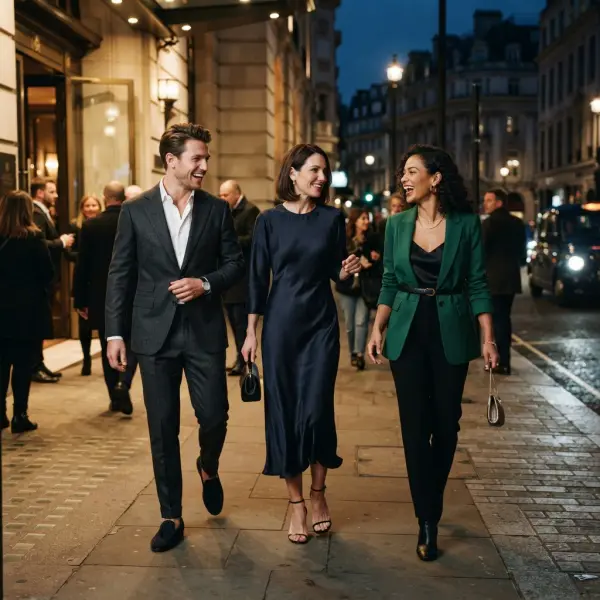
Eventwear is clothing designed, selected, or styled for social, ceremonial, professional, or celebratory occasions where the wearer expects a different level of presentation from ordinary daily dress.
The category can include evening gowns, cocktail dresses, tuxedos, formal suits, jumpsuits, tailored separates, culturally specific ceremonial clothing, dressy footwear, accessories, and less formal pieces styled for an event context.
That makes eventwear broader than formalwear.
A black-tie gown is clearly eventwear, but so is a relaxed linen suit chosen for a destination celebration, a polished co-ord worn to a graduation dinner, or an elevated dress used for a company reception.
It is also useful to distinguish eventwear from occasion dressing. Eventwear describes the clothing or product territory. Occasion dressing describes the decision process through which the wearer evaluates an event and chooses what to wear.
That broader decision framework is covered in occasion dressing for modern consumers. The role of specific formality signals is explored separately in how dress codes influence fashion choices for events.
Here, the more interesting question is different:
Why does clothing intended for relatively infrequent occasions continue to matter to fashion as a whole?
Special Clothing Has Long Occupied an Important Place in Fashion
The distinction between everyday dress and clothing for important social occasions is not a recent retail invention.
Historically, fashion systems frequently separated clothes according to time of day and social function. The Victoria and Albert Museum's history of the fashion show describes traditional couture presentations progressing through daywear categories before reaching cocktail, semi-evening, short evening, and other evening dress. Eveningwear effectively occupied the culminating part of the presentation. V&A history of the fashion show
That historical structure should not be copied directly into contemporary wardrobes. Social life, gender expectations, employment, travel, manufacturing, retail, and definitions of formality have changed substantially.
What remains relevant is the separation between ordinary dressing and heightened dressing.
Fashion has long had spaces in which greater construction, decoration, textile richness, or silhouette experimentation become socially acceptable. Weddings, balls, receptions, ceremonies, performances, and formal dinners have provided some of those spaces.
Eventwear still performs that function today, even when the garments themselves have become less rigid.
Why Do People Still Dress Differently for Events?
The simplest answer is that events are meant to feel different.
Clothing helps reinforce that distinction.
A graduation marks the completion of a period of study. A wedding marks a relationship and family milestone. An awards ceremony makes achievement visible. A religious celebration may carry communal or spiritual significance. A gala or formal dinner creates a deliberately heightened social environment.
People do not necessarily need expensive or elaborate clothing to participate in these moments. But changing the way they dress can help signal that the day does not belong to the ordinary routine.
This gives eventwear several overlapping functions.
It can communicate respect for the event, participation in a group ritual, social identity, personal style, celebration, professionalism, or simply the desire to feel different for several hours.
Those meanings vary considerably between cultures and individuals. It would be misleading to claim that every consumer experiences event dressing emotionally in the same way.
Yet the continued existence of event-specific fashion categories demonstrates a practical reality: consumers frequently make different clothing decisions when a particular date, venue, host, ceremony, or audience matters.
Eventwear Gives Fashion More Room for Expression
Everyday clothing normally has to negotiate repetition.
It may need to work for commuting, sitting at a desk, caring for children, walking, traveling, unpredictable weather, frequent laundering, or several activities within the same day. Those constraints often reward versatility and ease.
Eventwear can operate under a different brief.
A garment may be allowed to be more structured, elongated, reflective, delicate, decorative, tailored, or visually dramatic because it is designed for a narrower situation.
This difference creates creative space.
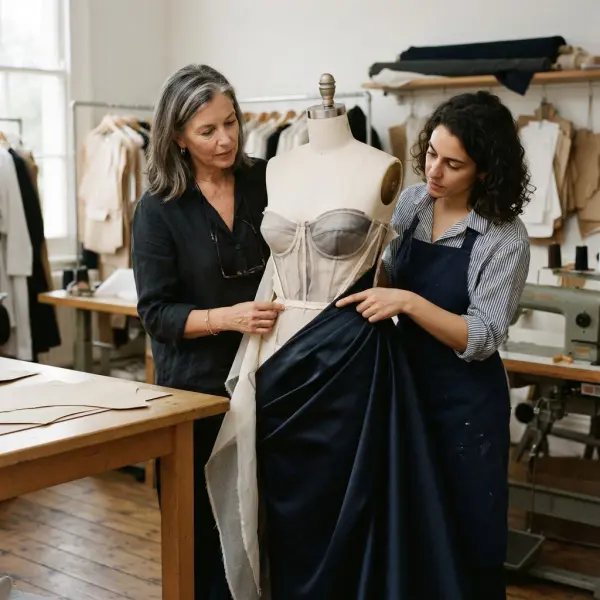
A designer can explore volume that would be cumbersome on public transport. A fabric can be selected for evening light rather than office practicality. Surface decoration may become part of the visual identity. Tailoring can become sharper because the product does not need to behave like relaxed weekend clothing.
Some of fashion's most technically ambitious garments have emerged from this territory. The Metropolitan Museum of Art, for example, describes a 1938 Charles James evening dress whose silhouette relied on a lightly stiffened foundation, silk-covered internal ribs, multiple gores, darts, and internal support structures. The Met's Charles James evening dress
Most contemporary occasion brands are not building garments at this couture level. The example matters because it illustrates a larger point: special-event clothing can support forms of garment engineering that everyday basics rarely require.

How Does Eventwear Influence Everyday Fashion?
The influence usually happens through translation rather than direct copying.
Consumers rarely start wearing full evening gowns for ordinary errands because formalwear appears on a runway or red carpet. Instead, individual components move into everyday fashion in more practical forms.
A visual idea may begin in high-impact event dressing and later appear as a simpler blouse, skirt, shoe, jacket, or accessory.
Common translations include:
|
Eventwear Element |
Everyday Translation |
|
Satin evening fabric |
Satin skirt, blouse, camisole, or relaxed shirt |
|
Formal tailoring |
Oversized blazer or structured everyday trousers |
|
Metallic surface |
Metallic flat, handbag, sneaker detail, or knit |
|
Sequins and embellishment |
Decorated collar, small trim, evening-to-day knit |
|
Corsetry or boning references |
Structured bodice, seam detailing, fitted top |
|
Full skirt volume |
Softer midi skirt or gathered everyday dress |
|
Statement jewelry |
Single focal accessory with simple clothing |
|
Tuxedo references |
Dinner-inspired blazer worn with denim or casual trousers |
|
Sheer evening layers |
Mesh tops, sheer overlays, or layered skirts |
|
Formal velvet |
Velvet jacket, shoe, bag, or seasonal separate |
What changes is usually intensity.
The materials may become easier to care for. Shapes become less restrictive. Decoration is reduced. Shoes become flatter. Tailoring becomes softer. A dramatic full look is separated into individual components.
This process gives eventwear influence far beyond the number of highly formal garments consumers actually buy.
The Boundary Between Eventwear and Everyday Clothing Is Increasingly Flexible
A useful way to understand modern eventwear is not as a completely separate wardrobe but as one end of a clothing spectrum.
At one end are genuinely specialized garments: ceremonial clothing, highly formal gowns, tuxedos, bridalwear, or technically complicated evening pieces.
At the other are everyday garments that can become event-ready through styling.
Between them sits a large commercial territory: products that are elevated enough for events but sufficiently adaptable to be worn again.
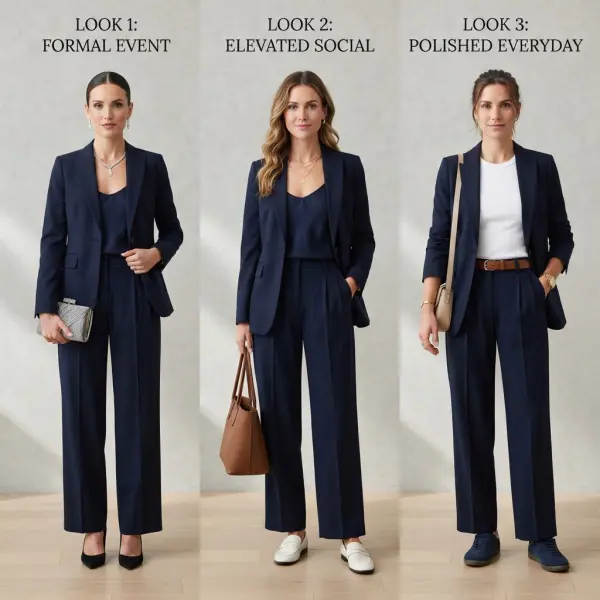
Consider a well-cut dark suit.
It might appear at a wedding with formal shoes and accessories, at a presentation with a shirt, or later as separate trousers and jacket in everyday professional wardrobes.
A fluid midi dress can work similarly. Styled with refined shoes and jewelry it can serve an evening event; paired with a cardigan or lower-profile footwear it may become suitable for other settings.
This versatility does not eliminate dedicated eventwear.
It expands the number of ways consumers can participate in occasion dressing.
Why Rewear Matters More for Eventwear
Eventwear faces a particular value problem: a garment can be emotionally important but worn infrequently.
That tension becomes more visible when the item is expensive, highly recognizable, difficult to style differently, complicated to care for, or suitable for only a narrow range of occasions.
Designing for rewear can therefore improve practical product value.
It may involve:
- separates rather than one-piece outfits;
- removable decorative elements;
- adaptable straps or styling configurations;
- restrained rather than highly event-specific embellishment;
- colors that integrate into the customer's existing wardrobe;
- jackets, skirts, or trousers that work independently;
- construction durable enough for repeated wear and cleaning.
Rewear should not be presented as an automatic sustainability claim. A product does not become environmentally preferable merely because a brand describes it as versatile. Actual impact depends on whether it replaces other purchases, how often it is used, how it is produced, how it is cared for, and what happens later in its life.
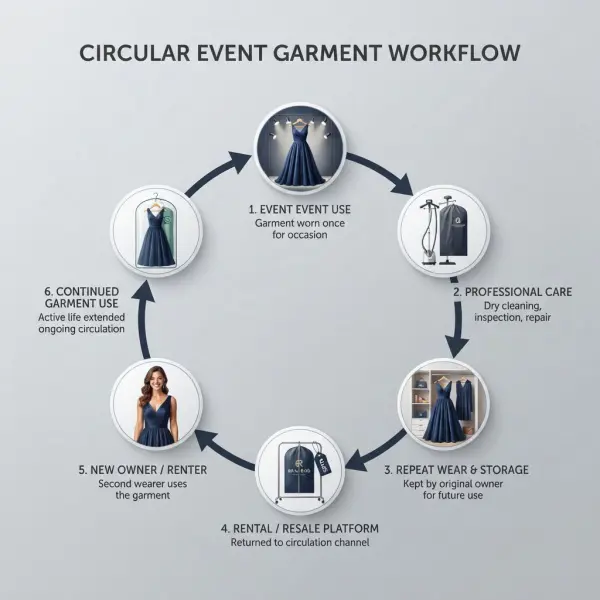
The Ellen MacArthur Foundation's circular-fashion framework similarly emphasizes increasing the use of products and identifies models such as rental, resale, repair, and remaking as ways of circulating clothing rather than relying entirely on new product sales. Ellen MacArthur Foundation on circular fashion business models
For eventwear, that principle is especially relevant because occasional use creates an obvious opportunity to ask whether ownership of a new garment is always necessary.
Rental and Resale Fit Some Eventwear Needs Particularly Well
Eventwear has characteristics that can make rental or resale attractive in certain markets.
The garment may be needed for one particular date. The customer may want visual novelty rather than repeated ownership. Higher-value pieces can be expensive relative to the number of expected wears. Some customers also have limited storage for formal garments.
Rental can address those issues when there is adequate inventory, fit information, cleaning capability, reverse logistics, and customer acceptance.
Resale addresses a different problem. A garment purchased for one event may still retain significant functional and aesthetic life even if the original owner no longer wants to wear it.
Neither model is operationally simple.
Rental businesses must manage cleaning, inspections, damage, alterations, delivery windows, returns, sizing, inventory availability, and product turnaround. Event purchases are also deadline-sensitive; a late rental delivery can be far more damaging to the experience than a late everyday purchase.
Resale has its own challenges around authentication where relevant, condition grading, sizing, pricing, photography, and unpredictable supply.
The business opportunity is real, but the operational model matters as much as the fashion appeal.
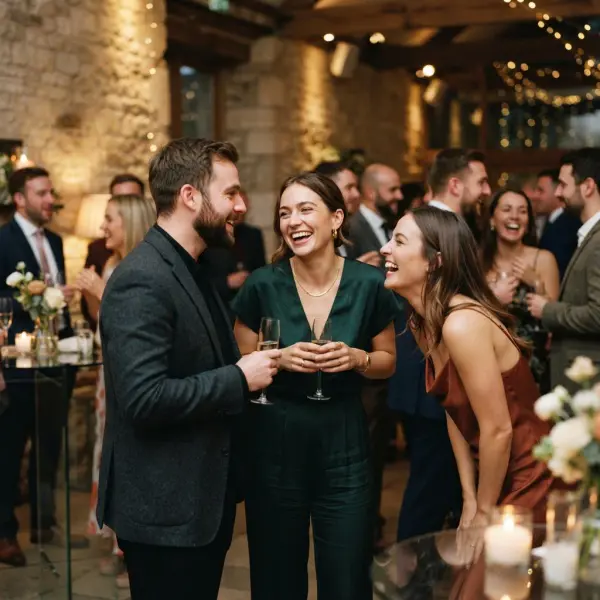
Social Media Changes the Visibility of Eventwear, Not Its Basic Purpose
Photography has always mattered to many celebrations, but digital sharing increases the number of people who may see an event look.
A wedding guest outfit might appear not only in a family album but across Instagram, TikTok, messaging groups, professional networks, or other digital channels. Brand events and award ceremonies can generate images that circulate far beyond the physical guest list.
This visibility may encourage some consumers to think more deliberately about distinction, novelty, styling, or whether an outfit has already appeared prominently in photographs.
However, it would be an overstatement to say social media is the reason eventwear matters.
Weddings, ceremonies, celebrations, and formal social dress existed long before social platforms.
Digital media changes the reach and lifespan of the image. It does not create the underlying human tendency to mark significant occasions through appearance.
For brands, the useful implication is that eventwear increasingly needs to succeed in two environments at once: physical experience and visual representation.
A garment still has to fit, move, remain comfortable, and survive several hours of use. Photogenic styling cannot compensate for poor construction.
Eventwear Helps Create Brand Aspiration
Some products are commercially valuable not only because of unit sales but because of what they communicate about the brand.
Eventwear can perform that role.
An evening dress may use more distinctive fabric, silhouette, styling, or craftsmanship than a brand's core everyday products. That gives campaigns, retail windows, editorials, launch events, and social content a focal point.
The product can communicate:
“This is what our design language looks like when it is intensified.”
For a tailoring brand, that may mean sharper proportions and refined evening fabrication.
For a romantic womenswear label, it may involve controlled volume, delicate surface detail, or special fabrics.
For a minimalist business, eventwear may remain exceptionally simple but rely on proportion, cut, textile quality, and finish.
Aspiration should not be confused with extravagance.
A restrained black dress can function as a brand-defining event product just as effectively as a heavily embellished gown if it expresses the design identity clearly.
Eventwear Can Act as a Product-Development Laboratory
Special-event products can also allow businesses to test ideas at higher intensity before adapting them elsewhere.
Suppose a brand develops a sculptural neckline for an event capsule. If the design resonates with customers but the original garment is too formal for regular use, the shape might later be translated into a simpler top.
A successful embellished textile might inspire a smaller trim treatment.
An event jacket with strong shoulder architecture could influence the following season's workwear blazer.
This does not mean brands should intentionally overdesign event collections merely to generate ideas.
The useful principle is that product categories can inform one another.
Eventwear can push silhouette, material, finishing, and styling further. Everyday collections then identify which parts of that experimentation have broader commercial relevance.
That creates a two-way relationship:
everyday requirements make eventwear more wearable, while eventwear gives everyday fashion new expressive ideas.
Everyday Fashion Is Also Making Eventwear Less Rigid
The influence does not run in only one direction.
Consumers accustomed to comfort, sneakers, knitwear, relaxed tailoring, modular wardrobes, and flexible styling bring those expectations into event dressing.
As a result, contemporary eventwear can incorporate characteristics that were once associated more strongly with everyday clothing:
- softer tailoring;
- stretch;
- pockets;
- lower-profile footwear;
- separates;
- adjustable construction;
- lighter layering;
- simpler maintenance;
- silhouettes that permit movement.
This does not mean traditional formalwear is disappearing. Highly formal and ceremonial events still exist.
Instead, the market has become more layered.
Some consumers want a specialist garment precisely because the event feels exceptional. Others want a product that meets the event requirement but returns easily to normal wardrobe life.
Both needs can coexist.
Why Accessories Are Important to the Eventwear Economy
Accessories can change formality without requiring the customer to replace the main garment.
A familiar dress may feel substantially different with another shoe, evening bag, belt, jewelry combination, scarf, tie, or outer layer.
This gives accessories a strategic role in eventwear merchandising.
They can provide novelty at a lower commitment than purchasing a new full outfit and can extend the range of contexts in which existing clothing feels appropriate.
For fashion businesses, that creates opportunities beyond obvious cross-selling.
A strong occasion edit can begin with a relatively small apparel range and expand its usefulness through footwear, jewelry, bags, outerwear, hosiery, and styling guidance.
The key is coordination.
An accessory recommendation is useful when it solves a styling or functional problem. It becomes noise when the retailer simply displays whatever high-margin items are available.
What Eventwear Means for Fashion Merchandising
Traditional merchandising often organizes inventory according to product type: dresses, trousers, jackets, shirts, shoes.
Customers preparing for events frequently think differently.
Their starting question is more likely to be:
“What can I wear to this?”
That shift from product intent to occasion intent is commercially significant.
A retailer can merchandise across categories around scenarios such as evening celebrations, graduation, work events, destination weddings, formal dinners, festive occasions, or daytime ceremonies.
The customer can then discover a suit next to a dress, a jumpsuit next to separates, and an accessory solution alongside all three.
This type of navigation works best when it connects to the contextual principles in event dress-code interpretation rather than using event labels as decorative marketing terms.
A black-tie landing page should actually reflect black-tie formality. A graduation edit should consider sitting, academic robes where relevant, photographs, weather, and footwear. A destination event page should account for packing and climate.
Useful merchandising begins with the event problem.
How Fashion Businesses Can Use Eventwear Strategically
The strongest strategy is not necessarily to launch a large occasionwear collection.
Brands should first determine what role eventwear can realistically play within their existing positioning.
Identify the Occasion Territory
A contemporary workwear label may have strong relevance for conferences, networking events, business dinners, graduations, and civil ceremonies without needing to produce ballroom gowns.
A romantic dress brand might naturally extend into wedding guest and celebration dressing.
A menswear brand could move between business tailoring, wedding suits, dinner jackets, and accessories.
The territory should follow product capability and customer need.
Decide How Specialized the Product Should Be
Some customers want maximum distinction. Others want versatility.
Brands need to decide deliberately where each product sits.
A highly embellished gown does not need to pretend it is an everyday dress. Equally, a versatile midi dress should not be made artificially formal simply to justify an “occasionwear” label.
Clear product roles make the range easier to understand.
Design for the Actual Wearing Experience
Fit, seating, walking, dancing, temperature, closure security, fabric abrasion, transparency, bag compatibility, and footwear all matter.
Event products are often purchased for a date that cannot move.
That increases the importance of accurate size information, reliable delivery, exchange policies, quality control, and realistic product imagery.
Show More Than One Life for Versatile Products
If rewear is genuinely possible, demonstrate it.
A product page or editorial can show the same blazer at a wedding and later with denim. A satin skirt might appear first in an evening look and then with knitwear. A coordinated set can be shown together and separately.
This makes versatility concrete rather than promotional.
Common Mistakes in Eventwear Strategy
One common mistake is assuming that eventwear must always be visually dramatic. Some customers want quiet, precise clothing for significant occasions rather than decoration.
Another is treating “occasionwear” as synonymous with dresses. Tailoring, trousers, coordinated sets, jumpsuits, accessories, traditional garments, and other forms of dress can all participate in event culture.
Brands also risk designing solely for imagery. A garment that performs well during a ten-minute campaign shoot may still fail when worn through a six-hour event.
A fourth mistake is using sustainability language too casually. “Wear it again” is good styling advice, but it is not proof of reduced environmental impact. Reuse, durability, rental, and resale can support increased utilization, but their real outcomes depend on customer behavior and the operating model.
Finally, brands can overestimate the number of highly specialized products the customer actually needs. Sometimes better styling, product information, navigation, alterations, or accessories solve the occasion problem with less inventory risk.
What Eventwear Does Not Mean
Eventwear does not mean that people need a new outfit for every invitation.
It does not mean that a garment must be expensive to be appropriate.
It does not mean that highly formal Western clothing is the universal standard for important occasions.
It does not mean that an event-specific product is inherently wasteful, nor that a versatile garment is inherently sustainable.
And it does not mean everyday comfort must disappear as soon as clothing becomes special.
These distinctions matter because eventwear is often discussed at extremes: either as glamorous fantasy or unnecessary consumption.
The reality is more practical.
Special occasions create real clothing needs. The fashion industry's challenge is to meet those needs in ways that fit different cultures, budgets, wardrobes, business models, and expectations of use.
Eventwear Matters Because Fashion Is Part of How People Mark Time
Everyday clothing is shaped by repetition. Eventwear is shaped by moments.
A garment may become connected with a wedding, graduation, anniversary, performance, promotion, family celebration, or professional milestone. That association can give clothing significance beyond its material construction.
Not every wearer becomes emotionally attached to an event outfit, and brands should not manufacture sentimental claims on behalf of consumers.
But fashion's relationship with memory helps explain why special-event garments often receive more attention than the number of annual wears alone would suggest.
They appear when people expect to be photographed, witnessed, celebrated, introduced, congratulated, or remembered.
That is a different product context from ordinary daily dressing.
Frequently Asked Questions About Eventwear
Is eventwear the same as formalwear?
No. Formalwear is a narrower category associated with relatively high levels of formality, while eventwear can cover clothing for many types of planned social or ceremonial occasions.
A black-tie gown or tuxedo is eventwear, but a tailored jumpsuit for a cocktail reception, a polished suit for graduation, or refined separates for a celebration can also fall within the broader eventwear territory.
For retailers, this distinction is useful because occasion customers should not automatically be directed toward the most formal products. The correct assortment depends on the event context and its expected level of dress.
Why does eventwear influence everyday fashion?
Eventwear provides space for stronger silhouettes, richer materials, decorative surfaces, tailoring, and statement accessories. Elements that attract interest in that setting can later be translated into more practical everyday products.
A full satin evening look might become a simple satin skirt. Formal tailoring can influence everyday blazers. Decorative evening details may appear as smaller trims.
The transfer is rarely literal. Everyday clothing usually reduces the intensity and improves practicality while retaining the visual idea. This allows fashion concepts associated with special occasions to circulate through much broader wardrobes.
Does modern eventwear need to be reusable?
Not every garment needs to serve multiple contexts. Some ceremonial or highly formal products are intentionally specialized.
However, rewear potential can be commercially useful when customers are concerned about value, storage, or limited opportunities to use formal clothing. Separates, adaptable styling, restrained embellishment, and products that work across different levels of formality may increase practical usefulness.
Brands should avoid presenting versatility as proof of sustainability. The benefit depends on actual use. A garment designed for ten possible occasions but worn only once has not automatically achieved higher utilization.
Is renting eventwear better than buying it?
It depends on the product, customer, price, location, logistics, and expected future use.
Rental can be attractive when a customer needs an expensive or distinctive garment for a limited period and is unlikely to wear it repeatedly. Buying may make more sense when the garment will be reused frequently, needs alterations, or has long-term personal value.
Rental also has operational impacts from cleaning, transport, packaging, repairs, and reverse logistics. It should therefore be evaluated as a business model rather than automatically described as the environmentally preferable choice in every case.
How can brands make eventwear more commercially versatile?
One approach is to design an assortment with different levels of specialization rather than making every product highly event-specific.
A collection might combine one statement dress, adaptable tailoring, coordinated separates, a simpler evening dress, and accessories that allow the same core products to shift between events.
Merchandising can reinforce this versatility through styling photography showing repeat use. Brands should also provide detailed fit and fabrication information because customers purchasing for a fixed event date have less tolerance for uncertainty or complicated returns.
Will casual fashion make eventwear irrelevant?
There is little basis for assuming that casualization automatically removes the need for eventwear.
It can change what eventwear looks like. Consumers accustomed to comfort may prefer softer tailoring, more flexible footwear, pockets, stretch, lighter construction, or products they can reuse.
But weddings, ceremonies, celebrations, professional events, and formal gatherings still create contexts in which people may want to dress differently from ordinary daily life.
The more realistic expectation is continued blending between comfort-oriented everyday clothing and event-oriented presentation rather than the complete disappearance of either category.
What should fashion businesses verify before expanding into eventwear?
They should first verify whether their customers actually attend occasions that match the proposed products.
Useful questions include which events matter, what level of formality customers need, how much they are willing to spend, whether they prioritize rewear, how precise the fit must be, and whether their market prefers ownership, rental, or resale.
Brands should also evaluate operational issues such as delivery deadlines, alterations, returns, specialist cleaning, inventory seasonality, and quality expectations. Eventwear can produce strong imagery, but that alone does not prove there is enough demand to support a large specialized assortment.
Conclusion
Eventwear continues to matter because fashion serves more than everyday utility.
People use clothing differently when the occasion itself carries meaning. Weddings, ceremonies, professional milestones, celebrations, and formal gatherings create reasons to change silhouette, material, styling, or level of presentation.
Those products then feed ideas back into ordinary wardrobes.
Satin becomes a daytime skirt. Evening tailoring becomes a blazer. Formal separates become workwear. Statement accessories refresh familiar clothing. At the same time, everyday expectations around comfort, versatility, and repeated use are reshaping eventwear itself.
For fashion businesses, this means eventwear should not be viewed only as a rack of dresses reserved for rare occasions. It can be a design territory, merchandising framework, styling opportunity, brand-expression tool, and use case for rental, resale, or more versatile product architecture.
The strongest strategies recognize both sides of the category.
Some moments deserve specialized clothing. Other occasions can be served by garments that move naturally back into everyday life.
Eventwear remains culturally relevant precisely because fashion still needs both.




Comments 0
Leave a CommentSend Comment
Anda harus Login terlebih dahulu untuk dapat memberikan komentar.