

Why Statement Accessories Are Becoming Central to Modern Styling
Quick Answer
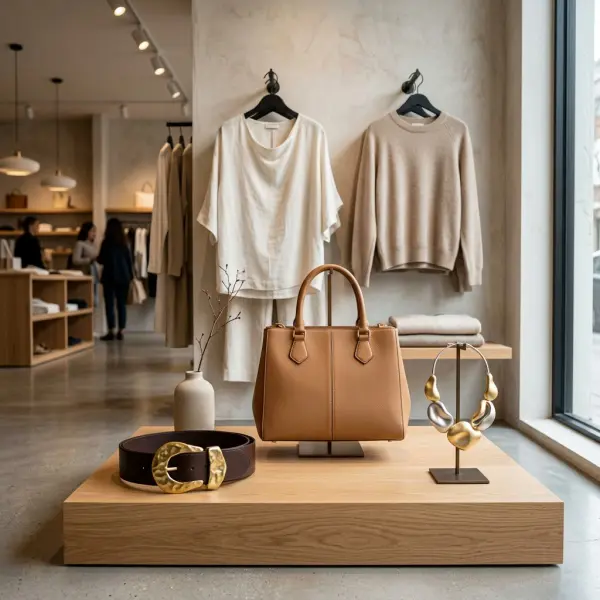
Statement accessories are becoming central to modern styling because they can establish the identity, visual hierarchy, and emotional tone of an outfit without requiring every garment to be visually complex. A sculptural necklace, distinctive belt, structured bag, expressive scarf, bold eyewear frame, or carefully placed brooch can turn familiar clothing into a more recognizable personal look.
The shift is visible in recent runway styling, where belts, brooches, pendants, scarves, gloves, hats, and oversized eyewear have frequently been used as defining elements rather than incidental finishing touches. Jewelry is also receiving greater commercial attention. McKinsey’s State of Fashion 2026 reports that jewelry unit sales growth has been outpacing other fashion categories, supported partly by demand for creative designs, personalization, and self-expression.
This does not mean every outfit needs a large or decorative accessory. A statement can be created through proportion, material, craftsmanship, symbolism, or unexpected placement. The larger change is strategic: accessories are increasingly being considered at the beginning of the styling and product-development process, not simply added after the clothing has been selected.
What Is a Statement Accessory?
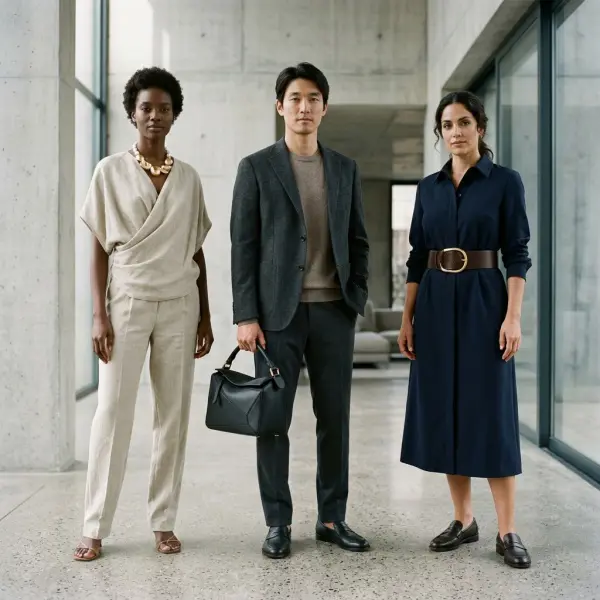
A statement accessory is a fashion item designed or styled to become one of the main visual or symbolic focal points of an outfit. It may attract attention through its shape, scale, color, texture, material, craftsmanship, cultural meaning, placement, or contrast with the surrounding garments.
The category is broader than oversized jewelry or brightly colored bags. A small silver brooch can become a statement when it is placed unexpectedly on a plain knit top. A slim belt may dominate a look when its buckle creates a sharp contrast against monochromatic tailoring. A black bag can function as a focal piece through an unusual handle, rigid geometry, or distinctive surface treatment, even without decorative color.
Statement accessories may include:
- handbags and small leather goods;
- jewelry, watches, and body adornment;
- belts and decorative harnesses;
- scarves, ties, and textile accessories;
- eyewear and fashion-oriented wearable products;
- hats, gloves, and hair accessories;
- brooches, charms, straps, and detachable trims;
- footwear when it serves as the primary visual anchor.
The defining characteristic is not simply visibility. It is influence. A statement accessory changes how the rest of the outfit is perceived.
Statement Does Not Always Mean Maximalist
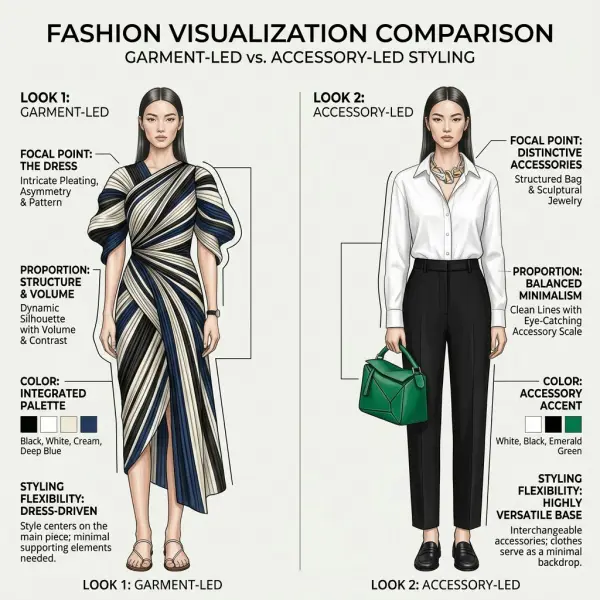
A statement piece can be bold without being heavily embellished. Minimalist accessories often make their impact through exact proportion, strong geometry, unusual material combinations, or deliberate restraint.
Consider a long, narrow pendant worn over an unbroken black silhouette. The necklace may contain little decoration, yet its vertical line changes the proportion and focal direction of the entire outfit. Similarly, a carefully structured handbag can communicate authority and precision without using bright colors, logos, or ornamental hardware.
This distinction matters to fashion businesses. When statement design is interpreted only as “larger, brighter, and more decorated,” brands may create products that attract attention in campaign images but prove difficult to integrate into customers’ wardrobes. Strong accessories usually have one clear point of distinction supported by disciplined secondary details.
Why Are Accessories Moving to the Center of Styling?
Accessories are moving closer to the center of styling because many contemporary looks rely on relatively familiar garments combined with distinctive personal details. Instead of building visual interest entirely through a complicated dress, jacket, or printed ensemble, the wearer can use an accessory to determine the mood and identity of the look.
Recent fashion coverage provides evidence of this emphasis. Vogue’s review of the Fall 2025 collections identified belts, brooches, scarves, pendant necklaces, hats, gloves, ties, tassels, and oversized sunglasses as recurring elements that helped define and personalize runway looks. Its Spring 2026 styling coverage also highlighted brooches, scarves, decorative footwear, and other focal elements as ways of introducing stronger expression into otherwise wearable outfits.
Readers can review the Fall 2025 small-accessories analysis for specific runway examples. The source documents a seasonal direction rather than proving a permanent or universal market shift.
Several connected forces are supporting this development.
|
Styling or Market Driver |
What It Changes |
Implication for Fashion Businesses |
|
Greater emphasis on individual expression |
Accessories introduce recognizable personal details |
Brands need stronger product codes rather than generic add-ons |
|
Continued use of wardrobe staples |
Familiar garments can support several styling directions |
Accessories can extend the relevance of core apparel |
|
Visual-first digital discovery |
Distinctive shapes and details can be recognized quickly |
Silhouette, scale, and styling clarity become important |
|
Interest in customization |
Charms, stacking, engraving, and interchangeable parts enable participation |
Modular product systems may support repeat engagement |
|
Combination of function and identity |
Bags, belts, eyewear, and watches remain useful while communicating style |
Design must balance expression with comfort and performance |
|
Selective discretionary spending |
Some customers may prioritize one distinctive product over several less differentiated items |
Product value must be clear, not based only on novelty |
|
Growth in selected accessory categories |
Jewelry and related products attract greater strategic attention |
Apparel brands may enter adjacent categories but need specialist capabilities |
Not all these factors operate equally in every region or consumer segment. Climate, income, cultural norms, dress codes, retail access, and local aesthetic preferences affect how statement accessories are adopted.
Personal Expression Is Changing the Role of Accessories
Accessories are well suited to personal expression because they can communicate highly specific information while leaving the main clothing relatively adaptable. They may indicate taste, profession, subculture, memory, heritage, humor, status, craftsmanship preferences, or attachment to a particular community.
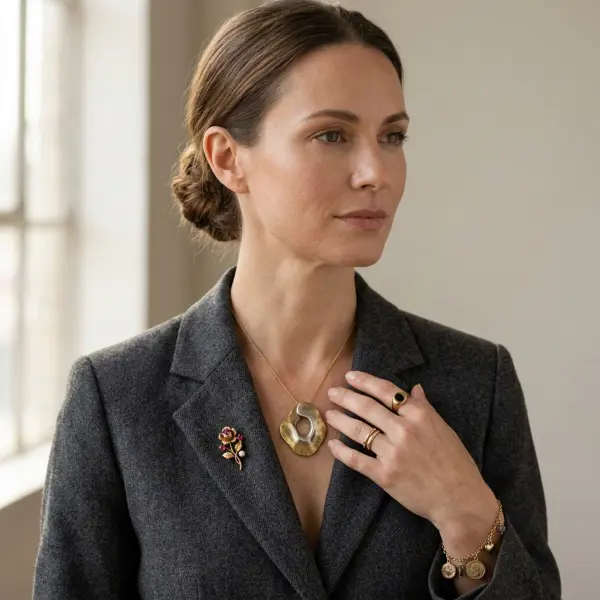
A pendant may commemorate a relationship. A vintage brooch can connect contemporary tailoring to another period. A handwoven scarf may communicate an appreciation of craft or regional textile traditions. An unusual pair of glasses can become part of a person’s recognizable public image.
Research on clothing behavior consistently treats dress as connected to identity and self-expression, although the strength and meaning of that relationship vary between individuals. A 2024 study on clothing-style confidence, for example, examined how personal values, confidence in one’s style, and interest in keeping or adapting clothing interact. The study involved 565 respondents in the United States, so its findings should not be generalized automatically to every market.
The research can be reviewed through this study on clothing-style confidence and personal values.
Accessories are particularly effective identity tools because they can be layered and recombined. A person may wear the same jacket repeatedly while changing the social or aesthetic message through a neck scarf, a group of brooches, a belt, or different jewelry.
The accessory does not merely decorate the wearer. It helps interpret the clothing.
Personalization Gives Customers a More Active Role
Personalization can turn an accessory from a completed design into a product that customers continue to shape. Charm systems, engraving, adjustable chains, interchangeable straps, removable handles, modular pendants, and stackable jewelry allow wearers to create combinations that feel more individual.
This can be commercially useful because it creates a relationship between the core product and later additions. A customer may begin with a bracelet and return for a charm, or purchase a bag and later add a different strap. The model can support repeat sales without requiring a completely new hero product each season.
However, modularity should provide genuine value. Adding decorative components simply to create frequent purchases may produce an assortment with little long-term relevance. Successful personalization systems normally need:
- reliable compatibility between components;
- clear dimensions and attachment mechanisms;
- consistent availability of core items;
- understandable visual relationships;
- durable connectors and closures;
- enough variety to feel personal without creating excessive complexity.
The strongest systems make the customer a participant without transferring all design responsibility to them.
Jewelry Shows Why Identity-Led Accessories Matter Commercially
Jewelry provides one of the clearest examples of accessories combining emotional meaning, visible design, repeat purchasing, and commercial growth. Unlike many garments, jewelry can be worn frequently across changing outfits, layered with existing pieces, purchased as a gift, or selected to commemorate a personal event.
McKinsey and The Business of Fashion reported in The State of Fashion 2026 that jewelry unit sales growth was outpacing other major fashion categories. In the consumer research cited by the report, 75% of respondents preferred creative or unique jewelry designs, while 71% associated jewelry with expressing personality. The exact findings should be interpreted within the markets and consumers included in the research rather than treated as global constants.
The State of Fashion 2026 report connects the category’s momentum with self-expression, self-purchasing, personalization, stacking, symbolism, and demand for products perceived as distinctive.
This evidence does not mean that every fashion brand should launch jewelry. Category expansion requires technical knowledge, reliable suppliers, quality standards, appropriate testing, and a credible connection to the wider brand identity.
The more useful lesson is that customers may value accessories not only as decorative objects but as portable expressions of identity. Fashion businesses that understand that motivation can develop products with greater emotional and styling relevance.
Accessories Support a More Modular Approach to Dressing
A modular wardrobe is built around garments that can produce several distinct looks through changes in layering, proportion, footwear, and accessories. Statement accessories support this approach because they can change the interpretation of an outfit without changing every item.
A plain white shirt and dark trousers can appear formal with a structured bag, narrow leather belt, and polished metal jewelry. The same clothes can feel more relaxed with a soft woven bag, printed scarf, and organic-shaped earrings. The garments remain stable, while the styling message changes.
The detailed mechanics of focal points, contrast, scale, and proportion belong more directly in how accessories transform simple outfits into stronger looks. At the strategic level, the important point is that accessories increase the number of narratives a brand or customer can build around a limited group of garments.
For fashion companies, this can support several activities:
- styling new accessories with previous apparel releases;
- extending content around core products;
- giving customers practical reasons to revisit familiar garments;
- developing seasonal updates without replacing an entire wardrobe concept;
- creating coordinated product families across categories;
- encouraging repeat engagement through styling education.
This does not automatically make accessory consumption more sustainable. A large quantity of poorly made novelty products can create additional waste rather than extend wardrobe use. The value depends on durability, versatility, emotional relevance, repairability, and how frequently the item is actually worn.
Digital Fashion Content Favors Clear Visual Anchors
Fashion products are increasingly encountered through small screens, social feeds, product thumbnails, short videos, creator content, digital lookbooks, and marketplace listings. In these contexts, the viewer may see an outfit for only a few seconds.
An accessory with a clear shape, placement, or contrast can provide an immediate visual anchor. A recognizable bag profile may remain legible in a full-body image. A strong pair of earrings can frame the face in a short video. A distinctive belt can make the waist and overall proportion readable even when garment details are less visible.
This does not mean products should be designed only to perform on social media. A bag that photographs well but is uncomfortable to carry is not a successful everyday product. Digital visibility can attract attention, but physical performance determines whether the item continues to earn a place in the customer’s life.
Accessories also provide strong demonstration opportunities. A brand can show:
- how a scarf works with several necklines;
- how a brooch changes the balance of a jacket;
- how different straps alter the function of a bag;
- how jewelry can be stacked or separated;
- how a belt affects garment proportion;
- how a piece appears at different body scales.
This creates content depth around a single product, but only when the presentation answers practical questions. A visually dramatic campaign should be supported by accurate dimensions, product weight, closure details, capacity, care instructions, and on-body imagery.
Product Legibility Matters More Than Decorative Complexity
Digital recognition does not require excessive ornamentation. Products with disciplined silhouettes, clear hardware, distinctive proportions, or recognizable construction can communicate effectively without visual noise.
For many brands, the more valuable objective is not to make every accessory immediately viral. It is to develop enough consistency that customers begin to recognize a shape, buckle, clasp, strap, or surface treatment as belonging to the brand.
Recognition is built through repetition with variation.

Statement Accessories Can Provide an Entry Point Into a Brand
Accessories often allow customers to engage with a brand at a different financial or emotional commitment level than a full garment or complete look. A scarf, belt, brooch, charm, eyewear frame, or small leather product may be priced below the brand’s major apparel pieces while still carrying recognizable design elements.
Accessible is a relative term. A designer belt or piece of jewelry may still be expensive. The strategic role is that the customer can acquire a concentrated expression of the brand without purchasing the most expensive product category.
For smaller fashion businesses, this creates an opportunity to translate brand identity into compact products. A tailoring label might use precise geometric hardware. A resortwear business might develop lightweight textile accessories. A craft-focused brand could emphasize material variation and visible handwork.
The accessory must still feel connected to the main collection. A generic tote printed with a logo rarely builds meaningful design authority. A stronger product carries elements customers can recognize even when the logo is removed.
Those elements may include:
- a recurring silhouette;
- a characteristic fastening system;
- a distinctive edge finish;
- a consistent material combination;
- a recognizable motif;
- a specific relationship between color and hardware;
- a repeatable approach to proportion.
Category-specific roles are discussed more deeply in bags, belts, and jewelry as details that shape personal image.
Function and Expression Are Not Opposing Goals
Some of the most relevant statement accessories derive their visual identity from function. A bag’s capacity determines its volume. A belt changes garment structure. Eyewear frames the face. A watch combines information, engineering, and personal presentation. A scarf can provide warmth, modesty, color, or styling flexibility.
Function can become the design concept rather than a restriction on it.
A bag may be recognizable because of its closure mechanism. A belt may use an adjustable construction that creates a distinctive line. A modular necklace can change length to suit different necklines. A reversible textile accessory can offer two different visual surfaces.
The difficulty lies in balancing image and use. Brands should decide whether a product is intended to be:
- an everyday functional accessory;
- an occasion piece;
- a limited collectible;
- a runway or editorial product;
- a recognizable signature item;
- a modular product with repeat-use potential.
Each role creates different expectations. An editorial bag may tolerate limited capacity if that limitation is communicated honestly. An everyday bag cannot rely on visual impact alone; it must remain secure, balanced, comfortable, and appropriate for repeated use.
A product becomes problematic when its marketing promises practicality that its construction cannot deliver.
What Statement Accessories Mean for Fashion Businesses
The move toward accessory-led styling affects product architecture, sourcing, manufacturing, inventory, pricing, merchandising, and customer communication. It should not be treated only as a campaign concept.
Product Development Must Begin With a Defined Role
Before drawing the product, teams need to decide what the accessory is supposed to accomplish.
Will it:
- introduce the season’s primary color;
- create the collection’s main focal point;
- repeat a recognizable brand motif;
- change garment proportion;
- serve as an entry-level product;
- generate editorial attention;
- support everyday utility;
- form the base of a modular system?
Without a defined role, the design process may produce a visually interesting object that does not fit the assortment.
A collection also needs hierarchy. If the bag, belt, necklace, sunglasses, footwear, and garment all demand equal attention, the overall message can become difficult to read. Some products should lead while others support.
Accessory Categories Require Specialist Manufacturing Knowledge
Accessories may avoid some of the fit and size complexity associated with apparel, but they introduce different technical challenges.
Leather-goods production can involve skiving, reinforcement, bonding, edge painting, lining, stitching, hardware installation, and load-bearing construction. Jewelry may require casting, soldering, polishing, plating, stone setting, and assembly of small findings. Eyewear involves frame materials, hinges, lenses, alignment, and category-specific safety requirements.
Apparel experience alone does not guarantee competence in these areas.
Before approving production, teams should verify:
- supplier experience in the exact accessory category;
- component specifications and availability;
- hardware finish and attachment strength;
- closure durability;
- product weight and balance;
- strap, chain, hinge, buckle, or connector stress points;
- dimensional tolerances;
- surface resistance and colorfastness where relevant;
- destination-market chemical and safety requirements;
- packaging protection;
- repair and replacement options.
Requirements vary according to product materials, construction, price point, intended use, and destination market. Supplier assurances should be supported by relevant documentation and testing where required.

Custom Components Affect Cost and Scalability
A custom buckle, clasp, frame, charm, chain, handle, or metal logo may require tooling and minimum production quantities. Tooling can improve distinctiveness, but it adds development cost and may create inventory commitments before demand is proven.
Small brands often underestimate these constraints because an accessory appears physically small. Product size does not determine manufacturing simplicity.
A compact bag may contain several material layers, multiple types of reinforcement, custom hardware, painted edges, a lining, pockets, zippers, and hand-finished details. A small piece of jewelry may require several molds, plating stages, precise assembly, and careful inspection.
Brands should calculate:
- prototype and sampling cost;
- mold or tooling cost;
- component minimum order quantities;
- unit cost at realistic production volumes;
- quality-control requirements;
- potential repair and warranty expense;
- replacement-component availability;
- residual inventory risk.
A signature detail is commercially useful only when the business can produce it consistently.
Inventory Complexity Can Appear in Unexpected Places
Accessories are sometimes described as easier to stock because many categories do not require the extensive size range associated with clothing. This is only partly true.
Belts, rings, hats, gloves, and wearable products may still require sizing. Bags and jewelry can develop extensive stock-keeping unit complexity through combinations of material, color, plating, hardware finish, stone, strap, and regional packaging.
One bag offered in four colors, three hardware finishes, and two straps creates 24 combinations before any channel-exclusive version is added.
Brands should forecast at the level of the actual stock-keeping unit rather than relying only on expected sales for the overall design. An apparently successful style can still contain several slow-moving variants.
Retail Presentation Must Show Both Object and Context
Statement accessories need enough visual space to communicate their form. A crowded table filled with competing products can neutralize the impact of even a strong design.
Retail presentation should show the product in several ways:
- a clean product view;
- an on-body scale reference;
- a complete styling context;
- close-ups of materials and construction;
- alternative combinations;
- accurate dimensions, weight, and care information.
The object view helps customers inspect the product. The styling view explains why it matters.
Physical displays can place an accessory beside coordinated garments to demonstrate its role in the collection. Digital merchandising should do the same through product photography, lookbooks, short demonstrations, and related-product recommendations.
Pricing Must Reflect More Than Visual Impact
Statement accessories are sometimes assumed to carry attractive margins because customers may attach high perceived value to small, distinctive products. Actual profitability varies widely.
Costs may include:
- specialist materials;
- metal price fluctuations;
- tooling;
- small-component wastage;
- hand assembly;
- quality testing;
- protective packaging;
- shipping and insurance;
- defect replacement;
- repairs and after-sales support;
- unsold components.
A visually simple accessory may be technically expensive, while an ornate-looking product may be relatively inexpensive to manufacture. Brands need transparent internal costing rather than estimating price from appearance alone.
A Practical Framework for Developing Statement Accessories
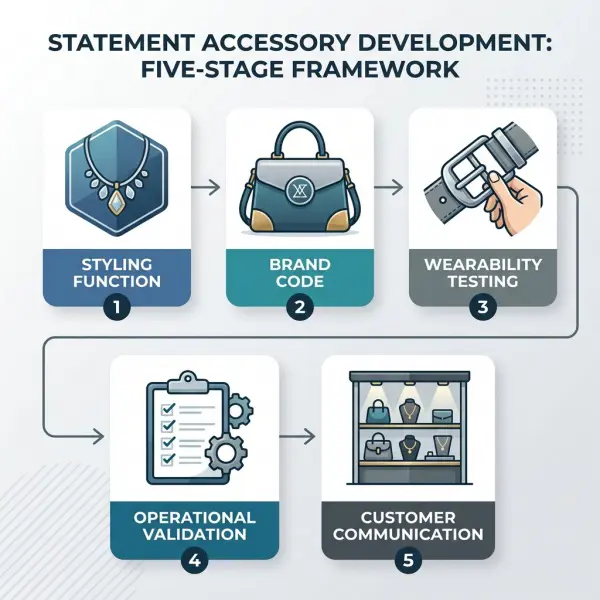
Fashion brands can use a five-stage framework to determine whether an accessory should become a central product within a collection.
1. Define the Styling Function
Start with the effect the accessory should create.
Should it establish a focal point, change proportion, introduce color, provide texture, frame the face, define the waist, or connect several garments? “Make it bold” is not a sufficiently precise design objective.
A clear styling function gives product designers, stylists, merchandisers, and content teams a shared direction.
2. Connect the Product to a Brand Code
Identify what makes the accessory recognizably connected to the brand. This could be a shape, material, motif, construction detail, clasp, handle, edge treatment, or relationship between texture and color.
The brand code should be repeatable without becoming identical. A signature does not require releasing the same product every season. It requires enough continuity for customers to recognize the design logic.
3. Establish the Wearability Boundary
Every statement product creates some tension between distinction and ease of use. The acceptable balance depends on the intended customer and occasion.
A runway piece may prioritize image. An everyday bag needs dependable closures, appropriate weight, useful capacity, and comfortable carrying. Earrings intended for several hours of wear require different weight considerations from a short editorial appearance.
Wear testing should include movement, sitting, commuting, packing, dressing, and repeated opening or fastening—not only still photography.
4. Validate the Operational Model
Before launching, confirm:
- supplier capability;
- tooling requirements;
- minimum production quantities;
- component lead times;
- tolerances and testing;
- packaging;
- quality-control procedures;
- repair options;
- realistic pricing;
- demand by variant.
A compelling sample made from unavailable or inconsistent components is not a scalable product.
5. Build a Complete Styling and Selling System
Plan how the accessory will be understood across campaign imagery, product pages, retail displays, lookbooks, social content, and sales-team communication.
Customers need to understand not only what the product looks like, but:
- how large it is;
- how it is worn;
- what it works with;
- how it moves;
- how it should be cared for;
- what function it performs;
- why it belongs to the brand.
A statement accessory should be supported by statement-level clarity.
Common Mistakes Brands Make With Statement Accessories
Mistake 1: Confusing Attention With Design Quality
Increasing scale, shine, color contrast, or decoration can make an accessory more noticeable, but it does not automatically make the product coherent.
When several dominant elements compete—such as an oversized shape, bright surface, heavy hardware, multiple motifs, and contrasting trims—the customer may see visual activity without understanding the central idea.
A stronger approach is to establish one dominant feature and let the remaining elements support it.
Mistake 2: Following a Trend Without Translating It
Runway trends can provide useful context, but direct imitation rarely builds durable brand recognition. When many labels reproduce the same oversized buckle, charm-covered bag, or pendant shape, the products become interchangeable.
Brands should interpret visible trends through their own:
- customer profile;
- design language;
- price level;
- manufacturing capability;
- retail environment;
- cultural context.
Trend awareness is useful. Trend dependence is risky.
Mistake 3: Ignoring Weight, Comfort, and Movement
Accessories interact directly with the body. Heavy earrings can pull on the ear. A rigid bag edge may press against the hip. A large buckle can restrict sitting. A rough necklace may damage a delicate neckline. An unstable ring can catch on garments.
These issues often appear only during realistic use testing. A sample that performs well on a mannequin or campaign set may behave very differently during commuting, working, or social activity.
The operational consequence is not limited to returns. Poor wearability can damage trust in the entire brand.
Mistake 4: Launching Too Many Variants
Customization can appear commercially attractive, but every color, plating finish, size, strap, charm, or material combination adds inventory complexity.
A small first release can provide better demand information than a large assortment based on assumptions. Brands can then expand the variants that customers actually request rather than dividing initial demand across too many options.
Mistake 5: Designing for Images Instead of Use
Some accessories create strong campaign photography but weak customer experiences. The bag does not close securely. The necklace twists. The belt holes do not match real fit requirements. The decorative hardware scratches easily.
Editorial impact can be a valid product objective, but the product role must be clear. Problems occur when an image-oriented object is sold as a dependable everyday accessory.
Mistake 6: Failing to Explain the Styling Role
Words such as “bold,” “iconic,” “timeless,” or “elevated” provide little practical guidance on their own.
Customers need to see how the item works with clothing, what proportion it creates, where it sits on the body, and whether it is designed for daily use or specific occasions. Styling guidance should demonstrate possibilities without suggesting that there is only one correct way to wear the product.
Mistake 7: Using Sustainability Claims Too Broadly
An accessory is not automatically sustainable because it helps restyle existing clothing, contains a recycled component, is handmade, or is produced in a limited quantity.
Its environmental and social profile depends on material sourcing, manufacturing, labor conditions, durability, transport, use frequency, repairability, and end-of-life options. A specific statement such as “the outer fabric contains recycled polyester” is more defensible than describing the entire bag as environmentally friendly without broader evidence.
Versatility can support longer use. It is not, by itself, proof of lower impact.
What This Trend Does Not Mean
The prominence of statement accessories should not be exaggerated into a universal rule.
It does not mean clothing has become unimportant. Garments still establish coverage, comfort, fit, movement, and much of the overall silhouette.
It does not mean every outfit needs a focal accessory. Some looks depend on continuity, texture, construction, or disciplined uniformity rather than contrast.
It does not mean minimalism has disappeared. A minimalist accessory can make a strong statement through proportion, craftsmanship, or material precision.
It does not mean accessories are easier to manufacture. They often require specialist components, processes, tolerances, and testing.
It does not mean statement products are universally affordable. Jewelry, leather goods, eyewear, and technical accessories can involve expensive materials and manufacturing.
It does not mean the same trend applies in every market. Cultural expectations, climate, occupation, purchasing power, dress norms, and local aesthetics influence how accessories are selected and worn.
The meaningful shift is that accessories have greater strategic potential. Whether that potential is relevant depends on the brand, customer, product category, and market.
What Brands Should Verify Before Acting
Before repositioning accessories as central products, fashion businesses should verify five areas.
Customer Relevance
Determine whether customers are actually seeking focal pieces, practical accessories, personalization, collectible items, or better styling guidance.
Social engagement can provide signals, but comments and likes should not be treated as demand forecasts without supporting sales, search, wait-list, pre-order, or customer-research data.
Product Capability
Confirm whether the design and sourcing teams understand the materials, construction processes, tolerances, testing, and typical failure points of the category.
A reliable apparel supplier may not be the correct supplier for bags, jewelry, eyewear, or metal hardware.
Brand Coherence
Remove the logo from the sample and ask whether the product still looks connected to the brand. If not, the accessory may be merchandise rather than a genuine extension of the design system.
Commercial Feasibility
Calculate tooling, components, minimum quantities, lead time, variant complexity, packaging, quality risk, after-sales support, and likely sales at the individual stock-keeping-unit level.
Communication Readiness
Prepare accurate dimensions, weight, materials, care information, on-body images, styling examples, functional demonstrations, and realistic product descriptions.
A statement accessory should survive all five tests. Strong campaign imagery cannot permanently compensate for weak product logic.
Frequently Asked Questions
What makes an accessory a statement piece?
An accessory becomes a statement piece when it significantly influences the visual hierarchy or meaning of an outfit. The effect may come from size, shape, color, material, texture, craftsmanship, symbolism, or unexpected placement. It does not need to be bright, oversized, or expensive. A small geometric brooch can become the focal point of a plain jacket, while a large neutral bag may define a silhouette through proportion. The relevant question is whether the accessory changes how the complete look is interpreted rather than simply performing a practical or decorative function.
Are statement accessories suitable only for maximalist fashion?
No. Statement accessories can work within minimalist, classic, formal, modest, romantic, streetwear, or experimental styling. In minimalist fashion, the statement may come from a precise shape, unusual surface, controlled asymmetry, or strong material contrast rather than heavy decoration. The surrounding garments also affect how dominant an item appears. A sculptural cuff may feel restrained beside a printed dress but highly expressive against a monochromatic suit. Brands should define statement design relative to their own aesthetic and customer rather than following a universal standard of boldness.
Can statement accessories help a small brand become recognizable?
Yes, when the accessory contains repeatable design codes such as distinctive hardware, a recognizable silhouette, specialist craft, or a consistent material treatment. One unusual product may attract attention, but recognition develops only when the design language continues across later releases. Small brands should also consider tooling, supplier minimums, quality control, and component availability. A signature accessory is valuable when it can be produced consistently and profitably. If its most recognizable element is difficult to source or frequently fails, it may create operational risk rather than lasting brand equity.
Are accessories easier to manufacture than garments?
Not necessarily. Some accessory categories require fewer body sizes than apparel, but they introduce other technical demands. Bags may need reinforcement, edge finishing, lining, hardware, closures, and load-bearing construction. Jewelry may involve casting, plating, soldering, setting, polishing, and restricted-substance requirements. Belts require accurate length specifications, reliable buckle attachment, hole positioning, and material stability. Supplier expertise is highly category-specific. Fashion businesses should assess the actual construction process rather than assuming that a physically smaller product is simpler or cheaper to manufacture.
Which accessory category should a fashion brand introduce first?
The best starting category is the one that fits the brand’s design language, customer behavior, supplier access, price level, and operational capacity. A tailoring label may find belts or brooches more coherent than casual beach bags. A resortwear business may have stronger opportunities in scarves, jewelry, woven bags, or hats. A technical apparel brand might prioritize functional packs or eyewear. Popularity alone is not a sufficient reason. The first accessory should have a clear styling function, manageable inventory structure, credible connection to existing products, and realistic production requirements.
Can accessories help customers wear their existing clothes more often?
They can provide additional ways to style familiar garments, which may support more frequent or varied use. A belt can change proportion, a scarf can introduce a new color relationship, and jewelry can alter the formality or identity of a look. The benefit is not automatic. Poorly made novelty accessories may simply add more short-lived consumption. Greater wardrobe use is more likely when the accessory is durable, compatible with several outfits, comfortable, emotionally relevant, and easy to maintain. Brands should communicate styling versatility without presenting it as proof of environmental sustainability.
How can brands prevent statement accessories from becoming dated quickly?
Brands can reduce dependence on short-lived trends by creating distinction through proportion, function, material quality, craftsmanship, and recognizable design codes. Seasonal elements can then be added around a stable foundation. For example, a recurring bag silhouette may receive new colors or straps while maintaining its construction and recognizable handle. Customer feedback and wear testing can help distinguish lasting usefulness from temporary visual appeal. No fashion item is permanently protected from changes in taste, but products built around coherent design and real utility usually have a stronger basis for continued relevance than novelty alone.




Comments 0
Leave a CommentSend Comment
Anda harus Login terlebih dahulu untuk dapat memberikan komentar.