

Sustainable Swimwear: How Recycled Fabrics Are Reshaping Design and Production
Few garment categories ask as much of a textile as swimwear. A swimsuit weighs less than most T-shirts, yet it must stretch in every direction, snap back into shape hundreds of times, and withstand chlorine, salt water, sunscreen, and direct UV exposure — conditions that would ruin ordinary apparel fabrics within a season.
For decades, the industry met these demands almost exclusively with virgin nylon and polyester. Today, a new generation of recycled performance fibers is proving that brands like Berlook swimwear can meet the same technical standards while carrying a far smaller environmental footprint. For fashion brands, garment producers, and designers, understanding this shift is quickly becoming essential product knowledge rather than a marketing footnote.
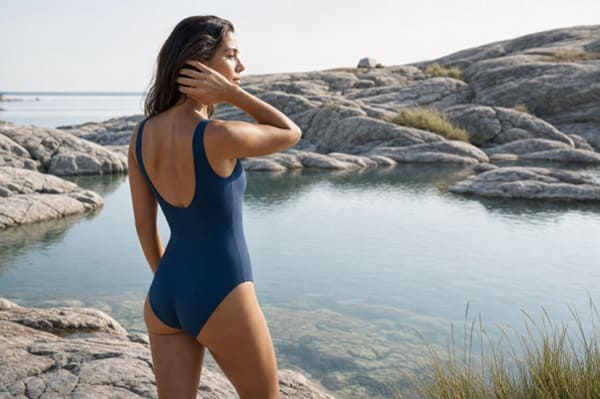
Why Swimwear Is One of the Most Demanding Textile Categories
A typical swim fabric is a warp-knitted blend of roughly 74–85% nylon (polyamide) or polyester with 15–26% elastane. That composition is not arbitrary. The fabric must deliver four-way stretch with excellent recovery so the garment moves with the body without bagging out; it must resist degradation from chlorine and salt; it needs strong colorfastness under intense sunlight; it should absorb very little water and dry quickly; and it has to remain opaque and stable when wet, which is why most swimwear is fully lined.
The two dominant fibers each bring trade-offs. Nylon offers a softer hand feel, better drape, and higher stretch, which is why it dominates fashion swimwear. Polyester holds dye and resists chlorine better, which is why competitive and training suits lean in that direction. What both have in common is that no natural fiber can realistically replace them in this category — cotton or viscose would absorb water, sag, and lose shape immediately. Any serious attempt to make swimwear more sustainable therefore has to happen within the world of performance synthetics, and that is exactly where recycled fibers come in.
The Environmental Cost of Conventional Swim Fabrics
Virgin nylon and polyester are both derived from crude oil through energy-intensive polymerization processes with a significant greenhouse gas footprint. There is also an uncomfortable irony specific to this category: abandoned and lost fishing gear — made largely from the same polyamide family used in swim fabrics — is among the most damaging forms of plastic pollution in the very oceans where swimwear is worn.
The problem is compounded at the end of the product's life. Fast-fashion swimwear tends to have a short lifespan because elastane breaks down quickly under chlorine and heat, and fiber blends of nylon or polyester with elastane are extremely difficult to separate and recycle mechanically. Add microfiber shedding during washing, and the conventional swimwear model looks linear in the least flattering sense: extract, produce, discard.

How Recycled Swim Fabrics Are Made
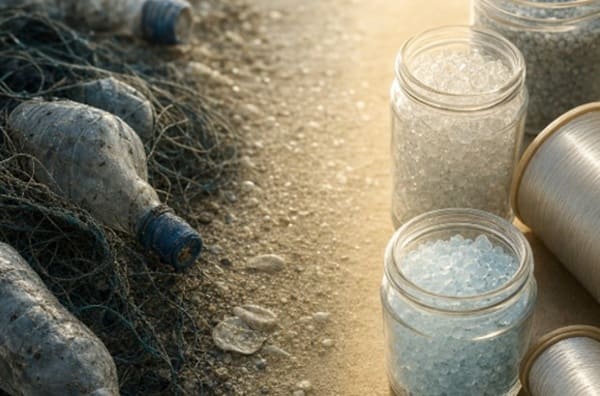
Two recycled fiber routes now dominate sustainable swimwear sourcing.
Regenerated nylon is produced through chemical recycling. Nylon waste — recovered fishing nets, carpet fluff, industrial fabric offcuts — is broken back down into its base monomer, caprolactam, and then re-polymerized into yarn that performs the same as virgin nylon. ECONYL® is the best-known trade name for this process, and because depolymerization restores the raw material completely, the fiber can in principle be regenerated again and again without loss of quality.
Recycled polyester (rPET) typically follows a mechanical route: post-consumer PET bottles are sorted, washed, flaked, melted into chips, and extruded into filament yarn. This supply chain is mature and widely scaled, which has brought rPET pricing close to parity with virgin polyester.
Verification matters as much as the fiber itself. The Global Recycled Standard (GRS) certifies recycled content percentages along with chain of custody and chemical and social criteria, while OEKO-TEX Standard 100 tests the finished fabric for harmful substances — particularly relevant for a garment worn directly against the skin. Brands and buyers should ask suppliers for valid scope and transaction certificates rather than accepting marketing claims at face value, since the gap between genuine recycled sourcing and greenwashing usually shows up in the paperwork.
It is also worth being honest about the limits. The elastane in most recycled swim fabrics is still virgin, and blended constructions remain challenging for textile-to-textile recycling at end of life. Recycled content solves the input side of the equation, not the disposal side. Even so, diverting waste streams like fishing nets and bottles while displacing virgin petroleum extraction represents a genuine, measurable improvement.
What the Shift Looks Like in Practice
A growing number of direct-to-consumer labels now build their entire assortment around recycled fibers rather than releasing a single token "eco capsule." Berlook Swimwear is a useful example of the model: its bikinis and one-pieces are cut from recycled polyamide and recycled polyester blends, alongside a dedicated ECONYL® regenerated nylon collection, and each product page discloses the exact fiber percentages of both shell and lining. The brand pairs its material strategy with operational choices such as small-batch production to limit deadstock and reduced-impact packaging, and it reports that more than 2.9 million plastic bottles have been recycled into its swimwear to date — across a range that covers standard and plus sizes, men's swim shorts, and activewear at mid-market prices.
There are three transferable lessons here for other fashion businesses. First, transparent fiber disclosure builds consumer trust and pre-empts accusations of greenwashing far more effectively than vague eco-language. Second, recycled performance fabrics no longer confine a label to premium price points, which removes the most common commercial objection to adopting them. Third, sustainability claims land better when they are tied to concrete, countable inputs — bottles recycled, certifications held — rather than adjectives.
Considerations for Designers and Garment Producers
From a product development perspective, recycled swim knits behave almost identically to their virgin equivalents, but a few points deserve attention. On the sourcing side, request GRS and OEKO-TEX documentation, order lab dips, and test sample yardage for stretch percentage, recovery after chlorine and salt exposure, and colorfastness before grading patterns. On the construction side, the standard swimwear playbook applies: stretch or ballpoint needles, seams sewn with zigzag, flatlock, or coverstitch to preserve elasticity, chlorine-resistant swim-rated elastic, and full lining. Patterns should be drafted with appropriate negative ease based on the measured stretch of the actual fabric rather than assumed values. On costing, regenerated nylon still carries a modest premium over virgin nylon, while rPET is close to price parity, so margin planning should reflect the specific fiber route chosen.
Longevity: The Other Half of Sustainable Swimwear
Material choice is only half the sustainability equation; how long the garment stays in use is the other. The care guidance is simple and worth printing on every hangtag: rinse the suit in cool fresh water after every wear, hand wash with mild detergent, never wring or tumble dry, dry flat in the shade, and rotate between suits so the elastane has time to recover its shape. A well-constructed piece of sustainable swimwear that is cared for properly can last several seasons, and every season of extended use multiplies the benefit of the better materials it was made from.
The Road Ahead
The next frontiers are already visible: recycled and degradable elastane, mono-material swim fabrics engineered for textile-to-textile recycling, and digital product passports as regulators — particularly in the EU — push for verifiable material disclosure. Swimwear is a small, technical, synthetic-dependent category, which makes it an unlikely but genuinely useful proving ground for circular fashion. The brands that treat recycled textiles as an engineering and sourcing discipline, rather than a marketing angle, are the ones best positioned to benefit as the industry moves in this direction.





Comments 0
Leave a CommentSend Comment
Anda harus Login terlebih dahulu untuk dapat memberikan komentar.