
Bags, Belts, and Jewelry: Details That Shape Personal Image
Quick Answer
Bags, belts, and jewelry shape personal image because they influence how an outfit is structured, where attention is directed, and what values or lifestyle the wearer appears to communicate. A bag can suggest practicality, formality, creativity, or mobility. A belt can make a look feel controlled, relaxed, utilitarian, or deliberately exaggerated. Jewelry can frame the face, introduce symbolism, and express personal history or aesthetic preferences.
These accessories may be physically smaller than the garments around them, but their visual and social influence can be substantial. A structured handbag can make relaxed clothing appear more precise. A loosely tied textile belt can soften formal tailoring. A small group of rings or an inherited brooch can make a simple outfit feel personal rather than generic.
Their effect is context-dependent. Materials, scale, condition, placement, cultural meaning, profession, and the surrounding clothing all influence interpretation. No bag, belt, or piece of jewelry carries one universal message.
For fashion businesses, these categories are valuable because they can translate brand identity into recognizable, repeatable details. Their success, however, depends on product quality, functional relevance, customer understanding, and a clear relationship with the wider collection.
What Does Personal Image Mean in Fashion?
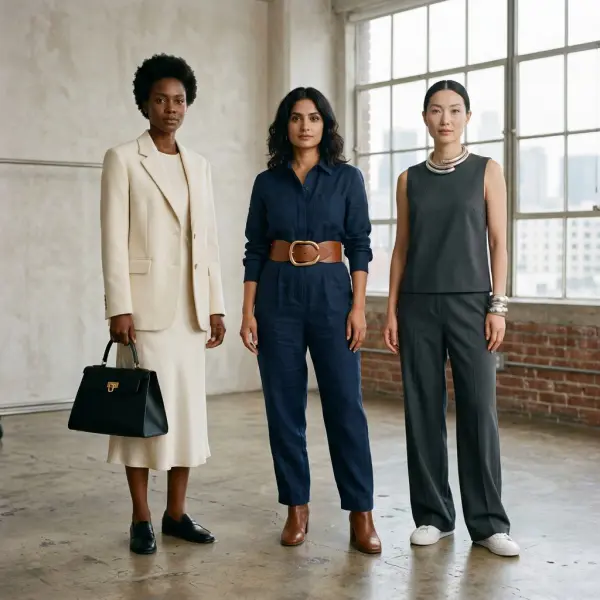
Personal image is the overall impression created through clothing, accessories, grooming, posture, movement, communication, and context. Fashion contributes to that impression, but it does not determine a person’s character, capability, profession, or social value.
Accessories influence personal image because they are often highly visible, repeatedly used, and closely connected to daily behavior. A bag is carried, opened, placed on surfaces, and used to organize personal belongings. A belt sits at the structural center of many outfits. Jewelry is worn near the face, hands, neck, or ears—areas that naturally attract attention during interaction.
These objects can communicate several kinds of information:
- aesthetic preference;
- practical priorities;
- profession or daily routine;
- relationship with craftsmanship;
- interest in fashion trends;
- cultural or family connection;
- formality and occasion;
- attitude toward visibility or restraint.
Interpretation remains subjective. A large metal necklace may communicate confidence to one viewer and artistic experimentation to another. A worn leather bag may suggest authenticity, practicality, sentimental attachment, or simply long-term use.
Personal image is therefore not a fixed code that accessories automatically produce. It is a relationship between the object, wearer, outfit, environment, and audience.
Why Small Accessories Can Have a Large Visual Effect
Bags, belts, and jewelry frequently occupy strategic locations on the body. Jewelry appears near the face and hands. Belts create a strong horizontal line through the center of an outfit. Bags add shape and visual weight near the shoulder, torso, hip, or hand.
This placement gives them influence beyond their physical size.
A small pair of earrings may be more noticeable than a large coat because the earrings sit beside the face. A narrow belt can alter an oversized dress because it interrupts a continuous silhouette. A compact bag can make a soft outfit feel more structured because its rigid geometry contrasts with the garments.
The effect is especially clear when the clothing is relatively simple. Neutral tailoring, monochromatic dresses, denim, knitwear, and basic shirts provide enough visual space for accessory details to become readable.
The mechanics of focal points, contrast, scale, and visual hierarchy are discussed more fully in how accessories transform simple outfits into stronger looks. This article focuses on what the three categories contribute to the wearer’s broader personal image.
Bags Communicate How Style Meets Daily Life
A bag is both a visual object and a practical container. Its role in personal image comes from the combination of silhouette, material, scale, carrying method, condition, and function.
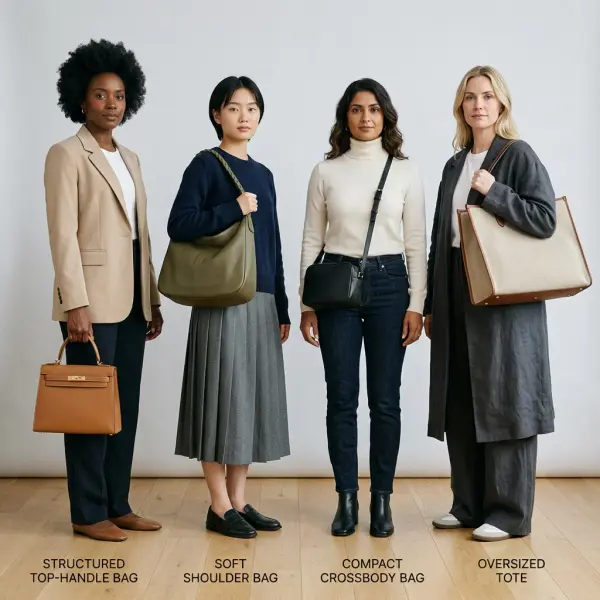
Unlike many decorative products, bags reveal something about how a person moves through the day. A large tote may suggest the need to carry work materials, personal items, purchases, or family essentials. A compact crossbody bag can signal mobility and hands-free convenience. A structured top-handle bag may create a more formal or deliberate impression.
These associations are not fixed. The same bag can communicate differently depending on styling and context. A structured leather bag worn with tailoring may reinforce formality. Worn with relaxed denim and a loose shirt, it can introduce contrast and precision.
Bag Shape Establishes Visual Character
A bag’s silhouette often communicates before its details are noticed.
Rigid geometric bags tend to create a sense of structure. Soft pouches and slouchy shoulder bags introduce movement and ease. Rounded forms can feel softer or more playful, while rectangular shapes may appear more controlled or functional.
The effect also depends on scale:
- a compact bag may appear selective, decorative, or occasion-focused;
- a medium structured bag may suggest everyday organization;
- an oversized tote may communicate practicality, volume, or deliberate exaggeration;
- a narrow elongated bag may create a more directional or fashion-led impression.
These are visual tendencies, not universal meanings. Material, color, construction, and the wearer’s behavior can change the result substantially.
Carrying Method Changes the Message
The same bag can influence personal image differently depending on how it is carried.
A top-handle bag held away from the body creates a composed, object-like presentation. A shoulder bag becomes integrated into the upper silhouette. A crossbody strap introduces a diagonal line and can make the look feel more mobile or informal. A clutch occupies the hand and may suggest a more controlled or occasion-oriented context.
Carrying method also affects function. A bag marketed as an everyday product should remain comfortable and stable in the position shown in campaign imagery. If the strap slips, twists, or creates pressure when the bag is filled, the styling promise is not supported by the product.
Material and Condition Affect Perceived Quality
Material contributes to the visual language of a bag. Polished leather may create sharper highlights and a more formal appearance. Canvas often feels more casual or utilitarian. Woven fibers can introduce craft, texture, or seasonal associations. Technical textiles may suggest mobility, performance, or contemporary utility.
Material alone does not guarantee quality. Construction matters.
Customers may notice:
- edge finishing;
- stitching consistency;
- handle reinforcement;
- hardware alignment;
- zipper performance;
- lining quality;
- shape retention;
- surface durability;
- how the bag ages with use.
Condition is also part of personal image. A well-maintained older bag can appear more intentional than a new product with damaged edges or unstable hardware. At the same time, visible wear may be valued when it reflects patina, history, or personal attachment.
Brands need to distinguish desirable aging from premature failure. Cracking coatings, peeling edge paint, broken attachments, or unstable handles should not be marketed as character.
Function Can Strengthen Rather Than Weaken Style
Practical details often become part of a bag’s identity. External pockets, modular compartments, adjustable straps, protective closures, expandable panels, or distinctive handles can create recognizable design codes.
The strongest functional products do not hide utility. They organize it.
For fashion brands, this creates a valuable product-development question: which daily behavior should the bag support? A commuter bag, travel tote, evening bag, laptop carrier, and small crossbody product require different proportions, materials, security features, and internal organization.
A bag becomes more credible when its visual message aligns with its actual use.
Belts Shape Structure, Proportion, and Attitude
Belts operate at the intersection of function and styling. They can secure clothing, adjust fit, gather fabric, hold tools or small objects, and divide the outfit visually.
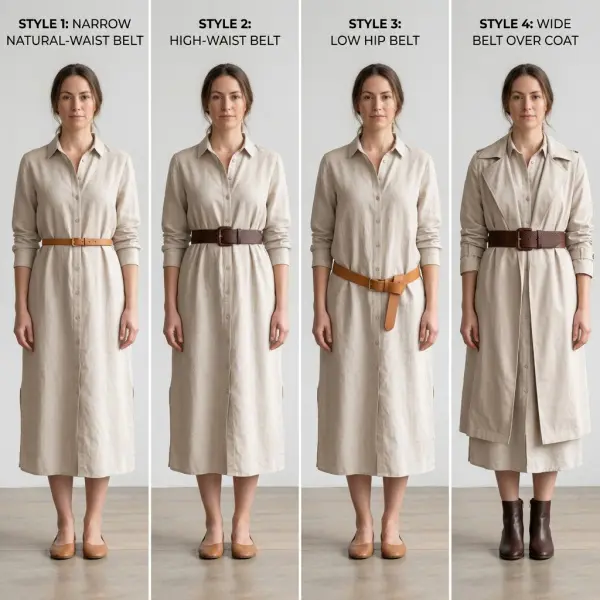
Their position across the torso gives them unusual power over proportion. A belt can make loose garments feel more structured, create a clear waistline, interrupt a long vertical silhouette, or introduce a contrasting material through the center of the look.
It can also communicate attitude. A polished narrow belt may feel precise. A wide corset-style belt can appear more dramatic or architectural. A loosely tied textile belt can make the outfit feel softer and less formal. A utility belt may suggest practicality, workwear, or technical styling.
Width Determines the Strength of the Division
A narrow belt creates a relatively subtle horizontal line. It may define the waist without dominating the garment.
A wide belt occupies more visual area and creates a stronger division between the upper and lower body. It can gather volume, change how a garment falls, and become the main focal point of the outfit.
Neither option is universally more flattering or appropriate. The result depends on:
- garment volume;
- belt position;
- body proportions;
- material stiffness;
- color contrast;
- buckle size;
- comfort;
- desired styling effect.
Fashion communication should avoid rigid body-shape rules. A customer may choose a wide belt precisely because they want exaggeration, contrast, or a deliberately shortened torso line.
Position Changes Proportion
Belts can be worn at the natural waist, higher on the torso, lower toward the hip, or over outer layers. Each position creates a different relationship between the upper and lower body.
A higher placement may visually lengthen the lower part of the outfit. A lower placement can create a more relaxed or elongated torso. A belt worn over a coat or jacket can gather substantial volume and convert outerwear into a more sculpted silhouette.
These are visual effects rather than corrections. The best position is the one that supports the wearer’s comfort, garment construction, and intended image.
Buckles Function as Visual Signatures
The buckle is often the most recognizable element of a belt. Its size, shape, finish, construction, and placement can communicate the brand’s design language in a compact format.
A geometric metal buckle may support a precise, architectural identity. A wrapped or covered buckle can feel softer and more integrated with the garment. An industrial clasp may reinforce a technical or utilitarian image. Hand-worked metal can communicate craft and variation.
Custom buckles can be valuable signature assets, but they create operational demands. Brands may need to manage:
- tooling or mold costs;
- minimum production quantities;
- plating consistency;
- abrasion and corrosion resistance;
- attachment strength;
- weight;
- compatibility with belt material;
- replacement availability.
A distinctive buckle is useful only when it remains functional and consistent across production.
Fit Information Is Essential
Belts appear simple but are frequently described poorly online. Total belt length does not always indicate the wearable size. Customers need to know whether the measurement refers to:
- total product length;
- length to the center hole;
- minimum and maximum wearable circumference;
- recommended waist or hip measurement;
- fit over clothing;
- adjustable or removable sections.
A belt used over coats or thick knitwear requires different allowance from one worn through trouser loops.
For fashion businesses, accurate measurement guidance is not a minor product-page detail. It affects comfort, styling success, returns, and customer trust.
Jewelry Directs Attention and Carries Meaning
Jewelry differs from bags and belts because its function is often more symbolic, decorative, emotional, or commemorative. It can frame the face, emphasize the hands, interact with the neckline, create movement, and introduce light or texture close to the skin.
Jewelry may also carry information that is not visible to every observer. A ring may commemorate a relationship. A pendant may contain religious, cultural, family, or personal meaning. A bracelet can mark a milestone. An inherited piece may connect the wearer to another person or period.
This combination of visible styling and private meaning gives jewelry a distinctive role in personal image.
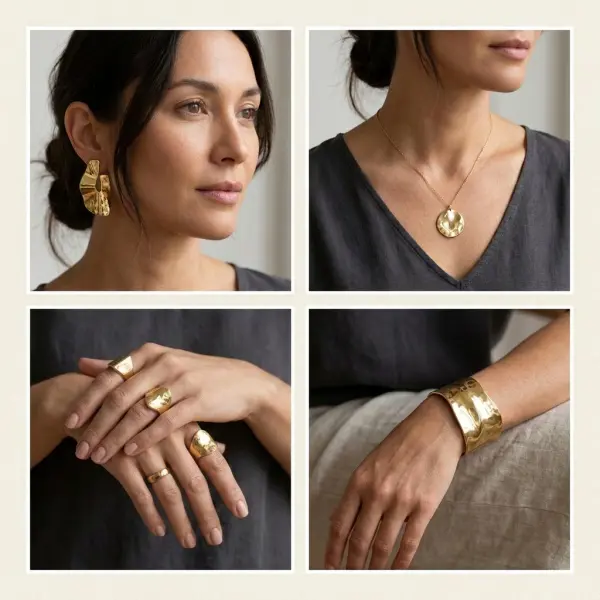
Earrings Frame the Face
Earrings sit close to the face and may influence how the head, hair, neckline, and upper body are visually connected.
Studs generally create small areas of light or color. Hoops establish a circular frame. Drop earrings introduce vertical movement. Sculptural earrings may create asymmetry or become the dominant upper-body detail.
Scale should be evaluated in relation to the hairstyle, collar, neckline, eyewear, and other jewelry. Large earrings may disappear beneath voluminous hair, while small reflective pieces can remain visible when positioned close to the face.
Comfort is critical. Product teams should verify weight, balance, attachment security, surface smoothness, and whether movement causes the piece to strike the neck or clothing.
Necklaces Interact With Necklines
A necklace does not exist independently of the garment. Its length, volume, and shape interact directly with collars and necklines.
A short necklace can create a boundary near the neck. A pendant introduces a vertical line. A broad collar necklace occupies more surface area and may become part of the garment composition. Layered chains create repeated lines and can make the styling feel more personal or accumulated over time.
Problems arise when the necklace and neckline compete without intention. A pendant may disappear inside a high collar. A heavy chain can distort delicate fabric. Sharp components may catch on knitwear, lace, or embroidery.
Brands should test necklaces with the clothing categories shown in marketing content, not only against bare skin or plain studio backgrounds.
Rings and Bracelets Emphasize Gesture
Hands are highly visible during conversation, work, dining, presentations, photography, and digital content. Rings and bracelets therefore influence personal image through movement as well as appearance.
A single large ring can create a strong focal point. Several fine rings may communicate layering and personal collection. A cuff can add structure near the wrist, while flexible bracelets create sound and movement.
Function matters here too. Rings should not restrict movement or catch easily on clothing. Bracelets need appropriate closures and should be tested against work activities, device use, and sleeve constructions.
Jewelry that looks compelling in still photography may prove intrusive in daily use.
Material Changes the Emotional and Visual Tone
Gold-colored metal, silver-colored metal, beads, enamel, resin, glass, stone, wood, textile, leather, ceramic, and mixed materials communicate differently because of their surface, weight, color, reflectivity, and cultural context.
Polished metal tends to create stronger highlights. Brushed surfaces feel quieter. Transparent materials interact with skin and clothing color. Irregular handmade components can emphasize craft and variation. Smooth geometric forms may feel more controlled or contemporary.
Material terminology must be accurate. A gold-colored plated product should not be presented as solid gold. “Silver tone” is not equivalent to sterling silver. Natural, laboratory-grown, simulated, and imitation stones should be described clearly.
Personal image may begin with appearance, but product trust depends on factual communication.
How Bags, Belts, and Jewelry Work Differently
The three categories overlap in their ability to create focal points, but their main contributions differ.
|
Accessory Category |
Primary Visual Role |
Functional Role |
Personal-Image Contribution |
Main Product Risk |
|
Bags |
Add shape and visual weight near the hand, shoulder, torso, or hip |
Carry and organize personal items |
Communicate mobility, practicality, formality, creativity, or lifestyle |
Poor capacity, discomfort, weak hardware, excessive weight |
|
Belts |
Divide or structure the torso and garment silhouette |
Secure, adjust, or gather clothing |
Communicate precision, utility, softness, drama, or control |
Incorrect sizing, restrictive fit, unstable buckles, garment incompatibility |
|
Jewelry |
Direct attention near the face, hands, neck, or ears |
Primarily decorative, symbolic, or commemorative |
Communicate personality, memory, affiliation, taste, or craftsmanship |
Weight, irritation, weak closures, unclear material claims |
No category is inherently more important. The appropriate choice depends on what the outfit and wearer need to communicate.
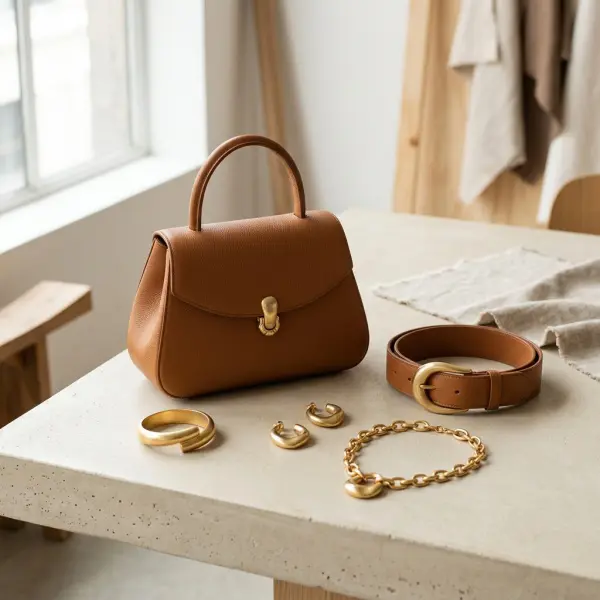
A bag often has the strongest relationship with lifestyle and daily function. A belt has the most immediate influence on garment structure. Jewelry usually carries the greatest potential for intimate symbolism and close-body expression.
Consistency Turns Individual Accessories Into Personal Style
Personal image becomes recognizable when certain choices recur over time. The wearer does not need to repeat the same product, but may repeatedly select similar shapes, metals, carrying methods, colors, or proportions.
Someone may consistently choose compact structured bags, narrow belts, and geometric silver jewelry. Another person may prefer soft woven bags, textile belts, and layered organic-shaped pieces. Over time, these patterns become part of how others recognize their style.
Consistency does not mean uniformity. It creates a base from which variation becomes meaningful.
Common forms of consistency include:
- repeated metal finishes;
- a preferred bag silhouette;
- recurring geometric or organic shapes;
- similar levels of visual scale;
- one dominant color family;
- preference for craft-based or technical materials;
- repeated balance between practical and decorative pieces.
For fashion brands, the same principle applies to product identity. A recognizable accessory system is built through recurring design logic rather than random seasonal objects.
The broader strategic role of these signature products is discussed in why statement accessories are becoming central to modern styling.
Context Changes How Accessories Are Read
The meaning of an accessory changes across environments.
A large tote may feel practical during commuting but excessive at a formal dinner. A jeweled brooch may appear conventional on a formal jacket and experimental on a sweatshirt. A wide belt can suggest historical dress, contemporary tailoring, performance costume, or utilitarian equipment depending on its design and context.
Important variables include:
- occupation;
- workplace safety;
- climate;
- social occasion;
- mobility needs;
- cultural expectations;
- religious dress practices;
- regional fashion norms;
- transportation;
- security concerns.
Brands serving global audiences should avoid presenting one styling interpretation as universal. The same product may need different imagery, descriptions, and use cases across markets.
Cultural or religious symbols require particular care. Their meaning should not be reduced to visual novelty. Brands need appropriate research, attribution, collaboration, and communication when using motifs connected to specific communities.
How Fashion Brands Can Apply Category-Specific Styling
Bags, belts, and jewelry should not be developed as interchangeable accessories. Each category needs its own product logic, supplier knowledge, merchandising, and communication strategy.
Define the Role of Each Category
A fashion brand may use:
- bags to express lifestyle and practical use;
- belts to connect garments and control silhouette;
- jewelry to communicate symbolism and close-body identity.
The roles can overlap, but defining them helps prevent an incoherent assortment.
A tailoring brand, for example, might use structured bags as its commercial anchor, precise belts as collection connectors, and restrained metal jewelry as a secondary detail. A resortwear brand may prioritize woven bags, textile belts, and lightweight jewelry with movement.
Develop Products With the Apparel Collection
Accessories should be reviewed beside real garments.
Product teams need to verify whether:
- bag straps damage or distort clothing;
- belt widths fit existing loops;
- buckles conflict with garment closures;
- jewelry catches on knits or embroidery;
- metal finishes coordinate with buttons and zippers;
- accessory scale works with actual silhouettes;
- colors remain compatible under natural and retail lighting.
A product can succeed technically but fail visually when it has been developed in isolation.
Build a Clear Price Architecture
The categories may occupy different price and margin positions.
A practical assortment could include:
- a recognizable hero bag;
- a core belt with several sizes;
- a small entry-level jewelry piece;
- a limited sculptural accessory;
- replacement straps or modular components;
- recurring signature products.
Pricing should reflect materials, labor, tooling, testing, packaging, repair support, and inventory risk. Small physical size should not be confused with low production complexity.
Explain Function and Meaning Separately
Product communication should distinguish what an accessory does from what it may express.
For example:
- “The adjustable strap allows shoulder and crossbody carrying” is a functional statement.
- “The geometric clasp reflects the collection’s architectural design direction” is a design statement.
- “Designed to express confidence” is subjective and should not replace practical information.
Customers need accurate facts before editorial interpretation.
Show Scale and Movement
Bags should be photographed empty and under realistic use where appropriate. Belts should be shown at different positions or over relevant garment weights. Jewelry should be shown near the face, hands, neckline, or wrist and accompanied by dimensions.
Product imagery should answer:
- How large is it?
- Where does it sit?
- How does it move?
- How heavy is it?
- How is it fastened?
- What does it look like with real clothing?
- Does the surface change under different light?
Visual clarity supports both styling confidence and purchasing decisions.
A Practical Decision Framework for Choosing the Right Accessory
1. Identify the Main Image Goal
Decide what the wearer or collection needs to communicate.
Possible goals include:
- precision;
- creativity;
- practicality;
- softness;
- confidence;
- restraint;
- cultural connection;
- movement;
- technical functionality.
The goal should guide the category.
A bag is useful when function and lifestyle are central. A belt is appropriate when garment structure needs to change. Jewelry works well when attention, symbolism, or close-body detail matters.
2. Assess the Existing Outfit
Review the garment silhouette, color, texture, neckline, waist construction, pockets, loops, closures, and overall visual weight.
The accessory should respond to what is already present.
3. Select the Main Category
Choose whether the bag, belt, or jewelry will carry the primary visual responsibility. Other categories can support it with quieter details.
This prevents the look from becoming a competition between several focal products.
4. Test Scale and Placement
Evaluate the accessory on the actual wearer and garment.
A bag may need a shorter strap. A belt may work better at a different position. A necklace may require another length to avoid conflicting with the neckline.
5. Verify Practical Use
Check:
- comfort;
- movement;
- security;
- weight;
- fit;
- capacity;
- fastening;
- garment compatibility;
- maintenance.
Personal image is weakened when the wearer must continually adjust or protect an impractical product.
6. Check Whether the Choice Feels Personal
A technically coordinated accessory may still feel generic.
The final question is whether the item reflects the wearer’s preferences, lifestyle, values, or desired expression. Personal image develops through relevance, not through formula alone.
Common Mistakes in Using Accessories to Shape Personal Image
Selecting Products Only for Status Recognition
Visible branding or price may contribute to how an accessory is interpreted, but status recognition alone rarely creates a coherent personal image.
When the product has little relationship with the wearer’s clothing, lifestyle, or preferences, it can appear disconnected. A more durable approach is to consider shape, function, material, scale, and emotional relevance alongside brand recognition.
Using Too Many Identity Signals at Once
A heritage-inspired bag, technical belt, romantic jewelry, sports cap, and formal shoes may each communicate a different story.
Eclectic styling can be intentional, but it needs a connecting logic. Without one, the outfit may look assembled rather than personal.
A repeated color, material, proportion, or attitude can help different references coexist.
Ignoring Product Condition
Accessories receive frequent handling and may show wear quickly.
Loose hardware, tarnished surfaces, frayed belt holes, unstable straps, peeling coatings, and damaged closures affect both function and appearance. Maintenance, repair, and appropriate storage are part of accessory styling.
Brands should provide category-specific care guidance rather than generic instructions.
Treating Personal Image as Body Correction
Belts and jewelry are often discussed through restrictive rules about making the body appear thinner, taller, smaller, or more proportionate.
These effects can be relevant when the wearer actively wants them, but they should not be presented as universal objectives. Fashion can also exaggerate volume, create asymmetry, interrupt conventional proportions, or reject corrective styling altogether.
The wearer’s intention matters more than a standardized ideal.
Choosing Scale Without Testing Comfort
A visually powerful bag may be too heavy. A broad belt may restrict movement. Large earrings may cause discomfort. Stacked rings may interfere with work.
The consequence is not merely practical. Discomfort changes posture, movement, and confidence, which directly affects personal presentation.
Assuming One Cultural Interpretation
Colors, materials, symbols, jewelry forms, and methods of wearing accessories can carry different meanings across communities.
Brands should avoid universal claims such as describing a symbol as inherently spiritual, protective, traditional, or empowering without specific cultural grounding.
Treating Accessories as Last-Minute Additions
When bags, belts, and jewelry are selected only after garment development is complete, they may conflict with proportions, materials, closures, or delivery schedules.
Accessory planning should begin early enough for real product integration, sample testing, and coordinated merchandising.
What These Accessories Cannot Communicate Reliably
Accessories can influence impressions, but they cannot prove personality, competence, income, values, or social status.
A structured bag does not establish that the wearer is organized. Expensive jewelry does not confirm wealth. Minimal accessories do not prove restraint. A worn belt does not necessarily indicate carelessness.
Fashion interpretation is shaped by assumptions, and those assumptions can be inaccurate.
For this reason, brands should avoid making excessive psychological claims about products. An accessory can be described as structured, expressive, lightweight, decorative, practical, or inspired by a particular design concept. Claiming that it makes the wearer powerful, successful, trustworthy, or sophisticated moves from product description into subjective promise.
Personal image is influenced by accessories, but it is never completely controlled by them.
What Brands Should Verify Before Expanding Into These Categories
Before launching bags, belts, or jewelry, fashion businesses should verify several operational areas.
Category expertise: Confirm that suppliers have relevant experience and equipment for the specific construction.
Material accuracy: Use precise terms for leather, coated materials, metals, plating, stones, textiles, and synthetic components.
Safety and compliance: Determine which chemical, mechanical, labeling, and product-safety requirements apply in the destination market.
Fit and dimensions: Provide wearable belt ranges, strap drops, bag capacity, jewelry measurements, and product weight where useful.
Quality control: Test closures, hinges, chains, straps, attachment points, coatings, edges, and surface durability.
Inventory structure: Model demand by color, size, plating, hardware, and other stock-keeping-unit variables.
After-sales support: Decide whether replacement straps, hardware, repairs, resizing, or replating will be available.
Brand coherence: Confirm that the category extends the design language rather than functioning as generic merchandise.
A successful accessory category requires both visual clarity and operational discipline.
Frequently Asked Questions
Which accessory has the strongest influence on personal image?
No single category is universally strongest. Bags often communicate lifestyle, mobility, and practical needs because they are large, visible, and used throughout the day. Belts have a strong effect on garment structure and body-level proportion. Jewelry attracts attention near the face, hands, and neckline while carrying personal or symbolic meaning. The most influential category depends on the outfit, setting, wearer, and intended message. One carefully chosen accessory may have more impact than several unrelated products.
What does a handbag communicate about personal style?
A handbag can suggest preferences for structure, practicality, craft, color, minimalism, decoration, or mobility. Its effect comes from the combined influence of shape, size, material, carrying method, condition, and surrounding outfit. A structured top-handle bag may feel formal in one context and create deliberate contrast in another. These interpretations are subjective and culturally influenced. A bag should not be used to make assumptions about the wearer’s income, profession, or personality.
How does a belt change personal image?
A belt changes personal image by altering garment structure and introducing a visible line through the center of the outfit. A narrow tonal belt may create precision without becoming dominant. A wide contrasting belt can produce a stronger, more architectural impression. Textile ties may feel softer or more relaxed, while utility buckles can introduce a functional direction. Position, width, material, fit, and comfort all influence the result. The belt should work with the garment’s construction rather than compressing pockets, pleats, or closures unintentionally.
Why is jewelry often considered more personal than other accessories?
Jewelry is worn close to the body and may carry emotional, cultural, religious, commemorative, or family meaning. A pendant, ring, bracelet, or brooch can represent a relationship, event, belief, memory, or personal interest that is not immediately visible to others. Jewelry is also frequently accumulated over time, allowing older and newer pieces to be combined. This does not make every piece meaningful; some jewelry is selected primarily for color, fashion, or decoration. Its personal role depends on the wearer’s relationship with the object.
Should bags, belts, and jewelry match?
They do not need to match exactly. A coherent relationship may come from shared metal finishes, similar shapes, compatible colors, repeated materials, or a consistent level of formality. Exact matching can create a controlled or formal appearance, but it may also feel overly coordinated in some contexts. Mixed accessories can work when one element leads and the others support it. The objective is not duplication but a readable visual relationship.
Can a fashion brand build recognition through accessories?
Yes, when accessories contain consistent and repeatable design codes. A distinctive handle, buckle, clasp, silhouette, motif, edge finish, or material combination can become recognizable across seasons. Recognition requires continuity and reliable production. One unusual product may attract attention without establishing long-term identity. Brands also need to consider tooling, component availability, quality control, and whether the signature detail can be reproduced consistently at the intended scale.
Are bags, belts, and jewelry easier to produce than clothing?
Not necessarily. They may avoid some garment-sizing complexity, but they require specialized processes. Bags need reinforcement, closures, hardware, edge finishing, lining, and load testing. Belts need accurate sizing, material stability, hole placement, and reliable buckles. Jewelry may require casting, soldering, polishing, plating, stone setting, and small-component assembly. Supplier capability, testing requirements, tooling, and minimum quantities can make these categories operationally demanding.
Can accessories make a personal image appear more consistent?
They can contribute to consistency when the wearer repeatedly chooses related shapes, materials, colors, scale, or carrying methods. For example, recurring geometric jewelry, compact structured bags, and restrained metal finishes may gradually become recognizable elements of a person’s style. Consistency does not require repeating the same products. It comes from recurring preferences and visual logic. Personal image should still allow experimentation; consistency is a pattern, not a restriction.
Conclusion
Bags, belts, and jewelry shape personal image in different but complementary ways. Bags connect appearance with daily function and mobility. Belts influence structure, proportion, and the relationship between clothing and the body. Jewelry directs attention toward the face, hands, and neckline while often carrying personal or symbolic meaning.
Their influence does not come from size alone. Placement, material, scale, condition, construction, cultural context, and the surrounding outfit determine how each item is perceived.
For wearers, these accessories provide a way to build consistency without repeating complete outfits. A recognizable preference for certain shapes, finishes, materials, or proportions can gradually become part of an individual style language.
For fashion businesses, the categories offer opportunities to translate brand identity into compact, recognizable products. They can also introduce specialist manufacturing requirements, fit concerns, inventory complexity, safety obligations, and quality risks that should not be underestimated.
The strongest personal image is not produced by adding every available signal. It develops when the selected details feel coherent with the wearer’s life, clothing, comfort, and point of view.
Bags, belts, and jewelry may be called finishing touches. In practice, they often reveal where the styling idea truly begins.




Comments 0
Leave a CommentSend Comment
Anda harus Login terlebih dahulu untuk dapat memberikan komentar.