
Weather-Ready Fashion Explained for Everyday Dressing
Quick Answer
Weather-ready fashion is an approach to everyday clothing that considers how garments perform when conditions change—such as sudden rain, wind, heat, humidity, or cooler temperatures—without requiring the wearer to dress like they are preparing for an outdoor expedition. It combines appropriate materials, garment construction, layering, fit, ventilation, protection, and practical details so clothing remains comfortable and useful across realistic daily situations.
The important distinction is that “weather-ready” does not describe one fabric technology or a universal performance standard. A lightweight water-repellent jacket, breathable overshirt, wind-resistant shell, quick-drying trouser, and insulating mid-layer may all serve different weather-related purposes. Their usefulness depends on the environment, activity level, garment design, and verified material performance.
For fashion businesses, the opportunity is therefore not simply to add technical-looking details. It is to design products around specific use cases, understand what fabric and garment performance claims actually mean, and communicate those capabilities accurately to customers.

What Is Weather-Ready Fashion?
For this article, weather-ready fashion means everyday apparel designed or selected to remain practical when the wearer encounters changing environmental conditions. The concept sits between ordinary seasonal dressing and highly specialized outdoor equipment. It may involve protection from light rain, improved airflow in humid conditions, resistance to wind, insulation during cooler periods, or the ability to add and remove layers as conditions change.
That distinction matters because weather performance is not a single property. A garment that sheds a brief shower may not withstand prolonged rain. A tightly constructed fabric that blocks wind effectively may feel uncomfortable during higher activity if moisture and heat cannot escape adequately. An insulated jacket may be useful on a cold commute but excessive in a heated train or office.
Weather-ready dressing therefore works best as a system of complementary garments, rather than as a search for one item that performs perfectly in every condition.
This also separates the concept from pure utility wear. Everyday products still need to work visually with the rest of a wardrobe, fit normal routines, tolerate repeated wear, and make sense for the customer's lifestyle. A commuter carrying a laptop through intermittent rain has different requirements from a trail runner, just as someone living in a hot and humid city needs a different solution from someone moving between freezing outdoor temperatures and heated indoor spaces.
Why Does Weather Readiness Matter in Everyday Dressing?
Weather rarely interacts with clothing in neat categories. A person may leave home during cool conditions, walk briskly to public transport, spend time in an air-conditioned building, encounter wind in the afternoon, and return during rain. Clothing has to manage not only the weather outside but also changes in activity and indoor environments.
This is where ordinary wardrobe planning often becomes inefficient. A heavy coat may provide protection but become cumbersome when the temperature rises. A lightweight fashion jacket may look appropriate but absorb water quickly. A highly impermeable shell can block rain effectively yet feel uncomfortable if the wearer generates heat and moisture during movement.
Weather-ready dressing addresses that problem through adaptability rather than maximum protection. The objective is usually to provide enough performance for the expected situation while maintaining comfort, wearability, appearance, and ease of use.
For fashion businesses, this changes the product-development question. Instead of asking, “How technical can this jacket become?”, the more useful question is, “What weather conditions does the customer realistically encounter, and what level of protection will actually improve the product?”
That framing prevents unnecessary complexity while encouraging functional decisions that customers can notice in daily use.
Weather Resistance Is Not One Performance Property
One of the most common misunderstandings around weather-ready clothing is treating terms such as water-repellent, water-resistant, waterproof, breathable, wind-resistant, and insulating as interchangeable. They describe different aspects of performance, and several can exist in the same garment at different levels.
Technical textile testing reflects those differences. For example, AATCC TM22 Water Repellency: Spray Test evaluates resistance to surface wetting, while AATCC TM127 Water Resistance: Hydrostatic Pressure evaluates resistance to water penetration under hydrostatic pressure. These are related characteristics, but they do not answer exactly the same performance question.
Water Repellency
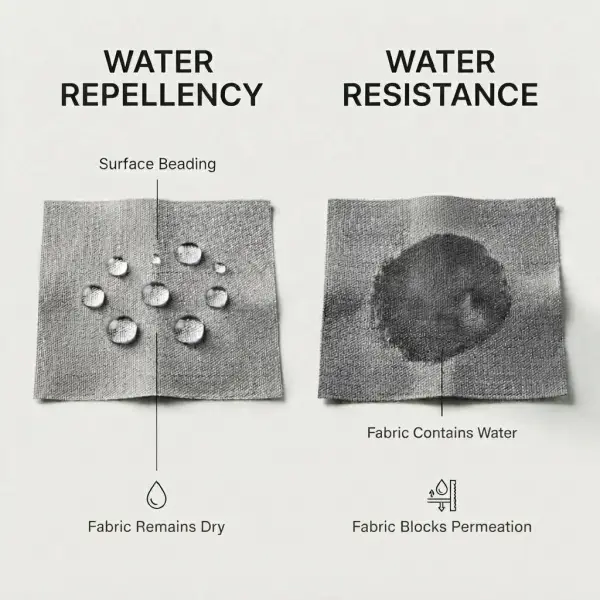
Water repellency generally describes how well the surface of a textile resists wetting. Water may bead and roll away rather than immediately spreading into the fabric.
This can be highly useful for everyday outerwear exposed to drizzle or short periods of rain. However, good surface repellency should not automatically be interpreted as proof that a garment will remain dry during prolonged or pressurized exposure. AATCC specifically distinguishes spray-based surface-wetting tests from tests intended to evaluate water penetration.
In practical merchandising language, a lightweight jacket that performs well against intermittent showers can be genuinely useful without needing to be positioned as an all-condition waterproof shell.
Water Penetration Resistance
Water resistance becomes more demanding when the objective is preventing water from passing through a textile.
Hydrostatic-pressure testing applies water pressure to a specimen to determine its resistance to penetration. The result depends not simply on fiber choice but on fabric construction and any coatings, membranes, or finishes applied to it.
Finished-garment performance introduces additional variables. Seams, closures, pocket construction, hood geometry, cuffs, garment openings, and the way the garment moves on the body can all influence practical rain protection. ISO 6956:2026, for example, evaluates water-resistant clothing under artificial rainfall using a moving manikin, illustrating why fabric performance alone does not completely describe how a garment behaves in use.
Breathability Is Also More Complicated Than It Sounds
“Breathable” is frequently used in fashion marketing, but the term can refer to different physical properties.
Air permeability describes how readily air passes through a textile. ASTM D737 is a standardized method for measuring textile air permeability and notes that fabric construction and finishing can substantially affect the result.
Moisture-vapour transport is another issue. ISO 11092:2026 specifies methods for measuring thermal resistance and water-vapour resistance in textile materials and multilayer assemblies. Those properties help characterize how materials interact with heat and moisture, but laboratory measurements still need to be interpreted in relation to garment construction and intended use.
This is why a brand should be careful with broad claims such as “fully breathable.” A better product specification identifies what was tested, under which method, and what practical benefit the result is intended to provide.
Wind and Thermal Protection Add Another Layer
Wind can increase heat loss and make otherwise comfortable temperatures feel substantially colder, while insulation helps slow heat transfer between the body and the environment. Yet more insulation is not always preferable.
A thick garment used during high activity may trap too much heat. Conversely, a lightweight but tightly constructed shell can sometimes improve comfort simply by reducing wind exposure. For extreme cold, the U.S. National Weather Service advises dressing in layers and replacing wet clothing with dry clothing, reinforcing the practical importance of adaptable clothing systems rather than relying on a single garment.
For everyday fashion, the relevant lesson is not that everyone needs expedition-grade insulation. It is that thermal comfort depends on the complete clothing system, activity level, wind exposure, moisture, and surrounding temperature.
The Layering Principle Makes Weather-Ready Dressing More Adaptable
Layering is one of the most useful ideas that everyday fashion can borrow from outdoor apparel, but it does not have to look technical.
The basic logic is simple: several garments with different functions can often adapt more effectively than one very heavy garment. A wearer can remove, add, open, or close layers as weather, activity, or indoor conditions change.
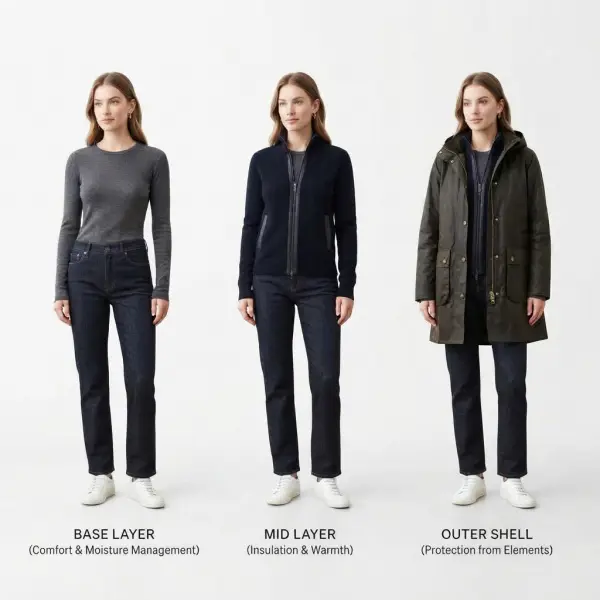
A three-part structure is commonly described as:
- Base layer: worn close to the body and selected partly for comfort and moisture management.
- Mid-layer: provides additional warmth when needed.
- Outer layer: manages external exposure such as wind or precipitation.
The U.S. National Weather Service similarly recommends layered clothing in extreme cold, although the precise combination required depends strongly on conditions and activity.
For ordinary wardrobes, this system can be much looser. A cotton shirt, lightweight knit, and packable shell may form a useful combination for a mild climate. In warmer regions, layering might mean a breathable base garment plus an ultralight rain layer that is carried rather than continuously worn.
The strongest layering system is therefore not the one with the most layers. It is the one that lets the wearer regulate protection and comfort without carrying unnecessary bulk.
What Actually Makes an Everyday Garment Weather-Ready?
Weather performance begins with textiles, but it does not end there. Garment architecture often determines whether laboratory material performance translates into useful everyday clothing.
A fashion team should consider several elements together:
- Fabric structure and finishing: density, fiber composition, coatings, membranes, surface treatments, and finishing can influence water, air, wind, thermal, and drying behaviour.
- Garment construction: seams, linings, closures, vents, hems, cuffs, hoods, pocket placement, and openings affect practical exposure.
- Fit and mobility: overly tight clothing can restrict layering, while excessive volume may interfere with movement or wind protection.
- Ventilation: openings, mesh sections, back vents, two-way zippers, or adjustable features can help users regulate heat.
- Weight and packability: an outer layer that is easy to carry may be used more often during unpredictable weather.
- Care requirements: performance needs to remain understandable to the customer after laundering, wear, and routine maintenance.
These characteristics interact. A hood may offer little benefit if it repeatedly falls away from the head. A highly resistant fabric may still allow water entry through poorly designed closures. A breathable textile cannot compensate completely for an excessively insulated garment worn during strenuous movement.
This interaction is also why product development should start from a wear scenario, not from a checklist of technical features.
Weather-Ready Dressing Changes by Climate and Use Case
There is no globally correct weather-ready wardrobe because different climates create different clothing priorities.
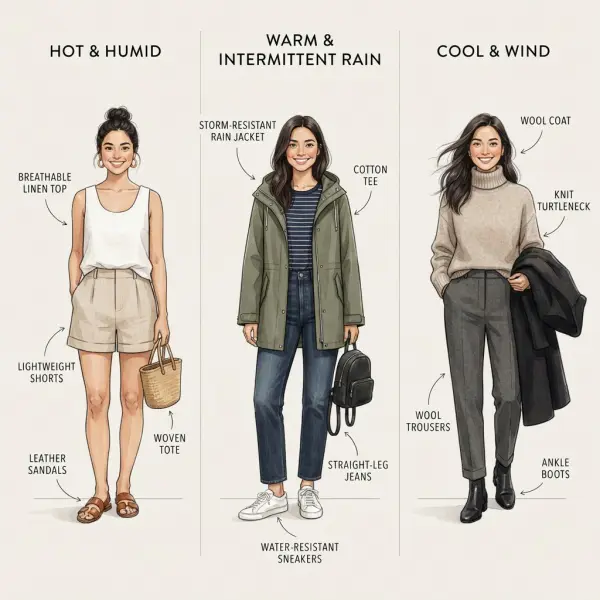
In hot and humid environments, the primary issue may be heat management, airflow, loose fit, rapid drying, and temporary rain protection rather than insulation. The UK Met Office, for example, recommends lightweight, loose-fitting clothing and breathable materials such as cotton or linen during hot conditions.
In a rainy but relatively warm city, an everyday wardrobe might prioritize a thin protective outer layer, quick-drying trousers, footwear compatible with wet streets, and garments that remain comfortable after the rain stops.
In a cooler and windy environment, the emphasis may shift toward wind reduction, adjustable insulation, and layering. Where temperature changes significantly between morning, afternoon, outdoor travel, and heated interiors, easy adjustment can matter more than maximum warmth.
These variations are explored more deeply in how function, comfort, and climate shape modern wardrobes. The important point here is that weather readiness should always be defined against a realistic environment rather than treated as a universal feature package.
Weather-Ready Fashion Is Not the Same as Technical Outdoor Gear
The categories overlap, but their design priorities can differ substantially.
|
Practical Question |
Everyday Weather-Ready Fashion |
Technical Outdoor Apparel |
|
Primary use |
Commuting, travel, work, errands, social activities |
More demanding outdoor environments or activities |
|
Protection level |
Appropriate to expected everyday exposure |
Often engineered for more specific or severe performance conditions |
|
Styling priority |
Strong integration with normal wardrobes |
Performance may take greater priority |
|
Weight and packability |
Often important for carrying during the day |
Depends on activity and technical requirements |
|
Features |
Selective and discreet |
May include more specialized adjustment, ventilation, reinforcement, or protection |
|
Testing expectations |
Should match the claims being marketed |
Often requires detailed performance specifications for intended conditions |
Neither category is inherently better. The appropriate level of engineering depends on what the garment is supposed to do.
For example, an urban commuter may benefit more from a lightweight jacket that looks appropriate in an office and handles a short shower than from a heavier shell designed for prolonged mountain exposure. Conversely, an everyday fashion coat should not be presented as equivalent to specialist rain protection merely because its surface causes water to bead.
This gap between appearance of performance and verified performance is one of the most important issues for brands entering functional fashion.
How Fashion Businesses Can Apply Weather-Ready Design
The commercial opportunity in weather-ready fashion lies in solving specific problems with an appropriate amount of performance.
Start With the Use Case
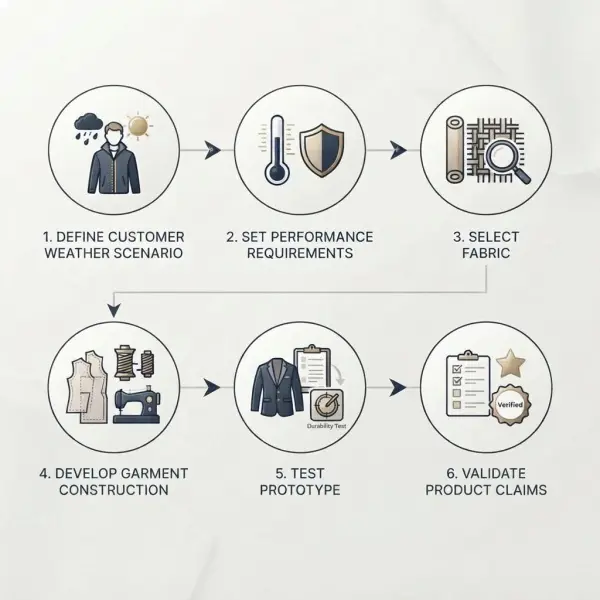
Product teams should define what the customer is likely to experience before selecting materials.
Consider a lightweight commuter jacket. A useful brief might specify walking 15–30 minutes outdoors, intermittent light rain, public transport, moderate wind, and frequent transitions into indoor environments. Those conditions imply a very different product from one intended for several hours of continuous heavy rain.
A clear use case improves decisions around fabric weight, lining, ventilation, hood design, storage, closures, and target performance testing.
Build the Specification Around Performance Questions
Instead of writing vague requirements such as “breathable waterproof fabric,” sourcing teams can ask more specific questions:
- What type of water exposure should the fabric resist?
- Is surface repellency sufficient, or is water penetration resistance required?
- Does the brand need air-permeability or water-vapour-resistance data?
- Which test method produced the supplier's stated values?
- Was the test performed on fabric, a material assembly, or the finished garment?
- How should performance change after washing and repeated use?
These questions reduce the risk of sourcing a textile based primarily on a marketing description.
Evaluate Finished Garments, Not Only Fabric Swatches
This is particularly important for rain protection. A strong material specification does not automatically validate the entire garment.
ISO's current testing landscape reflects this distinction. ISO 6956:2026 assesses leakage and water penetration in water-resistant clothing under artificial rainfall with a moving manikin, while ISO 24231:2024 addresses ready-made garments exposed to high-energy droplets from above.
Fashion brands do not necessarily need these particular standards for every casual product. They do, however, need a testing approach that is proportionate to the claims they intend to make.
Style Still Matters Because the Garment Has to Be Worn
Functional features have little practical value if a customer does not want to wear the product.
This sounds obvious, but it creates a real product-development tension. Technical pockets, storm flaps, drawcords, laminated surfaces, oversized hoods, taped seams, and highly visible hardware can improve certain functions while also pushing a garment toward a distinctly outdoor aesthetic.
The solution is not to remove function. It is to decide which functions deserve visual emphasis and which can be integrated quietly.
A lightweight coat might hide adjustment systems inside the garment. Ventilation could be incorporated through back construction rather than obvious mesh panels. Water-resistant closures can become part of a minimal design language instead of appearing as added technical decoration.
The growing stylistic role of these categories deserves a separate discussion, particularly as rain protection and lightweight outerwear move beyond purely utilitarian presentation. That relationship is covered in why rainwear and lightweight outerwear are becoming more stylish.
Retail Communication Should Match Actual Performance
Weather-ready products can be difficult to merchandise because customers often recognize familiar words without understanding the differences between them.
“Waterproof,” “water-resistant,” and “water-repellent,” for example, should not be treated as interchangeable shorthand. Retail descriptions should explain the actual use case wherever possible.
A product page might say that a jacket is intended to help manage brief showers and wind during everyday commuting rather than implying that it is designed for prolonged exposure to severe weather. If a quantitative rating is provided, the brand should explain what property was measured and, ideally, which test method was used.
The same principle applies to breathability. A numerical value without a test method, unit, or context can create an illusion of precision while telling the customer surprisingly little.
Clear communication can therefore become part of the product value itself. Customers do not necessarily need laboratory expertise, but they do need enough information to understand what the garment is designed to handle.
Common Mistakes in Weather-Ready Fashion Development
Mistake 1: Treating a Fabric Feature as a Complete Garment Benefit
A supplier may offer a textile with strong resistance to surface wetting, yet the final garment can behave differently because of seams, pocket openings, closures, fit, and construction.
The better approach is to connect each textile property to the finished-product scenario and verify the complete garment when the commercial claim requires it.
Mistake 2: Designing for the Most Extreme Possible Weather
Maximum protection can create unnecessary weight, stiffness, heat retention, cost, or visual complexity.
For everyday fashion, the more commercially useful product may be the one optimized for the conditions customers face frequently rather than the rarest possible event. A packable layer that handles intermittent rain may deliver more daily value than a substantially heavier garment designed for conditions the target customer seldom encounters.
Mistake 3: Assuming “Breathable” Means the Same Thing in Every Specification
Air permeability, water-vapour resistance, moisture management, ventilation, and subjective comfort are connected but not identical.
Brands should identify the property they actually need instead of asking suppliers for a generic “breathability” specification.
Mistake 4: Adding Technical Details Without a Functional Reason
Decorative toggles, waterproof-looking zippers, taped visual details, or utility pockets can create a technical aesthetic without necessarily improving weather performance.
This is particularly risky when the design visually implies a level of protection that has not been tested.
Mistake 5: Ignoring Care and Performance Retention
Weather-related performance is not only a point-of-sale characteristic. Finishes, coatings, laminations, seam treatments, and garment components can respond differently to laundering and wear.
Brands should therefore consider how the product will be maintained and what the customer needs to know to preserve its intended function.
Important Technical Caveats
Weather-ready fashion benefits from technical language only when that language is used carefully.
First, water repellency is not automatically waterproofness. AATCC spray testing measures resistance to wetting at the surface, while hydrostatic-pressure and rain-penetration methods address different forms of water resistance.
Second, fabric test data is not always equivalent to finished-garment performance. Construction details and garment interfaces can alter results substantially, which is why standards also exist for evaluating complete clothing systems.
Third, breathability should not be reduced to one universal metric. ASTM D737 addresses air permeability, while ISO 11092 measures thermal and water-vapour resistance under specified conditions. These methods characterize different properties.
Finally, laboratory performance does not eliminate context. Activity level, garment fit, layering, weather intensity, duration of exposure, maintenance, and individual comfort expectations all influence the user's real experience.
A Practical Weather-Ready Product Framework
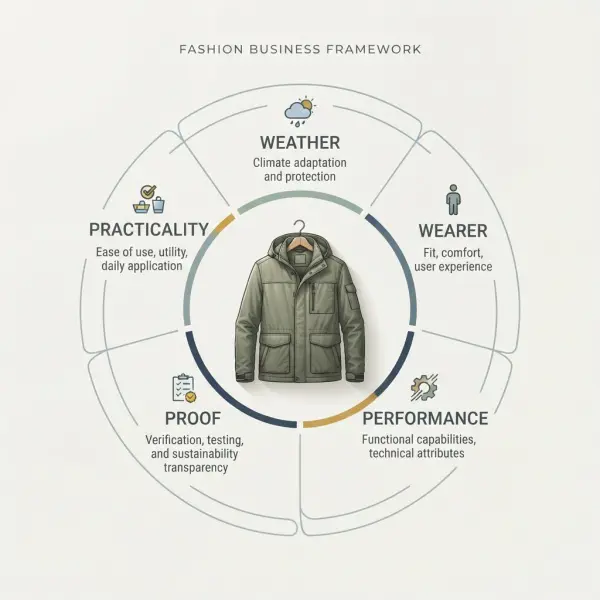
Before approving a weather-oriented fashion product, teams can use five questions to keep development grounded:
- Weather: What specific conditions is the product designed to handle?
- Wearer: What will the customer be doing while wearing it?
- Performance: Which material or garment properties are genuinely necessary?
- Proof: How will the relevant performance claims be tested or substantiated?
- Practicality: Will the garment still be comfortable, attractive, maintainable, and easy to use in normal life?
This framework deliberately starts with the customer rather than the technology.
A brand that answers those questions clearly can decide that some products need membranes, seam management, or quantified testing, while others simply need intelligent fabric selection, ventilation, packability, and thoughtful construction. Both can be legitimate forms of weather-ready fashion when the claims and design intent are aligned.
Frequently Asked Questions
Is weather-ready fashion the same as waterproof clothing?
No. Weather-ready fashion is a broader approach to clothing that helps the wearer manage realistic environmental conditions. Waterproof clothing is one possible component, but many weather-ready products are designed for lighter or different requirements.
A breathable overshirt for hot conditions, a wind-resistant jacket, a quick-drying trouser, and a packable rain layer can all belong to a weather-ready wardrobe without serving the same function. The appropriate performance level depends on expected weather, exposure duration, activity, and customer expectations. Brands should therefore describe the specific protection being offered rather than using “weather-ready” as a substitute for a technical waterproof claim.
What is the difference between water-repellent and water-resistant clothing?
Water repellency commonly refers to resistance to surface wetting, while water resistance can involve preventing water from penetrating the material under defined conditions. The exact terminology used commercially is not always consistent, which is why test methods matter.
AATCC TM22 evaluates how a textile surface responds to sprayed water, whereas AATCC TM127 evaluates resistance to penetration under hydrostatic pressure.
For customers, the practical question is therefore not simply which label appears on the hangtag. It is whether the garment has been designed and tested for the type and duration of rain they are likely to encounter.
Can one jacket work for every type of weather?
Usually not without significant compromises. Conditions that require ventilation, insulation, wind protection, and heavy-rain resistance can demand conflicting design characteristics.
A highly insulating garment can become uncomfortable in warm conditions, while an ultralight rain layer may provide very little warmth. A garment optimized for airflow can also behave differently from one designed primarily to block wind.
A more adaptable strategy is often to combine a versatile outer garment with compatible layers. Fashion brands can support this behaviour through coordinated silhouettes, easy layering proportions, low-bulk materials, and styling guidance rather than trying to make every product perform every function.
Does a breathable fabric guarantee a comfortable garment?
No. Material breathability is only one contributor to wearer comfort.
Fabric air permeability, water-vapour resistance, garment ventilation, insulation, fit, lining, humidity, temperature, and activity level can all influence how the product feels. ASTM D737 and ISO 11092, for example, evaluate different textile performance properties rather than providing a single universal “comfort” score.
For product teams, this means laboratory values should be evaluated alongside wear trials and garment construction. A high-performance textile can still feel uncomfortable if the finished design restricts ventilation or traps more heat than the intended use requires.
Should fashion brands publish technical performance ratings?
They can be useful when the rating genuinely helps customers make a decision and the brand can explain what was measured.
A technical number without the test method, unit, sample condition, or intended use can be misleading. Customers may compare figures produced under different protocols as though they were directly equivalent.
For everyday fashion products, clear use-case communication can sometimes be more useful than excessive specification. “Designed for intermittent light rain during urban commuting,” for example, provides meaningful context. For products making stronger performance claims, verified quantitative data and recognized test methods become increasingly important.
Is weather-ready fashion relevant in hot climates?
Yes, but the priorities are different.
Weather readiness in a hot climate may focus more on ventilation, loose fit, lightweight materials, rapid drying, sun exposure, humidity management, and protection from sudden rainfall than on insulation. The Met Office recommends lightweight, loose-fitting clothing and breathable fabrics such as cotton or linen in hot conditions, illustrating how clothing strategy changes when heat is the dominant concern.
Brands serving hot markets should therefore avoid simply adapting cold-weather technical products by reducing fabric weight. Pattern shape, airflow, drying behaviour, layering habits, local rainfall, indoor cooling, and customer lifestyle all deserve consideration.
What should a brand verify before marketing a garment as weather-ready?
The brand should first define what “weather-ready” means for that particular product.
That includes identifying the expected environment, duration of exposure, customer activity, relevant fabric properties, garment construction, care requirements, and the evidence behind any performance statements. If terms such as waterproof, water-repellent, breathable, wind-resistant, or insulating are used, sourcing and product teams should know precisely what supports those descriptions.
Finished-product testing becomes especially valuable when seams, openings, hoods, closures, or construction significantly influence performance. The objective is not to attach the largest possible technical claim to the product, but to ensure that customer expectations match what the garment can realistically deliver.
Conclusion
Weather-ready fashion is best understood as practical wardrobe engineering for ordinary life. It brings together textile performance, garment construction, layering, comfort, adaptability, styling, and accurate communication so clothing can respond more effectively to the environments in which people actually wear it.
The strongest products do not necessarily provide the highest level of protection. They provide the right level of protection for a clearly defined situation.
That difference matters for fashion businesses. A product designed around realistic commuting, travel, rain, heat, wind, or temperature changes can be more useful than one overloaded with technical features that customers rarely need. At the same time, performance terminology must be handled carefully: water repellency, penetration resistance, air permeability, water-vapour resistance, insulation, and whole-garment protection describe different properties and should not be collapsed into one vague promise.
For product teams, weather readiness therefore starts before fabric selection. It begins with understanding the wearer, defining the environment, deciding which performance characteristics matter, verifying them appropriately, and designing those functions into clothing people will genuinely want to wear.




Comments 0
Leave a CommentSend Comment
Anda harus Login terlebih dahulu untuk dapat memberikan komentar.