

What Fashion Brands Should Consider Before Selling Through Consignment
Getting a clothing collection into a well-positioned boutique can feel like an important commercial milestone for an emerging fashion brand. A retailer is willing to display the garments, customers can examine the products in person, and the designer gains exposure beyond their own sales channels. Yet when that opportunity comes through consignment, the brand needs to evaluate more than the appeal of additional retail visibility.
Unlike a conventional wholesale order, consignment usually does not require the retailer to purchase merchandise upfront. The fashion brand supplies the stock, the retailer sells it under an agreed arrangement, and payment to the brand depends on qualifying customer sales. This creates opportunities for market testing and distribution, but it also leaves the supplier responsible for much of the inventory investment.
For independent designers and growing apparel businesses, the financial consequences can be substantial. Production costs may already have been paid, sales may develop slowly, and unsold garments can remain outside the brand's direct control for weeks or months. Meanwhile, commission arrangements, promotional discounts, product returns, and retail operating practices can influence how much revenue the brand ultimately receives.
The key question is not simply whether a boutique will accept a collection. It is whether the proposed consignment relationship can generate sufficient commercial value without creating excessive cash-flow pressure, inventory exposure, or operational complexity.
Quick Answer: What Should Fashion Brands Consider Before Selling Through Consignment?
Before selling through consignment, fashion brands should evaluate retailer suitability, product profitability, working-capital requirements, inventory ownership, payment terms, sales performance expectations, and contractual risk protection.
In a typical fashion consignment arrangement, the designer or brand supplies merchandise to a retailer while retaining control of the goods until an agreed event, commonly a customer sale. The retailer receives a negotiated commission, and the brand receives its share of qualifying sales proceeds according to the settlement agreement.
This can help fashion brands access new customers and test retail demand without opening their own stores. However, consignment does not guarantee sales, immediate payment, or recovery of production costs. Unsold garments may remain the brand's financial responsibility, and poor stock records or unclear agreements can create additional risks.
A commercially sound approach begins with calculating the contribution from each completed sale, assessing the retailer's customers and operating reliability, and documenting the terms of the relationship. Brands should also establish a realistic selling period, measurable performance targets, and a clear process for recovering unsold merchandise.
Consignment is most useful when the expected sales opportunity, market insight, and distribution value justify the capital and resources committed.
Understand What the Brand Is Actually Agreeing To
A consignment arrangement is not the same as receiving a purchase order from a retailer.
In a genuine fashion consignment relationship, the retailer generally accepts garments for sale without becoming their purchaser upon delivery. The brand, or consignor, retains control of the merchandise until an agreed event, while the retailer, or consignee, provides the selling environment and related services.
For example, an independent clothing label might deliver 50 dresses to a multi-brand boutique. The retailer displays the dresses, assists customers, and records completed purchases. The brand receives its contracted share of sales revenue, but it does not ordinarily receive payment simply because the boutique accepted the initial delivery.
This distinction matters because a designer could have products displayed in several retail locations while generating relatively little actual cash revenue. Distribution presence and completed sales are separate measures of business performance.
The fundamentals of the arrangement are explained in Fashion Consignment Business Explained for Retailers and Designers.
Product Delivery Is Not Necessarily a Completed Sale
Fashion brands should distinguish physical possession from control of merchandise.
Under AASB 15, paragraphs B77–B78, reflecting IFRS 15 consignment guidance, delivering products to a dealer does not establish revenue recognition when the dealer has not obtained control. Relevant indicators include the supplier's ability to require return or transfer of the goods and the absence of an unconditional obligation for the dealer to pay.
For a fashion brand, this means internal financial reporting should not automatically treat merchandise delivered on consignment as completed product sales. The appropriate accounting treatment depends on the substance of the arrangement and the applicable reporting framework.
The operational implication is equally important. Every garment sent to a consignment partner still needs to be tracked until its status is resolved.
Evaluate Whether the Retailer Fits the Brand
The quality of a consignment opportunity depends heavily on the retailer accepting the merchandise.
A boutique with an attractive interior, established social media presence, or prestigious location may appear appealing. Those characteristics, however, do not necessarily mean its customers are likely to purchase the brand's products.
An independent label specializing in everyday linen clothing may perform well in a boutique serving customers who value relaxed silhouettes and natural fabrics. The same collection might struggle in a store whose customers primarily seek embellished occasionwear, even if the second store has higher overall foot traffic.
Retailer selection should begin with customer compatibility rather than general visibility.
Study the Retailer's Customer Profile
Before supplying merchandise, a brand should understand the retailer's typical customer, purchasing behavior, and product positioning.
Useful considerations include the store's dominant garment categories, common price ranges, size assortment, shopping occasions, and visual merchandising approach.
A designer producing premium tailored trousers, for example, should investigate whether the boutique attracts customers looking for structured workwear and elevated everyday clothing. A store dominated by inexpensive casualwear may not provide the right environment to communicate the product's construction quality and intended value.
Customer alignment can be assessed through store visits, product assortment reviews, publicly available information, and direct discussions with the retailer. When available, relevant sales data is more useful than broad claims about customer interest.
Brands can strengthen this evaluation by applying fashion customer segmentation principles to their retail distribution decisions.

Assess the Retailer's Merchandising Commitment
A retailer may accept a collection without giving it meaningful visibility.
Garments placed in a poorly organized corner, displayed in inappropriate size groupings, or presented without sufficient product information may struggle to attract buyers. This does not necessarily indicate that the garments themselves lack commercial potential.
Brands should discuss where merchandise will be displayed, how sales associates will be introduced to the collection, and whether the retailer intends to support it through styling recommendations, store communication, or appropriate online promotion.
Merchandising expectations should be realistic. A retailer carrying numerous labels cannot necessarily give every designer equal attention. The important issue is whether the proposed presentation is adequate for the products and consistent with the commercial terms.

Calculate Profitability Before Agreeing to the Commission
The commission percentage is often one of the first figures discussed in a consignment negotiation. It should not be the only one.
A retailer may propose retaining a portion of each sale in exchange for retail space, merchandising, customer service, transaction processing, and other selling activities. The brand receives the remaining proceeds, subject to the agreed calculation rules.
Whether that arrangement is profitable depends on more than the amount retained by the retailer. The brand must understand its product costs, delivery expenses, possible discounts, returns, and the cost of supporting the partnership.
There is no universal commission percentage suitable for every fashion consignment relationship. Product category, retailer services, selling price, expected volume, and commercial responsibilities all influence what the parties may reasonably negotiate.
Identify the Full Cost of Selling a Garment
Consider a fashion brand producing a cotton blouse for retail distribution.
Its direct manufacturing cost may include fabric, trims, cutting, sewing, finishing, and production quality control. The brand may also need to account for sampling, design development, labeling, packaging, transportation, inventory handling, and related operating expenses.
Some costs vary with the number of garments sold. Others are incurred before the collection reaches the boutique, regardless of sales results.
To assess commercial viability, the brand should understand both the contribution generated by each sold garment and the total cash invested in the collection.
Example: Calculating the Brand's Contribution per Sale
Assume a brand proposes the following arrangement:
|
Financial Component |
Illustrative Amount |
|
Retail selling price |
$120 |
|
Retailer commission |
40% |
|
Brand's share of the sale |
$72 |
|
Production cost per garment |
$45 |
|
Brand's additional cost per completed sale |
$7 |
|
Contribution per sold garment |
$20 |
Under these assumptions, the brand receives $72 for a completed full-price sale. After deducting the $45 production cost and $7 additional selling expense, the remaining contribution is $20.
That amount is not net profit. It has not yet covered other applicable expenses, such as initial collection delivery, marketing, fixed overhead, financing, or the cost of returning unsold merchandise.
A garment can therefore appear profitable at the individual transaction level while the overall consignment program fails to generate an adequate financial return.
Discounts Can Change the Economics Quickly
Suppose the same blouse sells at a 20% discount, reducing its customer price from $120 to $96.
If the retailer still receives 40% of the actual selling price, the brand's share becomes $57.60. After the same $45 production cost and $7 additional selling expense, the contribution falls to $5.60.
This is a substantial reduction from the original $20 contribution.
The effect would differ if the retailer absorbed the discount or the agreement protected a minimum amount payable to the brand. Those conditions should be specified before promotional activity begins.
Pricing and markdown approval are therefore commercial safeguards, not merely branding preferences.
Understand the Working-Capital Commitment
For many emerging fashion brands, working capital is the most consequential financial consideration in consignment.
The brand generally pays to produce merchandise before it knows how much the retailer will sell. Inventory may remain in the boutique throughout the selling period, while cash receipts depend on customer transactions and the settlement timetable.
A designer supplying several boutiques can accumulate substantial inventory exposure without generating matching revenue.
Consignment Can Increase Distribution Without Increasing Cash Receipts
Imagine a small clothing label supplying 60 garments to each of four boutiques.
The brand has placed 240 units across its retail network. If its production cost is $45 per garment, the manufacturing investment associated with that stock is $10,800.
That commitment exists before accounting for delivery, marketing, administration, or other costs.
If customer demand develops slowly, the brand may have limited cash available to finance production of its next collection. Expanding into additional stores could make the problem worse, even while the brand appears to be growing its physical retail presence.
This is why store count should not be confused with financial performance.
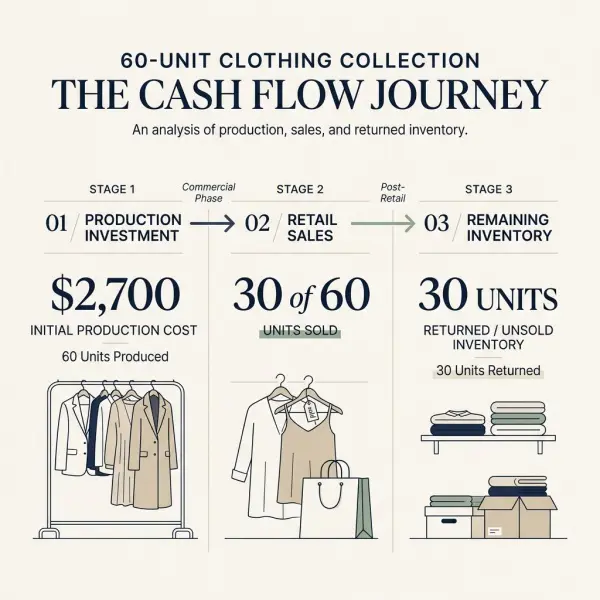
A Cash-Recovery Scenario for a 60-Unit Collection
Using the previous blouse example, suppose a brand sends 60 units to one boutique.
The following assumptions apply:
|
Variable |
Assumption |
|
Units produced and delivered |
60 |
|
Production cost per unit |
$45 |
|
Initial production investment |
$2,700 |
|
Retail selling price |
$120 |
|
Brand revenue per full-price sale |
$72 |
|
Additional selling cost per sold unit |
$7 |
|
Initial collection delivery cost |
$180 |
|
Return shipping/handling per unsold unit |
$4 |
If 30 units sell and the remaining 30 are returned, the brand receives $2,160 in sale proceeds before the stated additional costs. Selling expenses total $210, initial delivery costs $180, and returning the unsold merchandise costs $120.
After those expenses, the brand has collected $1,650 against its initial $2,700 production cash investment.
Cash position attributable to this collection: −$1,050.
This negative cash position does not mean the brand has automatically incurred an accounting loss of $1,050. It still holds 30 unsold garments with an initial production cost of $1,350. Their recoverable value depends on condition, remaining market demand, and future selling or disposal costs.
The example illustrates a critical distinction: a consignment collection can generate positive contribution on completed sales while failing to recover the cash initially invested in the full batch.
Brands should forecast both contribution and cash recovery instead of relying on sales revenue alone.
Protect the Brand's Position Through a Written Agreement
A written consignment agreement helps establish what each business is expected to provide and how financial or operational problems will be resolved.
Verbal assurances may be sufficient for an initial conversation but are a weak basis for transferring valuable merchandise into another company's custody.
A retailer may be reliable and cooperative yet still interpret payment terms, discount permissions, or inventory responsibilities differently from the designer. Written terms reduce the likelihood that ordinary operating decisions become disagreements.
According to Shopify's guide to consignment agreements and selling arrangements, important contractual considerations include commission splits, pricing authority, payment schedules, product damage, selling periods, and policies for unsold merchandise.
Terms Fashion Brands Should Confirm
The following areas deserve particular attention:
- Product ownership and identification: Establish which goods are supplied and the circumstances under which control or ownership may transfer.
- Commission and payment calculation: Define the agreed percentage, transaction base, taxes, deductions, and settlement procedures.
- Retail price and markdown authority: Specify who can change selling prices and how promotional discounts affect the brand's proceeds.
- Consignment duration: Set the agreed selling period and procedures for extensions or early withdrawal.
- Sales reporting: Define reporting frequency, minimum transaction information, and reconciliation responsibilities.
- Loss, damage, and insurance: Allocate responsibility for theft, deterioration, handling damage, storage incidents, and other relevant risks.
- Customer returns and unsold stock: Establish how refunds, exchanges, withdrawals, and return shipments will be handled.
- Termination and disputes: Define what happens when the arrangement ends or either party fails to meet its obligations.
The terms should be specific enough to guide everyday decisions. For example, stating that a boutique may offer discounts is less useful than defining when discounts are permitted, whether approval is required, and how the settlement is recalculated.
Avoid Relying on Ownership Clauses Alone
A contract stating that garments remain the designer's property is important, but it may not provide complete protection in every jurisdiction.
In the United States, certain transactions qualify as consignments under Article 9 of the Uniform Commercial Code. Under UCC Section 9-319, a consignee can be treated as having rights and title to consigned goods for specified creditor and purchaser purposes, subject to the law's exceptions.
Consequently, ownership arrangements may require additional legal safeguards, including appropriate security-interest procedures in circumstances where they apply.
The rules differ internationally, and not every commercial consignment falls within the same legal framework. Brands placing valuable merchandise should seek qualified local legal advice before relying on general contract language.
Establish Inventory Control Before Delivering Stock
Inventory visibility is essential because merchandise remains economically important to the brand even when it is physically held elsewhere.
Without reliable records, a designer may be unable to determine which garments have sold, which sizes remain available, and whether the retailer's payment statements accurately reflect transactions.
The challenge increases when the same collection is distributed through multiple boutiques and online channels.
Use Product-Level Records
Each delivery should be accompanied by a documented inventory record that identifies the products and quantities supplied.
Important information includes the SKU or unique item number, product description, size, color, quantity, retail price, delivery date, and relevant consignment terms.
When products vary by size and color, records should be sufficiently detailed to identify exactly which variants sold. A statement indicating that five dresses were purchased may be inadequate if the brand needs to determine whether those sales involved particular sizes or colors.
For one-of-a-kind designer garments or vintage pieces, individual item tracking may be more appropriate than standard SKU-level quantity tracking.
Reconcile Inventory and Sales Regularly
Sales reports should be matched against inventory movements and payment statements.
A useful reconciliation establishes how many units were delivered, sold, returned by customers, withdrawn, damaged, and still held by the retailer.
The brand should be able to verify that the resulting stock balance is consistent with the physical merchandise and transaction records.
For example, a boutique receiving 40 jackets and reporting 17 sales should account for the remaining 23 units, including any merchandise transferred, returned, or otherwise removed from available stock.
Consistent reconciliation helps identify discrepancies while they are still manageable. Waiting until the end of a long selling period can make missing products and incomplete transaction records harder to investigate.

Agree on Payment Timing and Financial Transparency
A commercially attractive commission agreement can still create problems if the retailer reports sales inconsistently or remits payment later than expected.
Brands need to understand what triggers the retailer's obligation to pay, how often sales are reported, and whether customer returns can affect previously calculated settlements.
Payment schedules vary. Some arrangements use monthly reconciliation, while others settle more frequently or establish additional periods to account for refunds.
The appropriate timing should reflect transaction volume, return practices, operational capability, and the brand's cash-flow requirements.
Determine What Counts as a Qualifying Sale
The agreement should establish whether commission and payment are triggered when a customer completes a transaction, when the merchandise is delivered, or after another defined event.
This matters for online orders, preorders, and products with customer return rights.
Suppose a boutique sells a designer jacket through its ecommerce store, but the customer returns it within the permitted period. The arrangement must specify how the transaction is reversed and whether the corresponding commission or supplier payment is adjusted.
Without a clear rule, both parties may report different amounts as sales for the same period.
Request Reports That Can Be Reconciled
A useful settlement statement should allow the designer to identify the merchandise sold, the agreed calculation of proceeds, and any adjustments.
For a multi-product collection, an aggregate payment amount is rarely enough for meaningful business analysis.
Brands should seek records showing relevant transaction dates, product identifiers, selling prices, discounts, customer returns, commissions, other authorized deductions, and the resulting payment amount.
Reliable reporting serves two purposes: it supports financial accountability and provides the product-level information needed to evaluate future collections.
Consider How Consignment Affects Brand Positioning
A retailer does more than provide a physical location for products. Its merchandising, customer service, neighboring brands, and promotional behavior influence how customers perceive a collection.
An independent label producing carefully constructed premium apparel may benefit from placement in a boutique that can communicate fabric quality, craftsmanship, and fit.
The same products may lose some of their intended appeal if they are displayed without sufficient context or repeatedly included in aggressive discount campaigns.
Brand positioning should therefore be part of retailer selection and contract negotiation.
Maintain Consistent Product Communication
Fashion products often require explanation beyond a basic price tag.
Customers may need information about fabric composition, garment fit, lining, care requirements, sizing, or construction details. Sales associates who understand these characteristics can provide more useful guidance and reduce avoidable misunderstandings.
Brands should provide clear product information and, when practical, short training materials for retail staff.
This becomes particularly relevant for products with unusual sizing, distinctive garment construction, delicate materials, or specialized care requirements.
Inaccurate descriptions can affect both customer satisfaction and compliance with applicable consumer protection requirements.
Plan for Channel Pricing Differences
A brand selling directly through its website may also work with boutiques operating under different cost structures and commercial terms.
Price inconsistencies can create customer confusion or tension between distribution partners. However, brands should distinguish legitimate coordination of brand communication from restrictions on independent resale pricing that may be unlawful in certain jurisdictions.
A retailer that owns wholesale merchandise may have different pricing rights from a retailer selling goods under a genuine consignment arrangement.
For a deeper explanation of those structural differences, see Consignment vs Wholesale: Key Differences in Fashion Retail Models.
Decide Which Products Are Suitable for Consignment
Not every garment deserves the same distribution strategy.
Some products are suitable for retail testing because the brand has limited sales history or wants to evaluate a specific audience. Others may be difficult to consign because they require substantial production investment, have short selling seasons, or are expensive to transport and return.
A designer should assess the commercial characteristics of the collection before deciding which styles and quantities to supply.
Evaluate Seasonality and Product Lifespan
Seasonal merchandise can lose selling relevance before the consignment period ends.
For example, an occasionwear collection intended for a particular holiday season may have fewer viable selling opportunities once the event has passed. Returning unsold inventory after that period could leave the brand with garments that require markdowns or alternative distribution.
More seasonally flexible products may provide additional selling opportunities, although they are not automatically more profitable.
The important question is whether the proposed selling period aligns with realistic customer demand and the brand's ability to redistribute unsold stock.
Consider Size Distribution and Replenishment
Fashion assortment performance often depends on size availability rather than overall product quantity alone.
A brand might consign several styles in limited size runs, only to discover that popular sizes sell early while less-requested variants remain.
That outcome should not automatically be interpreted as weak demand for the entire product.
Brands need enough information to understand which sizes, colors, and styles customers purchase. Retailer feedback can then inform future allocations and product development decisions.
This aligns with broader fashion assortment planning practices, where product mix and size depth are evaluated together.
Measure Performance Beyond Total Sales Revenue
A consignment program should be evaluated through a combination of sales performance, financial contribution, inventory exposure, and operational reliability.
A boutique generating a reasonable amount of sales may still be a poor distribution partner if payment is consistently delayed or the stock requires excessive management.
Conversely, a smaller retailer may provide valuable customer insight and strong sell-through even if its total sales volume is modest.
The relevant metrics should reflect the purpose of the partnership.
Key Performance Indicators for Fashion Consignment
|
KPI |
What It Measures |
Why It Matters |
|
Sell-through rate |
Proportion of available units sold during a defined period |
Evaluates product movement and demand |
|
Contribution per sold unit |
Brand proceeds less attributable unit costs |
Indicates transaction-level economics |
|
Inventory age |
Time garments remain unsold |
Identifies stock exposure |
|
Settlement timeliness |
Whether payments meet agreed deadlines |
Supports cash-flow reliability |
|
Return rate |
Share of customer sales subsequently returned |
Highlights product or expectation issues |
|
Stock accuracy |
Agreement between recorded and actual inventory |
Tests operational control |
|
Cash recovery |
Cash received relative to cash invested and related expenses |
Shows financing pressure |
Metrics should be interpreted together. High sell-through may not produce an acceptable financial return if heavy discounting reduces the brand's proceeds. Strong contribution per unit may also be insufficient if only a small fraction of the initial collection sells.
Understand the Limits of Sell-Through Data
Suppose a brand sends 50 jackets to a boutique and sells 20 during a ten-week period.
The initial-batch sell-through rate is 40%, assuming no replenishment or other inventory adjustments.
That figure describes the proportion of the original delivery sold within the measured period. It does not automatically indicate whether the collection succeeded or failed.
An evaluation should consider stock availability, customer traffic, seasonality, product placement, price positioning, and the retailer's selling activities.
For example, a collection may produce modest sell-through because the retailer received it late in the season. Another collection could appear successful because it was delivered in very limited quantities and sold out quickly, potentially leaving additional demand unmet.
Performance data becomes more useful when the brand understands the operating circumstances behind the figures.
Start With a Controlled Consignment Pilot
For brands entering a new retail relationship, a limited trial can reduce uncertainty before larger stock commitments are made.
A pilot should be treated as a commercial experiment with an agreed purpose, rather than simply a temporary product placement.
The parties might use the trial to evaluate customer demand, operational compatibility, inventory accuracy, or the viability of a new product category.
A clearly defined review process makes the results easier to interpret.
Structure the Pilot Around Measurable Questions
A small apparel brand might begin by placing a selected capsule collection in one boutique for an agreed selling period.
Before delivery, both parties should establish the commercial terms, baseline inventory, expected reporting frequency, and evaluation criteria.
The brand should then monitor actual sales, customer feedback, product returns, and the accuracy of settlement reporting.
A useful pilot asks whether the retailer can sell the collection to its intended audience at economically acceptable prices and whether the relationship operates reliably enough to continue.
Define the Decision at the End of the Trial
The review should lead to a deliberate decision.
The brand may continue the partnership with adjusted quantities, revise the assortment, negotiate different commercial terms, or withdraw the collection.
For example, if a boutique sells most of the supplied blouses but relatively few skirts, the brand may choose to concentrate future deliveries on the better-performing category.
If products sell well but payment reporting is consistently incomplete, the more urgent issue may be operational rather than merchandising-related.
A pilot succeeds as a learning process when it produces information that supports a better commercial decision, even if the partnership is not continued.

Common Mistakes Fashion Brands Make With Consignment
Accepting Every Retail Placement Opportunity
Emerging brands can be tempted to view every boutique placement as commercial progress. However, unsuitable retailers may produce weak sales while tying up valuable merchandise. A store with impressive branding is not necessarily the right channel for a particular product category or price position. Brands should evaluate customer fit, merchandising commitment, operating reliability, and financial terms before allocating stock.
Negotiating Commission Without Calculating Product Costs
A designer may accept a commission arrangement because the retained share of the retail price appears attractive. Without calculating production, delivery, selling, and return costs, the brand may discover that completed sales generate limited contribution. The problem becomes more serious when authorized markdowns reduce selling prices. Brands should model full-price and discounted scenarios before committing merchandise.
Supplying Too Much Inventory at the Beginning
Delivering a large collection can create the impression of a strong retail partnership, but it also increases the amount of capital held in unsold stock. When sales are uncertain, the brand may struggle to finance replenishment or future production. Beginning with a controlled assortment allows the designer to evaluate demand before expanding the commitment. Additional stock should be justified by sales performance rather than enthusiasm alone.
Relying on Informal Sales Reporting
A boutique may provide occasional messages about strong customer interest without supplying the transaction records needed for reconciliation. While informal feedback can be useful, it does not establish how much merchandise sold or what payment is due. Brands should require consistent product-level reporting and agreed settlement procedures. This protects the financial relationship and creates more dependable information for assortment decisions.
Ignoring the Cost of Recovering Unsold Products
Designers sometimes assume unsold merchandise can simply be returned without significant consequences. In practice, return shipping, handling, inspection, repackaging, and potential markdowns may reduce its remaining commercial value. Products may also return outside the most relevant selling season. The brand should estimate these costs before agreeing to the placement and establish how stock will be recovered at the end of the selling period.
Expanding to Multiple Retailers Before Validating the First
A fashion label may interpret early retailer interest as evidence that a broader consignment network is justified. Yet each additional boutique creates new inventory commitments, settlement relationships, and operational responsibilities. Scaling before establishing accurate tracking and cash-flow controls can magnify existing weaknesses. Brands should demonstrate that the initial arrangement is financially and operationally manageable before significantly increasing the number of partners.
Legal, Accounting, and Product Compliance Risks to Verify
A fashion consignment relationship involves more than a commercial agreement between two businesses. Depending on the market, it may also involve inventory ownership rules, creditor rights, tax obligations, product labeling, customer protection, and accounting requirements.
These considerations become more important when a brand distributes high-value merchandise, works across borders, or depends on a small number of retailers for substantial sales volume.
Consignor Rights and Retailer Financial Distress
If a retailer experiences financial difficulty, recovering merchandise may be more complicated than the brand expects.
In some jurisdictions, the treatment of consigned merchandise can be affected by secured transaction rules and creditor priorities. The brand's contractual assertion of ownership may not resolve every dispute.
Before placing significant inventory with a retailer, brands should consider the retailer's commercial reliability and obtain jurisdiction-specific advice on protecting their interests where appropriate.
Accounting and Tax Treatment
Consignment accounting should reflect the actual transfer of control and the parties' responsibilities.
Under IFRS-based guidance, a genuine consignment arrangement ordinarily does not result in the supplier recognizing revenue merely because inventory was delivered to the retailer. Revenue recognition depends on the satisfaction of the relevant performance obligations.
Tax treatment can differ from financial reporting treatment, and sales tax, value-added tax, invoicing, and cross-border obligations depend on local rules.
Brands should not assume that the retailer's commission statement alone provides all the information needed for accounting and tax compliance.
Garment Labeling and Customer Protection
Fashion brands remain responsible for understanding the product requirements applicable to the markets they serve.
In the United States, for example, the Federal Trade Commission's apparel labeling guidance explains requirements covering information such as fiber content, country of origin, responsible business identification, and care instructions for covered products.
The precise requirements vary by product and jurisdiction.
Brands should confirm that consigned merchandise complies with applicable labeling, product safety, and consumer protection obligations. The agreement should also define how the retailer handles product complaints, defects, returns, and any necessary corrective actions.




Comments 0
Leave a CommentSend Comment
Anda harus Login terlebih dahulu untuk dapat memberikan komentar.