

Consignment vs Wholesale: Key Differences in Fashion Retail Models
Choosing how to distribute a fashion collection involves more than finding retailers willing to put products on their shelves. The commercial structure behind that relationship determines who finances the inventory, when the designer receives payment, how much the retailer earns, and who carries the consequences when garments remain unsold.
Two established approaches are consignment and wholesale. Both allow fashion brands to reach customers through independent boutiques, multi-brand retailers, and other distribution partners. Yet their economics and operational responsibilities are fundamentally different.
Under consignment, a retailer typically sells merchandise on behalf of the designer or brand owner and receives an agreed commission. Under wholesale, the retailer purchases merchandise from the supplier at a negotiated price and resells it to customers. That difference affects inventory ownership, cash flow, pricing decisions, risk allocation, and the relationship between both businesses.
For an emerging clothing label, consignment might provide access to retail distribution without requiring the boutique to commit substantial purchasing capital. For an established apparel brand, wholesale may offer greater predictability in production orders and sales revenue. Neither arrangement is automatically more profitable or commercially appropriate.
The better decision depends on the product, retailer, customer demand, financial capacity, and contractual terms.
Quick Answer: What Is the Difference Between Consignment and Wholesale?
The main difference between consignment and wholesale in fashion retail is when the retailer acquires control of the merchandise and becomes obligated to pay for it.
In a typical consignment arrangement, a designer or fashion brand supplies clothing to a retailer without selling the inventory to that retailer upfront. The supplier retains control of the goods until an agreed event, commonly a customer sale. The retailer earns a commission or share of the sales proceeds, while unsold garments are handled according to the consignment agreement.
In a conventional wholesale arrangement, the retailer purchases merchandise from the supplier at an agreed wholesale price. Once control transfers under the sales contract, the retailer generally assumes the commercial risk of reselling that stock, even if customers do not purchase it. Payment may be made immediately, through a deposit, or according to agreed invoice terms.
Consignment can reduce the retailer's upfront inventory investment but usually leaves the supplier financing unsold merchandise. Wholesale can provide earlier, more predictable revenue for the brand while requiring the retailer to commit purchasing capital.
The choice is therefore not simply between a commission and a markup. It is a decision about inventory financing, payment obligations, risk allocation, commercial control, and how both parties intend to grow.
Understanding the Two Fashion Retail Business Models
Although both models place fashion products in front of retail customers, they organize the relationship between supplier and retailer differently.
A designer may supply identical garments to two boutiques, with one receiving them on consignment and the other purchasing them wholesale. The customer experience might look almost the same, but the financial arrangement behind each sale is considerably different.
What Is Fashion Consignment?
Fashion consignment is a retail arrangement in which a product owner, called the consignor, places merchandise with a retailer, called the consignee, for sale under agreed terms without necessarily transferring control of the merchandise upon delivery.
The retailer manages the agreed selling activities, which may include merchandising, customer service, transaction processing, and sales reporting. When a qualifying customer sale occurs, the retailer receives its negotiated share and remits the remaining proceeds to the consignor.
Imagine an independent fashion designer supplying 30 dresses to a boutique. The boutique displays the garments but does not purchase them upon delivery. As individual dresses sell, the retailer records the transactions and calculates the designer's entitlement. Remaining garments may be returned, retained for another selling period, or handled according to the agreement.
This arrangement can be attractive when a retailer wants to test unfamiliar merchandise without making a conventional stock purchase.
For a deeper explanation of this structure, see Fashion Consignment Business Explained for Retailers and Designers.
What Is Fashion Wholesale?
Fashion wholesale is a business-to-business distribution model in which a brand, manufacturer, or distributor sells merchandise to a retail business at an agreed price, usually for subsequent resale to consumers.
A retailer typically places an order specifying styles, colors, sizes, quantities, prices, and delivery requirements. The supplier fulfills the order and invoices the retailer according to the contract. Once the sale is completed and control transfers, the retailer generally holds the purchased inventory for its own account.
For example, a boutique might purchase 30 dresses from a fashion brand at $60 each and offer them to customers for $120 each. The retailer's potential gross profit is the difference between its selling price and the cost of the units sold, before other expenses and adjustments.
Wholesale therefore creates a different commercial relationship. The supplier earns revenue through selling goods to the retailer, while the retailer seeks to earn a return by reselling purchased inventory.
For fashion businesses developing relationships with boutiques, department stores, and institutional buyers, this connects directly to fashion B2B sales strategy.
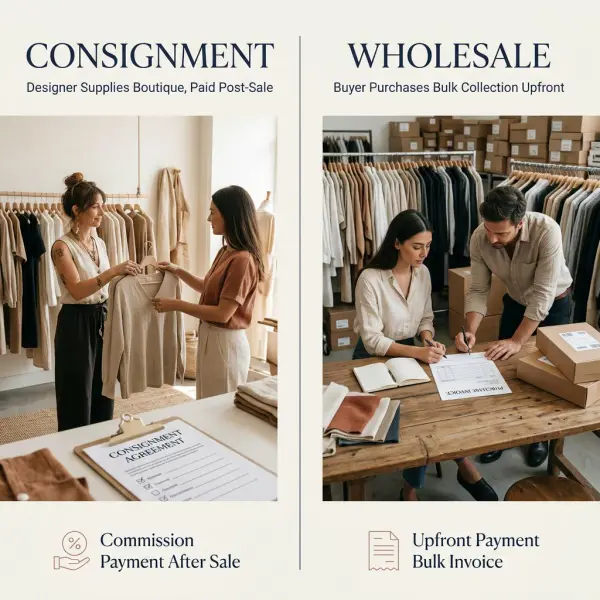
Consignment vs Wholesale: Side-by-Side Comparison
The distinction becomes clearer when the models are compared across the decisions that matter to fashion retailers and suppliers.
|
Business Factor |
Consignment |
Wholesale |
|
Basic arrangement |
Retailer sells merchandise on behalf of its owner |
Retailer purchases merchandise for resale |
|
Inventory ownership/control |
Usually retained by supplier until an agreed event |
Generally transfers to retailer under the sales contract |
|
Initial stock payment |
Usually no outright inventory purchase |
Purchase obligation arises under agreed terms |
|
Supplier payment |
Commonly follows qualifying customer sales |
Based on invoice or purchase agreement |
|
Retailer earnings |
Commission or agreed share of sales proceeds |
Difference between resale revenue and merchandise cost |
|
Unsold inventory exposure |
Often primarily remains with supplier |
Generally assumed by retailer |
|
Retail pricing authority |
Determined by consignment agreement |
Generally greater retailer discretion, subject to contractual and legal limits |
|
Inventory reconciliation |
Requires consignor-level tracking and settlement |
Primarily retailer-owned stock management |
|
Unsold product returns |
Often permitted under agreed conditions |
Depend on return rights and sales terms |
|
Supplier cash-flow pattern |
May be delayed and dependent on consumer sales |
Tied to retailer orders and agreed payment dates |
|
Retailer capital requirement |
Lower upfront inventory purchasing requirement |
Higher inventory purchasing commitment |
|
Typical strategic use |
Demand testing, limited collections, selective distribution |
Planned buying, repeat orders, established distribution |
These are characteristics of typical arrangements, not rules that apply to every contract. Wholesale agreements may include extended credit, stock rotation, return rights, or other mechanisms that shift risk. Consignment contracts may contain minimum guarantees, deposits, or arrangements that change the usual economics.
The underlying substance matters more than the terminology used by either party.

Inventory Ownership: Who Actually Owns the Clothes?
Inventory ownership and control are central to the difference between consignment and wholesale.
In a genuine consignment arrangement, the retailer normally possesses merchandise without obtaining control of it at delivery. The designer or supplier retains control until a specified event occurs, such as a sale to the end customer or another event defined in the agreement.
In a conventional wholesale transaction, the retailer purchases the products and obtains control according to the contractual delivery and acceptance terms. The retailer can generally treat those garments as merchandise acquired for resale, subject to applicable restrictions.
The distinction is significant for financial reporting. Under AASB 15, Appendix B, paragraphs B77–B78, which incorporate the corresponding IFRS 15 consignment guidance, an entity must assess whether a dealer has obtained control of delivered products. If the goods remain held on consignment, the supplier does not recognize revenue merely because they were delivered to the dealer.
Why Physical Possession Does Not Necessarily Mean Ownership
A boutique may display, store, and sell garments without purchasing them from the designer. Physical custody is therefore not enough to conclude that control has transferred.
This distinction becomes particularly important when stock is moved between retail branches, transferred to an ecommerce fulfillment facility, or returned after a selling period. Both parties need to establish which inventory remains the property of the supplier and what happens if goods are damaged or lost.
Under wholesale, the relevant control-transfer point may be tied to delivery, shipment, acceptance, or other contractual conditions. It should not be assumed that ownership always transfers at the moment a purchase order is issued.
What Happens When Garments Remain Unsold?
Consider two boutiques receiving the same capsule collection of tailored trousers.
The first accepts the products on consignment. After the agreed period, some sizes remain unsold. Depending on the contract, the boutique may return the trousers or request additional selling time.
The second purchases the trousers wholesale. If the products remain unsold, the retailer generally continues carrying them as its own inventory unless the supply agreement provides a specific return or adjustment right.
The wholesale retailer may decide to discount those garments to release stock investment and free selling space. The consignment retailer may need supplier approval before applying similar markdowns.
Neither arrangement guarantees protection against weak customer demand. It determines which party is more directly exposed to that demand risk and which decisions each party can make in response.
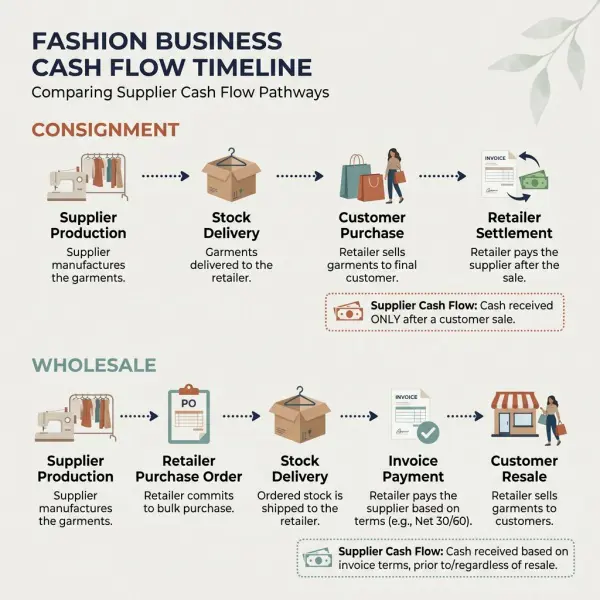
How Payment Timing Changes Cash Flow
Payment timing can be as commercially important as the final selling price.
Consignment commonly delays the supplier's receipt of cash until merchandise sells to customers. Wholesale creates a payment obligation based on the retailer's purchase, although the actual settlement date may be governed by deposits, credit periods, delivery milestones, or other terms.
This difference can influence how a fashion brand finances production, how quickly it can replenish raw materials, and whether it has enough working capital for additional collections.
Cash Flow Under Consignment
An independent designer may need to pay for fabric, trims, garment production, labeling, quality control, and transportation before delivering a collection to a retailer.
Once the merchandise arrives, there may be no immediate payment. The designer waits for customer purchases and the retailer's settlement cycle.
If sales are slow, money remains tied up in stock. Even when the merchandise is eventually returned, the designer still carries the cost of producing it and may incur additional transportation or handling expenses.
Consignment therefore provides distribution access without guaranteeing the speed or volume of cash receipts.
Cash Flow Under Wholesale
Wholesale can provide the supplier with a clearer contractual revenue pathway because the retailer commits to purchasing an agreed quantity.
However, wholesale should not automatically be described as immediate payment. A boutique may pay a deposit before manufacturing, settle the balance before shipment, or operate on approved invoice terms.
For a small designer, a large wholesale order can be attractive because it creates a defined sales commitment. Yet fulfilling that order may still require substantial working capital before payment arrives.
For the retailer, the exposure works in the opposite direction. Purchasing merchandise commits funds before the retailer knows whether customers will buy every unit.
Consignment Commission vs Wholesale Markup: A Financial Example
A comparison of consignment and wholesale profitability should use the same product, selling price, and production cost wherever possible.
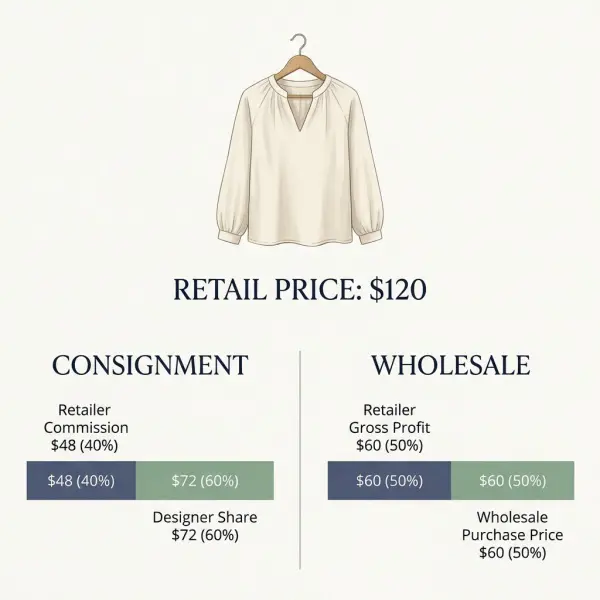
Suppose a fashion designer produces a premium cotton blouse with an assumed fully allocated unit production cost of $35. The target retail selling price is $120.
The designer is considering two retail partnerships:
- Consignment: The boutique receives a 40% commission on qualifying sales, while the designer receives 60%.
- Wholesale: The boutique purchases each blouse for $60 and independently resells it at the assumed $120 retail price.
These figures are illustrative commercial assumptions, not market averages or recommended commission rates.
Comparing the Financial Result per Blouse Sold
|
Financial Component |
Consignment |
Wholesale |
|
Customer selling price |
$120.00 |
$120.00 |
|
Retailer acquisition cost |
$0 upfront |
$60.00 |
|
Retailer commission or gross profit per sale |
$48.00 |
$60.00 |
|
Designer proceeds or wholesale revenue per unit |
$72.00 |
$60.00 |
|
Designer production cost |
$35.00 |
$35.00 |
|
Designer contribution per unit |
$37.00 |
$25.00 |
Under these assumptions, the designer retains $37 per blouse sold through consignment after the specified production cost, compared with $25 for a blouse sold wholesale.
For the retailer, the consignment commission is $48 per completed sale, while the wholesale gross profit is $60 per unit sold at full price.
However, these amounts are not directly equivalent to net profit. Retail commissions, wholesale margins, fulfillment expenses, discounts, returns, financing costs, and unsold inventory must be considered before judging the overall economics.
The wholesale retailer has committed purchasing capital and carries the risk of unsold merchandise. The consignment retailer has not made the same upfront inventory purchase, although it still bears the operating costs and liabilities assigned to it.
What Changes When Only Part of a Collection Sells?
Now assume each retailer receives 100 blouses and sells only 40 during the initial selling period. Illustrative financial outcome, before taxes, returns, discounts, and other operating expenses:
|
Metric |
Consignment |
Wholesale |
|
Units delivered |
100 |
100 |
|
Units sold |
40 |
40 |
|
Customer sales value |
$4,800 |
$4,800 |
|
Retailer commission / gross profit on sold units |
$1,920 |
$2,400 |
|
Supplier proceeds from current retail sales / initial wholesale order |
$2,880 |
$6,000 |
|
Unsold units |
60 |
60 |
|
Party generally carrying unsold-stock exposure |
Designer |
Retailer |
In the wholesale example, the retailer purchases all 100 blouses for $6,000. After selling 40 units, it has generated $4,800 in customer receipts, excluding taxes and other adjustments. Sixty purchased blouses remain in stock with an initial cost of $3,600.
That does not mean the retailer has recorded a $1,200 accounting loss. Its gross profit on the 40 sold units is $2,400, while the remaining inventory is an asset subject to applicable valuation requirements. The $1,200 difference between customer receipts and the original purchase payment instead illustrates the immediate cash invested that has not yet been recovered through sales.
Under consignment, the retailer receives $1,920 in commissions on the 40 units sold, assuming the agreed commission is earned and no later adjustments apply. The designer receives $2,880 from those transactions and continues to face commercial exposure on the remaining 60 units.
The supplier's wholesale receipt is associated with the full 100-unit purchase, while its consignment receipts depend on actual retail sell-through. This is why comparing only the earnings on a single sold garment can give a misleading picture of which model is financially stronger.
Pricing Control and Brand Positioning
Pricing is another area where consignment and wholesale can create different incentives.
A designer may want consistent retail prices across boutiques, ecommerce channels, and direct-to-consumer sales. A retailer, meanwhile, needs enough commercial flexibility to manage promotions, seasonal markdowns, and competitive conditions.
Neither objective is inherently unreasonable. The challenge is establishing a workable arrangement that respects commercial needs and applicable competition law.
Pricing Authority in Consignment
Consignment agreements commonly establish a selling price or an approved pricing framework. The retailer may need the supplier's permission before discounting merchandise, depending on the contract.
This can give designers greater practical involvement in pricing decisions than they would typically have after an outright wholesale sale.
For example, an independent label supplying limited-edition embroidered jackets may want to avoid unexpected promotional discounts that could undermine the collection's intended positioning.
However, a boutique may struggle to clear slow-moving garments if every markdown requires lengthy approval. A practical agreement can define promotional authority, discount thresholds, and procedures for seasonal stock reviews.
Pricing Decisions in Wholesale
In wholesale, the retailer generally purchases merchandise and has greater commercial exposure to pricing decisions.
A boutique selling a blouse purchased for $60 at a retail price of $120 may choose to run a promotion when demand weakens, subject to applicable law and any lawful contractual restrictions.
The commercial consequence is borne principally by the retailer because lowering the selling price reduces its gross profit on the purchased merchandise.
For fashion brands, this can create inconsistent customer-facing prices across channels. Yet brands should not assume that they can legally require independent retailers to maintain fixed resale prices. Resale price maintenance and other pricing restrictions are regulated differently across jurisdictions.
Both models therefore require careful pricing policies, but the commercial and legal framework for controlling prices can differ.
Inventory Risk and Product Returns
Fashion inventory is exposed to changing demand, seasonality, size imbalances, product damage, and the possibility of slow sell-through.
The financial consequences of those risks vary considerably depending on whether the merchandise was consigned or sold wholesale.
Who Carries the Risk of Unsold Garments?
Under a typical consignment arrangement, the supplier continues to carry much of the commercial risk associated with unsold merchandise. If a collection performs below expectations, the designer may receive little revenue while still holding the original production investment.
A wholesale retailer generally assumes the commercial risk after purchasing inventory. If customer demand weakens, it may need to discount merchandise, hold stock for a longer period, or recognize inventory write-downs when required by its accounting framework.
Risk, however, is not limited to whether garments sell. Theft, physical damage, storage conditions, shipping, product defects, and customer returns can create separate responsibilities.
The agreement must identify which party bears those risks instead of assuming they all follow legal ownership.
Return Rights Are Not the Same as Consignment
A wholesale agreement with a return option is not automatically a consignment arrangement.
Some retailers purchase merchandise but negotiate the right to return selected unsold products or receive credit for certain stock. The retailer may still have acquired control of the goods under the initial sale, depending on the contractual substance.
This distinction is particularly important in financial reporting and creditor protection.
For example, Uniform Commercial Code Section 2-326 distinguishes certain sale-on-approval and sale-or-return transactions. The applicable treatment depends on the relevant jurisdiction and circumstances.
Businesses should therefore evaluate the actual allocation of rights and obligations rather than assuming that any returnable retail merchandise is held on consignment.
Operational Differences for Fashion Retailers
For retailers, choosing between wholesale and consignment changes how stock is acquired, managed, and evaluated.
A wholesale-oriented boutique must plan purchasing budgets, place orders, forecast demand, and manage the cost of carrying inventory. A consignment-oriented boutique may spend less on initial merchandise purchases but can require more detailed supplier-level reporting and settlement administration.
Both models demand merchandising discipline. Neither protects a store from poor product selection, weak customer service, or ineffective inventory management.
Wholesale Requires Strong Purchasing and Demand Forecasting
Wholesale buying involves deciding which styles deserve purchasing commitments and how many units to order in each size and color.
For example, a retailer preparing an autumn collection might purchase a selection of denim jackets, trousers, and knitwear based on historical sales, customer preferences, delivery lead times, and expected seasonal demand.
If the buying plan overestimates demand, the store may finish the season with excess stock. If it underestimates demand, popular sizes may sell out before replenishment arrives.
Effective fashion assortment planning is therefore closely connected to the success of wholesale purchasing.
Consignment Requires Strong Stock Attribution and Settlement Controls
A consignment retailer needs to know not only how many garments remain in stock, but also which supplier owns each product and what amount is payable after a sale.
This becomes challenging when a boutique carries numerous independent labels with different commission agreements.
Product identifiers, transaction records, stock reconciliation, and settlement schedules need to work together. Sales through physical stores and online channels must also be synchronized to prevent incorrect stock availability.
A consignment arrangement may reduce purchasing capital requirements while increasing administrative complexity. Retailers should evaluate both effects before deciding how heavily to rely on the model.

Operational Differences for Designers and Fashion Brands
For fashion brands, distribution strategy affects production planning, revenue visibility, and the amount of inventory financed before customer demand becomes clear.
Consignment may allow a designer to place products in several boutiques without securing conventional purchase orders. Wholesale can create defined sales commitments but often requires competitive pricing, dependable production capacity, and consistent delivery performance.
The more suitable structure depends on the brand's maturity and resources.
Consignment Can Support Market Testing but Ties Up Working Capital
An early-stage designer launching a limited collection may find consignment useful when retailers are reluctant to commit to unfamiliar products.
The brand can observe customer demand, learn which sizes perform, and evaluate the suitability of different stores.
However, placing merchandise in several boutiques can create substantial inventory exposure. The designer must finance enough garments to support all locations while receiving payment only as qualifying sales occur.
This can become especially difficult when collections require expensive fabrics, specialized craftsmanship, or high minimum production quantities.
Wholesale Supports Production Commitments but Adds Delivery Pressure
Wholesale can help designers organize production around confirmed retailer orders.
A brand receiving orders from several boutiques may be able to consolidate quantities, plan material purchasing, and coordinate factory capacity more effectively.
Yet the business must still deliver the correct products, quantities, and quality within the agreed schedule. Late deliveries, incorrect sizing, or product defects may trigger deductions, cancellations, returns, or other contractual consequences.
Wholesale also requires careful cost calculation. The price paid by the retailer must leave the brand with sufficient contribution after production, logistics, development, and other relevant expenses.
A large purchase order can generate impressive revenue while still being commercially unattractive if its pricing and fulfillment costs are poorly understood.
When Consignment May Be the Better Choice
Consignment may be appropriate when product demand is uncertain, the retail relationship is new, or the parties want to evaluate a limited collection before committing to larger purchasing arrangements.
An independent boutique interested in an unfamiliar designer might agree to carry a small collection on consignment for a defined period. The store receives merchandise to test, while the designer gains an opportunity to observe actual customer responses.
The model can also be useful for selected high-value or limited-production products when retailers are cautious about owning expensive inventory.
Still, consignment requires both sides to evaluate whether the potential sales justify their respective costs.
For the retailer, low purchasing exposure may be offset by the cost of merchandising and administration. For the designer, a higher share of each successful sale may be offset by slow cash conversion and unsold-stock exposure.
Consignment is not inherently preferable for small brands. It is preferable when its specific benefits outweigh the financing and operational risks.
When Wholesale May Be the Better Choice
Wholesale may be more suitable when products have demonstrated demand, the retailer has adequate purchasing capital, and the supplier can fulfill orders consistently.
A boutique that has successfully sold a designer's collection through several seasons may prefer to place wholesale orders for proven styles. Doing so can simplify stock ownership and allow the retailer to manage purchases according to its merchandise planning process.
For the designer, wholesale can provide a clearer relationship between order volume, production requirements, and sales revenue.
This is particularly useful when production decisions depend on reaching minimum order quantities or coordinating manufacturing schedules.
However, wholesale may expose retailers to greater inventory risk, especially when sales forecasts are unreliable or products have short selling seasons.
A wholesale agreement is therefore not evidence that the products will ultimately sell through to consumers. It indicates that the retailer has agreed to purchase them under specified conditions.
Can Fashion Brands Use Consignment and Wholesale Together?
Yes. A fashion brand can use consignment and wholesale simultaneously with different retail partners or product categories.
A mixed distribution strategy may be commercially sensible when the brand serves retailers with different risk preferences, customer profiles, and purchasing capabilities.
For example, an apparel company might distribute its established basics collection through wholesale orders while using consignment to introduce a limited capsule collection in selected boutiques.
Another brand might begin a new retail relationship on consignment and later negotiate wholesale purchases after demonstrating sufficient customer demand.
Moving From a Consignment Trial to a Wholesale Partnership
A transition from consignment to wholesale should be based on repeatable commercial evidence.
One successful sales period may reflect favorable product placement, seasonal demand, or a particularly enthusiastic retailer. Before committing to larger wholesale quantities, both parties should evaluate whether the results are likely to continue.
Relevant indicators include consistent sell-through, customer return patterns, replenishment potential, size distribution, expected gross margins, and the brand's production reliability.
If those indicators are encouraging, the retailer may have a stronger basis for purchasing future collections. The designer, meanwhile, may gain a more predictable sales commitment.
The transition should involve new or amended commercial terms rather than assuming that the original consignment agreement automatically becomes a wholesale agreement.
Avoiding Channel Conflict
Operating both models can create tension if retailers receive substantially different commercial terms or pricing flexibility.
A wholesale partner purchasing stock outright may be frustrated if nearby consignment retailers offer the same products at unexpectedly lower prices. A consignment retailer may be reluctant to invest in merchandising if competing outlets regularly discount identical merchandise.
Brands should therefore consider product differentiation, distribution territories, promotional calendars, and partner communication.
Pricing policies must also comply with applicable competition laws. Commercial coordination should not be confused with imposing unlawful resale price restrictions.
The purpose of a mixed model is to serve different distribution needs while maintaining a coherent customer experience.

Common Mistakes When Comparing Consignment and Wholesale
Comparing Commission Percentages Directly With Wholesale Margins
A common mistake is assuming that a 40% consignment commission and a 40% wholesale markup represent the same financial outcome. They measure different things. A commission is commonly calculated as a share of an agreed sales base, while markup measures the difference between selling price and purchase cost relative to cost. Gross margin expresses gross profit relative to sales revenue. Businesses should compare actual cash flows, gross contribution, inventory exposure, and associated costs rather than relying on percentages alone.
Assuming Wholesale Always Produces Immediate Payment
Wholesale creates a contractual purchase obligation, but invoice terms may allow payment after delivery. A designer may have to finance manufacturing, packaging, and shipment before collecting the invoice. If the retailer pays late, the supplier can still experience cash-flow pressure. Brands should review deposits, credit terms, payment history, and the cost of financing production before treating wholesale as guaranteed immediate liquidity.
Assuming Consignment Has No Risk for Retailers
A consignment retailer may avoid paying for inventory upfront, but it still incurs costs associated with selling merchandise. Products occupy floor space, employees provide service, and management must reconcile transactions and stock. Contracts may also assign responsibility for damage, theft, or other losses. Retailers should evaluate commission contribution against those obligations rather than describing consignment stock as entirely risk-free.
Ignoring the Cost of Unsold Merchandise for Designers
A designer may prefer consignment because the brand receives a larger share of each completed retail sale. Yet garments that remain unsold continue tying up production capital. Their commercial value may also decline as seasons change or products become less relevant to the intended customer. Contribution per sold unit should therefore be considered alongside sell-through rates, stock age, return costs, and total capital committed to the retail relationship.
Treating Every Returnable Wholesale Arrangement as Consignment
A retailer's right to return products does not automatically mean the supplier retains control of them. Wholesale purchases may include return provisions, stock protection clauses, or agreed credit arrangements. The accounting and legal treatment depends on the substance of the transaction. Businesses should document when control transfers, whether payment is unconditional, and which party has the right to redirect or recover merchandise.
Applying the Same Strategy to Every Retail Partner
A brand may distribute successfully through both models but should not assume every retailer needs the same arrangement. A newly established boutique with limited purchasing capital may value a trial consignment relationship, while an established store with reliable demand may prefer wholesale purchasing. Partner-specific decisions should consider financial capacity, customer relevance, operational capability, and the expected commercial contribution for both sides.
How to Choose Between Consignment and Wholesale
The decision should begin with the commercial objective rather than the assumption that one model is universally superior.
A retailer seeking to test an uncertain category has different needs from a designer trying to finance a large production run. Similarly, a small boutique carrying limited-edition clothing has different constraints from a retailer replenishing proven everyday basics.
A practical evaluation can consider the following factors.
|
Decision Factor |
Consignment May Be More Suitable When |
Wholesale May Be More Suitable When |
|
Demand certainty |
Customer demand is still being tested |
Demand is relatively established |
|
Retailer capital |
Upfront purchasing resources are limited |
Purchasing capital is available |
|
Supplier cash flow |
Supplier can finance stock until sale |
Supplier prefers defined purchase obligations |
|
Product availability |
Small or selective collections are being introduced |
Repeatable supply is available |
|
Inventory exposure |
Supplier accepts more unsold-stock risk |
Retailer is prepared to carry inventory risk |
|
Reporting capability |
Reliable consignment tracking is available |
Conventional purchase and stock systems are preferred |
|
Relationship objective |
Trial placement and demand learning |
Ongoing purchasing and replenishment |
The table identifies possible advantages, not automatic decisions. A financially constrained supplier may find consignment attractive for market access but dangerous for cash flow. Likewise, a retailer may have sufficient capital to purchase inventory but still prefer a consignment trial for a particularly uncertain product category.
A Practical Decision Framework for Fashion Businesses
The commercial analysis should answer four questions.
First, who can afford to finance the inventory? If neither party has sufficient working capital, a large commitment under either model may create unnecessary pressure.
Second, how predictable is end-customer demand? Established repeat-purchase products provide a different basis for buying decisions than unfamiliar, seasonal, or highly specialized garments.
Third, what level of operational control does each party require? Pricing authority, retail presentation, inventory reporting, and customer service responsibilities should be compatible with the intended relationship.
Fourth, which model provides an acceptable financial return after risk and costs? The calculation should include expected sell-through, contribution margin, payment timing, handling costs, and unsold-stock exposure.
Once those questions are answered, the parties can negotiate terms that reflect their actual circumstances rather than relying on a standard industry assumption.




Comments 0
Leave a CommentSend Comment
Anda harus Login terlebih dahulu untuk dapat memberikan komentar.