
How Fashion Brands Build Engaged Customer Communities
Quick Answer
Fashion brands build engaged customer communities by giving customers a meaningful reason to participate beyond buying products. The foundation is not a platform, campaign, or follower count. It is a shared identity, problem, lifestyle, value, aesthetic, or aspiration that connects people to the brand and to each other.
An engaged fashion community usually needs five things: a clear community purpose, consistent participation formats, useful content, trusted moderation, and a feedback loop that shows customers their voices matter. For fashion businesses, this may include styling discussions, fit guidance, product education, member events, behind-the-scenes content, repair and care advice, customer stories, private groups, loyalty experiences, or local retail activations.
The best communities are not built by posting more often. They are built by designing better interaction. Customers need to know what they can do, why it matters, how they benefit, and how the brand will support the space. A strong community can improve loyalty, customer insight, advocacy, and brand relevance, but only when the product experience and customer experience are credible enough to sustain real conversation.

Start With a Community Purpose, Not a Platform
Many fashion brands begin community building by asking where the community should live: Instagram, TikTok, WhatsApp, Discord, a loyalty app, an email list, a private group, or an offline event series. That question matters, but it should not come first.
The first question is simpler and more strategic: why would people gather around this brand?
A fashion community needs a shared reason to exist. Without that reason, the brand is only creating another communication channel. Customers may follow for discounts, new arrivals, or visual inspiration, but they are unlikely to participate deeply unless the community helps them express identity, solve a real problem, learn something useful, or feel part of a recognizable style culture.
For example, a modest fashion brand may build community around elegant everyday dressing, practical layering, faith-conscious styling, and occasionwear confidence. A denim brand may build around fit education, repair culture, washing myths, and long-term garment wear. A workwear label may build around modern professional dressing, comfort, commuting, and capsule wardrobes. A children’s apparel brand may build around durability, washability, sizing, and parenting routines.
The clearer the purpose, the easier it becomes to design content, events, moderation, member roles, and measurement. Without purpose, every post becomes a guess.
A Useful Community Purpose Should Be Specific Enough to Guide Decisions
A weak purpose sounds like: “We want to connect with our customers.”
A stronger purpose sounds like: “We help women build polished, comfortable wardrobes for real working days.”
The second version gives the brand direction. It suggests potential discussion themes, product education topics, event ideas, styling formats, and customer segments. It also helps the brand decide what does not belong. That focus is important because communities become weaker when they try to be everything to everyone.
Fashion brands that need a broader strategic foundation can connect this topic with why fashion communities create stronger brands, which explains the brand value behind community building. This article focuses on the practical construction of engagement.
Define Who the Community Is For
A customer community cannot serve everyone equally. Fashion brands need to define the primary member profile clearly enough to make the community feel relevant, but not so narrowly that it becomes exclusionary or commercially limiting.
This does not mean reducing customers to demographics alone. Age, gender, location, income, and size range can matter, but fashion communities often form more strongly around lifestyle, taste, values, product needs, and style problems. A 28-year-old founder and a 45-year-old executive may both belong in the same workwear community if they share the same need for polished, practical, confidence-building clothing.
The brand should understand what members are trying to achieve. Are they learning how to dress better? Building a capsule wardrobe? Finding modest outfits for different occasions? Looking for better fit? Exploring local designer culture? Searching for investment pieces? Building confidence after a body change? Buying fewer but better garments? Looking for peer validation before purchase?
A community becomes more engaging when members feel the brand understands their actual wardrobe life, not only their purchasing power.
Build Around Member Motivation
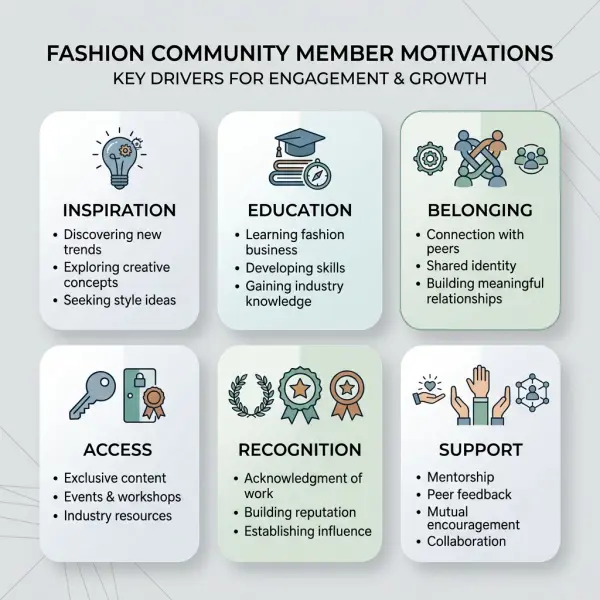
Before choosing a format, brands should map the motivation behind participation. Customers may join for different reasons:
- inspiration: they want styling ideas and visual references;
- education: they want to understand fit, fabric, care, or wardrobe planning;
- belonging: they want to meet people with similar taste or values;
- access: they want early previews, events, or closer connection to the brand;
- recognition: they want their styling, feedback, or loyalty to be acknowledged;
- support: they need help choosing sizes, outfits, or product combinations.
These motivations often overlap. A strong community strategy does not need to serve all motivations equally, but it should know which ones matter most to its customer base.
Design Participation, Not Just Content
Content can attract people, but participation is what builds community. Many fashion brands already produce lookbooks, reels, styling tips, campaign visuals, product launches, and email newsletters. Those formats are useful, but they usually remain brand-to-customer communication.
Community requires customer-to-brand and customer-to-customer interaction.
This means the brand must intentionally design what members can do. Can they ask styling questions? Share outfit photos? Vote on colors? Join a fit feedback panel? Attend local events? Submit repair stories? Join a wardrobe challenge? Test a new product category? Discuss fabric care? Invite friends? Meet the founder? Learn from a stylist? Review archived products? Contribute to a resale or repair program?
Good participation design is specific. “Engage with us” is too vague. “Share how you style this blazer for work, travel, or dinner” is easier to act on. “Tell us what you want next” is broad. “Vote between two sleeve lengths for our next shirt sample” is more concrete.
Give Members Clear Roles
Not every member will participate in the same way. In most communities, a small group contributes actively, a larger group reacts occasionally, and many members quietly observe. That is normal. Silent members may still receive value and eventually become buyers, advocates, or contributors.
Fashion brands can encourage healthier engagement by creating different participation roles:
- stylers who share outfit ideas;
- reviewers who give fit and product feedback;
- educators who explain care, fabric, or styling tips;
- hosts who lead local meetups or online sessions;
- collectors who preserve brand history or archive past pieces;
- testers who participate in sample feedback;
- advocates who recommend the brand naturally.
These roles should not feel forced. They simply help the brand recognize different forms of value. A community becomes more resilient when participation is not limited to posting glamorous outfit photos.
Choose the Right Community Format
There is no single best platform for every fashion community. The right format depends on the brand’s category, customer behavior, product price, content style, operational capacity, and the type of interaction the brand wants to encourage.
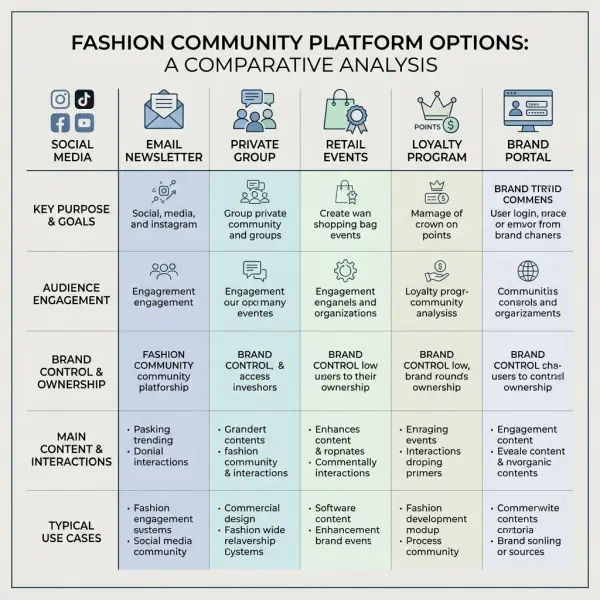
Instagram and TikTok are useful for discovery and visual culture, but they are less stable as owned community infrastructure. Email is strong for direct communication, but weaker for member-to-member interaction. Private groups can support conversation, but they require moderation. Events create deeper connection, but they need planning and cost control. Loyalty programs can support repeat behavior, but they can become transactional if they reward only purchases.
A modern fashion community often combines several layers rather than relying on one platform.
Community Format Comparison
|
Format |
Best For |
Strength |
Limitation |
|
Instagram or TikTok |
Discovery, styling content, visual identity |
High reach and visual engagement |
Platform-dependent and algorithm-sensitive |
|
Email newsletter |
Editorial storytelling and direct updates |
Owned communication channel |
Limited peer interaction |
|
Private group |
Discussion, support, feedback, member connection |
Stronger relationship depth |
Needs moderation and programming |
|
Retail events |
Styling, fitting, launch moments, local loyalty |
High emotional impact |
Requires logistics and budget |
|
Loyalty or membership program |
Repeat engagement and recognition |
Can connect behavior to rewards |
Risk of becoming discount-focused |
|
Brand app or portal |
Owned ecosystem and structured experience |
More control and data continuity |
Higher development and adoption barrier |
Most brands should start with the lightest structure that can deliver meaningful value. A small, well-run community is usually better than a large, inactive one.
Create Repeatable Community Rituals
Engagement becomes easier when members know what to expect. A community ritual is a repeated activity, theme, or interaction pattern that gives the community rhythm. In fashion, rituals work well because style habits are already seasonal, personal, and occasion-based.
A ritual could be a weekly styling question, monthly wardrobe challenge, seasonal preview session, fit clinic, customer spotlight, repair day, founder note, live styling consultation, fabric education post, local meetup, or “how to wear it three ways” series. The goal is not to fill a calendar with random content. The goal is to create familiar moments that members can anticipate and join.
Rituals are especially useful for smaller brands because they reduce the pressure to invent new engagement ideas every day. They also help customers build habits around the community.
Examples of Fashion Community Rituals
A fashion brand can create rituals around practical wardrobe behavior:
- Monday workwear styling: members share outfits for the week ahead.
- Fit Friday: the brand answers sizing and fit questions.
- Repair and care day: customers learn how to maintain garments.
- Member wardrobe story: one customer explains how they use a favorite piece.
- Seasonal preview session: members see a collection before public launch.
- One piece, three ways: the community styles the same item for different occasions.
- Color vote: members respond to sample color options.
- Local styling meetup: customers gather in a store or studio.
The best rituals are simple enough to repeat and meaningful enough to matter. If a ritual requires too much effort from members, participation may decline quickly.
Build Trust Through Moderation and Community Standards
Every community needs rules, even if the tone is warm and informal. Community standards protect members, guide behavior, and help the brand respond consistently when issues arise.
Fashion communities can involve sensitive topics: body image, sizing, cultural identity, religious dress, gender expression, price accessibility, sustainability claims, copying accusations, labor concerns, and product complaints. Without thoughtful moderation, conversations can become uncomfortable, exclusionary, or commercially damaging.
Good moderation does not mean controlling every opinion. It means creating a space where members can participate safely and constructively. Brands should allow honest product feedback while setting boundaries around harassment, discrimination, spam, misinformation, and disrespectful behavior.
A simple community standard may cover:
- respectful communication;
- no body shaming or discriminatory comments;
- transparent rules for promotions and affiliate links;
- clear process for product complaints;
- permission rules for reposting member content;
- disclosure rules for gifted products or paid relationships;
- privacy expectations for photos, events, and customer data.
This is not just a legal concern. It is a trust concern. Customers are more likely to participate when they know the environment is managed with care.
Handle Customer-Generated Content Responsibly
User-generated content can be powerful in fashion because customers often want to see products on real people, in real settings, and across different body types or styling contexts. But customer content must be handled responsibly.
A brand should not assume that tagging the brand automatically gives unlimited permission to reuse a photo in ads, emails, product pages, or paid campaigns. The brand should request permission, clarify usage, credit the creator appropriately, and respect removal requests where applicable. For global fashion brands, privacy, advertising, consumer protection, and image rights may vary by market.
Disclosure also matters when customers receive free products, commissions, affiliate links, ambassador benefits, or payment. In the United States, the FTC Endorsement Guides address endorsements and testimonials in advertising, including material connections. Brands operating outside the United States should verify local rules before launching ambassador or creator programs.
A responsible UGC system should include:
- clear permission request process;
- usage rights documentation;
- creator credit standards;
- disclosure requirements for paid or gifted relationships;
- content review for accuracy and brand safety;
- a process for removing or updating content when needed.
Customer content should feel like participation, not extraction. The brand’s responsibility is to make the value exchange transparent.

Connect Community Feedback to Product and Retail Decisions
An engaged community becomes more valuable when the brand listens visibly. Customers do not need every suggestion to be accepted, but they need to see that feedback is taken seriously.
Fashion brands can use community feedback to improve sizing, fit notes, product descriptions, styling content, care instructions, merchandising, event programming, and customer service scripts. The key is to separate useful patterns from isolated opinions. A few comments may be interesting. Repeated themes across customers, channels, and sales data are more important.
For example, if customers repeatedly ask whether a dress is suitable for petite heights, the brand may need better product measurements, model height references, or styling images. If members often ask how to style a sheer blouse modestly, the brand may need layering content or product bundles. If community members love a fabric but complain about wrinkling, the brand may need better care education or fabric expectation-setting.
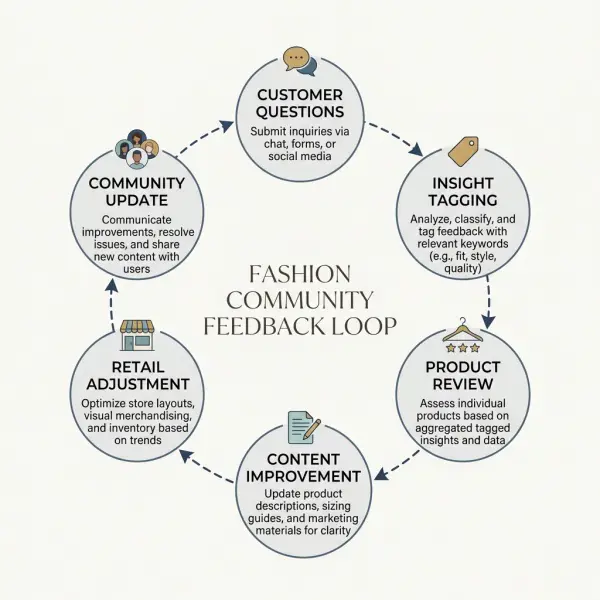
Feedback becomes stronger when it is organized. A brand should not rely on memory or scattered screenshots. It needs a simple system for tagging insights, assigning owners, and reviewing patterns regularly.
A Simple Community Feedback Loop
A practical feedback loop can follow this sequence:
- Collect recurring questions, comments, complaints, and styling needs.
- Categorize them by product, fit, content, service, pricing, or retail experience.
- Compare feedback with sales, returns, reviews, and customer service data.
- Decide which insights require action.
- Communicate visible improvements back to the community.
- Repeat the cycle.
This loop helps prevent community management from becoming performative. Members are more likely to keep contributing when they see that their input improves the brand experience.
Balance Brand Leadership With Member Participation
A strong community does not mean the brand disappears. Fashion brands still need creative direction, product discipline, visual standards, and editorial taste. The brand’s role is to lead the community with clarity while leaving enough room for members to interpret, contribute, and respond.
This balance is delicate. If the brand controls everything, the community feels staged. If the brand provides no direction, the community may become unfocused. The strongest fashion communities usually have a clear point of view and flexible participation.
A premium womenswear brand, for example, may set the tone through refined styling language, elegant visuals, and thoughtful wardrobe education. Members can then contribute their own versions of that aesthetic. A streetwear brand may set the tone through cultural references, drop rituals, and collaboration, while members bring local interpretation. A sustainable fashion brand may guide the conversation around care, longevity, and responsible consumption, while members share repair stories and wardrobe habits.
The brand remains the editor. The community becomes the living expression.
Measure Engagement Quality, Not Just Activity
Community metrics can be misleading. More comments do not always mean stronger community. A controversial post may generate high activity but weaken trust. A small styling discussion may produce fewer interactions but reveal valuable insight that improves conversion or reduces returns.
Fashion brands should measure engagement quality alongside volume. Useful metrics may include repeat participation, member-to-member replies, useful questions, content saves, event attendance, feedback adoption, UGC permission rates, member retention, repeat purchase behavior among community members, and customer service issue reduction.
The Community Roundtable’s Community Maturity Modelis useful as a broader reference because it frames community building as something that can be planned, assessed, and matured over time. For fashion brands, the same principle applies: community should evolve from informal activity into a managed business capability.
Better Community Metrics for Fashion Brands
Instead of looking only at surface engagement, fashion brands should track signals that reflect relationship depth:
- percentage of members who participate more than once;
- number of member-to-member replies, not only brand replies;
- quality of styling, fit, and product questions;
- volume of actionable feedback themes;
- event attendance and repeat attendance;
- UGC permission and reuse rates;
- retention or repeat purchase among community members;
- customer sentiment around trust, fit, service, and product quality.
The goal is not to turn the community into a spreadsheet. The goal is to understand whether the community is creating trust, insight, participation, and commercial relevance.
Avoid Over-Rewarding Only Purchases
Many fashion communities are connected to loyalty programs. This can work well, but brands should be careful not to reward only transactions. If the community becomes purely purchase-based, it may exclude valuable members who contribute in other ways.
Some customers may not buy frequently because the category is premium, seasonal, occasion-based, or designed for longer use. That does not mean they are unimportant. They may still share styling ideas, refer friends, attend events, provide feedback, or influence others.
A more balanced system can recognize both commercial and non-commercial participation. For example, a brand may reward customers for attending a styling session, completing a fit survey, joining a care workshop, contributing a wardrobe story, or helping answer peer questions. Rewards do not always need to be discounts. Recognition, access, education, and involvement can be more brand-building than constant price incentives.
This matters because over-discounting can weaken perceived value. Community should deepen the relationship, not train customers to engage only when a reward is attached.
Build Owned Community Assets Over Time
Fashion brands should not rely entirely on rented platforms. Social media platforms are powerful for discovery and cultural visibility, but algorithms, ad costs, policies, formats, and audience behavior can change quickly.
An owned community asset gives the brand more stability. This may include an email list, customer account area, membership program, event database, private customer portal, editorial hub, SMS list, clienteling system, or brand app. Not every brand needs a custom app, and many should avoid expensive technology before proving community demand. But every serious community strategy should consider how customer relationships will be protected outside social media.
A practical path may look like this: start with social content and email, test small community rituals, host occasional events, create a private group for the most engaged customers, collect structured feedback, then build a membership layer only when there is enough demand.
Technology should follow behavior. If members are not participating meaningfully in simple formats, a more complex platform will not solve the problem.
Common Mistakes When Building Fashion Communities
Fashion community building often fails not because the idea is weak, but because execution is rushed or misaligned with the brand’s real capacity.
Mistake 1: Launching Before the Brand Has a Clear Point of View
A vague brand creates a vague community. If customers cannot explain what the brand stands for, they are unlikely to gather around it. The better approach is to clarify the brand’s style position, customer problem, values, and voice before launching community programs.
Mistake 2: Posting More Instead of Designing Interaction
Many teams respond to low engagement by increasing content volume. But more posts do not automatically create stronger participation. The brand should examine whether members have clear prompts, useful reasons to respond, and formats that make participation easy.
Mistake 3: Ignoring Negative Feedback
Some brands treat criticism as a threat. In reality, recurring complaints about sizing, shipping, quality, imagery, or customer service can be valuable operational signals. The better approach is to moderate disrespectful behavior while listening carefully to repeated product and service issues.
Mistake 4: Making the Community Too Promotional
If every community moment points to a product launch, members may disengage. Commercial content is acceptable, but it should be balanced with education, styling value, behind-the-scenes context, customer stories, and genuine conversation.
Mistake 5: Underestimating Moderation Work
Communities need attention. Questions must be answered, conflicts managed, spam removed, rights clarified, and feedback organized. A brand that launches a community without assigning responsibility may create a poor experience for members.
What Brands Should Verify Before Scaling
Before scaling a community, fashion businesses should verify whether engagement is meaningful and operationally sustainable. Growth should not be the first goal. A larger inactive community is not stronger than a smaller engaged one.
Brands should check:
- whether members understand the purpose of the community;
- whether participation happens without constant incentives;
- whether the team can respond consistently;
- whether feedback is improving decisions;
- whether moderation standards are working;
- whether customer-generated content is handled legally and ethically;
- whether community members show stronger retention or advocacy signals;
- whether the community supports brand positioning rather than diluting it.
Only after these foundations are healthy should the brand move toward broader community-led growth. That deeper growth layer belongs naturally in community-led growth strategies for fashion businesses, where referral systems, ambassador structures, co-creation, launches, and advocacy loops can be explored more fully.

FAQ
What is an engaged fashion community?
An engaged fashion community is a group of customers or followers who actively participate in brand-related conversations, styling activities, feedback, events, or shared experiences. Engagement is not limited to likes or comments. It includes meaningful actions such as asking fit questions, sharing outfit ideas, attending events, giving product feedback, recommending the brand, or helping other customers make better choices.
How does a fashion brand start building a community?
A fashion brand should start by defining the community purpose and the customer it serves. The brand should identify the shared style problem, lifestyle, value, or identity that gives people a reason to gather. After that, it can choose simple participation formats such as styling prompts, fit Q&A sessions, customer stories, email discussions, private groups, or small events. Starting small is usually better than launching a large platform too early.
Which platform is best for a fashion brand community?
There is no universal best platform. Instagram and TikTok are strong for visual discovery, email is useful for owned communication, private groups support discussion, and retail events create deeper emotional connection. The best platform depends on where customers already spend time and what type of interaction the brand wants to encourage. Many brands need a combination of social visibility and owned communication channels.
How can small fashion brands build community with limited budget?
Small fashion brands can begin with low-cost rituals such as weekly styling prompts, customer fit discussions, behind-the-scenes product notes, care tips, founder Q&A sessions, or small local meetups. The priority should be consistency and relevance, not expensive technology. A small group of engaged customers can provide better insight and advocacy than a large but passive audience.
How should brands encourage customers to participate?
Brands should make participation clear, easy, and valuable. Instead of asking broad questions like “What do you think?” they can ask specific questions such as “How would you style this shirt for work?” or “Which inseam length works better for you?” Brands should also recognize contributions, respond thoughtfully, and show when feedback influences decisions. Participation grows when members feel their input matters.
What role does moderation play in fashion communities?
Moderation protects the quality and safety of the community. It sets expectations for respectful discussion, manages spam, handles criticism constructively, protects members from body shaming or discrimination, and clarifies rules around promotions or customer-generated content. Good moderation does not remove honest feedback. It creates the conditions for useful, respectful, and trustworthy conversation.
How can fashion brands measure community success?
Fashion brands should measure both activity and quality. Useful metrics include repeat participation, member-to-member replies, event attendance, customer-generated content, actionable feedback, sentiment, referral behavior, repeat purchase among community members, and customer retention. Follower count alone is not enough. A smaller community with strong trust and useful participation may be more valuable than a large passive audience.
Conclusion
An engaged fashion community is not built by accident. It requires a clear purpose, a defined member profile, useful participation formats, consistent rituals, thoughtful moderation, and a real feedback loop into the business.
For fashion brands, the opportunity is significant because clothing naturally connects to identity, lifestyle, confidence, culture, and belonging. But community building only works when the relationship is genuine. Customers need to receive value, not just marketing messages. They need space to participate, not just react. They need to see that the brand listens, not just collects engagement.
The strongest communities are built slowly and deliberately. They begin with a shared reason to gather, then grow through trust, usefulness, and consistency. For fashion businesses, that makes community building less of a campaign tactic and more of a long-term operating discipline.




Comments 0
Leave a CommentSend Comment
Anda harus Login terlebih dahulu untuk dapat memberikan komentar.