
Virtual Fashion Explained Beyond the Metaverse Hype
Quick Answer
Virtual fashion refers to clothing, accessories, and fashion products created as digital assets rather than physical garments. These assets may be worn by avatars, used in gaming environments, applied to campaign visuals, simulated in 3D design software, or displayed in virtual showrooms and online retail experiences.
The term became popular during the metaverse boom, but virtual fashion is broader than metaverse speculation. Its more practical value is in helping fashion businesses visualize products, test creative concepts, support digital marketing, reduce some sampling inefficiencies, and build new forms of consumer engagement.
For brands, virtual fashion should not be understood as a replacement for physical clothing. People still need real garments for daily life. Instead, virtual fashion works best as an additional layer in the fashion ecosystem: a digital tool for design, communication, storytelling, and experience-building.
The opportunity is real, but it is not automatic. Fashion businesses need to evaluate audience fit, technology cost, asset quality, commercial purpose, intellectual property, and whether digital garments solve an actual business problem.
What Virtual Fashion Really Means
Virtual fashion is fashion created for digital use. It can look like a dress, jacket, sneaker, handbag, or accessory, but instead of being cut and sewn from physical materials, it is built as a digital file. That file may be rendered as a still image, animated on a model, worn by an avatar, placed inside a game, used in augmented reality, or shown as part of a virtual showroom.
This is why virtual fashion should not be reduced to one platform or one trend cycle. It is not only about the metaverse. It is not only about NFTs. It is not only about gaming skins. Those are some possible expressions of the idea, but they are not the whole field.
At the business level, virtual fashion sits at the intersection of fashion design, 3D visualization, digital product development, marketing content, online retail, avatar identity, and digital asset management. A fashion company may use virtual fashion without ever launching a metaverse store. A brand may create 3D garments for internal sampling, product visualization, or campaign imagery long before it sells a digital-only dress to consumers.
A useful way to define it is this: virtual fashion is the creation and use of fashion products as digital assets that can represent, extend, or sometimes replace a physical garment in specific digital contexts.

Why Virtual Fashion Became Linked to the Metaverse
Virtual fashion entered mainstream business conversation during the period when the metaverse was heavily promoted as the next major digital environment. Fashion brands experimented with avatar outfits, virtual stores, NFT-linked products, digital collectibles, gaming collaborations, and immersive brand activations.
That association made sense at the time. Fashion has always been tied to identity, self-expression, status, community, and visual culture. In virtual spaces, people still want to express who they are. Avatars need clothing. Digital communities create their own aesthetic codes. Gaming platforms and social worlds gave fashion brands a new environment to test storytelling beyond physical retail.
The problem was that the metaverse narrative often moved faster than actual consumer behavior. Many virtual worlds did not become everyday destinations for mainstream fashion consumers. Some projects attracted press coverage but limited repeat engagement. Others were more useful as brand awareness experiments than as durable revenue channels.
This created a misleading perception: when metaverse hype cooled, some people assumed virtual fashion also lost relevance. In reality, many of the more practical applications continued developing outside the metaverse conversation. Digital garments remained useful for 3D design, campaign production, e-commerce imagery, virtual try-on experiments, gaming partnerships, and product visualization.
The metaverse gave virtual fashion visibility. It did not define its full value.
The Difference Between Virtual Fashion, Digital Fashion, and Digital Garments
The terms “virtual fashion,” “digital fashion,” and “digital garments” are often used interchangeably, but they can mean slightly different things depending on context.
Digital fashion is usually the broadest term. It may include 3D fashion design, virtual samples, avatar clothing, digital styling, computer-generated imagery, virtual showrooms, and AI-assisted fashion visuals. Virtual fashion often refers more specifically to clothing experienced in digital environments. Digital garments are the actual clothing assets created in digital form.
For a fashion business, the distinction matters because each term points to a different operational use. A digital garment used by a product development team has a different purpose from an avatar jacket sold inside a game. A 3D-rendered dress used in campaign imagery has different requirements from a virtual sample used for supplier approval.
Here is a simple way to separate the concepts:
|
Term |
Practical Meaning |
Common Business Use |
|
Digital fashion |
Broad category for fashion created or managed digitally |
Design, marketing, visualization, retail, education |
|
Virtual fashion |
Fashion experienced in virtual environments |
Avatars, gaming, virtual events, immersive brand spaces |
|
Digital garment |
A specific clothing item built as a digital asset |
3D sampling, renders, virtual try-on, content production |
|
Digital fashion asset |
A reusable digital file related to fashion |
Garment files, textures, trims, avatars, campaign assets |
The definitions overlap, but the business purpose should be clear before investing. A brand does not need every form of digital fashion. It needs the specific digital asset strategy that supports its audience, product category, and commercial goals.
How Virtual Fashion Works in Practice
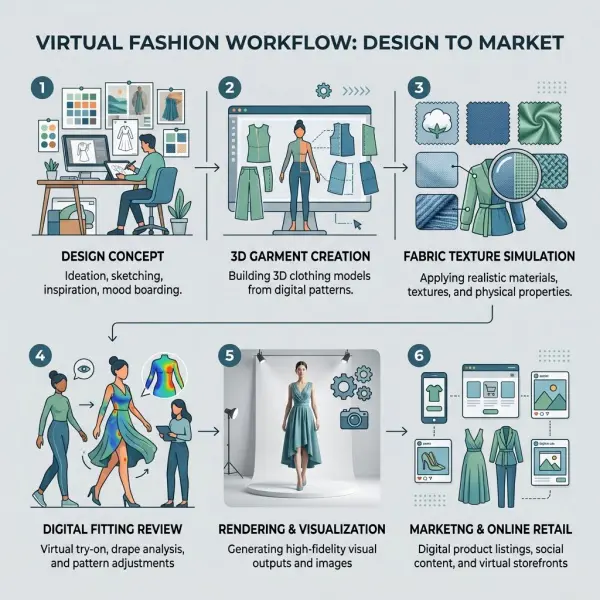
Virtual fashion begins with digital creation. A designer, 3D artist, technical designer, or digital product team builds a garment using software that can represent shape, pattern, fabric behavior, color, texture, and styling. In some workflows, the digital garment is based on a real pattern. In others, it is created primarily for visual use.
3D apparel design tools such as CLO 3D and Browzwear are widely associated with digital garment visualization and virtual product development. These tools allow teams to simulate garments, adjust silhouettes, review design details, and communicate ideas before or alongside physical sampling.
A simplified virtual fashion workflow usually involves several stages:
- Concept development and design direction
- Digital pattern or 3D garment creation
- Material, color, trim, and texture simulation
- Fit and silhouette review on an avatar or digital body
- Rendering for presentation, marketing, or product review
- Exporting assets for e-commerce, gaming, AR, or content use
Not every workflow is technically advanced. A small brand may use digital garments mainly for visuals. A manufacturer may use them to reduce sampling revisions. A gaming collaboration may require assets optimized for a specific platform. A luxury campaign may need highly polished CGI that looks editorial rather than technical.
The key point is that virtual fashion is not one process. It is a family of workflows, and each workflow has its own level of complexity.
Why Fashion Businesses Are Interested in Virtual Fashion
Fashion businesses are not exploring virtual fashion only because it looks innovative. The deeper reason is operational pressure. Fashion teams need to create more content, shorten product development cycles, reduce unnecessary sampling, serve online shoppers better, and build stronger digital brand experiences.
Virtual fashion can support these needs when used carefully. It gives teams a way to visualize ideas before committing to physical production. It can help marketing teams generate campaign concepts without producing every garment sample first. It can help retail teams show products in more flexible digital environments. It can also help designers communicate shape, proportion, and styling more clearly across global teams.
For brands with strong digital communities, virtual fashion may also create new forms of engagement. A digital accessory, avatar outfit, or virtual styling experience can function as a brand touchpoint. This is especially relevant in spaces where consumers already spend time customizing digital identity, such as gaming, social platforms, and avatar-based communities.
Still, the value is not automatic. A digital garment that looks impressive in a pitch deck may have limited business use if it does not connect to a customer behavior, marketing goal, or operational need.
Virtual Fashion Beyond the Metaverse: Where It Is Actually Useful
The strongest business cases for virtual fashion are often less dramatic than the headlines. They are practical, repeatable, and connected to existing fashion workflows.
Product Development and Digital Sampling
In apparel development, virtual garments can help teams review silhouettes, proportions, colorways, and construction ideas before producing multiple physical samples. This does not mean physical sampling disappears. Fit, fabric hand feel, drape, stitching quality, production feasibility, and wearer comfort still often need real-world validation.
The benefit is more realistic when framed as sample optimization rather than sample elimination. A brand may reduce some unnecessary iterations, improve communication with suppliers, or detect visual issues earlier. For categories with complex fit or technical performance requirements, physical prototypes remain essential.
Campaign and Content Creation
Fashion marketing is increasingly visual, fast, and multi-channel. Brands need images for websites, social feeds, paid ads, lookbooks, marketplaces, launch campaigns, and retail partners. Digital garments can help teams create flexible visuals without relying entirely on physical shoot logistics.
This becomes especially useful when a product is not yet fully available, when colorways need to be tested quickly, or when campaign concepts require visual experimentation. The deeper content production angle belongs in how digital garments are used in marketing and content creation, but the main point is simple: virtual fashion can expand the creative toolkit.
E-Commerce and Product Visualization
Online retail has a persistent limitation: customers cannot physically examine the garment before buying. Digital assets can help improve product understanding through 3D views, styling visualization, interactive product displays, or virtual try-on concepts.
These tools can support confidence, but they must be executed carefully. Poor-quality visualization may create inaccurate expectations. If fabric drape, fit, scale, or color is misleading, the customer experience can suffer rather than improve.
Gaming and Avatar Identity
Gaming and avatar environments are natural spaces for virtual fashion because clothing has social meaning there. A digital jacket or sneaker may not protect the body, but it can still communicate taste, belonging, status, humor, aspiration, or fandom.
For fashion brands, this creates a potential bridge to younger or digitally native audiences. The challenge is cultural fit. A luxury brand cannot simply place a runway item inside a gaming environment and expect relevance. The product, platform, community, and interaction model must make sense together.

What Virtual Fashion Does Not Mean
Virtual fashion is often misunderstood because the public conversation around it has been shaped by hype cycles. To understand the business value, it is just as important to clarify what it does not mean.
Virtual fashion does not mean physical apparel is becoming irrelevant. Most fashion demand is still grounded in real human needs: comfort, protection, identity, occasion dressing, workwear, modesty, climate, movement, and social presentation in physical life. Digital garments may extend fashion expression, but they do not remove the need for real clothing.
Virtual fashion also does not automatically mean sustainability. Digital products avoid some impacts associated with physical production, such as fabric waste, physical sampling, shipping, and unsold inventory. But digital systems still use energy, hardware, servers, rendering resources, and software infrastructure. A sustainability claim should be tied to a specific replacement effect, not a broad assumption.
Nor does virtual fashion guarantee new revenue. Some digital products can be sold, licensed, bundled, or used for engagement. Others may function mainly as marketing assets. A virtual fashion initiative that generates attention but has no measurable business objective can become an expensive experiment.
The more grounded view is this: virtual fashion is a tool. Like any tool, its value depends on where, why, and how it is used.
The Business Value of Virtual Fashion
The business value of virtual fashion usually falls into five areas: visualization, efficiency, engagement, content flexibility, and asset scalability.
Visualization is the most immediate value. Designers, buyers, merchandisers, suppliers, and marketers can review product ideas in a more visual format. This helps when teams are distributed across countries or when approvals need to happen before samples arrive.
Efficiency can appear when digital garments reduce avoidable back-and-forth. This is not guaranteed. A company still needs trained people, accurate asset standards, and workflow discipline. But when implemented well, digital sampling may help teams make decisions earlier.
Engagement is the consumer-facing side. Virtual fashion can create new moments of interaction: an avatar outfit, an AR try-on, a digital collectible, or a virtual styling experience. These are most useful when they align with audience behavior.
Content flexibility is increasingly important. Once a digital garment exists, it may be adapted into different visual formats. A brand can use it for lookbook concepts, e-commerce previews, social teasers, internal presentations, or retail partner communications.
Asset scalability is the long-term opportunity. A well-built digital asset library can support future campaigns, product updates, colorway testing, and cross-channel storytelling. This is where virtual fashion begins to connect with broader digital fashion asset strategy.

The Operational Reality Behind Virtual Fashion
Virtual fashion can look simple from the outside. A digital dress appears on screen, a campaign image is rendered, an avatar wears a branded jacket. Behind that output is a technical and operational system that must be managed carefully.
A high-quality digital garment requires more than a good-looking 3D model. The team may need accurate patterns, realistic fabric properties, correct trims, believable texture mapping, proper lighting, avatar compatibility, file optimization, and clear approval standards. For marketing visuals, the asset must look emotionally compelling. For product development, it must be technically credible. For gaming, it must work within the platform’s file and performance limitations.
This is where many brands underestimate the work. They treat digital fashion as a creative novelty rather than a production discipline. The result can be beautiful but unusable assets, or assets that work for one campaign but cannot be reused.
Operationally, fashion businesses should define the purpose before creating the asset. A digital garment for internal sampling does not need the same finish as a luxury campaign render. A gaming skin does not need the same construction logic as a manufacturing-ready virtual sample. A virtual try-on asset needs different standards from a social media visual.
Good virtual fashion strategy begins with use-case discipline.
Practical Ways Fashion Businesses Can Apply Virtual Fashion
For most fashion businesses, the best starting point is not a massive virtual world project. It is a focused use case that connects to an existing business need.
A brand can begin by identifying where digital visualization would reduce friction. For example, a growing apparel label may use 3D garments to review seasonal colorways before sampling every option. A manufacturer may use virtual samples to communicate garment construction more clearly with overseas clients. A retailer may test digital styling visuals to enrich product pages. A fashion school may use virtual garment tools to teach product development and visual presentation.
The most practical applications include:
- Using 3D garments during early design review
- Creating digital samples for buyer or supplier communication
- Testing colorways before physical sampling
- Producing campaign previews before final production
- Building virtual lookbooks for wholesale or retail partners
- Creating digital styling content for social media
- Preparing assets for AR, gaming, or interactive retail experiments
- Developing reusable digital product libraries
The best application depends on the business model. A DTC brand may care most about content speed and customer engagement. A garment manufacturer may care more about technical communication and sample efficiency. A fashion media platform may use virtual fashion as a storytelling format. A luxury brand may focus on brand experience and digital exclusivity.
Virtual fashion should be integrated into the business where it creates clarity, speed, engagement, or creative leverage. It should not sit outside the organization as a disconnected innovation project.
Common Mistakes Brands Make with Virtual Fashion
The first mistake is treating virtual fashion as a publicity tactic without defining what success means. A launch may generate short-term attention, but if the brand cannot connect it to awareness, engagement, content efficiency, community growth, product development improvement, or revenue, the project becomes difficult to justify.
The second mistake is assuming digital garments are automatically cheaper or faster. They can be more efficient in certain workflows, but high-quality 3D assets still require skilled labor, software, creative direction, technical review, rendering time, and revisions. Poor planning can make the process slower than expected.
The third mistake is separating virtual fashion from the real product system. If the digital garment has no relationship to actual product development, brand identity, merchandising, or customer experience, it may look interesting but fail to support the business.
The fourth mistake is overclaiming sustainability. Digital assets can reduce certain physical processes when they replace physical samples, unnecessary shoots, or overproduction-related visualization needs. But the claim must be specific. A digital garment is not automatically “sustainable” just because it is not made from fabric.
The fifth mistake is ignoring ownership and usage rights. Digital fashion assets may involve designers, 3D artists, software platforms, photographers, model likenesses, game environments, marketplace rules, and licensed brand elements. Businesses should clarify rights before using assets commercially across channels.
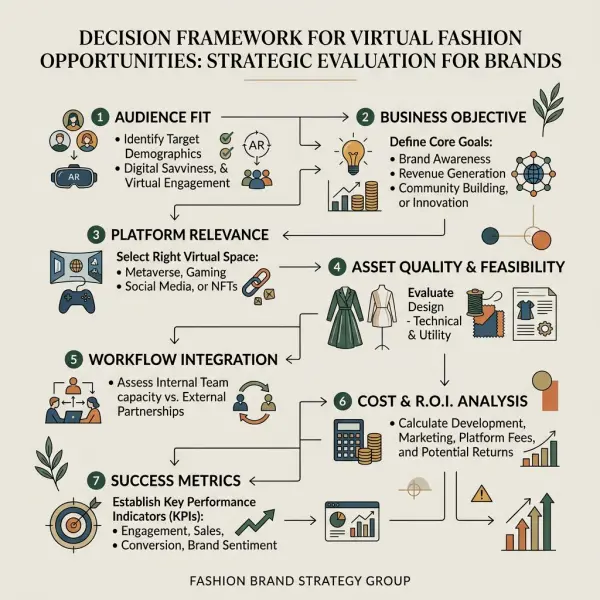
A better approach is to treat virtual fashion as a serious asset class. It needs a brief, budget, quality standard, workflow, legal review, and measurement plan.
What Brands Should Verify Before Investing
Before investing in virtual fashion, fashion businesses should ask practical questions rather than starting with technology.
The most important question is not “Should we enter the metaverse?” It is “Which business problem are we trying to solve with digital fashion assets?”
Brands should verify:
- Whether the target audience actually engages with digital fashion formats
- Which use case matters most: design, marketing, retail, gaming, or education
- What level of visual realism is required
- Whether the team has internal 3D skills or needs external partners
- How digital assets will be stored, updated, and reused
- Which platforms or channels will use the assets
- What legal rights are attached to the final files
- How success will be measured
This verification step keeps the strategy grounded. It also prevents a common problem: creating impressive digital assets that are difficult to operationalize later.
Important Technical Caveats
Virtual fashion is advancing, but current technology still has limitations. A garment may look beautiful in a render but behave differently in real fabric. Digital drape depends on the quality of fabric simulation data. Fit visualization depends on avatar accuracy, body measurements, pattern quality, and how the garment is modeled.
For product development, this means digital review should be treated as a decision-support tool, not a full replacement for physical validation. Physical sampling remains important for fabric hand feel, seam strength, production feasibility, comfort, movement, durability, wash performance, and final quality approval.
For marketing, brands should also be careful with visual accuracy. If a digital image creates expectations that the physical product cannot meet, it may damage trust. Color, texture, scale, opacity, and fit should be reviewed closely.
For consumer-facing virtual try-on, privacy and data handling also matter. Tools that rely on body images, measurements, or personal data need careful governance, especially across markets with different privacy expectations and regulations.
Virtual fashion can be powerful, but technical realism and consumer trust must be protected.
FAQ
Is virtual fashion the same as metaverse fashion?
Not exactly. Metaverse fashion is one part of virtual fashion, but virtual fashion is much broader. It includes digital garments used in 3D design, campaign visuals, online retail, augmented reality, gaming, virtual try-on, and digital sampling. A brand can use virtual fashion without creating a metaverse store or selling avatar clothing. For business purposes, it is better to think of virtual fashion as a digital asset strategy rather than a metaverse-only trend.
Can virtual fashion replace physical clothing?
Virtual fashion does not replace the everyday need for physical clothing. People still need garments for comfort, protection, work, climate, social life, movement, and self-expression in the physical world. What virtual fashion can do is extend fashion into digital environments and improve how products are designed, visualized, marketed, and experienced online. In most realistic business models, virtual and physical fashion work together rather than compete directly.
Why are fashion brands using digital garments?
Fashion brands use digital garments for several reasons: faster visualization, reduced dependency on early physical samples, more flexible marketing content, better online product presentation, and new consumer engagement formats. A digital garment can help teams review design ideas, create campaign assets, or support virtual retail experiences. The value depends on asset quality, workflow integration, and whether the digital garment serves a specific business purpose.
Is virtual fashion sustainable?
Virtual fashion can reduce certain physical impacts when it replaces activities such as unnecessary samples, some physical shoots, or speculative product development. But it should not automatically be called sustainable. Digital tools still require energy, hardware, software, storage, and rendering infrastructure. Sustainability claims should be specific, measurable where possible, and connected to what the virtual asset actually replaces in the business process.
What skills are needed to create virtual fashion?
Virtual fashion often requires a mix of fashion design, pattern understanding, 3D modeling, garment simulation, material visualization, rendering, styling, and digital asset management. For product development, technical garment knowledge is especially important. For marketing, creative direction and visual polish matter more. Many successful workflows combine traditional fashion expertise with digital production skills rather than relying only on software knowledge.
Is virtual fashion only relevant for luxury brands?
No. Luxury brands may receive more attention because their virtual projects are often highly visible, but virtual fashion can also be useful for mass-market brands, startups, manufacturers, fashion educators, and content creators. The use case may differ. A luxury brand may focus on experience and exclusivity, while a manufacturer may use digital garments for sample communication and product development efficiency.
How should a fashion business start with virtual fashion?
A fashion business should start with one focused use case. For example, it may test 3D garment visualization for one product category, create digital assets for a small campaign, or use virtual samples for internal design review. Starting small helps the team understand cost, workflow, quality standards, and practical value before scaling. The goal should be learning through a useful business application, not launching technology for its own sake.
Conclusion
Virtual fashion is more than a metaverse talking point. Its real significance lies in how digital garments and digital fashion assets can support the everyday work of design, product development, marketing, retail, and customer engagement.
The most credible opportunities are practical rather than exaggerated. Virtual fashion can help teams visualize products earlier, produce more flexible content, improve digital storytelling, and experiment with new forms of identity and interaction. But it does not remove the need for physical apparel, technical validation, strong creative direction, or clear commercial strategy.
For fashion businesses, the useful question is not whether virtual fashion is hype or the future. The better question is where digital assets can create value now, without weakening product credibility or customer trust.
Brands that approach virtual fashion with discipline will be better positioned to benefit from it. Not because every fashion product will become digital, but because digital assets are becoming a more important layer in how fashion is designed, communicated, and experienced.




Comments 0
Leave a CommentSend Comment
Anda harus Login terlebih dahulu untuk dapat memberikan komentar.