
Why Fashion Brands Are Investing in Augmented Reality Shopping
Quick Answer
Fashion brands are investing in augmented reality shopping because it helps customers understand products more visually, interactively, and personally before purchase. In online fashion retail, AR can support virtual try-on, 3D product viewing, product customization, immersive campaigns, styling previews, and in-store digital experiences.
The commercial reason is not simply novelty. AR shopping can help brands address practical e-commerce problems: customers want to judge scale, proportion, color, styling compatibility, and product detail without physically handling the item. Shopify’s product media guidance notes that product pages can use videos, 3D models, and augmented reality to increase customer confidence when browsing online stores. Shopify product media guidance
Still, AR shopping is not automatically worth the investment for every fashion brand. It works best when it supports a clear business case: improving product visualization, reducing uncertainty, enriching digital merchandising, supporting omnichannel retail, strengthening brand experience, or reusing 3D assets across multiple channels. Brands should treat AR as a retail capability, not just a marketing effect.

What Is Augmented Reality Shopping in Fashion?
Augmented reality shopping in fashion is a digital retail experience that places, previews, or simulates fashion products in a customer’s real-world or personalized visual context using a phone, tablet, web browser, app, smart mirror, or in-store screen. It helps shoppers see how a product may look on the body, face, hand, foot, outfit, or surrounding environment before they buy.
In fashion, AR shopping can appear in several forms. A shopper may virtually try on sunglasses through a phone camera, preview sneakers on their feet, view a 3D handbag from every angle, test jewelry scale on the hand, or see how a jacket might look on a digital model. For beauty-fashion categories, AR may also help customers compare makeup shades, although lighting and screen color still affect perception.
The first article in this cluster, AR virtual try-on explained for fashion retail, explains the core technology behind AR try-on. The second article, how virtual fitting tools help reduce online fashion returns, focuses on sizing, fit guidance, and return reduction. This article looks at the broader investment logic: why brands are allocating budget, staff attention, and product data infrastructure to augmented reality shopping.
The answer is increasingly strategic. Fashion retail is no longer built only around product pages and store displays. Brands need content, interaction, personalization, and product confidence across search, marketplaces, social commerce, mobile web, physical stores, and digital campaigns. AR can serve several of those touchpoints when it is built on reliable product assets and realistic customer needs.
Why Are Fashion Brands Investing in AR Shopping?
Fashion brands are investing in AR shopping because digital retail has a sensory gap. Customers can see photos, read descriptions, and check reviews, but they cannot touch the fabric, test the scale, try the styling, or compare proportions in the same way they would in a store.
AR does not remove that gap entirely. It narrows part of it.
For many product categories, the most valuable thing AR provides is visual confidence. A customer can better understand whether a frame shape suits their face, whether a sneaker looks bulky or sleek, whether a watch is too large for their wrist, or whether a jewelry piece has the right scale. In apparel, AR and AI try-on can help with visualizing silhouette and styling, although true fit still depends on measurements, construction, fabric behavior, and movement.
Fashion brands are also investing because AR assets can support multiple business functions. A high-quality 3D product model can be used on product pages, in AR try-on, in wholesale presentations, in digital showrooms, in advertising, and potentially in future immersive commerce environments. This makes the investment more attractive than a one-time campaign asset.

A useful way to frame the investment is simple: AR shopping becomes valuable when it helps customers make better product decisions and helps the brand reuse richer digital assets across channels.
AR Shopping Supports Product Visualization Beyond Flat Images
Flat product photography is still essential, but it has limits. A product image can show color, styling, texture, and mood, yet it often struggles to communicate scale, depth, movement, and personal proportion.
This is where AR and 3D product visualization become commercially interesting. Shopify describes 3D models as virtual representations of objects that can give customers a better sense of size, scale, and product details; customers can also view those models from different angles and, when supported, in their own environment. Shopify 3D model product media
For fashion, that matters most in categories where product shape is part of the buying decision. A bag’s depth, handle drop, closure structure, and hardware placement may not be fully clear in front-view photos. A sneaker’s outsole profile, toe shape, and upper construction may look different from side and top angles. Jewelry scale is notoriously difficult to judge from close-up product shots.
AR shopping gives brands another merchandising layer. It can answer visual questions such as:
- How large does this product appear in real scale?
- Does the shape suit the customer’s face, hand, wrist, or foot?
- What does the product look like from multiple angles?
- How does the item interact with styling context?
- Is the color visually compatible with the customer’s preference or wardrobe mood?
This does not mean every product needs AR. A basic T-shirt may not justify complex 3D treatment. A high-margin handbag, eyewear frame, watch, jewelry piece, sneaker, or premium outerwear item may.
AR Helps Brands Build More Interactive Product Pages
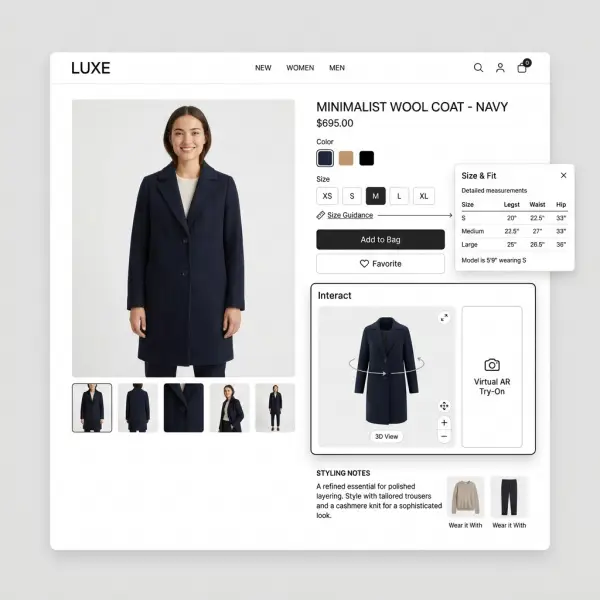
Fashion e-commerce has spent years improving product pages with bigger images, videos, model notes, reviews, size charts, and styling suggestions. AR adds another layer: interaction.
An interactive product page asks the customer to participate. Instead of only scrolling, the shopper can rotate, try on, compare, personalize, or inspect. This can increase time with the product, but the more important point is decision quality. A customer who interacts with the product may notice details that would otherwise be missed.
That interaction can also create useful merchandising signals. If many shoppers open AR try-on for a product but do not add to cart, there may be hesitation around price, scale, color, or styling. If customers repeatedly compare two frame shapes, the brand may learn something about assortment overlap. If a product receives high AR engagement but poor conversion, the feature may be revealing interest without enough purchase confidence.
This is where AR begins to overlap with retail analytics. The interaction itself becomes data. But brands need to interpret it carefully. AR usage does not automatically mean purchase intent. Some customers may use it for entertainment, especially if the feature appears in social channels. E-commerce teams should compare AR engagement with add-to-cart, conversion, return reasons, and customer feedback before judging impact.
AR Investment Is Also a 3D Asset Investment
Many fashion brands first think of AR as a customer-facing feature. More mature teams see it as part of a digital asset strategy.
To support AR at scale, brands often need 3D models, texture files, product dimensions, color data, material references, and consistent file formats. This pushes the organization to improve product data discipline. That work may feel technical, but it has commercial value. The same assets can support merchandising, marketplaces, product development, social content, B2B sales, and future retail experiments.
The Khronos Group’s 3D Commerce Working Group exists to reduce barriers to deploying 3D at scale, including work around glTF-based 3D commerce assets and guidelines for creating, manufacturing, and presenting 3D products across consumer platforms. Khronos 3D Commerce Working Group
This matters because fashion brands rarely sell through one channel only. A product may need to appear on the brand website, a marketplace, a wholesale portal, social media, a retail app, and a physical store display. If each channel requires separate visual production, costs rise quickly. If the brand builds reusable 3D assets, AR becomes one output from a broader asset pipeline.
There is a trade-off. Good 3D assets are not free. Brands need to budget for modeling, scanning, texture creation, optimization, file management, QA, and updates when products change. For seasonal fashion with high SKU turnover, this can become operationally heavy. The business case is stronger when products have longer selling windows, higher margins, repeated forms, or reusable components.
AR Shopping Can Strengthen Omnichannel Retail
AR shopping is not only for online stores. It can support omnichannel retail by connecting digital product exploration with physical store experience.
In-store AR mirrors can let customers preview colors, accessories, or styling options without physically trying every item. QR codes on displays can open 3D product views or virtual try-on from a customer’s phone. Sales associates can use AR tools to help customers compare variants. For out-of-stock sizes or colors, AR can help explain options that are available online.
The omnichannel value is especially relevant for fashion brands with limited store space. A boutique cannot display every size, color, or variant. A digital layer can extend the assortment without overloading the floor. For wholesale or showroom contexts, AR and 3D assets can also help buyers inspect products before samples are available or when shipping samples is costly.
The strongest use cases tend to be practical:
|
Retail Situation |
How AR Shopping Helps |
Business Value |
|
Limited in-store inventory |
Shows unavailable colors or variants digitally |
Extends assortment without more floor space |
|
Online product uncertainty |
Lets shoppers preview scale, style, or fit impression |
Supports purchase confidence |
|
Social commerce campaign |
Creates interactive product discovery |
Encourages engagement and sharing |
|
Wholesale presentation |
Shows products in 3D before full sample availability |
Supports faster buyer review |
|
Premium product detail |
Allows closer inspection of construction or materials |
Reinforces perceived value |
|
Store associate selling |
Helps compare products with customers |
Improves assisted selling experience |
The key is channel fit. A playful AR filter may work well for awareness. A precise 3D viewer may be better for high-consideration products. A virtual try-on tool may belong directly on the product page. Brands should avoid forcing one AR format across every customer journey.
AR Shopping Responds to the Cost of Returns, But It Is Not a Complete Return Solution
Return reduction is one reason brands invest in AR, but it should be treated carefully. AR can reduce certain types of avoidable uncertainty, especially around visual mismatch, scale, style, and product expectation. It may also support virtual fitting or size guidance when combined with stronger data.
However, AR alone does not solve returns. Online retail returns remain a large structural issue: NRF estimated that 19.3% of online sales would be returned in 2025. NRF 2025 Retail Returns Landscape In fashion, returns are affected by size, fit, fabric feel, delivery timing, quality, color accuracy, customer bracketing behavior, and return policy design.
This is why the business case must be specific. AR may help a jewelry brand reduce returns caused by unexpected scale. It may help an eyewear brand reduce hesitation around face shape. It may help a footwear brand improve style confidence. For apparel, AR and AI try-on may help visualization, but size accuracy still requires garment measurements, fit data, pattern consistency, and clear product communication.
The second article in this cluster, how virtual fitting tools help reduce online fashion returns, goes deeper into the return-management side. The strategic point here is that AR should be one layer in a wider return-reduction system, not a standalone promise.
Major Platforms Are Making Virtual Shopping More Visible
Fashion brands are also investing in AR because large technology platforms are making visual shopping more normal. When customers encounter try-on features through search, marketplaces, social media, or mobile shopping tools, they become more familiar with the behavior.
Google has expanded virtual try-on in Shopping. In 2023, Google described a generative AI virtual try-on model that shows apparel on real models with different body shapes and sizes, including details such as drape, folds, stretch, and wrinkles. Google generative AI virtual try-on In a later update, Google said U.S. shoppers could use a selfie or full-body photo to generate studio-like images for virtual try-on and shop from billions of product listings in its Shopping Graph. Google digital version virtual try-on update
For fashion brands, this creates both opportunity and pressure. The opportunity is that customers may become more comfortable using digital try-on experiences. The pressure is that product content must be structured well enough to appear in richer shopping environments.
This does not mean every brand should immediately chase every new platform feature. Platform tools can change. Meta announced that Meta Spark’s third-party tools and content would no longer be available from January 14, 2025, which is a useful reminder that fashion brands should assess platform dependency before building AR strategies around one ecosystem. Meta Spark platform update
The safer approach is to build reusable product assets and customer experience logic that can move across platforms when needed.
AR Helps Brands Tell Product Stories More Clearly
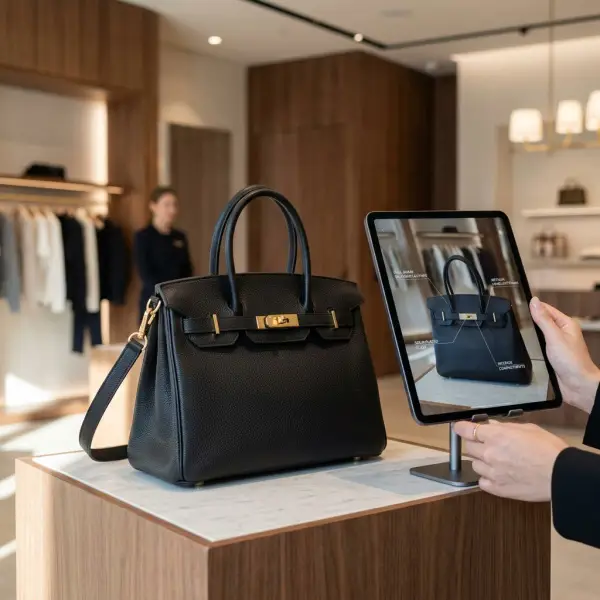
Fashion products often need explanation. A technical sneaker has construction details. A performance jacket has layered materials. A luxury bag has hardware, stitching, lining, compartments, and scale. A jewelry piece has stone setting, metal finish, and proportion. AR can make these details easier to explore.
This is especially valuable when a brand sells at a premium price. Customers need to understand why the product costs more. Static copy can explain craftsmanship, but interactive visualization may make details more tangible. A 3D model can let the shopper inspect a bag’s structure. An AR preview can show how a watch sits on the wrist. A virtual try-on can show how eyewear changes the face.
The brand storytelling opportunity is strongest when AR is restrained and useful. Overly futuristic effects can make products feel less credible, especially in fashion categories where material, construction, and taste matter. The technology should serve the product, not compete with it.
AR Shopping Supports Personalization and Styling
Fashion shopping is personal. A product is rarely evaluated in isolation. Customers ask whether it fits their face, body, wardrobe, occasion, identity, climate, and lifestyle. AR can support that personal layer by letting shoppers test products in a more individualized context.
For accessories, this is relatively direct. Eyewear can be shown on the face. Watches and jewelry can be shown on the hand or wrist. Shoes can be previewed on the foot. For apparel, personalization is harder but still developing through AI-generated try-on, model selection, avatar systems, and body-based visualization.
AR also supports styling. A customer may not only ask, “Does this fit?” but “Can I see myself wearing this?” That question matters for categories driven by taste and aspiration. A technically accurate size recommendation may not close the sale if the customer cannot imagine the product in their style life.
The commercial challenge is to keep personalization respectful. Body data, face imagery, and customer photos require clear consent and careful handling. Personalization should help the customer choose, not make them feel watched, judged, or manipulated.
Why AR Matters for Brand Differentiation
Fashion brands operate in crowded digital spaces. Product feeds, marketplace listings, ads, social posts, and search results can make many brands look similar. AR can create a more memorable brand interaction when it is tied to product quality and customer need.
For a new accessory brand, AR try-on can make online discovery more convincing. For a premium footwear brand, 3D viewing can communicate construction and silhouette. For a luxury brand, an interactive product experience can reinforce craft and exclusivity. For a mass retailer, virtual fitting and try-on may support convenience and scale.
But differentiation fades quickly when every brand uses AR in the same way. A generic try-on button is not a brand strategy. The experience should reflect the brand’s category, customer, tone, product detail, and service model.
A practical distinction:
|
Weak AR Use |
Stronger AR Use |
|
Adds AR because competitors are doing it |
Uses AR to solve a specific customer hesitation |
|
Focuses on visual spectacle |
Focuses on product understanding |
|
Uses low-quality overlays |
Builds accurate assets and realistic scale |
|
Measures only clicks |
Measures confidence, conversion, returns, and feedback |
|
Depends entirely on one social platform |
Builds reusable assets across web, app, retail, and campaigns |
|
Treats AR as a campaign |
Treats AR as a retail capability |
The difference is discipline. AR is useful when it clarifies the product and supports the customer’s decision. It becomes weak when it exists only to signal that the brand is “innovative.”
What Brands Should Verify Before Investing
Before investing in AR shopping, fashion brands should verify whether the technology fits their product category, customer behavior, operational capacity, and commercial goals.
The first question is category suitability. Eyewear, footwear, watches, jewelry, bags, cosmetics, and premium accessories often have clearer AR use cases than basic apparel. Apparel can still benefit, but fit simulation requires stronger data and more careful communication.
The second question is asset readiness. Does the brand have product dimensions, high-quality imagery, accurate colors, material references, and a system for maintaining 3D assets? If not, the AR experience may look inconsistent or become expensive to scale.
The third question is measurement. A brand should know what success means before launch. Possible metrics include AR feature usage, add-to-cart rate after AR interaction, conversion lift, return reason changes, time on product page, customer feedback, assisted selling results, and digital asset reuse.
Before committing budget, brands should ask:
- What customer problem will AR solve?
- Which product categories have enough margin or uncertainty to justify AR?
- What asset format, quality level, and production workflow are required?
- Will the experience work on mobile web, app, marketplace, or in-store devices?
- How will the brand handle customer photos, scans, body data, or consent?
- Who owns the 3D assets and can they be reused elsewhere?
- What happens if the platform or vendor changes direction?
- How will business impact be measured beyond engagement?
These questions help prevent a common mistake: buying a visually impressive feature without a realistic operating model.
Common Mistakes Fashion Brands Make With AR Shopping
Investing Before Fixing Product Content
AR cannot compensate for weak product information. If the product page lacks clear size guidance, accurate color, garment measurements, fabric notes, and model information, AR may only decorate an uncertain buying experience.
A better approach is to strengthen product content first, then use AR where visual interaction adds extra value.
Treating AR as a One-Time Campaign Asset
Many brands launch AR for a seasonal campaign and then abandon the asset pipeline. This can create a short burst of attention, but it rarely builds long-term capability.
A stronger strategy asks how the same 3D assets can support e-commerce, wholesale, social commerce, product education, retail stores, and future content production.
Overestimating Apparel Fit Accuracy
Apparel AR is improving, but garments are difficult to simulate. Fabric drape, stretch, garment ease, pattern shape, seam placement, lining, and body movement all affect fit. Brands should avoid implying that a visual try-on guarantees physical fit.
If fit accuracy is the main goal, AR should be combined with size recommendation, garment measurements, fit notes, and return feedback.
Ignoring Privacy and Consent
Virtual try-on may involve face data, body images, selfies, measurements, or uploaded photos. Customers need to understand what is collected, stored, processed, or deleted. A vague consent flow can damage trust.
Fashion brands should make the experience useful without making it feel intrusive.
Measuring Novelty Instead of Business Value
High AR usage may reflect curiosity, not purchase confidence. Brands should avoid judging AR only by clicks, shares, or time spent. The better question is whether AR improves the customer decision and supports business performance.
That means connecting AR metrics to conversion, returns, customer service questions, product feedback, and repeat usage.
How Fashion Brands Can Apply AR Shopping Strategically
The most practical AR strategy starts small and scales only after evidence. A fashion brand does not need to digitize the entire catalog immediately.
A focused pilot might begin with one category where visual uncertainty is high. An eyewear brand could test its best-selling frames. A jewelry brand could start with rings or earrings where scale matters. A footwear brand could use AR for hero sneakers. A bag brand could create 3D models for premium products with strong margins.
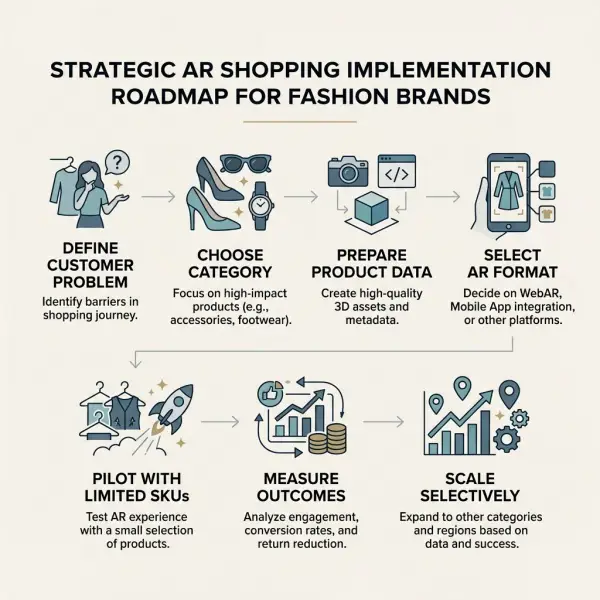
A useful implementation roadmap looks like this:
|
Stage |
Strategic Action |
Why It Matters |
|
Define the customer problem |
Identify whether the issue is scale, styling, fit, detail, color, or engagement |
Prevents technology-first implementation |
|
Choose the right category |
Start with high-visual-risk or high-margin products |
Improves chance of commercial impact |
|
Prepare product data |
Build accurate dimensions, images, material references, and variant logic |
Improves realism and consistency |
|
Select AR format |
Use try-on, 3D viewer, WebAR, in-store mirror, or AI visualization as needed |
Matches tool to customer journey |
|
Pilot with limited SKUs |
Test before full rollout |
Controls cost and reveals friction |
|
Measure behavior and outcomes |
Track usage, conversion, return reasons, feedback, and asset reuse |
Separates novelty from value |
|
Scale selectively |
Expand only where the data supports it |
Keeps investment disciplined |
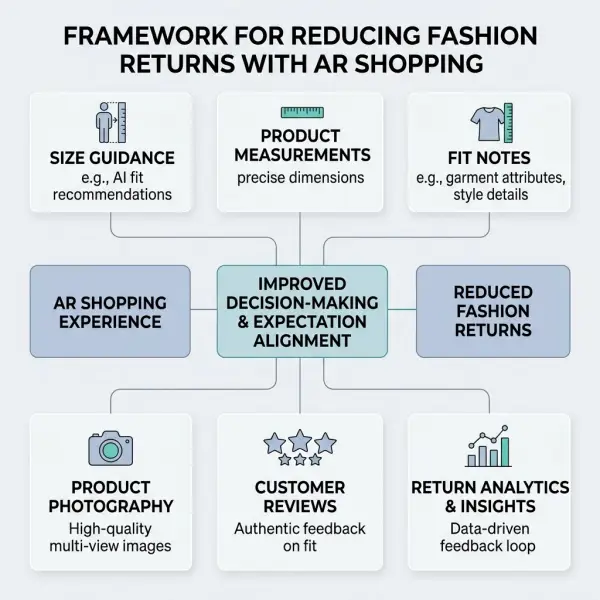
For small and medium fashion brands, the first step may be simple: improve product photography, measurements, model notes, and category-level fit communication. AR should come after the brand understands where shoppers hesitate most. For larger brands, AR may become part of a broader digital commerce infrastructure that includes product information management, digital asset management, 3D workflows, personalization, and retail analytics.
FAQ
Why are fashion brands investing in augmented reality shopping?
Fashion brands are investing in augmented reality shopping because it helps customers evaluate products more interactively before buying. AR can show product scale, proportion, styling, and visual compatibility in ways that flat images cannot always communicate. It can also support virtual try-on, 3D product viewing, omnichannel selling, digital campaigns, and richer product storytelling. The investment makes the most sense when AR solves a real customer hesitation, not when it is added only as a novelty feature.
Does AR shopping increase sales for fashion brands?
AR shopping may support sales when it improves product confidence and reduces hesitation, but results depend on product category, execution quality, customer adoption, asset realism, and e-commerce experience. It is more credible to say AR can support conversion than to claim it automatically increases sales. A high-quality AR experience for eyewear, jewelry, footwear, or premium accessories may help customers make decisions faster. A poor AR overlay on a weak product page may have little effect.
Which fashion categories benefit most from AR shopping?
Categories with strong visual uncertainty usually benefit most. Eyewear, watches, jewelry, footwear, bags, beauty products, and premium accessories are often suitable because customers care about scale, shape, color, and personal compatibility. Apparel can benefit too, especially through AI try-on or avatar-based visualization, but garment fit is harder to represent accurately because fabric drape, stretch, construction, and movement matter. Brands should prioritize categories where AR answers a real buying question.
Is AR shopping only useful for large fashion brands?
No. Small brands can use AR strategically, especially if they sell visually sensitive products such as eyewear, jewelry, shoes, or bags. However, small brands should be careful with cost and complexity. Before investing in advanced AR, they should improve product photography, measurements, fit notes, customer reviews, and product descriptions. A focused AR pilot on a few high-value products is usually safer than trying to digitize the full catalog immediately.
What is the difference between AR shopping and virtual try-on?
AR shopping is the broader category. It includes any augmented reality experience that helps customers shop, such as 3D product viewing, in-room product placement, interactive product detail, in-store AR displays, and virtual try-on. Virtual try-on is one specific use case where the customer previews a product on their face, body, hand, wrist, or foot. All virtual try-on can be part of AR shopping, but not all AR shopping is virtual try-on.
What are the risks of AR shopping for fashion brands?
The main risks are poor asset quality, unrealistic product representation, privacy concerns, platform dependency, weak customer adoption, and unclear business measurement. If the digital product does not match the physical product, customer trust can decline. If the feature requires personal photos or body data, consent must be clear. If the brand depends entirely on one third-party platform, changes to that platform can disrupt the AR experience. A responsible strategy should plan for these risks from the beginning.
Should fashion brands invest in AR or improve product content first?
Most brands should improve product content first unless they already have strong product data and a clear AR use case. Accurate product images, garment measurements, size notes, model information, fabric descriptions, videos, and customer reviews are still the foundation of online fashion retail. AR becomes more valuable when those basics are already strong. If the product page is weak, AR may create interaction without solving the customer’s real uncertainty.
Conclusion
Fashion brands are investing in augmented reality shopping because digital retail needs richer ways to help customers understand products. AR can support virtual try-on, 3D visualization, product storytelling, personalization, omnichannel selling, and customer confidence. It gives brands a way to make online shopping feel more interactive and product-aware.
The investment is strongest when it is tied to a clear business problem. Does the customer need to judge scale? Compare styling? Understand construction? Visualize a product on the body? Reduce uncertainty before purchase? If the answer is yes, AR may be commercially useful.
But AR is not a shortcut. It requires accurate product data, realistic digital assets, privacy-aware design, platform planning, and disciplined measurement. For fashion brands, the real opportunity is not simply adopting a new technology. It is building a more visual, interactive, and trustworthy shopping experience around products that customers already want to understand better.




Comments 0
Leave a CommentSend Comment
Anda harus Login terlebih dahulu untuk dapat memberikan komentar.