
How 3D Design Helps Reduce Fashion Waste and Costs
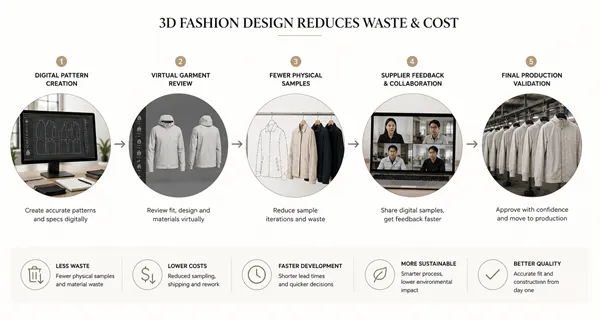
3D design can help reduce fashion waste and costs by allowing brands to develop, review, and revise garments digitally before producing physical samples. In apparel product development, this can mean fewer prototype rounds, less sample fabric consumption, reduced courier shipping, faster approval cycles, and clearer communication between design teams, technical developers, merchandisers, and suppliers.
The biggest cost benefits usually come from reducing unnecessary sample iterations and catching design or fit issues earlier. The biggest waste benefits usually come from using less fabric, fewer trims, and fewer physical prototypes during the development stage.
However, 3D design does not automatically make a fashion business sustainable or low-cost. It works best when combined with accurate digital patterns, reliable fabric data, trained technical teams, supplier readiness, better demand planning, and disciplined production decisions.
In practical terms, 3D design is not a magic replacement for physical testing. It is a development tool that can reduce avoidable waste and cost when used strategically.
Why Waste and Cost Problems Start Early in Fashion Development
Many waste and cost issues in fashion begin long before garments reach stores. They often start during product development, when brands test ideas, revise samples, change materials, adjust fit, and coordinate with suppliers across different locations.
Traditional apparel development usually requires several rounds of physical samples. Each sample may involve fabric cutting, sewing, trims, shipping, fitting, review, and revision. If the first sample is inaccurate, the team may request another. If the second sample still has fit or proportion issues, the cycle continues.
This process is normal in apparel development, but it can become expensive and wasteful when communication is unclear or development calendars are compressed.
3D design helps by moving part of the decision-making process into a virtual environment. Before a physical sample is made, teams can review the garment’s silhouette, proportion, seam placement, fabric appearance, colorways, and fit behavior digitally.
That does not remove every physical step. But it can reduce unnecessary physical trial-and-error.
How 3D Design Reduces Physical Sample Waste
The most direct waste reduction comes from lowering the number of physical samples needed during development.
In traditional sampling, every prototype consumes materials. Even a simple garment may require shell fabric, lining, interfacing, buttons, labels, thread, elastic, packaging, and shipping materials. Complex garments may require even more inputs.
With 3D design, teams can test many design decisions digitally first, including:
- garment length
- sleeve volume
- pocket placement
- silhouette balance
- color combinations
- print scale
- trim positioning
- basic fit issues
- styling variations
This means fewer physical samples may be needed for early visual decisions.
For example, a brand developing a women’s jacket can compare three pocket placements and two sleeve shapes digitally before requesting a physical prototype. Without 3D, those options might require multiple sewn samples or extensive back-and-forth revisions.
The sustainability logic is simple: if fewer unnecessary samples are produced, less development-stage material is consumed. But the result depends on whether the company actually changes its sampling behavior, not merely whether it owns 3D software.
3D vs traditional fashion sampling explains this difference more deeply from a workflow perspective.
How 3D Design Lowers Sampling and Development Costs
The financial benefit of 3D design usually appears across several cost areas rather than one single line item.
Physical samples are not only expensive because of fabric. They also require labor, shipping, review time, correction notes, coordination, and calendar space. When a brand works with overseas suppliers, international sample shipping can add further cost and delay.
3D design may reduce costs by helping teams:
- approve visual changes digitally
- reduce repeated prototype rounds
- minimize sample shipping
- identify design issues earlier
- communicate corrections more clearly
- prepare better technical instructions
- shorten development calendars
The strongest financial gains usually happen when 3D workflows are integrated into the development process, not used as a decorative visualization tool.
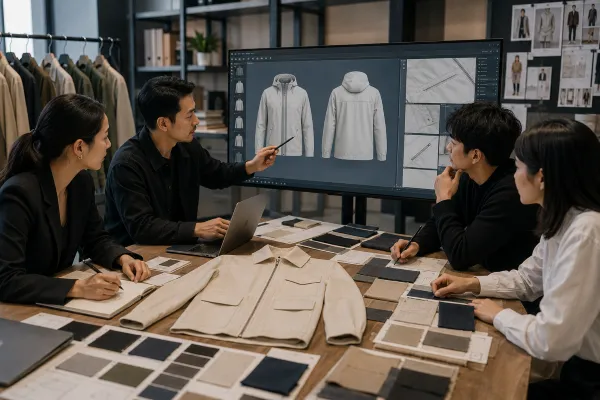
For example, if a merchandising team uses 3D only for presentation renders after the physical sample is already complete, the cost reduction may be limited. But if designers, pattern makers, technical developers, and suppliers use 3D earlier, the company has a better chance of reducing avoidable sample rounds.
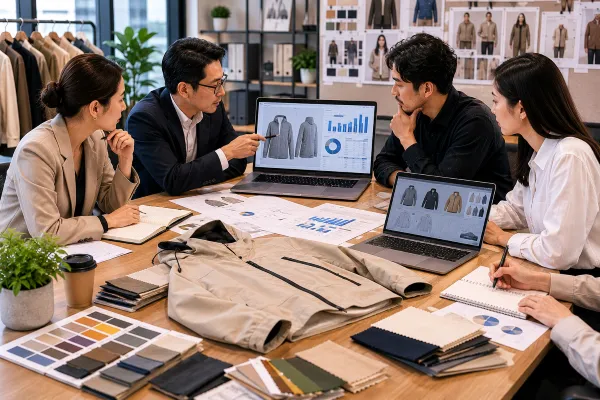
Fashion businesses are under pressure to improve efficiency, sourcing agility, and cost control; McKinsey’s State of Fashion 2026 notes that fashion brands and suppliers are pursuing efficiency, digitization, and automation as cost pressures reshape the value chain. (McKinsey & Company)
Where the Biggest Waste Savings Usually Happen
3D design is most effective at reducing waste in the development stage, not necessarily across the entire product lifecycle.
This distinction matters.
Fashion waste can come from many sources:
- sample waste
- cutting waste
- overproduction
- unsold inventory
- returned products
- damaged goods
- poor-quality products
- end-of-life disposal
3D design directly addresses only some of these areas. Its strongest influence is on sample waste, product development inefficiency, and early decision-making.
It may indirectly support better inventory decisions if brands use digital assets for earlier buyer feedback, virtual range review, or demand testing. But it does not automatically solve overproduction.
The Ellen MacArthur Foundation frames circular fashion around broader system changes, including products being used more, made to be made again, and made from safe and recycled or renewable inputs. Digital sampling may support part of this shift, but it is not a full circularity strategy by itself. (Ellen MacArthur Foundation)
How 3D Design Supports Better Decision-Making Before Production
One of the most underrated benefits of 3D design is decision quality.
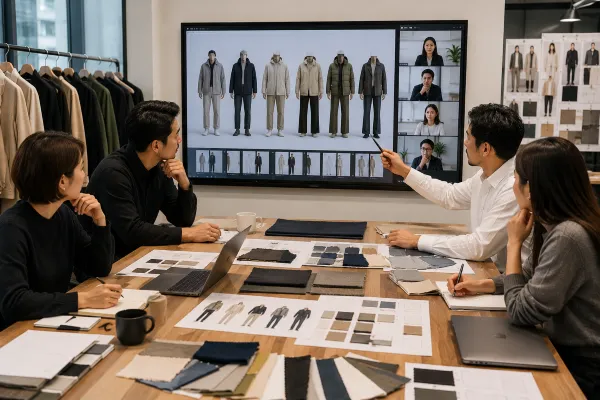
In many apparel companies, waste happens because decisions are made too late. A design may look promising as a sketch but fail after sampling. A colorway may be approved, then rejected after the sales team sees it. A fit issue may appear only after several physical rounds.
3D design helps teams make better early decisions by giving them a clearer visual and technical reference before committing resources.
This can support:
- earlier range editing
- faster colorway selection
- clearer buyer presentations
- better internal alignment
- more accurate supplier feedback
- fewer last-minute changes
For fashion startups and smaller brands, this can be especially valuable. Limited budgets leave less room for repeated sampling mistakes. A digital review process can help founders evaluate whether a garment direction is worth sampling physically.
How 3D Design Can Reduce Rework
Rework is one of the hidden cost drivers in apparel development.
A garment may need rework because of unclear instructions, poor fit interpretation, incorrect proportions, mismatched materials, or misunderstood construction details. Every correction consumes time and money.
3D design reduces rework by making product information more visual.
Instead of relying only on flat sketches, written comments, and reference photos, teams can review a virtual garment from multiple angles. This helps align expectations between the creative and technical sides of the business.
For suppliers, a digital garment can clarify:
- how the silhouette should sit on the body
- where seams should align
- how volume should be distributed
- how trims should be positioned
- how print scale should appear
- how color blocking should be balanced
This does not replace a complete tech pack. It strengthens it.
A strong 3D workflow should still include pattern specifications, measurements, material details, construction notes, grading information, and quality expectations.
3D fashion design explained for apparel industry gives a broader explanation of how these digital workflows function inside apparel product development.
Cost Areas 3D Design Can Influence
3D design affects cost differently depending on how deeply it is integrated into the business.
|
Cost Area |
How 3D Design Can Help |
Important Limitation |
|
Sample fabric |
Fewer early prototypes may reduce material use |
Final physical validation may still be required |
|
Sample labor |
Some revisions can happen digitally |
Skilled digital labor is also needed |
|
Shipping |
Fewer sample shipments may reduce courier costs |
Physical samples still need shipping for final checks |
|
Development time |
Faster digital feedback can shorten cycles |
Poor workflow setup can slow teams initially |
|
Merchandising |
Digital assets can support earlier review |
Buyers may still request physical samples |
|
Marketing assets |
Renders may support early content planning |
Final campaign imagery often still needs real garments |
The important point is that 3D design does not remove cost. It shifts cost from repeated physical correction toward better digital preparation and earlier decision-making.
That shift can be commercially powerful when managed well.
Sustainability Claims to Treat Carefully
3D design is often marketed as a sustainable fashion solution. That can be true in a limited and specific sense, but broad claims should be treated carefully.
A responsible claim would be:
3D design can reduce some development-stage waste by lowering unnecessary physical samples.
A risky claim would be:
3D design makes fashion sustainable.
Those are very different statements.
To communicate sustainability accurately, brands should avoid claims such as:
- “zero waste”
- “fully sustainable”
- “carbon neutral”
- “eco-friendly by default”
- “no physical samples needed”
- “completely eliminates waste”
unless they have reliable data to support the claim.
Sustainability depends on the entire product and business system: material sourcing, production volume, durability, logistics, inventory planning, use phase, repairability, resale potential, and end-of-life handling.
3D design can support waste reduction, but it should not be used to hide larger issues such as overproduction or poor-quality garments.
What Brands Need Before 3D Design Can Reduce Waste and Costs
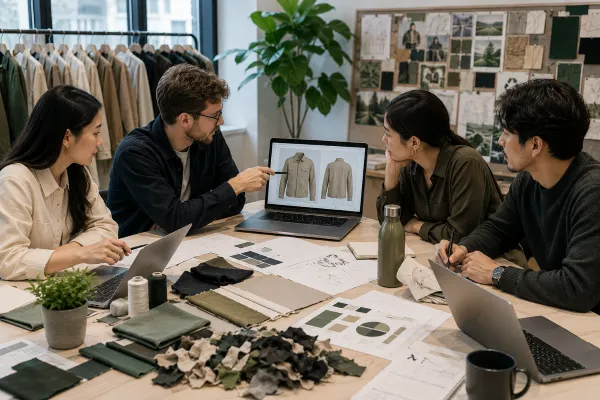
3D design produces better results when the supporting system is ready.
Software alone is not enough.
Fashion businesses need:
- accurate digital patterns
- reliable fabric data
- trained 3D designers or technical developers
- clear approval workflows
- supplier participation
- realistic digital avatars
- disciplined sample review rules
- integration with tech packs and PLM systems where relevant
Without these foundations, 3D design may create attractive images but limited operational savings.
For example, if digital fabric properties are inaccurate, the virtual garment may look good but behave differently in physical form. If suppliers are not involved, the digital sample may not translate cleanly into production. If teams still request the same number of physical samples out of habit, waste reduction will be minimal.
The most successful companies treat 3D design as a workflow change, not just a software purchase.
Practical Ways Fashion Businesses Can Apply 3D Design
A realistic implementation strategy usually starts small.
A brand does not need to digitize every product category immediately. It can begin with categories where visual review and repeated silhouettes make the biggest impact.
Good starting points may include:
- basic tops
- activewear
- simple dresses
- casual pants
- uniform programs
- repeat seasonal silhouettes
- ecommerce-focused collections
More complex categories such as tailored jackets, lingerie, washed denim, and technical outerwear may still benefit from 3D workflows, but they often require stronger technical validation.
A practical adoption path might look like this:
- Use 3D for early visual review.
- Build a fabric and trim library.
- Train designers and pattern teams together.
- Test with one supplier first.
- Compare digital approvals against physical outcomes.
- Track sample reductions and cost differences.
- Expand only after workflow accuracy improves.
This gradual approach reduces risk and gives teams time to build confidence.
Common Mistakes That Reduce the Value of 3D Design
Using 3D Too Late in the Process
If 3D design is used only after physical sampling is complete, its cost-saving potential becomes limited. The tool should support early decisions, not merely create polished visuals after most development costs have already occurred.
Ignoring Fabric Accuracy
A virtual garment depends heavily on fabric data. If the fabric simulation is wrong, digital approvals may create false confidence. This can lead to physical rework later.
Measuring Only Software Output
Some brands focus on how realistic the render looks but ignore operational metrics. Better metrics include sample rounds reduced, courier shipments avoided, revision time shortened, and approval accuracy improved.
Overpromising Sustainability Benefits
Digital sampling can reduce some development waste, but it does not automatically solve overproduction, returns, poor forecasting, or end-of-life waste. Brands should communicate benefits carefully and avoid greenwashing.
Failing to Involve Suppliers
Suppliers need to understand and trust the workflow. If factories are not aligned, digital samples may remain an internal brand tool rather than a true development system.
What Brands Should Measure
To know whether 3D design is actually reducing waste and costs, brands need measurable indicators.
Useful metrics include:
|
Metric |
Why It Matters |
|
Average number of physical sample rounds per style |
Shows whether digital review is reducing prototypes |
|
Sample approval time |
Measures calendar efficiency |
|
Sample shipping cost |
Tracks logistics savings |
|
Fabric used for development samples |
Measures material waste reduction |
|
Rework frequency |
Shows whether communication is improving |
|
Digital-to-physical accuracy |
Tests whether virtual approvals match real garments |
|
Supplier adoption rate |
Shows whether workflow integration is real |
|
Cost per approved style |
Connects digital development to business outcome |
These metrics help prevent vague claims. They also make it easier for management teams to decide whether 3D design deserves wider investment.
FAQ
Does 3D design really reduce fashion waste?
Yes, it can reduce some development-stage waste, especially waste from repeated physical samples. By reviewing garments digitally first, brands may use less fabric, fewer trims, and fewer sample shipments. However, 3D design does not automatically reduce all types of fashion waste. Overproduction, unsold inventory, returns, and end-of-life disposal require broader business and supply chain strategies.
How does 3D design reduce apparel costs?
3D design can reduce costs by lowering unnecessary sample rounds, improving communication with suppliers, reducing shipping expenses, and identifying issues earlier in development. The savings are usually strongest when 3D is integrated into the actual approval workflow. If it is used only for visual presentations, the cost benefit may be limited.
Can 3D design replace physical samples completely?
In most commercial apparel businesses, no. Physical samples remain important for checking fabric hand feel, comfort, wash behavior, stitching quality, trim performance, and real-world fit. 3D design is best used to reduce unnecessary early samples, while physical samples remain important for final validation.
Is 3D design only useful for large fashion brands?
No. Smaller brands can also benefit, especially when budgets are limited and repeated sampling mistakes are costly. A small brand may use 3D design for visual review, range planning, colorway decisions, or ecommerce preparation. Large brands usually gain additional value through supplier integration and enterprise workflow systems.
Which products benefit most from 3D sampling?
Products with repeatable silhouettes, simple to moderate construction, and frequent color or detail variations often benefit strongly. Examples include activewear, basics, casualwear, uniforms, and ecommerce-driven apparel. Highly technical garments, heavily washed denim, tailoring, and lingerie may still benefit but usually require more physical validation.
Does 3D design make fashion more sustainable?
It can support sustainability by reducing some sample waste and development-related shipping, but it does not make fashion sustainable by itself. True sustainability depends on product durability, responsible sourcing, production volume, inventory planning, circular design, repair, resale, recycling, and consumer behavior.
What should a brand check before investing in 3D design?
A brand should assess product categories, supplier readiness, internal technical skills, software costs, hardware needs, fabric data availability, and workflow discipline. The most important question is not “Which software looks best?” but “Where will digital development reduce real waste, time, or cost in our current process?”
Conclusion
3D design can help fashion businesses reduce waste and costs, but its value depends on how intelligently it is used.
Its strongest role is in product development: reducing unnecessary sample rounds, improving decision-making, clarifying supplier communication, and catching avoidable problems before physical production begins.
For brands and manufacturers, the goal should not be to replace every physical process. The better goal is to use digital tools where they improve accuracy, speed, and resource efficiency — while keeping physical validation where it still matters.
The companies that benefit most from 3D design are usually not those that simply adopt the latest software. They are the ones that build disciplined workflows around it: accurate patterns, reliable fabric data, trained teams, supplier collaboration, and measurable cost and waste reduction.
That is where 3D design becomes more than a visual trend. It becomes a practical operating advantage.




Comments 0
Leave a CommentSend Comment
Anda harus Login terlebih dahulu untuk dapat memberikan komentar.