
How to Build Buyer Personas Based on Fashion Shopping Behavior
A customer who buys a tailored blazer may be preparing for a new job, refreshing a professional wardrobe, or searching for an outfit for a special occasion. The product is identical, but the reasons behind the purchase are different. Those reasons can influence everything from the product information a shopper needs to the marketing message that encourages a final decision.
For apparel brands, understanding these motivations is essential to creating useful buyer personas. A persona based only on age, gender, income, or assumed lifestyle may describe a potential customer without explaining how that person actually shops.
A more valuable approach examines shopping behavior: how customers discover clothing, compare alternatives, evaluate fit, respond to price, make purchases, and decide whether to return to a brand.
Building buyer personas from this evidence can help fashion businesses create more relevant collections, improve product presentation, and make better decisions about customer acquisition and retention. The challenge is turning scattered observations into practical profiles without confusing assumptions with verified customer needs.
Quick Answer: How Do You Build Fashion Buyer Personas?
Building fashion buyer personas involves collecting customer research and shopping behavior data, identifying recurring purchasing motivations and decision patterns, and organizing those insights into realistic customer profiles that guide apparel product development, marketing, and retail experiences.
A useful persona describes more than who a customer is. It explains what they are trying to achieve, what influences their clothing purchases, which concerns may prevent them from buying, and how they typically evaluate fashion products.
For example, a brand may identify a group of shoppers who prioritize versatile clothing, reliable sizing, and easy care. Their persona should reflect these practical requirements rather than relying on an invented personality or demographic stereotype.
Fashion brands can develop personas through transaction records, customer interviews, product feedback, website interactions, and observations from physical retail environments. Combining quantitative and qualitative information helps distinguish what customers do from why they do it.
The resulting personas should inform real commercial decisions, including garment design, assortment planning, product descriptions, pricing communication, and customer service.
However, personas are research-informed representations, not exact descriptions of individuals. Their usefulness depends on the quality of the evidence, the clarity of their purpose, and whether they are updated as customer needs change.
What Is a Buyer Persona in Fashion Marketing?
A fashion buyer persona is a research-informed representation of a customer type that describes recurring clothing needs, shopping motivations, purchasing behaviors, expectations, and barriers to purchase. It helps apparel businesses translate customer evidence into practical product, marketing, and retail decisions.
Unlike a basic audience description, a useful persona explains the context behind a purchase.
Consider a clothing brand targeting adults aged 25–40. That age range may be useful for certain market-planning decisions, but it tells the design team relatively little about which garments to develop.
Within the same audience, some shoppers may prioritize comfortable clothing for everyday activities. Others may need polished garments suitable for office environments, while some may prefer statement pieces for occasional use.
These differences become clearer when the brand investigates the situations that trigger purchases and the criteria customers use when comparing products.
A well-developed persona might therefore describe a shopper who regularly purchases adaptable workwear, prefers consistent sizing, checks fabric composition before ordering, and hesitates when product photographs do not clearly show fit.
These characteristics can inform specific decisions. The brand might improve measurement information, introduce outfit combinations, or provide more realistic garment photography.
The Nielsen Norman Group's explanation of personas and jobs-to-be-done emphasizes that effective personas extend beyond demographic details to include behavioral characteristics, attitudes, needs, and goals. This distinction is particularly relevant to fashion, where the same product category can serve multiple purchasing motivations.

Buyer Personas Are Not the Same as Customer Segments
Customer segmentation and buyer personas serve related but different purposes.
Segmentation identifies groups with relevant similarities, such as customers who frequently purchase casual essentials or shoppers who buy mainly for specific occasions. A buyer persona develops a more detailed representation of the goals, concerns, and decision-making process associated with a customer type.
|
Aspect |
Customer segmentation |
Fashion buyer persona |
|
Primary purpose |
Identify meaningful customer groups |
Explain how a representative customer type shops and makes decisions |
|
Main focus |
Shared characteristics and patterns |
Motivations, goals, behavior, and purchasing barriers |
|
Typical evidence |
Transaction data, market research, customer attributes |
Customer interviews, behavioral evidence, feedback, contextual research |
|
Typical output |
Defined customer groups |
Research-informed customer profiles |
|
Business application |
Market targeting, assortment allocation, commercial prioritization |
Product experience, communication, creative decisions, customer journey design |
A persona should be connected to a real or strategically relevant customer segment, but it should not be mistaken for a statistical description of every member of that group.
The foundations of this approach are covered in fashion customer segmentation for apparel brands.
Why Shopping Behavior Should Come Before Fictional Personal Details
Some buyer persona templates emphasize names, photographs, occupations, and personal biographies. These details can make a profile memorable, but they are not necessarily the most useful information for an apparel business.
Knowing that a fictional shopper is a 32-year-old marketing manager does not explain whether they prefer structured tailoring, how they choose clothing sizes, or what makes them abandon a purchase.
Behavioral evidence provides a stronger connection to business decisions. A shopper's repeated interest in certain product categories, concern about garment fit, or tendency to compare materials may indicate requirements that a brand can address.
This does not mean demographic information is irrelevant. Occupation, age range, household circumstances, and geographic location may provide useful context when they are demonstrably connected to the purchasing decision.
The principle is to include information because it helps explain customer needs—not simply because a persona template has space for it.
Which Fashion Shopping Behaviors Should Brands Study?
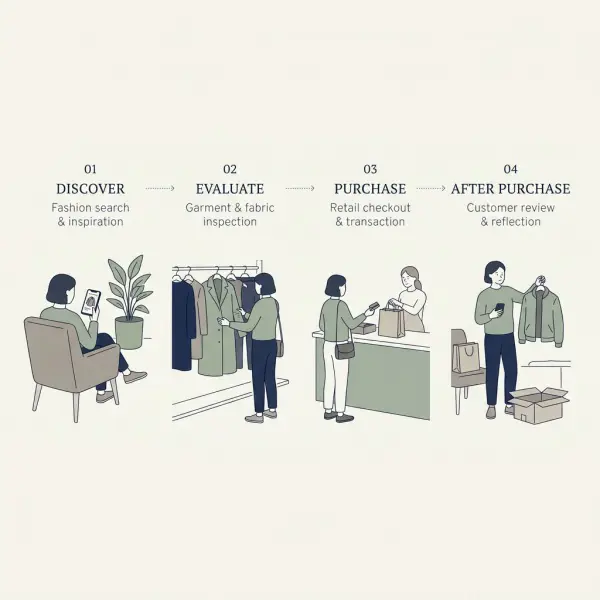
Fashion shopping behavior includes the actions and decisions customers make before, during, and after purchasing apparel. It covers product discovery, evaluation, transaction activity, usage experiences, and subsequent interactions with the retailer.
Different behaviors reveal different aspects of customer needs. A frequently viewed product category may indicate interest, while repeated purchases provide stronger evidence of actual demand. Neither observation, by itself, fully explains the customer's motivation.
Product Discovery and Initial Interest
The discovery stage concerns how shoppers become aware of clothing products and identify items worth considering.
Customers may find a product through search engines, social media, fashion publications, retail displays, recommendations, or direct visits to a brand's website.
A shopper searching for “comfortable linen trousers for summer” has expressed a more specific product requirement than someone casually browsing a seasonal collection.
Search terms and product navigation can therefore provide clues about the customer's immediate shopping objective.
However, discovery behavior should not be treated as a permanent preference. Someone researching formalwear for a wedding may not be a regular occasionwear customer.
Product Evaluation and Purchase Confidence
Apparel shopping involves uncertainty that differs from many other retail categories. Customers often need to assess garment sizing, fabric feel, drape, construction, comfort, and styling compatibility without having the product physically available.
This is particularly relevant to online fashion retail.
The Baymard Institute's 2026 apparel and accessories research, based on a survey of 1,922 US online shoppers, examines issues including sizing confidence, product evaluation, returns, and shopping expectations. The findings illustrate why uncertainty is an important part of online apparel purchase decisions, although results should not automatically be generalized to every international market.
Baymard
A buyer persona may reveal that some shoppers place considerable importance on precise garment measurements, while others primarily need clearer outfit styling or more detailed photographs.
These distinctions help brands identify which product information is most relevant to different buying situations.
Purchase Frequency, Basket Composition, and Spending Patterns
Purchase records can reveal how often customers buy, which categories they select, whether they frequently purchase complementary products, and how purchasing patterns vary over time.
For example, one group may regularly buy replacement wardrobe essentials. Another may purchase coordinated outfits around seasonal events.
The distinction matters because the first group may value product continuity and reliable restocking, while the second may require stronger occasion-based merchandising and delivery communication.
Brands should also examine purchasing context. A high average order value does not necessarily indicate a preference for luxury clothing, especially when customers are purchasing multiple items at once.
Post-Purchase Experience and Repeat Buying
The customer's experience after receiving a garment can reveal needs that were not visible during checkout.
Returns, exchanges, product reviews, service inquiries, repeat purchases, and feedback about fit or quality can help brands understand whether expectations were met.
A customer who repeatedly exchanges trousers because of inconsistent sizing may be experiencing a product problem rather than demonstrating unusual shopping behavior.
Likewise, a shopper who rarely returns may be satisfied, but the absence of returns alone does not prove satisfaction. The customer may simply choose not to return an unsuitable product.
Buyer personas become more reliable when brands interpret these signals carefully and use direct feedback to clarify ambiguous patterns.
How to Build Fashion Buyer Personas Step by Step
The strongest buyer personas are developed through a repeatable research process. Apparel brands should begin with a specific commercial question, collect evidence from relevant customers, identify meaningful differences, and test whether the resulting profiles improve business decisions.
Step 1: Define the Business Decision Your Personas Need to Support
Before collecting information, clarify why the brand needs buyer personas.
A clothing startup planning its first collection may need to identify the needs of its intended customers. An established online retailer may want to understand why shoppers abandon product pages. A premium apparel brand may be investigating what motivates repeat purchases beyond promotional discounts.
These objectives require different research priorities.
For example, a brand studying online purchase hesitation should investigate fit confidence, material information, pricing expectations, product photography, and delivery concerns. Research focused on collection development would place greater emphasis on wardrobe needs, product gaps, styling preferences, and shopping occasions.
Defining the objective early helps prevent the research from becoming a collection of interesting customer facts with little commercial application.
Step 2: Gather Evidence From Relevant Customer Touchpoints
The next step is to gather information that can reveal recurring purchasing patterns.
For an existing apparel business, useful sources may include customer relationship management (CRM) records, point-of-sale transactions, ecommerce analytics, customer reviews, product returns, and support inquiries.
A brand selling through several channels should consider whether customers behave differently online and in stores. Physical retail interactions may reveal fit questions and product comparisons that are difficult to detect through website analytics alone.
For online retailers, event-based analytics can help measure stages of the shopping journey. Google's official ecommerce measurement documentation describes events such as view_item, add_to_cart, begin_checkout, purchase, and refund. These events require suitable implementation and should not be assumed to be available automatically in every analytics setup.
The following table illustrates how fashion brands can interpret common information sources.
|
Evidence source |
What it can reveal |
What it cannot establish alone |
|
Product page views |
Categories and products attracting attention |
Whether interest will become a purchase |
|
Shopping cart activity |
Products shoppers seriously consider |
The exact reason for abandoning a cart |
|
Purchase history |
Actual purchasing frequency and product choices |
All motivations behind those purchases |
|
Returns and exchanges |
Potential fit, quality, or expectation issues |
Whether the product or another factor caused the return |
|
Reviews and interviews |
Stated motivations, concerns, and expectations |
How representative those opinions are of the full audience |
|
In-store observations |
Product questions and shopping interactions |
Patterns across customers who shop elsewhere |
The objective is not to collect the largest possible dataset. It is to assemble information relevant to the decisions the brand needs to make.
Step 3: Interview Customers to Understand Purchase Motivations
Transactional information is valuable, but interviews help explain the reasoning behind customer decisions.
Imagine a retailer noticing that customers regularly purchase relaxed-fit trousers. Sales data may confirm the preference, but interviews could reveal several different motivations: comfort during commuting, flexibility for daily activities, preference for a particular silhouette, or dissatisfaction with restrictive waistbands.
Those motivations lead to different product development and communication decisions.
Customer interviews should invite shoppers to describe actual recent experiences rather than asking them to predict hypothetical future behavior. Questions grounded in a specific purchase tend to provide more concrete context than broad questions about personal style.
A useful fashion buyer persona interview might explore:
- Purchase trigger: What made you start looking for this particular garment?
- Product comparison: What other garments or brands did you consider, and why?
- Decision criteria: Which details mattered most when choosing the product?
- Purchase hesitation: Was there anything that made you uncertain before buying?
- Post-purchase experience: After wearing the garment, did it meet your expectations?
Interviewers should allow customers to explain their choices in their own words rather than steering them toward the brand's preferred interpretation.
The Shopify guide to creating buyer personas similarly recommends beginning with customer research and examining why customers purchased a product and which alternatives they considered.
Brands should seek variation across relevant customer groups, including both satisfied and dissatisfied shoppers. Interviewing only enthusiastic repeat buyers may overlook barriers that prevent potential customers from purchasing.

Step 4: Identify Recurring Patterns Without Forcing Customers Into Categories
After gathering research, the next task is to identify similarities that matter commercially.
A brand may discover that some customers consistently prioritize fit confidence, while others mainly want versatile styling or dependable availability of familiar products.
These observations can become the foundations of separate personas when they represent sufficiently meaningful and recurring differences.
However, researchers should avoid interpreting every variation as a distinct customer type. A shopper's interest in one trend-led garment does not necessarily mean they belong to a permanently trend-focused group.
Qualitative findings should also be distinguished from statistically representative patterns. A few interviews may reveal useful hypotheses, but they cannot independently establish how common those preferences are across the entire market.
The Nielsen Norman Group's guidance on lightweight, qualitative, and statistical personas explains that persona development can use different levels of research investment and that approaches based exclusively on demographics or analytics tend to provide limited insight into user motivations.
For apparel brands, this means finding a workable balance between research depth and commercial resources.
Step 5: Create Persona Profiles That Explain Shopping Decisions
Once the main customer patterns are identified, the business can translate them into concise persona profiles.
Each profile should represent a recognizable type of fashion shopper while remaining grounded in research. Instead of producing an elaborate fictional biography, focus on the factors that influence product selection and purchasing behavior.
A practical fashion buyer persona template might include the following information.
|
Persona component |
What to document |
|
Persona name |
Memorable functional label, such as “The Versatile Wardrobe Buyer” |
|
Primary shopping goal |
What the customer wants to accomplish |
|
Purchase triggers |
Events or needs that initiate clothing searches |
|
Product priorities |
Fit, material, price, durability, silhouette, versatility, or other relevant attributes |
|
Shopping behavior |
How the customer discovers, compares, and purchases products |
|
Decision barriers |
Uncertainty or concerns that delay purchasing |
|
Preferred information |
Product specifications, styling guidance, reviews, measurements, or other decision support |
|
Research evidence |
Observations, interview findings, and supporting data |
|
Business implications |
Product, merchandising, marketing, or service decisions the persona may influence |
Not every profile needs the same level of detail. A specialist fashion manufacturer launching a new clothing line may focus primarily on product requirements and buying motivations. A direct-to-consumer brand may need more information about online discovery, checkout hesitation, and customer retention.
The key is to make the persona actionable without inventing unnecessary characteristics.
Step 6: Validate the Persona Against Customer Evidence
A persona is a working interpretation of research, not a finished fact.
Before adopting it across the business, teams should examine whether the profile accurately reflects the evidence and whether its proposed characteristics are supported by more than isolated examples.
For instance, a persona described as highly concerned about sizing should have relevant supporting evidence, such as repeated fit-related interview comments, sizing inquiries, or other appropriately interpreted behavioral information.
Where resources allow, brands can validate personas through additional interviews, customer surveys, product testing, or comparison with a separate set of customer records.
A brand may also discover that two supposedly different personas share essentially the same purchasing needs. Combining them can produce a clearer and more manageable framework.
Step 7: Translate Personas Into Decisions and Review Their Accuracy
The final step is to connect each persona with decisions the business can make.
If a persona highlights demand for predictable garment fit, the business might improve size specifications, measurement communication, and consistency between product batches.
If another persona frequently purchases clothing for specific occasions, the brand may test occasion-based merchandising and outfit recommendations.
These changes should be evaluated rather than assumed effective.
Personas should also be updated when customer research, product offerings, or buying patterns indicate meaningful changes. Maintaining a record of the evidence behind each persona helps future teams distinguish established findings from earlier assumptions.
Practical Examples of Fashion Buyer Personas
To understand how the process works, consider a hypothetical apparel brand offering casual essentials, professional clothing, and seasonal collections.
The following examples are illustrative models, not actual customer research findings. They demonstrate how different purchasing motivations can be translated into profiles and potential business responses.
Persona A: The Versatile Wardrobe Builder

Primary goal: Build a practical wardrobe with garments that work across different daily activities.
Potential shopping pattern: Purchases familiar silhouettes and coordinated essentials, checks garment measurements, and considers how new pieces combine with existing clothes.
Decision barriers: Uncertain fit, unclear fabric care instructions, and limited styling information.
This customer type may value dependable product availability more than constant novelty.
If research confirms these needs, the brand could maintain consistent core silhouettes, develop coordinated color options, and make garment measurements easier to compare between collections.
Marketing communication might focus on realistic outfit combinations and practical product details rather than repeatedly emphasizing new trends.
Persona B: The Professional Style Buyer

Primary goal: Find polished clothing that remains comfortable and functional during professional activities.
Potential shopping pattern: Compares garment structure, fabric composition, fit, ease of care, and versatility before purchasing.
Decision barriers: Concerns about comfort, restricted movement, maintenance requirements, and uncertainty about how formal the garment appears.
This persona may influence several product decisions. A brand might investigate comfortable tailoring, material suitability for repeated wear, and garment dimensions appropriate for the intended activities.
Product pages could provide clearer descriptions of fit, stretch, lining, and care requirements.
These details should describe the actual garment rather than presenting generic claims about premium quality.
Persona C: The Occasion-Led Fashion Shopper

Primary goal: Find a suitable outfit for a particular celebration, event, or social occasion.
Potential shopping pattern: Searches by occasion, compares silhouettes and styling combinations, and pays attention to delivery or availability deadlines.
Decision barriers: Uncertainty about garment appearance, fit, suitability for the event, and delivery timing.
For this customer type, the purchasing journey may be concentrated around a particular event rather than a regular shopping routine.
An apparel retailer could test occasion-based product navigation, relevant accessories, accurate delivery information, and styling content that helps customers visualize complete outfits.
The commercial strategy should recognize that an occasional buyer is not necessarily a low-value customer. Purchase frequency must be interpreted alongside margins, order values, acquisition costs, and the nature of the category.
These three personas may occasionally overlap. A single shopper could purchase wardrobe essentials regularly, professional clothing periodically, and occasionwear when needed.
For that reason, apparel brands should use personas as decision-making tools rather than rigid customer identities.
How Fashion Brands Can Use Buyer Personas Across the Business
The value of buyer personas is determined by what the brand does with them.
A visually appealing persona presentation may be useful for communication, but it has limited strategic value unless design, buying, merchandising, marketing, and customer service teams can translate its findings into operational decisions.
Product Development: Design for Recognizable Needs
Buyer personas can help product teams establish clear design priorities.
If research identifies shoppers who regularly seek adaptable garments, the collection may benefit from a consistent fit philosophy, versatile silhouettes, and materials selected for the intended wearing conditions.
If customers emphasize ease of movement, designers might investigate pattern construction, fabric stretch, garment ease, and practical details.
However, the persona does not replace technical product development. Material selection still requires assessment of performance, cost, construction compatibility, and supplier capability.
A useful persona provides the design brief with a clearer customer context, while sampling and product testing determine whether the resulting garment actually meets that need.
Merchandising: Match Products to Shopping Intent
Customers frequently approach fashion retail with a particular purpose.
Someone searching for comfortable everyday clothing may want to browse by garment type, fit, or material. An occasionwear shopper may prefer navigation organized around events or complete outfits.
Personas can help retailers decide which browsing paths, product filters, and editorial collections deserve attention.
These insights can complement fashion assortment planning for retail and online stores, where customer demand is translated into product breadth, size depth, and inventory decisions.
The objective is not to create a completely separate store for every persona. It is to make relevant products easier to discover without limiting the customer's ability to explore the broader collection.
Marketing: Communicate Benefits That Matter to Customers
A single garment may offer multiple legitimate benefits, but different customer types may prioritize them differently.
A lightweight jacket, for example, could appeal to commuters seeking practical layering, travelers looking for packable clothing, or customers who appreciate a particular silhouette.
Persona research may indicate which benefits deserve emphasis in product descriptions, campaign imagery, search content, and email communications.
This helps brands avoid generic messages that describe every product as stylish, comfortable, and versatile without explaining what those qualities mean in practice.
Marketing claims must remain consistent with the product's verified specifications. A garment should not be described as waterproof, breathable, durable, or suitable for specific conditions unless the claim is technically supportable.
Ecommerce: Reduce Uncertainty at Critical Purchase Points
Fashion buyer personas can help ecommerce teams understand why shoppers hesitate.
A customer concerned about sizing may need a detailed garment measurement table. Someone evaluating fabric quality might appreciate close-up photography and accurate composition information. Another shopper may need greater clarity about returns or delivery.
These concerns are not merely theoretical. Baymard's research on apparel sizing information reports that insufficient size information can make customers hesitant to purchase, based on its apparel ecommerce usability testing.
Persona findings can help prioritize improvements such as better fit information, clearer product descriptions, more representative photography, and easier navigation.
The improvements should still be tested with actual customers, since different groups may encounter different problems.

How to Measure Whether Buyer Personas Are Improving Decisions
Buyer personas should be evaluated through the commercial outcomes they were intended to influence.
For example, if a persona helps a brand identify problems with garment sizing information, relevant measures could include changes in size-related customer inquiries, purchase conversion, and returns attributed to fit.
If personas are used to develop more focused marketing campaigns, the brand may examine conversion rates, acquisition costs, contribution margin, and incremental revenue.
The appropriate measures depend on the business objective.
|
Persona-driven decision |
Suggested performance measures |
Important consideration |
|
Improve fit information |
Size-related returns, conversion, fit inquiries |
Review product-level differences and return reasons |
|
Introduce coordinated wardrobes |
Units per transaction, complementary item purchases, margin |
Distinguish incremental purchases from existing demand |
|
Target occasional shoppers |
Campaign conversion, order contribution margin |
Consider seasonality and event timing |
|
Improve repeat purchases |
Repeat purchase rate, customer retention, contribution margin |
Avoid mistaking frequent discounts for stronger loyalty |
|
Refine product development |
Sell-through, customer feedback, inventory aging |
Account for supply constraints and product availability |
Personas can also be evaluated directly by asking whether teams find them useful for making specific decisions and whether new research continues to support their defining characteristics.
Where possible, brands should test persona-informed changes against a suitable comparison group or baseline.
A campaign that performs well among an identified persona does not automatically prove that the persona caused the result. Product availability, pricing, promotional activity, and seasonal demand can also influence performance.
Common Mistakes When Creating Fashion Buyer Personas
Inventing a Lifestyle Instead of Studying Purchasing Behavior
A common mistake is creating elaborate fictional biographies that are only loosely connected to actual shopping decisions.
A persona might describe someone's hobbies, favorite destinations, and daily routine while providing little insight into garment fit, product evaluation, or purchase motivation.
These details can be distracting if they are unsupported or commercially irrelevant. A more useful approach begins with customer evidence and includes personal context only where it meaningfully explains purchasing behavior.
Treating One Customer Interview as Representative of a Market
A memorable customer interview can influence how a team understands its audience. However, a single person's experience may not represent the needs of a broader customer group.
For example, one shopper's dissatisfaction with synthetic fabrics does not establish that the entire audience prefers natural fibers.
Brands should look for recurring patterns across relevant research sources and distinguish qualitative insights from statistically supported conclusions.
Creating Personas That Do Not Influence Business Decisions
Some companies create buyer personas as marketing documents that are rarely referenced after the initial presentation.
When profiles do not influence collection development, merchandising, communication, or customer experience, maintaining them becomes difficult to justify.
Each persona should be associated with practical business questions and potential actions. Teams should also identify which decisions require further evidence before implementation.
Assuming Customers Have Only One Shopping Motivation
A shopper may prioritize affordability when purchasing basic T-shirts but consider fabric quality and fit more carefully when buying a tailored coat.
Likewise, someone who prefers minimalist everyday clothing may purchase a decorative garment for a particular celebration.
Personas that assume permanent and exclusive shopping preferences can misrepresent this flexibility. Brands should consider both relatively stable customer needs and the specific occasions that influence purchasing decisions.
Failing to Distinguish Research Findings From Assumptions
A persona may contain information directly supported by customer interviews, patterns suggested by purchase data, and hypotheses proposed by the marketing team.
These should not be treated as equally reliable.
An effective persona development process documents the source of important claims and identifies assumptions that still require validation.
This makes the profiles easier to update and prevents unsupported interpretations from becoming accepted business facts.
Important Caveats: Privacy, Bias, and the Limits of Customer Data
Fashion buyer personas can be developed using aggregated research, but individualized customer profiling raises additional privacy considerations.
Brands collecting customer information for marketing purposes must consider applicable privacy laws, transparency requirements, lawful processing grounds, and customer preferences.
The UK's Information Commissioner's Office explains in its guidance on profiling customers for direct marketing that profiling can involve assumptions about people's interests and behavior. Businesses should ensure that these activities are fair, transparent, lawful, and based on accurate, proportionate information.
Legal requirements vary by jurisdiction, so the obligations for an apparel business operating internationally may differ between markets.
Brands should also avoid using personas to reinforce unsupported stereotypes about age, gender, cultural background, or financial circumstances.
A further concern is the difference between customer behavior and customer identity. Someone buying children's clothing is not necessarily a parent. A customer buying expensive garments is not automatically wealthy. A shopper returning several items may be responding to inconsistent sizing rather than demonstrating a problematic preference.
These interpretations require evidence.




Comments 0
Leave a CommentSend Comment
Anda harus Login terlebih dahulu untuk dapat memberikan komentar.