
Tencel and Lyocell Fabric Explained for Fashion Applications
Quick Answer
Lyocell is a regenerated cellulose fiber generally produced by dissolving purified wood pulp in an organic solvent and spinning the resulting cellulose solution into fibers. TENCEL™ is not the generic name of the material. It is Lenzing’s trademarked brand covering specific lyocell and modal fibers.
In fashion, lyocell is valued for its smooth handfeel, fluid drape, moisture absorption, and relatively high strength among regenerated cellulosic fibers. It can be used in woven dresses, shirts, denim, trousers, lingerie, knit tops, loungewear, and blends with cotton, linen, wool, polyester, or elastane.
The final fabric, however, cannot be judged from the fiber name alone. Weight, yarn construction, weave or knit structure, blending ratio, dyeing, finishing, and garment construction all affect softness, dimensional stability, pilling, shrinkage, opacity, and durability.
Lyocell production can offer process advantages over conventional viscose, particularly when the solvent is efficiently recovered. That does not automatically make every lyocell garment sustainable. Brands still need to verify forest sourcing, fiber producer, processing impacts, chemical finishes, product durability, garment composition, and the evidence behind environmental claims.
What Are Lyocell and Tencel?
Lyocell is a manufactured regenerated cellulose fiber used in apparel, home textiles, nonwovens, and other textile products. In the United States, the Federal Trade Commission defines lyocell as a manufactured fiber composed of regenerated cellulose and permits “lyocell” to be used as its generic fiber description. The cellulose is regenerated from a solution rather than remaining in the original physical form found in wood or another plant source. The official lyocell fiber definition therefore distinguishes the material by both its cellulose composition and production route.
TENCEL™, by contrast, is a commercial fiber brand owned by Lenzing. The brand includes TENCEL™ Lyocell and TENCEL™ Modal fibers, along with specific technologies and product variants. This distinction matters because not every lyocell fiber is TENCEL™, and not every product carrying the TENCEL™ name is necessarily made from lyocell alone. Some products contain TENCEL™ Modal, while others blend branded fibers with cotton, wool, linen, polyester, elastane, or another material. Lenzing’s official overview of TENCEL fibers identifies the brand’s lyocell and modal fiber categories separately.
For buyers and product developers, the practical distinction is straightforward:
- Lyocell is a generic fiber category.
- TENCEL™ Lyocell is lyocell fiber supplied under Lenzing’s trademark.
- TENCEL™ Modal is branded modal fiber, not lyocell.
- “Tencel fabric” is an informal commercial expression rather than a complete technical specification.
- The fiber-content label should state the actual composition and percentages required in the market where the garment is sold.
A supplier describing a fabric only as “Tencel” has not provided enough information for a sourcing decision. The brand should still request the fiber percentage, whether the branded component is lyocell or modal, the identity of the other fibers, the fabric construction, test results, and evidence supporting use of the trademark.
Is Lyocell Natural, Synthetic, or Semi-Synthetic?
Lyocell is best described as a regenerated man-made cellulosic fiber. Its primary polymer is cellulose, commonly obtained from dissolving-grade wood pulp, but substantial industrial processing is required to dissolve, regenerate, wash, dry, and finish the fiber.
Calling lyocell simply “natural” can therefore mislead customers because the fiber does not move directly from a tree into a yarn in the way that cotton is separated from a cotton boll or wool is shorn from an animal. Calling it fully synthetic can also be confusing because its polymer is cellulose rather than a fossil-derived polymer such as conventional polyester or nylon.
The broader man-made cellulosic fiber category includes lyocell, viscose, modal, acetate, and several emerging regenerated cellulose technologies. Textile Exchange explains that these fibers are generally produced from dissolved wood pulp or other cellulose inputs and that their environmental performance depends heavily on feedstock sourcing and the manufacturing system used.
This classification has a commercial consequence. A brand should not build its material story around the vague idea that lyocell is “wood turned directly into fabric.” The real story is more technical: cellulose is extracted and purified, dissolved into a spinning solution, regenerated as a manufactured fiber, converted into yarn, and then made into fabric.
How Is Lyocell Fiber Produced?
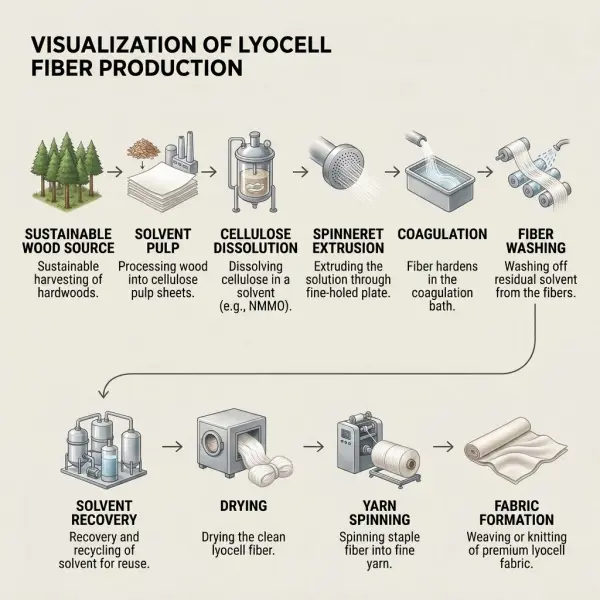
Lyocell production generally uses a direct-solvent process. Purified cellulose pulp is dissolved, commonly in an aqueous solution containing N-methylmorpholine N-oxide, known as NMMO. The cellulose solution is filtered and extruded through spinnerets. The emerging filaments pass through an air gap and enter a coagulation bath, where the cellulose regenerates into solid fibers.
This route differs from the chemical derivatization used in conventional viscose manufacturing. Lyocell cellulose is dissolved without creating the same cellulose derivative used in the viscose process. A technical review of the lyocell process describes it as a dry-jet wet-spinning system in which cellulose is dissolved, shaped through spinnerets, regenerated, washed, and converted into usable fiber.
The Main Production Stages
A simplified lyocell production sequence includes:
- Preparing dissolving pulp
Wood or another cellulose source is processed into highly purified dissolving-grade pulp. - Dissolving the cellulose
The pulp is mixed with the solvent system under controlled conditions to create a uniform cellulose solution, often called spinning dope. - Filtering and spinning
The solution is filtered and pushed through spinnerets to form continuous strands. - Regenerating the cellulose
The strands enter a coagulation bath, where the cellulose solidifies into fiber. - Washing and solvent recovery
Residual solvent is removed from the fibers and recovered from the process stream. - Drying and fiber finishing
The fibers are washed, dried, lubricated or finished as required, and prepared for downstream textile processing. - Converting fiber into yarn and fabric
Staple fibers may be cut, baled, blended, carded, and spun. Filament products follow a different yarn-processing route. The resulting yarn is knitted or woven and then dyed and finished.
Lenzing reports that its closed-loop lyocell system recovers 99.8% of the NMMO solvent used in its process. That figure describes Lenzing’s production technology and should not automatically be attributed to every lyocell producer without supplier-specific evidence.
Fiber, Yarn, Fabric, and Garment Are Not the Same Thing
Material discussions frequently treat fiber properties as though they automatically become garment properties. They do not.
Lyocell fiber may have a smooth surface, high orientation, good tensile performance, and strong moisture affinity, but a consumer wears a textile structure, not an isolated fiber. Before the material becomes a garment, it passes through yarn formation, knitting or weaving, pretreatment, dyeing, finishing, cutting, sewing, washing, and pressing. Each stage can strengthen, suppress, or alter the characteristics associated with the original fiber.
A lightweight single jersey containing lyocell and elastane may feel soft, fluid, and stretchy. A densely woven lyocell twill can feel substantially heavier and more structured. A fibrillated lyocell fabric may have a peach-like surface, while a carefully controlled filament construction can appear smooth and lustrous.
This is why two fabrics both described as “100% lyocell” may behave differently in opacity, crease recovery, shrinkage, pilling, recovery, sewing performance, and long-term appearance.
For product development, the specification must therefore move beyond the fiber name and include:
- Fiber composition and verified percentages
- Staple or filament construction
- Yarn count, yarn type, twist, and ply
- Woven or knitted structure
- Fabric weight and usable width
- Dyeing and finishing route
- Dimensional-stability results
- Pilling and abrasion performance
- Colorfastness requirements
- Garment-care method
- Restricted-substance compliance
The most commercially useful question is not “Is lyocell a good material?” It is “Does this specific lyocell fabric meet the performance, price, care, and aesthetic requirements of this particular product?”
What Does Lyocell Fabric Feel Like?
Lyocell fabrics are commonly associated with a smooth surface, soft handfeel, fluid movement, moisture absorption, and a subtle sheen. These qualities make the fiber particularly useful when a designer wants softness and drape without relying entirely on silk, viscose, or a lightweight synthetic filament.
However, there is no single universal “lyocell feel.” Fabric construction changes the result substantially. A fine woven fabric may feel cool and silky, while a brushed or fibrillated construction may feel softly sueded. A knitted fabric can feel relaxed and supple. A lyocell-cotton denim may retain a familiar denim appearance while feeling softer and less rigid than a comparable conventional cotton construction.
The fiber’s relatively high molecular orientation contributes to its strength profile, while its cellulosic structure gives it an affinity for moisture. Research comparing regenerated cellulose fibers also identifies fibrillation as an important lyocell characteristic, especially under wet mechanical action.
Important Characteristics in Fashion Products
|
Characteristic |
What it can contribute |
What controls the final result |
|
Smooth handfeel |
Comfortable next-to-skin products and refined surfaces |
Fiber fineness, yarn type, finish, laundering |
|
Fluid drape |
Dresses, blouses, wide-leg trousers, skirts |
Fabric weight, density, weave, pattern shape |
|
Moisture absorption |
Reduced clammy sensation in some everyday garments |
Fabric thickness, airflow, garment fit, climate |
|
Relatively high fiber strength |
Support for lightweight or blended constructions |
Yarn quality, wet processing, abrasion, stitching |
|
Dye affinity |
Rich or clear coloration in suitable processes |
Dye class, pretreatment, process control, finish |
|
Fibrillation potential |
Sueded effects or unwanted fuzz and pilling |
Wet abrasion, enzymes, finishing, laundering |
|
Cellulosic comfort profile |
Soft, breathable-feeling apparel |
Construction and finishing, not fiber identity alone |
The table should not be interpreted as a guarantee. A dense or heavily coated lyocell fabric may feel warmer and less breathable than an open cotton fabric. A badly stabilized lyocell knit may shrink more than expected. A low-quality finish may undermine the fiber’s otherwise attractive handfeel.
Where Is Lyocell Used in Fashion?
Lyocell can be engineered into both woven and knitted products, making it useful across a broad range of fashion categories. Technical literature and fiber suppliers identify applications including denim, chinos, shirts, dresses, underwear, casualwear, knitwear, and home textiles.
Its strongest applications are usually those where softness, movement, surface quality, and moisture interaction matter more than extreme stretch, weather protection, or rugged abrasion resistance.
Dresses, Blouses, and Skirts
Fine lyocell woven fabrics work well for garments that need fluid drape and a soft visual line. Shirt dresses, relaxed blouses, wrap dresses, and bias-cut skirts can benefit from this movement.
The product-development team must still check opacity, seam slippage, snagging, shrinkage, and pressing sensitivity. A fabric that looks elegant on a hanger may require lining, reinforced seams, or revised sewing parameters once it is tested as a complete garment.
Denim and Casual Trousers
Lyocell is frequently blended with cotton in denim and twill products. It can soften the handfeel, improve drape, and create a less rigid wearing experience. This is commercially useful for relaxed jeans, wide-leg trousers, soft utility styles, and lightweight overshirts.
The blend does not automatically solve every comfort issue. Garment fit, denim weight, elastane content, washing method, waistband construction, and finishing all influence wearability. Softer fabric can also require additional attention to seam stability and shape retention.
T-Shirts, Underwear, and Loungewear
Lyocell staple fibers can be used in jersey and rib structures for T-shirts, underwear, base layers, sleepwear, and loungewear. In these products, softness and moisture absorption are often the main selling points.
Pure lyocell knits may have limited elastic recovery compared with fabrics containing elastane. Designers should not confuse softness with stretch. Recovery must come from the knit structure, elastomeric content, yarn engineering, or a combination of these factors.
Shirts and Lightweight Tailoring
Woven lyocell can be used in fluid shirts, summer trousers, unstructured jackets, and relaxed tailoring. Blending it with cotton, linen, or wool can modify drape and handfeel while maintaining some of the visual character of the partner fiber.
The trade-off is that very fluid fabrics may not hold sharp silhouettes in the same way as crisp cotton poplin, compact wool, or structured synthetic blends. Material selection should follow the intended silhouette rather than the attractiveness of the fiber story.
Active-Inspired and Travel Apparel
Lyocell appears in travel clothing, yoga-inspired separates, casual performance products, and soft base layers. Its moisture absorption can support comfort, but it should not be marketed as equivalent to a specialized quick-drying synthetic textile without comparative testing.
A moisture-absorbing fiber can hold liquid within the textile structure. Whether the garment dries quickly depends on fabric weight, yarn architecture, surface area, airflow, environmental humidity, and blend composition. Activewear claims should therefore be validated on the finished fabric or garment.
How Does Blending Change Lyocell Fabric?
Blending allows mills and brands to adjust cost, appearance, resilience, stretch, texture, and processing behavior. It also means that the garment should be evaluated as a blended system rather than marketed exclusively through the most attractive fiber in the composition.
A fabric containing 30% lyocell behaves differently from a fabric containing 95% lyocell and 5% elastane. Even two fabrics with identical percentages may perform differently because the fibers can be mixed at different stages, placed in different yarns, or assigned separately to the warp, weft, face, or reverse side.
Common blend strategies include:
- Lyocell and cotton: familiar cotton character with additional softness or drape
- Lyocell and linen: dry surface texture balanced by greater fluidity
- Lyocell and wool: softer handfeel and altered moisture interaction
- Lyocell and elastane: stretch and recovery for fitted knits or trousers
- Lyocell and polyester: easier care, resilience, or quicker drying, depending on construction
- Lyocell and viscose: fluidity and cost-performance adjustment
- Lyocell and recycled fibers: a combined material story that still requires traceability and performance testing
Blending can solve a product problem, but it may introduce end-of-life complexity. A mono-material lyocell garment is not automatically circular, while a multi-fiber blend is not automatically irresponsible. The better choice depends on durability, care, recoverability, available recycling systems, production impact, and how long the garment remains useful.
A detailed material comparison belongs in Tencel vs rayon and the differences between cellulosic fabrics. For this article, the key point is that fiber categories and branded fibers should not be treated as interchangeable sourcing terms.
What Determines the Quality of a Lyocell Fabric?
Quality is determined by the interaction of raw fiber, yarn formation, fabric construction, wet processing, finishing, and garment manufacture. The TENCEL™ name can verify a branded fiber source when certification requirements are met, but it does not replace fabric-level quality assurance.
For example, a premium fiber can still be converted into a fabric with unstable dimensions, poor colorfastness, excessive surface fuzz, seam puckering, or inconsistent shade. Conversely, a well-engineered generic lyocell fabric may perform strongly even though it does not carry the TENCEL™ trademark.
Fiber and Yarn Variables
Fiber fineness, staple length, filament format, uniformity, and blend quality affect spinning and final surface appearance. Yarn twist, count, hairiness, strength, and evenness then influence abrasion, softness, pilling, and fabric clarity.
Fine yarns can support lightweight, smooth fabrics but may require more precise mill control. Low-twist yarns may improve softness but can reduce abrasion resistance. Compact or carefully engineered yarn structures may produce a cleaner surface.
Fabric Construction
A fabric’s density and structure determine airflow, stability, opacity, and movement. An open weave may feel airy but can be vulnerable to seam slippage. A dense twill may improve durability while reducing some of the lightness associated with lyocell marketing.
Knitted structures need particular attention to growth, spirality, shrinkage, recovery, and garment distortion. These risks are not unique to lyocell, but the fiber’s moisture response and fluidity can make fabric stabilization especially important.
Dyeing and Finishing
Dyeing and finishing can determine whether lyocell looks smooth, clean, washed, sueded, matte, or lustrous. Controlled fibrillation may be used to create a peach-skin or soft washed effect. Uncontrolled fibrillation can appear as fuzzing, whitening, pilling, or loss of color clarity.
Lyocell’s tendency to develop surface fibrils during wet mechanical treatment is well documented. Mills may manage it through process control, enzymatic treatment, resin or crosslinking systems, and other finishing technologies. Each route can affect cost, handfeel, strength, color, chemical profile, and care performance.
Garment Construction
A fluid fabric may require different handling from a stable cotton shirting or polyester woven. Cutting teams may need to control layer movement. Sewing teams may need to adjust needle size, thread, stitch density, differential feed, tension, seam type, and pressing conditions.
Testing should occur on sewn garments, not only fabric yardage. Seams, hems, waistbands, pockets, fusible interlinings, trims, and garment washing can create problems that were not visible in the original fabric report.
Fibrillation: Useful Surface Effect or Quality Risk?
Fibrillation occurs when small fibrils split or peel from the longitudinal surface of a lyocell fiber, particularly under wet abrasion or mechanical stress. The effect may produce a soft, suede-like surface when deliberately controlled. When uncontrolled, it can contribute to fuzziness, pilling, uneven appearance, and reduced color clarity.
This characteristic is neither automatically a defect nor automatically an advantage. Its value depends on the intended aesthetic.
A soft washed lyocell trouser may use controlled fibrillation to achieve a peach-skin effect. A dark, smooth blouse with a polished surface may require stronger fibrillation control because surface whitening would undermine the design. Scientific work on lyocell identifies the fiber’s high longitudinal orientation and relatively limited lateral cohesion as factors in its fibrillation behavior.
Brands should discuss four points with the mill:
- Whether the design intentionally uses a fibrillated surface
- Which process controls or treatments are being applied
- How the finish performs after repeated laundering
- Whether anti-fibrillation treatment changes strength, shade, handfeel, or chemical compliance
Is Lyocell a Sustainable Fabric?
Lyocell can be part of a lower-impact material strategy, but “lyocell” alone is not sufficient evidence that a garment is sustainable.
The production route can avoid some of the chemical-processing concerns associated with conventional viscose, particularly when a well-managed closed-loop system recovers and reuses the solvent. Environmental performance still varies according to forestry practices, pulp production, solvent recovery, energy source, factory efficiency, water treatment, dyeing, finishing, transportation, garment durability, and end-of-life conditions.
Textile Exchange emphasizes that the impact of man-made cellulosic fibers depends significantly on how their cellulose feedstock is produced. It recommends attention to certified or controlled forestry and wider supply-chain evidence rather than relying only on the generic fiber name.
Forest Sourcing Matters
Wood is renewable only when forests are managed and replenished responsibly. A forest-derived fiber can still be associated with deforestation, biodiversity loss, ecosystem conversion, or weak traceability if the pulp source is poorly controlled.
Brands should verify whether the pulp or fiber is covered by a credible forestry certification or controlled-sourcing system. Forest Stewardship Council guidance specifically identifies lyocell, viscose, and modal as forest-based textile materials whose environmental profile depends on responsible forest management.
Closed-Loop Claims Must Be Producer-Specific
A statement such as “99.8% solvent recovery” should be connected to the producer and process that generated the data. Lenzing reports this recovery level for its lyocell technology, but a brand should not copy the number onto an unspecified generic lyocell product.
The correct sequence is to identify the fiber producer, obtain supporting documentation, confirm that the fabric contains the claimed fiber, and use only approved wording. Generalizing a branded manufacturing claim to an entire global fiber category creates a greenwashing risk.
Biodegradability Does Not Describe the Whole Garment
Cellulose-based fibers may biodegrade under suitable tested conditions, but the environmental behavior of a finished garment depends on its full construction. Elastane, polyester sewing thread, synthetic interlining, coatings, prints, metallic components, zippers, buttons, and chemical finishes can change the result.
Biodegradable also does not mean that garments should be discarded in nature. Industrial composting, soil, freshwater, marine, and home-composting conditions are different. Any claim should specify what was tested, which component was tested, the applicable certification, and the conditions under which the result applies.
Durability Still Counts
A material with an improved production profile can still perform poorly if the garment loses shape, pills excessively, or requires replacement after limited use. Product longevity depends on fabric engineering, garment construction, care instructions, customer behavior, and repairability.
For decision-makers, the relevant sustainability question is broader than fiber selection: will the finished product deliver sufficient wear, maintain its appearance, and support the brand’s intended use case?
What Lyocell Does Not Automatically Provide
Marketing language around lyocell sometimes extends beyond what the fiber alone can guarantee. Brands should be cautious about the following assumptions.
It Is Not Naturally Stretchy in Every Form
Lyocell fiber is not a substitute for elastane. A lyocell jersey may stretch because of its knitted loops, but mechanical stretch and recovery depend on construction. Close-fitting garments usually require recovery testing and may need elastane or another engineering solution.
It Is Not Automatically Wrinkle-Free
Cellulosic textiles can crease. Finishing, blending, fabric density, and garment construction can improve crease recovery, but “wrinkle-free” should not be claimed without testing. A soft, fluid lyocell dress may wrinkle differently from a polyester dress or a resin-finished cotton shirt.
It Is Not Automatically Antibacterial
Moisture management may help maintain a more comfortable microclimate, but that is different from demonstrating antibacterial performance. Antibacterial claims usually require a defined treatment and validated laboratory testing against specified microorganisms.
It Is Not Automatically Quick-Drying
Moisture absorption and quick drying are different performance characteristics. A fabric can absorb moisture well yet retain it longer than a lightweight hydrophobic textile. Drying tests should reflect the complete fabric and intended use.
It Is Not Always Made Entirely from New Wood Pulp
Some lyocell products incorporate recycled cellulosic feedstock, while others use conventional dissolving pulp. The percentage, source, and chain of custody should be verified rather than inferred from the word “lyocell.”
How Fashion Businesses Can Use Lyocell Strategically
Lyocell works best when selected for a defined product need rather than added solely because customers recognize the name. The business should begin with silhouette, handfeel, performance, care, price, and brand-positioning requirements.
1. Start with the Garment Brief
Define what the material must do. For a relaxed summer trouser, priorities might include drape, opacity, seam stability, dimensional stability, softness, and acceptable creasing. For underwear, the priorities may shift toward next-to-skin comfort, stretch recovery, pilling, colorfastness, and repeated laundering.
Without this hierarchy, teams may approve a beautiful fabric that does not survive production or customer use.
2. Decide Whether a Branded Fiber Is Commercially Necessary
A generic lyocell fabric may satisfy the technical brief. TENCEL™ Lyocell may provide additional value where authenticated fiber sourcing, approved claims, recognizable branding, and supplier support matter.
The branded option should justify its commercial role through traceability, marketing value, product quality, customer recognition, or strategic sourcing—not simply because the name sounds premium.
3. Compare Actual Fabrics, Not Fiber Descriptions
Request multiple swatches with complete specifications. Evaluate them after washing, conditioning, sewing, pressing, and wearing. A lower-cost option may perform adequately, while a more expensive option may justify its price through better stability, surface quality, color consistency, or lower production risk.
A useful comparison should include:
- Fabric cost and minimum order quantity
- Lead time and repeat availability
- Composition and fiber authentication
- Weight, width, and yield
- Shrinkage and growth
- Pilling and abrasion
- Colorfastness
- Seam performance
- Handfeel before and after washing
- Approved environmental and brand claims
4. Run Garment-Level Testing
Produce a sample in the intended color and finish. Dark shades may reveal fibrillation or surface whitening more clearly. Lightweight colors may reveal opacity problems. Garment washing can change drape and dimensions.
Testing the final or near-final garment is especially important when the design includes elastic, fusible components, lining, embroidery, printing, garment dyeing, laser finishing, or washing treatments.
5. Build Accurate Customer Communication
Customer-facing copy should state what the material is, why it was selected, and what the wearer can realistically expect. Avoid unsupported phrases such as “chemical-free,” “zero impact,” “the world’s most sustainable fabric,” or “completely biodegradable clothing.”
Better communication might explain that the garment uses verified TENCEL™ Lyocell fibers for a smooth handfeel and fluid drape, while separately identifying the blend composition, manufacturing certification, care instructions, and limitations.
6. Protect Repeatability
A successful first order does not guarantee that the next production run will match. Record the mill, article number, fiber source, yarn specification, fabric construction, finishing route, approved shade, performance standards, and tolerance limits.
Material traceability supports both quality control and truthful marketing.

What Should Brands Verify Before Buying Tencel or Lyocell Fabric?
Before committing to bulk production, request evidence that connects the material description to the delivered fabric.
For generic lyocell, verify the composition, producer information where available, pulp sourcing, manufacturing documentation, fabric tests, and restricted-substance compliance. For TENCEL™ products, verify that the fabric is eligible for the branded claim and that the brand has permission to use Lenzing trademarks in its customer communication.
Lenzing states that its certification and licensing system is used to confirm fiber presence and authorize product-level use of its brands, claims, and hangtags. A valid product license is required when value-chain partners use Lenzing brands to label specific products made from certified materials.
A practical supplier-verification checklist includes:
- Exact fiber composition and percentage
- Confirmation of whether the branded fiber is lyocell or modal
- Fiber or fabric certification reference
- Trademark and product-license requirements
- Forestry or feedstock sourcing evidence
- Country and facility of fiber and fabric production
- Fabric construction and finish
- Chemical-compliance documentation
- Physical-performance test reports
- Bulk-production tolerances
- Care-label recommendation
- Approved wording for environmental claims
- Traceability documents covering the supplied lot
Certificates should be checked for scope, validity, facility, product coverage, and transaction relevance. A supplier logo sheet or marketing presentation is not equivalent to product-specific verification.
Common Mistakes When Developing Lyocell Products
Mistake 1: Using “Tencel” as a Generic Name for Every Lyocell Fabric
This often happens because TENCEL™ has strong recognition in sourcing and retail markets. The consequence is inaccurate labeling, potential trademark misuse, and confusion about the actual fiber producer.
The better approach is to use “lyocell” for the generic fiber and reserve TENCEL™ for verified, licensed branded fibers.
Mistake 2: Approving Fabric Based Only on Softness
A soft swatch can conceal poor dimensional stability, limited recovery, seam slippage, opacity problems, or excessive fibrillation. These issues often appear after garment washing or repeated wear.
Approval should include measurable performance criteria, not only a handfeel assessment.
Mistake 3: Assuming Moisture Absorption Means Sports Performance
Lyocell can contribute to moisture comfort, but demanding activewear also requires evaluation of drying rate, thermal comfort, stretch recovery, abrasion, odor-management claims, and repeated laundering.
Brands should test the intended fabric against the actual activity level rather than borrowing performance language from unrelated product categories.
Mistake 4: Repeating Supplier Sustainability Claims Without Scope
A mill may quote a solvent-recovery percentage, biodegradability certificate, forestry claim, or lifecycle result that applies to one fiber producer or one production facility. Repeating it as a universal claim for the finished garment can be misleading.
Every claim should be mapped to a document, product component, producer, test condition, and communication permission.
Mistake 5: Ignoring Fibrillation Until Bulk Production
Surface change may become visible only after wet processing, garment washing, or home laundering. On dark colors, uncontrolled fibrillation may appear as pale fuzz or washed-out areas.
The fabric should be tested in the intended shade, finish, wash route, and garment construction before bulk approval.
Mistake 6: Designing the Product Around the Material Story
A brand may choose lyocell first and then force it into every category. That can create weak products where crispness, recovery, abrasion resistance, weather protection, or easy care matters more than softness and drape.
Material strategy should follow product function. Lyocell is versatile, but it is not universally optimal.
A Commercial Decision Framework for Lyocell
A sourcing team can evaluate lyocell through four connected questions.
|
Decision area |
Core question |
Evidence required |
|
Product relevance |
Does the fabric support the intended silhouette and use? |
Garment sample, wear trial, construction review |
|
Technical performance |
Will it remain stable through production and care? |
Shrinkage, pilling, abrasion, colorfastness, seam tests |
|
Supply reliability |
Can the supplier repeat the material at the required scale? |
MOQ, capacity, lead time, article continuity, tolerances |
|
Claim integrity |
Can every fiber and environmental statement be substantiated? |
Certificates, producer documents, licenses, traceability |
A material should move into bulk production only when these areas align. Strong environmental documentation cannot compensate for an unsuitable garment. Excellent handfeel cannot compensate for unreliable supply. A compelling branded fiber story cannot compensate for inaccurate labeling.
The related article why lyocell is gaining attention in comfortable modern apparel examines the broader product and market reasons behind its use. The current decision should still be made at fabric and garment level.
Frequently Asked Questions
Is Tencel the Same as Lyocell?
Not exactly. Lyocell is the generic name for a regenerated cellulose fiber produced through the lyocell process. TENCEL™ is Lenzing’s trademarked brand for specific lyocell and modal fibers.
A fabric described as TENCEL™ may contain TENCEL™ Lyocell, TENCEL™ Modal, or a blend containing one of those branded fibers. Buyers should request the full fiber composition and certification rather than assuming the material is 100% lyocell.
When writing product descriptions, use the generic fiber name for legally required composition labeling and follow the brand owner’s rules when using the TENCEL™ trademark.
Is Lyocell a Type of Rayon?
The terminology depends partly on the labeling and industry system being used. In US textile regulations, lyocell is listed as a manufactured regenerated cellulose fiber and may be used as a generic description within the regulatory framework that also covers rayon-related fiber terminology.
Commercially, suppliers commonly distinguish lyocell from conventional viscose rayon because the production processes, fiber structures, processing behavior, and performance profiles differ. Fashion businesses should therefore avoid treating “rayon,” “viscose,” and “lyocell” as interchangeable purchasing specifications. The deeper technical and commercial differences are covered in Tencel vs rayon: what makes these cellulosic fabrics different.
Does Lyocell Shrink?
Lyocell fabric can shrink, grow, or distort depending on yarn construction, knit or weave structure, finishing, garment design, and washing conditions. The fiber name alone does not establish dimensional stability.
Knitted fabrics may be particularly sensitive to relaxation shrinkage or growth if stabilization is inadequate. Woven products can also change dimensions after laundering or garment finishing. Brands should require dimensional-stability testing using the intended care method and should test complete garments whenever waistbands, linings, elastics, interlinings, or multiple fabrics are combined.
A supplier statement that lyocell “does not shrink” should not replace a test report.
Is Lyocell Suitable for Hot Weather?
Lyocell can be suitable for warm-weather clothing because cellulosic fibers absorb moisture and can feel comfortable against the skin. The result still depends on fabric construction.
A lightweight, open lyocell woven may feel cooler than a dense, heavy lyocell twill. Loose garment fit can improve airflow, while a tightly fitted or coated fabric may retain heat. Humidity, fabric weight, color, layering, and drying behavior also influence comfort.
For tropical collections, brands should compare air permeability, fabric mass, moisture behavior, opacity, drying time, and real wear performance rather than relying only on the fiber’s reputation.
Is Tencel Fabric Always More Expensive?
TENCEL™ fabrics may carry a premium compared with some generic viscose or unbranded cellulosic fabrics, but pricing varies by fiber percentage, supplier, construction, finish, certification, order quantity, location, currency, and production capacity.
The cheapest price per meter is not necessarily the lowest commercial cost. A more stable fabric may reduce cutting loss, rework, customer complaints, and returns. A branded fiber may also support stronger product communication when the target customer recognizes the name.
Brands should calculate usable fabric cost, garment yield, testing cost, defect risk, and marketing value rather than comparing quotations only by meter or kilogram.
Can Lyocell Be Used Without Blending It with Other Fibers?
Yes. Fabrics can be made from 100% lyocell, but a pure-fiber composition is not automatically superior to a blend.
A 100% lyocell fabric may deliver fluid drape, softness, and a clear mono-fiber story. A blend may provide better recovery, structure, abrasion performance, drying speed, cost control, or a specific texture. The appropriate composition depends on the garment.
For example, a flowing blouse may work well in pure lyocell, while fitted leggings would usually require an elastomeric component or a carefully engineered stretch structure. Performance testing should guide the decision.
Can a Brand Put the TENCEL™ Name on Its Product Label?
Only when the product meets the brand owner’s certification and licensing requirements. Buying fabric that a supplier informally describes as “Tencel” does not automatically grant permission to use the trademark, hangtags, approved claims, or marketing assets.
The brand should obtain the relevant certification information from the fabric supplier and apply through Lenzing’s branding or licensing system where required. It should also confirm the approved way to display the trademark and describe the fiber.
For the statutory fiber-content label, the business must follow the textile-labeling rules of the country in which the product is sold.




Comments 0
Leave a CommentSend Comment
Anda harus Login terlebih dahulu untuk dapat memberikan komentar.