

Overlock, French Seam, and Bias Binding: When to Use Each Finish
Quick Answer
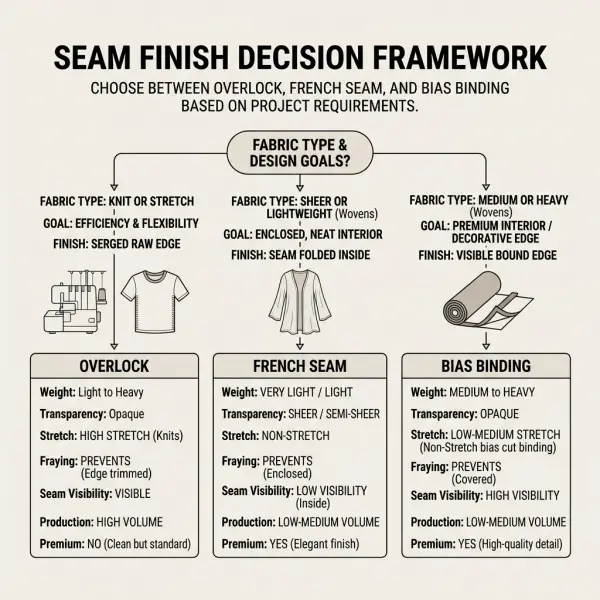
Overlock, French seams, and bias binding all control raw fabric edges, but they solve different garment-construction problems.
Overlocking is generally the most efficient option for commercial production. It trims and wraps a fabric edge quickly, making it suitable for many woven garments, knitwear, casual apparel, and high-volume manufacturing. Its final quality, however, depends on the correct stitch configuration, machine tension, differential feed, thread, and operator control.
A French seam encloses the raw edges inside a narrow folded seam. It is best suited to lightweight or sheer woven fabrics where the garment interior may remain visible. It creates a clean result without separate binding, but requires additional sewing, trimming, and pressing operations.
Bias binding covers a raw seam allowance with a separate strip of fabric. It is often selected for unlined jackets, coats, tailoring, and premium garments where the interior appearance contributes to perceived quality. It provides excellent edge coverage but adds material, labor, bulk, and production complexity.
The best finish is not necessarily the most elaborate one. It is the option that matches the fabric, seam location, garment use, quality positioning, factory capability, and target cost.
What Is the Difference Between Overlock, French Seam, and Bias Binding?
The simplest distinction concerns what happens to the raw fabric edge.
- Overlock thread wraps around an exposed raw edge.
- A French seam folds and encloses the raw edges within the seam itself.
- Bias binding covers a raw edge with an additional strip of material.
These methods are not completely interchangeable. They create different levels of bulk, flexibility, edge protection, visual refinement, and manufacturing cost.
It is also important to distinguish a seam finish from the seam that joins the garment pieces. Overlocking may serve only as an edge finish, or it may join and finish fabric layers in one operation. A French seam combines the joining seam and enclosed finish within one construction. Bias binding usually finishes the seam allowances after the main seam has already been sewn.
The ISO 4916 classification of textile seam types separates seam configurations according to how material components are positioned and joined. This technical distinction matters because terms such as “overlock seam” or “bound seam” can describe several different constructions unless the exact stitch and material arrangement are specified. ISO states that ISO 4916 should be read together with ISO 4915, which classifies stitch types.
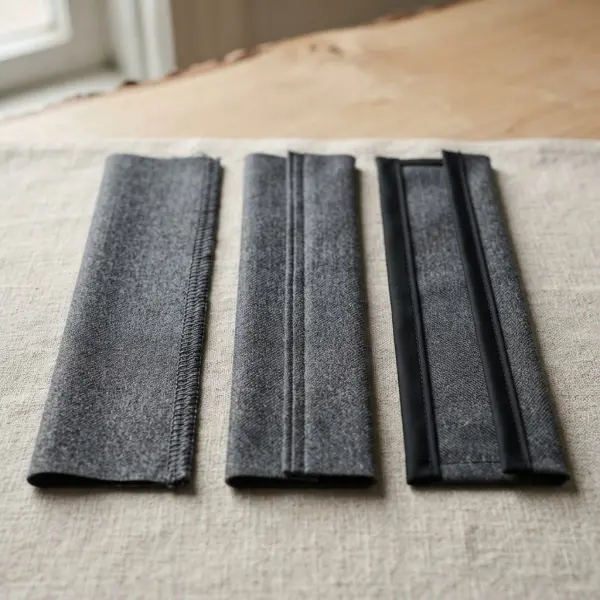
The three finishes can be compared at a glance:
|
Decision factor |
Overlock |
French seam |
Bias binding |
|
Raw-edge treatment |
Thread wraps around the cut edge |
Raw edges are enclosed inside the seam |
Separate strip covers the edge |
|
Typical production speed |
Fast |
Slower |
Moderate to slow |
|
Additional material |
Thread only in most cases |
No separate material |
Binding strip required |
|
Best-known application |
Casualwear, knitwear, commercial production |
Fine, sheer, or lightweight woven garments |
Unlined tailoring and premium interiors |
|
Suitability for heavy fabric |
Possible with the correct setup |
Usually poor |
Often suitable, subject to bulk |
|
Suitability for stretch fabric |
Often suitable |
Usually limited |
Depends on binding and construction |
|
Visual refinement |
Functional to polished |
Clean and discreet |
Deliberately decorative or premium |
|
Curved seam handling |
Generally manageable |
Difficult on tight curves |
Good when correctly cut and applied |
|
Factory scalability |
High |
Moderate |
Depends on equipment and skill |
|
Main risk |
Waving, loose loops, excessive trimming |
Bulk, trapped threads, difficult curves |
Uneven width, added bulk, high labor |
This comparison is a starting point rather than a universal rule. Fabric construction, seam stress, laundering, machinery, and garment design can change which option performs best.
For a broader explanation of seam finishes beyond these three methods, see seam finishing techniques for better garment quality.
When Should Overlock Finishing Be Used?
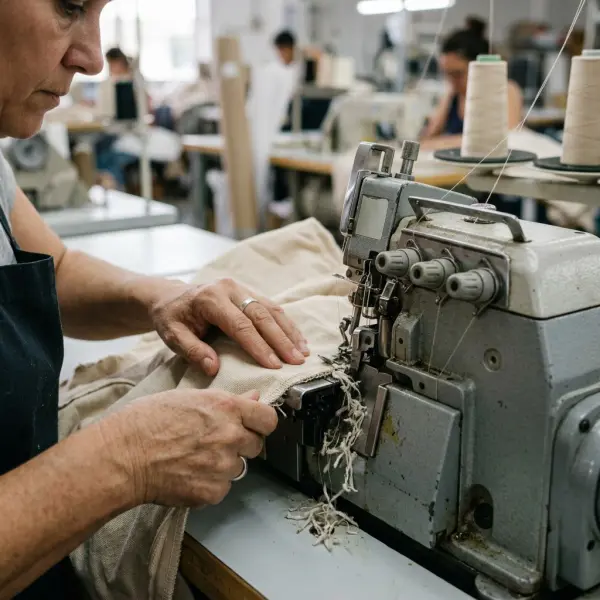
Overlock finishing is usually the most appropriate choice when a garment needs fast, flexible, repeatable raw-edge control at commercial production scale.
An overlock machine forms stitches around the edge of the fabric while an integrated knife can trim the seam allowance. Depending on the machine configuration, it may finish one raw edge, join two fabric plies, or combine edge wrapping with a separate chainstitch for greater seam security.
Overlocking is widely used because it combines several functions efficiently. It can reduce separate trimming and edge-finishing operations, support consistent production flow, and accommodate many woven and knitted materials.
Its efficiency should not be mistaken for simplicity. Thread tension, cutting width, differential feed, stitch density, needle selection, presser-foot pressure, and thread properties all affect the result.
Overlock for Woven Garments
In woven garments, overlocking is commonly applied after a plain seam has been joined with a lockstitch or chainstitch. The two seam allowances may be overlocked together and pressed to one side, or finished separately and pressed open.
Finishing the allowances together is generally faster. Finishing them separately allows the seam to be pressed open, which can reduce bulk and create a flatter result in some garments.
Typical applications include:
- casual shirts;
- dresses and skirts;
- trousers;
- uniforms;
- childrenswear;
- lightweight jackets;
- casual woven tops;
- lined garments with fray-prone outer fabric.
A three-thread overedge configuration is often used primarily for raw-edge finishing. A five-thread safety-stitch construction may combine an overedge stitch with a separate chainstitch to join woven garment panels more securely. Actual machine configurations and stitch numbers should be confirmed with the factory rather than assumed from the word “overlock.”
Overlock for Knitted Garments
Overlocking is especially common in cut-and-sew knitwear because the stitch structure can provide greater extensibility than a basic lockstitch seam.
T-shirts, knit dresses, leggings, casual underwear, sweatshirts, and similar products may be joined using three- or four-thread overlock configurations. A four-thread overlock is frequently selected where the seam must both join the fabric and tolerate extension, although the correct choice depends on garment stress, material stretch, thread properties, and required seam security.
This does not mean every overlocked knit seam will stretch adequately. A seam can still break when:
- the stitch density is too high;
- the needle threads are excessively tight;
- the thread has insufficient elongation;
- the garment opening must stretch beyond the seam’s capacity;
- the fabric is damaged by an unsuitable needle;
- the seam allowance is trimmed too narrowly;
- the wrong stitch configuration is used.
Products worn close to the body may also require attention to seam softness. The thread mass created by overlocking can feel abrasive when coarse thread, high tension, or bulky seam intersections are used.
Why Overlock Works Well in Volume Production
Overlock machinery supports production speed because cutting, edge control, and sometimes joining occur in one pass. This makes the method commercially attractive for products with tight cost targets and high order quantities.
Factories also tend to have established overlock capacity. Operators are familiar with the equipment, replacement parts are widely available, and the process can be integrated easily into conventional garment lines.
The advantage is strongest when:
- seam constructions are standardized;
- the factory has correct machine gauges and stitch configurations;
- operators can adjust differential feed;
- thread supply is consistent;
- quality standards define acceptable edge coverage;
- maintenance prevents blunt knives and timing problems.
A fast machine does not guarantee a fast production line. Repeated thread breaks, seam waving, skipped stitches, or trimming errors can create rework that removes the expected efficiency.
When Overlock Is Not the Best Choice
Overlocking may be unsuitable when the raw edge must be completely enclosed, when the garment interior is a visible design feature, or when thread loops would show through a sheer fabric.
It may also be a poor choice for:
- highly transparent garments where colored thread becomes visible;
- premium unlined tailoring that requires a deliberately finished interior;
- reversible products;
- fabrics that curl or distort severely during overlocking;
- materials damaged easily by the trimming knife;
- styles where the seam allowance must be released during alteration;
- garments requiring sealed, taped, or specialist protective seams.
Overlocking can still appear professional. The question is whether its visible thread-wrapped edge matches the product’s design and commercial positioning.
When Should a French Seam Be Used?
A French seam is most appropriate for lightweight or sheer woven garments that need fully enclosed raw edges without separate binding.
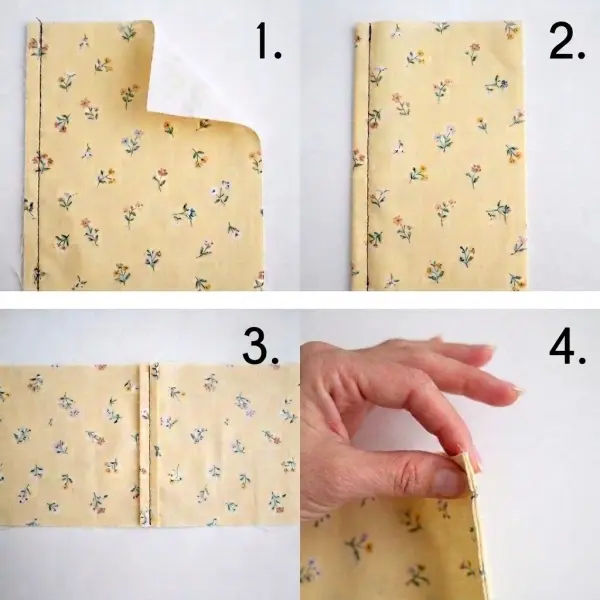
The construction is sewn in two stages. First, the fabric pieces are positioned with their wrong sides together and stitched close to the edge. The seam allowance is then trimmed, pressed, and turned so the right sides face each other. A second line of stitching encloses the first seam and its raw edges.
The result is a narrow folded seam visible on the garment interior and a conventional seam line visible from the outside.
The method is often selected for:
- chiffon blouses;
- organza garments;
- lightweight silk or silk-like fabrics;
- voile shirts;
- fine cotton dresses;
- unlined lightweight garments;
- lingerie made from stable lightweight wovens;
- garments whose inside may be seen through transparent material.
Why French Seams Suit Fine and Sheer Fabrics
A lightweight transparent garment exposes construction details that would remain hidden in an opaque product. Overlock thread may be visible through the outer fabric, particularly when the thread color, seam allowance width, or loop formation contrasts with the material.
A narrow French seam creates a controlled internal line. It does not require a separate binding strip, which helps preserve the delicate character of the fabric.
The finish can also reduce loose yarns inside garments that are difficult to line. This is valuable for lightweight summer dresses, fine shirts, and semi-transparent blouses where a full lining might alter drape, breathability, opacity, or price.
However, the seam is not invisible. If it is too wide, uneven, or poorly pressed, it may still show through the garment.
The Importance of Seam-Allowance Accuracy
French seams depend on accurate planning. The total seam allowance must accommodate both stitching stages while leaving enough room to enclose the first trimmed edge.
Suppose the required final seam position is not recalculated correctly. The finished garment may become smaller than intended because part of the seam allowance has been consumed during the first operation. This can affect chest width, sleeve circumference, armhole dimensions, or garment length where horizontal seams are involved.
Loose yarns may also protrude from the completed seam when the first allowance is not trimmed closely or consistently. Operators sometimes attempt to remove these threads after the seam has been completed, but prevention is more efficient than correction.
A reliable production method includes:
- a defined original seam allowance;
- an approved first stitching distance;
- a controlled trimming width;
- accurate pressing;
- a defined second stitching distance;
- inspection for trapped yarns;
- measurement of the completed garment.
French Seams and Curved Areas
French seams are easiest on straight seams and gentle curves. Tight curves create difficulties because the enclosed seam allowance must fit inside a different curved line after turning.
Concave curves may require clipping, but clipping too close to the first stitching line can weaken edge containment. Convex curves may need grading or very narrow allowances to prevent bunching.
Armholes, sleeve heads, necklines, and sharply shaped panels should therefore be sampled carefully. A French seam can be used in some curved locations, but its presence in a design reference should not be taken as proof that it will scale efficiently in production.
French Seams Are Not Automatically Stronger
The enclosed edge can improve neatness and limit fraying, but it does not automatically make the seam suitable for high-stress applications.
Seam performance depends on:
- fabric strength;
- resistance to yarn slippage;
- thread strength and elongation;
- stitch type;
- stitch density;
- needle damage;
- seam allowance;
- load direction;
- garment fit.
The ASTM D1683/D1683M test method for failure in sewn seams of woven fabrics evaluates sewn-seam failure under specified laboratory conditions. ASTM notes that seam performance can involve fabric rupture, sewing-thread failure, seam slippage, or combinations of these mechanisms. Laboratory seam results also should not be presented as a complete prediction of real-world wear.
A French seam in a delicate open weave may look clean while still allowing yarns to shift away from the stitch line under stress.
When French Seams Are a Poor Choice
French seams generally become less practical as fabric thickness and seam complexity increase.
They may not be suitable for:
- heavy denim;
- thick wool coating;
- bulky fleece;
- multilayer padded garments;
- tight internal curves;
- dense seam intersections;
- heavily fitted stress points;
- most high-stretch knit constructions;
- areas requiring easy alteration;
- seams that must lie completely flat.
The two-stage folded construction can create a ridge. On a close-fitting garment, that ridge may show on the outside or press against the wearer.
French seams are therefore best understood as a refined lightweight construction—not as a universal marker of premium quality.
When Should Bias Binding Be Used?
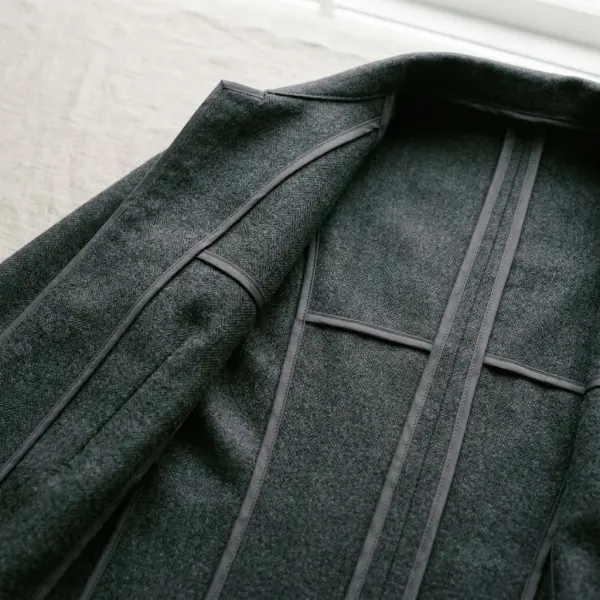
Bias binding is most appropriate when exposed seam allowances need complete edge coverage and the garment interior is intended to look deliberate, refined, or decorative.
The raw edge is wrapped with a separate strip of fabric and secured by stitching. When the strip is cut on the bias, it can follow curved edges more easily because the diagonal grain provides greater flexibility than the straight grain of a woven fabric.
Bias binding is commonly associated with:
- unlined jackets;
- unlined coats;
- tailored vests;
- premium dresses;
- corsetry and structured garments;
- reversible or partially reversible products;
- visible facings;
- armhole and neckline edges;
- garments with decorative internal construction.
Binding can be made from self-fabric, lining fabric, cotton lawn, rayon or polyester lining material, lightweight twill, or commercially manufactured tape. The chosen strip must be compatible with the garment’s weight, care method, colorfastness, shrinkage, and flexibility.
Fully Bound Seams and Hong Kong Finishes
“Bias-bound seam” can refer to more than one application.
In a fully bound edge, the binding encloses the raw edge on both sides. The front and back of the binding are visible around the seam allowance.
In a Hong Kong finish, a strip is stitched to the front of the seam allowance, wrapped around the raw edge, and secured so the underside may contain only a narrower or unfolded portion of the binding. This reduces some bulk while maintaining a refined appearance on the visible side.
The distinction matters in technical specifications. Asking for “bias binding” without a construction diagram can produce different results between factories.
The Coats overview of seam types describes bound seams as constructions formed by folding a binding strip over the edges of material plies and joining the binding to the material with one or more rows of stitching. It also demonstrates why seam configuration and stitch type must be specified separately.
Why Bias-Cut Strips Handle Curves
Woven fabric has lengthwise and crosswise grain directions that are comparatively stable. A strip cut diagonally across those directions can flex and shape around a curve more readily.
This flexibility is useful around:
- armholes;
- necklines;
- curved facings;
- scalloped details;
- shaped seam allowances;
- rounded hem edges.
Bias does not remove every construction problem. The strip may stretch unevenly during cutting, handling, pressing, or sewing. If it is pulled too firmly, the garment edge can gather or roll. If it is applied too loosely, it may ripple or stand away from the seam allowance.
For long straight seam allowances, some manufacturers use strips cut on another grain direction when flexibility is unnecessary. The technical pack should therefore specify whether true bias is required rather than treating all binding strips as identical.
Bias Binding as a Quality and Design Detail
A neatly bound garment interior can support premium positioning because it remains visible in an unlined product. Contrasting binding may also reinforce the brand’s visual identity or create a subtle decorative feature.
This value depends on execution. Uneven widths, missed edges, bulky intersections, twisted strips, mismatched thread, or poor colorfastness can make binding look worse than a controlled overlock finish.
Customers may also interpret binding differently by category. It can feel appropriate in an artisanal jacket or tailored vest but unnecessarily decorative in a technical base layer.
The business question is not whether bias binding looks expensive in isolation. It is whether the finish contributes enough visual, functional, or branding value to justify its additional cost.
Material and Labor Implications
Unlike French seams or basic overlocking, binding requires a separate component. This affects:
- bill of materials;
- shade approval;
- shrinkage compatibility;
- purchasing quantities;
- cutting yield;
- minimum order quantities;
- inventory management;
- sewing operations;
- quality inspection.
Self-fabric binding can create a coordinated appearance but may consume valuable shell material. A lightweight lining fabric can reduce bulk but may require separate sourcing and shade management.
Ready-made tape may improve consistency, although its composition, width, handfeel, shrinkage, and color range must match the garment specification.
Operator skill is also significant. The binding must cover the raw edge completely and remain consistent around curves and intersections. Industrial folders can improve speed, but the attachment must suit the strip width, fabric thickness, and machine setup.
When Bias Binding Is Not the Best Choice
Bias binding may be excessive or technically unsuitable when:
- the garment is fully lined and the edge will never be exposed;
- the fabric is extremely lightweight and the binding creates show-through;
- stretch requirements exceed the binding’s capacity;
- the garment must remain exceptionally low-bulk;
- order pricing cannot absorb the extra labor and material;
- the factory lacks suitable folders or skilled operators;
- seam intersections become too thick;
- the binding shrinks differently from the shell fabric;
- the product requires sealed or bonded seam technology.
A bound interior can be beautiful, but beauty does not compensate for stiffness, twisting, discomfort, or inconsistent production.
Which Finish Should Be Used for Different Fabrics?
Fabric name alone is not enough to determine the finish. Two fabrics sold under the same fiber description can differ in weave, knit structure, thickness, coating, finishing, yarn density, stretch, and fraying behavior.
Still, the following matrix provides a practical development starting point.
|
Fabric or construction |
Likely first option |
Possible alternative |
Main issue to verify |
|
Lightweight chiffon or organza |
Narrow French seam |
Fine narrow overlock |
Transparency and trapped yarns |
|
Cotton voile or lawn |
French seam |
Narrow overlock or turned finish |
Bulk and laundering |
|
Stable shirting poplin |
Overlock |
French seam or flat-felled seam |
Product positioning and seam location |
|
Linen or loose woven fabric |
Overlock or binding |
French seam in lightweight qualities |
Fraying and yarn slippage |
|
Medium tailoring wool |
Bias or Hong Kong finish in unlined products |
Overlock under lining |
Bulk and pressing |
|
Heavy coating |
Overlock or appropriate binding |
Lining-enclosed construction |
Thickness at intersections |
|
Lightweight jersey |
Four-thread overlock |
Specialist stretch construction |
Waving and seam extension |
|
High-stretch activewear knit |
Stretch overlock or specialist flat seam |
Coverseam-related construction |
Extension, recovery, and skin comfort |
|
Denim |
Overlock or safety stitch |
Flat-felled seam |
Bulk, seam strength, and wash effects |
|
Sheer woven dress fabric |
French seam |
Narrow binding in selected areas |
Seam visibility |
|
Lace |
Narrow overlock or specialist enclosed method |
Binding in structured areas |
Open structure and distortion |
|
Coated or laminated fabric |
Material-specific seam construction |
Binding or taped seam |
Needle holes and coating damage |
This table should guide sampling, not replace it. The final selection needs to be tested in the actual production fabric using the intended machinery.
Which Finish Works Best for Different Garment Categories?
Casual T-Shirts and Knit Basics
Overlock is usually the operationally appropriate choice because it can join and finish stretch fabric efficiently. The team should prioritize extension, recovery, seam softness, and resistance to skipped stitches.
French seams are generally unsuitable because their lockstitched folded construction may restrict stretch and create bulk. Bias binding may be used selectively at necklines or armholes, but it is not usually needed on all internal seams.
Lightweight Blouses and Sheer Dresses
French seams are often preferred at straight side seams and other visible internal areas. They create a clean appearance without a separate binding component.
Fine overlocking may remain appropriate at complex curves, gathered sections, sleeve insertions, or concealed areas. Using more than one finish within the same garment can be more technically sensible than forcing French seams everywhere.
Unlined Jackets and Tailored Vests
Bias or Hong Kong binding can create a controlled premium interior, particularly when seam allowances remain visible.
The binding should be tested at darts, princess seams, shoulder intersections, armholes, and pockets. These areas can accumulate thickness quickly. A combination of binding, lining, facing, and selective overlocking may deliver a better balance than fully binding every edge.
Fully Lined Tailoring
Overlocking may be sufficient to stabilize fray-prone seam allowances before the lining is installed. Premium binding beneath a complete lining can add cost without affecting customer experience or durability.
There are exceptions. Certain fabrics fray heavily during manufacturing, and some brands may use binding to support repairability or craftsmanship standards. The decision should be intentional rather than automatic.
Childrenswear
Children’s garments need secure seams, low irritation, wash durability, and controlled loose threads. Overlock is common because it is efficient and flexible, but bulky thread chains and rough seam intersections should be managed carefully.
French seams may work in lightweight woven dresses or sleepwear. Bias-bound internal seams may be appropriate in premium unlined products, although added stiffness should be assessed against comfort and movement.
Denim and Workwear
Overlock and safety-stitch constructions are common for internal seam control, while flat-felled or lapped constructions may be used where durability and a characteristic visual finish are required.
French seams are generally unsuitable because of fabric thickness and high-stress use. Binding is usually reserved for selected internal details rather than primary structural seams.
Lingerie and Intimate Apparel
No single finish applies across the category. Lightweight woven sleepwear may use French seams, while stretch lingerie usually requires overlock, coverseam, flat-seam, elastic application, or other specialized constructions.
Bias binding can finish edges, but its stretch and softness must match the garment. A visually narrow finish can still be uncomfortable if the thread, fold, or seam placement creates a hard ridge against the skin.
How Do the Three Finishes Affect Cost and Production Scale?
The cost difference is not limited to sewing time.
Overlock Cost Profile
Overlocking usually has the lowest unit cost when a factory has appropriate equipment and order volume. One pass can trim and finish the edge, or join and finish the seam.
Cost risks arise from:
- frequent machine adjustment;
- high thread consumption;
- unsuitable thread packages;
- knife damage;
- quality rework;
- inconsistent differential feed;
- limited specialist machine capacity.
Overlocking remains commercially efficient because its process is familiar and scalable, not because it requires no technical control.
French Seam Cost Profile
French seams require two stitching stages, intermediate trimming, turning, and usually pressing. Handling delicate fabric may further reduce operator speed.
The finish does not require a separate binding material, but labor cost increases. Production planning must also account for:
- additional workstations;
- pressing capacity;
- trimming consistency;
- work-in-progress handling;
- measurement risk;
- trapped-thread inspection.
The method can still be commercially viable in premium lightweight garments where its clean appearance supports the intended retail position.
Bias Binding Cost Profile
Bias binding has the broadest cost impact because it adds material and operations.
Potential cost components include:
- binding fabric or purchased tape;
- bias cutting;
- strip joining;
- pre-folding;
- machine attachments;
- operator training;
- additional stitching;
- pressing;
- shade matching;
- excess consumption around curves;
- inspection of binding width.
A factory equipped with automatic folders may apply binding far more efficiently than a sample room sewing the same finish manually. Costing should therefore use the intended production method rather than sample-room timing alone.
A Practical Commercial Comparison
|
Production issue |
Overlock |
French seam |
Bias binding |
|
Sewing operations |
Usually one main finishing pass |
At least two sewing stages |
Main seam plus one or more binding operations |
|
Separate material |
Usually no |
No |
Yes |
|
Pressing dependency |
Low to moderate |
High |
Moderate |
|
Specialist attachment |
Machine itself |
Usually no |
Often beneficial |
|
Operator learning curve |
Familiar in most factories |
Moderate |
Moderate to high |
|
Rework risk |
Trimming and stitch-balance defects |
Trapped threads and inaccurate seam width |
Uneven or missed binding |
|
High-volume suitability |
Strong |
Possible for appropriate products |
Depends heavily on equipment |
|
Premium visual value |
Moderate |
High in fine garments |
High in visible unlined interiors |
The most expensive finish is not necessarily the highest-quality decision. A finish becomes commercially valuable only when it supports product performance, interior appearance, customer expectation, or brand positioning.
What Should Be Written in the Technical Pack?
“Use French seam” or “bind all seams” may not provide enough information for consistent production.
The technical pack should define the construction precisely.
For an overlocked seam, specify:
- whether the seam is joined separately;
- whether allowances are finished together or separately;
- overlock stitch configuration;
- finished seam allowance;
- stitch density or approved range;
- thread type and color;
- pressing direction;
- acceptable edge coverage;
- whether thread chains must be secured.
For a French seam, specify:
- original cutting seam allowance;
- first stitching distance;
- trimming allowance;
- second stitching distance;
- finished seam width;
- pressing direction;
- locations where French seams are required;
- alternative finish for difficult curves or intersections.
For bias binding, specify:
- fully bound or Hong Kong construction;
- finished binding width;
- strip composition;
- color and shade standard;
- cut direction;
- single-fold or double-fold structure;
- stitch type;
- number and position of visible stitch lines;
- mitering requirements;
- treatment at seam intersections;
- acceptable variation in binding width.
A seam diagram and approved physical sample are generally more reliable than written terminology alone.





Comments 0
Leave a CommentSend Comment
Anda harus Login terlebih dahulu untuk dapat memberikan komentar.