
Satin vs Silk: Key Differences in Structure, Fiber, Performance, and Fashion Use
Quick Answer
Satin and silk are not competing versions of the same material. Satin is primarily a fabric structure created through a float-dominant weave, while silk is a natural protein fiber produced by certain insects, most commonly the domesticated mulberry silkworm.
This means satin can be made from silk, polyester, nylon, acetate, viscose, or blends. Silk, meanwhile, can be woven into satin but also into chiffon, organza, crepe, taffeta, twill, plain-weave fabrics, and many other constructions.
A silk satin combines both concepts: silk supplies the fiber, while satin supplies the weave. A polyester satin uses the same general structural principle with a different fiber. They may look similar in photographs but can differ in price, moisture behavior, heat sensitivity, care, production consistency, surface durability, and customer expectations.
For fashion businesses, the practical rule is straightforward: never treat “satin” as a fiber declaration or assume that “silk” describes the fabric construction. Buyers should specify both, verify the percentages, review the finish and weight, test the completed garment, and communicate the composition accurately to customers.
What Is the Main Difference Between Satin and Silk?
The main difference is classification. Satin describes how yarns are arranged into a fabric surface, while silk describes what the yarns are made from.
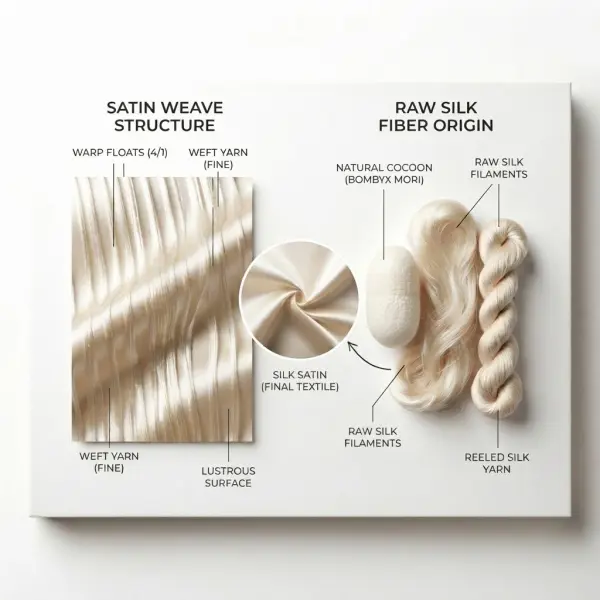
A satin weave distributes its interlacing points so that longer yarn floats cover much of the face. These relatively uninterrupted floats produce the smooth, light-reflective appearance associated with satin. The technical foundation is explained in Satin Fabric Explained: Weave, Finish, and Fashion Uses.
Silk is a natural animal-derived protein fiber. The Food and Agriculture Organization of the United Nations describes silk as an animal fiber produced by silkworms, particularly the domesticated Bombyx mori used in mulberry sericulture. Silk from other species also exists, and production methods, filament characteristics, and commercial names can vary.
The distinction can be summarized clearly:
|
Question |
Satin |
Silk |
|
What is it? |
A fabric construction and the resulting float-faced fabric |
A natural protein fiber |
|
What does it describe? |
How yarns interlace |
What the textile material is made from |
|
Can it contain different fibers? |
Yes |
Silk may be used alone or blended with other fibers |
|
Can it use different structures? |
Satin refers to the float-dominant structure |
Yes, silk can be woven or knitted into many structures |
|
Does the term prove fiber content? |
No |
It identifies fiber only when the composition is verified |
|
Does the term determine quality? |
No |
No; quality also depends on grade, yarn, construction, dyeing, finishing, and production |
The two terms overlap only when silk yarn is used in a satin construction. Calling every satin “silk” is inaccurate, but treating all silk as satin is equally misleading.
How Can Satin Be Silk and Silk Not Be Satin?
Satin can be silk when silk yarns are arranged in a satin weave. Silk is not necessarily satin because the same fiber can be formed into many other fabric constructions.
A useful way to understand the relationship is to separate textile development into stages:
- A raw material is produced or obtained.
- The material is processed into fiber or filament.
- Fibers or filaments are prepared as yarn.
- Yarns are woven, knitted, or otherwise formed into fabric.
- The fabric is dyed, printed, and finished.
- The finished material is cut and assembled into a product.
Silk belongs primarily to the fiber stage. Satin belongs to the fabric-construction stage. Finishing may enhance the resulting luster or handfeel, but it does not turn one classification into the other.
Several combinations are therefore possible:
- Silk fiber woven in a satin structure becomes silk satin.
- Polyester filament woven in a satin structure becomes polyester satin.
- Silk yarn woven in a plain structure remains silk, but it is not satin.
- Silk yarn used in chiffon, organza, crepe, or twill remains silk without becoming satin.
- A silk-and-polyester blend can use a satin construction, but its label must disclose the verified composition according to applicable rules.
This is not merely a technical distinction. It affects sourcing language, costing, care instructions, product descriptions, customs documentation, material claims, and what customers believe they are buying.
What Is Silk Fiber?
Silk is a protein-based fiber produced by certain insect larvae to form cocoons or protective structures. Most cultivated commercial silk is associated with the mulberry silkworm, Bombyx mori, although wild and non-mulberry silks also enter textile supply chains.
During conventional silk production, filaments are obtained from cocoons and processed into yarn. Continuous filaments can create smooth, fine yarns, while shorter silk fibers from damaged cocoons, waste, or deliberately cut material can be spun. Consequently, “silk” does not guarantee one perfectly smooth visual appearance.
Raw-silk selection, reeling, throwing, degumming, yarn twist, weaving, dyeing, and finishing all affect the finished material. A crisp silk organza, irregular dupioni, soft habotai, textured silk noil, and fluid silk satin can share a silk composition while looking and behaving very differently.
Why Silk Often Appears Lustrous
Silk filament can reflect light attractively because of its smoothness and physical structure. When it is placed into a satin weave, longer exposed floats create broader reflective areas, amplifying the visual effect.
That does not mean silk is always glossy. High yarn twist, crepe structures, textured spun yarns, matte finishing, irregular filaments, or surface treatments can produce a restrained or granular appearance.
The luster of silk satin is therefore a combined result:
silk filament characteristics + yarn preparation + satin weave + fabric density + dyeing and finishing
Removing any part of that equation can change the appearance substantially.

Silk Is Not One Uniform Commercial Material
Terms such as mulberry silk, tussar or tussah silk, eri silk, spun silk, silk noil, and raw silk may refer to different biological sources, processing routes, yarn characteristics, or trade categories. Usage can also vary across suppliers and markets.
A product developer should request documentation rather than treating “natural silk” or “premium silk” as a sufficient technical specification. At a minimum, the supplier should identify composition, fabric construction, weight, width, finish, color standard, care route, and any claim concerning silk type or origin.

What Is Satin Structure?
Satin is a woven structure in which binding points are spaced to allow longer warp or weft floats to dominate the fabric face. These floats reduce visible surface interruptions and can create a smooth, lustrous appearance.
Cotton Incorporated identifies satin as one of the basic woven fabric designs and notes that its long floats contribute to both its sheen and potential issues such as snagging and seam slippage.
The structure does not require silk. Modern satins are commonly offered in several fiber families:
- Polyester satin for dresses, linings, blouses, lingerie, accessories, and decorative applications.
- Acetate or triacetate satin where a particular drape, luster, or handfeel is desired.
- Nylon satin for selected lightweight apparel, lingerie, trims, and technical or decorative uses.
- Viscose or other regenerated-cellulosic satin for fluid apparel applications.
- Silk satin for luxury apparel, lingerie, bridalwear, scarves, and accessories.
- Blended satin where manufacturers seek a particular balance of appearance, cost, stretch, care, or performance.
Fiber composition alone does not reveal whether any of these options will be lightweight or heavy, stiff or fluid, matte or highly reflective. Those characteristics remain dependent on the complete fabric specification.
Silk Satin, Polyester Satin, and Other Satins Compared
Silk satin is not universally “better,” and polyester satin is not automatically a low-quality substitute. Each material must be judged against the product’s intended positioning, care requirements, construction, price, expected lifespan, and customer promise.
The following comparison describes common tendencies, not guaranteed results:
|
Factor |
Silk satin |
Polyester satin |
Acetate or triacetate satin |
Viscose satin |
|
Fiber category |
Natural animal-derived protein fiber |
Manufactured synthetic fiber |
Manufactured cellulosic-derived fiber |
Regenerated cellulosic fiber |
|
Typical market position |
Premium or luxury |
Broad commercial range |
Specialist fashion and lining applications |
Fluid fashion applications |
|
Surface character |
Can have nuanced natural luster |
Can range from subtle to highly reflective |
Often smooth with pronounced luster |
Often soft and fluid |
|
Moisture behavior |
Can absorb moisture, but comfort still depends on construction and climate |
Generally absorbs less moisture than silk or viscose |
Performance depends on fiber type and finish |
Often more moisture-responsive than polyester |
|
Heat response |
Requires controlled heat and care |
Thermoplastic; excessive heat can alter the surface |
Can be heat-sensitive |
Heat and moisture response depends on quality and finish |
|
Production consistency |
Natural variation may occur |
Can offer relatively repeatable industrial supply |
Supplier and process dependent |
Supplier and process dependent |
|
Care |
May require delicate washing or professional cleaning |
Some qualities may be washable |
Often needs carefully validated care |
Shrinkage and surface response should be tested |
|
Price |
Often higher, but varies by quality and origin |
Available across wide price levels |
Depends on source and specification |
Depends on quality, processing, and supply |
|
Main sourcing risk |
Unverified grade, origin, care, or silk claims |
Assuming all polyester satin performs alike |
Heat, solvent, or dimensional behavior |
Wet performance, shrinkage, and abrasion |
None of these cells should substitute for testing. A dense polyester duchess satin may be more appropriate for a structured gown than a lightweight silk charmeuse, while the opposite may be true for a fluid bias-cut dress.
The business question is not simply, “Is silk better than satin?” That question combines a fiber and a structure incorrectly. The useful question is, “Which satin construction and fiber combination best meets the product brief?”
Does Silk Always Feel Better Than Synthetic Satin?
No. “Better” is subjective and dependent on what the garment is designed to achieve.
Silk satin may offer a distinctive handfeel, nuanced surface, and premium material identity. Some customers value its natural origin, heritage, rarity, or association with luxury. Those attributes can support a higher price only when the fabric quality, garment construction, fit, and communication justify it.
Synthetic satin can be engineered across a broad spectrum. A poor-quality version may feel overly slick, static-prone, thin, or harsh. A more carefully developed polyester or nylon satin may provide controlled drape, consistent color, useful strength, or a care route that better suits the product.
Customer perception is also affected by garment-level decisions:
- Whether the fabric is lined.
- How seams touch the skin.
- Whether the cut allows airflow and movement.
- How much the garment clings in use.
- Whether trims, elastics, interlinings, or labels create irritation.
- How the fabric changes after cleaning.
- Whether the surface snags during ordinary wear.
A material can feel impressive on a swatch table but uncomfortable in a fitted, unlined garment. Handfeel evaluation should therefore be followed by wear testing.

Silk Fabrics That Are Not Satin
Silk can be made into substantially different fabrics because fiber and construction are separate variables. Recognizing this prevents buyers from using “silk” as though it were a complete description of appearance or performance.
Silk Chiffon
Silk chiffon is lightweight, sheer, and often slightly textured because of its fine yarns and twist. It behaves differently from smooth silk satin in transparency, surface, sewing, and layering.
The broader characteristics of this category are covered in Chiffon Fabric Explained: Characteristics, Uses, and Care.
Silk Organza
Silk organza is generally sheer and crisp rather than fluid and glossy. Designers may use it for volume, overlays, sleeves, sculptural details, or internal support.
Its visual identity comes from transparency and structure rather than the float-covered face of satin.
Silk Crepe
Silk crepe fabrics commonly use highly twisted yarns or related construction techniques to create a granular, matte, or softly pebbled surface. Crepe de chine, georgette, and crepe-backed materials can all display different degrees of texture and drape.
The presence of silk does not remove the crepe character, just as the presence of a crepe surface does not imply a particular fiber unless composition is verified.
Silk Taffeta
Silk taffeta is typically crisp and relatively structured, with a different interlacing pattern and movement from fluid silk satin. It can be selected for gowns, skirts, jackets, and other pieces that need volume or a pronounced shape.
Dupioni and Other Irregular Silk Fabrics
Dupioni is associated with visible slubs and irregularity arising from its yarn characteristics and processing. Its textured, lively surface contrasts with the smoother continuity expected from many satin fabrics.
These examples show why “100% silk dress” is not enough information for design, costing, or sourcing. The construction must also be named and verified.
Satin Fabrics That Are Not Silk
Many garments described as satin contain no silk. This can be entirely legitimate when the composition is communicated clearly.
Polyester satin is particularly widespread because polyester filament can create a smooth float-faced fabric across different weights, price levels, stretch options, and finishing effects. Other satins may use nylon, acetate, triacetate, viscose, cupro, cotton, elastane blends, or combinations of fibers.
The problem is not that satin is made from another fiber. The problem begins when “satin” is used to imply silk content, or when terms such as “silky satin” obscure rather than clarify what the product contains.
For business-to-business sourcing, a better description would be:
Lightweight warp-faced satin, 96% polyester and 4% elastane, with approved weight, width, stretch, recovery, finish, and color standard.
For consumer communication, the legally required label should state the verified composition in the format applicable to the sales market. Marketing copy may describe the surface or drape, but it should not contradict or conceal the fiber content.
Why Visual Identification Is Unreliable
A photograph cannot reliably distinguish silk satin from synthetic satin. Lighting, editing, fabric finish, color, camera exposure, and image compression can make different materials appear nearly identical.
Touch is more informative but still inconclusive. Manufactured filament yarns, mechanical finishing, softeners, weighting, washing, sanding, and blends can imitate or modify qualities commonly associated with silk.
Price is not proof either. A high retail price may reflect design, branding, low production volume, labor, distribution, or markup rather than silk content. Conversely, discounted genuine silk products can occasionally cost less than heavily branded synthetic garments.
Several informal identification methods circulate online, including burn tests, smell tests, ring tests, and visual inspection. These have serious limitations:
- Blends can produce ambiguous results.
- Finishes and dyes can alter burning behavior.
- Burn tests damage the product and introduce fire and fume hazards.
- Fabric density affects whether material passes through a ring.
- Smooth synthetic filament can resemble silk.
- Irregular silk yarns may not match the expected “silky” appearance.
For a commercial decision, use verified supplier documentation and appropriate laboratory fiber analysis where risk warrants it. Do not rely on a social-media identification trick.
How the Difference Affects Fashion Product Development
The satin-versus-silk distinction changes decisions across design, sourcing, costing, manufacturing, marketing, and after-sales care.
Design Teams Need Both Visual and Material Language
A designer may request “a soft champagne satin,” but this describes only part of the target. The product brief should clarify whether silk is mandatory, preferred, or unnecessary.
A well-developed brief might specify:
- Intended silhouette and drape.
- Required luster level.
- Fiber preference or restriction.
- Target fabric weight.
- Opacity and lining plan.
- Stretch and recovery.
- Skin-contact expectations.
- Care route.
- Target retail price.
- Required sourcing or traceability documentation.
This allows sourcing teams to present comparable materials instead of interpreting “satin” as a request for one undefined fabric.
Costing Must Separate Fiber Value From Construction Cost
Silk content can materially affect fabric price, but the final cost also reflects silk type, yarn quality, fabric weight, weaving complexity, dyeing, finishing, defect allowance, usable width, minimum order, origin, and supplier capability.
Synthetic satin is not cost-neutral either. Specialty yarns, stretch, high density, difficult colors, low minimum quantities, certified inputs, or advanced finishing may increase its cost.
Brands should compare total garment economics rather than price per meter alone. A lower-priced fabric that causes excessive cutting loss, shade rejection, seam repairs, or customer returns may not be the lower-cost option.
Production Settings Cannot Be Copied Across Satins
Silk satin and polyester satin can respond differently to heat, steam, needle penetration, tension, friction, and stain-removal methods. Even two polyester satins may require different sewing settings.
Before bulk production, teams should approve:
- Spreading and cutting direction.
- Lay height and cutting method.
- Needle, thread, stitch, and tension.
- Seam and hem construction.
- Interfacing and adhesive compatibility.
- Pressing temperature, moisture, pressure, and dwell time.
- Stain-removal procedure.
- Final cleaning and packing.
The approved production method should be tied to the nominated fabric code, not simply to the word “satin.”
Customer Expectations Change With the Fiber Claim
A customer buying silk may expect natural-fiber authenticity, premium handling, specific care, and a different value proposition from a customer buying polyester satin.
If the product page emphasizes satin’s appearance while leaving composition difficult to find, customers may infer silk incorrectly. Accurate merchandising should make the distinction visible before purchase, particularly where price and care expectations depend on it.

Labeling and Marketing: Why Terminology Matters
Fiber composition is regulated in many markets because consumers need accurate information about what textile products contain. “Satin” does not satisfy a fiber-content declaration.
In the United States, Federal Trade Commission guidance explains that covered textile labels generally need to disclose fiber content and other required identifying information. Requirements, exceptions, tolerances, and formatting should be checked for the actual product and market.
Regulation (EU) No 1007/2011 similarly establishes rules concerning textile fiber names and fiber-composition labeling. Brands selling internationally should not assume that one label format or marketing phrase works everywhere.
Potentially misleading descriptions include:
- Using “silk satin” for a product containing no silk.
- Calling polyester “synthetic silk” without clearly identifying polyester.
- Using “silk blend” without giving the required fiber percentages.
- Describing a surface as silk when the wording could be interpreted as fiber content.
- Listing “satin” in the composition field.
- Allowing marketplace sellers or affiliates to change the verified composition language.
A safer editorial approach distinguishes sensory description from material identity. A brand may describe a verified polyester satin as “smooth,” “fluid,” or “lustrous” if those descriptions are accurate, while stating the actual composition clearly and prominently.
Does Silk Automatically Make Satin More Sustainable?
No. Neither silk nor any other fiber should be declared more sustainable based only on its name.
Silk is renewable in the sense that it is produced biologically, but conventional silk is animal-derived and depends on sericulture, land, feed cultivation, energy, water, processing, labor, and regional production practices. Animal-welfare considerations may also matter to customers and brands.
Conventional polyester is generally fossil-derived, while recycled polyester may reduce reliance on virgin feedstock under certain conditions. That does not resolve every issue associated with energy, processing, shedding, durability, recycling infrastructure, or end of life. Recycled-content claims need appropriate evidence and chain-of-custody controls.
Comparisons also depend on:
- The geographic and technological scope of the assessment.
- Whether the comparison is made per kilogram, meter, garment, wear, or useful life.
- Fabric weight and production yield.
- Dyeing and finishing.
- Product durability and actual use.
- Cleaning and maintenance.
- Whether the garment is resold, repaired, recycled, or discarded.
- Which environmental and social indicators are included.
For brands, the credible approach is to describe verified attributes precisely. Avoid turning “natural,” “recycled,” “biodegradable,” “vegan,” or “luxury” into a broad environmental conclusion without supporting evidence and appropriate limitations.
Common Satin and Silk Misconceptions
“Satin Means Silk”
This misconception persists because satin was historically and commercially associated with silk luxury products. Modern satin can contain numerous other fibers.
The operational consequence is inaccurate supplier requests and misleading product descriptions. The better approach is to state construction and composition separately.
“Silk Is a Type of Satin”
Silk is a fiber, not one specific fabric structure. It can be used in satin, chiffon, organza, taffeta, crepe, twill, velvet, jersey, and other textiles.
Treating silk as one fabric type makes it difficult to compare suppliers or predict garment behavior.
“Silky” Proves Silk Content
“Silky” usually describes a sensory impression. It does not prove the presence of silk.
Whether the word is acceptable in marketing depends on context and applicable consumer-protection and textile-labeling rules. The verified fiber composition should remain easy to find and unambiguous.
“Silk Satin Is Always Delicate”
Some silk satin qualities are lightweight and sensitive to abrasion or marking, but silk satin is available in different weights, densities, yarns, and finishes. A heavier silk satin can behave differently from lightweight charmeuse.
“Delicate” should be treated as a product-specific care and performance judgment, not an automatic classification.
“Polyester Satin Is Always Cheap and Shiny”
Polyester satins range from thin, highly reflective qualities to dense, matte, stretch, sand-washed, or technically developed fabrics. Fiber name alone does not establish quality or price.
Judgment should be based on the actual fabric, production consistency, performance results, and suitability for the garment.
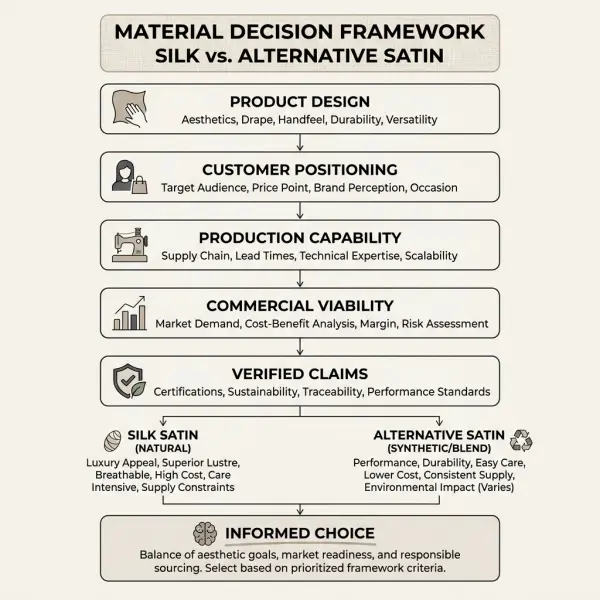
A Practical Decision Framework for Fashion Brands
Brands deciding between silk satin and another satin should begin with the product promise rather than material prestige.
Use five decision areas:
|
Decision area |
Questions to ask |
|
Product design |
Does the garment need fluid drape, structured volume, stretch, opacity, or reversibility? |
|
Customer and positioning |
Is verified silk part of the value proposition, or is the main promise visual appearance and function? |
|
Operations |
Can the factory cut, sew, press, clean, inspect, and pack the material consistently? |
|
Commercial model |
Can the fabric price, minimum order, waste, defect risk, and care expectation support the target margin? |
|
Claims and compliance |
Can composition, origin, recycled content, silk type, care, and sustainability claims be documented? |
A small occasionwear brand, for example, might use silk satin for a limited premium collection while selecting polyester stretch satin for a fitted commercial line requiring different care, price, and availability. That is not inherently inconsistent if the distinction is transparent and each material serves a deliberate purpose.
The next cluster article examines why satin remains popular in eveningwear, lingerie, and occasion pieces, where visual effect, product category, styling, and customer expectations become the central questions.
Frequently Asked Questions About Satin vs Silk
Is silk satin 100% silk?
Silk satin may be 100% silk, but the name alone should not be accepted as proof. Some fabrics described commercially as silk satin may contain additional fibers for stretch, cost, performance, or other effects.
Buyers should obtain a verified fiber-composition specification and confirm that the purchase order, testing documentation, garment label, and product page agree. Consumers should consult the fiber-content label rather than relying only on the product title. If a fabric is blended, the applicable percentages should be disclosed according to the rules of the destination market.
Which is more expensive, satin or silk?
The comparison is incomplete because satin is a construction and silk is a fiber. Silk satin is often more expensive than mass-market polyester satin, but prices vary widely according to fiber grade, fabric weight, quality, origin, finishing, volume, certification, and supplier.
A specialist synthetic satin may cost more than a basic or discounted silk fabric. Fashion businesses should compare materials that meet the same design and performance specification and then include cutting yield, defect allowance, production difficulty, testing, care, and return risk in the calculation.
Is satin vegan?
Satin can be vegan if it is made without silk, wool, or other animal-derived components and the complete product meets the brand’s definition of vegan. Polyester, nylon, acetate, viscose, or cotton satin may avoid silk fiber, but trims, dyes, coatings, adhesives, and processing aids may still require review.
The word “satin” itself does not establish whether a product is animal-free. Brands making vegan claims should define the scope, obtain supplier declarations, assess all relevant components, and avoid assuming that a plant-derived or synthetic main fabric proves the entire garment is vegan.
Is silk more breathable than polyester satin?
Silk generally has different moisture behavior from polyester, but garment comfort cannot be predicted from fiber alone. Fabric weight, density, lining, finish, garment fit, climate, activity level, and ventilation all influence heat and moisture management.
A lightweight, loose silk garment may feel more comfortable in certain conditions than a dense polyester satin garment, but that does not establish a universal rule for every fabric. Product teams should conduct wear trials using the finished garment in conditions that resemble expected use rather than relying solely on generic fiber descriptions.
Can polyester satin be labeled as silk satin?
No, not if it contains no silk and the wording represents the product as containing silk. “Satin” can accurately describe the weave or surface category, but “silk” identifies a fiber and creates a materially different composition claim.
A clearer name would be “polyester satin,” accompanied by the legally required fiber percentages. Descriptive phrases such as “silk-like” may also create confusion depending on placement, prominence, and local rules, so brands should review the complete presentation rather than treating one qualifying word as sufficient.
How should an online store describe satin accurately?
An online store should state both the verified fiber composition and the relevant fabric construction. It can then describe weight, stretch, opacity, luster, drape, lining, fit, and care in customer-friendly language.
For example: “Bias-cut midi dress in lightweight polyester satin with a lustrous face and fluid drape; unlined; 100% polyester.” The details must match the actual product and label. Avoid placing composition only in a hidden tab when the title, images, or price could reasonably lead customers to assume the garment is silk.
Which is better for eveningwear: silk satin or polyester satin?
Neither is universally better. Silk satin may suit premium positioning, refined handfeel, and a material-led luxury story. Polyester satin may better support a different price point, color program, care route, stretch requirement, or production volume.
The decision should consider silhouette, fabric weight, drape, opacity, seam stability, snagging, comfort, care, availability, minimum order, target margin, and customer expectation. The most suitable fabric is the one that meets the complete product brief and performs consistently—not necessarily the one with the most prestigious fiber name.
Conclusion
Satin and silk describe two different layers of a textile. Satin tells us how yarns are organized to create a float-dominant surface. Silk tells us what the fiber is. Only the phrase “silk satin,” supported by verified composition, brings the two together.
This distinction explains why one silk fabric can be crisp, sheer, granular, irregular, or fluid—and why two satin garments can look similar while behaving differently in wear, care, sewing, and pricing.
For fashion businesses, accurate terminology is operationally useful. It improves design briefs, supplier comparisons, costing, production trials, labels, product pages, and customer trust. It also prevents material prestige from replacing the less glamorous work of specification and testing.
The strongest sourcing question is therefore not “satin or silk?” It is: which fiber, yarn, construction, weight, finish, and performance profile does this particular garment require?





Comments 0
Leave a CommentSend Comment
Anda harus Login terlebih dahulu untuk dapat memberikan komentar.