

How Production Scheduling Improves Garment Efficiency
Quick Answer
Production scheduling improves garment efficiency by turning a broad production plan into a practical daily execution sequence. It helps manufacturers decide which styles run on which sewing lines, when each order should start, how many pieces should be completed per day, which operations may become bottlenecks, and how resources should be adjusted when actual output falls behind plan.
In apparel manufacturing, efficiency is rarely improved by speed alone. A sewing line can look busy but still perform poorly if materials arrive late, operators wait for cut panels, machines are not ready, complex styles are assigned to the wrong line, or finishing cannot keep up with sewing output. Production scheduling helps reduce these gaps by aligning work sequence, capacity, labor, machine availability, quality checkpoints, and shipment priorities.
A strong garment production schedule does not guarantee perfect execution. Fabric issues, absenteeism, buyer changes, machine downtime, and quality rework can still disrupt the factory. But scheduling gives manufacturers a more disciplined way to manage flow, reduce idle time, control work-in-progress, and protect on-time delivery.
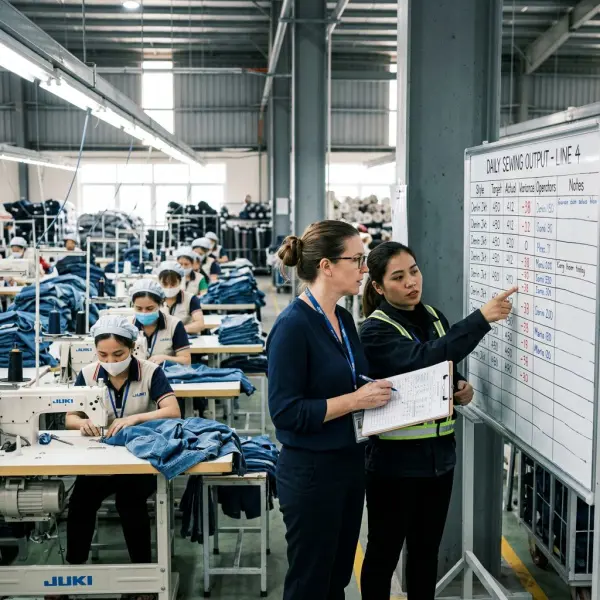
What Production Scheduling Means in Garment Manufacturing
Production scheduling is the detailed coordination of manufacturing activities over a specific time period. In a garment factory, it translates the production plan into a sequence of line allocation, daily output targets, process timing, material release, quality checkpoints, finishing flow, and shipment readiness.
The broader production plan answers whether the factory can produce an order within a required delivery window. Scheduling answers a more immediate question: how should the factory run the work day by day so the order moves through cutting, sewing, finishing, inspection, packing, and shipment without unnecessary delay?
This distinction matters. A manufacturer may have an approved production plan, sufficient total capacity, and a confirmed delivery date, but still lose efficiency if daily execution is poorly sequenced. Apparel production is highly dependent on flow. If cutting releases panels late, sewing lines wait. If sewing output piles up faster than finishing can handle, work-in-progress grows. If a complex style starts on a line without the right attachments or trained operators, efficiency drops before the first production report is written.
Production scheduling is therefore not just an administrative calendar. It is a shop-floor control tool. It gives supervisors, planners, merchandisers, quality teams, and factory management a common reference for what should happen next.
For a broader explanation of the planning layer behind this process, manufacturers can first review apparel production planning explained for manufacturers. Scheduling builds on that foundation but focuses more sharply on execution rhythm, line loading, bottlenecks, and daily output.
Why Scheduling Has Such a Strong Impact on Garment Efficiency
Garment efficiency depends on how well people, machines, materials, and time are coordinated. The sewing floor is especially sensitive because most apparel production remains labor-intensive and style-specific. Even in modern factories, many operations require skilled handling, correct machine setup, balanced workflow, and close quality control.
A production line loses efficiency whenever operators wait, repeat work, change tasks too often, handle unclear instructions, or receive inconsistent input from upstream processes. These losses may appear small during a single hour, but they accumulate quickly across multiple lines, multiple styles, and multiple days.
Scheduling improves efficiency by reducing avoidable uncertainty. It tells teams what style is coming next, which line will run it, when materials should arrive, when cutting must release bundles, what output is expected, and where risk is likely to appear. A schedule also makes trade-offs visible. If one urgent order is moved forward, another order may have to move back. If a line is assigned a complex new style, the factory may need to adjust the expected efficiency during the learning curve.
In supply chain management, planning and execution are closely connected. ASCM defines supply chain management as the design, planning, execution, control, and monitoring of supply chain activities to create value and synchronize supply with demand. ASCM supply chain management definition In apparel manufacturing, production scheduling is one of the practical ways this synchronization happens on the factory floor.
The Efficiency Problems Scheduling Helps Solve
Production scheduling does not fix every manufacturing problem, but it can reduce several common sources of inefficiency. Many garment factories already know what needs to be produced. The challenge is sequencing the work so the factory can produce it with fewer interruptions.
Scheduling is especially useful for managing these operational issues:
- idle time caused by late input from cutting or material preparation;
- frequent line changes that reduce operator rhythm;
- bottlenecks in difficult sewing operations;
- mismatch between style complexity and operator skill;
- excessive work-in-progress between sewing, finishing, and packing;
- late identification of orders at risk;
- rushed final inspection caused by poor upstream timing;
- unplanned overtime near shipment.
These issues are connected. A late cutting release can reduce sewing output. Low sewing output can compress finishing. Compressed finishing can increase quality pressure. Quality pressure can create rework. Rework can delay packing. By the time shipment is at risk, the root cause may be several days old.
A good schedule helps the factory see these connections earlier.
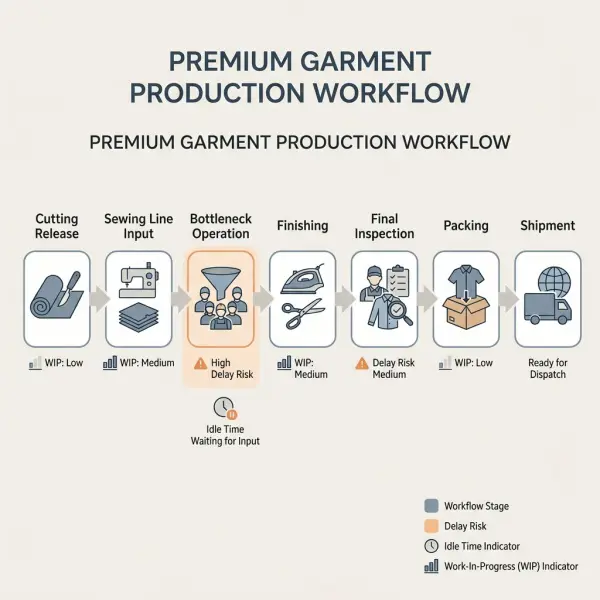

How Scheduling Improves Sewing Line Efficiency
Sewing line efficiency is one of the most visible performance indicators in apparel manufacturing. It compares the productive time used to make garments against the available working time, often using standard minute value, actual output, operator count, and working hours.
The schedule affects sewing efficiency before sewing begins. If the wrong style is assigned to the wrong line, the line may struggle from the start. If a line changes styles too frequently, operators lose rhythm. If attachments, folders, guides, needles, thread, or machine settings are not prepared, the line may wait. If the schedule ignores the learning curve of a new style, the daily target may become unrealistic.
A practical production schedule improves line efficiency in three ways. First, it allocates styles to lines based on capability, not just availability. Second, it sequences work to reduce unnecessary changeover. Third, it gives supervisors enough visibility to prepare machines, operators, and instructions before the style reaches the line.
Matching styles to line capability
Not every sewing line performs equally across all product types. One line may be strong in knit tops, another in woven shirts, another in jackets, another in activewear. Scheduling improves efficiency when it respects these differences.
A simple blouse with basic seams may run smoothly on a general sewing line. A tailored blazer with lining, collar setting, shoulder shaping, and pressing control requires a different skill profile. If both styles are scheduled as if they have the same production difficulty, the factory may create avoidable delays.
Better scheduling considers:
- product category and construction complexity;
- standard minute value and expected learning curve;
- operator skill and previous experience with similar styles;
- machine type, attachments, and layout requirements;
- quality risk and defect history;
- order quantity and shipment priority.
This does not mean a factory should never develop new capabilities. It means capability development should be planned. Training a line on a new product type is different from expecting full efficiency from day one.
Reducing changeover losses
Every time a sewing line changes from one style to another, the factory may lose time. Operators need new instructions. Machines may require adjustment. Attachments may change. Supervisors may need to rebalance operations. Quality teams may need to approve first output.
Scheduling can reduce these losses by grouping similar styles where commercially possible. For example, a factory may sequence similar fabric types, construction methods, or machine requirements together. This does not always override delivery priority, but it can reduce unnecessary disruption.
The goal is not to avoid changeover entirely. Fashion manufacturing naturally involves style changes. The goal is to make changeover visible, prepared, and controlled.
Scheduling, Takt Time, and Production Rhythm
Takt time is commonly used in lean production to align production pace with customer demand. The Lean Enterprise Institute defines takt time as available production time divided by customer demand, with the purpose of matching production with demand. Lean Enterprise Institute takt time definition
In apparel factories, takt time must be applied carefully. Garment production is not always as uniform as automotive or electronics assembly. Style complexity, fabric behavior, operator skill, and line balance can vary significantly. Still, the underlying idea is useful: production should have a rhythm that matches required output.
A production schedule can translate shipment demand into daily and hourly targets. If an order requires 12,000 pieces and the factory has a limited number of production days, the schedule should show the required pace clearly. If the required daily output is unrealistic for the assigned line, the problem should be visible before production starts.
This is where scheduling becomes a decision tool. It helps management decide whether to add a line, extend the production window, split the order, improve preparation, or renegotiate delivery expectations.
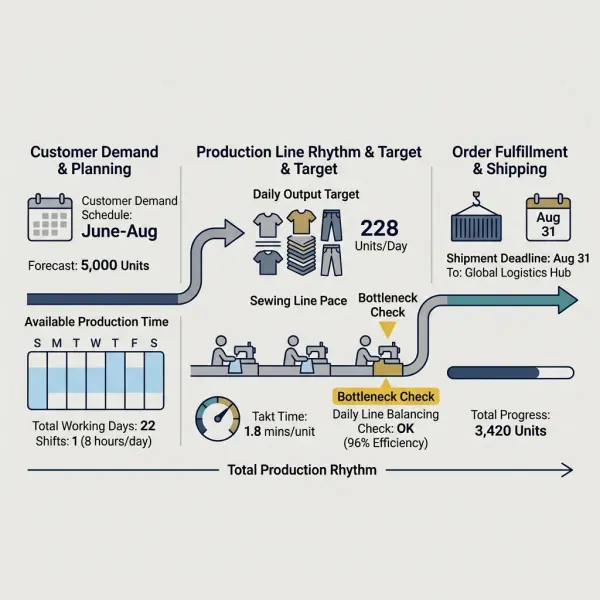
Managing Bottlenecks Through Better Scheduling
A bottleneck is the operation or process that limits the output of the entire flow. In garment manufacturing, bottlenecks may appear in sewing, cutting, finishing, pressing, washing, inspection, or packing. They often shift depending on style, fabric, order quantity, and operator availability.
Production scheduling improves efficiency by making bottlenecks easier to anticipate. A complex collar operation, difficult zipper attachment, delicate fabric handling, or labor-intensive finishing step can slow the whole line if not planned properly.
The most practical scheduling response is not simply to push workers harder. A better response is to identify the constraint and adjust the system around it.
Common bottleneck responses include:
- assigning a more skilled operator to the difficult operation;
- adding helper operations before or after the bottleneck;
- adjusting line balance;
- preparing semi-finished components earlier;
- splitting work across two lines or workstations;
- improving method, folder, attachment, or workstation setup;
- reducing unnecessary style changes around complex operations.
Bottleneck management should be treated as part of scheduling, not as a last-minute firefighting activity. When planners know a style contains a difficult operation, the schedule can allow for preparation and realistic output ramp-up.
How Scheduling Controls Work-in-Progress
Work-in-progress, often called WIP, refers to garments or components that have started production but are not yet completed. Some WIP is necessary. Too much WIP, however, can hide problems and reduce efficiency.
In apparel manufacturing, excessive WIP often appears when cutting releases more panels than sewing can process, sewing produces faster than finishing can handle, or final inspection is delayed. The factory may look busy because many pieces are moving around, but the flow is not efficient.
A better schedule controls the release of work based on downstream capacity. This is closely related to lean production thinking. The Lean Enterprise Institute describes pull production as a production control method where downstream activities signal their needs to upstream activities, with the aim of reducing overproduction. Lean Enterprise Institute pull production
Garment factories do not have to adopt a pure pull system to benefit from the principle. Even a practical scheduling discipline can help prevent cutting from releasing too far ahead or sewing from overwhelming finishing. The key is to schedule flow, not just activity.
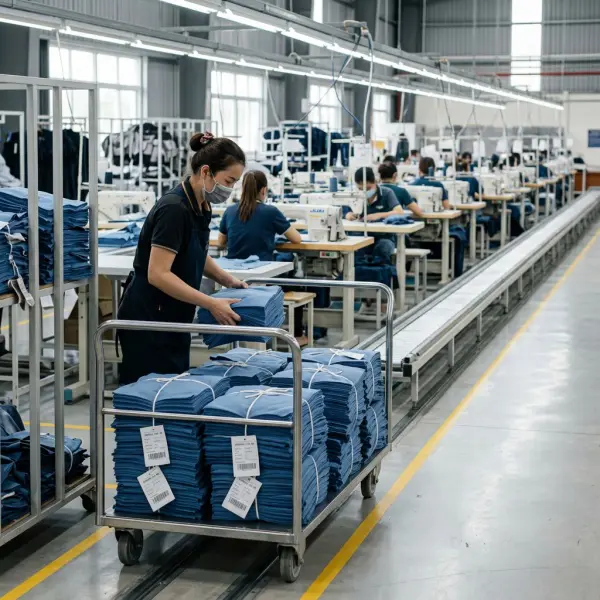
Scheduling and Quality Efficiency
Efficiency should not be measured only by speed. A line that produces quickly but creates defects is not truly efficient. Rework consumes time, labor, materials, supervisor attention, and finishing capacity. In some cases, quality issues discovered late can threaten delivery more severely than a slower but controlled sewing line.
Production scheduling improves quality efficiency by placing quality checkpoints at the right moments. For example, the schedule should allow time for pilot runs, first output checks, inline inspection, measurement review, and finishing approval. When these checkpoints are ignored, defects may travel too far before they are detected.
This is especially important for new styles, difficult fabrics, high-value garments, wash-sensitive products, and orders with strict buyer standards. A delicate satin blouse, bonded activewear garment, structured coat, or garment-dyed product may need more careful scheduling than a repeat basic T-shirt.
A practical schedule should not treat quality control as a final gate only. It should integrate quality into the flow of production.
Finite Capacity Scheduling: Why Real Limits Matter
One common scheduling mistake is assuming that factory capacity is flexible without consequence. In reality, capacity has limits. There are only so many operators, machines, hours, attachments, supervisors, quality inspectors, and finishing stations available at a given time.
Finite capacity scheduling considers actual resource limits when organizing production work. Oracle’s manufacturing documentation describes finite scheduling as planning that considers current and future facility capacity to organize and release work using available resources effectively. Oracle NetSuite finite scheduling documentation
For apparel manufacturers, the principle is highly relevant even if the factory uses spreadsheets rather than advanced scheduling software. A schedule that assigns too many styles to the same line, assumes unavailable operators, or ignores finishing capacity is not realistic. It may look organized on paper but fail on the floor.
Finite thinking forces hard but useful questions:
- Do we have enough skilled operators for this style?
- Can the line complete this order within the available days?
- Is cutting capacity aligned with sewing start dates?
- Can finishing and packing handle the planned sewing output?
- Are we overloading the same supervisors or quality inspectors?
- Does the schedule depend on overtime that may not be sustainable?
The benefit is not perfection. The benefit is honesty. When capacity limits are visible, the factory can make better decisions earlier.
The Human Side of Production Scheduling
Garment production depends heavily on people. Scheduling therefore has a direct human impact. A poorly sequenced factory may create unnecessary stress, last-minute overtime, unclear priorities, and inconsistent supervision. A more disciplined schedule can help teams work with better rhythm and fewer surprises.
This does not mean scheduling alone solves labor conditions. It does not. Wage systems, purchasing practices, compliance, worker representation, workplace safety, and management culture all matter. But unrealistic scheduling can intensify operational pressure, especially near shipment deadlines.
The International Labour Organization has published research on working hours in the global garment industry, reflecting the sector’s long-standing concern with working time and overtime conditions. ILO research note on working hours in the global garment industry
For manufacturers, this makes scheduling both an efficiency tool and a management responsibility. Overloading a schedule may appear to protect delivery in the short term, but it can increase defect risk, worker fatigue, overtime dependence, and buyer compliance concerns.
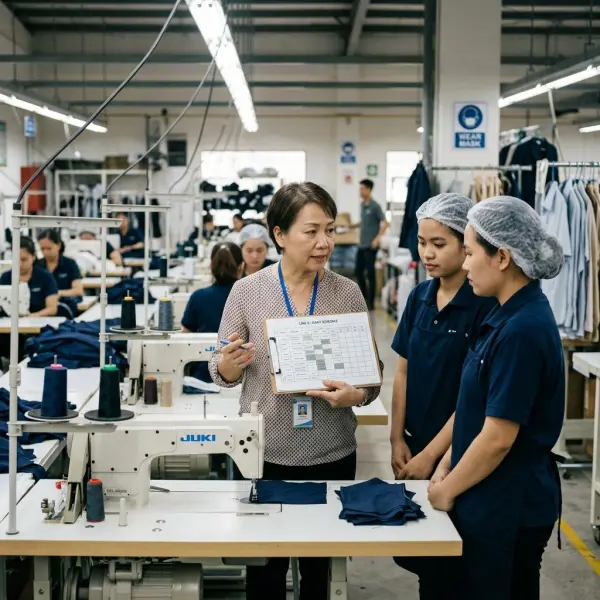
How Fashion Businesses Can Apply Production Scheduling Strategically
Production scheduling is often seen as an internal factory discipline, but its effects reach brands, sourcing teams, retail calendars, and customer-facing business decisions.
For manufacturers, scheduling should become part of the factory’s management rhythm. It should connect order acceptance, material readiness, line loading, daily production control, quality monitoring, and shipment planning. This requires more than a spreadsheet. It requires consistent communication between departments.
For fashion brands and sourcing teams, scheduling should influence how orders are placed and managed. Late approvals, unclear tech packs, frequent changes, unrealistic delivery windows, and unstable order priorities all make scheduling harder. A brand that expects reliable production must also support reliable scheduling.
For garment manufacturers
Manufacturers can improve scheduling by starting with production readiness. A style should not be placed into a firm sewing schedule until the factory confirms sample approval, material availability, trim readiness, machine requirements, and quality instructions.
Factories should also review schedule performance regularly. Planned output and actual output should be compared daily. If a line misses target, the team should identify whether the issue came from material input, line balance, operator skill, machine downtime, quality rework, or unrealistic target setting.
For fashion brands and sourcing teams
Brands can support better scheduling by giving suppliers stable information earlier. This includes final tech packs, approved samples, confirmed colorways, accurate size breakdowns, packaging instructions, and clear shipment priorities.
When brands change product details after scheduling has begun, the effect is rarely limited to one order. It may disrupt cutting, sewing allocation, finishing flow, and other buyer orders already scheduled in the factory.
For retail and inventory planning
Production scheduling affects whether products arrive in time for planned sales windows. A delayed production schedule can affect campaign timing, e-commerce launch dates, wholesale delivery, seasonal merchandising, and inventory allocation.
Retail teams do not need to manage sewing line details, but they should understand that production schedules have operational constraints. A launch date is only reliable when the production schedule behind it is realistic.
Common Mistakes in Garment Production Scheduling
Scheduling problems often look like factory inefficiency, but many begin earlier in the decision process. A weak schedule may be too optimistic, too disconnected from material readiness, or too focused on shipment date without understanding the production path.
Mistake 1: Scheduling styles before they are production-ready
Factories sometimes schedule sewing start dates before fabric, trims, approvals, or technical details are fully confirmed. This creates false confidence. When the planned start date arrives, the line may be ready but the order is not.
The better approach is to separate tentative scheduling from firm scheduling. Tentative schedules are useful for planning capacity, but firm schedules should depend on verified readiness.
Mistake 2: Using the same efficiency target for every style
A repeat basic product may reach stable efficiency quickly. A new complex style may require a slower ramp-up. If the schedule applies the same efficiency assumption to both, the complex style may appear late even when the line is performing reasonably.
Better scheduling uses style complexity, historical data, and line capability to set more realistic daily targets.
Mistake 3: Ignoring upstream and downstream capacity
Many schedules focus heavily on sewing because sewing is the largest production stage in many garment factories. But sewing cannot perform efficiently if cutting is late, and sewing output does not create shipment value until garments are finished, inspected, packed, and ready to ship.
A better schedule includes cutting, sewing, finishing, inspection, packing, and logistics milestones. Efficiency should be measured across flow, not only inside one department.
Mistake 4: Changing priorities too often
Priority changes are sometimes unavoidable. Buyer urgency, material delays, quality issues, and shipment commitments may require adjustments. But constant priority changes reduce stability and weaken execution.
When everything is urgent, the schedule loses authority.
A better approach is to define escalation rules. Which orders can interrupt the schedule? Who approves the change? What other order will be affected? What is the revised shipment risk? These questions turn priority changes into management decisions rather than daily confusion.
Mistake 5: Treating software as the solution
Scheduling software can improve visibility, especially in complex factories. But software cannot fix inaccurate data, unclear processes, unrealistic capacity assumptions, or poor communication. A digital schedule is only useful if the factory maintains reliable inputs and acts on the information.
Small manufacturers can improve scheduling with disciplined manual systems before investing in advanced tools. Larger manufacturers may need more integrated systems, but the operational logic remains the same.
What Manufacturers Should Verify Before Changing a Schedule
Schedule changes should not be made casually. Moving one style forward may delay another. Adding a line may require more supervisors or quality inspectors. Extending working hours may affect cost and labor conditions. Splitting an order may create shade, quality, or packing complexity.
Before revising a production schedule, manufacturers should verify:
- whether the new priority is commercially confirmed;
- which order will be affected by the change;
- whether materials and cut panels are ready;
- whether the assigned line has the right skill and machines;
- whether finishing and packing can absorb the revised output;
- whether quality checkpoints still have enough time;
- whether the revised schedule depends on excessive overtime;
- whether the buyer has been informed of realistic implications.
This verification protects the factory from solving one problem while creating another. In garment manufacturing, schedule changes should be managed as controlled decisions, not informal reactions.
Production Scheduling vs. Production Planning
Production scheduling is closely connected to production planning, but the two should not be treated as identical.
Production planning defines the larger production approach. It determines whether the manufacturer can accept an order, what materials are required, what capacity is needed, and how the order fits into the factory’s broader production calendar. Production scheduling is more detailed. It organizes the sequence of work over days, shifts, lines, and operations.
|
Area |
Production Planning |
Production Scheduling |
|
Main focus |
Overall production feasibility |
Daily and weekly execution |
|
Key question |
Can we produce this order as promised? |
How should we run it efficiently? |
|
Time horizon |
Medium-range, often order or season-based |
Shorter-range, often day, shift, or week-based |
|
Main users |
Planning, merchandising, purchasing, management |
Production control, supervisors, line managers |
|
Output |
Production plan and capacity view |
Line schedule, output targets, sequence, dispatch priorities |
The strongest factories connect both layers. Planning creates the foundation. Scheduling protects execution. When they are disconnected, the factory may accept orders that cannot be scheduled realistically or build schedules that ignore the commercial plan.
For related operational risks, the next article on common production planning challenges in fashion manufacturing should examine the broader causes of planning failure, including late approvals, material delays, capacity conflicts, and coordination gaps.
FAQ: Production Scheduling in Garment Manufacturing
What is production scheduling in garment manufacturing?
Production scheduling in garment manufacturing is the process of organizing when and how each order moves through production stages such as cutting, sewing, finishing, inspection, packing, and shipment. It assigns styles to lines, sets daily output targets, sequences work, and helps supervisors manage bottlenecks. While production planning gives the broader production framework, scheduling turns that plan into a practical execution rhythm for the factory floor.
How does scheduling improve garment efficiency?
Scheduling improves garment efficiency by reducing waiting time, controlling work-in-progress, improving line allocation, preparing machines and operators before style changeover, and identifying bottlenecks earlier. It helps factories avoid situations where sewing lines wait for cut panels, finishing teams are overloaded, or urgent orders disrupt the entire production flow. Efficiency improves most when scheduling is based on realistic capacity and accurate production data.
What data is needed for garment production scheduling?
Garment production scheduling usually requires order quantity, delivery date, style complexity, standard minute value, line capacity, operator skill, machine availability, cutting status, material readiness, finishing capacity, quality requirements, and shipment priority. Historical performance data is also useful, especially for repeat styles or similar product categories. Without reliable data, the schedule may look organized but fail during execution.
What is the difference between line planning and production scheduling?
Line planning focuses on assigning specific styles or orders to sewing lines. Production scheduling is broader because it also considers timing, daily output targets, process sequence, cutting readiness, finishing flow, inspection, packing, and shipment deadlines. Line planning is one part of production scheduling. A factory may assign a style to a line, but scheduling determines when it starts, how output is tracked, and how the order moves through the full production flow.
Can production scheduling reduce overtime?
Production scheduling can help reduce unnecessary overtime when it identifies capacity limits, bottlenecks, and delays early enough for the factory to adjust. However, it cannot eliminate overtime by itself if order lead times are unrealistic, materials arrive late, or buyer approvals are delayed. The most effective approach combines realistic order acceptance, timely material readiness, stable buyer communication, and disciplined daily schedule control.
Does production scheduling require software?
Production scheduling does not always require advanced software, especially for smaller factories with limited product complexity. A disciplined spreadsheet-based system can work if data is accurate, responsibilities are clear, and teams update the schedule consistently. Larger factories with many lines, styles, buyers, and constraints may benefit from ERP, MRP, or advanced planning and scheduling tools. Software helps visibility, but process discipline matters first.
How often should a garment production schedule be reviewed?
A garment production schedule should be reviewed daily at the execution level and weekly or biweekly at the management level, depending on factory size and order complexity. Daily reviews should focus on output gaps, bottlenecks, quality issues, material shortages, and shipment risks. Management reviews should examine capacity, priority changes, upcoming orders, and broader delivery commitments. The schedule should be stable enough to guide work but flexible enough to respond to real conditions.
Why do garment production schedules often fail?
Garment production schedules often fail because they are built on incomplete information or unrealistic assumptions. Common causes include late fabric or trims, unapproved samples, inaccurate efficiency targets, poor line allocation, frequent priority changes, bottlenecks, machine downtime, quality rework, and weak communication between merchandising, planning, production, and quality teams. A schedule is only reliable when the factory verifies readiness and updates actual progress honestly.
Conclusion
Production scheduling improves garment efficiency by giving factory teams a clearer rhythm for execution. It connects order priorities with line capacity, material readiness, operator skill, machine setup, quality checkpoints, finishing flow, and shipment deadlines.
In apparel manufacturing, efficiency is not simply about producing faster. It is about reducing waiting time, avoiding unnecessary changeovers, controlling work-in-progress, managing bottlenecks, and making realistic decisions before problems become urgent. A good schedule gives the factory visibility. A disciplined scheduling routine turns that visibility into action.
For manufacturers, production scheduling protects margin, delivery reliability, and floor stability. For brands and sourcing teams, it reveals why timely approvals, stable specifications, and realistic lead times matter. The factory floor can only run efficiently when the schedule reflects real constraints.
As garment production becomes more complex, scheduling will remain one of the most practical tools for improving performance. Not because it makes production effortless, but because it makes execution more deliberate, measurable, and manageable.





Comments 0
Leave a CommentSend Comment
Anda harus Login terlebih dahulu untuk dapat memberikan komentar.