

Opportunities and Challenges of Digital Fashion Assets
Quick Answer
Digital fashion assets are reusable digital files that represent fashion products, materials, visuals, or experiences. They may include 3D garment files, digital fabric textures, avatar wearables, virtual showroom assets, product renders, AR-ready models, campaign visuals, digital samples, and related metadata.
For fashion businesses, these assets create opportunities in product development, marketing, e-commerce, wholesale selling, virtual try-on, gaming collaborations, customer engagement, and content production. A well-managed digital asset can support multiple teams and channels instead of being used only once.
The challenge is that digital fashion assets are not automatically valuable. Their usefulness depends on quality, accuracy, file standards, ownership rights, platform compatibility, storage, version control, and clear business purpose. Poorly managed assets can become expensive, inconsistent, legally risky, or impossible to reuse.
The strategic opportunity is not simply to create digital garments. It is to build a disciplined digital asset system that supports design, sales, storytelling, and customer experience. Brands that treat digital fashion assets as long-term business infrastructure will likely benefit more than those that treat them as short-term trend experiments.
What Are Digital Fashion Assets?
Digital fashion assets are digital files created to represent, support, or extend fashion products and fashion experiences. They are not limited to digital-only clothing. A digital fashion asset may be connected to a physical garment, used to sell a product, support a campaign, visualize a collection, dress an avatar, or help a product team make decisions before sampling.
In practical terms, digital fashion assets can include 3D garment models, digital fabric textures, trims, buttons, zippers, labels, avatars, product renders, animation files, augmented reality assets, virtual showroom environments, campaign visuals, and product metadata. Some assets are created for internal use. Others are built for consumers, retailers, gaming platforms, or public-facing campaigns.
This is where the topic becomes more strategic than the broader idea of virtual fashion. A digital asset is not just a visual output. It can become part of a company’s operating system. If a garment file is accurate, reusable, well-labeled, properly owned, and compatible with multiple workflows, it can support product development, marketing, e-commerce, wholesale, and future content production.
A poorly made asset may look impressive once but provide little long-term value.

Why Digital Fashion Assets Matter Now
Fashion businesses are under pressure to produce more visuals, develop products faster, reduce unnecessary revisions, support online selling, serve global teams, and communicate collections across more channels. Digital fashion assets are becoming relevant because they can help connect these needs.
A physical sample can be used in a fitting, photographed in a studio, shown to buyers, and sent to a retailer. But it is limited by geography, time, production availability, and logistics. A digital garment asset can potentially be shared, rendered, updated, localized, animated, adapted, and reused across teams. That does not make it superior in every context, but it does make it strategically useful.
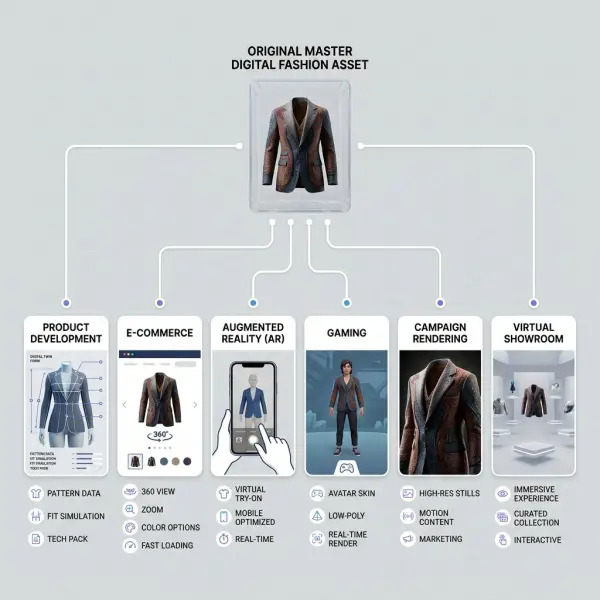
The business value becomes clearer when digital assets are treated as reusable infrastructure rather than one-off content. A 3D jacket created only for a single campaign may have limited value. A 3D jacket built with accurate materials, correct product information, approved usage rights, and platform-ready formats can support internal review, e-commerce, wholesale presentation, AR try-on, and future styling content.
That is the difference between a digital file and a digital fashion asset.
The Main Types of Digital Fashion Assets
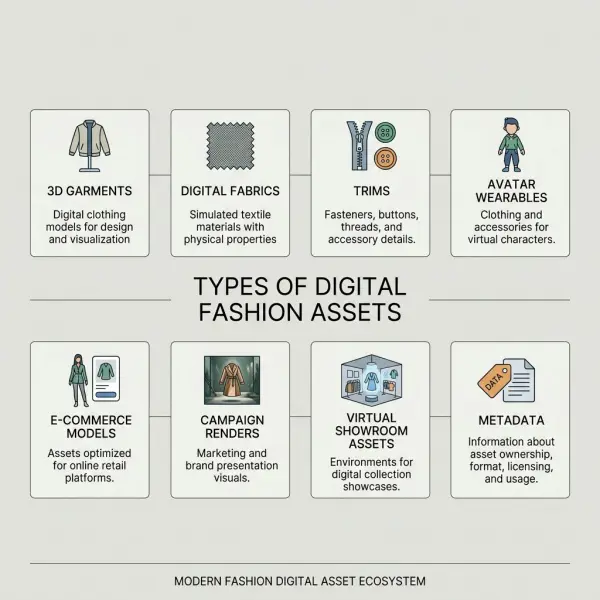
Digital fashion assets can serve different purposes across the fashion value chain. Some are technical, some are creative, and some are commercial. The most useful asset strategy begins by recognizing which type of asset the business actually needs.
Common categories include:
- 3D garment files: digital representations of clothing used for design, sampling, visualization, rendering, or product review.
- Digital material assets: fabric textures, colorways, prints, trims, hardware, labels, stitching, and surface details.
- Avatar-ready wearables: garments or accessories optimized for digital bodies, games, social platforms, or virtual environments.
- E-commerce 3D models: product models prepared for interactive viewing, AR, product pages, or online retail presentation.
- Campaign renders and CGI assets: high-quality visuals created for advertising, social media, editorial campaigns, or launch storytelling.
- Virtual showroom assets: collection files, digital racks, room environments, line presentations, and buyer-facing visual tools.
- Metadata and product information: structured data attached to assets, such as SKU, color, season, size range, usage rights, and product status.
These categories often overlap. A 3D garment created for product development may later support marketing. A campaign render may be adapted into social content. A material scan may support multiple future products. The more reusable the asset, the more valuable it becomes.
Opportunity 1: Faster Product Visualization and Decision-Making
One of the strongest opportunities is faster product visualization. Digital fashion assets allow teams to review a garment’s silhouette, color direction, print placement, styling potential, and construction concept before committing to every physical version.
This can be valuable for brands with distributed teams. A designer in one country, a merchandiser in another, a factory in another, and a buyer in another may all need to discuss the same product. A digital asset gives them a shared visual reference. It does not remove the need for technical specifications, physical validation, or production sampling, but it can reduce ambiguity during early decision-making.
Software platforms such as CLO 3D and Browzwear are examples of tools used in digital apparel design and development workflows. Their relevance is not only in creating attractive visuals, but in helping teams connect design, fit, review, and product communication.
For fashion companies, the opportunity is especially strong when digital assets help prevent avoidable revisions. If a team can identify proportion issues, color conflicts, or styling inconsistencies earlier, it may save time later. The benefit depends on product complexity, team capability, and how well digital review is integrated into the development process.
Opportunity 2: More Scalable Content Production
Digital fashion assets can make content production more flexible. Once a garment exists as a usable digital file, it can potentially be rendered in different views, colorways, scenes, styling combinations, aspect ratios, and campaign formats.
This is highly relevant because fashion content is no longer limited to seasonal campaigns. Brands need product pages, social posts, marketplace images, paid ads, email visuals, launch videos, creator assets, wholesale presentations, store screens, and editorial storytelling. A single physical photoshoot may not cover every requirement.
Digital assets can help content teams produce more variations without starting from zero each time. A jacket can be rendered on a neutral background for e-commerce, styled in a campaign environment, animated for a launch teaser, and adapted into a digital lookbook. The same asset may also support future content if the file is properly stored and documented.
Still, scalability depends on quality. A low-resolution or poorly modeled asset may not be usable beyond its original purpose. A campaign-grade asset may be visually beautiful but too heavy for AR. A gaming asset may be optimized for platform performance but not realistic enough for e-commerce. The asset must be built for intended use.
The opportunity is real, but only when creative production and technical standards work together.

Opportunity 3: Stronger E-Commerce and Product Experience
Digital fashion assets can support better online product presentation. This matters because customers shopping online often need more visual information before purchasing. Flat images can show a garment clearly, but they may not fully communicate structure, scale, volume, texture, or styling potential.
E-commerce 3D models, interactive viewers, and AR-ready product assets can help customers understand a product more deeply. Shopify’s 3D model guidance, for example, emphasizes that 3D models for merchants should meet quality standards and may be used across AR, VR, product rendering, and marketing contexts. That illustrates a broader point: digital product assets are most useful when they are accurate, versatile, and technically prepared for real channels.
For apparel, the challenge is more complex than for hard goods. A chair, lamp, or sneaker may be easier to model accurately than a flowing dress, sheer blouse, or stretch garment. Fabric behavior, body movement, fit, opacity, and drape are difficult to represent perfectly. This does not make digital assets useless. It means brands must choose the right product categories and avoid overpromising accuracy.
Digital assets can enhance e-commerce, but trust remains the priority. If a digital representation makes the product look better than the real garment, it may increase returns, disappointment, or customer skepticism.
Opportunity 4: New Revenue and Engagement Models
Some digital fashion assets may become consumer-facing products. Avatar wearables, digital collectibles, game skins, AR accessories, and digital-only fashion items can create engagement and, in some cases, revenue. These models are most relevant when the audience already spends time in digital environments where appearance and identity matter.
For example, a digital sneaker in a game does not function like a physical sneaker. It does not provide comfort or performance. Its value comes from identity, access, status, creativity, belonging, or participation in a digital community. This is closer to fashion as symbolic expression than fashion as physical utility.
Brands can use digital assets for:
- Avatar customization
- Limited digital drops
- Gaming collaborations
- Digital loyalty rewards
- Member-only virtual products
- AR social filters
- Community-based design experiments
The opportunity should be evaluated carefully. Not every audience wants digital-only products. Not every brand has permission to enter a gaming or avatar community credibly. And not every digital collectible becomes valuable. Consumer interest depends heavily on platform relevance, creative quality, community behavior, and perceived usefulness.
Digital revenue is possible, but it should not be assumed.
Opportunity 5: Building Long-Term Digital Asset Infrastructure
The most mature opportunity is not a single campaign or virtual product. It is building a long-term digital asset infrastructure.
A fashion business with a strong digital asset system can organize files by product category, season, SKU, color, material, size range, channel, approval status, and usage rights. This allows different teams to find and reuse assets without recreating work. It also supports consistency across design, sales, marketing, and retail.
This matters as fashion becomes more digitally mediated. Product development teams need visual files. Marketing teams need campaign assets. E-commerce teams need product media. Wholesale teams need presentation tools. Education teams may need training materials. Retail teams may need screen content. If each team creates its own files separately, the business wastes effort and creates inconsistency.
A centralized digital fashion asset system can support:
- Faster internal collaboration
- Better brand consistency
- Reduced duplicate work
- Easier localization
- More efficient campaign adaptation
- Better product history and version tracking
- Stronger cross-channel storytelling
This is where digital fashion assets become more than creative outputs. They become operational assets.

Challenge 1: Asset Quality and Technical Accuracy
The first major challenge is quality. A digital fashion asset must be accurate enough for its intended purpose. A beautiful render may be useful for a campaign, but not reliable for product development. A technical 3D garment may support internal review but may not look polished enough for consumer marketing.
Fashion is especially demanding because garments are soft, flexible, layered, and body-dependent. A digital asset needs to represent proportion, fabric behavior, texture, color, trims, and construction details in a believable way. If the asset is used for e-commerce, it must also avoid misleading the customer.
Technical accuracy depends on the source data. Patterns, material scans, fabric physics, measurements, print files, color references, trim libraries, and fit avatars all influence the result. Weak input creates weak output.
For many brands, this creates a capability gap. They may have strong designers and marketers but limited internal 3D production expertise. Or they may have technical 3D artists who do not fully understand garment construction. High-quality digital fashion assets often require collaboration between fashion specialists and digital production specialists.
Challenge 2: File Standards and Interoperability
Digital assets are only useful if they can move across systems. A garment file created in one tool may not work smoothly in another. A high-resolution campaign render may be too heavy for AR. A platform-specific avatar wearable may not be transferable to another virtual world. A 3D model may need different optimization for e-commerce, gaming, mobile viewing, or internal review.
This is why file standards matter. Formats such as glTF are used in broader 3D workflows because they are designed for efficient transmission and loading of 3D scenes and models. For fashion businesses, the larger lesson is that digital assets need technical planning if they are expected to travel across platforms.
Interoperability remains a real challenge. The fashion industry does not yet have one universal digital garment format that solves every use case. Product development software, game engines, AR platforms, e-commerce systems, and asset management tools may all require different formats, optimization levels, and metadata structures.
A brand should not assume that one digital garment file can automatically work everywhere. It may need multiple versions of the same asset.
Challenge 3: Ownership, IP, and Usage Rights
Digital fashion assets raise important ownership questions. Who owns the 3D garment file? Who owns the render? Who owns the texture, print, avatar version, animation, or digital showroom environment? Can the brand modify the asset later? Can it use the same file in advertising, e-commerce, gaming, licensing, or resale?
These questions should be answered before production begins. Intellectual property issues become more complex when digital assets include logos, prints, licensed artwork, model likenesses, third-party software, marketplace terms, platform rules, or creator collaborations.
The World Intellectual Property Organization has discussed how IP rights apply to virtual objects, NFTs, and metaverse environments, emphasizing that trademarks, copyright, designs, and other intangible rights remain relevant even when the object is digital. Fashion businesses should treat digital fashion assets with the same seriousness as physical product designs, campaign photography, brand marks, and licensed artwork.
Ownership should not be vague. A contract should clarify:
- Who owns the source files
- Who can modify the asset
- Where the asset can be used
- Whether commercial use is included
- Whether usage is global or channel-limited
- Whether the asset can be resold, licensed, or tokenized
- Whether third-party components are included
- What happens if the platform changes or shuts down
This is not only a legal issue. It is a business continuity issue. A brand that cannot access, modify, or reuse its own digital assets may lose long-term value.
Challenge 4: Cost, Skills, and Workflow Integration
Digital fashion assets are sometimes presented as a cheaper alternative to physical production. In some workflows, they can reduce certain costs. But they are not free, and they are not automatically cheaper.
Costs may include software subscriptions, 3D design labor, technical training, material digitization, rendering, retouching, asset storage, platform integration, legal review, and ongoing updates. For complex campaigns, costs may also include creative direction, animation, environment design, AR development, or game platform adaptation.
The skill challenge is equally important. A brand may need:
- 3D garment specialists
- Technical designers
- Digital material experts
- CGI artists
- Creative directors
- Digital asset managers
- E-commerce technologists
- Legal and licensing support
- Platform integration partners
The most common operational mistake is treating digital fashion as a side project handled by one person. In reality, useful digital asset systems require cross-functional collaboration. Product, design, marketing, e-commerce, technology, legal, and sales teams may all need to contribute.
Without workflow integration, digital assets become isolated files. With integration, they become business tools.
Challenge 5: Sustainability Claims and Greenwashing Risk
Digital fashion assets are often linked to sustainability because they may reduce the need for some physical samples, travel, shipping, photoshoot production, or unsold exploratory products. This potential should not be dismissed. But it must be framed carefully.
A digital asset is not automatically sustainable. It still requires hardware, energy, software, rendering infrastructure, cloud storage, and devices. Its environmental benefit depends on what it replaces. If a 3D sample replaces several unnecessary physical samples, there may be a meaningful reduction in material and logistics impact. If a brand simply creates additional digital content on top of existing production without changing anything else, the sustainability claim is weaker.
Fashion businesses should avoid vague claims such as “digital fashion is eco-friendly” or “virtual garments are zero waste.” More credible language would be specific: digital sampling may reduce some physical sample iterations in certain workflows, depending on product category, adoption level, and whether teams actually change their development process.
Sustainability credibility depends on evidence, not aesthetics.
Challenge 6: Consumer Trust and Visual Honesty
Digital fashion assets can create beautiful visuals, but they can also create unrealistic expectations. This is especially sensitive when the asset is used to sell a physical product.
If a digital dress appears more structured than the real garment, if a fabric looks heavier than it is, if a color looks richer than production reality, or if a virtual try-on gives a misleading fit impression, the customer may feel deceived. In e-commerce, this can affect returns, reviews, and trust.
Brands should distinguish between expressive campaign imagery and product-selling imagery. A campaign can be imaginative. A product page needs clarity. A virtual showroom needs commercial accuracy. A technical sample review needs construction credibility.
The safest rule is simple: the closer the asset is to a purchase decision, the more accurate it needs to be.
Strategic Framework: How Brands Should Evaluate Digital Fashion Assets
A strong digital fashion asset strategy starts with business purpose, not technology selection. Before building assets, brands should decide what role the asset will play.
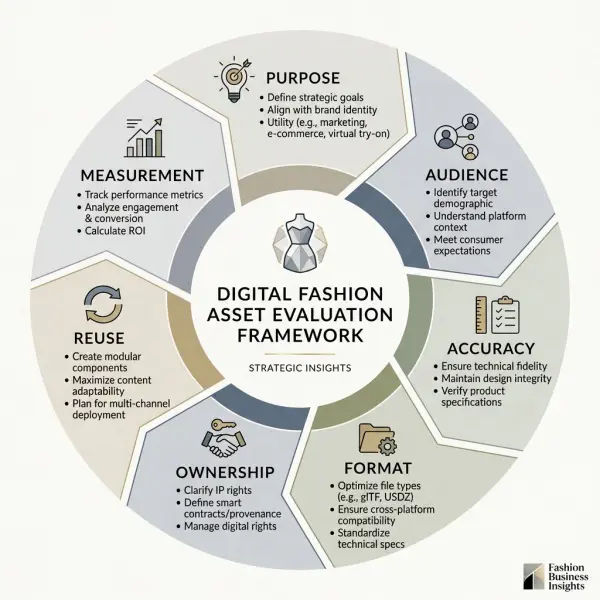
A practical evaluation framework includes seven questions:
- Purpose: What business problem will the asset solve?
- Audience: Who will use or experience it?
- Accuracy: How technically realistic does it need to be?
- Format: Which platforms and channels must support it?
- Ownership: Who owns and controls the source files?
- Reuse: Can the asset support multiple future use cases?
- Measurement: How will value be evaluated?
This framework helps separate strategic assets from trend-driven experiments. A digital file created only for attention may have limited life. A digital asset created with purpose, standards, rights, and reuse potential can create compound value over time.
Practical Applications for Fashion Businesses
The right application depends on the type of fashion business. A small direct-to-consumer brand, a garment manufacturer, a fashion marketplace, and a luxury house will not use digital assets in the same way.
A DTC brand may begin with digital product renders and campaign variations. A manufacturer may focus on digital samples and buyer communication. A retailer may use 3D assets for online product visualization. A fashion education provider may use digital garments to teach design and product development. A luxury brand may focus on immersive storytelling, collectible experiences, or brand-controlled digital worlds.
Practical starting points include:
- Creating digital samples for one product category
- Building a small library of reusable fabric textures and trims
- Testing 3D assets for selected e-commerce products
- Producing digital campaign variations for a product launch
- Using virtual showroom assets for wholesale presentations
- Developing avatar-ready accessories for one platform
- Creating a governance system for naming, rights, and file storage
The best approach is gradual. Start with one clear use case, measure whether it improves workflow or customer experience, then scale with stronger standards.
Digital fashion assets should become more organized as the business matures. What begins as a single project can evolve into a structured library, then a cross-functional asset system.
Common Mistakes to Avoid
- The first mistake is creating digital assets without defining reuse. A one-time render may be useful, but it should not be confused with a long-term asset strategy. If the file cannot be modified, adapted, or found later, its value is limited.
- The second mistake is ignoring source file ownership. Some brands receive only final images, not the editable 3D files. This may be acceptable for a campaign, but problematic if the brand expects future reuse.
- The third mistake is overbuilding. A small brand does not need an expensive digital ecosystem before proving the use case. A focused pilot can be more valuable than a complex system nobody uses.
- The fourth mistake is underbuilding. A brand may commission cheap assets that look acceptable in one image but fail in e-commerce, AR, or future campaign formats. Low-quality assets can become more expensive later if they must be rebuilt.
- The fifth mistake is separating digital assets from product truth. Digital fashion assets should not drift too far from the real garment unless the project is clearly digital-only. Product credibility matters.
The better approach is disciplined creativity: build assets that are visually strong, technically appropriate, legally clear, and operationally useful.
What Brands Should Verify Before Acting
Before investing significantly in digital fashion assets, brands should verify both business and technical readiness.
At minimum, they should clarify:
- Which product categories are suitable for digital asset creation
- Whether the assets represent physical products, digital-only products, or both
- Which file formats are required for each channel
- Who is responsible for product accuracy
- Who approves final digital representations
- Whether the asset can be reused commercially
- How source files are stored and protected
- Whether third-party rights are involved
- How updates and version control will be handled
- Which metrics define success
This verification process may feel operational, but it protects the creative value of the project. Strong digital asset strategy depends on boring details: naming, rights, formats, approvals, documentation, and ownership.
Those details determine whether the asset remains useful after the launch moment has passed.
FAQ
What is a digital fashion asset?
A digital fashion asset is a digital file that represents or supports a fashion product, material, or experience. It may be a 3D garment model, digital fabric texture, avatar wearable, product render, AR-ready file, virtual showroom asset, campaign visual, or product metadata. The key difference between a simple digital file and a true asset is usefulness. A digital fashion asset should be structured, owned, searchable, reusable, and connected to a business purpose.
How are digital fashion assets different from digital garments?
Digital garments are one type of digital fashion asset. A digital garment usually refers to a clothing item created in digital form, such as a 3D jacket or virtual dress. Digital fashion assets are broader. They may include garments, materials, trims, avatars, renders, animations, metadata, showroom environments, and platform-ready files. For business strategy, the broader asset view is more useful because it considers how files are stored, reused, governed, and monetized across the company.
Can digital fashion assets reduce production costs?
They can reduce certain costs in specific workflows, especially when they help lower unnecessary sample iterations, speed up review cycles, or make content production more efficient. However, they also introduce new costs, such as software, skilled labor, rendering, asset management, legal review, and platform integration. The cost benefit depends on implementation quality. Brands should test digital assets against a clear workflow or marketing objective rather than assuming automatic savings.
Who owns a digital fashion asset?
Ownership depends on the contract, creator agreement, software terms, platform rules, and included intellectual property. A brand may own the final render but not the editable source file. A freelancer may retain rights unless the agreement transfers them. A platform may restrict how an avatar wearable can be used. Because digital assets are reusable and adaptable, ownership should be clarified before production begins. Brands should specify source file access, commercial usage, modification rights, and channel permissions.
Are digital fashion assets sustainable?
Digital fashion assets may support sustainability goals when they replace some physical samples, reduce unnecessary logistics, or improve decision-making before production. But they are not automatically sustainable. Digital creation uses hardware, energy, cloud storage, software, and rendering infrastructure. Sustainability claims should be specific and evidence-based. The strongest claim is usually conditional: digital assets can reduce certain impacts when they replace more resource-intensive physical processes.
What makes a digital fashion asset high quality?
A high-quality digital fashion asset is accurate, usable, appropriately optimized, well-documented, and suitable for its intended channel. For product development, it should reflect garment construction and material behavior credibly. For marketing, it should look visually compelling. For e-commerce, it should avoid misleading the customer. For AR or gaming, it must meet platform requirements. Quality is not one universal standard; it depends on purpose.
Do small fashion brands need digital asset management?
Small brands may not need enterprise-level digital asset management systems, but they still need basic organization. Even a simple structure for file naming, version control, ownership notes, usage rights, and storage can prevent confusion later. As digital content increases, disorganized files become costly. A small brand can begin with a lightweight system and scale only when the volume of assets grows.
What is the biggest risk of investing in digital fashion assets?
The biggest risk is creating assets without a clear business purpose or governance system. A visually impressive asset may have little value if it cannot be reused, modified, found, legally used, or integrated into real workflows. Other risks include poor technical quality, misleading product visuals, unclear IP ownership, platform incompatibility, and overclaiming sustainability. The safest strategy is to start with a focused use case and build standards gradually.
Conclusion
Digital fashion assets are becoming an important part of how fashion businesses design, communicate, sell, and extend products into digital environments. Their value is not limited to metaverse projects or digital-only fashion. They can support product development, marketing, e-commerce, wholesale, virtual try-on, gaming, education, and long-term brand storytelling.
The opportunity is significant, but it requires discipline. Digital assets need clear purpose, technical quality, ownership clarity, file standards, version control, and realistic expectations. Without those foundations, they can become isolated visual experiments. With them, they can become reusable business infrastructure.
The most successful fashion businesses will not be the ones that create the most digital assets. They will be the ones that create the most useful digital assets: files that support decisions, improve communication, strengthen customer experience, and remain valuable beyond a single campaign.
Digital fashion assets are not the whole future of fashion. But they are becoming a serious layer in the industry’s digital operating system.





Comments 0
Leave a CommentSend Comment
Anda harus Login terlebih dahulu untuk dapat memberikan komentar.