
How Virtual Fitting Tools Help Reduce Online Fashion Returns
Quick Answer
Virtual fitting tools help reduce online fashion returns by giving customers better information before they buy. These tools may recommend the right size, compare garment measurements, create body-based fit guidance, show virtual try-on previews, summarize fit feedback from reviews, or use customer and product data to identify likely fit issues.
The main benefit is not that technology magically eliminates returns. It helps reduce avoidable returns, especially those caused by size confusion, poor fit expectation, unclear product measurements, color or proportion uncertainty, and customers ordering multiple sizes to try at home. This matters because online returns remain a major pressure point for retail: the National Retail Federation estimated that 19.3% of online sales would be returned in 2025. NRF 2025 Retail Returns Landscape
For fashion brands, virtual fitting works best when it is part of a wider fit strategy: consistent sizing logic, accurate garment measurements, strong product photography, fit notes, review data, fabric information, and customer-friendly communication. A weak product page with a virtual fitting widget is still a weak product page.

What Are Virtual Fitting Tools?
Virtual fitting tools are digital systems that help customers understand how a fashion product may fit, look, or correspond to their body, measurements, preferences, and previous purchase behavior before completing an online order. In apparel retail, their purpose is to reduce uncertainty around size, fit, proportion, and product expectation.
This category includes several different tools. Some are simple, such as size guides that recommend a size based on height, weight, body shape, or previous purchases. Others are more advanced, using artificial intelligence, body scanning, computer vision, customer reviews, garment measurements, or 3D avatars.
The key point is that virtual fitting is not only about visual try-on. The first article in this cluster, AR virtual try-on explained for fashion retail, focused on augmented reality as a visual shopping experience. This article goes deeper into the return problem: how fit guidance, product data, and expectation management can reduce avoidable returns in online fashion.
Virtual fitting tools may include:
- Size recommendation tools that suggest the most suitable size for a customer.
- Fit finders that ask questions about body shape, fit preference, and previous brand sizes.
- Body measurement tools that use photos, scans, or manual input.
- Garment comparison tools that compare a product with an item the customer already owns.
- 3D avatar systems that visualize how a garment may sit on a digital body.
- AI review summaries that extract fit, stretch, length, and body-area feedback from customer reviews.
- AR or AI virtual try-on tools that help customers preview appearance, proportion, and styling.
These tools are most useful when they answer a decision problem that customers genuinely have. If shoppers return dresses because the waist fits but the bust gaps, the tool needs to address body-area fit. If customers return trousers because inseam length is unclear, the product page needs measurement clarity. If customers order three sizes because the brand’s sizing is inconsistent, the issue may be grading and fit standardization, not only website technology.
Why Online Fashion Returns Are So Difficult to Manage
Online fashion returns are difficult because fashion buying is personal, tactile, and size-sensitive. Customers buy based on images, measurements, model references, reviews, and brand trust, but the actual product is judged only after it arrives.
Retail returns are not a small operational issue. NRF reported that retailers estimated 15.8% of annual sales would be returned in 2025, totaling $849.9 billion, while online sales were expected to have a higher return rate of 19.3%. NRF also noted that 82% of consumers considered free returns an important factor when shopping online. NRF 2025 retail returns press release
Fashion is especially exposed because the product has to satisfy multiple expectations at once. A garment must fit the body, suit the customer’s style, feel acceptable against the skin, match the image shown online, work for the intended occasion, and justify the price. If any one of these expectations fails, the product may come back.
Coresight Research estimated a 24.4% average online apparel return rate in the US based on a 2023 survey of 100 decision-makers at US apparel brands and retailers. In the same survey, size and fit were cited as the top reason for online apparel returns by 53% of respondents, followed by color and damage. The report was sponsored by 3DLOOK, so its findings are useful but should be read with that context. Coresight Research apparel returns analysis
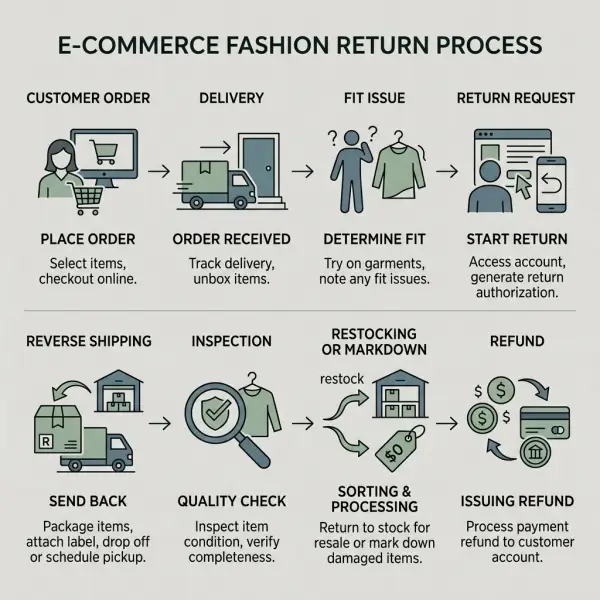
The business cost is not only the refund. A return can involve reverse shipping, warehouse handling, inspection, repackaging, discounting, customer service, payment processing, fraud risk, inventory aging, and sometimes product loss. For seasonal fashion, timing makes this even harder. A returned party dress, swimwear item, winter coat, or trend-driven blouse may come back after its peak selling window.
How Virtual Fitting Tools Reduce Returns in Practice
Virtual fitting tools reduce returns by improving the customer’s decision before checkout. They work best when they reduce mismatch between what the customer expects and what the product actually delivers.
For apparel, the most direct return-reduction opportunity is size and fit. If the customer chooses a better size the first time, there is less need to order multiple sizes, exchange sizes, or return an item that otherwise suits them. A 2021 paper on SizeFlags described online fit as a major driver of fashion e-commerce returns and presented a probabilistic model tested across 14 countries to reduce size-related returns. SizeFlags research on size-related returns
But sizing is only one layer. A virtual fitting strategy can also reduce returns by improving expectation quality. If a shopper learns that a dress is designed with a close fit through the bust, a long hemline, low stretch, and structured waist, she can make a more informed decision. If she prefers a relaxed fit, the tool may recommend sizing up or choosing a different silhouette.
Virtual fitting can reduce returns through several mechanisms:
|
Return Problem |
How Virtual Fitting Helps |
Business Implication |
|
Customer chooses the wrong size |
Recommends size using measurements, fit preference, past purchases, or body profile |
Fewer size exchanges and fewer avoidable returns |
|
Customer orders multiple sizes |
Increases confidence in one size choice |
Lower bracketing behavior and lower reverse logistics cost |
|
Product looks different on body |
Uses visual try-on, model comparison, or body-shape guidance |
Better expectation around proportion and silhouette |
|
Size chart is confusing |
Converts measurements into personalized guidance |
Less friction on product pages |
|
Fit issues repeat across SKUs |
Uses return data and reviews to identify pattern problems |
Product teams can improve future fit, grading, or size communication |
|
Customer does not understand fabric behavior |
Highlights stretch, drape, thickness, lining, or compression |
Better alignment between product expectation and actual wear |
A tool that simply says “buy medium” is less valuable than one that explains why. For example: “Based on your previous purchases and preference for a relaxed fit, medium may feel close through the shoulder; large may provide more ease.” That kind of explanation gives the customer decision confidence, not just a size output.
The Difference Between Size Recommendation, Virtual Fitting, and Virtual Try-On
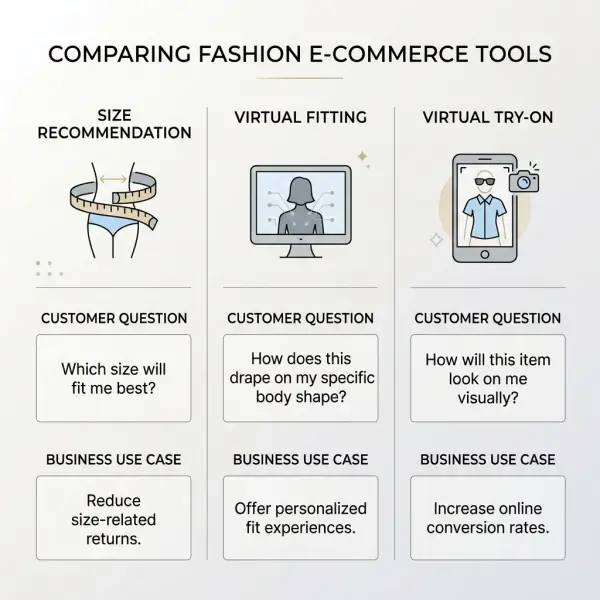
Size recommendation, virtual fitting, and virtual try-on are connected, but they solve different problems. Fashion brands should not blur these terms too much, because customers may expect more accuracy than the technology can provide.
Size recommendation helps the customer choose a size. It may use body measurements, purchase history, return history, brand comparisons, customer feedback, or fit preference. This is useful when the main problem is choosing between S and M, size 8 and 10, or 28 and 30.
Virtual fitting is broader. It helps the customer understand how the garment may fit the body, sometimes using an avatar, body scan, garment measurements, or simulated fit zones. It may show whether a garment is likely to be tight at the chest, loose at the waist, short in the sleeve, or long in the leg.
Virtual try-on is often more visual. It may show how a product looks on the customer or a digital model. AR try-on is strong for eyewear, footwear, jewelry, and accessories, but apparel fit remains harder because clothing folds, stretches, drapes, and moves with the body.
|
Tool Type |
Main Question It Answers |
Best For |
Main Limitation |
|
Size recommendation |
“Which size should I buy?” |
Apparel, footwear, multi-size products |
Depends on accurate data and customer input |
|
Virtual fitting |
“How might this fit my body?” |
Apparel with fit-sensitive categories |
Hard to simulate fabric and movement perfectly |
|
Virtual try-on |
“How might this look on me?” |
Eyewear, shoes, jewelry, accessories, styling |
Visual appearance is not the same as physical fit |
|
Fit review summaries |
“What did similar customers say?” |
Products with enough reviews |
Can be biased if review data is limited |
|
Garment comparison |
“Is this similar to something I own?” |
Repeat customers and wardrobe-based shopping |
Requires reference garment data |
For fashion retailers, the strongest setup often combines several tools. A size recommender suggests the size. Fit notes explain garment behavior. Model images show scale. Customer reviews reveal real fit experience. Product measurements give objective reference. Virtual try-on supports visual confidence.
Where Virtual Fitting Tools Work Best
Virtual fitting tools work best in categories where return behavior is strongly linked to size, fit, proportion, or body confidence. This often includes jeans, trousers, dresses, outerwear, fitted tops, bras, swimwear, performance apparel, and footwear.
Jeans are a strong example. Customers often care about waist, hip, rise, inseam, stretch, thigh fit, leg opening, and recovery after wear. A basic size chart is rarely enough. A stronger fitting tool may ask about body shape, preferred rise, existing denim size, stretch tolerance, and whether the customer prefers a snug or relaxed fit.
Dresses are another high-risk category because fit is distributed across several body areas. A dress can fit the waist but pull at the bust, sit too loose at the shoulder, feel too short, or behave differently depending on lining and fabric weight. A virtual fitting tool that only recommends one size may help, but product-specific fit notes may matter just as much.
Footwear has a different fit logic. Length is only one variable. Width, toe box shape, arch support, instep height, heel grip, cushioning, and intended use all affect satisfaction. A virtual shoe try-on may help with visual style, but size recommendation and customer review summaries are still needed for comfort-related decisions.
For loose silhouettes, oversized garments, scarves, basic T-shirts, or accessories with low fit risk, virtual fitting may be less urgent. These products may benefit more from strong photography, styling images, color accuracy, and product videos.
Why Fit Data Matters More Than the Widget
The quality of a virtual fitting tool depends on the quality of the data behind it. A polished interface cannot compensate for inconsistent product measurements, vague size charts, poor grading logic, or missing return reasons.
Many apparel brands underestimate this part. They may install a fit finder but still use generic size charts across multiple product categories. A woven blouse, stretch knit top, structured jacket, and relaxed T-shirt should not all rely on the same fit logic. The garment’s pattern, fabric, construction, and intended fit must be reflected in the recommendation.
Good fit data may include:
- Garment measurements by size, not only body measurements.
- Fit intent, such as slim, regular, relaxed, oversized, cropped, longline, or compression.
- Fabric behavior, including stretch, drape, weight, recovery, opacity, and lining.
- Model measurements and the size worn in product images.
- Customer fit feedback by body area.
- Return reasons separated by size, color, product, and customer segment.
- Pattern or grading notes for high-return styles.
- Regional sizing differences if the brand sells internationally.
Amazon’s Fit Insights Tool is one example of how large retailers use AI to extract and aggregate feedback on fit, style, and fabric, contextualize returns and size chart analysis with reviews, and identify possible defects in size charts. Amazon Fashion AI fit insights
For smaller brands, the same principle can be applied manually at first. Track which SKUs are returned for size, which sizes are exchanged most often, which products receive repeated “runs small” comments, and which garment areas cause dissatisfaction. A simple internal return-reason dashboard can be more valuable than an advanced tool with poor data.

How Virtual Fitting Reduces Bracketing
Bracketing happens when customers order multiple sizes, colors, or styles with the intention of keeping one and returning the rest. In fashion, this behavior is often rational from the customer’s perspective. If sizing is inconsistent and returns are free, ordering two or three sizes may feel safer than guessing.
For retailers, bracketing is expensive. It increases outbound shipping, ties up inventory, raises return volume, delays resale, and may reduce full-price availability for other customers. It also creates misleading demand signals. A product may appear popular because customers order multiple sizes, even if the true keep rate is weak.
Virtual fitting tools can reduce bracketing by improving confidence in one size choice. The tool does not need to be perfect to help. It needs to be credible enough that the customer feels less need to create a fitting room at home.
This works best when the customer receives clear, product-specific guidance:
- “This jacket has a narrow shoulder and structured lining.”
- “This trouser runs long; check inseam before ordering.”
- “Customers between two sizes often size up for a relaxed fit.”
- “This knit has high stretch but limited recovery after prolonged wear.”
- “The model is 178 cm and wears size S; garment length is 124 cm.”
The better approach is not to shame customers for returning. It is to reduce the uncertainty that causes defensive ordering behavior in the first place.
Virtual Fitting and the Product Development Feedback Loop
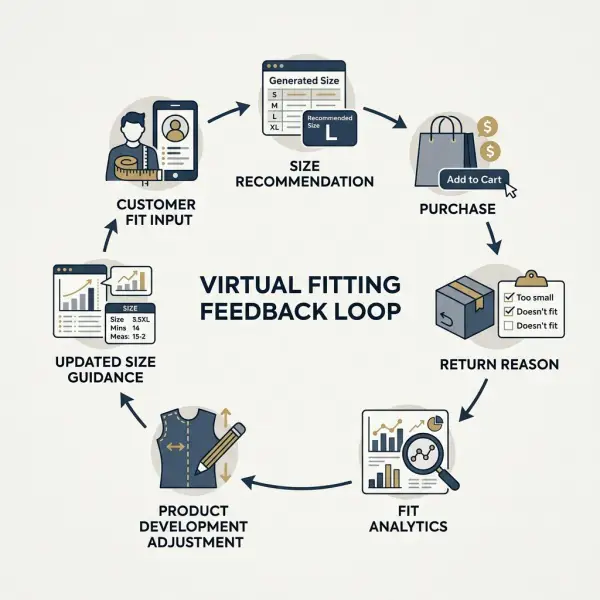
The most mature use of virtual fitting is not only on the product page. It creates a feedback loop between customer behavior, fit performance, product development, merchandising, and inventory planning.
If a certain dress has high try-on engagement but high return due to bust fit, the issue may be pattern balance. If a trouser receives many size-up recommendations and frequent exchanges, the grade rule may not match the target customer. If a jacket performs well in one market but poorly in another, body proportion, climate, styling expectation, or size naming may need review.
This is where virtual fitting becomes more strategic. Return data can help brands improve future collections. Fit feedback can guide pattern adjustment. Size-level return rates can improve buying depth. Customer preference data can support better merchandising. Over time, the brand stops treating returns only as a logistics problem and starts treating them as product intelligence.
For fashion businesses already working on digital transformation, this connects with broader topics such as how technology improves fashion supply chain visibility. Fit data has limited value if it stays trapped inside the e-commerce platform. It becomes more useful when product, merchandising, sourcing, and production teams can act on it.
What Virtual Fitting Cannot Solve
Virtual fitting tools cannot solve every return problem. This is one of the most important points for fashion brands to understand.
A fit tool cannot fix poor quality, weak stitching, misleading fabric descriptions, inaccurate colors, delayed delivery, wrong item shipment, uncomfortable trims, disappointing handfeel, or a product that looks different from campaign imagery. It cannot fully simulate how a garment feels while sitting, walking, sweating, stretching, layering, or washing.
Recent research also shows why apparel simulation remains technically challenging. A 2026 arXiv paper introducing the MV-Fashion dataset notes that existing fashion datasets can lack realistic garment dynamics or task-specific annotations, while real-world captures often lack the detailed paired data needed for virtual try-on and size estimation. The dataset was designed to capture complex garment dynamics such as layering, rolled sleeves, tucked shirts, material properties, and multi-view worn garments. MV-Fashion virtual try-on and size estimation dataset
This means brands should be cautious with visual claims. A generated image of a dress on a body may look convincing, but real fit still depends on pattern engineering, fabric behavior, seam placement, garment ease, lining, stretch recovery, and body movement.
Virtual fitting should reduce uncertainty. It should not create false certainty.
Common Mistakes Fashion Brands Make With Virtual Fitting Tools
Treating Return Reduction as a Technology-Only Problem
The most common mistake is assuming a virtual fitting tool will solve returns by itself. In reality, returns often reveal deeper problems: inconsistent sizing, vague product descriptions, poor quality control, misleading photography, weak fabric explanation, or unclear fit intent.
A better strategy starts by analyzing return reasons. Which categories return most often? Which SKUs create repeated complaints? Which sizes are exchanged? Are customers returning because of size, fabric, length, color, quality, or delivery expectation? Without this diagnosis, the brand may buy the wrong tool.
Using Generic Size Charts Across Different Product Types
A generic size chart may be convenient internally, but it often fails customers. A size M in a fitted woven shirt does not behave like a size M in a relaxed knit top. A blazer with shoulder pads does not fit like an unstructured cardigan. A stretch denim skinny jean does not fit like a rigid denim wide-leg trouser.
Virtual fitting tools need product-level fit logic. If the brand feeds generic data into the system, the output will also be generic.
Asking Too Much From the Customer
Some fit tools ask for many personal details: height, weight, age, body shape, measurements, photos, preferred fit, previous brand size, and more. That may improve accuracy, but it can also create friction.
The right balance depends on product risk. A customer may accept a longer process for premium denim, tailored jackets, bras, or technical sportswear. They may not tolerate it for a casual T-shirt. The tool should match the decision value of the product.
Overpromising Return Reduction
Some vendors and brands make aggressive claims about reducing returns. Fashion brands should be careful. Return reduction depends on product category, baseline return rate, data quality, customer adoption, size consistency, logistics policy, and how accurately returns are tracked.
The more credible claim is narrower: virtual fitting tools may reduce avoidable fit-related returns when they are implemented with accurate product data and used by enough customers before purchase.
Ignoring Privacy and Customer Comfort
Body scans, uploaded photos, measurements, and fit profiles can feel personal. If customers do not understand what is collected, why it is needed, and how it is stored, they may avoid the tool.
A strong fitting experience should explain data use clearly, request only necessary information, and avoid making customers feel judged. Fit guidance should be practical, not body-shaming. The tone matters.
How to Implement Virtual Fitting Tools Strategically
Fashion brands should implement virtual fitting tools in stages. The goal is not to launch the most advanced feature immediately, but to improve fit confidence where it has measurable business value.
Start with the return data. Identify which categories have the highest return rates and which reasons dominate. If size and fit are not the main problem, a fitting tool may not be the first priority. If color mismatch is the issue, better photography and color calibration may matter more. If quality complaints dominate, product development and QC need attention before digital tools.
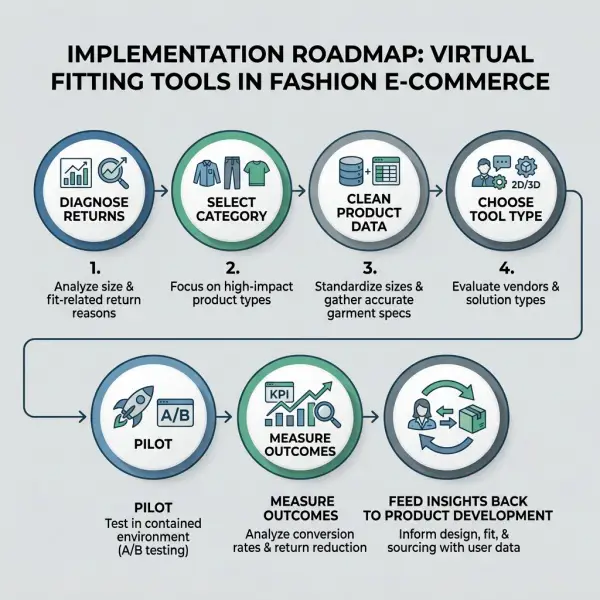
A practical implementation roadmap may look like this:
|
Stage |
What to Do |
Why It Matters |
|
Diagnose return reasons |
Separate size, fit, color, damage, quality, changed mind, and late delivery |
Prevents solving the wrong problem |
|
Select priority category |
Start with high-return, fit-sensitive categories |
Focuses budget where impact is likely |
|
Clean product data |
Improve measurements, fit notes, size charts, model data, and fabric descriptions |
Makes the tool more reliable |
|
Choose tool type |
Pick size recommender, fit finder, body scan, avatar, review summary, or virtual try-on |
Matches technology to customer need |
|
Run a pilot |
Test limited SKUs before full rollout |
Controls complexity and cost |
|
Measure adoption and outcomes |
Track usage, conversion, exchange rate, return rate, and return reasons |
Shows whether the tool is actually helping |
|
Feed insights back to product teams |
Use fit data for pattern, grading, buying, and merchandising decisions |
Turns return reduction into long-term product improvement |
A smaller brand may begin with improved garment measurements, model notes, fit preference questions, and return-reason tracking before buying advanced body-scanning technology. A larger retailer may need an integrated solution connected to product information management, customer profiles, review data, and return analytics.
What Fashion Brands Should Measure
A virtual fitting tool should be measured against business outcomes, not only clicks. High usage is useful, but usage alone does not prove value. Customers may interact because the feature is novel, not because it improves purchasing decisions.
Brands should track:
- Tool engagement rate by product category.
- Add-to-cart rate after using the tool.
- Conversion rate for users and non-users.
- Size exchange rate.
- Return rate by size, SKU, category, and customer segment.
- Return reasons before and after implementation.
- Bracketing behavior, such as orders with multiple sizes of the same product.
- Customer feedback on fit confidence.
- Cost per avoided return.
- Impact on customer service questions.
The most useful metric is often return reason movement. If total returns fall slightly but fit-related returns fall sharply, the tool may be working. If fit returns do not change but conversion increases, the tool may be improving confidence without reducing post-purchase mismatch. Both outcomes matter, but they should be interpreted differently.
How Virtual Fitting Fits Into a Wider Return Reduction Strategy
Virtual fitting should sit inside a wider return reduction strategy. Fashion returns are affected by product accuracy, customer expectation, logistics policy, price sensitivity, fraud, product quality, and inventory strategy.
Amazon’s decision to phase out “Try Before You Buy” by January 31, 2025, was reported by AP as being linked partly to the limited reach of the program and growing use of AI-powered features such as virtual try-on, personalized size recommendations, review highlights, and improved size charts. This does not prove that AI fitting tools replace physical try-before-buy for every retailer, but it shows how major platforms are rebalancing fit support toward digital decision tools.
For most fashion brands, the best return-reduction strategy combines several layers:
- Better pre-purchase information: measurements, fit notes, model data, fabric behavior, videos, and customer reviews.
- Better fit guidance: size recommendation, fit finder, body profile, garment comparison, or avatar-based fitting.
- Better product consistency: pattern standards, grading review, QC, supplier alignment, and fit approval.
- Better return analytics: structured return reasons, SKU-level diagnosis, exchange tracking, and customer feedback.
- Better policy design: clear return windows, exchange incentives, fraud controls, and customer education.
This is where the third article in the cluster, why fashion brands are investing in augmented reality shopping, can expand the strategic picture. Return reduction is only one reason brands invest in immersive commerce. Customer engagement, brand differentiation, social shopping, product discovery, and digital asset reuse also matter.
FAQ
Do virtual fitting tools really reduce fashion returns?
Virtual fitting tools can reduce some fashion returns, especially those caused by size and fit uncertainty, but they do not eliminate returns entirely. Their impact depends on product category, customer adoption, data quality, fit consistency, and whether the tool is integrated with product measurements and return analytics. A size recommender is more likely to help if the brand has accurate garment data and clear fit logic. It is less likely to help if returns are caused mainly by poor quality, misleading photos, slow delivery, or fabric disappointment.
What is the best virtual fitting tool for apparel brands?
There is no universal best tool. For basic apparel, a strong size recommender and improved product measurements may be enough. For denim, dresses, tailoring, bras, or performance apparel, a more detailed fit finder or body-profile tool may be useful. For visual categories such as eyewear, shoes, bags, or jewelry, AR virtual try-on may add more value. The right choice depends on the product’s return reason, price point, fit risk, customer behavior, and available product data.
How is virtual fitting different from a size chart?
A size chart provides general measurement information, usually in a static table. Virtual fitting tools personalize that information by using customer inputs, product measurements, past purchases, body profile, fit preference, or review data. A basic size chart may say that size M fits a bust measurement of 90–94 cm. A virtual fitting tool may say that size M is recommended, but the customer should size up if they prefer a relaxed fit because the garment is narrow through the shoulder. The difference is context.
Can virtual fitting tools stop customers from ordering multiple sizes?
They may reduce multiple-size ordering when customers trust the recommendation. Bracketing often happens because customers do not trust size consistency, especially in apparel categories with high fit variation. A fitting tool can help by explaining the recommended size, comparing garment measurements, showing fit preference options, and clarifying fabric stretch or garment ease. However, if returns are free and sizing remains inconsistent, some customers may continue ordering multiple sizes as a risk-management habit.
What data is needed for virtual fitting?
Useful data may include garment measurements by size, body measurement ranges, model measurements, fabric stretch, garment fit intent, customer fit preference, purchase history, return reasons, exchange data, and review feedback. More advanced tools may use uploaded photos, body scans, or AI-based measurement estimation. The more personal the data, the more important privacy, consent, and transparency become. Brands should collect only what is necessary and explain how the data improves the shopping experience.
Are virtual fitting tools useful for small fashion brands?
Yes, but small brands should start practically. They may not need advanced 3D avatars or AI body scanning at the beginning. A small brand can first improve garment measurements, model-size notes, fit descriptions, fabric behavior explanations, and return-reason tracking. Once the brand understands which categories create the most fit-related returns, it can test a lightweight size recommender or fit finder. The goal is not to look technologically advanced; the goal is to help customers buy the right product with fewer doubts.
What are the risks of using virtual fitting tools?
The main risks are inaccurate recommendations, weak product data, low customer trust, privacy concerns, and inflated expectations. If the tool recommends a size poorly, customers may blame the brand. If the tool asks for too much personal data, customers may abandon it. If the brand claims the tool guarantees perfect fit, disappointment can damage trust. A good implementation should be transparent, tested on real products, measured carefully, and supported by clear product information.
Conclusion
Virtual fitting tools help reduce online fashion returns when they make the customer’s buying decision more accurate before checkout. Their strongest contribution is reducing avoidable uncertainty: wrong size, unclear fit, poor proportion judgment, vague fabric behavior, and the habit of ordering multiple sizes just to test at home.
The technology is useful, but it is not a shortcut around good retail fundamentals. A brand still needs consistent sizing, accurate garment measurements, reliable fit notes, honest photography, useful reviews, strong product development, and structured return data. Without that foundation, a virtual fitting feature may look impressive while solving very little.
The most commercially useful approach is to treat virtual fitting as both a customer experience tool and a product intelligence system. It helps shoppers choose better. It also helps brands learn where sizing, grading, fit communication, or product design needs improvement. That is where return reduction becomes more than a logistics target. It becomes part of building a better fashion business.




Comments 0
Leave a CommentSend Comment
Anda harus Login terlebih dahulu untuk dapat memberikan komentar.