
AR Virtual Try-On Explained for Fashion Retail
Quick Answer
AR virtual try-on is a digital shopping technology that lets customers preview fashion products on their face, body, feet, or physical environment using augmented reality, computer vision, 3D assets, and sometimes artificial intelligence. In fashion retail, it is most commonly used for eyewear, footwear, watches, jewelry, cosmetics, accessories, and increasingly apparel.
Its value is not simply entertainment. When implemented well, AR virtual try-on can help shoppers understand scale, proportion, color, styling, and visual compatibility before purchase. For fashion brands, that can support product discovery, customer confidence, merchandising, and more informed online buying decisions.
The caveat is important: AR virtual try-on is not the same as a guaranteed fit system. It may show how an item looks, but accurate garment fit still depends on body measurements, pattern engineering, fabric behavior, size grading, product data quality, and the precision of the try-on technology. For most fashion retailers, AR virtual try-on works best as a visual confidence tool, not a replacement for strong sizing, product photography, fit notes, and clear return policies.
What Is AR Virtual Try-On in Fashion Retail?
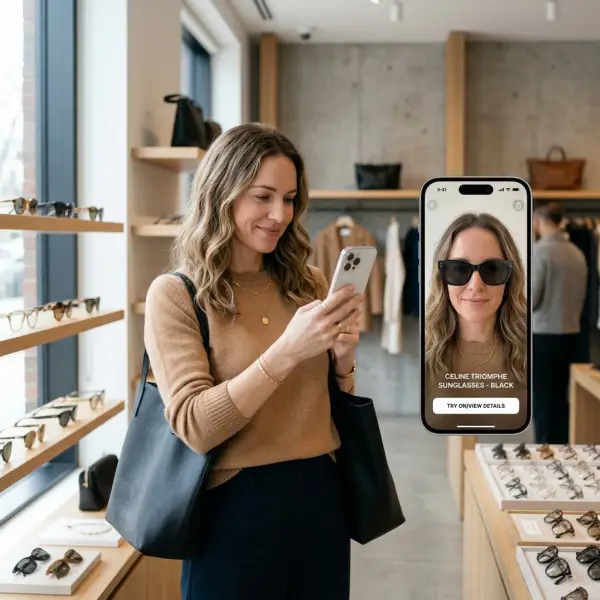
AR virtual try-on is an augmented reality shopping experience that overlays or generates a digital representation of a fashion product onto a live camera view, uploaded photo, model image, avatar, or physical retail environment so shoppers can preview how the product may look before buying. In practical fashion retail terms, it helps answer a question that flat product photos often cannot answer well: “How might this look on me, with my face, body, style, or surroundings?”
The technology sits at the intersection of several systems. Augmented reality places digital elements into a real-world visual context. Apple describes AR as adding 2D or 3D elements to the live view from device sensors so those elements appear to inhabit the real world, while ARKit combines tracking, scene understanding, and display tools for AR experiences. Apple ARKit documentation Google’s ARCore also provides cross-platform APIs for building immersive AR experiences, and its Augmented Faces API can identify face regions so digital assets can be positioned on facial contours. Google ARCore documentation
For fashion brands, this matters because fashion products are visual, personal, and context-dependent. A pair of sunglasses can look premium in a product image but too wide on a narrow face. A sneaker colorway may look appealing on a white background but less convincing with a customer’s usual wardrobe. A ring may appear delicate in a close-up photo but larger than expected on the hand. AR virtual try-on attempts to reduce that gap between product presentation and personal visualization.
It should still be understood carefully. AR virtual try-on can improve product visualization, but it does not automatically solve size accuracy, garment comfort, fabric feel, construction quality, or post-purchase satisfaction. The strongest implementations connect AR with accurate product data, realistic 3D assets, clear size guidance, and a merchandising strategy that helps the customer make a better decision.
How AR Virtual Try-On Works
AR virtual try-on usually works by detecting a user, body part, object, or environment, then placing a digital fashion item into that visual context. The experience may happen through a brand website, mobile app, marketplace, social platform, or in-store smart mirror.
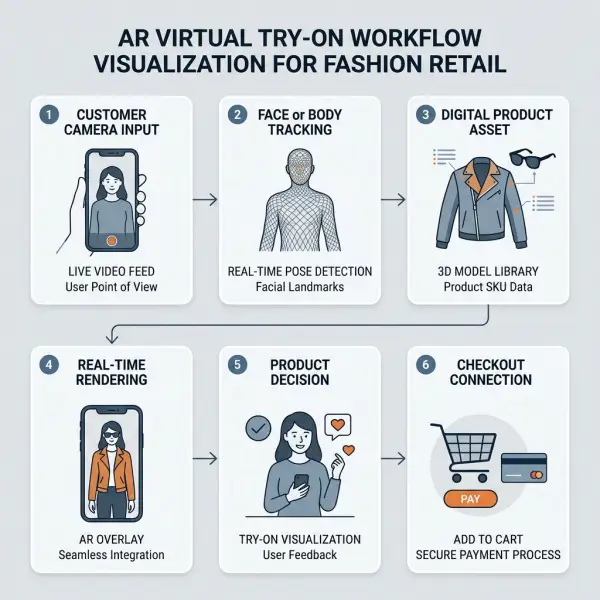
At a technical level, most systems combine four layers: camera input, recognition or tracking, digital product assets, and rendering. The camera captures the shopper’s face, body, foot, hand, or environment. Computer vision identifies landmarks such as facial points, foot position, hand shape, body pose, or surface planes. The system then aligns a digital product asset with the detected position and renders it in real time or near real time.
For fashion retailers, the operational challenge is not only “installing AR.” The harder work is preparing product data and visual assets in a format that can behave consistently across devices, screen sizes, lighting conditions, and body variations.
A simplified AR virtual try-on workflow usually looks like this:
- The customer opens the try-on feature on a product page, app, marketplace, or in-store device.
- The system asks for camera access, photo upload, model selection, or avatar input.
- Computer vision detects relevant landmarks such as face shape, hand position, body pose, or foot angle.
- A 2D overlay, 3D model, AI-generated image, or simulation is aligned with the customer’s image.
- The customer views the product from one or more angles, sometimes with color, size, or styling options.
- The retailer connects the experience to product selection, add-to-cart, wish list, store visit, or personalized recommendation.
The rendering layer is where customer trust is won or lost. If eyewear floats slightly above the nose, shoes slide away from the foot, jewelry appears at the wrong scale, or garments look like flat stickers, the feature can feel like a novelty rather than a decision aid. In fashion, small visual inaccuracies matter because customers use proportion, drape, color, and styling cues to judge whether a product suits them.
AR Virtual Try-On Is Not One Single Technology
One common misunderstanding is treating virtual try-on as a single tool. In reality, fashion retailers use several different technical approaches, each with different strengths, costs, and limitations.
2D Overlay Try-On
2D overlay try-on places a flat or semi-flat product image onto a detected area, such as lips, eyes, face, or sometimes clothing zones. It is relatively lightweight and can work well for categories where the product sits close to the surface of the body, such as makeup shades, simple accessories, or some eyewear previews.
The limitation is realism. A 2D overlay may not capture depth, angle, reflection, shadow, fabric thickness, or realistic interaction with the body. For low-risk products or early testing, it may be enough. For premium fashion categories, it may feel too approximate unless carefully designed.
3D Product Try-On
3D try-on uses a three-dimensional model of the product, allowing the item to rotate, scale, and align more realistically with the user’s face, hand, foot, body, or environment. This is especially useful for eyewear, watches, shoes, bags, jewelry, and structured accessories.
The asset pipeline becomes more important here. Retailers need clean 3D models, accurate textures, realistic scale, and optimized file sizes. The Khronos Group’s glTF format is widely used for efficient transmission and loading of 3D scenes and models, and its 3D Commerce Working Group focuses on reducing barriers to deploying 3D commerce at scale. Khronos glTF for 3D commerce
AI-Generated Virtual Try-On
AI virtual try-on may use generative models to create an image of how a garment could look on a person, model, or uploaded photo. Google, for example, has expanded virtual try-on shopping features that allow users to upload a selfie or full-body photo and generate studio-like images for clothing visualization. Google virtual try-on shopping feature
This approach can be visually compelling, but brands should treat it with extra care. AI-generated try-on can create persuasive imagery, yet the output may still depend on the quality of the product image, training data, model assumptions, garment category, pose, and body representation. It may show a plausible look, not a guaranteed physical fit.

Avatar-Based Fitting
Avatar-based systems create or use a digital body model based on measurements, scans, or selected body profiles. These systems may support apparel fit visualization better than simple overlays, especially when combined with size data, pattern information, or garment simulation.
The trade-off is friction. Customers may need to enter measurements, scan their body, or create a profile. Some will find that useful. Others will abandon the process if it feels too personal, slow, or invasive. For retailers, avatar-based fitting requires strong privacy design, clear consent, and a reason for customers to trust the experience.
Why AR Virtual Try-On Matters for Fashion Retail
AR virtual try-on matters because online fashion shopping still struggles with a fundamental limitation: customers cannot physically test the product before purchase. Product photos, size charts, model shots, and reviews help, but they often fail to answer highly personal visual questions.
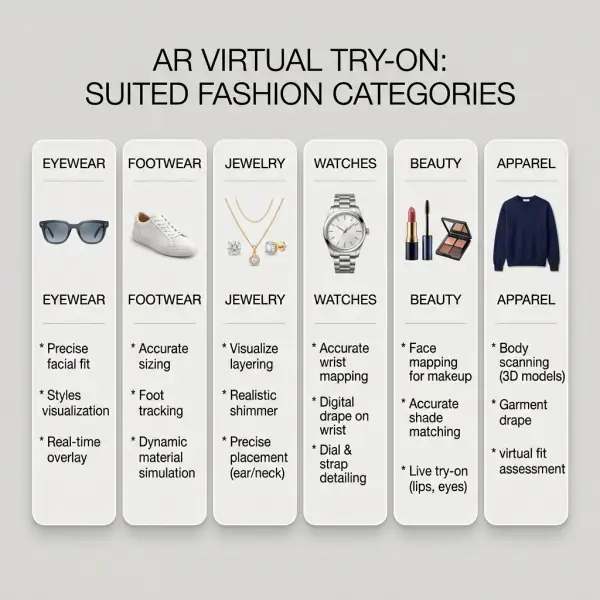
For fashion retail, the most useful role of AR is not replacing the store. It is extending product understanding into digital channels. A shopper browsing sunglasses on a mobile phone can compare frame shapes on their own face. A customer considering sneakers can see silhouette and color proportion on their feet. A jewelry buyer can judge scale on the hand. A beauty customer can compare shades without visiting a counter.
This is especially relevant for categories where visual suitability strongly influences purchase confidence:
|
Fashion Category |
Why AR Try-On Can Help |
Key Limitation |
|
Eyewear |
Shows frame shape, width, and face compatibility |
Lens quality, comfort, and prescription needs still require verification |
|
Footwear |
Helps visualize silhouette, color, and styling proportion |
Does not fully confirm comfort, arch support, or exact size |
|
Watches and Jewelry |
Shows scale on wrist, hand, or face |
Material feel, weight, finish, and craftsmanship need other content |
|
Beauty and Cosmetics |
Helps compare shades on face or skin tone |
Lighting, screen color, and skin undertone can affect accuracy |
|
Apparel |
Helps visualize styling and silhouette |
Drape, fit, fabric stretch, and body movement remain difficult to simulate accurately |
The business implication is straightforward but nuanced. AR virtual try-on can support confidence where visual uncertainty is a barrier. But if a product’s main purchase risk is size, comfort, construction, or fabric handfeel, AR must be paired with other decision-support tools.
AR Virtual Try-On, Virtual Fitting, and Size Recommendation: What Is the Difference?
AR virtual try-on, virtual fitting, and size recommendation are related, but they are not the same thing. AR virtual try-on is mainly about visualizing appearance. Virtual fitting is more focused on how a garment may sit on a body. Size recommendation helps customers choose the most suitable size based on measurements, product data, or purchase history.
This distinction matters because retailers often use these terms interchangeably in marketing. That can create unrealistic expectations. A shopper may assume “try-on” means accurate fit prediction, while the retailer is only offering visual overlay.
|
Term |
Main Purpose |
Typical Input |
Best Use Case |
|
AR virtual try-on |
Visual preview of product appearance |
Camera, photo, face/body/foot tracking, 3D asset |
Eyewear, accessories, shoes, beauty, styling visualization |
|
Virtual fitting |
Simulated garment fit or body-product interaction |
Body measurements, avatar, garment data, sometimes fabric properties |
Apparel fit exploration and fit confidence |
|
Size recommendation |
Suggesting a size to buy |
Measurements, past purchases, size chart, return data |
Reducing size confusion and improving purchase decision |
|
3D product viewer |
Viewing product from multiple angles |
3D product model |
Bags, footwear, accessories, luxury product detail |
For a fashion brand, the safest approach is to communicate the feature precisely. If the tool shows visual appearance, call it a virtual try-on or style preview. If it recommends size, explain the data used. If it simulates fit, clarify the assumptions and limitations. This is not just a legal or technical issue; it is a trust issue.
What Fashion Brands Need Before Implementing AR Try-On
A brand does not become AR-ready simply by choosing a vendor. The quality of the experience depends on product data, asset workflow, e-commerce integration, customer privacy design, and internal ownership.
The first requirement is reliable product information. AR needs more than a product name and price. For realistic try-on, the brand may need product dimensions, color values, texture references, material finish, size variants, images from multiple angles, and sometimes 3D scans or CAD-derived assets. Without this foundation, the try-on can look inconsistent or misleading.
The second requirement is a repeatable asset pipeline. For a brand with seasonal collections, hundreds of SKUs, limited drops, or frequent color updates, creating AR assets manually for every product can become expensive and slow. A pilot may look impressive with ten hero products. Scaling it across a full assortment is a different operational challenge.
Before implementation, fashion teams should verify:
- Which product categories are suitable for AR try-on first.
- Whether 2D, 3D, AI-generated, or avatar-based try-on is most appropriate.
- What product data and image assets are required.
- How long asset production takes per SKU.
- Whether the experience works on mobile web, native app, marketplace, or in-store devices.
- How customer images, body data, and consent will be handled.
- Whether results can be measured through conversion, engagement, return reasons, or customer feedback.
- Who owns the 3D assets and whether they can be reused across platforms.
The ownership question is often overlooked. If a retailer pays for 3D models, those assets may become valuable beyond the first AR campaign. They can support product pages, wholesale presentations, marketplace listings, social commerce, digital showrooms, or future virtual merchandising. But this only works if file formats, licensing, and usage rights are clear from the beginning.
Where AR Virtual Try-On Adds the Most Business Value
AR virtual try-on adds the most value when it solves a specific decision problem. It should not be added merely because it looks modern. The strongest use cases appear where customers hesitate because they cannot judge personal suitability from standard product images.
For eyewear, the decision problem is face compatibility. Shoppers want to know whether the frame width, bridge shape, lens size, and overall proportion suit their face. For jewelry, the issue is scale. A ring, hoop earring, or pendant can look very different depending on body proportion and styling context. For shoes, customers may want to understand silhouette, color, and outfit compatibility.
Apparel is more complex. A digital dress preview may help with styling, color, and general silhouette, but accurate fit requires stronger data. Fabric drape, stretch recovery, pattern shape, garment ease, lining, seam construction, and body movement all affect how a garment feels and behaves. This is why apparel AR should be presented carefully. It can help customers imagine the look, but it should not overpromise fit certainty.
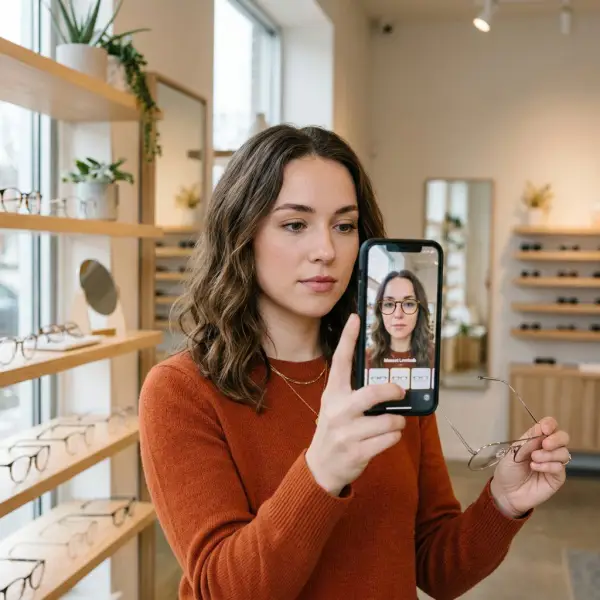
A practical way to prioritize AR is to start with high-visual-risk products. These are products where customers often hesitate because proportion, color, or scale is hard to judge online. For many brands, that means eyewear, jewelry, watches, shoes, bags, or hero accessories before full apparel simulation.
What AR Virtual Try-On Means for Merchandising and E-Commerce
AR virtual try-on changes the product page from a static information page into an interactive decision environment. That has implications for merchandising, photography, content planning, and conversion measurement.
A standard product page usually presents product images, price, color, size, description, and checkout options. With AR try-on, the product page must also guide the shopper into interaction. The call-to-action cannot be buried. The experience should be easy to launch, fast to load, and clearly connected to product variants. If a customer tries a black frame but then selects tortoiseshell, the AR view should update smoothly. If it does not, the feature may create confusion instead of confidence.
For merchandising teams, AR can also reveal which products attract interaction. A frame shape that receives high try-on engagement but low conversion may indicate price hesitation, poor color selection, size uncertainty, or weak product description. A product with low try-on usage may not need AR placement at all. In this sense, AR is not only a customer-facing tool; it can become a behavioral signal.
This connects naturally with broader fashion technology decisions such as how technology improves fashion supply chain visibility, because the value of digital tools often depends on whether product data is structured, accurate, and usable across teams.
Operational Implications for Fashion Teams
AR virtual try-on affects more than the website team. Product development, photography, merchandising, IT, customer service, legal, and marketing may all be involved.
Product teams need to define which attributes matter visually. For eyewear, that may include frame width, bridge position, lens shape, color opacity, and temple design. For footwear, it may include outsole thickness, toe shape, upper texture, and color blocking. For jewelry, it may include metal finish, stone scale, and reflective properties.
Creative teams need to produce assets that match the brand’s visual standard. Poor 3D texture can make a premium product look cheap. Inaccurate scale can create complaints. Overly polished AI imagery can set expectations that the physical product cannot meet. Fashion retail is sensitive to these details because customers often buy based on small visual cues.
Technology teams need to consider deployment. Native app AR can offer stronger device integration, while web-based AR can reduce friction because customers do not need to install an app. The WebXR Device API exists to support immersive experiences on the web, but W3C notes that immersive computing requires high-precision, low-latency communication and introduces distinct security concerns for the web. W3C WebXR Device API
For fashion businesses, that means implementation should be tested on real devices, not only in a vendor demo. A feature that works beautifully on a flagship phone in good lighting may perform differently on older devices, weak internet connections, low-light rooms, or browsers with limited support.
Customer Trust, Privacy, and Consent
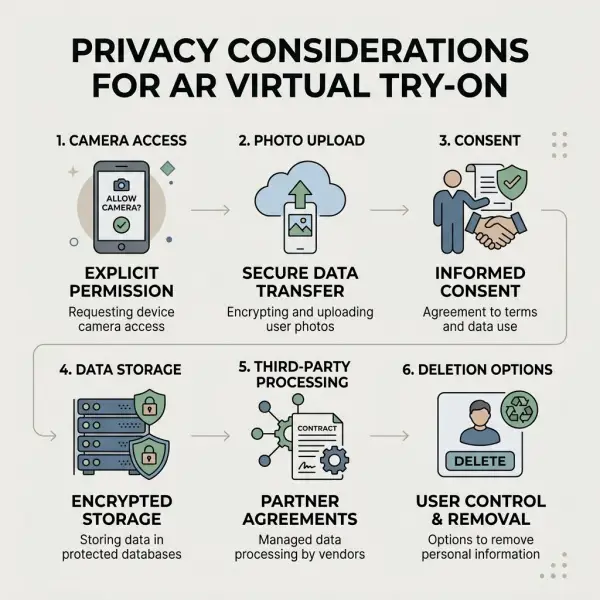
AR virtual try-on may involve sensitive customer data, especially when it uses face scans, body images, body measurements, or uploaded photos. Brands should not treat this as a minor technical detail.
At minimum, customers should understand what data is collected, whether images are stored, how long data is retained, whether it is used for model training, whether third-party vendors process it, and how the customer can delete or control it. In markets covered by strict privacy rules, this becomes even more important. The European Commission lists biometric data processed solely to identify a human being as sensitive personal data under EU data protection rules. European Commission guidance on sensitive data
Not every virtual try-on photo automatically becomes biometric data in every legal context. The classification depends on how the data is processed, whether identification is involved, and applicable jurisdiction. Still, fashion brands should design for caution. Customers are more likely to use try-on features when the experience feels useful, respectful, and transparent.
A good consent flow should be short, clear, and specific. A bad consent flow hides important details behind vague language. In fashion retail, trust is part of the customer experience. A try-on tool that feels invasive can harm the brand even if the technology itself works.
Limits of Current AR Virtual Try-On Technology
AR virtual try-on is useful, but it has limits. The most important limitation is that visual realism does not equal physical accuracy.
A customer may see a jacket on a digital body and like the look, but the real garment may still feel tight across the shoulder, too warm for the climate, too stiff because of interlining, or different in drape because of fabric weight. A sneaker may look right on screen but feel narrow at the toe. A ring may appear proportional but feel too heavy. These are not failures of AR alone; they are reminders that fashion products are tactile, constructed, and worn in motion.
Current technology is generally stronger in categories where the product has a stable shape and clear attachment point. Eyewear sits on the face. Watches sit on the wrist. Shoes sit on the foot. Jewelry can be scaled to a body part. Apparel is harder because garments deform, fold, stretch, and interact with many body shapes.
Brands should be especially careful with claims around fit, sustainability, and return reduction. Retail returns are a major business issue; the NRF reported that retailers estimated 16.9% of annual sales would be returned in 2024, with total returns projected at $890 billion. NRF 2024 retail returns report But claiming that AR alone will significantly reduce returns is too broad. Return behavior depends on sizing, product quality, customer expectations, pricing, logistics, return policy, and category. This article’s next cluster topic, how virtual fitting tools help reduce online fashion returns, should explore that issue more directly.
Common Mistakes Fashion Brands Make With AR Virtual Try-On
Treating AR as a Marketing Gimmick
The most common mistake is launching AR as a campaign effect rather than a shopping tool. This often happens when the brand is excited by the novelty of interaction but does not define the customer problem.
The consequence is predictable: customers try it once, share it perhaps, and then ignore it. A stronger approach begins with a product decision problem. Are customers unsure about frame shape? Ring scale? Sneaker color? Lipstick shade? Outfit styling? The AR feature should solve that specific hesitation.
Using Weak Product Assets
AR is unforgiving. If the product model is inaccurate, poorly textured, incorrectly scaled, or badly lit, the feature can damage product perception. This is especially risky for premium fashion, where material finish and proportion carry brand value.
A leather bag rendered with flat texture may look synthetic. A gold ring without realistic reflection may look cheap. A shoe with wrong outsole thickness may mislead the customer. Brands should treat digital assets as product assets, not disposable campaign files.
Overpromising Fit Accuracy
Many customers interpret “try-on” as “this will fit me.” For apparel, that is a dangerous assumption unless the tool is specifically designed for fit prediction and supported by reliable measurement and garment data.
A better approach is to separate visual try-on from fit guidance. Use AR to show appearance. Use size recommendation, fit notes, garment measurements, model information, and customer reviews to support size selection.
Ignoring Device and Browser Performance
A try-on experience that loads slowly or fails on common devices will frustrate customers. Fashion shoppers may browse casually during short mobile sessions. If the feature requires too much effort, the customer may leave before seeing its value.
Testing should cover old and new devices, Android and iOS, different browsers, various lighting conditions, and slower network connections. This is especially important for brands selling in markets where customers use mid-range phones.
Depending Too Much on One Platform
Some brands build AR experiences inside a social platform and assume that channel will remain stable. That can be risky. Meta announced that its Meta Spark third-party tools and content would no longer be available from January 14, 2025, which forced many creators and brands to rethink AR filter strategies. Meta Spark platform update
For fashion retailers, platform dependency should be part of the risk assessment. Social AR can be useful for discovery, but commerce-critical try-on experiences may need a more durable home on the brand’s website, app, or commerce infrastructure.
How Fashion Brands Can Apply AR Virtual Try-On Strategically
The best way to apply AR virtual try-on is to start narrow, measure carefully, and scale only where the experience improves customer decisions. A brand does not need to digitize every product immediately.
A practical pilot might begin with one category, one customer use case, and a limited number of SKUs. For example, an eyewear brand may start with its top 20 frames, focusing on face proportion and frame shape. A jewelry brand may test rings and earrings where scale is a frequent customer question. A footwear brand may begin with hero sneakers where silhouette and colorway drive purchase interest.
A useful implementation roadmap could look like this:
|
Stage |
What to Do |
Why It Matters |
|
Category selection |
Choose products where visual uncertainty affects buying decisions |
Avoids using AR where it adds little value |
|
Asset audit |
Review product photos, dimensions, materials, color data, and 3D readiness |
Prevents poor rendering and inconsistent visuals |
|
Pilot build |
Launch with limited SKUs and clear use case |
Controls cost and complexity |
|
Customer testing |
Observe real customer interaction, not only internal demos |
Reveals friction, confusion, and trust issues |
|
Performance review |
Compare engagement, add-to-cart, conversion, return reasons, and feedback |
Shows whether AR supports business goals |
|
Scale decision |
Expand only to categories where value is proven |
Protects the team from expensive novelty projects |
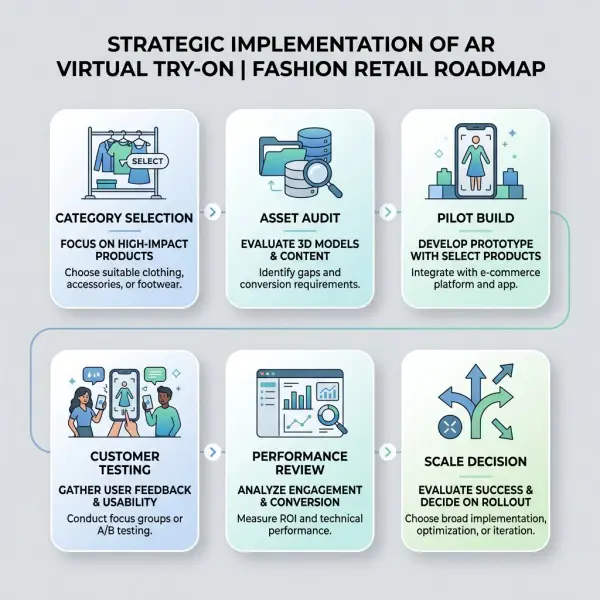
For smaller brands, the first step may not be custom AR development. It may be improving product photography, size charts, model notes, product measurements, and variant data. AR becomes more valuable when the basic product information is already strong. Otherwise, the technology may simply decorate a weak product page.
For larger retailers, the opportunity is broader. AR try-on can connect with customer profiles, loyalty programs, personalization, social commerce, in-store screens, and digital asset management. But the governance challenge grows as well. Teams need standards for product data, asset quality, privacy, vendor contracts, and measurement.
What Brands Should Verify Before Choosing an AR Vendor
Choosing an AR vendor should be treated as both a technology decision and a retail operations decision. A beautiful demo is not enough.
Brands should ask practical questions about asset production, platform compatibility, performance, analytics, privacy, integration, and long-term ownership. The vendor should be able to explain not only what the feature looks like, but how it will work inside the brand’s actual catalog, CMS, product information system, e-commerce stack, and marketing workflow.
Key questions include:
- Does the solution support mobile web, app, marketplace, in-store, or all of these?
- What product categories does the vendor handle best?
- Are assets created from photos, CAD files, 3D scans, manual modeling, or AI generation?
- Who owns the final 3D or AR assets?
- Can assets be exported in reusable formats such as glTF or USDZ where relevant?
- How does the system handle different sizes, colors, materials, and variants?
- What happens when a product is discontinued or updated?
- Does the vendor store customer photos, scans, or measurements?
- Can the brand access analytics on try-on usage and product-level engagement?
- What is the expected load time on common mobile devices?
These questions may sound operational, but they determine whether AR becomes a scalable retail capability or a one-time visual experiment.
The Role of AR Virtual Try-On in the Future of Fashion Shopping
AR virtual try-on is likely to remain part of fashion retail’s digital toolkit, especially as mobile devices, computer vision, 3D asset workflows, and AI-generated visualization improve. The more realistic view is not that AR will replace stores, models, product photography, or fit guidance. It is that AR will become one more layer in how customers evaluate products.
The direction is already visible. Google has expanded virtual try-on features in shopping experiences, web standards such as WebXR continue to support immersive web development, and 3D commerce standards are helping retailers think beyond static images.
For fashion brands, the strategic question is not “Should we use AR because competitors are using it?” A better question is: “Where does our customer still lack confidence before purchase, and can AR reduce that uncertainty better than existing content?” Sometimes the answer will be yes. Sometimes better photography, fit copy, product videos, model diversity, or customer reviews will be more urgent.
This is also where the wider cluster connects. The business case for AR overlaps with return management, but it should not be reduced to returns alone. The next article, how virtual fitting tools help reduce online fashion returns, can go deeper into sizing, logistics, and return behavior. The third article, why fashion brands are investing in augmented reality shopping, can explore brand strategy, customer engagement, and competitive positioning in more detail.
FAQ
What is AR virtual try-on in simple terms?
AR virtual try-on is a shopping feature that lets customers see a digital version of a fashion item on themselves or in their environment before buying. It may use a phone camera, uploaded photo, face tracking, body tracking, 3D product model, or AI-generated image. In fashion retail, it is commonly used for eyewear, shoes, watches, jewelry, beauty products, accessories, and some apparel. The simplest way to understand it is this: AR virtual try-on helps shoppers preview appearance, but it does not automatically guarantee physical fit, comfort, or product quality.
Is AR virtual try-on the same as virtual fitting?
No. AR virtual try-on mainly helps customers visualize how a product may look, while virtual fitting focuses more on how a garment may fit the body. Size recommendation is another related but separate function that suggests which size to buy. Some advanced systems combine all three, but many retail tools only provide visual preview. Fashion brands should describe the feature accurately so customers do not assume it can predict exact fit when it cannot.
Which fashion products work best with AR virtual try-on?
AR virtual try-on usually works best for products with clear shape, scale, and placement, such as eyewear, watches, jewelry, shoes, bags, and beauty products. Apparel can also use AR or AI try-on, but it is technically more difficult because garments drape, stretch, fold, and move differently across body shapes and materials. Structured products are generally easier to visualize accurately than soft garments with complex fit behavior.
Can AR virtual try-on reduce returns?
AR virtual try-on may help reduce some returns related to visual mismatch, such as wrong style, unexpected scale, or unsuitable color. However, it should not be treated as a guaranteed return-reduction tool. Fashion returns are also caused by size confusion, fabric feel, comfort, delivery expectations, product quality, and customer buying habits. AR works best when combined with accurate size charts, fit notes, product measurements, strong photography, and honest product descriptions.
Do small fashion brands need AR virtual try-on?
Small fashion brands do not necessarily need AR virtual try-on immediately. The priority should depend on product category, customer hesitation, budget, and operational readiness. A small eyewear, jewelry, or footwear brand may benefit from a focused AR pilot if visual suitability is a major buying barrier. A small apparel brand may get better results first from improving size guidance, model photos, garment measurements, product videos, and customer support before investing in advanced try-on technology.
What data does AR virtual try-on need?
AR virtual try-on may need product dimensions, high-quality images, 3D models, color references, texture information, size variants, and customer camera or photo input. More advanced systems may use body measurements, avatars, face landmarks, hand tracking, or foot tracking. The exact data depends on the category and technology. Brands should verify what data is collected, how it is processed, whether it is stored, and whether the customer has clear consent and deletion options.
What is the biggest risk of AR virtual try-on for fashion retailers?
The biggest risk is overpromising. If the feature looks impressive but does not accurately represent scale, color, fit, or product detail, it can create disappointment. Another risk is operational: brands may underestimate the work needed to create and maintain digital assets across many SKUs. Privacy is also important when customer photos, body data, or facial data are involved. A responsible AR strategy should balance customer experience, technical accuracy, data protection, and measurable business value.
Conclusion
AR virtual try-on is best understood as a visual decision-support tool for fashion retail. It helps customers move beyond flat product images and imagine how a product may look on their face, body, feet, hand, or personal context. That can make online shopping more interactive and more informative, especially in categories where proportion, color, scale, and styling compatibility matter.
The strongest business value comes when AR solves a real customer hesitation. It is less effective when used as decoration, campaign novelty, or a vague innovation signal. Fashion brands need accurate product assets, realistic category selection, careful privacy design, reliable performance testing, and honest customer communication.
AR virtual try-on will not remove the need for good product development, fit consistency, size guidance, photography, merchandising, and customer service. It works better when those foundations are already in place. Used strategically, it can become part of a stronger digital retail experience. Used carelessly, it becomes another feature customers try once and forget.





Comments 0
Leave a CommentSend Comment
Anda harus Login terlebih dahulu untuk dapat memberikan komentar.