
Leather and Leather Alternatives Explained for Fashion Applications
Quick Answer
Leather is a material made by tanning animal hide or skin so that its original fibrous structure is preserved and protected from decomposition. Leather alternatives are a broader group of materials designed to provide some of leather's visual, tactile, or functional qualities without using conventional animal leather. They include polyurethane (PU)- or polyvinyl chloride (PVC)-coated textiles, partially bio-based composites made with agricultural inputs, mycelium-based sheets, and other developing biomaterials.
These categories are not technically interchangeable. A material may resemble leather yet behave differently when folded repeatedly, stitched near an edge, exposed to moisture, abraded, or stored in heat and humidity. Likewise, “vegan,” “plant-based,” and “plastic-free” do not mean the same thing. A plant-derived ingredient may form only part of a composite that also contains a textile backing, adhesive, synthetic binder, and protective coating.
For fashion businesses, the useful question is not simply whether a material is leather or an alternative. It is whether the exact construction can meet the product's performance target, manufacturing process, price point, care requirements, compliance obligations, and substantiated environmental claims.
What Are Leather and Leather Alternatives?
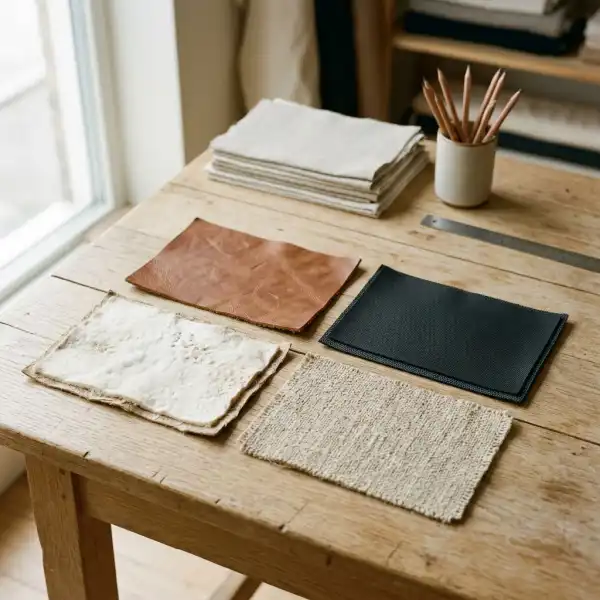
Leather and leather alternatives are flexible sheet materials used when a fashion product needs a combination of surface character, structure, resistance to wear, and workable construction. The resemblance can be close at first glance, but the materials achieve those qualities through different raw materials and manufacturing systems.
A technical definition matters here. The United Nations Economic Commission for Europe describes leather as hide or skin whose original fibrous structure remains more or less intact and has been tanned so it will not decompose under normal conditions. That definition helps separate leather from coated fabrics and reconstituted mixtures, even when all three carry an embossed grain. The terminology is set out in the UNECE leather traceability analysis.
“Leather alternative” is not one standardized composition. It is a practical umbrella term for materials intended to replace leather in an application or reproduce selected leather-like properties. “Faux leather,” “synthetic leather,” “artificial leather,” “leatherette,” and “vegan leather” are often used in retail, but they can conceal important differences in polymer, backing, bio-based content, finish, and expected service life.
That distinction has commercial consequences. In the United States, for example, Federal Trade Commission guidance says that a non-leather material made to look like leather should be disclosed as non-leather or by its general material nature. It also treats bonded or reconstituted leather separately and calls for disclosure of leather-fiber and non-leather content when those terms are used. Brands selling relevant products should review the FTC guidance on leather and imitation-leather composition and obtain market-specific legal advice rather than assuming one label works globally.
The Main Material Families Used in Fashion
The clearest way to understand the category is by construction, not by marketing name. Two swatches described as “cactus leather,” for instance, may use different percentages of plant input, different binders, and different backings. Their performance and end-of-life routes may therefore have little in common.
|
Material family |
Basic construction |
What buyers should understand |
Typical fashion relevance |
|
Natural leather |
Tanned animal hide or skin, with finishing that may be light or heavily pigmented |
Species, hide section, grain condition, split, tanning system, finish, and thickness all affect behavior |
Footwear uppers, bags, belts, jackets, trims, and small leather goods |
|
Bonded or reconstituted leather |
Leather fibers or particles combined with non-leather binders and formed into a sheet |
It contains leather but is not equivalent to an intact hide; fiber and binder content matter |
Cost-sensitive accessories, panels, reinforcement, and selected decorative uses |
|
PU-coated textile |
A woven, knitted, or nonwoven backing coated with polyurethane and usually given a top finish |
Backing, PU chemistry, coating weight, and hydrolysis resistance influence performance |
Bags, footwear, apparel panels, trims, and upholstery-inspired fashion items |
|
PVC-coated textile |
A textile support coated with plasticized polyvinyl chloride and finished for appearance and protection |
Can offer an even surface and water resistance, but formulation, flexibility, weight, and chemical compliance require review |
Fashion bags, rain-oriented items, belts, and decorative surfaces |
|
Partially bio-based composite |
Plant fibers, powders, oils, or agricultural residues combined with a binder, backing, and often a surface coating |
Plant content can be meaningful without making the entire material bio-based, biodegradable, or plastic-free |
Bags, small accessories, footwear components, and limited apparel applications |
|
Grown or biofabricated sheet |
Mycelium, microbial cellulose, or another biological structure developed into a sheet and commonly finished or reinforced |
Commercial readiness, coating, reinforcement, consistency, and scalable supply vary by material |
Selected premium accessories, panels, concept products, and controlled product programs |
This table describes families rather than grades. Within each family, a well-engineered material can outperform a poorly specified one for a particular use. The material name alone is not a quality grade.
Natural leather is itself a varied category
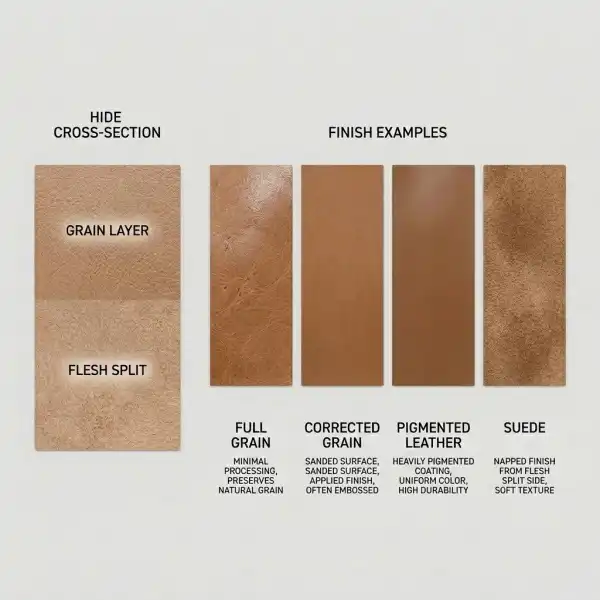
Natural leather is not a uniform surface. Full-grain leather retains the grain surface without removing it by buffing. Corrected-grain leather has had imperfections reduced or obscured before finishing. Split leather comes from a lower layer created when a hide is divided through its thickness and lacks the original outer grain. Suede presents a napped surface, while nubuck is usually made by lightly abrading the grain side.
Aniline and semi-aniline finishes expose more natural character than heavily pigmented leather, but they create different expectations for color variation, stains, and maintenance. Pigmented finishes can offer a more consistent appearance and targeted resistance. The correct option depends on the product brief, not a simple natural-versus-coated hierarchy.
Conventional synthetic leather is usually a layered material
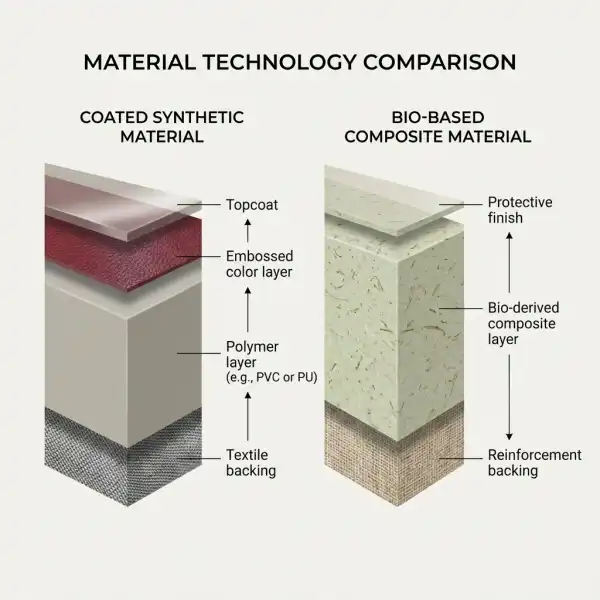
Most conventional synthetic leather combines a fabric or nonwoven substrate with a polymer layer, surface color, embossing, and a protective topcoat. The substrate contributes stability and tear behavior; the coating provides the visible surface, cleanability, and much of the resistance to exposure.
PU is widely used where softness, flexibility, and a leather-like hand are desired. PVC can be engineered for a consistent surface and useful moisture resistance, though it may feel heavier or behave differently in cold and repeated flexing depending on formulation. These are broad tendencies, not purchase specifications. Textile Exchange notes both the functional use of polyurethane and the practical difficulty of recycling it after it has been applied as a coating to another material in its overview of commonly used synthetic materials.
Plant-based and next-generation materials are usually composites
Newer alternatives may incorporate pineapple leaf fiber, fruit residues, cactus-derived feedstock, natural rubber, cork, cellulose, or fungal mycelium. The commercial sheet often still needs a binder, carrier, adhesive, or top finish. Its bill of materials—not the headline ingredient—determines overall bio-based content, manufacturing behavior, layer separability, and realistic disposal routes.
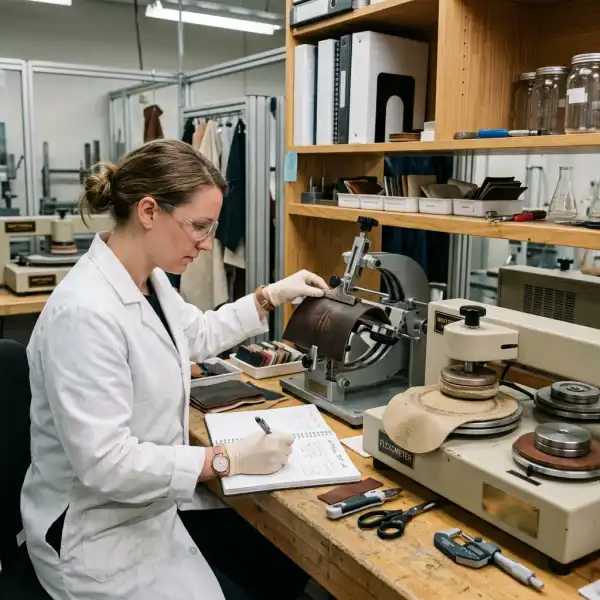
Research comparing leather and selected alternatives has also found large differences in tensile, tear, flex, water-vapor, and other properties across materials. The practical lesson from the peer-reviewed comparison of technical performance is not that one family always wins. It is that brands need application-specific test data for the exact material rather than assuming visual similarity predicts engineering performance.
How Does Material Construction Affect Fashion Performance?
Material construction affects bending, stretch, stitch-hole tear, moisture behavior, color retention, aging, and finishing. A sample card shows color and handfeel but cannot establish performance after repeated flexing or storage in heat and humidity.
For product teams, the following properties are usually more decision-useful than the material's category name:
- Tensile and tear behavior, including tear growth near seams, eyelets, handles, and folded corners.
- Flex resistance, especially for footwear vamps, bag gussets, sleeves, and other repeatedly moving areas.
- Abrasion and rub fastness, covering both surface wear and color transfer under dry or wet rubbing.
- Resistance to hydrolysis, heat, humidity, light, and storage aging where the polymer or finish may deteriorate.
- Water-vapor permeability and moisture management for products worn close to the body.
- Thickness consistency, recovery, drape, edge quality, and compatibility with skiving, folding, bonding, and stitching.
- Cleanability, stain response, and surface repairability under the care instructions customers will actually receive.
Failure is often local. A bag body may remain sound while its handle attachment tears; a shoe upper may pass a pull test but crack at the flexing vamp. Tests must reflect component placement and use.
The backing is often as important as the face
With coated and composite alternatives, the reverse matters. A knitted backing can support stretch and softness, a woven support may provide directional stability, and a nonwoven may behave differently at perforations or folds. Fiber type, weight, structure, and layer bonding all influence the component.
Delamination is a useful example. The top surface may remain visually intact while adhesion between coating and backing weakens under flexing, moisture, heat, or incompatible adhesives. Material approval should therefore include both surface tests and construction-level trials.
Leather varies because it began as a biological structure
Natural hides vary in thickness, fiber density, scars, stretch, and usable area. This can support natural character but also affects nesting, cutting yield, color matching, and inspection. Price per square unit alone may therefore misstate usable cost.
Sheet alternatives tend to offer more regular dimensions and visual consistency. That can simplify cutting plans, but consistency should not be confused with durability. A uniform roll can still have batch-to-batch shade movement, coating defects, edge curl, or aging weaknesses.
Where Do These Materials Fit in Fashion Products?
Leather and leather alternatives appear in bags, shoes, jackets, belts, wallets, trims, jewelry, and protective or decorative panels. Suitability depends on the component, not merely the product category. A handbag may use one material for the body, another for the lining, a reinforcement inside the handle, edge paint, adhesive, thread, foam, and metal hardware. The customer sees one item; the factory manages a system.
At an early development stage, teams can use the following directional map:
|
Product or component |
Performance priorities |
Questions to ask before approval |
|
Bag body |
Surface abrasion, shape retention, seam strength, cleanability |
Will the surface crease attractively or look damaged? Is the backing stable at large panel sizes? |
|
Handles and straps |
Tear strength, elongation control, edge durability, attachment security |
Does the specification require reinforcement? Has the complete handle assembly been load-tested? |
|
Footwear upper |
Repeated flexing, abrasion, bonding, climate comfort |
Has the material been tested at the intended vamp, toe, and collar locations? |
|
Jacket or skirt panel |
Drape, weight, flex, moisture management, colorfastness |
Is the hand comfortable across a full garment, not only on a small swatch? |
|
Belt or structured trim |
Dimensional stability, hole strength, edge finish, bending |
Will the material stretch permanently or crack around holes and folds? |
|
Small leather goods |
Fold endurance, edge quality, surface precision, bulk |
Can the material be skived or folded to the required thickness without delamination? |
The more detailed component-level decision belongs in material selection for bags, shoes, and outerwear. The key principle here is simpler: do not approve a material for an entire product category when it has only been proven for one low-stress panel.
Sustainability Cannot Be Read From the Material Name
No single word—leather, vegan, plant-based, recycled, or bio-based—provides a complete environmental assessment. Each material system has upstream inputs, manufacturing impacts, chemicals, durability characteristics, and end-of-life constraints. The weight given to those factors changes with the product's function and expected use.
For natural leather, relevant questions include origin, land-use risk, traceability, tanning chemistry, water, energy, wastewater, chemicals, yield, and longevity. The Leather Working Group manufacturer standard assesses areas including traceability, chemical management, water, energy, emissions, waste, effluent treatment, and operations, as described in the LWG Leather Manufacturer Standard scope. Its scope should be read carefully; it does not automatically make every finished product sustainable.
For PU- and PVC-based materials, coating chemistry, solvents, additives, backing, layer separation, lifetime, and waste infrastructure matter. Recycled content can improve one attribute without making an inseparable multilayer sheet readily recyclable.
For plant-containing and grown materials, buyers should verify:
- The percentage and measurement basis of bio-based content.
- Whether the figure refers to the full material or only one layer.
- The identity and proportion of binder, coating, backing, adhesive, and finish.
- Whether biodegradability or compostability has been tested for the complete finished material under stated conditions.
- Whether production is available at the required width, color, volume, consistency, and lead time.
- How durability changes the amount of product needed to provide the same function over time.
A fair environmental comparison needs equivalent function, quality, and duration, along with a transparent system boundary. The European Commission's Product Environmental Footprint method requires a specific bill of materials, product-relevant manufacturing data, defined functional unit, system boundary, assumptions, and limitations. Those principles are explained in the European Commission Product Environmental Footprint method. Comparing an unverified “impact per square meter” figure from one supplier with a cradle-to-grave product study from another is unlikely to support a reliable superiority claim.
Durability is important, but it does not erase other impacts
A long service life can improve material efficiency when the product is actually used longer. Yet physical durability alone cannot compensate for broken hardware, poor fit, inaccessible repairs, or early style-driven disposal. Material choice must work with product architecture, care, and repairability.
What Fashion Businesses Should Verify Before Sourcing
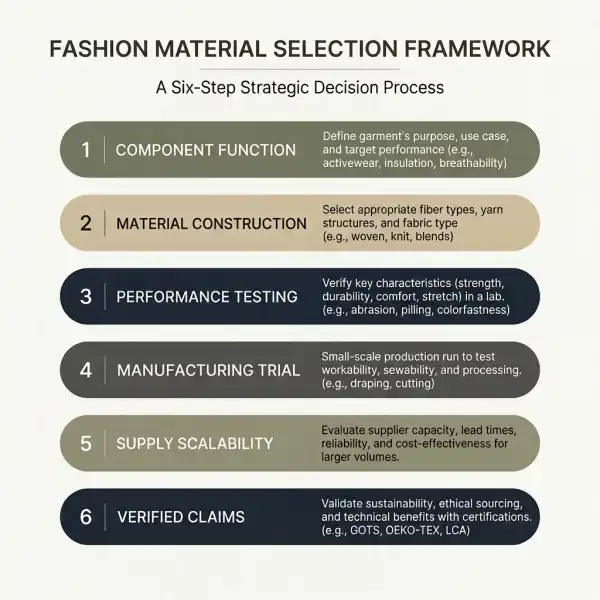
A credible sourcing process begins with a written performance brief. The brief should describe the component, use conditions, required tests, target thickness and weight, surface standard, color tolerance, care method, restricted-substance requirements, volume, and commercial target. Without that baseline, sampling becomes a series of subjective reactions to attractive swatches.
A practical approval sequence is:
- Define the component and failure risk. Identify whether the material will form a body panel, flex zone, strap, edge, lining, or decorative part.
- Request the full material description. Ask for composition by layer, backing structure, coating or binder type, thickness, width, country of manufacture, and relevant certifications or test reports.
- Set application-specific tests. Select physical, colorfastness, aging, chemical, and performance tests that reflect the product and sales market.
- Build a representative prototype. Use the intended thread, needle, adhesive, reinforcement, edge finish, machinery, and seam allowance.
- Test the assembled product. Component interaction can create failures that do not appear in a flat material test.
- Confirm scalable supply. Review minimum order quantity, capacity, lead time, color reproducibility, defect allowance, change-control procedure, and contingency options.
- Approve marketing language last. Claims should follow verified composition, process, and test evidence—not precede them.
For growing brands, this process should sit inside a broader fashion sourcing strategy. A technically suitable material can still be commercially unsuitable if the minimum order quantity forces excess inventory or if color replenishment cannot be repeated.

Build a supplier data pack, not a claims folder
A shared data pack can include the technical sheet, bill of materials by layer, relevant chemical declarations, test reports tied to a material code and batch, care guidance, color standard, certificate scope and validity, traceability records, and approved claim wording.
Certificates need careful reading. A facility certificate, raw-material certificate, chain-of-custody document, and finished-product claim each answer a different question. A logo on a supplier presentation is not enough; the team should confirm the certified entity, site, material, transaction scope, validity period, and whether the certificate supports the specific statement the brand intends to make.
Common Mistakes When Working With Leather-Like Materials
Treating “vegan” as a material composition
“Vegan” communicates the absence of conventional animal-derived content as represented by the supplier or brand; it does not identify what the material is made from. The operational consequence is that design and marketing teams may overlook a fossil-based coating, an undisclosed backing, or a binder that changes recyclability and care. Request a layer-by-layer composition and define how animal-derived processing aids or adhesives are handled if that matters to the claim.
Approving from appearance and handfeel alone
A soft, convincing sample can still perform poorly under repeated flexing, abrasion, heat, humidity, or seam loading. This mistake often occurs when selection is driven by a trade-show swatch rather than a component specification. The better approach is to combine sensory review with laboratory tests and a finished-product wear or use trial.
Reusing one specification across every product
The material that works on a rigid tote panel may fail on a shoe vamp or fitted jacket sleeve. The stress, moisture exposure, backing requirement, adhesive system, and comfort expectation are different. Create a material-component matrix and approve the material only for the tested uses.
Ignoring manufacturing compatibility
A substitute material can change cutting yield, needle marks, skiving behavior, edge painting, heat response, folding radius, bonding time, and machine settings. If the factory receives the new material after the pattern and operation bulletin are fixed, rework becomes likely. Include production technicians during development and run a controlled pilot before confirming bulk.
Making sustainability claims from one attractive attribute
Agricultural waste input, recycled backing, water-based chemistry, or lower measured impact in one category can be valuable, but none proves overall environmental superiority. Claims should state the specific attribute, measurement boundary, evidence, and relevant limitation. Broader comparisons need compatible life-cycle methods and equivalent functions.
Confusing price per meter with product economics
Material price is only one line in the cost. Yield, defect rate, inspection, reinforcement, special adhesives, slower sewing, rejected pieces, testing, care complaints, and replacement risk may change total product cost. The commercially stronger choice is the material system that reaches the required quality and margin reliably, not necessarily the lowest quoted unit price.
Important Technical and Marketing Caveats
Several statements about leather and alternatives require especially careful handling:
- “Genuine leather” is not a universal grade. It indicates real leather in ordinary commerce but does not by itself establish grain layer, finish quality, durability, or value. The deeper purchasing comparison is covered in [internal-link]genuine leather versus vegan leather|genuine-leather-vs-vegan-leather-what-fashion-buyers-should-know[/internal-link].
- “Bio-based” does not automatically mean biodegradable. A bio-derived feedstock can be processed into a durable polymer, and the finished composite may contain non-biodegradable layers.
- “Biodegradable” is incomplete without conditions. Ask what portion was tested, which standard was used, under what temperature and environment, for how long, and what residues remained.
- “Water-resistant” and “waterproof” are not interchangeable. Claims should match a defined test and the performance of the finished product, including seams and closures.
- Tanning labels do not settle the environmental comparison. Chrome, chrome-free, metal-free, vegetable, and other systems have different chemistries and performance profiles; process control, chemical management, wastewater treatment, energy, and yield remain relevant.
- A new biomaterial may still be commercially limited. Pilot availability does not prove stable bulk capacity, color continuity, multi-season supply, or performance across applications.
The safest editorial rule is to name what can be verified. Specific descriptions such as “upper made with a PU-coated recycled-polyester backing” or “contains 35% bio-based content by dry mass, based on supplier documentation” are more informative than a broad “eco leather” claim—provided the evidence and calculation basis are valid.
Frequently Asked Questions
Is vegan leather always made from plastic?
No. Vegan leather means the marketed material is intended to avoid animal leather; it does not prescribe a single chemistry. Many widely available products use PU or PVC coatings, while newer options may incorporate plant fibers, agricultural residues, natural rubber, mycelium, or microbial cellulose. Some of these newer materials still contain synthetic binders, coatings, adhesives, or textile backings. Buyers should request the composition of the complete material by layer and avoid equating a plant-based ingredient with a plastic-free finished sheet.
What is the difference between leather, split leather, and bonded leather?
Leather retains an animal hide or skin's fibrous structure after tanning. Split leather is a lower layer produced when a hide is divided through its thickness; it is still leather, but it lacks the original outer grain surface. Bonded or reconstituted leather is made by combining leather fibers or particles with non-leather substances to form a sheet. These constructions differ in structure, finishing possibilities, and performance. Product descriptions should be accurate for the specific market, especially when bonded material could otherwise be mistaken for intact leather.
Are plant-based leather alternatives biodegradable?
Not necessarily. Plant content does not establish biodegradability for the finished material. A commercial sheet may combine plant particles or fibers with polyurethane, another binder, a textile support, adhesive, pigments, and a protective topcoat. Even if one ingredient can biodegrade, the composite may not do so under ordinary landfill, marine, soil, or home-compost conditions. Ask for testing on the complete finished material, the applicable standard, test environment, disintegration and biodegradation results, duration, and remaining residue information before making a claim.
Which material is most durable for bags and footwear?
There is no universal winner. Durability depends on the exact leather grade or alternative construction, finish, thickness, component placement, workmanship, care, climate, and type of use. Full-grain leather can perform very well in some applications, while an engineered coated textile may provide more consistent water or stain resistance in another. Compare candidate materials against a component-level test plan, then test the complete bag or shoe. Results from an unrelated material grade should not be transferred to the one being purchased.
What documents should a brand request from a material supplier?
Request a technical data sheet, layer-by-layer composition, material and color codes, thickness and width tolerances, test reports, restricted-substance or chemical compliance documentation for the target market, care guidance, minimum order quantity, lead time, change-control policy, and relevant traceability or certification records. For environmental or bio-based claims, request the calculation method, test standard, system boundary, certificate scope, and evidence tied to the exact material code. Reports should identify the tested specimen and date; a generic corporate brochure is not a substitute.
Can a brand switch from leather to an alternative without changing the pattern?
Sometimes, but it should not be assumed. A substitute may have different stretch, thickness, drape, recovery, edge behavior, seam strength, and folding radius. It may also require another reinforcement, adhesive, needle, stitch density, or allowance. Build a representative prototype using production-intent components and processes, then evaluate appearance, assembly time, wear, and failure points carefully. If the material changes the structure of a critical component such as a shoe vamp or bag handle, the pattern and construction specification may need revision.
Does a tannery or material certification prove that the final product is sustainable?
No. Certification normally evaluates a defined material, facility, process, chain-of-custody system, or claim under a stated scope. It does not automatically cover every component, assembly site, transport stage, use pattern, or end-of-life outcome of the final product. Certifications can provide useful evidence when their scope is understood and verified. Brands should describe the certified attribute accurately and assess the finished product separately rather than converting a supplier-level credential into unrestricted product-level claims covering the entire product life cycle.
Conclusion
Leather and leather alternatives should be treated as families of engineered materials, not as opposing labels. Natural leather varies by hide, layer, tanning, and finish. Synthetic leather depends on the interaction between backing, polymer coating, and top finish. Plant-containing and grown materials introduce different feedstocks, but their commercial performance and end-of-life profile still depend on the complete construction.
For fashion businesses, disciplined specification is more useful than category loyalty. Define the component, identify credible failure risks, inspect every material layer, test the exact grade, trial it in production, and verify that supply can be repeated. Only then should the marketing team decide how to describe it.
That approach does not produce a simplistic answer about which material is “best.” It produces something more valuable: a defensible choice for a particular product, customer, price, and use case, supported by evidence that sourcing, quality, compliance, and communication teams can all understand.




Comments 0
Leave a CommentSend Comment
Anda harus Login terlebih dahulu untuk dapat memberikan komentar.