

What Fashion Businesses Should Prepare Before Entering Global Markets
Quick Answer
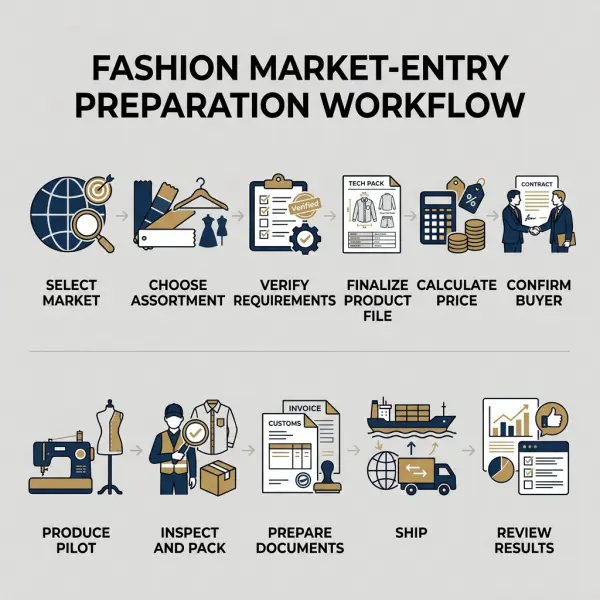
Before entering global markets, a fashion business should prepare a focused market-entry plan, export-ready product information, destination-specific compliance records, reliable production capacity, documented quality standards, complete export costing, clear sales terms, and a controlled logistics process.
The preparation should begin before the brand signs a major international order. Interest from foreign customers does not confirm that a product can be imported legally, priced profitably, produced consistently, or delivered within the buyer’s required window.
For most growing fashion businesses, the strongest approach is to start narrowly: one target market, one sales channel, a small group of proven products, and a commercially meaningful pilot order. The company can then test its specifications, labels, pricing, documentation, production controls, shipping arrangements, and buyer communication without exposing the entire business to unnecessary risk.
What must be prepared will vary by destination, product category, material composition, customer age group, distribution model, and buyer requirements. A general checklist is useful for organizing the work, but legal, customs, tax, product-safety, and labelling obligations must always be verified for the actual transaction.

Start With a Specific Export Case, Not a General Ambition
A fashion business should not begin its international preparation with the objective of “selling globally.” That ambition is too broad to determine which products, prices, labels, partners, or operational systems will be needed.
A practical export case answers five questions:
- Which country or regional market will be targeted first?
- Which customer segment is expected to buy?
- Which product category will be introduced?
- Through which sales channel will the products be sold?
- Why should the offer be commercially relevant in that market?
This narrower approach matters because wholesale distribution, direct-to-consumer e-commerce, marketplace selling, private-label manufacturing, and supply through an agent all create different requirements.
A brand supplying independent boutiques may need seasonal line sheets, wholesale price structures, minimum order quantities, sample policies, and delivery windows. A direct-to-consumer exporter may need cross-border fulfilment, localized product information, customer-service procedures, return management, and transparent duty or tax communication.
The U.S. International Trade Administration recommends that an export plan define the product, target market, pricing strategy, sales channel, operational requirements, resources, schedule, and method for evaluating results. Although its guidance is written primarily for U.S. exporters, the planning logic is broadly relevant: an export programme should translate ambition into specific operational commitments. official guidance on developing an export plan
A defined market case also prevents the business from preparing everything at once. A small apparel brand does not need to adapt its complete product catalogue for ten destinations before making its first sale. It may achieve more by preparing three commercially proven styles for one market and learning from a controlled launch.
Readers who still need to assess whether their operating system is ready can begin with fashion export readiness for growing apparel brands.
Research the Market Beyond General Demand
Market research should establish whether a product can compete under real commercial conditions, not merely whether people in the destination buy clothing.
Fashion businesses need to understand the segment in which they intend to operate. A country may have substantial apparel imports, but that does not prove there is room for a new label at a particular price point.
Useful research should cover:
- The target customer’s purchasing context
- Relevant product categories and price ranges
- Local and international competitors
- Common retail and distribution channels
- Seasonal calendars and buying periods
- Climate and practical wear requirements
- Typical size availability
- Import duties, taxes, and market-access costs
- Buyer expectations regarding materials, packaging, and delivery
- Digital shopping behaviour where e-commerce is involved
The objective is not to collect every available statistic. It is to determine whether the business can form a credible market-entry hypothesis.
For example, a linen resortwear brand may identify a warm-climate market with strong tourism and premium retail activity. That appears promising, but the next questions are more important: does the product’s final retail price fit the target store? Are its sizes appropriate? Can the fabric and construction withstand the care expectations of the customer? Does the buyer purchase seasonally, through an agent, or directly from brands?
A brand should also distinguish market attractiveness from market accessibility. High consumer spending does not guarantee easy entry. Duties, certification, importer requirements, competition, shipping cost, retailer margin, and customer acquisition expenses can make an attractive market commercially difficult.
Prepare a Market Assumption Sheet
A short assumption sheet is often more useful than a long report that no one uses. It can record:
|
Question |
Working assumption |
Evidence needed |
|
Who will buy? |
Professional women aged 25–40 |
Retailer interviews and audience data |
|
What will they buy? |
Lightweight modest workwear |
Competitor assortment review |
|
At what price? |
Mid-premium retail range |
Local retail price benchmarking |
|
Through which channel? |
Independent boutiques |
Buyer discussions and distributor research |
|
Why this brand? |
Breathable materials and consistent fit |
Product testing and positioning review |
|
What could block entry? |
Import cost and size mismatch |
Tariff, landed-cost, and fit analysis |
Assumptions should be treated as questions to test, not conclusions to defend.

Select a Controlled Export Assortment
Entering a new market with the full domestic collection can create avoidable complexity.
Each additional style, fabric, trim, colour, size, and packaging variation increases the number of specifications, labels, supplier dependencies, quality checkpoints, stock decisions, and customs descriptions the business must control.
An initial export assortment should normally favour products that are:
- Commercially proven in the home market
- Technically stable
- Supported by dependable materials
- Relatively easy to reproduce
- Suitable for the destination climate and channel
- Capable of carrying export-related costs
- Distinct enough to justify buyer attention
This does not mean that only basic garments should be exported. A signature or technically distinctive product may provide the strongest reason for market entry. The company should simply understand whether its complexity can be managed at the proposed volume.
A highly embellished dress, for example, may attract buyers because of its craftsmanship. It may also require handwork capacity, fragile components, specialized packaging, careful inspection, and longer replenishment lead times. Those implications should be incorporated into the offer rather than discovered after the order has been accepted.

Build a Complete Product Information File
One of the most important export preparations is a reliable product record.
International buyers, factories, testing providers, freight specialists, customs professionals, marketplaces, and regulators may request different parts of the same product information. If those details are inconsistent, errors can spread across labels, invoices, declarations, online listings, packing lists, and production instructions.
For each export style, the product file should connect the commercial product with its technical and compliance information.
Product Identification
The file should establish a stable way to identify the item:
- Style number or stock keeping unit
- Product name
- Product category
- Season or collection
- Colour code
- Size range
- Product photographs
- Country of manufacture
- Manufacturer or production facility where relevant
A product should not be described one way in the catalogue and another way on the commercial invoice without a clear reason. Descriptions may need different levels of detail for different documents, but they should refer to the same underlying item.
Material and Component Information
The business should know what the product is actually made from, not only what the supplier calls the fabric.
Relevant records may include:
- Fibre composition by weight
- Fabric construction
- Fabric weight
- Lining composition
- Trim and accessory materials
- Coatings or surface treatments
- Non-textile parts of animal origin
- Supplier name
- Batch, lot, or purchase reference
- Available test reports
- Approved substitute materials
This information supports labelling, product claims, costing, customs classification, testing, traceability, and quality control.
A phrase such as “premium cotton blend” may be acceptable marketing language in some contexts, but it is not a technical composition record. The business needs the actual fibre names and percentages supported by supplier information or appropriate testing.
Technical Specifications
The approved construction should be documented through a tech pack or equivalent production file containing:
- Technical drawings
- Bill of materials
- Measurement chart
- Grading rules
- Measurement tolerances
- Seam and stitch requirements
- Construction details
- Artwork or print placement
- Colour references
- Label placement
- Folding and packing instructions
- Approved sample status
The objective is not to create paperwork for its own sake. It is to reduce interpretation.
When the buyer, brand team, and factory refer to the same approved data, discussions about quality become more specific. Instead of arguing whether a garment “looks too large,” the parties can compare the finished measurement with the approved specification and tolerance.
Verify Destination-Market Product Requirements
Product compliance must be checked for the actual market before labels and packaging are finalized.
Fashion businesses often assume that clothing is a low-regulation category. Ordinary apparel may not require the same approval process as medical products or protective equipment, but it can still be subject to fibre-composition rules, product-safety obligations, chemical restrictions, care-labelling requirements, country-of-origin rules, children’s product requirements, packaging regulations, and online information obligations.
Requirements may depend on:
- Destination country
- Fibre and material composition
- Garment category
- Intended use
- Adult or children’s sizing
- Product claims
- Physical components
- Sales channel
- Role of the importer or local economic operator
Prepare Destination-Specific Labels
A universal label is convenient but not always sufficient.
For textile products sold to consumers in the European Union, Regulation (EU) No 1007/2011 establishes rules for fibre names and fibre-composition labelling. Multi-fibre products generally need to state constituent fibres and their percentages by weight in descending order. Required information must be durable, legible, visible, and accessible, and fibre information must be provided in the applicable official language or languages of the country where the product is offered. EU textile fibre names and labelling rules
In the United States, covered textile products are subject to Federal Trade Commission requirements concerning fibre content, manufacturer or marketer identity, and country of origin. Textile wearing apparel is also generally subject to the Care Labeling Rule, which requires manufacturers and importers to provide instructions for regular care and to have a reasonable basis for those instructions. FTC Care Labeling Rule for textile apparel
The two systems overlap in some areas but should not be treated as identical. A label prepared for one market should be reviewed before being used in another.

Review General Product-Safety Obligations
General consumer products may also be subject to broader safety requirements.
The European Union’s General Product Safety Regulation, Regulation (EU) 2023/988, requires products placed on the market to be safe and establishes responsibilities for manufacturers, importers, distributors, responsible economic operators, and online marketplaces. The applicable obligations depend on the product, supply-chain structure, and role of each party. Its provisions have applied since 13 December 2024, and the official text should be checked in its current consolidated version. EU General Product Safety Regulation
For fashion businesses, product-safety analysis may involve more than the textile itself. Drawstrings, small detachable parts, sharp components, flammability exposure, metal accessories, chemical residues, and foreseeable use may require attention depending on the garment and user.
Children’s apparel deserves particular care. Age classification, cords and drawstrings, small parts, sleepwear, and chemical requirements may be governed by specific rules in some jurisdictions. A brand should not assume that an adult garment can be reduced in size and exported as childrenswear without further review.
Prepare Evidence for Product Claims
Marketing claims should be supported before they appear on export labels, catalogues, wholesale presentations, or product pages.
Claims that may require evidence include:
- Organic fibre content
- Recycled content
- Antibacterial performance
- Ultraviolet protection
- Water resistance
- Flame resistance
- Compostability
- Biodegradability
- Country-of-origin statements
- Artisan or handmade production
- Environmental benefit claims
The evidence needed depends on the claim and jurisdiction. Supplier statements may be adequate for internal sourcing decisions but insufficient for a regulated or independently certified claim.
A commercially attractive phrase should not move from a supplier brochure into consumer communication without verification. The brand is responsible for the claims it presents, even when the wording originated upstream.
Establish Customs Classification and Origin Records
Fashion products need accurate customs information before the first commercial shipment.
The Harmonized System provides the international foundation for classifying traded goods. Individual countries may extend the international six-digit structure for tariff and statistical purposes. Apparel classification can depend on whether a garment is knitted or woven, its fibre composition, garment type, intended user category, and other construction details.
Classification should therefore begin with the physical and technical characteristics of the product, not with the marketing name.
A “performance top,” for example, may require analysis of whether it is a T-shirt, shirt, sports garment, undergarment, or another category under the destination tariff schedule. Similar-looking items can receive different classifications when their construction, use, fastening, or material differs.
The company should prepare:
- Proposed Harmonized System or destination tariff code
- Technical rationale for the classification
- Product composition
- Knit or woven construction
- Garment description
- Intended use where relevant
- Product photographs
- Prior rulings or broker advice where available
A customs broker can assist, but the brand must still provide accurate product details.
Do Not Confuse Country of Manufacture With Preferential Origin
A garment’s country-of-origin marking and its eligibility for preferential tariff treatment are related but distinct questions.
Preferential treatment under a trade agreement depends on the agreement’s product-specific rules of origin. Cutting and sewing a garment in a country may not automatically qualify it for a reduced tariff if the fabric or yarn comes from elsewhere and the applicable rule requires additional transformation.
Before claiming preference, the business should verify:
- The applicable trade agreement
- Product-specific origin rule
- Origin of yarns, fabrics, and relevant components
- Required manufacturing operations
- Cumulation provisions
- Tolerance rules
- Documentary proof required
- Record-retention period
A certificate or declaration of origin should not be issued merely because the product was packed or finished in the exporting country.
Confirm Production Capacity Under Export Conditions
Production preparation should be based on dependable capacity rather than maximum theoretical output.
A workshop may report that it can produce 3,000 garments per month. That number may not reflect other client orders, machine bottlenecks, worker availability, material delays, inspection time, rework, packing, or the complexity of the export assortment.
The brand should calculate capacity for the actual product and delivery period.
Map the Critical Production Path
The preparation should cover more than sewing time:
- Material ordering
- Lab-dip, strike-off, or colour approval
- Fabric inspection
- Pre-production sample
- Pattern and marker preparation
- Cutting
- Sewing and assembly
- Finishing
- In-line inspection
- Final inspection
- Labelling
- Folding and packing
- Carton preparation
- Shipment release
The critical path shows which delayed activity would move the final delivery date.
For many brands, the longest risk is not sewing. It may be custom fabric, printed packaging, imported trims, wash development, embroidery capacity, or repeated sample approval.
Establish Material Contingencies
An approved substitute should not mean “whatever similar fabric is available.”
Material substitution can change colour, handfeel, shrinkage, drape, opacity, garment measurements, care instructions, performance, cost, composition labels, and customs information.
The brand should establish:
- Which materials are critical
- Minimum inventory or ordering lead time
- Approved alternative suppliers
- Substitute approval procedure
- Re-testing triggers
- Buyer-notification requirements
- Effect on price and delivery
This is especially important when the garment’s main selling point depends on a specific fabric or finish.
Define Quality Before Negotiating the Order
“Good quality” is not a measurable acceptance standard.
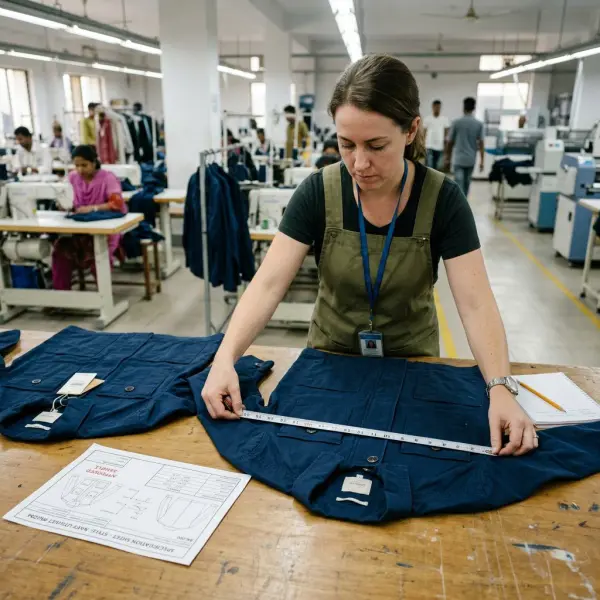
The brand and buyer need enough detail to determine whether bulk products conform to the approved offer. Quality criteria may cover measurements, material, workmanship, colour, print placement, trims, labels, packaging, carton quantities, and appearance.
A practical quality file may include:
- Approved sample
- Measurement tolerances
- Workmanship standard
- Defect categories
- Colour or shade standard
- Testing requirements
- Inspection stages
- Sampling method
- Acceptance criteria
- Rework procedure
- Release authority
- Claims process
The depth of the system should match the order’s scale, product risk, and buyer expectations. A small pilot order does not necessarily require the same inspection protocol as a large department-store programme, but it still needs an agreed reference.
Calculate the Full Export Price
Export pricing should begin with the commercial structure of the transaction, not by adding an estimated freight charge to the domestic wholesale price.
The calculation may need to include:
- Materials and trims
- Cutting and manufacturing
- Finishing
- Labels and packaging
- Product testing
- Quality inspection
- Documentation
- Inland transport
- Warehousing
- Freight-forwarder charges
- International transport
- Insurance
- Bank and payment costs
- Sales commission
- Currency buffer
- Financing cost
- Expected claims or rework allowance
- Target margin
Not every item will be the seller’s responsibility in every transaction. That is why delivery terms must be selected before the quotation is finalized.
State the Incoterms Rule Correctly
Incoterms® rules clarify defined responsibilities, costs, and risks between buyers and sellers in the delivery of goods. The current edition is Incoterms® 2020, containing 11 rules. The selected rule should be written with a named place or port and the edition—for example, “FCA [named place], Incoterms® 2020.” official ICC Incoterms 2020 overview
Incoterms rules do not establish every part of the sales relationship. They do not independently determine product ownership, complete payment conditions, product specifications, remedies for breach, or dispute resolution.
Those matters need separate contractual treatment.
Model the Landed Price
The exporter should also understand the likely landed price, even where the buyer is responsible for import costs.
A product that leaves the factory at a competitive price may become unattractive after freight, duty, tax, brokerage, local delivery, distributor margin, retailer margin, and currency conversion are added.
A simplified commercial chain may look like this:
|
Price layer |
Typical content |
|
Ex-factory cost |
Garment production and factory margin |
|
Export selling price |
Export preparation and seller margin |
|
Delivered or import cost |
Freight, insurance, clearance, and applicable duty |
|
Distributor price |
Importer or distributor operating margin |
|
Wholesale price |
Price charged to the retailer |
|
Retail price |
Retailer margin and applicable consumer taxes |
The exact structure varies. The purpose of modelling is not to dictate the buyer’s margin but to determine whether the final product can still occupy the intended market position.
Prepare Working Capital Before Accepting Volume
A profitable purchase order can still create a cash shortage.
Fashion production often requires deposits for fabric, trims, packaging, printing, and manufacturing before the exporter receives full payment. The larger the order, the greater the gap may become.
The brand should prepare a cash-flow schedule showing:
- Buyer deposit date
- Supplier deposit dates
- Material balance payments
- Labour and manufacturing payments
- Testing and inspection payments
- Freight and logistics payments
- Buyer balance date
- Possible delay scenarios
- Currency used for each payment
A buyer offering a large order with a low deposit and long payment terms may effectively ask the supplier to finance the production.
That may still be commercially acceptable, but it should be a conscious financing decision rather than an accidental consequence of the contract.
Verify the Buyer and Commercial Partner
A professional website, trade-show meeting, or branded email address does not eliminate counterparty risk.
Before extending credit, reserving production capacity, granting exclusivity, or sending high-value samples, the business should conduct reasonable due diligence.
Depending on the order, this may include:
- Confirming the legal company name
- Checking registration information
- Verifying the business address
- Reviewing the buyer’s sales channels
- Requesting trade references
- Confirming authorized contacts
- Checking payment history where possible
- Reviewing sanctions or restricted-party requirements
- Clarifying importer responsibilities
- Assessing whether requested volumes are commercially plausible
Due diligence should be proportionate. A small prepaid sample transaction does not require the same investigation as an exclusive distribution agreement or a large order supplied on open-account terms.
The purpose is not to distrust every buyer. It is to make the commercial exposure consistent with the available evidence.
Put the Sales Terms in Writing
An export transaction should not depend entirely on messages scattered across email, chat applications, video calls, and spreadsheets.
The final agreement should identify:
- Buyer and seller
- Products and specifications
- Quantities and size breakdown
- Price and currency
- Incoterms rule and named place
- Production lead time
- Delivery window
- Payment terms
- Sample and approval process
- Labelling and packaging
- Inspection method
- Defect and claims procedure
- Cancellation or change terms
- Intellectual-property responsibilities
- Governing law and dispute mechanism where appropriate
The contract does not need to be unnecessarily complicated, but ambiguity becomes expensive when goods have already been produced.
A purchase order should also be reviewed rather than treated as automatically correct. It may contain terms that differ from the quotation, negotiation, sample approval, or standard sales conditions.
Design the Export Documentation Workflow
Export documents should be generated from controlled transaction and product data.
Common documents may include:
- Pro forma invoice
- Commercial invoice
- Packing list
- Purchase order
- Export declaration
- Transport document
- Certificate or declaration of origin
- Insurance certificate
- Inspection report
- Test documentation
- Product-specific permit or declaration
The exact requirements vary by destination, transport method, product, and trade arrangement.
A reliable workflow assigns responsibility for preparing, reviewing, approving, sending, and archiving each document. It should also verify that product descriptions, quantities, currency, values, weights, delivery terms, carton numbers, and origin information remain consistent.
Create a Shipment Data Sheet
A central shipment data sheet can reduce repeated manual entry. It may contain:
- Buyer and consignee details
- Invoice number
- Purchase-order reference
- Style numbers
- Product descriptions
- Tariff codes
- Quantities
- Unit and total values
- Currency
- Country of origin
- Net and gross weights
- Carton dimensions
- Delivery term
- Named place
- Shipping method
- Required document list
The commercial invoice, packing list, customs declaration, and freight booking can then be checked against the same approved source.
Prepare Packaging for the Journey and the Market
Export packaging must protect the product, support handling, meet buyer requirements, and avoid unnecessary cost or volume.
Fashion businesses should prepare specifications for:
- Folding method
- Individual product protection
- Size and colour identification
- Barcode or stock label
- Polybag or alternative packaging
- Moisture protection where appropriate
- Carton strength
- Carton dimensions
- Carton quantity
- Assortment ratio
- Shipping marks
- Pallet requirements
- Retail-ready presentation where required
Packaging affects freight cost because carriers may charge according to actual or volumetric weight. An oversized carton can erode margin even when the garments themselves are light.
Sustainability decisions also need operational judgment. Reducing packaging material may be desirable, but under-protection can create damage, contamination, creasing, or returns. The better solution is to test whether the packaging is appropriate for the product, transport mode, storage conditions, and buyer’s handling system.
Prepare the Sales and Buyer Information Package
Buyers need information that helps them evaluate both the product and the supplier.
A professional export sales package may contain:
- Company profile
- Brand positioning
- Product catalogue
- Line sheet
- Wholesale prices
- Recommended retail prices where appropriate
- Minimum order quantities
- Size and colour options
- Lead times
- Sample policy
- Payment terms
- Delivery terms
- Production location
- Material and compliance information
- Relevant certifications
- Contact and order process
The presentation should remain accurate. A visually polished line sheet cannot compensate for unclear pricing, unrealistic delivery promises, or products that are not available at the stated minimum quantity.
Claims about production capacity, certifications, sustainability, retail partnerships, or market reach should be verifiable.
Assign Internal Ownership
Export work often crosses sales, design, production, finance, quality, compliance, and logistics. When ownership is unclear, every task moves back to the founder.
Before market entry, the business should assign responsibility for:
|
Activity |
Primary owner |
Required approval |
|
Buyer quotation |
Sales or commercial lead |
Finance and production |
|
Product specification |
Product-development lead |
Design and quality |
|
Compliance review |
Compliance or appointed specialist |
Management |
|
Material ordering |
Sourcing or production |
Finance |
|
Quality inspection |
Quality lead |
Shipment-release authority |
|
Export documents |
Logistics or administration |
Commercial reviewer |
|
Buyer updates |
Account owner |
Management for major changes |
|
Payment monitoring |
Finance |
Commercial lead |
A small company may assign several roles to one person. The important point is that responsibility is explicit and supported by documented information.
Run a Commercially Meaningful Pilot
A pilot order should test the actual export process, not only whether a courier can deliver a sample.
A useful pilot includes enough complexity to evaluate:
- Purchase-order confirmation
- Product specifications
- Material availability
- Production scheduling
- Quality inspection
- Destination-market labels
- Export packaging
- Commercial documentation
- Freight coordination
- Buyer receipt
- Claims or feedback
- Actual margin
The pilot does not need to be large, but it should resemble the intended commercial model.
A direct-to-consumer brand might test a limited launch involving real international orders, duty communication, fulfilment, customer service, and returns. A wholesale brand might test a small multi-size order for one retailer.




Comments 0
Leave a CommentSend Comment
Anda harus Login terlebih dahulu untuk dapat memberikan komentar.