
Bamboo Viscose vs Cotton: Which Fabric Feels Better for Daily Wear?
Quick Answer
Bamboo viscose often feels smoother, silkier, and more fluid than a basic cotton fabric, while cotton commonly feels drier, more familiar, and structurally stable. Neither fiber is universally more comfortable for daily wear because the final experience depends on yarn quality, fabric weight, knit or weave construction, finishing, garment fit, climate, activity level, and laundering.
For relaxed T-shirts, underwear, sleepwear, and loungewear, bamboo viscose may be preferred when the priority is a soft surface and flowing drape. Cotton may be the stronger choice for everyday garments that need a crisp handfeel, easier care, abrasion resistance, or greater shape stability. Blends can provide a practical middle ground.
Moisture absorption should not be confused with moisture management. Bamboo viscose can absorb substantial moisture, but that does not automatically make it faster drying or better at transporting sweat away from the body. Research comparing regenerated bamboo and cotton fabrics has produced results that vary with fabric structure and test method, so broad claims that one is always cooler or more breathable are not technically reliable.
What Are Bamboo Viscose and Cotton?
Bamboo viscose and cotton are both cellulose-based fibers, but they reach the textile mill through very different routes.
Cotton is a natural staple fiber collected from the seed bolls of cotton plants. After harvesting and ginning, the fibers are cleaned, carded or combed, spun into yarn, and converted into knitted or woven fabric.
Bamboo viscose is a manufactured regenerated cellulosic fiber. Bamboo is used as the cellulose feedstock, but the plant material is converted into dissolving pulp, chemically dissolved, and regenerated into a new fiber. Most garments sold as bamboo are therefore technically rayon or viscose made from bamboo rather than fabric made directly from natural bamboo fibers. The US Federal Trade Commission requires this distinction in US labeling and advertising. FTC guidance on bamboo textile labeling
That difference affects more than labeling. It influences fiber uniformity, yarn behavior, drape, wet strength, laundering response, sourcing documentation, and how brands should communicate environmental claims.
Readers who need a deeper explanation of the manufacturing routes can review bamboo fabric properties, production, and fashion uses.
Which Fabric Feels Softer?
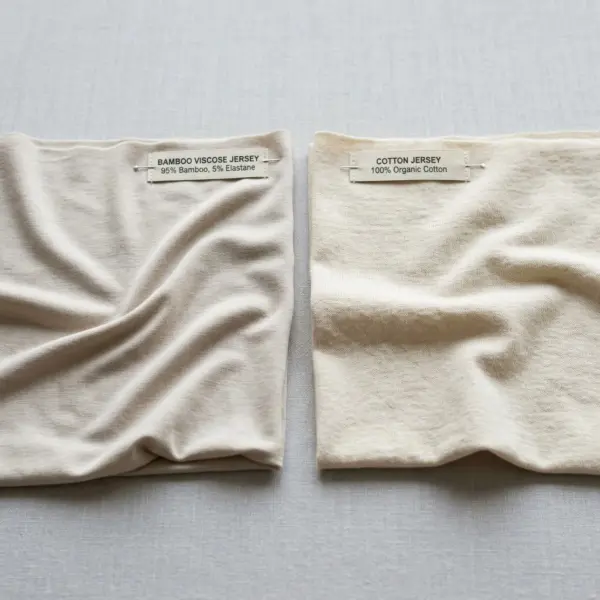
Bamboo viscose frequently feels smoother and silkier than standard cotton, particularly when it is spun into fine yarn and knitted into lightweight jersey. Regenerated viscose fibers can be produced with a relatively uniform surface, allowing the fabric to drape closely and slide easily against the skin.
Cotton softness varies more visibly between grades and constructions. Shorter or coarser fibers may create a slightly hairier, drier surface, while long-staple combed cotton can feel exceptionally smooth. Brushing, enzyme washing, silicone softening, mercerization, yarn twist, and fabric density can further change the result.
This means that “bamboo is softer than cotton” is reasonable as a common first-touch observation, but not as a universal material rule.
A premium combed cotton interlock may feel smoother and more substantial than a low-quality bamboo-viscose single jersey. Likewise, heavily softened bamboo fabric may feel luxurious in a showroom but lose some of that sensation after several wash cycles.
Why First Touch Can Be Misleading
Fashion buyers often evaluate fabric by rubbing a new swatch between their fingers. That test is useful, but incomplete.
Fabric softness can come from several sources:
- the inherent surface and flexibility of the fiber;
- fiber fineness and staple length;
- yarn hairiness and twist;
- knitted or woven construction;
- mechanical finishing;
- enzyme treatment;
- silicone or other chemical softeners;
- residual moisture;
- washing and tumble drying.
Some finishing treatments gradually wash away. Others may increase surface fuzzing or reduce moisture wetting performance. A fabric should therefore be assessed in its original condition and after repeated laundering.
For a daily-wear product, retained softness is usually more commercially important than impressive showroom softness.
Softness Is Not the Same as Skin Comfort
A smooth handfeel may reduce the sensation of roughness, but total skin comfort also depends on garment fit, seam construction, heat, perspiration, labels, elastics, dyes, finishes, and personal sensitivity.
A bamboo-viscose underwear fabric can be very soft while still feeling uncomfortable if the elastic is tight or the seams are bulky. A basic cotton T-shirt can feel pleasant all day when it fits loosely and allows air circulation.
Brands should evaluate the complete garment rather than turning a fiber characteristic into a medical or hypoallergenic claim.
How Do Bamboo Viscose and Cotton Differ in Daily Wear?
The most useful comparison is not a single softness ranking. It is a review of how each fabric behaves across the conditions people encounter during ordinary use.
|
Daily-wear factor |
Bamboo viscose |
Cotton |
Practical interpretation |
|
Initial handfeel |
Commonly smooth, soft, and silky |
Often soft but drier and more familiar |
Bamboo viscose may create a stronger luxury first impression |
|
Drape |
Fluid and body-following |
Varies from soft to structured |
Cotton is often easier for stable or boxy silhouettes |
|
Moisture absorption |
Generally high |
Also absorbent |
Neither automatically guarantees fast drying |
|
Airflow |
Depends on construction and thickness |
Depends on construction and thickness |
Fiber name alone cannot determine breathability |
|
Drying behavior |
May retain moisture in dense fabrics |
Can also dry slowly, especially in heavy cotton |
Fabric weight and structure are decisive |
|
Shape retention |
Can be vulnerable to growth or distortion |
Often relatively stable, depending on construction |
Bamboo-viscose garments need careful stabilization |
|
Abrasion resistance |
Can fuzz or pill in soft lightweight qualities |
Often robust in well-built fabrics |
Cotton may suit higher-friction daily products |
|
Wrinkling |
May crease and lose surface smoothness |
Often wrinkles, particularly in untreated woven fabrics |
Finishing and garment structure affect both |
|
Care tolerance |
May require gentler handling |
Often tolerates routine laundering well |
Actual care instructions must come from testing |
|
Familiarity |
Less consistently understood by consumers |
Highly familiar globally |
Cotton may be easier to communicate and merchandise |
The table describes common patterns rather than guaranteed outcomes. Fabric engineering can reverse several of these differences.
Which Fabric Feels Cooler in Hot Weather?
Neither bamboo viscose nor cotton is automatically cooler in every garment. Thermal comfort is influenced by fiber chemistry, yarn, thickness, fabric density, porosity, air permeability, moisture content, garment fit, ambient humidity, wind, and physical activity.
A lightweight loose cotton voile may feel cooler than a dense bamboo rib knit. A thin bamboo-viscose jersey may feel cooler against the skin than a heavy cotton interlock. Comparing fiber names without matching fabric specifications produces little useful information.
One study comparing rib-knitted fabrics made from regenerated bamboo, cotton, and a 50:50 blend reported reduced garment thickness and body heat-storage rate for the tested 100% regenerated bamboo construction. The result applies to the specific yarns and knitted structures studied; it does not establish that every bamboo-viscose garment is cooler than every cotton garment.
A broader review of sportswear fabric engineering found no consistent empirical basis for treating regenerated bamboo as universally superior to cotton or conventional viscose in thermal and moisture-management performance. The review emphasized that fabric structure can be as influential as fiber type.
The Cool-Touch Effect
Bamboo-viscose fabric may initially feel cool when placed against the skin. This sensation can result from a smooth, moisture-absorbing surface transferring heat away from the skin during initial contact.
Cool touch is a transient sensation. It does not necessarily mean that the garment will maintain a lower microclimate temperature after hours of wear.
For long-duration comfort, brands should consider:
- air permeability;
- thermal resistance;
- fabric thickness;
- water-vapor transmission;
- liquid spreading;
- drying time;
- garment ventilation;
- cling when damp.
A consumer may enjoy the cool first touch of bamboo-viscose pajamas but still prefer loose cotton clothing during a humid day because of the garment’s structure and drying behavior.
Moisture Absorption vs Moisture Management
Bamboo viscose and cotton both absorb water because they are cellulose-based fibers. Bamboo viscose is often promoted as particularly absorbent, but higher absorption does not automatically produce better sweat management.
Moisture comfort involves several separate processes:
- Perspiration reaches the fabric.
- The inner surface wets.
- Liquid spreads or moves through the structure.
- Moisture reaches a larger evaporation area.
- Water vapor or liquid leaves the garment.
- The fabric dries without prolonged cling or chilling.
A fabric can absorb a large amount of sweat but hold it close to the skin. Another fabric may absorb less into the fiber itself but use capillary pathways to spread moisture quickly.
A study of cotton, bamboo, and bamboo-cotton knitted fabrics found that the tested constructions all achieved useful moisture-management behavior, but their spreading and transport characteristics differed. The findings reinforce the need to evaluate the specific fabric rather than infer performance from fiber content.
Research on bamboo viscose, cotton, and other regenerated fibers also shows that porosity, weight, fabric structure, and blend proportion materially affect measured moisture performance.
Why Absorbent Fabrics Can Dry Slowly
When water penetrates deeply into hydrophilic fibers, more energy and time may be required to remove it. Dense fabrics also contain more material and may hold a larger quantity of moisture.
This is particularly relevant for:
- thick T-shirts;
- sleepwear used in hot climates;
- underwear;
- socks;
- towels;
- children’s basics;
- travel clothing;
- yoga or studio apparel.
A lightweight bamboo-viscose garment can feel comfortable during moderate perspiration but unpleasant when saturated. A similar issue occurs with heavy cotton.
Brands promoting “quick drying” should support the statement with finished-fabric or garment testing. Absorbency data alone is not sufficient.
Cotton Can Be Engineered for Moisture Performance
Untreated cotton is absorbent but does not always transport and dry perspiration as efficiently as purpose-built performance textiles. Textile construction and finishing technologies can alter this behavior.
Cotton Incorporated, an industry-funded cotton research organization, has developed finishing systems intended to improve cotton wicking and drying. These examples demonstrate that fiber performance is not fixed; finishes and fabric engineering can materially change the wearer experience. Cotton moisture-management technologies
The same principle applies to bamboo viscose. A well-engineered blend can outperform a poorly constructed 100% fabric, regardless of which fiber has the stronger marketing story.
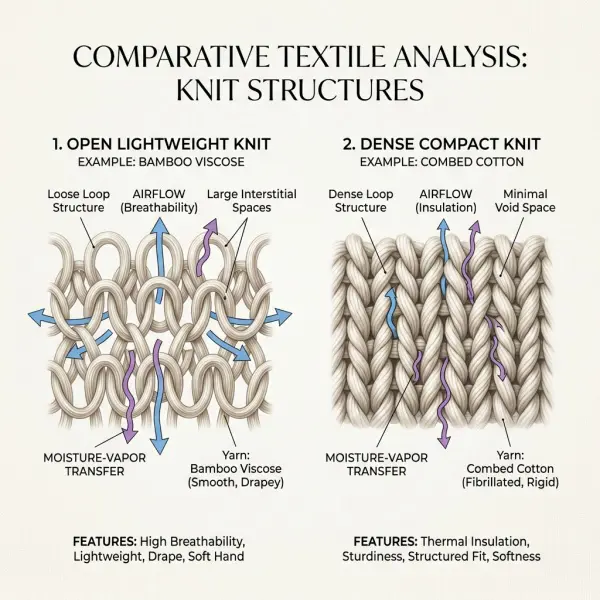
Breathability Depends More on the Fabric Than the Label
Breathability is commonly used as a broad marketing word, but it can refer to air permeability, water-vapor permeability, or general thermal comfort. These are related but not identical properties.
A loose fabric with open pores normally allows more air movement than a dense structure. Fabric thickness, loop length, weave density, yarn diameter, surface finishing, and stretch can alter the available air pathways.
Research examining clothing comfort consistently identifies fabric structure, density, thickness, humidity, air permeability, and surface treatment as major influences alongside fiber type.
For sourcing teams, the operational lesson is simple: do not approve a “breathable bamboo fabric” without specifications or test data.
Ask for:
- fabric weight in grams per square meter;
- knit or weave construction;
- thickness;
- air permeability;
- water-vapor resistance or permeability;
- moisture-management results;
- drying time;
- test conditioning and method.
A supplier may describe two fabrics as 95% bamboo viscose and 5% elastane while one is a lightweight single jersey and the other a dense rib. Their daily-wear comfort can be dramatically different.
Drape, Fit, and Garment Silhouette
Bamboo viscose generally creates a softer, more fluid silhouette than basic cotton of a comparable lightweight category. It can fall close to the body, move easily, and create rounded folds rather than crisp volume.
This behavior works well for:
- relaxed T-shirts;
- soft tanks;
- body-skimming dresses;
- draped tops;
- pajamas;
- wide-leg lounge pants;
- maternity apparel;
- underwear;
- lightweight cardigans.
Cotton can be developed across a broader structural range. Fine cotton jersey may drape softly, while poplin, canvas, denim, pique, Oxford cloth, or heavy interlock can hold more defined shapes.
For product developers, the choice is partly visual. A boxy premium T-shirt often benefits from the body and stability of cotton. A fluid lounge top may benefit from bamboo viscose.
Fluidity Can Create Fit Problems
The same softness that makes bamboo viscose attractive can allow a garment to grow during sewing, pressing, hanging, or wear.
Potential problems include:
- necklines becoming wider;
- shoulder seams dropping;
- hems lengthening;
- knees or elbows bagging;
- side seams twisting;
- garments clinging more than expected;
- dimensional change after washing.
Patternmakers may need to adjust seam stabilization, neckband ratio, negative ease, garment length, and relaxation time before final measurement.
Cotton is not immune to shrinkage or distortion, particularly in unstable knit structures, but many cotton fabrics provide a firmer platform for shapes that need definition.
Durability and Appearance After Repeated Wear
Cotton is often selected for everyday apparel because it can deliver a practical balance of comfort, abrasion resistance, wash tolerance, and shape. Actual durability varies considerably by fiber length, yarn quality, fabric weight, construction, finishing, and garment care.
Bamboo-viscose fabrics can also be durable enough for daily products, but lightweight, highly softened qualities may be vulnerable to fuzzing, pilling, snagging, or dimensional instability.
Viscose fibers can lose strength when wet compared with their dry state. This does not mean bamboo-viscose garments are inherently fragile, but it makes wet handling, washing, drying, and fabric engineering important.
Pilling Is Not Determined by Fiber Name Alone
Pilling develops when loose fibers migrate to the surface, become entangled, and remain attached as small balls. The outcome depends on fiber length, yarn twist, hairiness, fabric structure, abrasion, singeing, finishing, and the strength of the fibers holding each pill.
A very soft bamboo-viscose jersey may develop surface fuzz because the yarn has been engineered for a low-twist, plush handfeel. A cheap cotton jersey can pill for similar reasons. A compact, well-specified version of either material may perform much better.
The correct sourcing response is to establish a pilling-performance requirement for the intended use and test the finished color and finish.
Shape Retention Matters in Daily Basics
Consumers notice when T-shirts twist, pajamas grow longer, waistbands curl, or knees remain stretched. These failures may matter more to customer satisfaction than the difference between two fibers at first touch.
For bamboo-viscose products, brands should pay particular attention to:
- length and width shrinkage;
- spirality;
- stretch recovery;
- neckline recovery;
- seam growth;
- appearance after washing;
- pilling and fuzzing;
- wet garment handling.
Cotton products should be tested against the same criteria. Familiarity does not make cotton automatically stable.
Which Fabric Is Easier to Care For?
Cotton is often easier for consumers to understand because it has a long history in routine clothing care. Many cotton T-shirts, underwear products, and home textiles can tolerate regular machine washing, although heat may still cause shrinkage, fading, or surface wear.
Bamboo-viscose garments frequently benefit from lower temperatures, mild detergent, moderate agitation, and controlled drying. Care requirements depend on construction and finishing rather than the fiber name alone.
A poorly stabilized garment should not be protected indefinitely by an excessively restrictive care label. Product developers should test the garment under realistic consumer conditions and determine whether the proposed instructions are commercially acceptable.
For mass-market daily wear, care complexity affects:
- return rates;
- customer satisfaction;
- review scores;
- garment longevity;
- energy and water used during ownership;
- suitability for travel or family use.
A fabric that feels slightly more luxurious but requires careful handling may work for premium loungewear. It may be less suitable for school basics, uniforms, or high-frequency family laundry.
Do Bamboo Viscose Clothes Control Odor Better?
Bamboo-viscose garments should not automatically be described as naturally antibacterial or odor resistant. The manufacturing process dissolves and regenerates the plant cellulose, and there is no reliable basis for assuming that antibacterial characteristics associated with the growing bamboo plant remain in the finished rayon fiber.
The FTC has specifically warned sellers against unsupported claims that rayon made from bamboo retains natural antimicrobial properties. FTC consumer guidance on bamboo fabric claims
Odor performance in clothing depends on several interacting factors:
- how much perspiration the garment absorbs;
- how rapidly it dries;
- bacterial growth on skin and textile surfaces;
- fabric construction;
- laundering;
- finishing treatments;
- activity level;
- garment fit;
- personal physiology.
A bamboo-viscose garment may feel fresher to an individual wearer because it is soft, absorbent, or loosely fitted. That subjective experience is not the same as verified antimicrobial performance.
Where odor-control or antibacterial claims are commercially important, brands should test the finished product through an appropriate method and determine whether the effect survives laundering.
Is Bamboo Viscose Better for Sensitive Skin?
Bamboo-viscose fabric can feel comfortable against the skin because it is often smooth and flexible. Cotton can also be highly suitable for close-to-skin products, particularly when made from fine yarn and processed with carefully controlled dyes and finishes.
Neither fiber is universally hypoallergenic.
Skin response may be influenced by:
- residual processing chemicals;
- dyes and pigments;
- formaldehyde-based finishes;
- softeners;
- antimicrobial treatments;
- detergents;
- elastic components;
- labels and seams;
- garment tightness;
- individual allergies or skin conditions.
Brands should avoid broad medical promises. More defensible communication includes statements about verified fiber composition, smooth construction, product testing for harmful substances, flat seams, tag-free design, or absence of a specifically documented substance.
For babywear, underwear, sleepwear, or products marketed to sensitive users, the finished garment should be evaluated—not merely the undyed fiber.
Which Fabric Is Better for Different Daily-Wear Products?
There is no single winner across every apparel category. The product requirement should determine the material choice.
|
Product category |
Bamboo viscose may work well when… |
Cotton may work well when… |
|
Everyday T-shirts |
Softness and fluid drape are priorities |
Shape, structure, familiarity, and wash tolerance matter |
|
Underwear |
A smooth, flexible surface is required |
A firmer, familiar handfeel or simple care is preferred |
|
Sleepwear |
Cool touch and soft movement support the concept |
Durability and frequent laundering are priorities |
|
Loungewear |
The collection uses relaxed, body-following silhouettes |
The product needs more body or fleece-like structure |
|
Socks |
Softness and moisture absorption are desired |
Abrasion resistance and proven construction are priorities |
|
Children’s basics |
Softness is supported by robust testing |
Frequent washing and hard wear dominate the brief |
|
Dresses |
Fluid drape and movement are central |
The style needs crisp volume or defined shape |
|
Travel basics |
Lightweight softness is valuable |
Fast, predictable care and resilience matter |
|
Light activewear |
The activity is low intensity and the blend has recovery |
Familiar cotton comfort suits casual movement |
|
High-intensity activewear |
Only with engineered moisture and recovery performance |
Usually requires finishes or synthetic blending as well |
These are product-development starting points, not purchasing rules.
Everyday T-Shirts
Bamboo-viscose jersey creates a soft, fluid T-shirt that often falls closer to the body. It can suit premium basics, relaxed fits, or garments marketed around tactile comfort.
Cotton jersey offers more options for structured silhouettes, from lightweight combed single jersey to dense heavyweight tees. Cotton may also be easier to cut, sew, print, and stabilize depending on the chosen quality.
The better option depends on whether the brand wants a draped, silky T-shirt or a substantial garment that holds its shape.
Underwear and Sleepwear
Bamboo viscose is commercially attractive for underwear and sleepwear because first-touch softness is immediately noticeable. Yet these garments also require stretch recovery, seam durability, wash stability, and suitable drying performance.
Cotton remains a strong option where consumers value natural-fiber familiarity and straightforward care. Cotton-elastane can provide stable everyday underwear, while bamboo-viscose-elastane may create a softer, more fluid alternative.
The deeper role of bamboo-based materials in underwear and loungewear is examined in why bamboo-based fabrics are popular in comfort-focused apparel.
Children’s Clothing
Softness matters in childrenswear, but daily laundering, staining, crawling, playground friction, and dimensional stability are equally important.
A bamboo-viscose children’s basic may perform well when the fabric is compact, stable, colorfast, and tested through repeated washing. Cotton may be easier to use for hard-wearing basics where abrasion and routine care are dominant requirements.
Claims about sensitive skin, antibacterial behavior, or chemical-free production require evidence regardless of the selected fiber.
Can Bamboo Viscose and Cotton Be Blended?
Bamboo viscose and cotton are commonly blended to combine characteristics rather than force a choice between them.
A bamboo-viscose–cotton blend may provide:
- a softer handfeel than a comparable basic cotton fabric;
- more body than 100% lightweight bamboo viscose;
- improved processing stability;
- a balanced drape;
- differentiated brand positioning;
- access to familiar cotton finishing and garment formats.
The result depends on the blend ratio, yarn spinning system, fiber length, fabric construction, and finish. A 70:30 cotton-to-bamboo blend will not behave like a 30:70 blend.
Research on bamboo-cotton knitted and woven fabrics confirms that blend proportion and structure affect air permeability, moisture management, mechanical behavior, dyeing, and shrinkage. The direction and size of the effect differ between studies and constructions.
When a Blend Makes Commercial Sense
A blend is useful when it solves a measurable design or production problem.
For example, a brand may find that its 100% bamboo-viscose pajama fabric feels excellent but stretches during sewing and grows after washing. Introducing cotton, changing yarn twist, or moving to a more stable construction may create a more reliable product without losing the desired softness.
A blend should not be presented as automatically superior. It adds complexity to sourcing, testing, labeling, and recycling. The performance benefit should justify that complexity.

What About Environmental Impact?
A comfort comparison does not determine which material has the lower environmental impact. Bamboo viscose and cotton each involve multiple production systems with widely varying results.
Cotton impacts depend on factors such as location, irrigation, fertilizer and pesticide practices, yield, soil management, ginning, energy, spinning, dyeing, finishing, product durability, and disposal.
Bamboo-viscose impacts depend on land and bamboo sourcing, dissolving-pulp production, chemical management, solvent or chemical recovery, energy, air emissions, wastewater, dyeing, finishing, durability, and end of life.
The bamboo plant’s growth characteristics do not automatically make conventional bamboo viscose environmentally preferable to cotton. Likewise, cotton should not be treated as one uniform system.
The comparative study of polyester-bamboo-viscose and polyester-cotton fabrics explicitly noted that the environmental profile of bamboo viscose depends on the production method.
A responsible brand should compare defined supply chains rather than generic fiber names. Relevant evidence may include:
- origin and chain of custody;
- fiber-producer identity;
- chemical recovery;
- wastewater and air-emission performance;
- energy mix;
- farming or forestry practices;
- restricted-substance testing;
- lifecycle assessment boundaries;
- garment durability;
- verified content documentation.
Sustainability should not be used as a shortcut for predicting comfort, and comfort should not be treated as proof of sustainability.
What Fashion Businesses Should Test Before Choosing
Fabric selection should move from subjective touch to controlled product validation.
Match the Test to the Product
A daily T-shirt, pajama set, sock, underwear product, and summer dress require different performance thresholds.
A practical test program may include:
- fabric weight and thickness;
- fiber composition;
- dimensional stability;
- spirality or skew;
- pilling;
- abrasion;
- bursting or tensile strength;
- stretch and recovery;
- air permeability;
- water-vapor permeability;
- liquid moisture management;
- drying time;
- colorfastness;
- seam performance;
- appearance after laundering.
Not every product requires every test, but comfort claims should be connected to measurable performance where possible.
Compare Like With Like
A meaningful bamboo-viscose versus cotton trial requires fabrics with reasonably matched:
- garment type;
- weight;
- thickness;
- knit or weave;
- fit;
- coverage;
- finish;
- color;
- care method.
Comparing a lightweight bamboo single jersey with a heavyweight cotton fleece will say more about fabric construction than fiber.
Conduct Wear Trials
Laboratory testing cannot fully reproduce daily routines. A small, structured wear trial can identify issues that instruments may not capture clearly.
Participants can evaluate:
- first-touch softness;
- comfort after several hours;
- dampness during activity;
- cling;
- drying after perspiration;
- odor perception;
- shape retention;
- irritation at seams or elastics;
- appearance after laundering;
- preference by climate and activity.
The sample should be large and diverse enough to reveal variation, but brands should not present an informal wearer trial as clinical proof.
Common Comparison Mistakes
Declaring Bamboo the Winner Based on One Swatch
A single premium bamboo-viscose swatch is often compared with an inexpensive standard cotton fabric. The conclusion then reflects quality level, construction, and finishing rather than fiber alone.
A fair comparison requires similar product specifications and multiple laundering cycles.
Using “Absorbs More” to Mean “Wicks Better”
Absorption, wicking, spreading, vapor transmission, and drying are different processes. Converting one test result into a complete moisture-management claim can mislead consumers.
Brands should state the measured property precisely.
Ignoring Garment Fit
Loose cotton can feel cooler than tight bamboo viscose because airflow and skin contact differ. A poorly fitted garment can overwhelm small material advantages.
Comfort testing should use the intended pattern and size specification.
Treating All Cotton as Basic Cotton
Combed cotton, long-staple cotton, mercerized cotton, open-end yarn, ring-spun yarn, compact yarn, jersey, interlock, poplin, and fleece offer very different experiences.
“Cotton” is a broad material category, just as “bamboo fabric” is often an imprecise commercial term.
Treating Bamboo as an Antibacterial Fiber
Bamboo viscose should not inherit marketing claims from the natural plant without finished-product evidence. Regulators have challenged this practice.
Choosing Handfeel Over Product Longevity
A fabric that wins the first-touch test but pills, twists, or grows after washing may produce more dissatisfaction than a slightly drier fabric that retains its appearance.
For daily wear, comfort must survive use.
A Decision Framework for Fashion Brands
Brands can make a practical choice by working through four questions.
1. What Should the Garment Feel Like?
Choose bamboo viscose when the concept depends on a smooth surface, fluid drape, and soft close-to-skin sensation.
Choose cotton when the product requires a drier touch, more body, crispness, or familiar everyday texture.
2. How Will the Garment Be Used?
Consider activity, climate, washing frequency, friction, travel, drying conditions, and expected service life.
Soft sleepwear and hard-wearing school basics should not use the same decision criteria.
3. Can the Supplier Control the Fabric?
Review yarn quality, construction, finishing, shrinkage, pilling, recovery, repeatability, traceability, and testing capacity.
A stable supplier relationship can matter more than a theoretically ideal fiber.
4. Can the Product Claims Be Supported?
Use the correct generic fiber name. Avoid unsupported antibacterial, hypoallergenic, quick-drying, or environmental superiority claims.
A precise statement such as “95% viscose made from bamboo and 5% elastane, developed for a soft, fluid handfeel” is more credible than a collection of broad natural-performance promises.
Frequently Asked Questions
Is Bamboo Viscose Softer Than Cotton?
Bamboo viscose often feels smoother and silkier than standard cotton because regenerated fibers can be made relatively uniform and spun into fine yarn. This is a common first-touch difference rather than a guaranteed hierarchy.
Premium combed or long-staple cotton can also feel exceptionally soft, while low-quality bamboo viscose may feel thin, fuzzy, or over-finished.
The better comparison is between finished fabrics of similar weight and construction after repeated washing. For brands, retained softness, pilling resistance, shape stability, and customer care expectations are more useful than showroom handfeel alone.
Is Bamboo Viscose More Breathable Than Cotton?
Not automatically. Breathability depends heavily on fabric thickness, porosity, density, yarn, knit or weave structure, finishing, and garment fit.
Some studies have reported favorable air or vapor permeability for particular regenerated-bamboo fabrics or blends, while broader textile reviews caution that regenerated bamboo is not consistently superior across all structures.
A lightweight open cotton knit may be more breathable than a dense bamboo-viscose fabric. Brands should request air-permeability or vapor-resistance data for the actual finished fabric.




Comments 0
Leave a CommentSend Comment
Anda harus Login terlebih dahulu untuk dapat memberikan komentar.