
Why Emotional Connection Matters in Everyday Fashion Decisions
Quick Answer
Emotional connection matters in everyday fashion decisions because clothing can acquire personal significance beyond its appearance, price, and functional purpose. Individuals may develop emotional attachments to garments through positive wearing experiences, personal memories, self-expression, cultural associations, familiarity, and a sense of continuity in their identity.
These connections can influence what people purchase, which garments they repeatedly wear, how they care for their clothing, and what they decide to retain, repair, replace, or discard. A familiar jacket, for example, may remain valuable to its owner long after newer alternatives become available because it combines practical usefulness with meaningful personal associations.
For fashion businesses, understanding emotional attachment offers opportunities to develop more relevant products, strengthen customer relationships, and support longer-lasting wardrobe experiences. Consistent fit, dependable quality, thoughtful personalization, authentic storytelling, and accessible after-sales services can provide conditions in which meaningful customer-product relationships develop.
However, emotional attachment does not automatically guarantee brand loyalty, higher sales, or sustainable consumption. Customers may retain sentimental garments without wearing them, while emotionally motivated shopping can sometimes encourage unnecessary purchases. The commercial and environmental value of emotional connection therefore depends on how it translates into actual consumer behavior.

What Is Emotional Connection in Fashion?
Emotional connection in fashion refers to the personal significance and feelings that individuals associate with clothing, accessories, fashion brands, and the experiences surrounding their use. These connections may develop before a purchase, through anticipation and identification with a product, or gradually through ownership, repeated wear, and meaningful life experiences.
Unlike purely functional product evaluation, emotional connection involves subjective interpretations that cannot be fully explained through garment specifications. Two jackets may offer comparable materials, construction quality, and protection from cold weather, yet one may hold considerably greater personal value because of its associations with a particular person, event, or period of life.
Emotional connection is a broad concept. Emotional attachment describes a more specific bond that develops between an individual and a particular object or brand. A customer may enjoy looking at a fashion collection without becoming attached to any individual garment, while an ordinary shirt may eventually become a meaningful possession through years of use.
Research by Hendrik N. J. Schifferstein and Elly P. H. Zwartkruis-Pelgrim, published in the International Journal of Design in 2008, provides a useful foundation for understanding this distinction. Their study, Consumer-Product Attachment: Measurement and Design Implications, examined seven potential determinants of attachment to durable consumer products. Among the factors investigated, memories and enjoyment made positive contributions to attachment in their analysis.
Although this research was not limited to apparel, its findings help explain why a garment's personal value may increase through experiences that cannot be anticipated from its original retail price.
Emotional Value vs Functional Value in Clothing
Functional value describes what a garment provides through its practical characteristics, while emotional value concerns the feelings, associations, and personal significance connected to that garment.
The two forms of value frequently overlap. A comfortable pair of trousers may initially be purchased for functional reasons but gradually become emotionally meaningful because it remains dependable throughout important everyday activities.
|
Aspect |
Functional value |
Emotional value |
|
Primary consideration |
Practical performance and suitability |
Personal meaning and emotional experience |
|
Typical attributes |
Fit, durability, coverage, mobility, comfort |
Familiarity, memories, identity, enjoyment |
|
Evaluation method |
Technical testing and practical assessment |
Subjective experiences and personal interpretation |
|
Development over time |
May change as materials and construction deteriorate |
May strengthen, weaken, or change through experience |
|
Replacement decision |
Influenced by performance and availability |
May involve reluctance to replace a meaningful garment |
|
Business implication |
Product quality and reliability |
Customer-product relationships and perceived relevance |
Fashion businesses should avoid treating these forms of value as competing objectives. Functional reliability can provide the foundation upon which emotional attachment develops, while personal significance may give customers additional reasons to maintain a garment after its initial purchase.
The Psychology Behind Emotional Attachment to Clothing
Clothing occupies an unusual position among consumer products because it is worn directly on the body, incorporated into everyday routines, and frequently involved in the presentation of personal identity. A garment can therefore become associated with experiences that extend considerably beyond its original commercial purpose.
Understanding these relationships requires examining identity, memory, familiarity, enjoyment, and personal aspirations rather than assuming that attachment develops simply because a product is fashionable or expensive.
Clothing as an Extension of Personal Identity
The concept of the extended self, introduced by consumer researcher Russell W. Belk in his influential 1988 article Possessions and the Extended Self, describes how individuals may incorporate possessions into their understanding and expression of who they are. The framework has become an important theoretical reference in consumer behavior research.
Applied to fashion, the extended self helps explain why certain garments feel particularly representative of their owners. A designer may repeatedly wear a distinctive jacket because it aligns with their creative identity, while another person may value an understated wardrobe that reflects their preference for simplicity.
These relationships do not necessarily depend on conspicuous labels or expensive materials. An inexpensive garment can become personally significant if it consistently supports how an individual understands or expresses themselves.
For fashion brands, the implication is that identity relevance cannot be measured exclusively through price positioning or visual exclusivity. Products need to fit into the lives and self-perceptions of the customers who purchase them.
Personal Memories and Associations
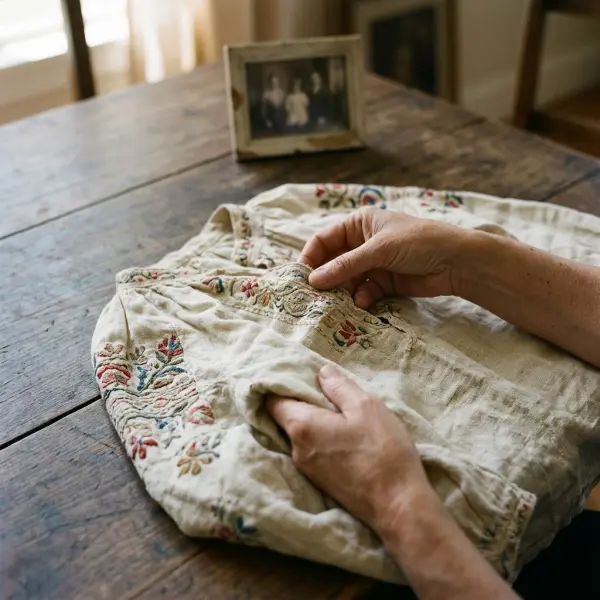
Clothing can become a tangible reminder of relationships, places, achievements, and different stages of life. A graduation dress, a jacket purchased during a meaningful trip, or a shirt inherited from a family member may carry associations that cannot be reproduced by an identical new garment.
Research published in the Journal of Consumer Culture, Memories Reminisced, Reconciled, Renewed: Hong Kong Male Consumers' Wardrobes and Their Search for a Congruent Self, examines relationships between fashion possessions, memories, emotions, and personal identity through wardrobe interviews. Its findings illustrate how both actively worn and inactive clothing can retain emotional significance.
This distinction matters because the value of a meaningful garment is not necessarily determined by wearing frequency. An inherited coat may remain important even when its size, construction, or style makes regular use impractical.
Fashion businesses cannot directly manufacture customers' personal memories. They can, however, develop products capable of accompanying meaningful experiences and provide services that help preserve garments when those associations develop.
Familiarity and Predictable Wearing Experiences
Familiar garments can become emotionally important because they provide a dependable experience. The wearer understands how the garment fits, how it feels throughout the day, how it responds to laundering, and how easily it coordinates with other clothing.
Consider a customer who regularly wears the same pair of jeans despite owning several newer alternatives. The preference may reflect a combination of familiar fit, fabric characteristics, movement allowance, and confidence that the garment is appropriate for different everyday activities.
Repeated use can create opportunities for attachment to develop, although frequent wearing does not necessarily indicate a strong emotional bond. Some garments are worn regularly simply because they are required for work, readily available, or affordable.
For apparel manufacturers, this highlights the importance of product consistency. A garment that performs reliably over time provides more opportunities for positive wearing experiences than one whose fit or material properties deteriorate prematurely.
Enjoyment and Sensory Satisfaction
Emotional attachment may also develop through the enjoyment of wearing a garment. Pleasant material sensations, satisfying movement, attractive visual details, and compatibility with personal style can contribute to a garment's perceived value.
A 2019 qualitative study by Rebecka Fleetwood-Smith, Kate Hefferon, and Carolyn Mair, Exploring the Lived Experience of Clothing Attachment During Wear, investigated the experiences of five participants wearing garments to which they felt emotionally attached. The researchers found that these garments carried personal and symbolic meanings that participants experienced through wearing them. The small qualitative sample provides detailed individual perspectives rather than population-wide estimates.
For product developers, the practical implication is that emotional relevance should be investigated through actual wearing experiences, not merely initial visual reactions during product selection.
The sensory and visual design characteristics supporting these experiences are explored further in How Clothing Colors, Textures, and Silhouettes Shape Style Expression.
Aspirational Identity and Personal Development
Clothing may also become emotionally significant because it represents a desired future identity rather than an existing one. A person entering a new profession, beginning a creative project, or adapting to a major lifestyle change may select garments associated with the person they hope to become.
This form of emotional motivation can encourage experimentation and provide a way of expressing personal development. However, it can also create a gap between anticipated ownership experiences and actual wardrobe requirements.
A customer may purchase formal clothing associated with an aspirational professional lifestyle but rarely encounter situations in which the garments are appropriate. The products remain emotionally appealing as symbols without necessarily becoming useful possessions.
Fashion retailers should recognize this distinction when developing aspirational campaigns. Showing customers how products fit into realistic daily activities can be more useful than presenting an idealized identity that depends primarily on continued purchasing.
Emotional Attachment vs Mood Dressing vs Brand Attachment
Emotional attachment, mood dressing, and brand attachment are related concepts within fashion psychology and consumer behavior, but they address different relationships between consumers and fashion.
Mood dressing concerns the influence of present or desired emotions on clothing selection. Emotional attachment concerns the significance of a particular garment or possession. Brand attachment concerns the relationship an individual develops with a commercial brand.
A person may choose a familiar sweater because they want a comforting dressing experience on a particular day. That decision reflects mood dressing. If the sweater carries memories of a meaningful period of life, it may also reflect garment attachment. If the person feels personally connected to the company that produced it, brand attachment may be involved as well.
|
Concept |
Primary focus |
Typical time orientation |
Example |
|
Mood dressing |
Current or desired emotional experience |
Immediate or situational |
Choosing familiar clothing before a demanding day |
|
Garment attachment |
Personal bond with a specific clothing item |
May develop over an extended period |
Retaining a meaningful jacket for many years |
|
Brand attachment |
Personal connection with a fashion brand |
Often develops through repeated interactions |
Feeling personally connected to a preferred apparel label |
|
Product satisfaction |
Evaluation of product performance against expectations |
Following purchase and use |
Being satisfied with a shirt's fit and construction |
|
Brand loyalty |
Continued preference or purchasing behavior toward a brand |
Across multiple purchasing occasions |
Repeatedly buying from the same retailer |
A 2010 study published in the Journal of Marketing, Brand Attachment and Brand Attitude Strength: Conceptual and Empirical Differentiation of Two Critical Brand Equity Drivers, distinguishes brand attachment from favorable brand attitudes. The researchers found that attachment offered additional predictive value for several consumer behaviors, including actual purchasing behavior and the proportion of relevant purchases allocated to a brand. These findings do not establish that attachment guarantees equivalent results in every fashion market.
For apparel businesses, an important practical distinction is that customers can become deeply attached to individual garments without developing equivalent loyalty to the companies that produced them. Conversely, repeated purchases from a retailer may be motivated primarily by affordability, accessibility, or reliable sizing rather than a strong emotional relationship.
The immediate relationship between emotional states and clothing selection is discussed in Mood Dressing Explained: How Emotions Influence Clothing Choices.
How Emotional Connection Influences the Fashion Decision Journey
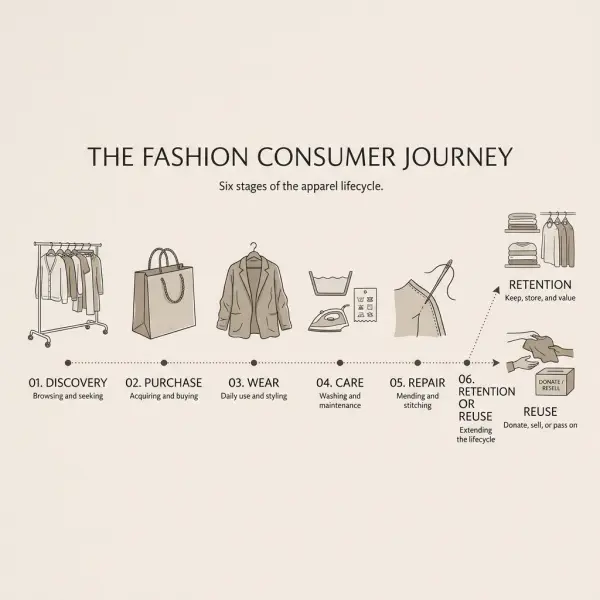
Emotional connection can influence multiple stages of fashion consumption, beginning with product discovery and continuing through purchase, ownership, use, maintenance, and eventual replacement or disposal.
These stages should not be understood as an inevitable sequence. Some customers develop attachment after years of ownership, while others lose interest shortly after purchasing a product that initially seemed meaningful. The relationship evolves through interactions between expectations, actual product performance, and changing personal circumstances.
Product Discovery and Initial Attraction
Emotional relevance may begin when a customer recognizes something personally meaningful in a product. The connection might involve a familiar design reference, a preferred aesthetic, a cultural association, or an anticipated wearing experience.
A customer encountering a modern interpretation of a traditional textile may feel drawn to the product because it connects contemporary clothing with a familiar cultural heritage. Another customer may respond to a jacket because its appearance aligns with an emerging personal style.
At this stage, the customer is primarily evaluating anticipated value. The actual relationship with the product remains uncertain because fit, comfort, construction, and everyday suitability have not yet been fully experienced.
Purchase Decisions and Anticipated Value
Emotional considerations may influence how individuals evaluate alternatives during purchasing. A customer may accept a higher price for a personally meaningful design or choose a familiar brand because previous product experiences have reduced uncertainty.
However, emotional appeal can also encourage purchasing decisions that receive insufficient practical evaluation. Limited-edition positioning, idealized lifestyle imagery, and the expectation of personal transformation may attract customers toward garments that do not suit their wardrobes.
Retailers can help reduce this gap by providing accurate sizing information, realistic styling examples, material specifications, and clear product descriptions. Emotional attraction should complement informed purchasing rather than replace it.
Ownership and Repeated Wear
The post-purchase experience is particularly important because it reveals whether the garment fulfills the expectations established during product discovery.
A shirt purchased because of its attractive design may become a wardrobe favorite if its fit remains comfortable, its appearance coordinates easily with existing clothing, and its fabric responds well to routine care. The emotional value of the product can strengthen through repeated satisfactory experiences.
This creates an important commercial distinction between attracting customers and delivering meaningful products. Effective campaigns may generate initial interest, but consistent product performance provides opportunities for longer-term attachment to develop.
Care, Maintenance, and Repair
Customers may choose to invest additional effort in maintaining garments they value. This can involve following appropriate care instructions, replacing damaged buttons, repairing seams, or arranging professional alterations.
The 2024 systematic literature review Defining Sustainable Clothing Use: A Taxonomy for Future Research examined 77 articles and identified wearing, caring, and repairing as three central dimensions of sustainable clothing-use practices. This framework highlights the importance of consumer behavior after the original transaction.
For fashion businesses, repairability and accessible maintenance services can support garment use beyond the initial product sale. However, emotional attachment alone does not guarantee that customers possess the resources, knowledge, or willingness required to maintain clothing.
Retention, Replacement, and Disposal
Emotional connection can influence whether customers retain, replace, donate, sell, or discard garments. A product carrying meaningful memories may be retained despite having limited practical use, while an ordinary garment with little personal significance may be replaced more readily.
Importantly, retention and continued use are different outcomes. A ceremonial garment preserved for sentimental reasons may remain in a wardrobe for decades without contributing substantially to everyday clothing needs.
Understanding this distinction allows businesses to assess the role of emotional attachment more accurately rather than assuming that long ownership automatically represents successful product utilization.
Why Some Garments Become Favorites While Others Remain Unworn
A favorite garment is not necessarily the most expensive, visually distinctive, or technically advanced product in a person's wardrobe. It may become a preferred item because it combines practical suitability, personal relevance, and positive experiences more successfully than available alternatives.
Imagine two jackets purchased at approximately the same time. The first features an impressive design but requires careful styling, has restrictive sleeves, and needs professional cleaning. The second is less visually distinctive but fits comfortably, coordinates with several outfits, and can be maintained easily. Over time, the second jacket may become more meaningful because it participates regularly in the owner's everyday life.
A 2013 study by Kirsi Niinimäki and Cosette Armstrong, From Pleasure in Use to Preservation of Meaningful Memories: A Closer Look at the Sustainability of Clothing via Longevity and Attachment, investigates the relationship between garment longevity, attachment, enjoyment, and meaningful experiences. Its research provides a clothing-specific perspective on how relationships with garments develop and change over time.
The following framework illustrates factors that may contribute to different wardrobe outcomes.
|
Factor |
Potential contribution to becoming a favorite |
Potential barrier to repeated wear |
|
Fit |
Predictable and comfortable wearing experience |
Restriction, instability, or inconsistent sizing |
|
Material performance |
Enjoyable handfeel and dependable wearability |
Irritation, excessive pilling, or poor recovery |
|
Personal style |
Compatibility with established aesthetic preferences |
Limited relevance outside an initial trend |
|
Wardrobe compatibility |
Easy coordination with existing garments |
Requires additional purchases to create outfits |
|
Emotional associations |
Meaningful memories and positive experiences |
Uncomfortable or unwanted personal associations |
|
Practical maintenance |
Manageable care and repair requirements |
Complicated cleaning or expensive maintenance |
|
Lifestyle suitability |
Relevant across recurring activities |
Purchased for an anticipated but infrequent occasion |
|
Perceived quality |
Confidence in continued product performance |
Premature deterioration or construction failure |
No individual factor guarantees that a garment will become a favorite. Personal circumstances, body measurements, preferences, and wardrobe requirements can change in ways that reduce the usefulness of an otherwise excellent product.
For fashion businesses, this reinforces the need to investigate actual product use. A successful initial sales period does not necessarily indicate that the product has become an established part of customers' wardrobes.
Emotional Durability and Its Relevance to Fashion
Emotional durability describes an approach to product design concerned with sustaining meaningful relationships between people and the products they use. Rather than focusing exclusively on resistance to physical deterioration, it considers how products remain personally relevant and valuable over time.
Design researcher Jonathan Chapman explored this concept in his 2009 article Design for (Emotional) Durability, providing a design-oriented perspective on the relationship between product longevity and consumer attachment.
Within apparel development, emotional durability is particularly relevant because clothing can lose perceived value before it becomes physically unusable. Changing preferences, lifestyle transitions, fitting problems, or declining interest may interrupt garment use even when the underlying materials remain functional.
Physical Durability vs Emotional Durability
Physical durability concerns a garment's ability to withstand relevant forms of wear, care, movement, and deterioration. Emotional durability concerns the continuation of a personally meaningful relationship with the garment.
A technically durable coat may remain in excellent condition but receive little use because its design no longer suits the owner's lifestyle. Conversely, a cherished jacket may continue to hold emotional value despite requiring substantial repairs.
|
Aspect |
Physical durability |
Emotional durability |
|
Primary objective |
Maintain functional and structural performance |
Maintain personal relevance and attachment |
|
Main influences |
Materials, construction, care, and usage conditions |
Identity, enjoyment, memories, and experiences |
|
Evaluation methods |
Textile tests, construction assessment, wear trials |
Interviews, wardrobe studies, longitudinal feedback |
|
Typical design strategies |
Reinforcement, appropriate materials, reliable seams |
Adaptability, personalization, meaningful design |
|
Potential failure |
Garment deterioration or component damage |
Loss of relevance, interest, or attachment |
|
Limitation |
Durable clothing may remain unused |
Meaningful clothing may no longer be wearable |
A commercially useful apparel strategy should address both forms of durability. Emotional relevance without adequate construction can create disappointment, while excellent technical performance does not ensure that customers will continue wearing a product.
Designing Garments That Remain Relevant Over Time
Long-term relevance does not necessarily require eliminating fashion trends or avoiding distinctive design. A visually expressive garment can remain meaningful if it continues to align with an individual's preferences and practical circumstances.
Designers can support adaptability through features such as adjustable waist systems, accessible seam allowances where appropriate, replaceable components, versatile closures, and coordinated garment platforms. These features may allow selected products to accommodate changes in styling preferences, body measurements, or everyday activities.
Such decisions involve manufacturing trade-offs. Additional adjustment mechanisms can increase construction complexity, while replaceable components may require spare-parts management. The value of each feature should therefore be evaluated against likely customer use rather than assuming that greater adaptability is automatically desirable.
Does Emotional Attachment Make Fashion More Sustainable?
Emotional attachment can support more sustainable clothing consumption when it encourages continued use, appropriate maintenance, repair, and reduced replacement purchasing. However, attachment alone is insufficient evidence of environmental improvement.
The environmental relevance of garment longevity depends partly on the amount of useful service provided by the clothing and whether continued use reduces demand for additional production. The length of time a garment remains in someone's possession is therefore only one component of a broader environmental assessment.
Longer Ownership Is Not the Same as Longer Active Use
A 2020 international wardrobe study, What Affects Garment Lifespans? International Clothing Practices Based on a Wardrobe Survey in China, Germany, Japan, the UK, and the USA, distinguished garment lifespan measurements based on years, number of wears, and number of users. The researchers identified different factors influencing these measurements, demonstrating why clothing longevity cannot be adequately represented by ownership duration alone.
Consider two hypothetical garments with different ownership and utilization patterns.
|
Measurement |
Garment A |
Garment B |
|
Ownership duration |
10 years |
3 years |
|
Average annual wears |
5 |
50 |
|
Total wears |
50 |
150 |
|
Primary ownership motivation |
Sentimental preservation |
Regular practical use |
|
Wardrobe utilization |
Occasional |
Frequent |
Although Garment A has been owned for substantially longer, Garment B has provided three times as many wearing occasions. This example illustrates why ownership duration and active utilization should be evaluated separately.
It does not establish which garment has the lower total environmental impact. Materials, manufacturing processes, laundering requirements, transportation, subsequent ownership, and replacement behavior would also need to be considered.
Emotional Attachment Can Also Encourage Unnecessary Accumulation
The relationship between emotional connection and sustainable consumption is not universally positive. Consumers may retain garments they no longer wear because those products symbolize previous identities, important relationships, or anticipated future lifestyles.
Research published in Consumption Markets & Culture, Fashionable Detachments: Wardrobes, Bodies and the Desire to Let Go, examines how clothing attachment and detachment relate to personal identity and wardrobe practices. It identifies circumstances in which meaningful associations help explain why garments remain in wardrobes despite no longer being used.
For consumers, retaining a sentimental possession can be reasonable even when it provides little functional value. Environmental considerations do not invalidate personal or cultural reasons for preservation.
For fashion businesses, however, this distinction prevents overstating sustainability benefits. Encouraging customers to become attached to additional products does not necessarily reduce consumption, especially when emotional marketing primarily promotes novelty and acquisition.
Supporting Useful Garment Lifespans
The more defensible sustainability objective is to support continued useful service rather than simply encourage customers to retain possessions indefinitely.
A 2026 review published in Fashion and Textiles, Beyond Production: A Review of Use-Phase Environmental Impacts in Apparel Life Cycle Assessment, discusses the environmental significance of garment longevity and clothing care within life cycle assessment. It highlights the relevance of both wearing frequency and use-phase practices when interpreting environmental performance.
For apparel businesses, practical opportunities include producing garments capable of meeting recurring customer needs, providing accurate maintenance instructions, facilitating repair where feasible, and helping customers coordinate new purchases with existing wardrobes.
The environmental benefits of these strategies should be assessed through actual product use and relevant lifecycle evidence rather than inferred solely from customer sentiment.
Why Emotional Connection Matters to Fashion Brands and Retailers
Understanding emotional connection helps fashion businesses distinguish between immediate product appeal and longer-term customer value. These objectives are related, but they require different commercial approaches.
A collection may achieve strong initial conversion because of promotional pricing, visual novelty, or campaign performance. Long-term customer relationships, however, also depend on what happens when the products enter customers' wardrobes.
Building Customer Relationships Beyond the Initial Transaction
Brands can strengthen the foundations of customer relationships by providing consistent experiences across product development, purchasing, delivery, garment use, and after-sales support.
A customer who discovers that a brand's clothing fits reliably may return because the experience reduces uncertainty. Over time, those positive interactions may contribute to trust and a deeper sense of connection with the business.
This relationship should not be confused with guaranteed loyalty. Competitor availability, affordability, product assortment, customer service, and changing preferences remain important influences on future purchasing.
For retailers, understanding the reasons behind repeat purchases can be more useful than treating every returning customer as emotionally attached to the brand.
Differentiating Products Without Depending Entirely on Novelty
Emotional relevance provides a possible alternative to product differentiation based exclusively on new designs, seasonal trends, or frequent assortment changes.
A fashion brand might become recognizable for dependable workwear, meaningful textile techniques, thoughtful personalization, or garments designed around specific customer lifestyles. These characteristics can provide reasons for customers to value products after the initial novelty has diminished.
However, emotional positioning needs a credible product foundation. Storytelling cannot reliably compensate for poor construction, inadequate sizing, or disappointing material performance.
The strategic opportunity lies in developing products whose continued usefulness reinforces the brand's positioning over time.
Understanding the Difference Between Product Loyalty and Brand Loyalty
A customer who repeatedly wears a favorite garment may be loyal to that particular product without making additional purchases from its manufacturer. The brand may have achieved strong product relevance without establishing a broader commercial relationship.
This creates a particularly interesting challenge for fashion companies adopting longevity-oriented strategies. If a garment remains useful for an extended period, the customer may have little immediate reason to purchase a replacement.
Businesses can explore related wardrobe needs, maintenance services, alterations, complementary products, or other appropriate sources of value. Nevertheless, the financial viability of these approaches depends on customer demand, service costs, pricing, and the broader business model.
The goal should be to develop commercially sustainable relationships without undermining the continued usefulness of the original garment.
How Fashion Businesses Can Build Meaningful Customer-Product Relationships
Fashion businesses can support emotional connection by developing products that remain relevant during actual use, communicating honestly about garment characteristics, and maintaining meaningful interactions beyond the initial purchase.
The strongest starting point is understanding customers' existing relationships with clothing. Brands should investigate which products remain useful, why certain garments become favorites, and what prevents other items from entering regular wardrobe rotation.
1. Research Actual Wardrobe Behavior
Conventional customer research often emphasizes purchase intentions, preferred aesthetics, and reactions to proposed products. These methods can provide useful commercial information, but they may overlook what happens after garments are purchased.
Wardrobe interviews and voluntary clothing diaries can help businesses examine the differences between anticipated preferences and actual use. Customers may discover that their most frequently worn clothing does not correspond closely with the styles they find most attractive during shopping.
Useful customer research questions include:
- Which garments have remained in regular use for the longest period, and why?
- What distinguishes customers' favorite products from visually similar alternatives?
- Which recently purchased garments receive little or no use?
- What fit, construction, or maintenance problems interrupt repeated wear?
- Which garments would customers consider repairing rather than replacing?
- Which personal experiences or associations make particular products meaningful?
The resulting information should be interpreted alongside garment performance and purchasing data. Emotional attachment cannot be reliably inferred from a single interview response or sales transaction.
2. Develop Products Around Recurring Customer Needs
A garment is more likely to enter regular wardrobe rotation when it serves activities customers encounter repeatedly. This makes lifestyle relevance an important product development consideration.
For example, a brand targeting professionals with hybrid working arrangements might investigate clothing suitable for both home-based work and occasional office attendance. Instead of relying exclusively on formal tailoring or traditional loungewear, the product team could explore garments combining an appropriately polished appearance with movement allowance and manageable care requirements.
The emotional relevance of such products may develop through their continued usefulness rather than through a predetermined psychological effect. Pattern development, fabric sourcing, fitting, and wear testing should therefore remain central to the process.
3. Maintain Fit and Construction Consistency
Customers who become attached to garments may value the reliability of specific product characteristics. Unexpected changes to fit blocks, fabric quality, construction methods, or sizing conventions can undermine those experiences.
A brand planning to replace the fabric used in a successful shirt should consider whether the new material changes drape, shrinkage, handfeel, opacity, or fitting performance. Even when the replacement appears visually similar, customers may recognize differences during use.
Apparel manufacturers should maintain controlled technical specifications, approved reference samples, measurement tolerances, and material approval procedures. These operational practices support product continuity and provide a credible foundation for consistent customer experiences.
4. Offer Meaningful Personalization and Customer Participation
Personalization may support attachment when customers can incorporate preferences, identities, or meaningful details into their garments. Appropriate options could include monogramming, selected fabric choices, custom lengths, embroidery, or configurable design details.
However, personalization introduces practical considerations involving production scheduling, order accuracy, minimum quantities, quality control, returns policies, and lead times.
For smaller brands, limited customization within established garment platforms may be more manageable than unrestricted made-to-order development. A controlled selection of options can provide opportunities for individual expression without creating disproportionate manufacturing complexity.
The effectiveness of personalization should be evaluated through customer satisfaction and subsequent product use. Personalization does not automatically create emotional attachment or guarantee that customers will wear garments more frequently.




Comments 0
Leave a CommentSend Comment
Anda harus Login terlebih dahulu untuk dapat memberikan komentar.