
Best Sportswear Fabrics for Football Apparel During World Cup Season
Quick Answer
The best sportswear fabrics for football apparel during World Cup season are usually lightweight polyester knits, recycled polyester blends, polyester-spandex fabrics, breathable mesh panels, and selected nylon blends. These materials are widely used because they can support moisture management, durability, movement, color vibrancy, and repeat washing better than many traditional casualwear fabrics.
For fashion brands, the right material depends on the product purpose. A performance-inspired football jersey needs different fabric specifications from a lifestyle fan shirt, a limited-edition supporter tee, or a premium retail capsule. During a major football event such as the FIFA World Cup 2026, which runs from 11 June to 19 July according to the official FIFA World Cup 2026 match schedule, consumer demand often shifts toward national colors, club-inspired styling, breathable tops, and comfortable match-day apparel.
The key is not choosing one “best” fabric for every product. It is matching the fabric to the wearer, climate, retail price, performance expectation, and production capability.

Why World Cup Season Creates a Strong Fabric Opportunity
World Cup season is not only a football moment. For apparel businesses, it becomes a temporary but powerful style cycle. Fans buy shirts for viewing parties, brands release national-color capsules, retailers refresh sportswear displays, and small labels often produce football-inspired tops that are not official merchandise but still respond to the mood of the tournament.
That demand puts fabric choice under pressure. A shirt that looks good on a rack may disappoint customers if it feels hot, sticks to the body, loses shape after washing, or traps odor too easily. Football apparel is often worn in crowded fan zones, outdoor gatherings, stadium environments, gyms, community events, and casual streetwear settings. The wearer may not be playing 90 minutes, but they still expect movement, comfort, and visual energy.
This is where sportswear fabric selection becomes a business decision rather than only a design decision. A brand must ask whether the garment is meant for actual sport, everyday fanwear, athleisure, retail storytelling, or promotional volume. Each route points to a different material strategy.
For example, a local fashion brand creating a World Cup-themed capsule may not need elite match-grade jersey fabric. It may need a mid-weight polyester pique or interlock that prints well, dries reasonably fast, holds color, and remains affordable in small production. A sportswear label targeting active football players, on the other hand, needs stronger attention to breathability, stretch recovery, seam placement, abrasion resistance, and wash durability.
What Are Sportswear Fabrics for Football Apparel?
Sportswear fabrics for football apparel are textile materials engineered or selected to support movement, sweat management, comfort, durability, and visual performance in football-related garments. They may be used for player jerseys, training tops, warm-up jackets, fan shirts, athleisure products, or lifestyle capsules inspired by football culture.
In practice, most modern football apparel is built around synthetic fibers, especially polyester. Polyester is popular because it can be knitted into lightweight structures, dyed in vibrant colors, printed with sharp graphics, and finished for moisture management. It is also relatively durable and scalable for mass production.
But fabric performance does not come from fiber alone. A 100% polyester shirt can feel excellent or uncomfortable depending on yarn quality, knit structure, weight, finishing, ventilation zones, garment pattern, and quality control. The same fiber can behave differently as interlock, mesh, pique, jacquard, double knit, or brushed fleece.
This is why brands should avoid treating “polyester” as one simple category. The commercial question is more specific: What kind of polyester construction, at what weight, with what finishing, for what use case?
The Main Fabric Requirements for Football-Inspired Apparel
Football apparel has to balance visual identity and physical comfort. A national-color jersey must look energetic. A supporter tee must be easy to wear. A training top must handle sweat. A premium capsule must feel intentional, not like generic event merchandise.
The most important fabric requirements usually include:
- Breathability, so heat and moisture do not feel trapped too quickly.
- Moisture management, especially for garments worn outdoors or during physical activity.
- Lightweight handfeel, because football tops are often layered over innerwear or worn in warm weather.
- Color performance, since football apparel depends heavily on bold team colors and graphic contrast.
- Shape stability, so the garment does not stretch out or twist after washing.
- Print compatibility, especially for sublimation, screen printing, heat transfer, or digital decoration.
- Durability, because fanwear is often washed repeatedly during tournament season.
These requirements do not carry equal weight for every product. A mass-market supporter tee may prioritize price, color, and print clarity. A premium football-inspired polo may prioritize texture, drape, and refined finishing. A training jersey needs stronger performance testing.
For deeper discussion on sweat transport and drying behavior, this cluster should connect naturally to breathable and quick-dry fabrics in modern sportswear. This article focuses more on material selection and business application during World Cup season.
Best Sportswear Fabrics for Football Apparel During World Cup Season
There is no single fabric that works for every football apparel product. The strongest choice depends on whether the garment is performance-driven, fan-oriented, promotional, or premium lifestyle. Still, several fabric groups are especially relevant for World Cup-themed collections.
1. Lightweight Polyester Knit
Lightweight polyester knit is one of the most practical choices for football jerseys, training tops, and fanwear because it can combine durability, color clarity, and relatively efficient moisture movement when constructed and finished properly. It is also commercially accessible, which matters for brands producing event-based collections with short selling windows.
Common options include polyester interlock, polyester pique, bird-eye mesh, and single jersey polyester. Interlock often gives a smoother and slightly more stable surface, while pique and bird-eye structures may add texture and airflow. For sublimation printing, polyester remains especially important because the process works best on polyester-rich fabrics.
The trade-off is comfort perception. Some customers still associate polyester with a synthetic or less premium feel. This can be managed through yarn selection, fabric weight, finishing, and pattern design. A cheap, overly shiny polyester may look like low-grade promotional wear. A matte, soft-touch, breathable polyester knit can feel much closer to contemporary sportswear.
For a fashion business, lightweight polyester knit is often the safest starting point when the product needs football styling, bold color, and scalable production.

2. Recycled Polyester Fabric
Recycled polyester is increasingly used in sportswear because it allows brands to reduce reliance on virgin polyester while keeping many of the performance and production advantages of polyester. However, sustainability claims must be handled carefully. Recycled content alone does not automatically make a garment sustainable in every respect.
Brands should verify recycled material claims through credible certification systems. Textile Exchange explains that its recycled standards help companies verify certified recycled content and chain-of-custody claims through recognized systems such as RCS and GRS, which can support more credible sourcing communication Textile Exchange recycled standards.
For World Cup-themed apparel, recycled polyester can be attractive for brands that want to connect football culture with more responsible material messaging. It works especially well for jerseys, training tops, and lifestyle sportswear where customers already expect synthetic performance fabrics.
The operational challenge is supplier verification. A brand should not simply say “made from recycled plastic” unless the supply chain documentation supports that claim. It should check fiber composition, certification scope, transaction certificates, dyeing and finishing processes, minimum order quantity, price difference, and lead time. The material story is only useful if it can survive buyer scrutiny.
3. Polyester-Spandex Blends
Polyester-spandex blends are useful when football apparel needs stretch, closer fit, and better movement recovery. Spandex, also called elastane in many markets, is an elastic fiber used to improve stretch and shape recovery. The LYCRA Company describes LYCRA fiber as a spandex or elastane fiber that adds stretch and recovery to apparel LYCRA fiber and elastane performance.
In football-inspired apparel, polyester-spandex blends are often suitable for slim-fit training tops, compression-inspired base layers, women’s sportswear cuts, fitted fan jerseys, and athleisure pieces. A small percentage of elastane can improve comfort, but it also changes production behavior. The fabric may require more careful cutting, sewing, heat handling, and recovery testing.
The trade-off is recyclability and cost. Blended fabrics can be harder to recycle than mono-material polyester, especially when elastane content is significant. They may also be more sensitive to heat during printing or finishing. For brands selling performance-inspired fashion rather than true athletic gear, the question is whether stretch adds real value or only increases complexity.
Use stretch where the garment needs it. Do not add it automatically.
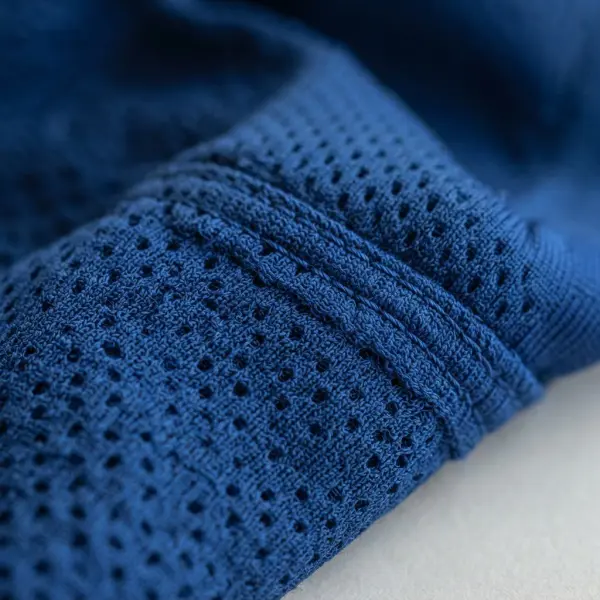
4. Polyester Mesh
Polyester mesh is highly relevant for football apparel because it supports airflow, reduces visual heaviness, and creates a technical sportswear look. It may be used as the main body fabric for fanwear, as side panels in training tops, or as ventilation inserts in areas where heat builds up.
Mesh is not one fabric. It can be open-hole athletic mesh, fine micro-mesh, jacquard mesh, bird-eye mesh, or engineered ventilation fabric. The right choice depends on opacity, durability, snag resistance, and comfort against the skin.
For event-based fashion capsules, mesh can create strong visual cues. It immediately signals sport. But brands must be careful with transparency, rough texture, and print distortion. A mesh fabric that looks dynamic in a photo may feel too exposed or too casual for some markets. A fine mesh or bird-eye structure often works better for mainstream fanwear because it suggests breathability without looking like a training bib.
5. Nylon Blends
Nylon blends can be useful for football-related jackets, training shorts, lightweight outer layers, and some premium sportswear pieces. Nylon often has a smooth handfeel and good strength, making it suitable for woven windbreakers, track jackets, and technical layering pieces.
For football apparel during World Cup season, nylon is less likely to be the main jersey fabric but can be excellent for capsule products around the jersey: warm-up jackets, packable outerwear, panelled shorts, stadium-ready layers, or premium athleisure sets. A nylon-spandex woven can offer mobility and a polished surface, while a coated nylon may support weather resistance for outerwear.
The limitation is heat and moisture comfort. Some nylon constructions can feel less breathable if the fabric is tightly woven or coated. For warm climates, brands should test whether the garment feels comfortable beyond the fitting room. A lightweight jacket that looks sharp may become uncomfortable in a crowded outdoor viewing event if ventilation is poor.
6. Cotton-Polyester Blends for Fanwear
Cotton-polyester blends can be a smart option for casual fanwear, especially when the product is closer to lifestyle apparel than performance sportswear. These blends can offer a more familiar handfeel than 100% polyester while improving shape stability and drying behavior compared with some 100% cotton garments.
This is useful for supporter tees, casual polos, streetwear-inspired football tops, and family-oriented merchandise. Not every World Cup-themed product needs to look like a professional match jersey. Many consumers want something comfortable enough for daily wear but still connected to the football moment.
The caveat is performance. Cotton absorbs moisture more readily than polyester, so it may feel heavier when wet and may dry more slowly. That does not make cotton blends wrong. It means brands should position them honestly as fanwear or lifestyle pieces, not high-performance training apparel.
7. Jacquard and Engineered Knits
Jacquard and engineered knits allow brands to integrate texture, pattern, ventilation zones, and subtle identity details into the fabric itself. This can be especially useful for premium football-inspired collections where the brand wants more depth than a printed graphic.
For example, a jersey-style top can use tonal jacquard patterns inspired by movement, national motifs, stadium architecture, or football pitch lines. The result can feel more elevated than a flat printed shirt. Engineered knits may also support body-mapped ventilation, although this requires stronger development capability and supplier coordination.
The trade-off is cost and minimum order quantity. Jacquard development usually requires more sampling, longer lead time, and higher fabric commitment. For small fashion brands, it may be better to use accessible textured knits first before moving into fully engineered fabric programs.
Fabric Comparison for Football Apparel
The table below gives a practical view of how different sportswear fabrics may fit football-related products. It is not a universal ranking. It is a sourcing guide for matching material to purpose.
|
Fabric Type |
Best Used For |
Main Advantage |
Key Trade-Off |
|
Lightweight polyester interlock |
Jerseys, training tops, sublimated fanwear |
Smooth surface, good color, scalable production |
Can feel synthetic if low quality |
|
Polyester bird-eye or pique |
Fan jerseys, polos, casual football tops |
Texture, airflow, sporty appearance |
Print detail may vary by surface |
|
Recycled polyester knit |
Sportswear capsules, jersey programs, responsible material stories |
Supports recycled-content positioning |
Requires verified certification and documentation |
|
Polyester-spandex blend |
Fitted tops, base layers, athleisure football apparel |
Stretch and recovery |
More complex production and recycling |
|
Polyester mesh |
Ventilation panels, active tops, sporty fanwear |
Breathability and technical look |
Transparency and snagging risks |
|
Nylon woven or nylon-spandex |
Jackets, shorts, outer layers |
Smooth surface, strength, premium sportswear feel |
May need ventilation or coating checks |
|
Cotton-polyester blend |
Casual fan shirts, lifestyle supporter tees |
Familiar comfort and easier daily wear |
Not ideal for high-sweat performance use |
The strongest fabric choice is the one that aligns with the product promise. If the label says “performance,” the fabric must support that claim. If the garment is lifestyle fanwear, comfort, fit, print quality, and price may matter more than advanced technical features.
How Fashion Brands Should Choose the Right Fabric
A fashion business should begin with the garment’s real use case, not the trend. World Cup season can tempt brands to rush into football-inspired designs without testing whether the fabric matches the customer’s wearing environment.
A useful starting point is to divide the product line into three categories: performance-inspired, lifestyle fanwear, and premium capsule. Performance-inspired apparel needs lighter synthetic knits, mesh zones, stretch options, and quality testing. Lifestyle fanwear can use cotton-polyester, polyester pique, or softer jersey structures. Premium capsules may justify jacquard, textured knits, refined trims, and more distinctive finishing.
The same football theme can produce very different fabric decisions:
- A training top may need 120–160 gsm lightweight polyester with ventilation details.
- A supporter tee may work better in cotton-polyester or soft polyester jersey.
- A retro football shirt may need heavier pique, rib collar, and woven trims.
- A premium capsule jersey may use jacquard knit or matte recycled polyester.
- A stadium jacket may require nylon woven, mesh lining, and water-repellent finishing.
This decision also affects pricing. A basic fan shirt can compete on accessibility and volume. A premium football-inspired top must justify its price through fabric handfeel, construction, detail, and storytelling. Customers may accept a higher price during tournament season, but only if the product feels better than ordinary merchandise.

Sourcing and Production Implications
Fabric selection affects every stage after design approval. A fabric that looks suitable in the first sample may create production problems when scaled across sizes, colors, prints, and delivery deadlines.
For football apparel, print compatibility is one of the biggest issues. Sublimation requires polyester-rich fabric and works best on lighter base colors. Screen printing may work across more fabric types but needs testing for stretch, wash durability, and handfeel. Heat transfer graphics can be useful for names, numbers, and small-batch customization, but poor application can crack, peel, or feel heavy.
Sourcing teams should confirm practical details before placing production orders:
- Fiber composition and allowed tolerance
- Fabric weight, width, shrinkage, and colorfastness
- Print method compatibility
- Stretch and recovery behavior, if elastane is used
- Pilling and snagging resistance
- Wash-care requirements
- Lead time for lab dips, strike-offs, and bulk approval
- Certification documents for recycled or branded fibers
- Minimum order quantity and reorder possibility
This is where many small brands underestimate the operational side of event-based apparel. World Cup season has a fixed calendar. A delayed fabric shipment or failed print test can reduce the selling window dramatically. For tournament-linked products, speed matters, but skipping fabric validation can create returns, complaints, and dead stock.
What About Heat, Sweat, and Climate?
Football apparel is often worn in heat, humidity, crowds, and outdoor settings, especially during June and July. Current reporting during the 2026 tournament has highlighted heat and hydration concerns in several host locations, which reinforces why breathable and moisture-managing fabrics matter for match-day clothing and fanwear World Cup heat and hydration reporting.
For fashion businesses, the lesson is not to market every garment as elite performance wear. The practical lesson is to consider where and how the garment will be worn. A fan shirt for indoor viewing parties has different comfort needs from a jersey worn outdoors in a crowded fan zone.
Moisture management should also be tested, not assumed. AATCC provides textile standards and test methods used by the industry for evaluating textile quality and performance AATCC textile standards and testing resources. For serious sportswear programs, lab testing can help validate claims related to moisture behavior, colorfastness, dimensional stability, and durability.
A small brand may not test at the same level as a global sportswear company, but it can still conduct practical checks: wash samples several times, test print durability, wear-test in warm conditions, check seam comfort, and compare fabric feel before and after sweating.
Sustainability Claims to Treat Carefully
Recycled polyester, low-impact dyeing, and responsible sourcing are increasingly common in sportswear conversations. These claims can add value, but only if they are specific and verifiable.
A World Cup-inspired collection made with recycled polyester may sound attractive, especially to younger consumers and retailers that care about material transparency. Yet brands should avoid broad claims such as “eco-friendly jersey” or “sustainable sportswear” unless they can explain what is actually improved and what limitations remain.
Better claims are more specific:
- “Made with certified recycled polyester.”
- “Contains recycled polyester verified through supplier documentation.”
- “Designed as a durable fanwear piece for repeated wear.”
- “Uses a mono-material polyester shell to support easier sorting compared with complex blends, where local recycling infrastructure exists.”
The last phrase matters. Design for recyclability is not the same as actual recycling. A garment may be easier to sort in theory, but recovery depends on collection systems, labeling, trims, contamination, and textile recycling infrastructure.
For brands, the safest sustainability strategy is transparency. State what the fabric contains, what certification supports it, what care instructions extend the product’s life, and what claims are not being made. This builds more trust than broad environmental language.

Common Mistakes When Choosing Football Apparel Fabrics
The most common fabric mistakes during event-driven sportswear production happen because brands move too quickly from visual idea to bulk order. The tournament calendar creates urgency, but fabric decisions still need discipline.
Choosing Fabric Only by Appearance
A fabric may look sporty because it has shine, mesh texture, or bold color. That does not mean it is comfortable or durable. Some low-cost polyester fabrics look attractive in photos but feel rough, trap heat, or pill quickly.
The better approach is to evaluate both surface appearance and wearing behavior. A fabric should be checked under real use conditions: movement, sweat, washing, printing, and extended wear.
Treating All Polyester as the Same
Polyester can be lightweight, heavy, smooth, textured, breathable, stiff, matte, shiny, soft, or harsh. The fiber name alone tells only part of the story.
Brands should compare knit type, yarn quality, finishing, GSM, stretch, and handfeel. Two polyester fabrics with the same composition can produce very different customer experiences.
Overusing Stretch Without Need
Stretch can improve comfort, but it can also raise cost and production complexity. Polyester-spandex fabric may require more careful sewing, heat control, and fit testing.
For loose fan jerseys, elastane may not be necessary. For fitted training tops or women’s athleisure styles, it may be valuable. The decision should follow the fit and function, not trend language.
Making Sustainability Claims Without Documentation
A supplier saying “recycled” is not enough for credible communication. Brands should request certification, transaction documents where relevant, and clear composition details.
Unsupported sustainability claims can damage trust, especially when retailers, partners, or customers ask for proof.
Ignoring Print and Decoration Testing
Football apparel often uses numbers, names, badges, stripes, sponsor-style graphics, or national color details. These decorations interact directly with fabric.
A print that looks clean on a flat fabric swatch may crack on stretch fabric, blur on textured mesh, or feel too heavy on lightweight jersey. Testing is not optional if the garment will carry strong graphics.
Practical Application for Fashion Businesses
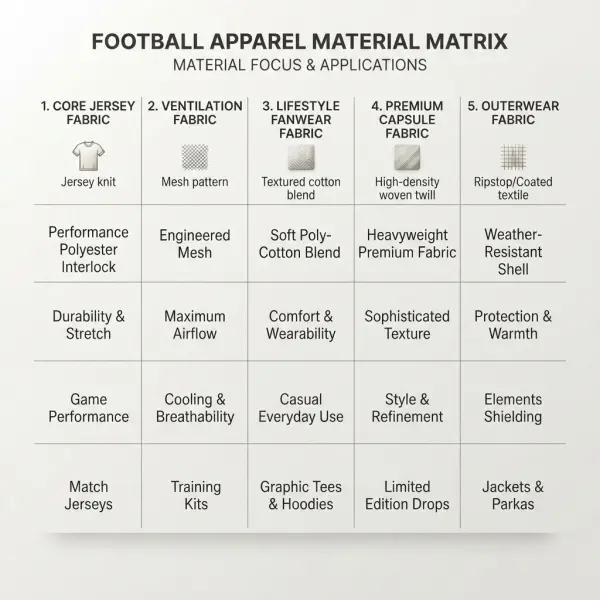
For fashion brands, garment manufacturers, and sourcing teams, the best fabric strategy is to build a small but clear material matrix before designing the full collection. This keeps the product line coherent and prevents random fabric decisions.
A practical World Cup-season fabric matrix may include:
- Core jersey fabric: lightweight polyester interlock or pique for the main football-inspired top.
- Ventilation fabric: mesh or bird-eye polyester for side panels, back panels, or training details.
- Lifestyle fabric: cotton-polyester blend for casual supporter tees.
- Premium option: jacquard knit or recycled polyester for limited-edition capsule pieces.
- Outerwear fabric: nylon woven or polyester woven for jackets and stadium layers.
This structure gives the brand flexibility without making sourcing chaotic. It also helps retail teams explain the collection clearly: one product for active wear, one for casual support, one for premium styling, and one for layering.
For manufacturers, early fabric alignment reduces sampling waste. Pattern makers can adjust seam construction, shrinkage allowance, rib compatibility, and trim selection according to fabric behavior. For retailers, the material story becomes easier to communicate online: breathable jersey, soft fan tee, recycled polyester capsule, lightweight match-day jacket.
That clarity matters because World Cup season is crowded. Many brands will release football-inspired products. The ones that stand out will usually combine timely design with credible material choices, good fit, and honest product communication.
What Brands Should Verify Before Choosing a Fabric
Before committing to bulk production, brands should verify the fabric from both technical and commercial angles. A beautiful sample is not enough.
The most important checks include fabric performance, supplier reliability, decoration compatibility, and market positioning. If the garment is sold as breathable or quick-dry, the brand should have evidence from supplier data, lab testing, or at least structured wear testing. If it is sold as recycled, documentation should support the claim. If it is sold at a premium price, the handfeel and finishing should justify that positioning.
A good pre-production checklist should include:
- Confirm final garment use: sport, fanwear, lifestyle, or premium capsule.
- Approve fabric weight and handfeel after washing.
- Test print, transfer, embroidery, or badge application.
- Check shrinkage and twisting after repeated wash cycles.
- Review colorfastness for bold team-inspired colors.
- Verify recycled-content documents if used.
- Confirm MOQ, lead time, and reorder availability.
- Wear-test the garment in realistic heat and movement conditions.
This may sound basic, but it is often where event-based collections succeed or fail. The right fabric does not only make the garment more comfortable. It protects margin, reduces returns, supports clearer marketing, and helps the product remain wearable after the tournament is over.
How This Article Connects to the Full Cluster
This article focuses on choosing the best fabric categories for football apparel during World Cup season. It gives brands a sourcing and product-development foundation.
The next article, why breathable and quick-dry fabrics matter in modern sportswear, should go deeper into moisture movement, drying behavior, breathability, and comfort testing. That topic deserves its own technical treatment because quick-dry performance depends on fiber, yarn, knit structure, finishing, and garment design.
The third article, how football jersey materials influence comfort, performance, and style, should focus more specifically on jersey construction, fit, panels, trims, graphics, and how material decisions shape the final football shirt experience.
Together, the cluster can help fashion readers understand not only what materials are used, but why those materials matter commercially and technically.
FAQ
What is the best fabric for a football jersey?
The best fabric for most football jerseys is usually a lightweight polyester knit, often in interlock, pique, mesh, or bird-eye construction. Polyester is widely used because it can support strong color, sublimation printing, durability, and moisture management when the fabric is properly engineered. However, the “best” option depends on whether the jersey is for sport performance, casual fanwear, or premium fashion retail. A professional-style training jersey may need lighter fabric and ventilation zones, while a supporter shirt may prioritize comfort, price, and print quality.
Is recycled polyester good for football apparel?
Recycled polyester can be a good option for football apparel when it meets the required performance, color, and durability standards. It allows brands to reduce reliance on virgin polyester while retaining many sportswear advantages. The important caveat is verification. Brands should request credible documentation, certification where applicable, and clear supplier information before making recycled-content claims. Recycled polyester is useful for jerseys and sportswear capsules, but it should not be marketed with broad sustainability claims unless the brand can support them with specific evidence.
Is cotton suitable for football shirts?
Cotton can be suitable for casual football-inspired shirts, supporter tees, and lifestyle fanwear, but it is usually not the best choice for high-sweat performance jerseys. Cotton tends to absorb moisture, which can make the garment feel heavier when wet and slower to dry. Cotton-polyester blends may offer a balanced option for everyday fanwear because they can feel familiar while improving shape stability compared with some pure cotton fabrics. Brands should position cotton-based products as casual or lifestyle apparel rather than technical training wear.
Why do football jerseys often use polyester?
Football jerseys often use polyester because it is lightweight, durable, color-friendly, and compatible with common sportswear printing methods. Polyester can also be constructed into breathable knits and mesh structures that support comfort during movement. The final performance still depends on fabric construction and finishing. A low-quality polyester may feel hot or harsh, while a well-developed polyester knit can feel soft, breathable, and suitable for repeated washing. For brands, polyester is also practical because it is widely available and scalable.
Should football apparel include spandex?
Football apparel should include spandex only when stretch and recovery are needed. Spandex can improve mobility, fit, and comfort in fitted training tops, compression-inspired garments, and athleisure styles. It may be unnecessary for relaxed fan jerseys or casual supporter tees. Brands should also consider production and sustainability trade-offs, because elastane blends may require more careful sewing, heat handling, and recycling consideration. The decision should follow the garment’s fit, function, and price point.
What fabric works best for World Cup fanwear?
For World Cup fanwear, the best fabric depends on the product tier. A budget-friendly supporter tee may work well in cotton-polyester blend or polyester jersey. A jersey-inspired shirt may use polyester pique, interlock, or bird-eye mesh. A premium capsule may use recycled polyester, jacquard knit, or refined textured fabric. Fanwear does not always need elite performance material, but it should still be comfortable, washable, visually strong, and suitable for the climate where customers will wear it.
How can brands make football apparel feel more premium?
Brands can make football apparel feel more premium by improving fabric handfeel, using matte or textured surfaces, refining fit, adding thoughtful trims, testing print quality, and avoiding overly shiny low-grade polyester. Jacquard patterns, rib collars, embroidered details, and recycled-content storytelling can also support premium positioning when executed well. The garment should feel intentional, not like generic event merchandise. Premium value comes from the combination of material, construction, design restraint, and credible communication.
Conclusion
World Cup season creates a strong commercial window for football apparel, but the opportunity is not only about graphics, flags, or team-inspired colors. Fabric choice determines whether the garment feels like a thoughtful sportswear product or a short-lived promotional shirt.
For most brands, lightweight polyester knits, recycled polyester, mesh structures, polyester-spandex blends, nylon layers, and cotton-polyester fanwear fabrics provide the most practical starting points. Each material has a role. Polyester supports jersey performance and print clarity. Mesh adds airflow and sport identity. Spandex improves stretch when needed. Cotton blends help casual fanwear feel more familiar. Recycled polyester can strengthen the material story when properly verified.
The smartest approach is not to chase the most technical fabric available. It is to choose the fabric that matches the product promise. A training top should perform. A fan shirt should feel comfortable. A premium capsule should justify its price. A recycled-content claim should be documented.
That discipline helps fashion businesses turn a global football moment into products that customers can enjoy during the tournament and continue wearing after the final whistle.





Comments 0
Leave a CommentSend Comment
Anda harus Login terlebih dahulu untuk dapat memberikan komentar.