

Common Customer Service Gaps That Hurt Fashion Businesses
Quick Answer
Common customer service gaps in fashion businesses usually appear when the customer-facing team lacks the information, authority, systems, or cross-functional coordination required to resolve a customer's problem accurately. Typical gaps include weak product and sizing knowledge, inconsistent information between channels, poor order visibility, complicated returns, unclear escalation rules, fragmented customer histories, inadequate staffing during demand peaks, excessive automation, and failure to turn recurring complaints into operational improvements.
These gaps matter because fashion customer service sits close to several high-uncertainty moments: choosing the right size, waiting for an order, discovering that a garment does not meet expectations, requesting an exchange, or trying to recover money after a return. A small operational weakness can therefore become highly visible to the customer.
The solution is not necessarily more agents or more technology. For many brands, the first priority is simpler: establish reliable product data, define policies clearly, connect service with inventory and order information, give frontline staff appropriate decision authority, and create a process for identifying recurring problems.
Customer service performs best when it is connected to the systems and teams that create the customer experience—not when it is expected to compensate indefinitely for problems elsewhere.

Why Customer Service Gaps Are Often System Problems
A customer service gap is the difference between what customers need from the service process and what the business is actually capable of delivering consistently. Sometimes that difference is obvious, such as unanswered emails. More often, the visible interaction hides a deeper operational problem.
An agent may appear unhelpful because the inventory system does not show reliable stock. A store employee may give a different answer from the ecommerce team because the returns policy has not been translated into clear operational rules. A customer may need to repeat an order problem three times because different channels do not share case history. None of these problems can be solved permanently by reminding employees to "provide better service."
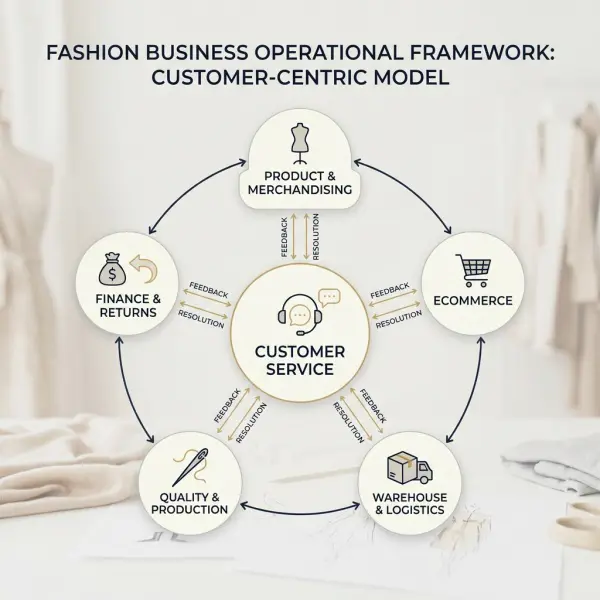
This distinction is important for fashion businesses because the support function often becomes the final destination for problems created elsewhere. Product development influences fit questions. Merchandising influences whether product information is understandable. Warehousing affects incorrect shipments. Logistics affects delivery complaints. Finance and payment systems affect refund timing.
Customer service reveals those failures, but it does not necessarily cause them.
The broader commercial risk is real. PwC's 2025 U.S. Customer Experience Survey found that 29% of surveyed consumers said they had stopped using or buying from a brand because of poor online or in-person customer experience. The figure is cross-industry and should not be treated as a fashion-specific abandonment rate, but it illustrates why persistent service friction should not be dismissed as a minor operational inconvenience.
Gap 1: Customer Service Does Not Know the Product Well Enough
Weak product knowledge is one of the most damaging service gaps in fashion because many customer questions require more than generic retail information. Shoppers may ask whether a fabric stretches, whether trousers are high-rise, whether a jacket is lined, how two sizes compare, whether a garment is suitable for hot weather, or how the fit differs from another style.
When representatives cannot access reliable answers, several predictable behaviors appear. Some copy the product description without adding useful information. Others ask colleagues informally, producing slow responses. The most dangerous response is improvisation: an employee gives a confident answer based on assumption rather than product data.
The underlying gap is usually not training alone. It may be that the brand has never created sufficiently detailed product information for internal use.
Useful service information can include garment measurements, intended fit, fiber composition, lining, stretch behavior, fastening method, fabric weight where relevant, model measurements, care information, recurring fit observations, and known product limitations. A well-designed fashion customer service system makes this information accessible without expecting every employee to memorize an entire assortment.
Research into online fashion presentation further shows why product information deserves attention. A 2025 study examining how consumers perceive fabrics online found that presentation methods can affect the accuracy with which shoppers understand textile characteristics. That research addresses digital merchandising rather than customer service directly, but it reinforces the broader point: customers make fashion decisions using imperfect representations of physical products, so inaccurate or incomplete information creates avoidable uncertainty.
The sizing knowledge problem is especially difficult
Sizing questions deserve particular caution because there is a difference between providing information and promising an outcome. An agent can explain garment measurements, intended fit, stretch, or how a style compares with another product. The agent cannot reliably guarantee that a garment will fit a particular body exactly as the shopper imagines.
Brands sometimes attempt to close this gap with recommendation technology. That can be useful, but it should not be treated as a complete solution. A 2025 study using data covering 496,365 fashion items from a major ecommerce platform found a more nuanced relationship between size-finder usage, returns, and subsequent customer value rather than a simple "size recommendation reduces returns" effect.
The operational lesson is to provide better evidence, not stronger promises.

Gap 2: Customers Receive Different Answers From Different Channels
A customer rarely thinks in organizational charts. They may begin with an Instagram message, continue through email, and later visit a store. From their perspective, every interaction comes from the same brand.
Internally, however, those channels may be managed by different teams with different tools, performance targets, training, and access to information. Social staff may focus on speed and engagement, store staff on immediate sales, and ecommerce support on order resolution. Without shared rules, contradictions emerge easily.
A common example is returns. Social media tells a shopper that an item can be exchanged in store, but store staff are told that ecommerce purchases must be returned by courier. Neither employee necessarily acted irresponsibly; the service architecture failed to create one reliable answer.
Promotions produce similar problems. A customer sees an offer online, receives one interpretation through chat, and encounters another at checkout. Even when a technical condition legitimately differs by channel, the customer experience feels inconsistent if nobody explains the distinction clearly.
Consistency does not mean every case receives the same outcome. It means that differences have understandable reasons. A final-sale garment may follow different rules from a regular-priced item. International orders may require different procedures from domestic ones. What damages confidence is not necessarily the difference itself, but unexplained contradiction.

Gap 3: Agents Cannot See Enough of the Order Journey
One of the most frustrating service situations occurs when the customer knows more about their order than the person supposedly helping them.
An agent may see that an order exists but not whether the warehouse has packed it. Another system holds the courier data. Refund information sits with finance. Marketplace orders appear in a separate portal. Store purchases may be almost invisible to ecommerce support.
The result is often message forwarding rather than problem solving.
This gap becomes especially harmful during time-sensitive situations. A customer asking to change an address before dispatch does not benefit from a response two days later saying the request has been sent to another department. A customer whose parcel appears lost needs more than a copy of the tracking link they already checked.
Better service does not require giving every employee unrestricted access to every system. Privacy, security, and financial controls still matter. The operational requirement is that customer-facing staff can obtain the information needed to resolve routine cases through a defined process.
A useful test is simple: how many internal handoffs does a customer problem require before someone can make a decision?
When that number is consistently high, the business probably has a workflow problem rather than an employee-performance problem.
Gap 4: Returns Are Designed Around Internal Convenience
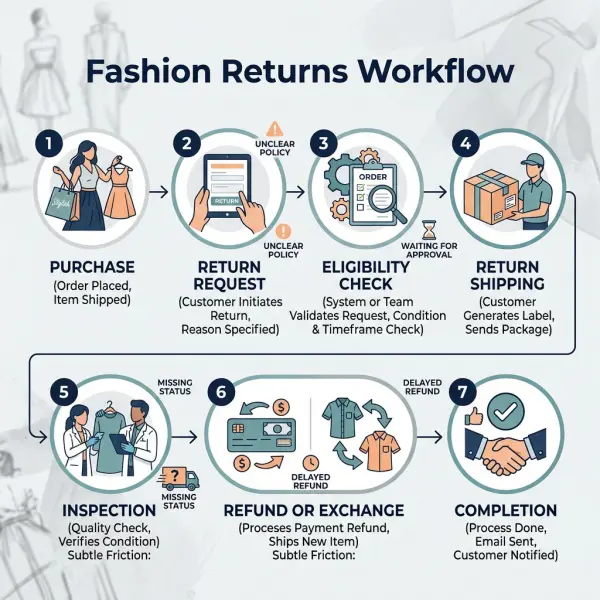
Returns expose weaknesses because they reverse nearly every part of the original sales process. The business must receive the item, determine eligibility and condition, update inventory or disposition, process money or an exchange, and communicate the result to the customer.
In fashion ecommerce, this is a significant operating issue. The National Retail Federation's 2025 U.S. retail research estimated that 19.3% of online sales would be returned. The study covered multiple retail verticals and large U.S. merchants, so the figure should not be presented as a universal fashion return rate. Still, it demonstrates how substantial the reverse flow of products can become for ecommerce operations.
Fashion-specific research likewise identifies returns as a complex supply-chain problem with product-level differences and operational implications. A 2025 study of fashion ecommerce returns examined real-world data and highlighted variation across product categories as well as the effects of practices such as ordering multiple alternatives and returning unwanted items.
The customer-service gap appears when the brand optimizes the process only for internal control. Instructions are difficult to find. Customers must contact support merely to discover whether a return is eligible. Refund status is invisible. Exchange stock disappears while the original garment is travelling back. Every exception requires managerial approval.
That does not mean brands should make returns unlimited or cost-free. Return shipping, handling, fraud, product condition, and inventory loss have real economic consequences. NRF's 2025 research also documented significant concern among retailers about return fraud and operational costs.
The better objective is clarity plus control. Customers should know the conditions before purchasing, while the business retains appropriate mechanisms to manage abuse and cost.
Gap 5: Frontline Staff Have Responsibility but No Decision Authority
Some companies tell customer service agents to "own the customer problem" while denying them authority to resolve even routine cases. The contradiction produces long queues of approvals.
An agent may recognize immediately that the warehouse sent the wrong size but still need managerial approval to arrange replacement shipping. A store employee may see an obvious product defect but have no authority to process the case. A minor shipping-fee adjustment may require several internal messages.
Controls are necessary. Employees should not have unlimited refund or compensation authority. Yet there is a large difference between unlimited discretion and carefully defined decision rights.
A mature service model specifies thresholds and conditions. Frontline staff might independently replace a verified incorrect shipment, while high-value refunds require additional approval. A suspected safety issue might always be escalated. Fraud indicators may trigger a specialist workflow.
Qualtrics' 2025 contact-center research, based on responses from more than 23,000 consumers globally, reported that fewer than two-thirds of issues in its study were resolved on the first call and identified waiting time as one of the weaker areas of customer satisfaction. These figures are not fashion-specific, but they illustrate why organizations should examine whether internal processes prevent frontline resolution.
Faster service often comes from removing unnecessary decision layers rather than asking employees to type faster.
Gap 6: The Customer Has to Repeat the Same Story
A customer explains that the wrong coat arrived through chat. The agent asks for photographs and the order number. Two days later the customer follows up by email and is asked for both again. The case moves to the returns team, which asks for the same explanation a third time.
Each individual request may look reasonable when viewed in isolation. Together, they signal fragmented case management.
This gap appears when communication channels do not share conversation history, when internal teams maintain separate tickets, or when handoffs contain too little structured information. It can also happen when automation successfully recognizes a customer but fails to make useful context available to the human employee who takes over.
The solution is not necessarily a single expensive customer relationship management platform. Even smaller brands can establish better case identifiers, standardized escalation notes, common tags, and clear ownership rules.
What matters is continuity.
Customers should not function as the integration layer between a brand's internal systems.
Gap 7: Response-Time Targets Encourage Shallow Answers
"Reply within one hour" sounds like a customer-centered objective. It can become counterproductive when teams optimize the metric rather than the outcome.
Agents under pressure may send acknowledgment messages that do not move the case forward. Difficult tickets may be transferred so they no longer appear in one person's queue. Templates may be sent before the employee has read the details carefully.
The dashboard improves while the customer's effort increases.
Response time still matters. Qualtrics' contact-center research found that consumers were least satisfied with waiting time, so long silence should not be dismissed. The problem is treating speed as the only measure of quality.
Fashion businesses should distinguish between at least three concepts: first response, meaningful progress, and final resolution. A short acknowledgment can be useful when investigation genuinely requires time, but the message should explain what happens next rather than exist merely to stop a timer.
Urgency should also influence prioritization. An unanswered question about garment care and an address correction for an order about to ship are not operationally equivalent.
Gap 8: Staffing Does Not Follow the Fashion Calendar
Fashion customer-service demand is rarely uniform throughout the year.
Promotional campaigns, collection launches, holiday sales, marketplace events, gifting periods, seasonal transitions, and large influencer campaigns can generate sudden increases in questions. Returns may peak after the sales peak rather than at the same time. A business that staffs support only around average monthly ticket volume can therefore be under-resourced precisely when service risk is highest.
The problem is not limited to headcount. New temporary agents may lack sufficient product knowledge. Warehouses may be overloaded at the same time. Customer-service managers may extend working hours while finance or fulfillment teams remain unavailable for escalations.
Capacity planning should therefore consider the complete operating system.
Historical inquiry volume can help identify patterns, but fashion businesses should also overlay the commercial calendar. If a large campaign introduces a product category with complex sizing, the service workload may increase even when order volume remains within forecast.
The strongest plans include both demand capacity and escalation capacity.

Gap 9: Automation Is Used to Block Customers Instead of Helping Them
Automation can perform useful service work. It can answer straightforward policy questions, retrieve order status, classify requests, summarize conversations, suggest knowledge-base content, translate messages, and route cases.
The gap appears when automation becomes primarily a barrier to human assistance.
A chatbot repeatedly offers articles that do not address the customer's situation. A customer requesting a refund cannot leave the predefined menu. The system continues asking questions even after enough information has been collected. Human escalation is hidden because it would increase contact-center cost.
These designs may reduce apparent agent workload while increasing unresolved customer effort.
Consumer attitudes also justify caution. PwC's 2025 U.S. Customer Experience Survey found that 58% of respondents were only somewhat or not at all comfortable using AI tools to engage with brands. This is not evidence that customers reject every automated service tool, but it does show that AI adoption should not be equated automatically with customer preference.
A better principle is to automate tasks with predictable inputs and outcomes while providing clear escalation when judgment, exceptions, sensitive issues, or complex product interpretation are required.
PwC has similarly warned in 2026 that layering new automation onto broken processes can simply automate existing friction rather than resolve it.
Gap 10: Customer Service Data Never Reaches the Teams That Can Fix the Problem
This may be the most expensive hidden gap.
A service team answers hundreds of messages about an unclear size chart. The following season, the product page uses the same format. Customers repeatedly complain that a light-colored blouse is more transparent than expected, but merchandising never receives the pattern. Shipping complaints rise after a logistics change, yet managers evaluate agents only on response time.
The organization is treating each interaction as an isolated ticket rather than a source of operational evidence.
Customer-service data is valuable because it captures questions that customers could not resolve themselves. Those questions frequently identify friction in product information, checkout, fulfillment, returns, or product performance.
The data needs structure before it becomes useful. Teams should classify issues consistently enough to distinguish sizing questions from product defects, delivery delays from missing shipments, customer preference from specification error, and policy confusion from genuine policy disputes.
Service data should then be combined with other evidence. Ten complaints about one garment mean something different when ten units were sold versus ten thousand. A high return count may reflect sales volume rather than an unusually high return rate.
Customer service identifies the signal. Cross-functional analysis determines what it means.
The Most Common Gaps and Their Hidden Business Cost
Customer-service problems often create costs outside the service budget itself.
|
Customer Service Gap |
Visible Customer Problem |
Hidden Business Effect |
|
Weak product knowledge |
Vague or inaccurate answers |
More pre-purchase hesitation, repeated contacts, avoidable expectations |
|
Channel inconsistency |
Conflicting information |
Lower predictability and additional resolution work |
|
Poor order visibility |
Agent cannot explain status |
More handoffs and repeat inquiries |
|
Complicated returns |
Customer struggles to complete return |
Higher support workload and possible customer exit |
|
Low frontline authority |
Routine cases need approval |
Longer resolution times and managerial workload |
|
Fragmented customer history |
Customer repeats information |
Higher effort for both customer and staff |
|
Speed-only metrics |
Fast but incomplete replies |
Recontacts and misleading performance data |
|
Poor capacity planning |
Queues surge during campaigns |
Delayed responses during critical sales periods |
|
Excessive automation |
Customer becomes trapped in self-service |
Escalation, frustration, and duplicate contacts |
|
Weak feedback loop |
Same problems recur |
Service cost remains while root cause survives |
The important pattern is that service gaps often create double cost. The original operational problem creates one expense, then customer service spends additional resources explaining or repairing it.
A wrong shipment, for example, consumes warehouse labor, replacement logistics, customer-service time, and potentially a return shipment. Preventing the picking error has broader value than merely improving the wording of the apology.
How Can Fashion Businesses Identify Their Real Customer Service Gaps?
Brands should begin with contact drivers rather than assumptions about what "good customer service" should look like.
Analyze why customers are contacting the business. The categories might include size and fit, product information, stock availability, payment, order changes, tracking, late delivery, missing parcels, damaged products, quality concerns, returns, exchanges, refunds, promotions, and store issues.
Then examine what happens to those contacts.
A useful diagnostic combines several questions:
- Which issues generate the greatest number of contacts relative to transaction volume?
- Which cases require the most repeated contacts?
- Where do agents frequently ask managers for approval?
- Which issues move repeatedly between departments?
- What information do agents regularly need but cannot access?
- Which product questions could have been answered on the product page?
- Which complaints recur for the same product, supplier, fulfillment route, or policy?
- Which cases take long to resolve even when the final decision is straightforward?
The objective is not merely to identify a slow team. It is to locate friction in the customer journey and the internal process behind it.
A brand discovering that 25% of support volume concerns delivery tracking, for example, should investigate tracking visibility and proactive communication before simply hiring 25% more service capacity.
Fix Root Causes Before Adding More Customer Service Staff
Hiring additional staff can be necessary when service capacity genuinely falls below demand. It should not be the automatic response to increasing ticket volume.
Suppose customers repeatedly ask whether a particular skirt has an elastic waistband. If the information can be added accurately to the product page, answering each inquiry manually is inefficient. If customers repeatedly contact support because tracking links are delayed, the business should examine fulfillment data flow. If every exchange requires an agent because there is no clear process, workflow redesign may produce more value than additional headcount.
This principle has an important limit: self-service should not become an excuse to make human help inaccessible. Some customers will have unusual circumstances, accessibility needs, payment disputes, product complaints, or cases that do not fit a standard workflow.
The goal is to remove avoidable contacts while preserving effective support for contacts that genuinely require assistance.
Create a Single Operational Source of Truth
One of the most practical improvements is establishing a maintained source of truth covering the information service teams use most frequently.
That source may contain product information, sizing guidance, promotions, shipping options, delivery expectations, returns policies, exchange procedures, refund processes, escalation contacts, fraud-handling rules, and instructions for unusual cases.
A document alone does not solve the problem. Ownership matters.
When the returns policy changes, someone must update the internal guidance. When a new product launches, customer service needs information before questions begin arriving. When a known issue is discovered, affected teams need a controlled update rather than an informal message that disappears in a chat channel.
The strongest knowledge systems are not necessarily the most sophisticated. They are the ones employees trust enough to stop inventing their own answers.
Build Clear Escalation and Decision Rules
A useful escalation process answers three questions: what can I decide, what must I escalate, and where does it go?
The answer should vary according to risk. A low-value routine replacement may be appropriate for trained frontline staff. A suspected safety issue, privacy request, charge dispute, high-value fraud concern, or unusual legal complaint may require specialist handling.
Escalation should also transfer enough context. The receiving team should not need to restart the investigation from zero.
For example, a suspected garment defect escalation might include the order identifier, product style, size, production information where available, photographs, description of the issue, previous communication, and the remedy already requested. This structure helps product or quality teams distinguish an isolated customer complaint from a potentially recurring manufacturing problem.
Good escalation is not simply "send it to a manager." It is a designed information flow.
Connect Customer Service With Product, Operations, and Quality Teams
Fashion businesses gain more value from service data when recurring issues enter regular operational review.
A monthly or weekly review does not need to be complicated. The team can examine the largest contact categories, unusual changes, repeated complaints, products generating disproportionate support, delayed case types, and cases where agents lacked information.
Different patterns should go to different owners.
Sizing confusion may need merchandising or technical design. Recurring seam failures may need quality and production. Shipping complaints may need fulfillment or logistics. Promotion misunderstandings may need marketing and ecommerce. Delayed refunds may require finance or payment operations.
This is where customer service stops being merely reactive.
The team becomes a sensing mechanism for the wider business.
Common Mistakes When Trying to Fix Service Gaps
Buying software before defining the process
A new helpdesk or CRM can improve visibility, but software cannot decide what an unclear returns policy should mean. When teams do not agree on ownership, escalation, decision authority, or product data, technology may simply digitize the confusion. Map the workflow first, then determine which system capabilities actually support it.
Treating every customer complaint as an agent problem
A representative may be the person speaking to the customer, but the cause may be stock accuracy, garment construction, unclear merchandising, warehouse error, or payment processing. Coaching agents for problems outside their control can improve scripts while leaving the failure untouched.
Expanding channels without expanding operating capacity
Adding WhatsApp, live chat, marketplace messaging, social media, and phone support can make a brand look accessible while creating fragmented queues. Each new channel requires monitoring, ownership, knowledge consistency, and escalation. Channel availability should reflect real service capacity.
Automating the highest-friction journeys first
Complex complaints may appear attractive for automation because they consume significant agent time. They are often the worst place to begin because unusual cases require interpretation and exceptions. Automating stable, repetitive tasks usually creates less risk than forcing complicated disputes through rigid workflows.
Measuring customer service without measuring recurring demand
A team can improve response time while overall ticket volume continues rising because an underlying problem remains unresolved. Managers should track not only how efficiently support handles contacts, but also why those contacts exist.
What Brands Should Verify Before Changing Their Service Model
Customer-service practices should fit the brand's business model rather than copying whichever retailer currently receives attention for customer experience.
A small made-to-order label may reasonably require different exchange rules from a mass-market retailer carrying deep inventory. A luxury boutique may invest more heavily in individual product guidance. A marketplace seller must operate partly within the platform's communication and returns rules. An international brand must account for differences in shipping, payments, consumer law, and operational infrastructure.
Before changing a service policy or adding technology, verify whether the underlying systems can support the promise.
Real-time stock guidance depends on sufficiently reliable inventory data. Fast exchanges require replacement inventory and reverse-logistics capability. Automated order updates require accurate status feeds. Generous returns depend on economics that can absorb the associated handling and logistics costs.
This is also why customer service cannot be optimized independently from the rest of the fashion business.
A promise becomes customer service only when operations can fulfill it.
How Customer Service Gaps Affect Trust and Repeat Business
Operational gaps become commercially important when customers interpret them as evidence about the brand.
One inconsistent answer may look like a mistake. Repeated inconsistencies suggest the company may not know its own policies. One delayed refund may be an exception. Several unresolved interactions can make future purchases feel risky.
The mechanism is explored more deeply in how service quality influences reviews, repeat sales, and trust. The important point for operational teams is that customers do not experience internal causes separately. Warehouse failure followed by weak customer support feels like one brand experience.
NRF's 2025 U.S. returns study offers a useful example. Among consumers surveyed who had made an online return in the previous year, 71% said a poor returns experience made them less likely to shop with the retailer again. Because the sample and geography are specific, the percentage should not be generalized to every fashion customer, but it demonstrates how an operational process such as returns can become a retention issue.
This is why service-gap analysis should extend beyond the contact center. The question is not only "Why did the agent fail to resolve this ticket?" but also "Why did the customer need this ticket in the first place?"
FAQ: Customer Service Gaps in Fashion Businesses
What is the most common customer service gap in fashion?
There is no universal single gap, but weak access to accurate information is one of the most fundamental. Fashion service teams frequently need product measurements, fit information, stock status, order progress, returns rules, and refund information. When these data are incomplete or scattered across systems, even capable employees struggle to give consistent answers. Brands should therefore examine information flow before assuming that service problems primarily result from insufficient communication skills.
How can a small fashion brand improve customer service without expensive software?
Start with process clarity. Create one maintained source for product information and policies, define who owns each type of issue, establish simple escalation rules, and track customer inquiries consistently. A shared helpdesk or structured inbox can be sufficient at modest volume if responsibilities are clear. Expensive technology becomes more useful when complexity or scale justifies integration, automation, reporting, and multi-channel case management. Buying software before defining the workflow often makes a small operation more complicated rather than more effective.
How do brands know whether they need more customer service staff?
Compare demand with capacity, but also investigate what generates demand. Persistent queues, excessive overtime, declining response times, and unfinished cases may indicate insufficient staffing. However, high ticket volume can also come from unclear product information, delivery failures, confusing returns, or broken automation. Before increasing permanent headcount, determine which inquiries genuinely require human assistance and which could be prevented by correcting an upstream problem.
Why are sizing questions such a difficult customer service issue?
Sizing combines objective information with subjective fit. Garment measurements, construction, fabric stretch, and intended silhouette can be documented, but people differ in body proportion and fit preference. A service representative can help interpret product data but should avoid guaranteeing an exact result. Better product measurements, fit notes, comparison information, imagery, and consistent terminology can improve guidance while keeping the unavoidable uncertainty clear.
Should fashion brands automate returns?
Returns can be partially automated when eligibility rules and transaction data are sufficiently structured. Automation may handle requests, labels, status updates, or standard exchanges, but exceptions still require judgment. High-value goods, suspected fraud, defects, unusual product conditions, payment disputes, or legal issues may need human review. The objective should be to remove repetitive administrative work without creating a rigid process that prevents legitimate cases from being resolved.
What customer service metric reveals operational gaps most clearly?
No single metric does. First response time shows speed, but not resolution. First-contact resolution can reveal repeated effort but depends on how "resolved" is defined. Contact reason, recontact rate, escalation rate, resolution time, customer satisfaction, return reasons, and product-level complaint patterns provide different perspectives. The most valuable analysis usually combines several metrics and relates them to order or product volume rather than examining raw counts alone.
How often should customer service feedback be reviewed by other teams?
The appropriate cadence depends on order volume and risk. High-volume businesses may review key contact drivers weekly or even daily during campaigns, while smaller brands may use a monthly review. Urgent signals such as suspected safety problems, widespread fulfillment errors, payment failures, or recurring defects should not wait for the regular meeting. The essential point is to create a predictable feedback process so recurring service evidence reaches teams capable of correcting its root cause.
Conclusion
Customer service gaps rarely begin with a customer service conversation. They begin when product information is incomplete, systems are disconnected, policies are ambiguous, decision authority is unclear, capacity does not match demand, or recurring customer feedback has nowhere to go.
The support team simply makes those weaknesses visible.
For fashion businesses, this visibility is particularly valuable because customers regularly confront uncertainty around fit, material, inventory, delivery, product condition, and returns. Every question provides information about where the buying journey requires too much interpretation or effort.
The practical response is not to pursue an unrealistic goal of eliminating every customer problem. Fashion products are physical, personal, and sometimes subjective. Deliveries can fail. Customers change their minds. Exceptions will always exist.
The better objective is to eliminate avoidable uncertainty and repeated friction.
Give customer-facing teams reliable product and order information. Make policies understandable. Design return processes deliberately. Define frontline authority. Preserve case context across channels. Use automation where outcomes are predictable and human judgment where they are not. Most importantly, connect service evidence back to merchandising, product, quality, fulfillment, finance, and operations.
When brands do this, customer service stops functioning as the department that cleans up everyone else's problems. It becomes part of the system that prevents those problems from recurring.





Comments 0
Leave a CommentSend Comment
Anda harus Login terlebih dahulu untuk dapat memberikan komentar.