

How Pre-Orders, Inventory, and Production Cycles Affect Cash Flow
Quick Answer
Pre-orders, inventory, and production cycles affect fashion cash flow because they determine when a brand pays for products, how long money remains tied up before those products sell, and when customer cash becomes available.
A conventional inventory model often requires a fashion brand to fund sampling, materials, manufacturing, freight, and finished stock before significant customer receipts arrive. The longer products remain in raw materials, work in progress, transit, or unsold finished inventory, the longer cash remains committed.
Pre-orders can change that sequence by bringing some customer cash in before production is completed. This may reduce the amount of working capital the brand needs to provide itself, but it does not eliminate production costs, delivery obligations, refund exposure, or demand risk. Under IFRS 15, customer prepayments are generally recognized as contract liabilities until the promised goods or services are transferred rather than automatically being recognized as revenue when cash is received.
The practical objective is therefore not simply to minimize inventory or maximize pre-orders. It is to design a product and production cycle in which cash commitments, customer receipts, inventory availability, and delivery expectations remain financially sustainable.
How Do Production and Inventory Affect Fashion Cash Flow?
Production and inventory affect cash flow by creating a delay between spending money to make a garment and recovering that money through sales.
That delay can be short for a locally produced, made-to-order garment. It can be much longer for a seasonal collection that requires custom fabric, offshore manufacturing, ocean freight, warehouse storage, and wholesale payment terms.
This is why production planning is also a working-capital decision.
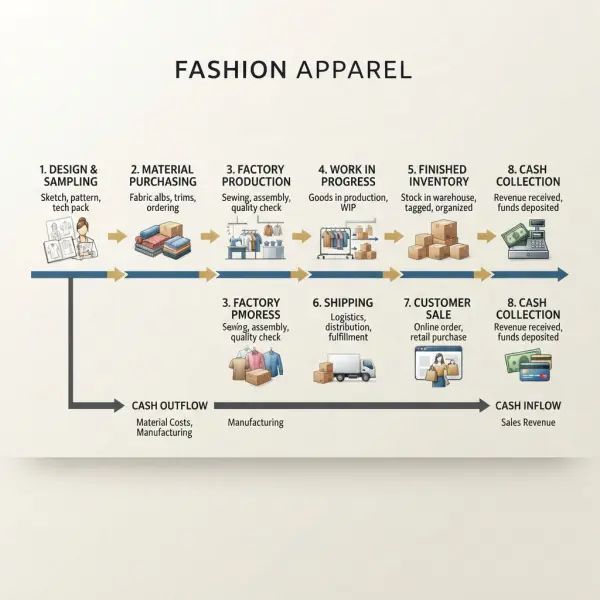
A fashion founder may think of a collection as moving through design, sampling, production, delivery, and selling. Finance sees another sequence running underneath it:
cash commitment → inventory creation → finished stock → customer sale → cash recovery.
The two sequences are connected, but their timing is not identical.
ACCA's working capital guidance defines the cash operating cycle as the period between paying suppliers and receiving cash from sales. In manufacturing, inventory days can include raw materials, work in progress, and finished goods.
That framework is particularly relevant to apparel because one garment can absorb capital at several stages before it generates revenue.
The Production Cycle and Cash Cycle Are Not the Same Thing
The production cycle describes how a product moves through manufacturing.
The cash cycle describes how money moves around that product.
A garment might take six weeks to manufacture, but its cash cycle could be much longer.
Suppose a brand pays a fabric deposit three weeks before cutting begins. Garment production takes another six weeks. Freight takes two weeks. The product then spends eight weeks in inventory before selling.
Even if the production process itself lasts only six weeks, money may be committed for several months before returning as cash.
Customer and supplier payment terms can extend or shorten the gap further.
A wholesale customer paying 60 days after delivery increases the period before the brand recovers cash. A supplier granting 30-day payment terms may reduce the amount of time the brand's own cash is committed.
This is why the commonly used cash operating cycle formula is:
Inventory days + Receivables days − Payables days
The longer that cycle becomes, the more working capital is generally required to support the same level of business activity.
For a broader explanation of this financial foundation, see fashion cash flow management for small brands.
Where Cash Becomes Tied Up During Fashion Production
Inventory should not be thought of only as finished garments hanging in a warehouse.
Under IAS 2, inventories can include materials and supplies used in production, work in progress, and finished goods held for sale. Inventory cost can include purchase costs, conversion costs, and other costs incurred in bringing inventory to its present location and condition.
For an apparel company, capital can therefore sit in several places at once.
|
Production position |
Fashion example |
Cash implication |
|
Raw materials |
Fabric, yarn, trims, labels |
Cash committed before garments exist |
|
Work in progress |
Cut panels or garments being sewn |
Money invested but product cannot yet be sold |
|
Finished goods |
Completed garments awaiting sale |
Product is sellable but cash has not yet returned |
|
Goods in transit |
Finished stock moving from factory to warehouse |
Capital remains committed during transport |
|
Wholesale receivables |
Goods delivered but retailer has not paid |
Product has sold, but cash may still be unavailable |
This is why inventory growth can consume significant cash even when the income statement still looks healthy.
IAS 2 also requires inventories within its scope to be carried at the lower of cost and net realisable value. Stock may therefore create not only a cash-timing issue but also economic risk if products become obsolete, damaged, heavily discounted, or otherwise recover less than originally expected.

Why Long Production Cycles Usually Require More Working Capital
Longer production cycles can increase working-capital requirements because cash remains committed for a longer period before the final product can generate customer receipts.
Consider two brands selling similar dresses.
One works with a nearby factory that can produce replenishment quantities in four weeks.
The other uses a specialized overseas supplier requiring fabric reservations, larger production quantities, and a four-month end-to-end procurement and manufacturing timeline.
The second brand may have valid reasons for that sourcing strategy—specialized craftsmanship, fabric capability, price, quality, scale, or technical expertise.
But financially, it may need to make purchasing decisions much earlier.
That creates several consequences.
Forecast uncertainty becomes greater because the brand must predict demand further in advance. Order quantities may need to be larger. More money may remain in production or inventory at any moment. Reactions to unexpected demand may also be slower.
A long production cycle is therefore not necessarily bad.
It is simply more capital-intensive under many sourcing structures.
The relevant question is whether the commercial benefits of the sourcing model justify the working-capital exposure it creates.

How Pre-Orders Change the Cash Sequence
A pre-order allows a customer to place an order before the product is immediately available for normal fulfilment.
Depending on the commercial model, the brand may collect full payment, a deposit, or another agreed amount before manufacturing is complete.
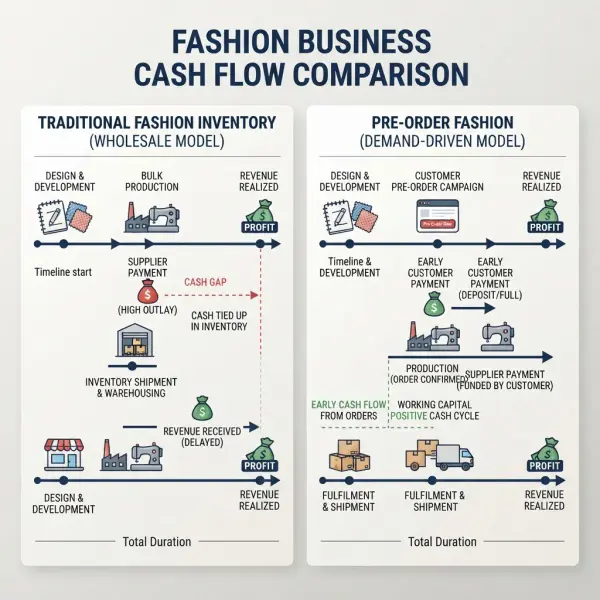
From a cash-flow perspective, this can reverse part of the conventional sequence.
Conventional inventory model
Brand pays → product is manufactured → inventory arrives → customer orders → customer pays
Pre-order model
Customer orders and may pay → brand completes or funds production → product is delivered
The attraction is obvious.
Customer cash may arrive closer to, or even before, major production payments.
That can reduce the amount of capital the brand needs to provide from retained earnings, owner funding, or financing.
But this distinction matters:
receiving cash is not the same as earning revenue.
IFRS 15 states that when a customer provides consideration before the company transfers the promised good or service, the company generally presents a contract liability until that performance obligation is satisfied. The standard recognizes revenue when the relevant promised goods or services are transferred to the customer.
For management purposes, this means cash collected through pre-orders should not automatically be treated as unrestricted economic profit.
The brand still owes customers their products.
Pre-Orders Can Reduce Working-Capital Pressure—But Only Under the Right Conditions
Pre-orders are commercially useful when they genuinely change the timing or certainty of demand.
Imagine a small brand planning a limited jacket.
Without pre-orders, it might need to finance production for 500 units without knowing exactly how many will sell.
With a well-designed pre-order campaign, the company may secure orders for 250 units before committing to the final production quantity.
That can create two advantages.
First, customer receipts may contribute to funding production.
Second, actual orders provide stronger demand information than a purely internal sales forecast.
Neither advantage eliminates risk.
The remaining 250 units may still require funding. Customers can cancel or seek refunds depending on commercial terms and applicable law. Manufacturing can be delayed. Material prices can change. Quality problems can occur. The factory may require a deposit before enough pre-orders have accumulated.
Pre-orders work best when they are part of a deliberate operating model rather than an emergency response to inadequate cash.
Why Pre-Order Cash Is Not “Free Money”
The most dangerous way to manage pre-order cash is to view it as available revenue that can immediately fund unrelated spending.
Operationally, pre-order money arrives with an obligation attached.
The company still needs to:
- manufacture or procure the promised product;
- complete quality control;
- pay remaining supplier and freight costs;
- pack and fulfil the order;
- manage customer service;
- absorb potential refunds or cancellations where applicable;
- respond if production is delayed or the product cannot be delivered.
If all pre-order receipts are spent before these obligations are adequately funded, the model can create a new cash problem.
This becomes particularly risky when one pre-order campaign starts funding older obligations.
For example, Collection B pre-order receipts are used to pay unpaid costs from Collection A. When Collection B production payments arrive, management becomes dependent on cash from Collection C.
That pattern can temporarily hide a structurally weak cash cycle.
Pre-orders should reduce a financing gap, not simply move the gap forward.
Pre-Order, Made-to-Order, and Stock Models Have Different Cash Profiles
These models are sometimes discussed as though they are interchangeable.
They are not.
|
Model |
When production happens |
Typical inventory exposure |
Cash-flow characteristic |
|
Ready stock |
Before individual customer demand is known |
Higher if stock is produced speculatively |
Brand usually funds production before sales |
|
Pre-order |
Product may be planned or partially committed before customer orders close |
Can be lower depending on how quantities are finalized |
Customer cash may arrive before final production or fulfilment |
|
Made-to-order |
Production begins or is completed in response to a specific customer order |
Often lower finished-goods inventory |
Customer order can be closely aligned with production |
|
Small-batch replenishment |
Initial stock is limited and replenished based on sales |
Moderate and responsive |
Cash is deployed in smaller production waves |
None is universally superior.
Made-to-order can reduce inventory exposure but may increase customer lead time and unit production cost.
Ready stock can support immediate delivery but requires more demand forecasting and working capital.
Pre-orders can improve cash timing but introduce fulfilment and communication obligations.
Small-batch replenishment can reduce initial exposure but depends on suppliers being able to replenish quickly enough.
The financially strongest model is the one aligned with the brand's customer expectations, supplier capability, margin structure, product type, and access to capital.
Inventory Depth Changes Both Sales Opportunity and Cash Risk
Fashion inventory planning is a balancing exercise.
Too much stock ties up cash.
Too little stock can lose sales.
This means the goal should not be “minimum inventory.”
The goal is productive inventory.
Suppose a brand has $100,000 available to invest in stock.
It could place that money into:
- large quantities of a few proven core styles;
- many styles with shallow quantities;
- a mix of core replenishment products and seasonal bets;
- raw materials that can be converted into several products later.
Each structure creates a different cash and demand-risk profile.
A deep order in a proven bestseller may have a relatively predictable path back to cash.
The same amount spread across many experimental fashion SKUs could take much longer to recover.
SKU count matters because every additional combination of style, color, and size divides the inventory commitment.
A collection with 20 styles may sound small.
If each style has three colors and five sizes, the assortment already contains 300 style-color-size combinations.
Not every SKU needs equal depth, but the example shows how assortment complexity can quickly increase capital requirements.
Slow Inventory Extends the Cash Cycle
The production payment is only the beginning.
Once garments arrive, sell-through determines how quickly cash returns.
Suppose two fashion brands each spend $50,000 manufacturing inventory.
Brand A sells most of its stock in six weeks.
Brand B needs nine months.
Even if both eventually produce the same gross profit, Brand B's capital remains unavailable for much longer.
During those nine months, the company may still need to fund:
- new sampling;
- the next collection;
- salaries;
- marketing;
- supplier deposits;
- rent;
- software;
- freight.
Slow-moving inventory therefore creates an opportunity cost.
Cash committed to one collection cannot simultaneously finance another priority.
This is one reason profitable fashion brands can still run out of cash: strong margins do not guarantee fast cash conversion.
Shorter Production Cycles Can Improve Flexibility, but They May Cost More
Short production cycles are attractive because brands can commit cash closer to actual demand.
A business that can reorder every four weeks may need less safety inventory than one that can reorder only twice a year.
That can reduce forecasting risk and potentially improve cash conversion.
However, shorter production runs may involve trade-offs.
Factories may charge more per unit for small batches. Material suppliers may still have minimum order quantities. Frequent shipments can increase logistics costs. Local production may offer shorter lead times but not the same unit economics or technical capabilities as another sourcing region.
The correct comparison is therefore not:
short lead time = good, long lead time = bad.
It is:
Does the total commercial value of the sourcing model justify the amount of cash and inventory risk it requires?
A slower supply chain can be completely rational when the brand has stable demand, strong margins, suitable payment terms, or specialized product requirements.
A Numerical Example: Traditional Stock Versus Pre-Order
Consider a small fashion brand launching a capsule collection.
Assume the planned production requires:
|
Cash requirement |
Amount |
|
Sampling and development |
$4,000 |
|
Fabric and trims |
$12,000 |
|
Factory production |
$24,000 |
|
Freight and receiving |
$5,000 |
|
Campaign costs |
$5,000 |
|
Total pre-sale cash requirement |
$50,000 |
Scenario A: Produce first, sell later
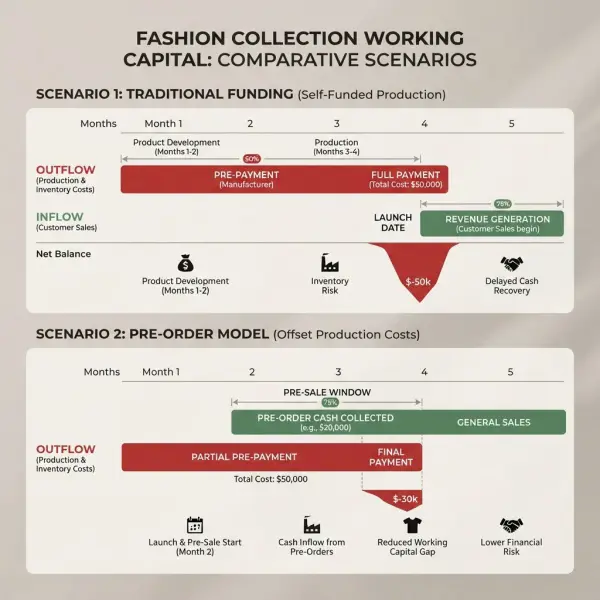
The brand finances the full $50,000 before meaningful customer receipts arrive.
If stock then takes four months to sell, a significant portion of that capital remains committed through production and the subsequent selling period.
Scenario B: Secure pre-orders before final production payment
Suppose the brand collects $18,000 of valid customer prepayments before the final factory balance becomes due.
The underlying collection still costs $50,000.
Pre-orders have not made production cheaper.
But they have changed who temporarily provides part of the working capital and when the cash becomes available.
The brand may now need less of its own cash during the peak funding period.
That difference can be commercially significant for a small business.
It also creates an obligation.
If those customers have paid, the business must preserve enough financial and operational capacity to complete production and fulfil those orders.
Supplier Payment Terms Can Change the Cash Cycle as Much as Production Speed
Lead time receives a great deal of attention in fashion sourcing, but payment timing can be just as important financially.
Consider two suppliers.
Supplier A has a 60-day production lead time but requires full payment before manufacturing starts.
Supplier B has a 90-day lead time but accepts a deposit followed by the balance near shipment.
Supplier A is operationally faster.
Supplier B may require less cash at the beginning of the cycle.
The best choice depends on more than either variable alone.
Brands should evaluate:
lead time + minimum order quantity + deposit requirement + final payment timing + freight time + reorder flexibility + quality and cost.
Negotiated supplier credit can shorten the brand's cash operating cycle because cash leaves later.
But longer payment terms should be agreed commercially rather than created by simply paying suppliers late.
Small labels often depend heavily on supplier goodwill. A marginal working-capital improvement is rarely worth damaging a reliable manufacturing relationship.
Wholesale Can Extend the Cycle After Production Is Already Finished
For wholesale brands, the cash cycle may continue after inventory has physically left the warehouse.
Suppose a brand:
- pays suppliers;
- produces the garments;
- ships the collection to a retailer;
- invoices the retailer;
- receives payment 30 or 60 days later.
The product has effectively completed its production and fulfilment journey before the brand receives the final cash.
That means inventory planning and receivables management must be analyzed together.
A large wholesale order can look financially attractive while requiring considerable interim funding.
If several major retailers place larger orders simultaneously, the company may need more cash—not less—even though future revenue has increased.
The operating cycle cannot therefore be understood by looking only at manufacturing lead time.
How Production Overlap Creates Hidden Cash Pressure
Fashion collections rarely wait politely for the previous collection to finish selling.
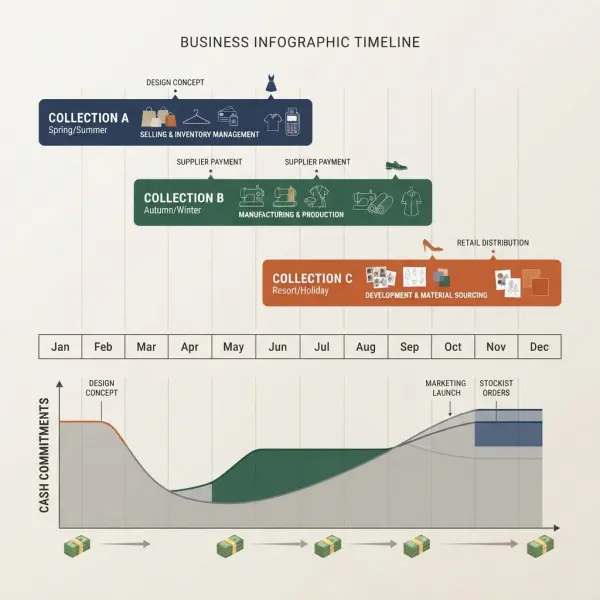
While one range sits in stores, the next may already be in production and a third may be in development.
Cash can therefore be tied up across several product generations simultaneously.
For example:
Collection A: finished inventory still selling
Collection B: garments currently in production
Collection C: fabrics and samples being developed
The company is funding three different points in the product lifecycle at once.
That overlap can become one of the largest hidden working-capital requirements in a growing fashion business.
It also explains why annual profit is not enough to judge financial capacity.
Management needs a rolling view showing when each collection creates cash commitments and when each is expected to release cash.
How Fashion Brands Can Apply This in Practice
A useful cash-management system should connect the financial forecast directly to product operations.
Do not forecast “inventory spending” only as one monthly number.
Break major collections into actual milestones.
A practical production cash map can include:
Product development: pattern development, prototypes, samples, fit revisions.
Material commitment: fabric deposits, trim orders, printing, dyeing, minimum order commitments.
Manufacturing: factory deposit, progress payment if applicable, final production balance.
Logistics: freight, customs-related expenses where applicable, receiving, fulfilment preparation.
Selling: expected launch date, wholesale delivery, DTC sales curve, pre-order receipts.
Cash recovery: expected payment processor settlement, wholesale collection date, remaining stock liquidation.
Once those milestones are plotted, management can see when multiple collections create peak cash demand.
That is far more useful than discovering the problem after the bank balance has already fallen.
What Metrics Should Fashion Teams Track?
The exact dashboard depends on the business model, but a small brand should generally understand several operational numbers.
Production lead time shows how long products remain in the manufacturing pipeline.
Raw material, work-in-progress, and finished-goods exposure shows where money is currently sitting.
Inventory days provides a broader measure of how long inventory remains tied up.
Sell-through by style or SKU helps distinguish productive stock from slow-moving stock.
Supplier payment schedule shows when committed production cash will actually leave.
Pre-order cash received versus fulfilment cost remaining helps prevent the business from spending customer advances too aggressively.
Receivable days becomes important for wholesale.
Projected minimum cash balance reveals whether these commitments can coexist without creating a liquidity shortfall.
Metrics should lead to decisions.
Tracking inventory days is not useful if nobody changes buying depth, reorder strategy, or assortment architecture when stock consistently moves too slowly.
Common Mistakes in Managing Pre-Orders, Inventory, and Production Cash
Mistake 1: Treating all inventory as equally valuable
A bestseller with repeat demand and an aging seasonal fashion SKU may carry similar accounting cost but very different cash-conversion prospects.
Management should review inventory by age, sell-through, category, season, and SKU productivity rather than looking only at total stock value.
Mistake 2: Using pre-orders only because cash has already run out
A pre-order proposition still requires production capability, reliable lead times, customer communication, and fulfilment planning.
Launching one at the last minute to finance overdue bills can transfer financial pressure into delivery risk.
A stronger approach is to decide in advance which products and customer segments are genuinely suited to pre-order.
Mistake 3: Assuming pre-order receipts are immediately available profit
They are cash inflows, but the company still has obligations to customers.
Under IFRS 15, advance consideration received before goods or services are transferred is generally represented as a contract liability rather than revenue immediately upon receipt.
Operationally, brands should therefore know how much of the pre-order cash is still needed to complete and fulfil the orders.
Mistake 4: Choosing the lowest unit cost while ignoring the cash cycle
A supplier offering a lower price at 5,000 units may appear cheaper than one producing 1,000 units at a higher price.
But the larger order may require substantially more cash and create additional storage, markdown, and demand risk.
Unit cost matters.
So does capital efficiency.
Mistake 5: Ignoring overlapping collection commitments
Each collection may look affordable when reviewed individually.
The problem appears when several deposits, freight bills, payroll cycles, and launch costs occur at the same time.
Cash planning should therefore evaluate the portfolio of production commitments rather than one purchase order at a time.
Mistake 6: Shortening inventory too aggressively
Reducing inventory can release cash, but extreme reductions may create stockouts, expensive emergency freight, smaller and more costly production runs, or missed demand.
Working-capital efficiency should support the commercial strategy rather than undermine it.
What Brands Should Verify Before Changing Their Production Model
Changing from ready stock to pre-order, shortening runs, moving suppliers, or reducing inventory can have consequences beyond finance.
Before acting, verify:
- supplier minimum order quantities;
- production and replenishment lead times;
- payment milestones;
- material availability;
- realistic defect and rework allowances;
- freight and customs timing;
- customer tolerance for longer delivery;
- cancellation and refund obligations;
- applicable consumer-protection rules;
- marketplace rules where products are sold;
- payment processor settlement policies;
- inventory accounting treatment;
- demand forecast reliability;
- fulfilment capacity if orders exceed expectations.
Consumer, tax, revenue-recognition, and refund requirements vary by jurisdiction and transaction structure. Fashion businesses should therefore verify local requirements rather than assuming that a pre-order structure used by another brand can be copied unchanged.
Pre-Orders Are a Business Model Choice, Not Just a Financing Technique
Pre-orders are often discussed primarily as a solution to excess inventory.
That is only one part of the decision.
Customer experience matters.
Some shoppers are comfortable waiting for a limited designer product, customized piece, crowdfunding-style launch, or item with genuine scarcity.
The same shoppers may be far less willing to wait several months for an ordinary wardrobe basic they could purchase immediately elsewhere.
Brand positioning therefore influences whether pre-order works.
So does communication.
Customers need realistic information about delivery timing and what they are buying. Repeated delays can damage trust even if the financial logic of the model appears attractive.
A cash-efficient operating model that weakens customer confidence is not genuinely efficient.
The Best Cash Cycle Is Not Necessarily the Shortest Possible Cycle
Reducing the cash cycle is generally attractive because it frees working capital sooner.
But fashion businesses should avoid treating cycle length as an isolated optimization target.
A brand might shorten its cycle by:
- holding less inventory;
- purchasing smaller quantities;
- sourcing closer to market;
- collecting customer cash earlier;
- negotiating later supplier payments.
Each action has trade-offs.
Smaller orders may cost more.
Local suppliers may have different capabilities.
Pre-orders may increase customer wait times.
Very low inventory can create lost sales.
Long supplier terms may not be commercially available.
The best production and inventory structure is therefore the one that produces an acceptable combination of:
margin, availability, demand risk, customer experience, production reliability, and working-capital requirement.
That combination will differ between a luxury made-to-order label, a basics brand, a wholesale fashion company, and a trend-driven DTC startup.
Frequently Asked Questions
Do pre-orders improve cash flow for fashion brands?
They can. Pre-orders may bring customer cash into the business before final production and fulfilment costs are paid, reducing the amount of working capital the brand must provide itself. They can also provide stronger demand information before final quantities are committed. However, pre-orders do not eliminate production costs or fulfilment obligations. The brand must still fund manufacturing, quality control, freight, customer service, refunds where applicable, and delivery. Their effectiveness therefore depends on payment timing, supplier terms, margins, lead times, and customer acceptance.
Does reducing inventory always improve cash flow?
Reducing inventory can release or preserve cash, but reducing it too far can create commercial problems. A brand may experience stockouts, lost sales, repeated small production runs, higher unit costs, or expensive expedited shipping. The objective is not minimum inventory but an inventory level appropriate to demand uncertainty, supplier lead time, margin, replenishment capability, and customer service expectations. Slow-moving and highly speculative stock usually deserves more scrutiny than proven inventory with reliable sell-through.
Why does a long fashion production cycle require more cash?
A longer cycle often means money is committed for more time before products can be sold. Cash can sit in raw materials, work in progress, goods in transit, and finished stock before returning through customer payments. Longer lead times may also require brands to forecast further ahead and place larger or earlier orders. The actual working-capital requirement still depends on supplier deposits, payment terms, sales speed, customer payment timing, and whether customer prepayments are available.
What is the difference between pre-order and made-to-order?
A pre-order generally allows customers to order a product before it is ready for normal immediate fulfilment. The brand may still manufacture a batch containing both pre-sold and speculative units. Made-to-order production is more directly triggered by a specific customer's order and may involve producing that particular item only after the order is received. Both models can reduce finished-goods inventory compared with conventional ready stock, but their production economics, customer lead times, scalability, and cash requirements can differ substantially.
How does wholesale make the production cash cycle longer?
Wholesale can extend the cash cycle because the brand may fund production before shipping merchandise and then wait additional time for the retailer to pay. Even after the garments have left the brand's warehouse, cash may remain tied up as accounts receivable. Large wholesale orders can therefore increase revenue and profit while simultaneously increasing short-term working-capital requirements. Supplier payment schedules and retailer payment terms should be modeled together before accepting rapid wholesale growth.
Is a shorter production lead time always better financially?
No. Shorter lead times can reduce forecast uncertainty and allow smaller, more responsive inventory commitments, but they can come with higher unit costs, different supplier capabilities, or more expensive logistics. A longer lead time may be financially reasonable when the brand receives favorable pricing, specialist production capability, stable demand, or suitable supplier payment terms. The financially relevant measure is the total economic and working-capital effect rather than lead time alone.
How much pre-order cash should a brand keep available?
There is no universal percentage. A brand should estimate the remaining cash required to produce and fulfil the outstanding pre-orders, including manufacturing balances, freight, fulfilment, customer service, expected refunds, and other related commitments. Management should also consider downside scenarios such as delays, quality failures, or cost increases. The key principle is that pre-order receipts should not be treated as fully discretionary while substantial obligations to those customers remain.
Conclusion
Pre-orders, inventory, and production cycles shape fashion cash flow because they determine how long the business must finance the journey between product commitment and customer payment.
Inventory is not merely a merchandising issue.
Raw materials consume cash. Work in progress consumes cash. Finished garments consume cash until they sell. Wholesale receivables can keep that cash unavailable even after products have been delivered.
Production timing determines how long those stages last.
Pre-orders can rearrange the sequence by bringing some customer money forward, potentially reducing the brand's own working-capital requirement. But that advantage comes with fulfilment obligations, accounting implications, operational risk, and customer expectations.
For small fashion brands, the strongest approach is rarely to maximize one variable.
It is not always better to carry the least inventory.
It is not always better to use pre-orders.





Comments 0
Leave a CommentSend Comment
Anda harus Login terlebih dahulu untuk dapat memberikan komentar.