

Garment Yoke Construction Explained for Shirts, Dresses, and Jackets
A well-designed garment yoke can change how a shirt sits across the shoulders, how a dress falls from the upper bodice, or how a jacket communicates its structural design. Although it may appear to be a simple seam dividing two fabric sections, the yoke can influence garment fit, fabric distribution, assembly techniques, and the overall appearance of a finished product.
For fashion designers and apparel manufacturers, understanding yoke construction requires more than recognizing where the seam is positioned. The shape of the pattern pieces, the way fabric is attached, and the relationship between the yoke and surrounding garment sections all determine whether the detail serves a functional purpose, a decorative purpose, or both.
The distinction becomes particularly relevant when developing shirts, dresses, and jackets for commercial production. A construction that works well in a lightweight cotton blouse may require different engineering when applied to a structured denim jacket or a flowing woven dress.
Quick Answer: What Is Garment Yoke Construction?
Garment yoke construction is a method of assembling clothing using a separate shaped fabric section, usually positioned around the shoulders, upper chest, back, waist, or hips, to connect garment panels and control their fit, fullness, or appearance. A yoke creates a defined seam where the adjoining fabric sections meet, allowing designers to introduce shaping, gathers, pleats, or decorative details.
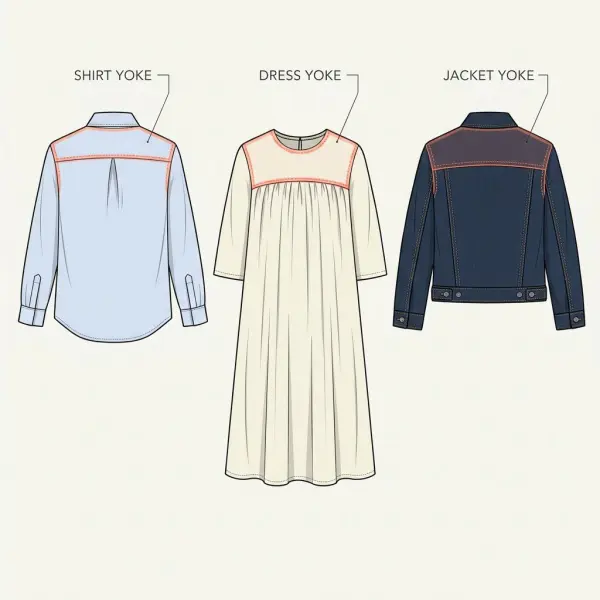
In shirts, the yoke commonly forms the upper back and shoulder area, connecting the main back panel to the front sections. In dresses, it can define the upper bodice or provide a fitted section above a gathered or flowing body. Jackets may incorporate yokes across the shoulders, chest, or back to establish distinctive design lines and, where appropriate, support structural shaping.
The practical benefits depend on the pattern and construction method. A shaped yoke can help accommodate body contours, while a double-layer yoke can conceal internal seam allowances and produce a cleaner finish. However, adding a yoke does not automatically improve fit, comfort, or durability.
For apparel businesses, effective yoke construction combines accurate pattern engineering, suitable fabric selection, consistent sewing operations, and clear production specifications.
What Is a Yoke in Garment Construction?
A yoke is a separate fabric section incorporated into a garment pattern, typically positioned where a relatively fitted area connects to another garment section. Unlike an ordinary decorative stitch line, a constructed yoke normally consists of one or more actual fabric pieces joined to adjoining panels. It can follow a straight, curved, angled, or more elaborate seam shape, depending on the intended design.
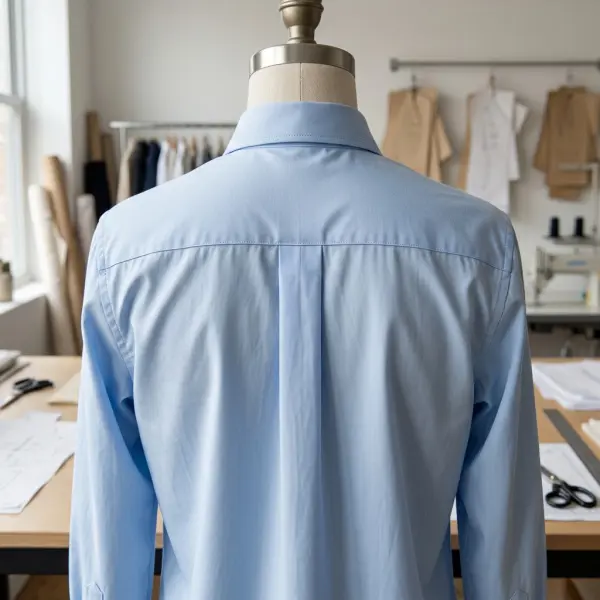
In conventional shirt construction, the most familiar example is the back shoulder yoke. This panel extends across the upper back, often from one shoulder area to the other, with the lower back fabric attached along its bottom edge. The yoke may also extend over the shoulder toward the front of the garment, depending on the pattern.
The principle is not limited to upper-body clothing. Yokes also appear in skirts and trousers, where shaped panels around the waist or hips can contribute to fitting and silhouette development. As discussed in The Cutting Class's guide to basic yokes, a yoke seam can incorporate shaping that might otherwise be handled through darts, while also becoming a visible design feature.
This ability to combine garment engineering with visual design explains why yokes appear in both understated everyday clothing and more elaborately constructed fashion products.
The Yoke as a Separate Pattern Piece
In garment pattern development, a yoke is created by dividing the original pattern into distinct sections. The designer or patternmaker establishes the desired seam position, separates the relevant pieces, and develops the necessary shaping and seam allowances. If the yoke is intended to replace part of a dart, the pattern must be adjusted to preserve the required three-dimensional fit.
This is different from simply drawing a line across an existing garment. Dividing a pattern without accounting for seam allowances, shaping, grain direction, or the relationship between connecting edges can change the garment's measurements or produce unwanted tension.
A well-engineered yoke therefore begins with the relationship between the garment's two-dimensional pattern and its three-dimensional fit. The location of the seam is important, but the geometry of the joining pieces ultimately determines how the finished garment behaves.
Functional Yokes Versus Decorative Yokes
Some yokes actively contribute to shaping the garment. A curved back yoke may help accommodate the shoulder blades, while a fitted upper section of a dress can provide a controlled transition to gathered fabric beneath it. In these applications, the yoke is part of the garment's fitting system.
Other yokes are primarily decorative. A Western-style shirt may use a pointed shoulder yoke to establish a recognizable design aesthetic, even when the garment's main fit is controlled elsewhere. Contrasting fabrics, piping, embroidery, and topstitching can emphasize the seam without necessarily changing the underlying silhouette.
Many commercial garments combine both functions. The key for designers is to establish whether the yoke is expected to provide shaping, carry fabric fullness, create a visual identity, or perform several of these tasks simultaneously.
How Yoke Construction Influences Garment Fit and Shape
The relationship between a yoke and the rest of the garment determines whether the construction genuinely improves fit or merely introduces another seam. Its effectiveness depends on where fullness is needed, which parts of the body require closer fitting, and how the fabric responds to movement.
Controlling Fit Across the Shoulders and Upper Back
The upper back is not a flat surface. Shoulder slope, shoulder-blade prominence, upper-back curvature, and individual posture all influence how fabric sits between the neckline and armholes. A properly shaped yoke seam provides an additional location where a patternmaker can adjust the garment to accommodate these contours.
For example, a fitted blouse may develop excess fabric near the back armhole while pulling across the shoulder blades. Instead of relying exclusively on shoulder darts or changing the side seams, a designer may incorporate a curved back yoke seam that absorbs some of the necessary shaping.
Sarah Veblen explains this approach in Threads' guide to adding a yoke for fit and style. The technique demonstrates how a yoke can incorporate dart shaping and provide contouring across the shoulder blades and upper back.
The qualification matters: a yoke only provides this benefit when the pattern is designed to do so. A straight seam added to an otherwise unchanged loose-fitting shirt may have little influence on its fit.
Managing Gathers, Pleats, and Fabric Fullness
A yoke can also create a controlled transition between a relatively fitted section and a fuller garment body. This is particularly useful in blouses, relaxed shirts, children's clothing, and dresses where designers want volume without excessive fabric around the neckline or shoulders.
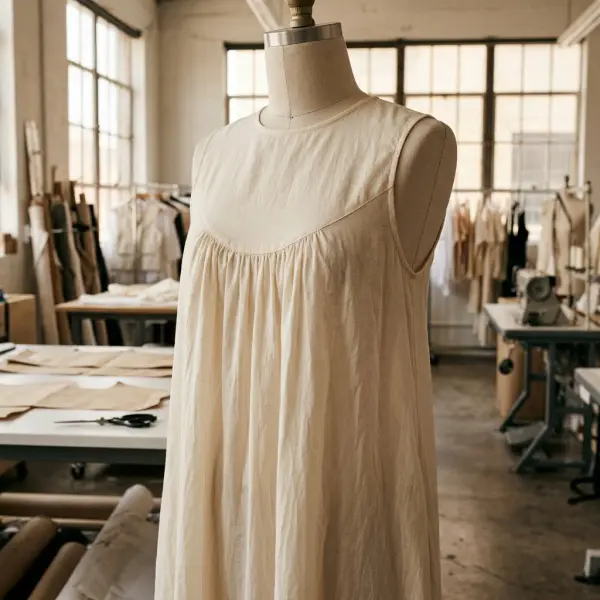
Consider a lightweight woven dress with gathers below a front yoke. The yoke can fit relatively smoothly around the upper chest while the lower bodice contains additional fabric distributed into the joining seam. Instead of attempting to shape the entire front as one continuous piece, the designer manages fit and fullness separately.
The same principle can apply to a shirt with a center-back box pleat below the yoke. The pleat introduces additional fabric into the lower back area, which may help accommodate movement when properly proportioned. However, the amount of usable ease depends on the pleat design, the overall shirt measurements, and the characteristics of the fabric.
For a closer examination of the construction techniques used to organize this fullness, see pleats, tucks, and gathers in garment construction.

Creating Visual Structure Without Excessive Tailoring
Yoke seams can introduce horizontal, curved, or angular design lines without requiring the garment to use heavy tailoring techniques. On a casual jacket, for instance, a clearly defined upper-back yoke may create a more structured appearance even when the garment is made from relatively soft fabric.
This visual effect should not be confused with physical stiffness. A yoke only adds meaningful structural support when its pattern, fabric, layers, interlining, or seam construction contribute to that result. Otherwise, the seam primarily changes how the eye reads the silhouette.
Designers can use this distinction deliberately. A soft shirt dress may need a yoke for subtle shaping and gathering, while a workwear-inspired jacket may emphasize a prominent yoke through heavier topstitching or contrasting materials.
Garment Yoke Construction in Shirts, Dresses, and Jackets
Although the underlying principle is similar, yokes are applied differently across clothing categories. A shirt yoke generally focuses on the upper back and shoulders, a dress yoke often controls the relationship between fitted and fuller fabric sections, and a jacket yoke may serve both structural and visual purposes.
Understanding these differences helps apparel businesses avoid applying the same construction specification indiscriminately to every product.
Shirt Yokes: Shoulder Fit and Clean Construction
The back yoke is a familiar component of woven button-down shirts, particularly traditional dress shirts, casual shirts, and various workwear styles. It normally connects the upper back to the main shirt body and may incorporate the front shoulder area depending on the design.
Many shirts use an outer yoke and an inner yoke, creating a double-layer construction. When assembled appropriately, these layers enclose seam allowances around the upper-back joining seam and shoulder connections, giving the interior a cleaner finish.
This construction can be useful in shirts made from cotton poplin, oxford cloth, chambray, and other woven materials. The actual result depends on the fabric weight, thickness, and sewing method. A bulky fabric may require careful seam grading and pressing to prevent the double-layer area from becoming unnecessarily thick.
Shirt yokes may be constructed from one continuous outer pattern piece or divided into separate sections. The choice affects pattern cutting, seam placement, and potentially fabric orientation, but it should not be treated as an automatic indicator of better fit or quality.
Those distinctions are examined in more detail in one-piece versus split yokes in shirt construction.
Dress Yokes: Controlling Volume and Silhouette
Yokes in dresses offer a broader range of design possibilities because dresses vary considerably in length, volume, waist placement, and bodice construction. A yoke may appear at the neckline, across the upper chest, around the shoulders, or at the waist and hip areas.
In a gathered day dress, a smooth upper yoke can support a fuller body section. In a shirt dress, the back yoke may resemble conventional shirt construction, although the longer garment body introduces additional considerations involving drape and weight. A more fitted dress may use shaped yoke seams to integrate bodice contours into the overall pattern.
Fabric selection becomes particularly important. A lightweight cotton lawn or viscose fabric may gather comfortably into a yoke seam, while a firm, heavy woven material may produce substantial seam bulk or an unwanted stiff transition.
The designer must also consider how the garment behaves when worn. If a yoke supports a relatively heavy lower section, the seam, fabric stability, and overall garment balance need to be assessed during sampling rather than assumed from the sketch.
Jacket Yokes: Construction Detail and Design Identity
Yokes appear in several jacket categories, including denim jackets, Western-inspired jackets, utility outerwear, and some tailored or casual coats. They may run across the upper back, form shaped front shoulder sections, or create angular decorative lines.
On a denim jacket, an upper-back yoke can establish a strong design boundary between the shoulder area and the lower body. Visible topstitching may reinforce that design language. In Western-inspired styles, pointed or curved yokes can become defining visual elements, sometimes combined with contrasting fabric or embroidery.
A jacket yoke is not necessarily a reinforcement component. Its actual contribution to durability depends on the seam construction, fabric strength, stitch specifications, and how stresses are distributed through the garment. Similarly, a visually structured yoke does not automatically make the jacket more supportive or protective.
For manufacturing teams, the main challenge is balancing appearance with material thickness and assembly requirements. Multiple fabric layers at the yoke, armhole, collar, or lining intersections can create bulk, particularly in heavier outerwear.
Comparing Yoke Applications Across Garment Categories
The following comparison illustrates how the construction priorities change according to product type.
|
Garment category |
Common yoke placement |
Typical construction purpose |
Main production consideration |
|
Button-down shirt |
Upper back and shoulders |
Upper-back shaping, panel connection, clean interior finishing |
Shoulder alignment, seam finishing, fabric matching |
|
Relaxed blouse |
Upper back or front bodice |
Controlled gathers or pleats, design shaping |
Even fullness distribution and seam smoothness |
|
Casual dress |
Upper bodice, neckline, or waist |
Transition between fitted and fuller sections |
Fabric drape, seam stability, silhouette |
|
Denim jacket |
Upper back or front shoulders |
Design segmentation, potential shaping |
Topstitching accuracy and seam bulk |
|
Utility or casual jacket |
Shoulder, chest, or back |
Panel organization, styling, and possible structural shaping |
Material compatibility, assembly sequence, stress points |
The practical lesson is that yoke construction should be specified according to the intended garment function. Using a construction method because it is familiar from shirtmaking may not be appropriate for a gathered dress or a thick outerwear fabric.
Common Yoke Construction Methods and Variations
A yoke can be developed using several construction approaches. These variations influence cutting requirements, assembly operations, internal seam finishes, and the garment's appearance.
Single-Layer Yoke Construction
A single-layer yoke uses one fabric layer for the relevant panel. It is joined to the surrounding garment sections using an appropriate seam construction, with the exposed seam allowances finished according to the product specification.
This approach can be suitable for garments where an additional yoke layer is unnecessary, such as certain lightweight blouses, casual dresses, or unlined garments. It may reduce fabric consumption and layer thickness compared with an otherwise identical double-layer construction, although the final savings depend on cutting layouts and finishing operations.
The exposed seam allowances still require consideration. Depending on the material and design, manufacturers may use overlocking, binding, or another suitable seam finish.
Double-Layer Yoke Construction
A double-layer yoke consists of an outer yoke and an inner yoke, sometimes called a yoke facing. The layers can enclose the seam allowances where the yoke connects to the garment, particularly in conventional shirt construction.
The result is often a cleaner appearance on the inside. Additional fabric may also affect how the upper section feels and holds its shape, but the degree of reinforcement is material- and construction-dependent.
A commonly used assembly technique is the burrito method, in which garment sections are temporarily rolled between the two yoke layers while the shoulder seams are stitched. Once the garment is turned right side out, the relevant seam allowances remain enclosed.
The procedure is demonstrated in Style Arc's double shirt yoke construction tutorial. It illustrates how the back and front sections can be assembled using this enclosed-seam technique.
Shaped and Decorative Yokes
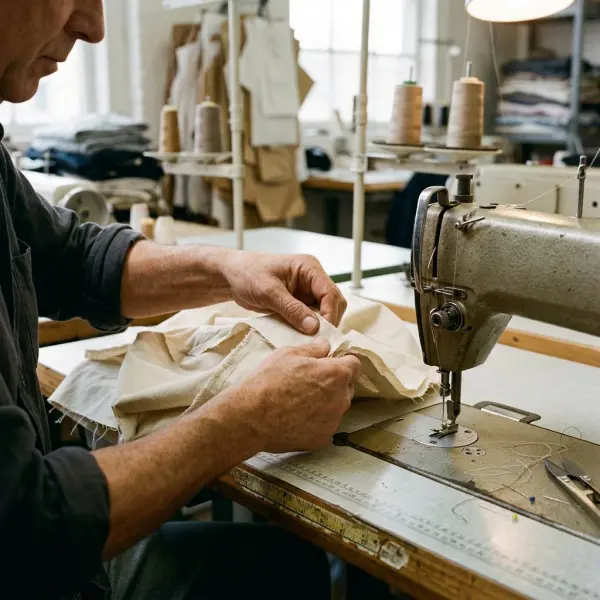
Shaped yokes incorporate curved, angled, pointed, or otherwise contoured seamlines. Their geometry may help create fit adjustments, but a shaped yoke can also be introduced primarily for aesthetic purposes.
For example, an angular yoke on a Western-inspired shirt can establish a recognizable design feature. A curved yoke on a blouse may be shaped to accommodate the upper back while maintaining a softer visual line.
More elaborate seam shapes require careful production planning. Sharp points, tight curves, and multiple seam intersections may need clipping, grading, accurate stitching, and controlled pressing to achieve a clean result.
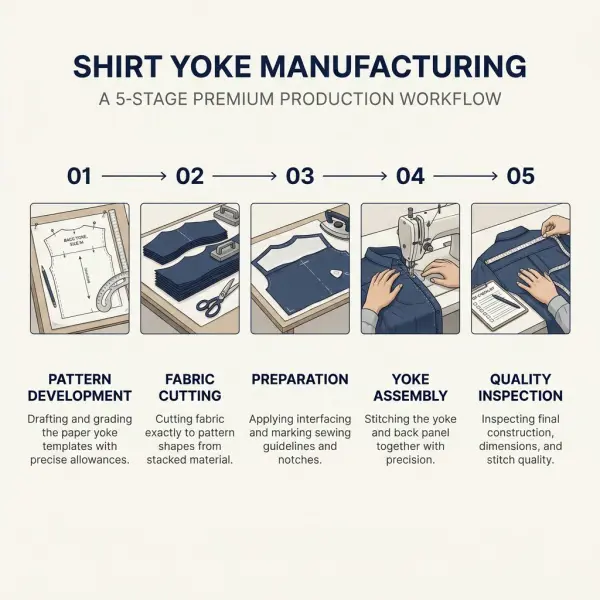
How Is a Garment Yoke Constructed?
Garment yoke construction generally follows a sequence involving pattern development, cutting, preparation, joining, and finishing. The exact order changes with the garment design and whether the yoke is single-layered, double-layered, gathered, lined, or integrated with other components.
1. Develop the Yoke Pattern
The process begins with a base garment pattern that has the intended fit and silhouette. The patternmaker establishes the yoke seam position and determines whether it should incorporate darts, shaping, or additional fullness.
Once the pattern is divided, the new pieces must be prepared with appropriate seam allowances, grainline markings, notches, and other assembly references. These details are essential for maintaining the garment's original proportions.
If the new yoke changes shoulder geometry or armhole dimensions, adjoining pieces may also require adjustment. Changing an armhole without checking the corresponding sleeve pattern can produce sewing difficulties or fit problems later.
2. Select the Material and Cutting Direction
The yoke material is normally selected to work with the main garment fabric, although contrasting materials can be used deliberately. The patternmaker and technical team must determine whether the yoke should follow the same grain direction as the surrounding panels.
Grain orientation can influence the panel's dimensional behavior, drape, and the way stripes or checks appear. Cutting a yoke on the bias, for example, can create an attractive diagonal pattern effect, but it may also introduce additional stretch or distortion that requires consideration during construction.
The cutting plan should also account for symmetry and pattern matching. This is particularly relevant for checked shirts, striped garments, and jackets featuring prominent visible yoke seams.
3. Prepare the Yoke and Adjoining Fabric Sections
Before joining, manufacturers may need to stabilize selected edges, position pleats, prepare gathers, or attach interfacing where specified.
A shirt back with a box pleat must have the pleat folded and secured in the correct position before the yoke seam is assembled. Similarly, a gathered dress bodice needs its fullness distributed according to the pattern markings so that the garment does not develop unintended asymmetry.
Preparation also includes ensuring that the connecting pieces have compatible seam lengths. If a seam is designed to contain gathers or easing, the instructions must identify the intended excess rather than leaving operators to interpret a mismatch.
4. Join the Yoke to the Garment
The joining method depends on the design. A single-layer yoke may be attached using a conventional seam and separately finished seam allowances. A double-layer shirt yoke may use an enclosed-seam procedure.
Accurate stitching is especially important where the seam curves or intersects with other construction lines. Operators must maintain the specified seam allowance and avoid stretching or distorting the fabric while sewing.
In some garments, the yoke seam is topstitched after assembly. This can emphasize the design and help hold seam allowances in their intended position, but the stitch specification must be appropriate for the material and construction.
5. Press, Finish, and Inspect
Pressing helps the joined sections settle into their intended shape. Curved seam allowances may require controlled clipping or grading, depending on the construction, to prevent puckering or excess bulk.
The completed yoke should be inspected for seam alignment, symmetrical shaping, smooth fabric surfaces, and secure stitching. For double-layer yokes, the interior must also be checked for trapped folds, twisting, or uneven layer positioning.
The garment should then be assessed on a dress form or fit model. A yoke that looks technically neat when laid flat may still pull across the upper back or distort the body silhouette when worn.
Fabric Selection and Technical Considerations for Yoke Construction
Fabric properties influence how successfully a yoke can be assembled and how it performs after repeated wearing and laundering. A construction technique that produces a smooth, clean finish in one fabric may create puckering, stiffness, or undesirable distortion in another.
Fabric Weight and Thickness
Lightweight woven fabrics such as cotton lawn, poplin, and certain viscose fabrics can be suitable for gathered or smoothly fitted yoke construction. Their relatively low thickness can help minimize bulk where several layers meet.
Heavier fabrics, including denim and some canvas constructions, require greater attention to seam allowances and stitching intersections. Multiple layers can become difficult to handle around the armhole, collar, or shoulder area, particularly when a yoke is combined with facings or linings.
Manufacturers may need to adjust seam finishing, grading, needle selection, or pressing techniques according to the material. The appropriate method should be validated through sampling rather than established solely from fabric weight.
Grain Direction and Dimensional Stability
The fabric grain affects how a yoke responds to tension, drape, and movement. In woven materials, the lengthwise and crosswise directions can behave differently, while bias-oriented pieces may exhibit greater flexibility and a stronger tendency to distort.
For checked or striped garments, changing the grain direction may be an intentional design decision. However, the aesthetic advantage must be balanced against any resulting differences in dimensional behavior.
Patternmakers should specify the intended grainline rather than allowing cutting operators to decide during production. Where unusual grain orientations are used, the sample should be examined for seam distortion and dimensional stability after the relevant care procedures.
Interfacing, Lining, and Seam Finishes
Not every yoke requires interfacing or lining. These components should be selected according to the intended garment structure, material properties, and finishing requirements.
A lightweight blouse may need no additional reinforcement, while a particular jacket design may use interfacing or interlining to achieve a desired shape. A double-layer shirt yoke already incorporates an internal fabric layer, but that layer should not be confused with an automatically sufficient substitute for every structural requirement.
In lined jackets, the relationship between the outer yoke and the garment lining also needs consideration. The lining must accommodate the intended body movement and garment shape without introducing excessive pulling or bulk.
For a broader understanding of these construction choices, see how garment lining affects comfort and finishing.
What Garment Manufacturers Should Check for Quality Control
Yoke quality is determined by more than straight stitching. A technically acceptable yoke needs to maintain its intended shape, connect correctly with adjacent panels, and remain visually consistent across production units.
A shirt with uneven yoke depth may appear asymmetrical even when its stitches are secure. A dress with poorly distributed gathers may develop unwanted fullness on one side. In a jacket, inconsistent topstitching around the yoke can make an otherwise well-constructed garment appear poorly finished.
Quality control should therefore include both measurable specifications and visual assessments.
|
Quality checkpoint |
What manufacturers should examine |
Possible defect |
|
Yoke placement |
Position relative to neckline, shoulders, and pattern reference points |
Uneven yoke depth or incorrect placement |
|
Symmetry |
Matching left and right sections where the design requires symmetry |
Uneven curves or distorted shoulder lines |
|
Seam accuracy |
Seam allowance, stitch consistency, and alignment |
Puckering, exposed allowances, or weak joining |
|
Fullness distribution |
Pleats, gathers, and ease against pattern markings |
Uneven or misplaced fabric volume |
|
Interior finishing |
Seam enclosure, raw edges, and layer positioning |
Twisted inner yoke or visible unfinished edges |
|
Fabric appearance |
Pattern matching, grain consistency, and pressing |
Misaligned checks or distorted seams |
|
Wearable fit |
Upper-back comfort, shoulder balance, and intended movement |
Pulling, restriction, or excessive fabric |
These checkpoints should be translated into practical inspection criteria for the specific product. There is no single universal yoke-depth tolerance or stitch specification that applies equally to every shirt, dress, and jacket.
Sampling becomes especially valuable when the construction introduces curved seams, unusual fabrics, decorative stitching, or multiple layers. A technically correct pattern is only the starting point; manufacturing consistency must still be demonstrated.
How Fashion Businesses Can Apply Yoke Construction Strategically
For fashion brands, yoke construction is both a product-development decision and an operational commitment. Every additional panel affects the pattern, cutting process, sewing sequence, and potentially the amount of time needed for inspection and finishing.
The goal is not to add more construction details. It is to select details that contribute meaningful value to the intended garment.
Product Development: Match Construction to the Silhouette
A fashion startup developing a relaxed shirt collection may use a conventional back yoke to establish a familiar shirt silhouette and provide a neat internal finish. A brand specializing in flowing dresses may prefer shaped or gathered yokes that allow variations in body volume without redesigning the entire upper bodice.
A jacket brand, meanwhile, may use a distinctive yoke shape to create consistency across its collections. The yoke can become part of the product's recognizable design language, particularly when combined with consistent pocket placements, stitching patterns, or material choices.
These benefits are most useful when they are established during the initial design and pattern-development stages. Adding a complicated yoke late in sampling can introduce construction changes that require additional fitting, costing, and production validation.
Sourcing: Confirm Material and Supplier Capability
A supplier's ability to construct a basic shirt yoke does not necessarily establish proficiency with every type of shaped or multi-layer yoke. Curved seams, pointed corners, intricate pattern matching, and thick materials can require different levels of sewing skill and equipment.
Sourcing teams should assess supplier capability against the actual garment design rather than relying on general statements about factory experience.
For more demanding styles, a useful supplier evaluation includes reviewing comparable samples, checking sewing and pressing capabilities, and confirming how the factory handles inspection and rework. This approach is particularly relevant when the yoke is a prominent visual feature.
Production Cost: Understand the Construction Trade-Offs
A separate yoke can affect manufacturing cost through additional pattern pieces, cutting operations, seams, pressing, and quality-control requirements. A double-layer yoke generally introduces more fabric layers and potentially more assembly work than an otherwise comparable single-layer yoke.
The relationship is not necessarily linear. Some yoke constructions may simplify particular finishing operations or replace other shaping details. A design that eliminates separate darts, for example, may redistribute the sewing work rather than simply adding to it.
The actual cost effect should be evaluated through sample costing and a review of the production operation sequence. Without knowing the fabric, construction details, factory efficiency, and order quantity, a reliable percentage increase cannot be confirmed.
For smaller brands, the commercial question is whether customers will recognize or benefit from the construction detail enough to justify its production cost.
Technical Specifications: Reduce Ambiguity Before Production
A garment specification sheet, commonly called a tech pack, should communicate exactly how the yoke is intended to be constructed.
For a commercially produced shirt or jacket, the relevant information may include:
- Yoke geometry: Shape, depth, position, and relationship to the neckline, shoulders, and adjoining panels.
- Pattern and cutting requirements: Piece count, grainline, material orientation, and pattern-matching instructions.
- Construction method: Single-layer or double-layer assembly, seam type, and finishing requirements.
- Stitching details: Topstitch location, stitch specification, and any decorative construction.
- Fit and quality references: Approved sample, measurement points, grading requirements, and critical inspection criteria.
These details help turn a visual design into repeatable production instructions. The value becomes particularly clear when production is transferred between factories or when the same style is repeated across multiple seasons.
Branding and Product Communication
A carefully executed yoke can be worth showing in product imagery, especially when its design contributes to the garment's distinctive appearance. Close-up photographs of a curved jacket yoke, matched fabric patterns, or a clean shirt interior can communicate construction details that are difficult to explain through a generic product description.
Retail communication should remain accurate. Describing a shirt as having a double-layer back yoke is a specific, verifiable feature. Claiming that it guarantees superior comfort, exceptional durability, or a perfect fit requires evidence that the construction alone does not provide.
For fashion businesses, technically accurate descriptions can help customers understand what they are purchasing without inflating expectations.
Common Yoke Construction Mistakes and How to Prevent Them
Several recurring construction errors can undermine the appearance and functionality of a garment yoke. They often emerge from incomplete pattern development, unclear specifications, or insufficient sampling.
1. Adding a Yoke Without Correcting the Pattern
One of the most fundamental mistakes is dividing an existing garment pattern without accounting for the new seam allowances or shaping requirements. This can change the finished garment dimensions or create a seam that does not sit correctly on the body. Patternmakers should verify the connecting seam lengths and preserve the intended fit when creating the separate pieces. If dart shaping is transferred into the yoke seam, its effect must be retained in the revised pattern.
2. Assuming a Yoke Automatically Improves Fit
A yoke does not solve poor shoulder measurements or an unsuitable garment block simply because it creates an additional seam. The upper back may still pull if the pattern lacks sufficient length, width, or shaping for the intended wearer. In some cases, a yoke added primarily for appearance will provide little functional adjustment. Designers should establish the fitting problem first and then determine whether the yoke seam is an appropriate way to address it.
3. Ignoring Grain Direction and Pattern Matching
Incorrect grain placement can cause unwanted visual differences or affect the dimensional behavior of a yoke. The problem is particularly noticeable in striped and checked fabrics, where the joining seam becomes a prominent reference line. Cutting instructions should identify whether the yoke follows the main grain direction or uses a deliberate alternative orientation. Pattern matching must also account for seam allowances and the actual stitching line.
4. Using Excessive Fabric Layers
Multiple yoke layers, interfacing, lining, and seam allowances can create unnecessary thickness when combined without considering the finished construction. This is especially problematic in heavier fabrics or around the collar and armhole intersections. Excessive bulk may affect comfort, appearance, and sewing consistency. Manufacturers should evaluate layer buildup during sampling and use appropriate grading, finishing, or revised construction where necessary.
5. Failing to Control Gathers and Pleats
When a yoke connects to a fuller garment section, uneven gathering can distort the design and produce inconsistent fit. This may happen when gathering marks are unclear or operators distribute excess fabric by eye. The result can be especially visible on dress fronts and blouse backs, where symmetry influences the overall silhouette. Accurate pattern notches, defined fullness distribution, and sample-based sewing instructions help reduce this problem.
Important Technical Caveats Before Using Yoke Construction
Yokes provide useful design and construction options, but several common assumptions deserve qualification.
First, a yoke is not inherently stronger than an uninterrupted fabric panel. Seam performance depends on the material, stitching, seam type, and loading conditions. Additional seams create construction opportunities, but they also introduce joining points that must be engineered appropriately.
Second, a double-layer yoke is not automatically more comfortable. It may offer a clean interior finish and affect local fabric stability, but it also adds thickness. Comfort depends on the complete garment pattern, fabric properties, fit, and intended use.
Third, a shaped yoke does not necessarily replace every dart or fitting adjustment. Its ability to incorporate shaping depends on the position of the seam relative to the areas requiring contour control.
Finally, yoke construction should not automatically be presented as a more sustainable design choice. Additional panels may improve material utilization in some cutting layouts or create more waste in others. Fabric consumption, manufacturing efficiency, product lifespan, repairability, and material selection must be evaluated together before making environmental claims.
The most reliable decision is based on the intended function of the yoke and evidence from the actual garment sample.
Frequently Asked Questions About Garment Yoke Construction
1. What is the main purpose of a yoke in clothing?
The main purpose of a garment yoke is to connect a shaped section of fabric to adjoining garment panels while helping control fit, fullness, or design appearance. In shirts, it commonly organizes the upper-back and shoulder construction. In dresses, it may support gathered fabric beneath a fitted section, while jacket yokes can establish distinctive construction lines.
Not every yoke performs all these functions. Some are primarily decorative, while others incorporate important pattern shaping. For product developers, the practical objective should be specified before selecting the yoke design, rather than assuming a particular construction method will automatically improve garment performance.
2. Is a yoke necessary in every button-down shirt?
No. A button-down shirt can be developed without a separate back yoke, provided its pattern, shoulder construction, and fit are designed accordingly. A yoke is common in traditional woven shirt designs, but it is not a universal requirement.
Removing the yoke may simplify certain construction operations, although alternative seams or shaping methods might still be necessary. The design decision should consider the intended shirt silhouette, fabric, production method, and desired internal finish. Brands should compare actual samples rather than treating the presence or absence of a yoke as a standalone measure of quality.
3. What is the difference between a yoke and an ordinary garment panel?
A yoke is a particular type of garment panel, usually positioned around the shoulders, upper chest, waist, or hips and often associated with shaping or the attachment of other fabric sections. A garment panel is a broader term that can describe almost any separately cut section forming part of the garment.
For example, a jacket may contain front panels, side panels, sleeve panels, and a back yoke. All are garment components, but they have different locations and construction purposes. Understanding this distinction helps technical designers communicate pattern architecture accurately. More detailed applications of panel seams are covered in how panel seams improve garment shaping and design flexibility.
4. Can a yoke improve shoulder mobility in shirts?
A yoke can contribute to a comfortable upper-back fit when its shape, seam placement, and relationship to the surrounding fabric are properly engineered. However, the yoke itself does not guarantee greater shoulder mobility.
Movement depends on several interconnected factors, including shoulder width, armhole geometry, sleeve construction, overall garment ease, and fabric properties. A back pleat positioned below the yoke may provide additional fabric for movement in a suitably designed shirt. For workwear or active-use clothing, these effects should be assessed through practical fitting and movement tests using the intended fabric.
5. Which fabrics are suitable for gathered dress yokes?
Lightweight and medium-weight fabrics that can form controlled gathers are often suitable for gathered dress yokes. Examples include certain cotton lawns, cotton poplins, viscose fabrics, and lightweight woven blends.
Suitability depends on more than fiber content. Fabric thickness, drape, stiffness, surface texture, and gathering density influence whether the joined seam lies smoothly and whether the garment hangs as intended. A crisp fabric may produce more pronounced gathering volume, while a softer material may create a more fluid appearance. Sample testing is particularly useful when combining a fitted upper yoke with a relatively full lower bodice.
6. Does adding a yoke increase garment manufacturing costs?
Adding a yoke can increase manufacturing costs because it may require additional pattern pieces, cutting operations, seams, pressing, and inspection. A double-layer construction can also increase material consumption compared with a similar single-layer version.
The actual cost difference depends on garment complexity, fabric pricing, factory processes, and production scale. In some designs, a yoke may replace other shaping or finishing operations, partially offsetting the added work. Manufacturers should assess the complete construction sequence rather than estimating cost from the number of panels alone. An approved sample and production costing sheet provide a more reliable basis for commercial decisions.
7. How can fashion brands identify poor yoke construction?
Poor yoke construction may be visible through uneven seam placement, unwanted puckering, asymmetrical shaping, inconsistent topstitching, or distorted fabric patterns. Internal inspection may reveal twisted layers, unfinished seam allowances, or excessive bulk.
Visual inspection alone is not sufficient to determine whether a yoke fits properly. The garment should also be assessed on the body or an appropriate fit model, especially around the shoulders, neckline, and upper back. Brands can reduce recurring problems by maintaining approved construction samples, clear pattern specifications, and consistent quality-control checkpoints. These measures are particularly valuable when the same garment is manufactured by different suppliers.
Conclusion: A Small Construction Detail With Significant Design Implications
Garment yoke construction illustrates how a seemingly simple fabric panel can influence multiple aspects of apparel development. In shirts, yokes commonly organize upper-back construction and provide opportunities for cleaner finishing or fit adjustments. In dresses, they can manage the transition between fitted and fuller fabric sections. In jackets, they often contribute to the garment's structural appearance and recognizable design identity.
The effectiveness of a yoke depends on how well its pattern, materials, seam construction, and finishing methods support the intended product. Additional panels or more elaborate stitching do not automatically produce better garments. They create design and engineering possibilities that must be executed correctly.
For fashion businesses, the most useful approach is to evaluate yoke construction from the beginning of product development. Establish its purpose, validate the pattern through sampling, document the assembly method, and examine the result under realistic wearing and manufacturing conditions.
When these decisions are coordinated, yoke construction becomes an intentional part of garment engineering rather than an isolated decorative feature.





Comments 0
Leave a CommentSend Comment
Anda harus Login terlebih dahulu untuk dapat memberikan komentar.